Effects of High White and Brown Sugar Consumption on Serum Level of Brain-Derived Neurotrophic Factor, Insulin Resistance, and Body Weight in Albino Rats
Ali Shamsi-Goushki1, Zinat Mortazavi2, Mohammad Ali Mirshekar3,4,*, Fatemeh Behrasi1, Nasroallah Moradi-Kor5, Rasul Taghvaeefar1
1Student Research Committee, 2Health Promotion Research Center, 3Clinical Immunology Research Center, and, 4Department of Physiology, School of Medicine, Zahedan University of Medical Sciences, Zahedan; 5Research Center of Physiology, Semnan University of Medical Sciences, Semnan, Iran
Background: In recent decades, consumption of simple sugars has increased dramatically, which contributes to health problems including insulin resistance and obesity. In this study, we investigated the effects of high concentrations of white sugar (WS) and brown sugar (BS) on serum concentration of brain-derived neurotrophic factor (BDNF), insulin resistance, and body weight in albino rats.
Methods: Twenty-four male Wistar rats were randomly divided into three groups: control, a group treated with 15% WS, and a group treated with 15% BS. Rats were given WS and BS by gavage (daily) for 42 days. At the end of the intervention period, serum level of BDNF, insulin resistance, and body weight were measured.
Results: Body weight and insulin resistance were significantly increased and serum BDNF level was decreased in both WS and BS groups compared to the control group (P<0.05). In the WS-treated rats, the amount of chang- es in the insulin resistance, body weight, and serum BDNF level was greater compared to that in BS-treated (P<
0.05).
Conclusion: Due to the adverse effects of consuming high levels of WS and BS on serum level of BDNF, insulin resistance, and body weight, high intakes of these sweeteners are not recommended.
Key words: Brown sugar, White sugar, Brain-derived neurotrophic factor, Insulin resistance
Received April 27, 2020 Reviewed June 8, 2020 Accepted September 21, 2020
* Corresponding author Mohammad Ali Mirshekar
https://orcid.org/0000-0002-0449-6440 Clinical Immunology Research Center, Zahedan University of Medical Sciences, Persian Gulf Highway, Zahedan 009816875569, Iran Tel: +98-54-3329-5720 Fax: +98-54-3329-5720 E-mail: [email protected]
Copyright © 2020 Korean Society for the Study of Obesity
This is an Open Access article distributed under the terms of the Creative Commons Attribution Non-Commercial License (https://creativecommons.org/licenses/by-nc/4.0/) which permits unrestricted non-commercial use, distribution, and reproduction in any medium, provided the original work is properly cited.
2017-03-16 https://crossmark-cdn.crossref.org/widget/v2.0/logos/CROSSMARK_Color_square.svg
INTRODUCTION
In recent decades, consumption of sugars has increased rapidly, with negative effects on human health.1 Excessive consumption of sweetened beverages causes metabolic diseases such as type 2 dia- betes mellitus (T2DM), obesity, and cardiovascular diseases.2 The World Health Organization (WHO) recommends that the daily consumption of sugars not be greater than 5%–10% of the overall daily caloric intake.3 Problems associated with high consumption of simple sugars are obesity and, consequently, insulin resistance.2 Insulin resistance has on inverse effect on serum level of brain-de- rived neurotrophic factor (BDNF).4
BDNF is one of the factors of the neurotrophin family that is widely secreted in some areas of mammalian cerebral tissue, such as the hippocampal region.5 BDNF plays a vital role in develop- ment and maintenance of central and peripheral nervous system health and synaptic plasticity.4 Serum level of BDNF has been re- ported to decrease in patients with insulin resistance and diabetes.4 A common belief exists that brown sugar (BS) is less damaging to health than white sugar (WS), but preliminary experimental in- formation on this matter is scarce. The purpose of this study was to investigate the effects of high WS and BS consumption on se- rum level of BDNF, insulin resistance, and body weight in albino rats.
Effects of High White and Brown Sugar Consumption on Serum Level of Brain-Derived Neurotrophic Factor, Insulin Resistance, and Body Weight in Albino Rats
Ali Shamsi-Goushki1, Zinat Mortazavi2, Mohammad Ali Mirshekar3,4,*, Fatemeh Behrasi1, Nasroallah Moradi-Kor5, Rasul Taghvaeefar1
1Student Research Committee, 2Health Promotion Research Center, 3Clinical Immunology Research Center, and, 4Department of Physiology, School of Medicine, Zahedan University of Medical Sciences, Zahedan; 5Research Center of Physiology, Semnan University of Medical Sciences, Semnan, Iran
Background: In recent decades, consumption of simple sugars has increased dramatically, which contributes to health problems including insulin resistance and obesity. In this study, we investigated the effects of high concentrations of white sugar (WS) and brown sugar (BS) on serum concentration of brain-derived neurotrophic factor (BDNF), insulin resistance, and body weight in albino rats.
Methods: Twenty-four male Wistar rats were randomly divided into three groups: control, a group treated with 15% WS, and a group treated with 15% BS. Rats were given WS and BS by gavage (daily) for 42 days. At the end of the intervention period, serum level of BDNF, insulin resistance, and body weight were measured.
Results: Body weight and insulin resistance were significantly increased and serum BDNF level was decreased in both WS and BS groups compared to the control group (P<0.05). In the WS-treated rats, the amount of chang- es in the insulin resistance, body weight, and serum BDNF level was greater compared to that in BS-treated (P<
0.05).
Conclusion: Due to the adverse effects of consuming high levels of WS and BS on serum level of BDNF, insulin resistance, and body weight, high intakes of these sweeteners are not recommended.
Key words: Brown sugar, White sugar, Brain-derived neurotrophic factor, Insulin resistance
Received April 27, 2020 Reviewed June 8, 2020 Accepted September 21, 2020
* Corresponding author Mohammad Ali Mirshekar
https://orcid.org/0000-0002-0449-6440 Clinical Immunology Research Center, Zahedan University of Medical Sciences, Persian Gulf Highway, Zahedan 009816875569, Iran Tel: +98-54-3329-5720 Fax: +98-54-3329-5720 E-mail: [email protected]
METHODS
In this experimental study, 24 healthy male Wistar rats, aged 3 months and weighing 200–250 g, were purchased from the labo- ratory of the animal research center of Zahedan University of Med- ical Sciences. All stages of the study were designed and implement- ed according to the guidelines of the laboratory animal ethics com- mittee of Zahedan University of Medical Sciences (No. IR.ZA- UMS.REC.1398.448). The rats were exposed to dark/light cycles and allowed free access to diet and water. The environmental tem- perature was kept at 24°C± 2°C with 60%± 5% humidity. The in- tervention was started after 2 weeks of acclimatization.6
Solution preparation
The percentages of sugar solutions were calculated based on the daily caloric intake of rats (15–16 g). According to the WHO rec- ommendation that healthy people should not consume more than 5% of their daily calories as sugar, 15% of the daily caloric intake of rats was determined to be 2.25 g. For each of the sugar groups, the concentration of total sugar in solution was 2.25 g wt: vol (compa- rable to sugar-sweetened beverages [SSBs] typically consumed by humans) in distilled water.
Experimental design and dietary regimen
The rats were divided into three equal groups (eight rats per each group) including:7 group 1, control group; group 2: group treated with 15% of WS; group 3, group treated with 15% of BS. Rats had free access to water and food. The control group received normal saline, and the intervention groups received WS or BS (Haft Tapeh Sugar Cane Company, Ahvaz, Iran) by oral gavage (daily) for 42 days.8
Collecting samples
At the end of the experimental period, the rats were anesthetized with 60 mg/kg of ketamine and 5 mg/kg of xylazine (Alfasan, Wo- erden, the Netherlands) after 12 hours of overnight fasting.6 Blood samples were collected through cardiac puncture for determination of biochemical parameters. Blood samples were centrifuged at 3,000 rpm for 10 minutes to obtain serum. The serum samples were isolated in special micro-tubes and frozen at –75°C until biochemi-
cal assessments.6 At the beginning and end of the intervention, body weight was measured using a digital scale (EK610i; A&D, Tokyo, Japan). At the end of the intervention, the rats were anesthetized with an intraperitoneal injection of a mixture of ketamine/xylazine for euthanasia.
Plasma biochemical assays
Serum levels of insulin and BDNF (Bioassay Technology Labo- ratory, Shanghai, China) were measured using rat-specific kits by enzyme-linked immunosorbent assay (ELISA) using an ELISA reader (Stat Fax 2100; Awareness Technology, Palm City, FL, USA).9
Estimation of insulin resistance
The homeostatic model assessment for insulin resistance (HOMA-IR) formula was used to estimate insulin resistance.10
Statistical analysis
Statistical analysis was performed using GraphPad Prism version 8.0 (GraphPad, San Diego, CA, USA). The Kolmogorov-Smirnov test was utilized to test data required for various assessments of normal distribution. If the distribution was normal, data were pre- sented as mean ± standard error of the mean. HOMA-IR and BDNF were analyzed at the end of the intervention using one-way analysis of variance (ANOVA) after applying Tukey’s post hoc test.
Body weight data were analyzed by repeated one-way ANOVA fol- lowed by Tukey’s post-hoc test. The P-values <0.05 were consid- ered significant.
RESULTS
Effects of WS and BS consumption on rat body weight
The effects of WS and BS consumption on body weight were measured before and after of the intervention. Excessive con- sumption of WS and BS significantly increased body weight in the intervention groups compared to the control group at the end of the intervention (P<0.05). Interestingly, WS caused greater in- crease in body weight than BS, and this difference was significant (P<0.05). These differences were not significant before the inter- vention.
Effects of WS and BS consumption on insulin resistance in rats
The effects of WS and BS consumption on HOMA-IR were measured at the end of the intervention and are shown in Fig. 1.
HOMA-IR values were significantly increased in both WS and BS compared with the control group (P<0.05).
Effects of WS and BS consumption on serum level of BDNF in the rats
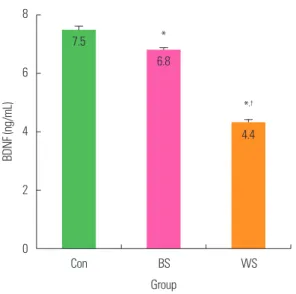
The effects of WS and BS consumption on serum level of BDNF were measured at the end of the intervention and are shown in Fig. 2.
The serum level of BDNF in WS and BS groups was significantly decreased compared to that of the control group (P<0.05), and mean BDNF concentration in the WS group was less than that in the BS group (P<0.05).
DISCUSSION
In our study, the effects of high consumption of WS and BS on serum level of BDNF, insulin resistance, and body weight in Wistar rats were investigated. We found that body weight and HOMA-IR were significantly increased in the WS and BS groups in compari- son with the control group. Zhao and Castonguay11 reported that
long-term consumption of sugar can increase the risk of obesity and other associated diseases. Lozano et al.12 investigated whether a high fructose and high-fat diet can increase the risk of diabetes and its complications and showed that 2 months of consumption of a high fructose and high-fat diet can cause increases in body weight and HOMA-IR. Gómez-Crisóstomo et al.8 conducted a study to investigate the effects of high-calorie diets on insulin sensitivity in rats and showed that 1-week consumption of solution containing 30% sugar had little effect on insulin sensitivity. These results indi- cate that development of insulin resistance depends on the amount of sugar in solution and the duration of the intervention. The harmful effects of SSBs may be explained by de novo lipogenesis, resulting in weight gain and fat accumulation in the abdomen.13 Consumption of SSBs may also aggravate inflammation and insulin resistance by altering expression of related genes, such as interleu- kin-6 and monocyte chemoattractant protein-1.14
In our experimental study, we found that serum level of BDNF in WS and BS groups was significantly decreased compared to that in the control group. The WS group exhibited greater weight gain compared to the BS group, explaining the differences in HOMA- IR and BDNF between WS and BS. To explain how diet may im- pact neural plasticity, studies have shown that obesity reduces the concentration and function of BDNF, and that high sugar diets can Figure 1. Effects of white and brown sugar consumption on insulin resistance in
rats. Values are presented as mean± standard deviation (n= 8) and analyzed by one-way analysis of variance and Tukey’s post-hoc tests. *P< 0.001 compared to the Con group; †P< 0.001 compared to the BS group. HOMA-IR, homeostatic model assessment for insulin resistance; Con, control; BS, brown sugar; WS, white sugar.
3
2
1
0
HOMA-IR
Con BS WS
Group
*
*,†
2.43
1.12
0.59
Figure 2. Effects of white and brown sugar consumption on serum level of BDNF in rats Values are presented as mean± standard deviation (n= 8) and analyzed by one-way analysis of variance and Tukey’s post-hoc tests. *P< 0.001 compared to the Con group; †P< 0.001 compared to the BS group. BDNF, brain-derived neuro- trophic factor; Con, control; BS, brown sugar; WS, white sugar.
8
6
4
2
0
BDNF (ng/mL)
Con BS WS
Group
*
*,†
4.4 6.8
7.5
enhance the production of free radicals in the liver and brain. Neu- rotrophic factors such as BDNF protect neurons against oxidative stress, and the high-fat sucrose diet can attenuate neurotransmitter secretion that is typically modulated by BDNF and synapsin 1.4 In- sulin resistance reduces the expression of BDNF in sensory and motor roots.15 BDNF concentration is also decreased in the plasma of T2DM patients. Therefore, there is an inverse correlation be- tween BDNF and fasting plasma glucose/HOMA-IR index.16
Chromium is an element that plays a role in improving insulin sensitivity. There is three times as much of this element in BS as in WS.8 Therefore, WS is more effective than BS for increasing HOMA- IR and decreasing serum level of BDNF.8 In this context, Feng et al.17 reported that chromium malate improved glucose metabolism in diabetic rats. Another reason that BS more effectively lowers HOMA-IR than does WS is due to its high antioxidant values.8
Finally, we conclude that excessive consumption of WS and BS has negative effects on serum level of BDNF, insulin resistance, and body weight. The negative effects of BS on these factors are less than those of WS. We also recommend that future research exam- ine the effects of different doses of WS and BS intake on biochemi- cal factors in healthy and diabetic albino rats. Histology pheno- types (liver, adipose, muscle, brain) and immunohistochemistry were not identified in this study.
CONFLICTS OF INTEREST
The authors declare no conflict of interest.
ACKNOWLEDGMENTS
The authors acknowledge the Research Affairs of the Health Promotion Research Center, Deputy of Research and Technology (Grant no. 9481) Zahedan University of Medical Sciences for pro- viding facilities and financial support.
AUTHOR CONTRIBUTIONS
Study concept and design: MAM; acquisition of data: ASG;
analysis and interpretation of data: ZM; drafting of the manuscript:
ASG, MAM, NMK, and FB; critical revision of the manuscript:
NMK; statistical analysis: RT; obtained funding: ASG; administra- tive, technical, or material support: MAM; and study supervision:
MAM.
REFERENCES
1. Hsiao A, Wang YC. Reducing sugar-sweetened beverage con- sumption: evidence, policies, and economics. Curr Obes Rep 2013;2:191-9.
2. Prinz P. The role of dietary sugars in health: molecular com- position or just calories? Eur J Clin Nutr 2019;73:1216-23.
3. Yang Q, Zhang Z, Gregg EW, Flanders WD, Merritt R, Hu FB. Added sugar intake and cardiovascular diseases mortality among US adults. JAMA Intern Med 2014;174:516-24.
4. Rozanska O, Uruska A, Zozulinska-Ziolkiewicz D. Brain-de- rived neurotrophic factor and diabetes. Int J Mol Sci 2020;21:
841.
5. Bathina S, Das UN. Brain-derived neurotrophic factor and its clinical implications. Arch Med Sci 2015;11:1164-78.
6. Ganugula R, Arora M, Jaisamut P, Wiwattanapatapee R, Jør- gensen HG, Venkatpurwar VP, et al. Nano-curcumin safely prevents streptozotocin-induced inflammation and apoptosis in pancreatic beta cells for effective management of Type 1 diabetes mellitus. Br J Pharmacol 2017;174:2074-84.
7. Molteni R, Barnard RJ, Ying Z, Roberts CK, Gómez-Pinilla F.
A high-fat, refined sugar diet reduces hippocampal brain-de- rived neurotrophic factor, neuronal plasticity, and learning.
Neuroscience 2002;112:803-14.
8. Gómez-Crisóstomo NP, de la Cruz AD, Camacho LJU, de la Cruz-Hernández EN, Martínez-Abundis E. Chronic consump- tion of refined but not brown sugar induces Hypertriglyceri- demia and fat accumulation in rat liver. Acad J Sci Res 2017;5:
451-9.
9. Ranjbar Kohan N, Nazifi S, Tabandeh MR, Ansari Lari M.
Effect of L-carnitine supplementation on Apelin and Apelin Receptor (Apj) expression in cardiac muscle of obese diabetic rats. Cell J 2018;20:427-34.
10. Oza MJ, Kulkarni YA. Formononetin treatment in type 2 dia- betic rats reduces insulin resistance and hyperglycemia. Front Pharmacol 2018;9:739.
11. Zhao C, Castonguay TW. Effects of free access to sugar solu- tions on the control of energy intake. Food Rev Int 2017;33:
105-22.
12. Lozano I, Van der Werf R, Bietiger W, Seyfritz E, Peronet C, Pinget M, et al. High-fructose and high-fat diet-induced dis- orders in rats: impact on diabetes risk, hepatic and vascular complications. Nutr Metab (Lond) 2016;13:15.
13. Lee G, Han JH, Maeng HJ, Lim S. Three-month daily consump- tion of sugar-sweetened beverages affects the liver, adipose tissue, and glucose metabolism. J Obes Metab Syndr 2020;29:
26-38.
14. Kanda H, Tateya S, Tamori Y, Kotani K, Hiasa K, Kitazawa R, et al. MCP-1 contributes to macrophage infiltration into adi-
pose tissue, insulin resistance, and hepatic steatosis in obesity.
J Clin Invest 2006;116:1494-505.
15. Eslami R, Gharakhanlou R, Kazemi A, Dakhili AB, Sorkhka- manzadeh G, Sheikhy A. Does endurance training compen- sate for neurotrophin deficiency following diabetic neuropa- thy? Iran Red Crescent Med J 2016;18:e37757.
16. Krabbe KS, Nielsen AR, Krogh-Madsen R, Plomgaard P, Ras- mussen P, Erikstrup C, et al. Brain-derived neurotrophic factor (BDNF) and type 2 diabetes. Diabetologia 2007;50:431-8.
17. Feng W, Zhao T, Mao G, Wang W, Feng Y, Li F, et al. Type 2 diabetic rats on diet supplemented with chromium malate show improved glycometabolism, glycometabolism-related enzyme levels and lipid metabolism. PLoS One 2015;10:e0125952.