ISSN 2288-1069 (Online)
http://dx.doi.org/10.12925/jkocs.2020.37.3.409
제 2형 당뇨 마우스의 운동 형태가 ẞ-Amyloid, BDNF 및 인지기능에 미치는 영향
김도연1
․우진희
2․신기옥
2․노희태
2․이율효
2․윤병곤
3․박찬호
4✝1부산대학교 체육교육학과, 교수
2동아대학교 체육학과, 교수
3동의대학교 체육학과, 교수
4동의대학교 레저스포츠학과, 교수
(2020년 3월 30일 접수: 2020년 6월 10일 수정: 2020년 6월 12일 채택)
Effects of Exercise Type on ẞ-Amyloid, BDNF and Cognitive Function in Type 2 Diabetic Mice
Do-Yeon, Kim
1․Jinhee, Woo2․Ki-Ok, Shin2․Hee-Tae, Roh2․Yul-Hyo, Lee2Byung-Kon, Yoon
3․Chan-Ho, Park4✝1
Department of Physical Education, Pusan National University, Busan, Republic of Korea
2
Department of Physical Education, Dong-A University, Busan, Republic of Korea
3
Department of Physical Education, Dong-Eui University, Busan, Republic of Korea
4
Department of Leisure and Sport, Dong-Eui University, Busan, Republic of Korea (Received March 30, 2020; Revised June 10, 2020; Accepted June 12, 2020)
요 약 : 본 연구는 서로 다른 운동유형이 당뇨처치 그룹의 베타 아밀로이드, BDNF 및 인지기능에 미치는 영향을 알아보기 위하여 24마리의 C57BL/6 쥐를 당뇨처치를 하지 않은 그룹 6마리(통제그룹:
6)와 당뇨처치 그룹 18마리로 무작위 할당하여, 이를 다시 당뇨처치 그룹의 경우 통제그룹 6마리, 유산 소 운동그룹 6마리, 저항운동 그룹 6마리로 나누었고 운동그룹은 8주간 주 5회 저강도로 각각 트레드밀 운동과 사다리 운동을 실시하였다. 그 결과 베타아밀로이드는 8주 후 당뇨처치 그룹의 통제그룹 (DM.G.)이 나머지 세 그룹에 비하여 높은 수준을 나타내었으나 통계적으로 유의한 차이는 나타나지 않 았다. BDNF의 경우는 당뇨통제그룹이 나머지 세 그룹에 비하여 낮은 수준을 나타냈으며 통계적으로 유 의한 차이를 나타냈다(p<.05). 인지기능을 알아보기 위한 Y-미로 검사에서도 당뇨통제 그룹이 나머지 세그룹에 비하여 낮은 수준을 보였으며 통계적으로도 유의한 차이를 나타냈다(p<.05).
주제어 : 당뇨, 운동유형, 베타 아밀로이드, BDNF, 인지기능
✝
Corresponding author
(E-mail: [email protected])
Abstract : The purpose of this study was to investigate the effects of different types of exercise training on ẞ-Amyloid, Brain-Derived Nerurotrophic Factor(BDNF) and cognitive function in mice with Diabetes Mellitus Group(DM.G). 24 male C57BL/6 mice were randomly assigned to the control (C.G. n = 6) and Diabetes Mellitus Group(DM.G. n = 18) groups. After the Diabetes Mellitus induction period, the DM group was subdivided into DM.G. + sedentary (DM.G., n = 6), DM.G. + endurance exercise (A.G, n = 6), and DM.G. + resistance exercise (R.G., n = 6). The A.G. and R.G performed treadmill and ladder climbing exercises 5 times per week for 8 weeks, respectively. After 8 weeks the results are as follows: ẞ-Amyloid showed higher levels of DM.G.
than in A.G., R.G., and C.G., but was not statistically significant(p>.05). BDNF was significantly lower in DM.G. than in C.G., A.G., and R.G.(p <0.05). The Y-maze task performance for cognitive function was significantly lower in DM.G. than in C.G., A.G., and R.G.(p <0.05). These results predict that diabetes can negatively affect ẞ-Amyloid, BDNF and cognitive function. It can also be predicted that low-intensity exercise can positively improve ẞ-Amyloid, BDNF and cognitive function regardless of the type of exercise.
Keywords : Diabetes Mellitus, exercise type, ẞ -Amyloid, BDNF, cognitive function
1. 서 론
현재 우리나라의 노인인구는 전체인구의 14.9%를 차지하고 있어 고령사회라 할 수 있으 며, 향후 고령화 속도는 더욱 빨라져 초고령 사 회에 진입하는 것도 시간문제라 할 수 있다. 이 러한 노인인구의 증가는 각종 사회, 경제적 문제 를 야기하게 되는데, 이 중 노인성 질환으로 인 한 건강보험료의 지출 증가는 가파른 증가추세에 있어 심각한 사회문제가 되고 있다.
특히, 치매질환의 증가는 의료비용의 증가뿐 아니라 사회적, 정신적으로 큰 부담이 되는 요인 으로 그 심각성이 대두되고 있다[1].
치매란 주로 노인에게 나타나는 정신병적 증상 중 가장 흔한 원인성 질환으로 대개 만성적이고 서서히 악화되는 진행성으로 나타나며 기억력, 사 고력, 학습능력, 판단력 등의 손상을 포함하는 인 지기능의 장애이다[2].
이러한 치매 중 알츠하이머 병과 뇌졸중과 같 은 뇌혈관성 질환이 원인으로 발생되는 치매가 전체 치매의 90%를 차지하고 있으며 고혈압과 당뇨병이 위험인자로 알려져 있다[3].
이 중 당뇨병은 대표적인 만성질환으로 치매를 촉진할 뿐 아니라 중추신경계의 변성과 기능장애 와도 밀접한 관련이 있어서 학습과 기억력 감소, 인지기능 감소 등에 영향을 미치는 것으로 알려 져 있다[4].
이는 학습과 기억을 담당하는 뇌의 해마 (hippocampus)가 지속적인 신경세포 생성을 통 해 역할을 수행하기 때문에 다른 부위의 신경세 포보다 대사적 요구량이 높으며[5] 이로 인해 당뇨와 같은 만성 대사성 질환 발생 시 인지기능 이 매우 민감하게 영향을 받을 수 있기 때문인 것[6]으로 보고되고 있다.
해마의 신경세포 생성에 중요한 역할을 하고 기억과 일반적인 인지기능 손상에 대한 생체지표 로 사용되는 BDNF(Brain-Derived Nerurotrophic Factor)는 치매 발병과 높은 상관이 있으며[7, 8], ẞ-Amyloid의 경우 대뇌피질과 대뇌변연계에 축 적되어 노인반(Amyloid plaque)을 형성하여 신경 세포를 손상시켜 세포간의 신호전달이 원활치 않 아 뇌의 위축과 뇌세포 괴사가 일어나 치매로 진 행된다[2, 9]고 보고하고 있다.
당뇨병의 비약물적 치료방안으로서의 운동은 뇌질환의 예방뿐 아니라 뇌기능 향상에도 효과적 인 방안[10]으로 알려져 있으며, 규칙적인 운동은 신경세포 생성과 시냅스 가소성을 촉진하는 것으 로 보고되었다[11].
아직 기전이 명확하지는 않지만 운동이 신경세 포의 생성을 촉진시키고, 여러 관련인자들의 개선 및 유지에 영향을 주는 것으로 알려지고 있으나 운동유형과의 관련성에 대해서는 연구가 미비한 실정이다.
이에 본 연구에서는 당뇨유발 쥐를 대상으로
하여 유산소 운동그룹과 저항 운동그룹으로 나누 어 운동을 실시한 후 BDNF, ẞ-Amyloid, Y-maze task를 통한 인지기능의 각 운동 유형별 효과를 규명하고자 한다.
2. 연구방법
2.1. 연구대상
본 연구를 위해 D대학교 의대 동물실험실에서 4주령의 C57BL/6 마우스를 Cage당 4마리씩을 수용하여 36주까지 정상식이를 섭취하는 통제군 6마리와 당뇨를 유도한 마우스로 사육하였다. 37 주차부터 당뇨를 유도한 마우스는 유산소운동군 6마리, 저항운동군 6마리, 당뇨 통제군 6마리로 나누어 8주간 실험을 실시하였다.
실험실은 온도 22±2℃, 상대습도 55%를 유지 하였으며 12시간 주기로 조명을 조정하였다.
모든 실험절차는 D대학교 의대 동물관리 및 사용위원회의 지침에 따라 진행되었으며 승인되 었다.
2.1.1. 당뇨유발 방법
C57BL/6 마우스에게 고지방 식이 처치를 4주 간 실시한 후 6시간 공복 후 Streptozotocin (STZ; Sigma Chemical, USA)을 0.1M sodium citrate solution(pH 4.5) 용액에 용해시킨 후 4일 에 걸쳐 총 4회 40mg/kg을 하복부에 투여하였 고, 당내성 검사 시 공복혈당이 250mg/dL 이상 일 경우 제 2형 당뇨가 발생한 것으로 판단하였 다.[12, 13, 14]
2.2. 트레이닝 방법
유산소운동그룹의 경우 8주동안 주당 5일, 1일 40분간 트레드밀 운동을 실시하였는데, 준비운동 과 정리운동을 각각 5분간 실시하고 본운동을 30 분간 실시하여 총 40분간 운동을 실시하였다. 처 음 1-4주간은 8m/min의 속도로 본 운동을 실시 하였고, 이후 5-8주간은 8m/min에서 10m/min 까지 점증적으로 속도를 올려 운동강도를 조절하 였다. 저항운동그룹은 Sanches 등[15]의 프로토콜 을 활용하여 8주간 주 5회, 꼬리에 추를 달고 1RM을 측정한 후 50%에 해당하는 추를 달고 강도를 조절하여 경사도 80°의 사다리를 1회 운 동시 8회 반복하여 오르도록 하였다.
2.2.1. 1RM 설정방법
C57BL/6 마우스의 1RM을 구하기 위하여 실 험 전 마우스의 체중을 측정하고, 사다리 운동의 적응을 위하여 3일 동안 저항없이 1일 1회 사다 리 운동을 실시하였다. 이 후 체중의 75%에 해 당하는 중량 추를 꼬리에 달고 사다리 운동을 실 시하였고 성공할 경우 체중의 15% 중량을 점진 적으로 추가하여 1RM을 구하였다.
2.3. 측정항목 및 방법
2.3.1. 해마(hippocampus) 적출 방법
운동그룹의 경우 운동의 일시적인 효과를 배제 하기 위하여 운동 후 48시간 경과 후 해마를 적 출하였으며, 적출 12시간 전부터는 물을 제외한 음식물의 공급을 중단하였다. 적출된 해마는 액체 질소 –80°에서 저장하였다.
2.3.2. ẞ-Amyloid, Brain-Derived
Nerurotrophic Factor(BDNF) 측정방법
해마의 ẞ-Amyloid와 BDNF를 측정하기 위하 여 해마조직을 방사선 면역 침전 분석(radio immuno precipitation assay: RIPA) 완충액 200 μl에서 용해시켜 단백질을 추출한 후 30분 동안 14,000rpm으로 원심분리시켜 상청액을 BCA단백 질 분석장치(UVmini-1240, Shimadzu Co., Japan)를 이용하여 측정하였다.동일한 단백질 함량의 샘플을 10 또는 12 % gel에서 SDS- polyacrylamide gel 전기 영동에 의해 분석하고 membrane으로 옮겼다. membrane 을 phosphate-buffered saline(PBS) 중 5 % 탈지 유로 막고, 이어서 BDNF(sc-65513, Santa Cruz Biotechnology, USA)와 ẞ-Amyloid(sc-28365, Santa Cruz Biotechnology, USA)에 대한 1차 항 체(1 : 1000 희석)와 함께 밤새 4℃에서 배양하 였다. 이후 membrane을 10분 동안 6회 세척하 고 goat anti-mouse 또는 anti-rabbit lgG이 혼 합된 이차항체 용액에 실온에서 1시간 동안 배양 한 후 ECL solution(Amersham Pharmacia Biotech, USA)을 이용하여 밴드를 검출하였고 ImageQuant LAS-4000 시스템(GE Healthcare, Sweden)으로 시각화하였다.
2.3.3. 인지기능
인지기능은 Y-maze task를 사용하여 측정하였 다. Y-maze는 3개의 통로로 구성되어 있으면 각
통로는 넓이 5cm, 길이 35cm, 높이 10cm로 각 통로의 끝부분을 A, B, C로 지정하였다. 마우스 는 통로에 끝에 위치하여 1회당 5분 동안 미로 속을 움직이게 된다. 세 가지 방향의 통로에 대 한 이동 동작을 통한 인지기능의 평가는 다음 공 식을 이용한다.
Alternation behavior(%) =
[ number of entries in the other direction / (total number of entries – 2) × 100 ]
2.4. 자료처리 방법
실험분석 결과로 나온 자료는 SPSS Window Ver. 25를 사용하여 측정항목에 대한 평균값과
표준편차를 산출하였고, 각 그룹 간의
ẞ-Amyloid와 BDNF의 차이를 규명하기 위하여 One-way ANOVA를 이용하였으며, 인지기능 (Y-maze task)의 경우는 운동 전·후의 그룹과 시 기간의 상호작용을 알아보기 위하여 two-way repeated measure ANOVA를 이용하였다. 통계 적으로 유의미한 경우 Tukey’s post-hoc을 이용 하여 사후분석을 실시하였으며 통계적 유의수준 은 p < .05으로 설정하였다.
3. 연구결과
3.1. ẞ-Amyloid
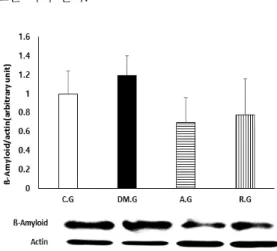
각 그룹별 ẞ-Amyloid 수준을 비교분석한 결 과는 당뇨 그룹이 통제그룹보다 높은 수준을 보 였으며, 유산소 운동그룹과 저항운동 그룹의 경우 는 통제그룹과 당뇨그룹에 비하여 낮은 수준을 보여 각각의 운동이 ẞ-Amyloid 수준을 개선시 키는 것으로 나타났으나 통계적으로 유의한 차이 는 나타나지 않았다(p>.05). ẞ-Amyloid의 변화 수준은 Fig. 1.에서 보는 바와 같다.
3.2. BDNF
각 그룹별 BDNF 수준을 비교분석한 결과는 당뇨그룹이 통제그룹보다 낮은 수준을 보였으며, 유산소 운동그룹과 저항운동 그룹의 경우는 통제 그룹과 당뇨그룹에 비하여 더 높은 수준을 보여 각각의 운동이 BDNF 수준을 개선시키는 것으로 나타났으며, 통계적으로도 유의한 차이를 나타냈 다(p<.05). 또한 사후검증에서도 당뇨그룹과 저항 운동그룹 사이에서 통계적으로 유의한 차이가 나 타났다(p<.05). BDNF의 변화 수준은 Fig. 2.에서
보는 바와 같다.
Fig. 1. The results of ẞ-Amyloid expression in hippocampus.
Fig. 2. The results of BDNF expression in hippocampus.
3.3. 인지기능(Y-maze task)
각 그룹별 인지기능(Y-maze task)의 차이를 비교분석한 결과는 Table 1.에서 보는 바와 같이 시기간의 차이에서는 모든 그룹에서 운동 전과 후에 통계적으로 유의한 차이가 나타나지 않았다.
그룹 간의 차이에서는 운동 전에는 나타나지 않 았으나 운동 후에는 유산소운동그룹, 저항운동그 룹, 통제그룹이 당뇨그룹에 비하여 높은 수준을 보여 각각의 운동이 인지기능을 개선시키는 것으 로 나타났으며, 통계적으로도 유의한 차이(p<.05) 가 나타났다. 시기와 그룹사이의 상호작용이 통계 적으로 나타났다(p<.05). 사후검증 결과에서도 당 뇨그룹과 나머지 세 그룹 사이에서 각각 통계적
C.G DM.G A.G(DM) R.G(DM) F-value
AB(%)
pre 62.82±7.27 64.85±8.70 53.88±6.87 55.55±6.12 G: 4.032*
T: .340 I: 7.482*
post 69.37±10.39
+ 44.14±13.67 63.24±8.13 +
66.77±8.41 +
t -2.265 2.505 -2.318 -2.115
C.G: Control Group DM.G: Diabetes Mellitus Group A.G: Aerobic exercise Group R.G:
Resistance exercise Group, AB: Alternation Behavior, G:Group, T: Time, I: Interaction
* Two-way repeated measure ANOVA result indicated that there was a significant difference between the groups(p<.05).
+ Tukey’s post-hoc result showed significant difference versus DM.G.(p.<.05) Table 1. Changes in Cognitive function(% Alternation Behavior) for each group.
으로 유의한 차이가 나타났다(p<.05).
4. 논 의
4.1. ẞ-Amyloid
ẞ-Amyloid는 실이 풀린 모양으로 뇌척수액 속에 녹아 있으며, 이 물질이 뭉치면 섬유 형태 의 Amyloid fibril이 되고 이것이 Amyloid plaque(노인반)를 형성하여 뇌 조직에 침착됨으로 써 알츠하이머형 치매를 유발하기도 한다[16].
최근 연구에 따르면 명확한 기전이 밝혀지지는 않았으나 제2형 당뇨에서도 높은 수준의 ẞ-Amyloid 축적 현상이 관찰되어 치매와의 강 한 연관성을 시사하였다[17, 18, 19].
본 연구에서 통제그룹에 비하여 당뇨그룹에서 ẞ-Amyloid의 수준이 높게 나타나 선행연구와 일치하는 결과가 나타났으나 통계적으로 유의한 차이는 없었다.
또한 당뇨그룹을 유산소운동그룹과 저항운동그 룹으로 나누어 8주간 저강도 운동프로그램을 실 시한 후 나타난 결과에서는 유산소운동그룹과 저 항운동그룹 모두 당뇨그룹에 비하여 낮은 수준을 나타내었다.
이는 고령자를 대상으로 12주간 복합운동 후 ẞ-Amyloid의 감소를 나타낸 Yokoyama 등[20]
의 연구를 비롯한 노인여성들을 대상으로 한 다 수의 연구[21, 22, 23] 결과와도 일치하였다. 이 는 운동으로 인해 뇌로 가는 혈류량이 증가되어 Amlyoid 전구체 단백질(Amyloid Precursor Protein, APP)의 대사 조절 및 Amyloid 분해능력
이 향상되었고 이로 인해 뇌세포의 플라크 침착 이 감소한 결과[24]라 생각된다.
4.2. BDNF
뇌유래신경영양인자(Brain Derivated Neuro- trophic Factor)라 불리우는 BDNF는 주로 뇌에 서 생성되고, 혈중 BDNF의 75%는 해마, 대뇌피 질, 소뇌, 시상하부 등 뇌에서 분비되고[25], 혈관 뇌장벽을 통과할 수 있다[26].
일반적으로 BDNF는 중추신경계에서는 뉴런의 보호 및 생존, 축삭과 수상돌기의 성장과 개조, 시냅스 전달의 효율성에 중요한 역할을 수행하며, 말초에서는 혈중 글루코스 수준을 낮추고 인슐린 민감성을 증가시키는 것으로 보고되고 있다[27].
또한 신경세포의 생성을 자극하여 기억을 형성 하고 이를 장기기억으로 전환하는 역할을 하는 것으로 알려져 있어[28] 혈중 BDNF 농도의 감 소는 기억손실의 결정적인 지표가 된다고 보고하 고 있다[8].
본 연구에서 당뇨그룹이 통제그룹에 비하여 BDNF농도가 낮은 수준을 보여 말초에서의 BDNF의 역할과 관련된 선행연구를 지지하는 결 과를 나타내었고 당뇨그룹을 다시 유산소운동그 룹과 저항운동그룹으로 나누어 8주간 저강도 운 동프로그램을 실시한 후 나타난 결과에서도 두 그룹 모두 당뇨그룹에 비하여 높은 수준의 BDNF 농도를 나타내어 운동이 BDNF 농도에 긍정적인 변화를 가져온다는 것을 나타내었다.
이는 운동이 BDNF에 미치는 영향에 관한 다 수의 선행연구[29, 30, 31]와도 일치하였다. 반면 에 운동이 BDNF에 영향을 미치지 않는다는 선
행연구[32, 33, 34]들도 보고되고 있는데 이는 이 미 안정적인 BDNF농도를 가진 일반인에게 있어 서는 천정효과로 인해 더 이상 유의한 증가가 나 타나지 않는다는 점을 예측해 볼 수 있다[35].
본 연구에서도 사후검증 결과 당뇨그룹과 저항 운동그룹 사이에서는 통계적으로 유의한 차이 (p<.05)가 나타났으나 나머지 통제그룹과 두 운 동그룹에서는 사후검증 결과 유의한 차이가 없는 것으로 나타나 이를 뒷받침하는 것으로 생각된다.
즉, 당뇨를 비롯한 여러 가지 원인에 의해 BDNF 농도가 낮은 대상에 대한 운동프로그램은 뇌세포에 더 많은 영양과 산소를 공급하고 BDNF를 활성화하여 뇌기능 저하를 방지할 수 있을 것으로 생각된다.
4.3. 인지기능(Y-maze task)
Naissner[36]는 “인지(cognition)란 내외적으로 유입된 감각정보가 변형되고, 감소되고, 정교화되 고, 저장되고, 인출되고, 사용되는 정신활동을 의 미하며, 지각, 주의, 기억의 부호화, 기억의 보유, 기억의 회상, 의사결정, 추리, 문제해결, 상상, 계 획, 집행 등의 다양한 기능들을 포함한다.”라고 정의하였다.
운동과 인지기능의 관계에 대한 연구는 1950 년대부터 이루어졌으며 2000년대 이후 그 수가 급격하게 증가하기 시작했다[37]. 본 연구에서 실 시한 Y-maze task는 인지기능이 저하되거나 여 러 가지 원인으로 정상적인 사고활동이 어려운 경우 새로운 방향으로 나아가지 못하고 왔던 길 을 되돌아가는 특성을 이용한 행동 관찰 테스트 로, 방향 전환 점수가 높을수록 공간인지나 기억 력이 높다고 할 수 있다[38].
본 연구결과에서 당뇨그룹(44.14±13.67%)이 통제그룹(69.37±10.39%)에 비하여 낮은 점수를 낮은 점수를 나타내 당뇨환자에게 있어 인지기능 이 떨어지는 것을 확인할 수 있었고 당뇨유발 마 우스를 유산소운동그룹과 저항운동그룹으로 나누 어 운동프로그램을 실시한 그룹에서도 유산소운
동그룹(63.24±8.13%), 저항운동그룹
(66.77±8.41%) 모두 당뇨그룹보다 높은 점수를 나타내었고, 사후검증결과에서도 당뇨그룹과 나머 지 세그룹 사이에서 통계적으로도 유의한 차이 (p<.05)를 나타내었다.
이는 조한삼[39]의 연구에서 나타난 인지기능 이 감소된 노화 마우스의 운동효과를 본 결과와 일치하는 것으로, 운동이 인지기능 개선에 영향을
미친다는 여러 선행연구[40, 41, 42, 43]들과도 일치하는 결과가 나타났다. 이러한 인지기능의 개 선이 앞서 서술한 ẞ-Amyloid의 감소나 BDNF 농도의 증가와 어떠한 상관이 있으며, 운동과 인 지기능 요인과의 관계에 대해서도 추후 지속적인 연구가 필요하다고 생각된다.
5. 결 론
저강도 운동프로그램에서 운동유형이 당뇨마우 스의 ẞ-Amyloid, BDNF, 인지기능의 미치는 영 향을 알아보고자 실시한 연구 결과 다음과 같은 결론을 얻었다.
당뇨병은 ẞ-Amyloid의 증가를 가져오고 BDNF 농도의 감소를 가져오며, 인지기능에 부정 적인 영향을 미치는 것으로 나타났으며, 이에 대 한 운동의 효과는 ẞ-Amyloid의 경우는 운동의 형태와 관계없이 감소하였으나 통계적으로 유의 한 차이는 나타나지 않았다. BDNF의 경우는 농 도의 증가가 운동의 형태와 관계없이 통계적으로 유의하게 나타났다(p<.05). 인지기능을 알아보기 위한 Y-maze task에서도 그룹과 시기 간의 통계 적으로 유의미한 상호작용을 보였다(p<.05).
감사의 글
본 연구는 대한민국 교육부와 국립 연구재단의 지원을 받아 수행되었습니다.
(NRF-2015S1A5A2A03048932)
References
1. S. M. Lee, “Effects of the type of exercise pattern on cognitive function, physical functions in elderly patients with dementia.”
Graduate school of Yongin Univ
.(2011).2. Mcdowell I., “Alzheimer’s disease: Insights from epidemiology”,
Aging
. Vol.13, No.3 pp. 143-162,(2001).3. S. H. Lee, “Relationships between Dementia Knowledge, Depression and Dementia Preventive Behaviors among patients with
HTN or DM.”
Graduate school of Chungnam national Univ.,
(2015).4. Biessels G. J., Deary I. J., Ryan C. M.,
“Cognightion and diabetes: a lifespan perspective.”
Lancet Neurol.
. Vol.7, pp.184-190,(2008).5. Cheiri C., Staines W., Miki T. Seino, S., Messier, C., “Glucose transporter plasticity during memory processing.”
Neurosci.
Vol.130, pp.591-600,(2005).
6. Gispen W. H., Biessels G. J., “Cognition and synaptic plasticity in diabetes mellitus.
Trends.”
Neurosci.
Vol.23, pp.542-549, (2000).7. Donovan M. H., Yamaguchi M., Eisch A.
J., “Dynamic expression of TrkB receptor protein on proliferation and maturing cells in the adult mouse dentate gyrus.”
Hippocampus,
Vol.18, pp.435-439,(2008).8. Komulainen P., Pederson M., Hanninen T., Bruunsgaard H., Lakka T. A., Kivipelto M., “BDNF is a novel marker of cognitive function is aging women: the DR’s EXTRA study.”
Neurobiology of Learning and Memory.
Vol.90, No.4, pp.596-603, (2008).9. Pietrzit C., Behl C., “Concepts for the treatment of Alzheimer’s disease molecular mechanisms and clinical application.”
Int.
J. Exp. Pathol.
Vol.86, No.3, pp.173-185, (2005).10. Loimaala A., Huikuri H. V., Koobi T., Rinne, M., Nenonen, A., Vuori, I.,
“Exercise training improves baroreflex sensitivity in type 2 diabetes.”
Diabetes
Vol.52, No.7, pp.1837-1842,(2003).11. Fontấn-Lozano A. Sấez-Cassanelli J. L Inda M. C., de los Santos-Arteaga, M., Sierra-Dominguez, S. A., Lopez-Liuch, G., Delgado-Gracia, J.M., Carrion, A.M..
“Caloric restriction increases learning consolidation and facilitates synaptic plasticity through mechanisms dependent on NR2B subunits of NMDA receptor.”
J.
Neurosci.
Vol.27, No.38, pp.10185-10210, (2007).12. Chengxin Sun, Xinzhi Li, Lu Liu, Mark J Canet, Yuan Guan, Yuying Fan, Yifa Zhou, Effect of fasting time on measuring mouse blood glucose level.
Int J Clin Exp Med.
pp.4186-4189.(2016).13. Clee S. M, Attie A. D., The genetic landscape of type 2 diabetes in mice.
Endocr Rev.
pp.48–83.(2007)14. Fajardo R. J., Karim L., Calley V.I., Bouxsein M. L., A review of rodent models of type 2 diabetic skeletal fragility.
J Bone Miner Res.
pp.1025-40.(2014).15. I. C. Sanches, F. F. Conti, M. Sartori, M.
C. Irigoyen, K. De Angelis. "Standardization of resistance exercise training: effects in diabetic ovariectomized rats"
Int J Sports Med,
Vol.35, No.4, pp.323-329,(2014).16. Selkoe, D. J., “Alzheimer's disease: genes, proteins, and therapy.”
Physiological reviews
, Vol. 81, No.2, pp.741-766,(2001).17. M. Shinohara, N. Sato, "Bidirectional interactions between diabetes and Alzheimer's disease"
Neurochem. Int,
Vol.108, pp.296- 302,(2017).18. P. Bharadwaj, N. Wijesekara, M.
Liyanapathirana, P. Newsholme, L. Ittner, P. Fraser, G. Verdile, "The Link between Type 2 Diabetes and Neurodegeneration:
Roles for Amyloid-β, Amylin, and Tau Proteins."
J. Alzheimers Dis.,
Vol.59, No.2, pp. 421-432,(2017).19. S. M. de la Monte, "Type 3 diabetes is sporadic Alzheimer’s disease: mini-review"
Eur Neuropsychopharmacol,
Vol.24, No.12, pp.1954-1960,(2014).20. Yokoyama, H., Okazaki, K., Imai, D., Yamashina, Y., Takeda, R., Naghavi, N., Ota, A., Hirasawa, Y., & Miyagawa, T.,
“The effect of cognitive-motor dual-task training on cognitive function and plasma amyloid β peptide 42/40 ratio in healthy elderly persons: a randomized controlled trial.”
BMC geriatrics
, Vol.15, No.1, p.60,(2015).21. S. K. Kim, “The effect of combined exercise on cognitive function·functional
fitness·blood lipids and risk factors of dementia in elderly women.”
Graduate school of Pusan National Univ
.(2011).22. J. W. Lee, C. H. Kim, S. I. Han, P. W.
Lee, “The effect of Aquatic exercise program in elderly women on the cognitive function and Alzheimer’s disease dementia factor.”
Korean Journal of Physical Education,
Vol.51, No.5, pp.627- 637,(2012).23. C. H. Park, J. U. Cheon, “ Effects od 16-week combined exercise on dementia, depression, and cognitive function in elderly women.”
Journal of Korean applied science and technology
, Vol.36, No.2, pp.456-467,(2019).24. P. A. Adlard, V. M. Perreau, V. Pop, C.
W. Cotman, “Voluntary exercise decreases amyloid load in a transgenic model of Alzheimer’s disease.”,
The Journal of Neurosci.
Vol.25, No.17, pp.4217-4221, (2005).25. Rasmussen, P., Brassard, P., Adser, H., Pedersen, M. V., Leick, L., Hart, E., Secher, N. H., Perdersen, B. K., Pilegaard, H., “Evidence for a release of brain- derived neurotrophic factor from the brain during exercise.”
Experimental physiology,
Vol.94, No.10, pp.1062-1069,(2009).26. Pan, W., Banks, W. A., Fasold, M. B., Bluth, J., & Kastin, A. J., “Transport of brain-derived neurotrophic factor across the blood–brain barrier.”
Neuropharma- cology,
Vol.37, No.12, pp.1553-1561, (1998).27. Piepmeier, A. T., & Etnier, J. L.,
“Brain-derived neurotrophic factor(BDNF) as a potential mechanism of the effects of acute exercise on cognitive performance.”
Journal of Sport and Health Science,
Vol.4, No.1, pp.14-23.(2015).28. Bekinschtein, P., Cammarota, M., Katche, C., Slipczuk, L., Rossato, J. I., Goldin, A., Izquicrdo, I., Medina, J. H., “BDNF is essential to promote persistence of long-term memory strage.”
Proceedings of
the national Academy of Sciences of the U.S.A.
Vol.105, pp.2711-2716,(2008).29. Hutchinson, K. J., Gomez-Pinilla, F., Crowe, M. J., Ying, Z., Basso, D. M.,
“Three exercise paradigms differentially improve sensory recovery after spinal cord contusion in rats.”
Brain,
Vol.127, No.6, pp.1403-1414.(2004).30. Y. K. Jeon, J. H. Kim, J. I. Chol, “The Change of Brain-Derived Neurotrophic Factor(BDNF), Insulin-Like Growth Factor-1(IGF-1) and Working-Memory in Adolescents by Aerobic Exercise Intensity for 12 weeks.”
Korean Journal of Physical Education
, Vol.52, No.5, pp.753-763, (2013).31. B. G. Chol, H. K. Yoon, “The Effects of Aerobic and Thera-Band Combined Exercise on Cerebral Blood Flow, BDNF, and Aging-Related Hormone in Elderly.”
The Korean Journal of growth and development,
Vol.21, No.4, pp.341-346, (2013).32. Levinger, I., Goodiman, C., Matthews, V., Hare, D. L., Jerums, G., Gamham, A., Selig, S., “BDNF, Metabolic risk factors and resistance training in middle-aged individuals.”
Journal of Medicine and Sciences in sports Exercise.
Vol.40, No.3, pp.533-541.(2008)33. Rojas Vega, S., Knicker, A., Hollmann, W., Bloch, W., Strȕder, H. K., “Effect of resistance exercise on serum levels of growth factors in humans.”
Hormone and Metabolic Research
. Vol.42, No.13, pp.982-986,(2010).34. Goekint, M., De Pauw, K., Roelands, B., Njemini, R., Bautmans, I., Met, T., Meeusen, R., “Strength training does not influence serum brain-derived neurotrophic factor.”
European Journal of Applied Physiology
, Vol.110, No.2, pp.285-293, (2010).35. Knaepen, K., Goekint, M., Heyman, E.
M., & Meeusen, R., “Neuroplasticity—
Exercise-Induced Response of Peripheral
Brain-Derived Neurotrophic Factor.”
Sports Medicine,
Vol.40, No.9, pp.765-801, (2010).36. Naissner, U.,
Cognitive psychology.
New York: Appleton-Century-Crofts.(1967).37. McMorris, T.,
Exercise-Cognition Interaction: Neuroscience Perspectives.
Elsevier Science.(2015).
38. Da-Young Gong, Yun-Sik Choi,
“Development of New Analytical Method Evaluating Working Memory on Y Maze.”
J. Life Science.
Vol.26, No.2, pp.234-240, (2016).39. H. S. Cho, “Effect of aging and treadmill exercise on mitochondrial function and neuronal plasticity in the rat hippocampus.”
Graduate school of Kyung Hee Univ.
(2016).40. Angevaren, M., Aufdemkampe, G., Verhaar, H., Aleman, A., & Vanhees, L., “Physical activity and enhanced fitness to improve cognitive function in older people without known cognitive impairment.”
Cochrane Database Syst Rev,
Vol.3, No.3, p.101.(2008).41. Smith, P. J., Blumenthal, J. A., Hoffman, B. M., Cooper, H., Strauman, T. A., Welsh-Bohmer, K., Browndyke, J. N., Sherwood, A., “Aerobic exercise and neurocognitive performance: a meta- analytic review of randomized controlled trials.”
Psychosomatic medicine,
Vol.72, No.3, p. 239,.(2010).42. Hamer, M., & Chida, Y., “Physical activity and risk of neurodegenerative disease: a systematic review of prospective evidence.”
Psychological medicine,
Vol.39, No.01, pp. 3-11.(2009)43. Sofi, F., Valecchi, D., Bacci, D., Abbate, R., Gensini, G., Casini, A., & Macchi, C.,
“Physical activity and risk of cognitive decline: a meta-analysis of prospective studies.”