• 검색 결과가 없습니다.

Endoscopic Resection for the Treatment of Superficial Esophageal Neoplasms

N/A
N/A
Protected

Academic year: 2021

Share "Endoscopic Resection for the Treatment of Superficial Esophageal Neoplasms"

Copied!
6
0
0

로드 중.... (전체 텍스트 보기)

전체 글

(1)

KJTCVS

The Korean Journal of Thoracic and Cardiovascular Surgery

Endoscopic Resection for the Treatment of Superficial Esophageal Neoplasms

Ga Hee Kim, M.D., Ph.D., Hwoon-Yong Jung, M.D., Ph.D., AGAF, FASGE

Department of Gastroenterology, Asan Digestive Disease Research Institute, Asan Medical Center, University of Ulsan College of Medicine, Seoul, Korea

ARTICLE INFO Received May 6, 2020 Revised May 23, 2020 Accepted May 25, 2020 Corresponding author Hwoon-Yong Jung Tel 82-2-3010-3197 Fax 82-2-476-0824 E-mail [email protected] ORCID

https://orcid.org/0000-0003-1281-5859

This article was presented at the 6th Esophageal Cancer Symposium (lecture on No vember 16th, 2019, Samsung Medical Center, Seoul, Korea).

Superficial esophageal neoplasms (SENs) are being diagnosed increasingly frequently due to the screening endoscopy and advances in endoscopic techniques. Endoscopic resec- tion (ER) is a relatively noninvasive treatment method with low morbidity and mortality that provides excellent oncologic outcomes. Endoscopic submucosal dissection is asso- ciated with higher rates of en bloc, complete and curative resections and lower rates of local recurrence than endoscopic mucosal resection. The most serious complication of ER is stricture, the treatment and prevention of which are crucial to maintain the patient’s quality of life. ER for SEN is feasible, effective, and safe and can be considered a first-line treatment for SENs in which it is technically feasible.

Keywords: Superficial esophageal neoplasm, Endoscopic submucosal dissection, Endo- scopic mucosal resection, Esophageal squamous cell carcinoma, Endoscopy

Copyright © The Korean Society for Thoracic and Cardiovascular Surgery. 2020. All right reserved.

This is an Open Access article distributed under the terms of the Creative Commons Attribution Non-Commercial License (http://creativecommons.org/licenses/

Introduction

Recently, cases of superficial esophageal neoplasm (SEN) has been increasing common due to advances in endoscop- ic screening and techniques, image-enhancement and nar- row-band imaging in Korea and Japan [1-4]. In Western countries, adenocarcinoma (ADC) associated with Bar- rett’s esophagus is the most commonly diagnosed esopha- geal cancer (EC). In contrast, squamous cell carcinoma (SCC) is the most common histologic type of EC diagnosed in Asian countries. The scope of options regarding, treat- ment methods for SEN has expanded, with endoscopic re- section (ER) considered the standard treatment. The endo- scopic treatment of SENs, including early-stage EC and esophageal dysplasia, has attracted interest as an alterna- tive therapy. The results of ER are comparable to those of conventional surgery, with superior safety and acceptable oncologic outcomes [5-7]. However, although ER represents an excellent treatment option, the misjudgments of indica- tions for its use or the incorrect assessment of curability can result in unfavorable clinical outcomes.

In this review article, we discuss the indications for ER

of SENs with squamous cell histology, the subsequent on- cologic outcomes, and the management of complications associated with this treatment method. We hope that this information will lead to improved patient management.

History of endoscopic resection

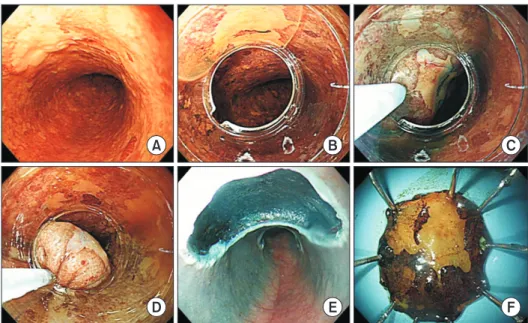
ER encompasses 2 main techniques; endoscopic mucosal resection (EMR) and endoscopic submucosal dissection (ESD). The use of EMR in the esophagus was first reported in 1990 by Inoue and Endo [8] from Japan as a tool in the management of patients with both high grade dysplasia and superficial esophageal cancer (SEC). EMR is used to remove sessile, flat, or discrete mucosal lesions smaller than 2 cm in diameter and involving less than two-thirds of the circumference of the esophageal wall. EMR can as- sist in determining the local stage, the degree of differenti- ation, and the lymphovascular invasion (LVI) of neoplastic lesions [9]. This technique requires the use of a standard endoscope without any additional equipment or procedur- al assistance and has the advantage of being relatively sim- ple (Fig. 1). However, EMR cannot be used for the en bloc

Collective of current Review, Lecture

https://doi.org/10.5090/kjtcs.2020.53.4.172 pISSN: 2233-601X eISSN: 2093-6516

Korean J Thorac Cardiovasc Surg. 2020;53(4):172-177

(2)

Ga Hee Kim and Hwoon-Yong Jung. The Role of ER in the Treatment of SEN KJTCVS

removal of lesions larger than 2 cm in size. Furthermore, the piecemeal resection of tumor lesions larger than 2 cm is associated with a relatively high risk of local recurrence [5,10,11]. In addition, EMR may be technically difficult in certain cases (e.g., in recurrent or non-lifting lesions).

Compared to EMR, ESD is reported to have a high rate of en bloc resection with a low rate of local recurrence, re- gardless of lesion size. However, it requires advanced endo- scopic skills [12].

Indication criteria

ER is an accepted curative treatment method for SEC if the risk of lymph node metastasis (LNM) is minimal [13].

The risk of LNM is associated with tumor differentiation, histology, depth, and LVI. According to the Japan Esopha- geal Society, ER is a sufficient method of treatment for le- sions confined to the epithelium of the mucosa (M1) and the lamina propria (M2). Lesions extending up to the mus- cularis mucosae (M3) or lightly infiltrating the submucosa (<200 μm) are also amenable to mucosal resection; howev- er, they are associated with an elevated risk of LNM. These are some of the relative indications [14,15]. The European Society of Gastrointestinal Endoscopy recommends that ESD as the initial treatment option for superficial esopha- geal SCC. This recommendation is based on a series of 15 studies involving the use of ESD for superficial esophageal SCC. Among these studies, en bloc resection rates were 83%–100%, complete resection rates were 78%–100%, and local recurrence rates were as low as 0%–2.6% [16].

Morphological assessments are performed according to

the Paris classification system, and can assist in predicting the depth of invasion [17]. Invasion into the submucosa is more common protruding lesions and excavated than in completely flat lesions, which are associated with the lower risk of submucosal invasion [18]. Endoscopic ultrasound (EUS) is reported to be the most accurate modality for TNM staging of advanced EC. In a meta-analysis of super- ficial SCC and ADC, the overall accuracy of EUS was 81%

for SCC and 84% for ADC. The specificity and sensitivity of EUS for T1a tumors were 87% and 85%, respectively, while the specificity and sensitivity of this technique for T1b tumors were both 86% [19]. While EUS is the gold standard for TNM staging of advanced EC, the role of EUS in the staging of SEC is more controversial due to the po- tential for over- or under-staging. In a report by Pouw et al. [20], EUS was found to have a minimal clinical impact on the staging of SEN, strengthening the role of diagnostic ER as a possible final step in diagnosis. Pathologic evalua- tion of the resected specimen is still the most important first staging tool [21]. The intrapapillary capillary loops (IPCL) of esophageal mucosa demonstrate characteristic changes of tissue atypism and provide an estimate tumor depth [22,23]. In early SCC, the vascular pattern of the IPCL can be watched using high definition endoscopy, which can help to classify and predict the depth of the tu- mor [24].

Principles of endoscopic submucosal dissection

ESD is a procedure used to resect tumors via the dissec-

Fig. 1. Endoscopic mucosal resec- tion of superficial esophageal can- cer. (A) A 1-cm sized flat elevated lesion on the mid-thoracic esoph- agus. (B) Chromoendoscopy with Lugol’s solution demarcating the lesion. (C) Submucosal saline in- jection. (D) Performing resection using a snare. (E) An artificial ul- cer after endoscopic resection. (F) Chromoendoscopic findings of the en bloc resection specimen.

A B C

D E F

(3)

https://doi.org/10.5090/kjtcs.2020.53.4.172

KJTCVS

tion of the submucosal layer. With this procedure, relative- ly large tumors can be resected en bloc, effectively yielding histologic information through complete oncologic resec- tion [10].

Prior to performing procedure, endoscopic examination (using white-light imaging, narrow band imaging, and chromoendoscopy with Lugol’s solution) is performed to determine the exact margin of the tumor (Fig. 2B). Lugol’s solution is applied to highlight abnormal areas, and muco- sal markings are made through coagulation 0.5 cm from the border of the tumor (Fig. 2C). After several dots are drawn around the lesion, normal saline mixed with epi- nephrine and indigo carmine is injected into the submuco- sal layer. A small incision is made with a HookKnife (Olympus, Tokyo, Japan) followed by a circumferential mucosal incision outside the marking. A circumferential incision was made with a HookKnife (Olympus) (Fig. 2D).

Various knives, including the IT NanoKnife, HookKnife, and DualKnife (Olympus) were used to dissect the submu- cosal layer parallel to the muscle layer until the lesion is completely removed (Fig. 2E). Hemostasis is achieved with hemostatic forceps (FD-410LR; Olympus), hemoclips, or argon plasma coagulation. All visible non-bleeding vessels are coagulated after the completion of ER.

Long-term outcomes

Several previous reports including long-term follow-up have identified ESD as a favorable treatment modality for the curative resection of SEC [25-32]. In a meta-analysis of 21 studies of ESD in the treatment of early EC, the pooled

en bloc resection rate was 99% [33]. The pooled complete (R0) resection rate was 90% (95% confidence interval [CI], 87%–94%), while for large tumors (those with diameters greater than 2.5 cm), the R0 rate was 85% (95% CI, 80%–

90%). Relative to esophagectomy, ESD is a minimally inva- sive operation. ER of the mucosal lesions allows preserva- tion of the normal anatomical structure of the digestive system without leading to postoperative reflux or weight loss [34]. This largely preserves the patient’s short- and long-term quality of life. As of yet, no randomized trials have compared ESD and esophagectomy. Recently, 2 retro- spective studies compared the outcomes of ESD and sur- gery for the treatment of T1 esophageal SCC (Table 1). In a Korean study by Min et al. [6], the ESD group exhibited lower procedure-related morbidity than the esophagectomy group. The overall rates of survival, disease-specific sur- vival, and recurrence-free survival were comparable be- tween the ESD and surgery groups. ESD can be considered a first-line treatment for patients with SEC without clear evidence of submucosal invasion [6]. In another study of patients with T1a-M2/M3 or T1b SEC who underwent ESD or esophagectomy in China, no significant difference was observed in overall survival recurrence, or metastasis in patients with T1a or T1b SEC treated with ESD or esophagectomy [7]. Furthermore, significantly fewer severe adverse events were reported in the ESD group than in the esophagectomy group (15.2% versus 27.7%, p<0.001).

Adverse events

Complications of ESD for the treatment of SEN include

Fig. 2. Endoscopic submucosal dis- section of superficial esophageal cancer. (A) A 2.5-cm flat hyperemic lesion on the mid-thoracic esoph- agus. (B) Chromoendoscopy with Lugol’s solution demarcating the lesion. (C) Markings made around the lesion. (D) Circumferential mu- cosal pre-cutting. (E) An artificial ulcer after submucosal dissection.

(F) Chromoendoscopic findings of the en bloc resection specimen.

A B C

D E F

(4)

Ga Hee Kim and Hwoon-Yong Jung. The Role of ER in the Treatment of SEN KJTCVS

bleeding (1.5%–1.8% of patients), perforation (1.5%–4.6%

of patients), and strictures (6.5%–11.6% of patients), all of which can be managed endoscopically without serious long-term complications [25,35].

Esophageal ESD is characterized by the rare occurrence of postoperative bleeding, relative to ESD of the stomach and colorectum [36,37]. Acute bleeding during ESD can be successfully managed with hemoclips or coagulation for- ceps. Delayed bleeding is defined as sudden blood loss with hematemesis, melena, or an acute decrease in hemoglobin level of >2 g/dL occurring up to 1-month post-procedure;

this complication may require an emergency endoscopy.

The management of postprocedural hemorrhage during the repeated procedure is similar to the management of any other acute upper gastrointestinal hemorrhage. A pre- vention strategy can be useful to avoid bleeding-related complications. Visible blood vessels (1 mm or larger) in the submucosal layer should be preemptively subjected to he- mostasis with a coagulation current. In addition, larger vessels should be grasped with a coagulation grasper and

treated with soft coagulation. Perforation during the pro- cedure can be treated either with endoscopic closure in- volving a combination of an endoloop and clips or with stent placement. Delayed perforation due to the develop- ment of artificial ulcers following ESD is rare, but may re- quire surgical intervention.

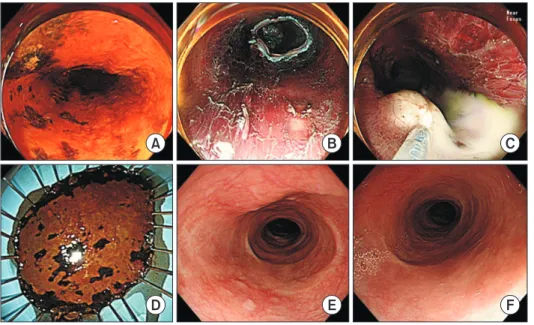
The most common late adverse event is esophageal stric- ture [38]. The reported incidence rate of strictures after ESD is 6.9%–18% [27,39]. Previous studies have reported that resection margins extending up to 75% of the entire esophageal circumference, M2 invasion depth, a >3-cm length of the mucosal defect, and excessive cautery during the procedure were independent risk factors of post-ESD esophageal stricture formation [39,40]. Endoscopic balloon dilatation (EBD) has been reported to be effective method in controlling post-ESD stricture [41]. Various innovative preventive modalities (including intralesional injection or oral administration of steroids and endoscopic transplan- tation of cell sheets, EBD followed by the administration of anti-inflammatory drugs, and the insertion of stents) can

Fig. 3. Superficial esophageal can- cer treated via circumferential ESD.

(A) A 5-cm flat Lugol voided lesion on the mid thoracic esophagus. (B) An artificial ulcer appeared imme- diately after ESD and resulted in a mucosal defect affecting >75% of the circumference (C) Local injec- tion of steroids. (D) The tumor was removed en bloc with tumor-free lateral and basal margins. (E) Fol- low-up endoscopy 7 months after ESD revealed no postprocedural stricture. (F) Follow-up endoscopy 15 months after ESD revealed no postprocedural stricture. ESD, en- doscopic submucosal dissection.

A B C

D E F

Table 1. Comparison of long-term outcomes between ER and SR for T1 SCC Author

(publication year)

No. of patients FU period (mo) R0 resection (%) 5-Year RFS (%) 5-Year OS (%) 5-Year DSS (%)

ER SR ER SR ER SR ER SR ER SR ER SR

Min et al. [6] (2018) 157 191 43 63.5 NA NA 92.8 95.3 93.9 91.2 100.0 97.4

Zhang et al. [7] (2019) 322 274 23 21 91.9 98.2 NA NA 79.4 71.5 NA NA

Yuan et al. [28] (2018) 69 47 43.8 49.4 92.7 100 NA NA 91.5 97.1 98.5 100

Gong et al. [29] (2019) 78 128 NA NA 73.1 100 NA NA NA NA NA NA

ER, endoscopic resection; SR, surgical resection; SCC, squamous cell carcinoma; FU, follow-up; RFS, recurrence-free survival; OS, overall survival;

DSS, disease-specific survival; NA, not available.

(5)

https://doi.org/10.5090/kjtcs.2020.53.4.172

KJTCVS

be beneficial in managing the risk of stricture formation.

The most prevalent method to prevent post-ESD stricture formation is the local injection of steroids or the adminis- tration of oral prednisolone (Fig. 3). The administration of steroids (odds ratio [OR], 0.108; 95% CI, 0.020–0.578;

p=0.009), specifically oral steroids (OR, 0.109; 95% CI, 0.019–0.622; p=0.013), has been found to be associated with a lower rate of post-ESD strictures [42]. Since dyspha- gia secondary to post-ESD stricture decreases quality of life of patients, clinicians should be keep in mind that the size and circumferential extension of the tumor are associ- ated with the risk of post-ESD esophageal stricture.

Conclusion

In summary, ER of SENs has shown favorable clinical outcomes, suggesting that it may be an effective and safe treatment strategy. For clinical T1a (M1–M2) disease, ER can be a curative modality. For clinical T1a (M3) or T1b (SM1–SM2) disease, diagnostic ESD may be safely applied for organ preservation. Complications, such as strictures, may arise; therefore, the treatment and prevention of stric- tures may be crucial to preserve the patient’s quality of life.

Further studies of the technical aspects of ESD, as well as, detailed investigations with long-term follow-up data, are needed to determine the feasibility of ESD for the treat- ment of SEC that has invaded the muscularis mucosa (T1a M3) or submucosa (T1b).

Conflict of interest

No potential conflict of interest relevant to this article was reported.

ORCID

Ga Hee Kim: https://orcid.org/0000-0002-7652-2580 Hwoon-Yong Jung: https://orcid.org/0000-0003-1281-5859

References

1. Fujiyoshi T, Tajika M, Tanaka T, et al. Comparative evaluation of new and conventional classifications of magnifying endoscopy with narrow band imaging for invasion depth of superficial esophageal squamous cell carcinoma. Dis Esophagus 2017;30:1-8.

2. Kim DU, Lee JH, Min BH, et al. Risk factors of lymph node metas- tasis in T1 esophageal squamous cell carcinoma. J Gastroenterol Hepatol 2008;23:619-25.

3. Takubo K, Aida J, Sawabe M, et al. Early squamous cell carcinoma

of the oesophagus: the Japanese viewpoint. Histopathology 2007;51:

733-42.

4. Jung HK, Tae CH, Lee HA, et al. Treatment pattern and overall sur- vival in esophageal cancer during a 13-year period: a nationwide co- hort study of 6,354 Korean patients. PLoS One 2020;15:e0231456.

5. Draganov PV, Wang AY, Othman MO, Fukami N. AGA institute clinical practice update: endoscopic submucosal dissection in the United States. Clin Gastroenterol Hepatol 2019;17:16-25.

6. Min YW, Lee H, Song BG, et al. Comparison of endoscopic submu- cosal dissection and surgery for superficial esophageal squamous cell carcinoma: a propensity score-matched analysis. Gastrointest Endosc 2018;88:624-33.

7. Zhang Y, Ding H, Chen T, et al. Outcomes of endoscopic submucosal dissection vs esophagectomy for T1 esophageal squamous cell carci- noma in a real-world cohort. Clin Gastroenterol Hepatol 2019;17:73- 81.

8. Inoue H, Endo M. Endoscopic esophageal mucosal resection using a transparent tube. Surg Endosc 1990;4:198-201.

9. Mannath J, Ragunath K. Endoscopic mucosal resection: who and how? Therap Adv Gastroenterol 2011;4:275-82.

10. Takahashi H, Arimura Y, Masao H, et al. Endoscopic submucosal dissection is superior to conventional endoscopic resection as a cura- tive treatment for early squamous cell carcinoma of the esophagus (with video). Gastrointest Endosc 2010;72:255-64.

11. Cao Y, Liao C, Tan A, Gao Y, Mo Z, Gao F. Meta-analysis of endo- scopic submucosal dissection versus endoscopic mucosal resection for tumors of the gastrointestinal tract. Endoscopy 2009;41:751-7.

12. Guo HM, Zhang XQ, Chen M, Huang SL, Zou XP. Endoscopic sub- mucosal dissection vs endoscopic mucosal resection for superficial esophageal cancer. World J Gastroenterol 2014;20:5540-7.

13. Choi JY, Park YS, Jung HY, et al. Feasibility of endoscopic resection in superficial esophageal squamous carcinoma. Gastrointest Endosc 2011;73:881-9.

14. Kitagawa Y, Uno T, Oyama T, et al. Esophageal cancer practice guidelines 2017 edited by the Japan Esophageal Society: part 1.

Esophagus 2019;16:1-24.

15. Kitagawa Y, Uno T, Oyama T, et al. Esophageal cancer practice guidelines 2017 edited by the Japan Esophageal Society: part 2.

Esophagus 2019;16:25-43.

16. Pimentel-Nunes P, Dinis-Ribeiro M, Ponchon T, et al. Endoscopic submucosal dissection: European Society of Gastrointestinal Endos- copy (ESGE) Guideline. Endoscopy 2015;47:829-54.

17. The Paris endoscopic classification of superficial neoplastic lesions:

esophagus, stomach, and colon: November 30 to December 1, 2002.

Gastrointest Endosc 2003;58:S3-43.

18. Endoscopic Classification Review Group. Update on the Paris classi- fication of superficial neoplastic lesions in the digestive tract. Endos- copy 2005;37:570-8.

19. Thosani N, Singh H, Kapadia A, et al. Diagnostic accuracy of EUS

(6)

Ga Hee Kim and Hwoon-Yong Jung. The Role of ER in the Treatment of SEN KJTCVS

in differentiating mucosal versus submucosal invasion of superficial esophageal cancers: a systematic review and meta-analysis. Gastro- intest Endosc 2012;75:242-53.

20. Pouw RE, Heldoorn N, Alvarez Herrero L, et al. Do we still need EUS in the workup of patients with early esophageal neoplasia?: a retrospective analysis of 131 cases. Gastrointest Endosc 2011;73:

662-8.

21. Takeuchi M, Suda K, Hamamoto Y, et al. Technical feasibility and oncologic safety of diagnostic endoscopic resection for superficial esophageal cancer. Gastrointest Endosc 2018;88:456-65.

22. Kim SJ, Kim GH, Lee MW, et al. New magnifying endoscopic clas- sification for superficial esophageal squamous cell carcinoma. World J Gastroenterol 2017;23:4416-21.

23. Wu HL, Guan BX, Liu B, et al. The intrapapillary capillary loop (IPCL) changes in superficial esophageal lesions. Dis Esophagus 2017;30:1-5.

24. Yip HC, Chiu PW. Endoscopic diagnosis and management of early squamous cell carcinoma of esophagus. J Thorac Dis 2017;9:S689- 96.

25. Park HC, Kim DH, Gong EJ, et al. Ten-year experience of esopha- geal endoscopic submucosal dissection of superficial esophageal neoplasms in a single center. Korean J Intern Med 2016;31:1064-72.

26. Noh JH, Gong EJ, Kim DH, et al. Endoscopic submucosal dissection for superficial esophageal neoplasms in elderly patients: a sin- gle-center, large-scale, retrospective study. Geriatr Gerontol Int 2020;

20:430-5.

27. Ono S, Fujishiro M, Niimi K, et al. Long-term outcomes of endo- scopic submucosal dissection for superficial esophageal squamous cell neoplasms. Gastrointest Endosc 2009;70:860-6.

28. Yuan B, Liu L, Huang H, et al. Comparison of the short-term and long-term outcomes of surgical treatment versus endoscopic treat- ment for early esophageal squamous cell neoplasia larger than 2 cm:

a retrospective study. Surg Endosc 2019;33:2304-12.

29. Gong L, Yue J, Duan X, et al. Comparison of the therapeutic effects of endoscopic submucosal dissection and minimally invasive esophagectomy for T1 stage esophageal carcinoma. Thorac Cancer 2019;10:2161-7.

30. Nagami Y, Ominami M, Shiba M, et al. The five-year survival rate after endoscopic submucosal dissection for superficial esophageal squamous cell neoplasia. Dig Liver Dis 2017;49:427-33.

31. Probst A, Aust D, Markl B, Anthuber M, Messmann H. Early esoph- ageal cancer in Europe: endoscopic treatment by endoscopic submu- cosal dissection. Endoscopy 2015;47:113-21.

32. Kim DH, Jung HY, Gong EJ, et al. Endoscopic and oncologic out- comes of endoscopic resection for superficial esophageal neoplasm.

Gut Liver 2015;9:470-7.

33. Sun F, Yuan P, Chen T, Hu J. Efficacy and complication of endoscop- ic submucosal dissection for superficial esophageal carcinoma: a systematic review and meta-analysis. J Cardiothorac Surg 2014;9:78.

34. Shimada H, Nabeya Y, Matsubara H, et al. Prediction of lymph node status in patients with superficial esophageal carcinoma: analysis of 160 surgically resected cancers. Am J Surg 2006;191:250-4.

35. Yang D, Zou F, Xiong S, Forde JJ, Wang Y, Draganov PV. Endoscop- ic submucosal dissection for early Barrett’s neoplasia: a meta-analy- sis. Gastrointest Endosc 2018;87:1383-93.

36. Isomoto H, Yamaguchi N, Minami H, Nakao K. Management of com- plications associated with endoscopic submucosal dissection/endo- scopic mucosal resection for esophageal cancer. Dig Endosc 2013;25 Suppl 1:29-38.

37. Tsujii Y, Nishida T, Nishiyama O, et al. Clinical outcomes of endo- scopic submucosal dissection for superficial esophageal neoplasms:

a multicenter retrospective cohort study. Endoscopy 2015;47:775-83.

38. Pouw RE, Beyna T, Belghazi K, et al. A prospective multicenter study using a new multiband mucosectomy device for endoscopic re- section of early neoplasia in Barrett’s esophagus. Gastrointest En- dosc 2018;88:647-54.

39. Mizuta H, Nishimori I, Kuratani Y, Higashidani Y, Kohsaki T, Onishi S. Predictive factors for esophageal stenosis after endoscopic submu- cosal dissection for superficial esophageal cancer. Dis Esophagus 2009;

22:626-31.

40. Shi Q, Ju H, Yao LQ, et al. Risk factors for postoperative stricture af- ter endoscopic submucosal dissection for superficial esophageal car- cinoma. Endoscopy 2014;46:640-4.

41. Na HK, Choi KD, Ahn JY, et al. Outcomes of balloon dilation for the treatment of strictures after endoscopic submucosal dissection com- pared with peptic strictures. Surg Endosc 2013;27:3237-46.

42. Pih GY, Kim DH, Gong EJ, et al. Preventing esophageal strictures

with steroids after endoscopic submucosal dissection in superficial

esophageal neoplasm. J Dig Dis 2019;20:609-16.

수치

Fig. 1. Endoscopic mucosal resec- resec-tion of superficial esophageal  can-cer. (A) A 1-cm sized flat elevated  lesion on the mid-thoracic  esoph-agus
Fig. 2. Endoscopic submucosal dis- dis-section of superficial esophageal  cancer. (A) A 2.5-cm flat hyperemic  lesion on the mid-thoracic  esoph-agus
Table 1. Comparison of long-term outcomes between ER and SR for T1 SCC Author

참조

관련 문서

Concentration-Dependent inhibition of cell viability by adenosine in human oral fibroblast and FaDu human head and neck squamous cell carcinoma · · ·

It also suggest that cell proliferation inhibits by a novel signal transduction for adenosine effect in human FaDu hypopharynx squamous cell carcinoma cells....

Differential Expression of Desmoglein1, Desmoglein3, Epithelial Membrane Antigen, Ber-EP4 and CD10 in Basal Cell Carcinoma and Squamous Cell Carcinoma

6. Acute biliary pancreatitis: the roles of endoscopic ultrasonography and endoscopic retrograde cholangiopancreatography.. endoscopic ultrasonography in the

편평상피세포암(squamous cell carcinoma), 선암(adenocarcinoma) 그리고 대세 포암(large cell carcinoma)으로 나뉘고 그에 따라 치료제가 조금씩

Lee, H.S., et al., Therapeutic efficacy of transcatheter arterial chemoembolization as compared with hepatic resection in hepatocellular carcinoma patients with compensated

1 John Owen, Justification by Faith Alone, in The Works of John Owen, ed. John Bolt, trans. Scott Clark, &#34;Do This and Live: Christ's Active Obedience as the

Method We obtained blood samples from 49 patients who underwent surgical treatment for esophageal squamous cell cancer (ESCC) We performed ctDNA analysis with