Printed in the Republic of Korea
183
다양한 치환기가 붙은 Styryl 4-Methoxy-1-Naphthyl Ketone의 합성과 치환기 효과에 관한 연구
G. Thirunarayanan* and P. Ananthakrishna Nadar
Department of Chemistry, Annamalai University, Annamalainagar-608 002, India (2005. 12. 23 접수)
Synthesis and Substituent Effects in Substituted Styryl 4-Methoxy-1- Naphthyl Ketones
G. Thirunarayanan* and P. Ananthakrishna Nadar
Department of Chemistry, Annamalai University, Annamalainagar-608 002, India (Received December 23, 2005)
요 약. 초음파를이용한응축반응을이용하여다양한치환기가붙은 4-methoxy-1-naphthyl ketone화합물들을
90% 이상의높은수율로합성하였으며, 생성된화합물물들을미세분석법, IR, 1H, 13C NMR 분석법등을이용하여 확인하였다. IR 스펙트럼에서s-cis와s-trans C=O stretching 모드를확인하였으며, NMR 데이터로부터에틸렌의탄소 와수소에대한 chemical shift를확인하였다. 이러한분광데이터를이용하여여러분자들에대한 Hammet 치환기상수 값들을얻을수있었으며, 이들로부터가용매분해반응에미치는치환기효과를해석할수있었다.
주제어: 합성, 치환기효과, 적외선분광법, 핵자기공명분광법, 나프틸칼콘
ABSTRACT. A series of substituted styryl 4-methoxy-1-naphthyl ketones [(2E)-1-(4-methoxy-1-naphthyl)-3-phenyl- 2-propen-1-ones] were synthesized using facile method of microwave assisted condensation reaction. The yield of chal- cones is more than 90%. They are characterized by their physical constants, micro analysis, infrared (KBr, 4000-400 cm−1) and NMR both 1H and 13C spectral data. From infrared spectra, the s-cis and s-trans stretching vibrations of carbonyl group, from NMR spectra the ethylenic proton and carbon chemical shifts (ppm) are assigned. These spectral data are correlated with various Hammett substituent constants. From the results of statistical analysis the effect of substituents on CO, α and
β proton and carbons are explained.
Keywords: Synthesis, Substituent Effects, Infrared Spectroscopy, NMR Spectroscopy, Naphthyl Chalcones
INTRODUCTION
With microwave irradiationof substituted benzal- dehydes and aromatic ketones in presence of anhy- drous zinc chloride gave exclusively high yield of substituted styryl chalcones.1 Their basic skeletons of chalcones are widely figured in natural products and are known to have multi pronged activity.2 Many of the chalcones are used as agrochemical and drugs.3 Recently much attention has paid on the
synthesis of chalcones mainly from acetophenone analogs4 with various aromatic benzaldehydes. Sev- eral catalysts5 such as basic alumina, Al2O3-AlPO4, P2O5-piperidoneultrasonic rays using C-200 and Lewis acids have been used for knovenogal con- densation and bases or quaternary ammonium salts have also been employed. Further studies on the efficient synthesis of chalcones are of current inter- est because of their wide range of application. Thus the author to report here the first time a simple fac-
ile approach to synthesis high yield of substituted styryl 4-methoxy-1-naphthyl chalcones and investi- gate the substituent effects from infrared and nuclear magnetic resonance spectra were recorded.
EXPERIMENTAL SECTION
A mixture of substituted benzaldehydes (0.01 mol) and 4-methoxy-1-naphthyl ketones (0.01 mol) and anhydrous zinc chloride (0.001mol) was taken in ACE tube and flushed with Argon and tightly capped. The mixture is subjected to microwave oven heating for 5-8 minutes in a domestic micro- wave oven (LG Microwave Oven MG-395WA) and then it is allowed to reach to room temperature.
The reaction mixture was treated with ethanol and the separated solid was filtered, washed with n-Hex- ane and dried. The solid was recrystallised by ben- zene-hexane mixture6. The reaction is shown in Scheme 1. Compounds a-f and h are unknown and the remaining compounds are known.
Melting points were determined in open glass capillaries on Mettler FP51 melting point apparatus and are uncorrected. Infrared spectra (KBr, 4000- 400 cm−1) were recorded on JASCO IR-700 Japan model spectrophotometer. The nuclear magnetic resonance spectra both 1H and 13C of chalcones were recorded using UNITYPLUS-300 “KIBSIPS”
300 MHz spectrometer, operating at 200MHz fre- quency for recording 1H NMR spectra and 75.45 MHz
frequency for recording 13C NMR Spectra. The micro analysis of the chalcones were performed in Perkin Elmer 240C Analyzer.
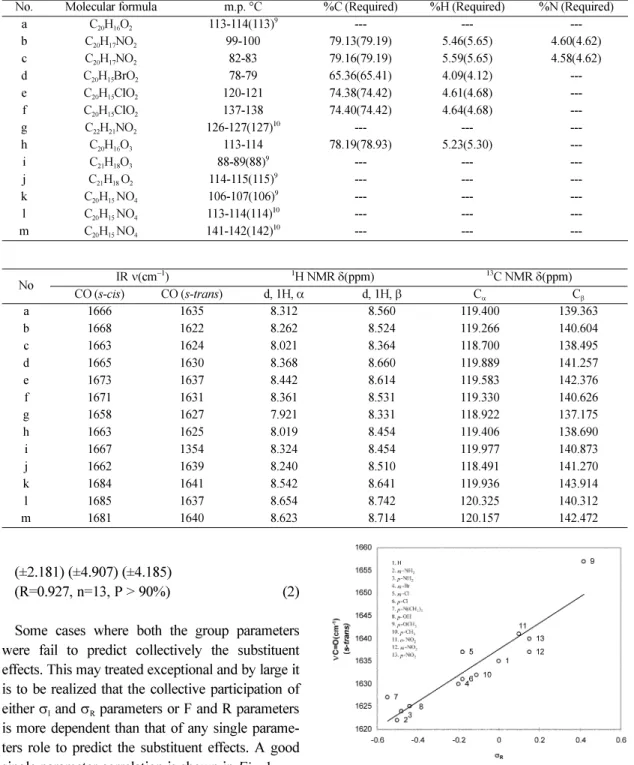
Based on Hays and Timmons7 infrared carbonyl stretching frequencies of s-cis and s-trans conform- ers are assigned. The NMR chemical shifts (ppm) of ethylene α, β protons and carbons are assigned based on reported in earlier literature8. The Physi- cal constants, micro analysis and spectral data of all chalcones are summarized in Table 1.
Substituent effects
Correlation study involves the prediction of ground state molecular equilibrations11 of organic substrates such as s-cis and s-trans isomers of alkenes, alkynes, benzoylchlorides, styrenes and α, β-unsaturated ketones from spectral data. Their use in structure parameter correlations has now becomes popular for studying transition state study of reaction mechanisms,12 bio- logical activities and normal coordinate analysis.13 Dhami and Stothers14 have extensively studied the
1H NMR spectra of a large number of acetophenones and styrenes with a view to establish the validity of the additivity of substituent effects in aromatic shieldings, first observed by Lauterber.15 Savin and coworkers16 obtained the NMR spectra of unsatur- ated ketones of the type RC6H4-CH=CH-COCMe3 and sought Hammett correlations for the ethylenic protons. Solcaniova and coworkers17 have measured
1H and 13C NMR spectra of substituted phenyl sty-
Scheme 1.
renes and substituted styryl phenyls and obtained good Hammett correlations for the olefinic protons and carbons. Now a day’s scientists18 have paid more interest to correlate the group frequencies of spectral data with Hammett substituent constants to explain the substituent effect of organic compounds.
Recently Dae Dong Sung and Ananthakrishna Nadar19 investigate elaborately the single and multi substitu- ent effects by spectral data of biphenyl and 9H-Flu- orenyl chalcones. With in the above view there is no information available in the literature in the past with substituted styryl 4-methoxy-1-naphthyl ketones.
Hence the authors have synthesized thirteen chal- cones of the above type using microwave irradia- tion technique. And the substituent effects of above compounds are investigated from infrared and NMR spectra were made.
Substituent Effects from infrared spectra The carbonyl stretching frequencies (cm−1) of s-cis and s-trans isomers of present study are shown in Table 1 and the corresponding conformers are shown in (I).
The infrared spectra were all recorded on the KBr disc in order to avoid the shoulder formation20 on carbonyl doublets. The s-cis conformers exhibit higher frequencies than the s-trans conformers due to the bulkier naphthalene group causes greater strain and they enhance the higher absorption of carbonyl group of s-cis isomer than the s-trans isomer. These frequencies are separately analyzed through vari- ous Hammett sigma constants.
From the statistical analysis, there is no signifi- cant correlation obtained with Hammett sigma con- stants in s-cis conformers. This is the conjugation between the C=O and the -CH=CH- parts is less important due to non-co planarity arising out of non bonded repulsion between naphthalene and styryl parts in the systems. In s-cis conformers there is significant correlation is obtained (r=0.995) with σR
constants. Further no significant correlations are obtained for both conformers with σ+, σI and σR
parameters except s-trans with σR constants. This is due to the cross conjugation of methoxy substituent in fourth position of naphthyl ring as shown in (II)
In view of the inability of some σ constants to produce individually satisfactory correlations, it was thought worthwhile to seek multiple correlations involving either σI and σR constants or Swain-Lupton’s F and R parameters. The correlation equations (1,2) generated are
νC=O (s-cis) (cm−1)=1669 + 17.660F + 11.697R (±2.311) (±4.580) (±2.900)
(R=0.939, n=13, P > 90%) (1)
νC=O (s-trans) (cm−1)=1638.8-2.769σI+29.893σR
(±2.181) (±4.907) (±4.185)
(R=0.927, n=13, P > 90%) (2) Some cases where both the group parameters were fail to predict collectively the substituent effects. This may treated exceptional and by large it is to be realized that the collective participation of either σI and σR parameters or F and R parameters is more dependent than that of any single parame- ters role to predict the substituent effects. A good single parameter correlation is shown in Fig. 1.
Substituent effects from NMR Spectra
1H NMR Spectra
The 1H NMR spectral signals of ethylenic pro- tons in all chalcones investigated are assigned. The chemical shifts of Hα protons are at higher field
Table 1. Physical constants, micro analysis and spectral data of substituted styryl 4-methoxy-1-naphthyl ketones.
No. Molecular formula m.p. °C %C (Required) %H (Required) %N (Required)
a C20H16O2 113-114(113)9 --- --- ---
b C20H17NO2 99-100 79.13(79.19) 5.46(5.65) 4.60(4.62)
c C20H17NO2 82-83 79.16(79.19) 5.59(5.65) 4.58(4.62)
d C20H15BrO2 78-79 65.36(65.41) 4.09(4.12) ---
e C20H15ClO2 120-121 74.38(74.42) 4.61(4.68) ---
f C20H15ClO2 137-138 74.40(74.42) 4.64(4.68) ---
g C22H21NO2 126-127(127)10 --- --- ---
h C20H16O3 113-114 78.19(78.93) 5.23(5.30) ---
i C21H18O3 88-89(88)9 --- --- ---
j C21H18 O2 114-115(115)9 --- --- ---
k C20H15 NO4 106-107(106)9 --- --- ---
l C20H15 NO4 113-114(114)10 --- --- ---
m C20H15 NO4 141-142(142)10 --- --- ---
No IR ν(cm−1) 1H NMR δ(ppm) 13C NMR δ(ppm)
CO (s-cis) CO (s-trans) d, 1H, α d, 1H, β Cα Cβ
a 1666 1635 8.312 8.560 119.400 139.363
b 1668 1622 8.262 8.524 119.266 140.604
c 1663 1624 8.021 8.364 118.700 138.495
d 1665 1630 8.368 8.660 119.889 141.257
e 1673 1637 8.442 8.614 119.583 142.376
f 1671 1631 8.361 8.531 119.330 140.626
g 1658 1627 7.921 8.331 118.922 137.175
h 1663 1625 8.019 8.454 119.406 138.690
i 1667 1354 8.324 8.454 119.977 140.873
j 1662 1639 8.240 8.510 118.491 141.270
k 1684 1641 8.542 8.641 119.936 143.914
l 1685 1637 8.654 8.742 120.325 140.312
m 1681 1640 8.623 8.714 120.157 142.472
Fig. 1. Plot of νC=O (s-trans) of substituted styryl 4-methoxy- 1-naphthyl ketones versus σR.
than those of Hβ protons in all chalcones. The ethyl- enic proton signals give an AB pattern and the β protons doublet in most cases is well separated from the signals of the aromatic protons. The chem- ical shifts of α, β protons are given in Table 1. The observation that Hα protons appear at higher field than that of Hβ protons makes the subject very inter- esting. This may possibly due to the polarization of C=C double bond in the system being predomi- nantly caused by the carbonyl group so as to make electron density greater at the α position than that of β position.
The results of statistical analysis are presented in Table 2. All the attempted correlations involving substituent parameters gave only positive ρ values.
This shows normal substituent effects is operates in all the chalcones. The Chemical shifts observed for Hα and the Hβ protons in the present investigation are correlated satisfactorily with Hammett sigma constants. In some cases correlation of Hβ with σ values is slightly better. By and large the necessity of enhanced σ values for correlation is not demanded by substituents. That the correlation with σI and σR
parameters is not satisfactory in Hα implies that
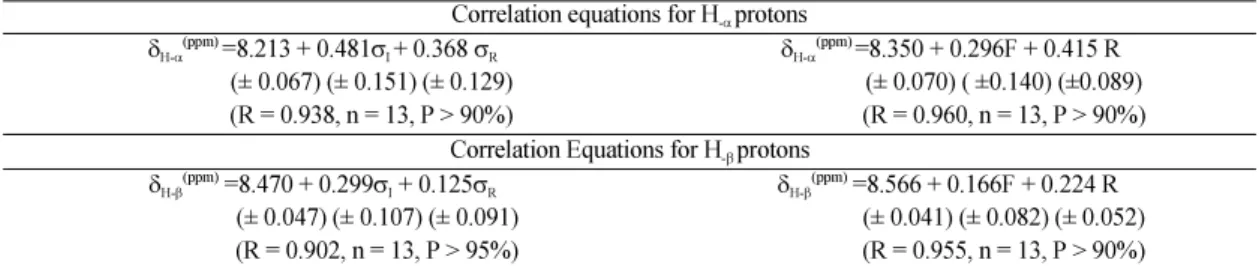
such σ values are incapable of predicting chemical shifts individually due to the domination of cross conjugation between carbonyl group and methoxy group in naphthyl ring. In Table 3 the multiple cor- relations involving either σI and σR or F and R val- ues for these ketones are presented. It is indeed satisfactorily that in most cases the multiple correla- tions are successful. Some of the single parameter
Table 2. Results of statistical analysis of chemical shifts of H-α and H-β protons of substituted styryl 4-methoxy-1-naphthyl ketones Type of protons Constants for correlation r I ρ s n Substituents in styryl part
H-α σ 0.974 8.278 0.148 0.070 13 H, m-NH2,
p-NH2, m-Br, m-Cl, p-Cl, p-NMe2, p-OH, p-OCH3, p-CH3, o-NO2, m-NO2 ,
p-NO2
σ+ 0.970 8.355 0.263 0.077 13
σI 0.878 8.096 0.687 0.150 13
σR 0.861 8.391 0.564 0.158 13
H-β σ 0.980 8.527 0.233 0.031 13
σ+ 0.983 8.570 0.149 0.030 13
σI 0.900 8.430 0.369 0.083 13
σR 0.766 8.547 0.247 1.105 13
Table 3. Results of statistical analysis of chemical shifts of H-α and H-β protons of substituted styryl 4-methoxy-1-naphthyl ketones with σI and σR or F and R parameters
Correlation equations for H-α protons
δH-α(ppm) =8.213 + 0.481σI + 0.368 σR
(± 0.067) (± 0.151) (± 0.129) (R = 0.938, n = 13, P > 90%)
δH-α(ppm) =8.350 + 0.296F + 0.415 R (± 0.070) ( ±0.140) (±0.089) (R = 0.960, n = 13, P > 90%) Correlation Equations for H-βprotons
δH-β(ppm) =8.470 + 0.299σI + 0.125σR
(± 0.047) (± 0.107) (± 0.091) (R = 0.902, n = 13, P > 95%)
δH-β(ppm) =8.566 + 0.166F + 0.224 R (± 0.041) (± 0.082) (± 0.052) (R = 0.955, n = 13, P > 90%)
Fig. 2. Plot of δH-α (ppm) of substituted styryl 4-methoxy- 1-naphthyl ketones versus σ.
correlations are shown in Fig. 2, 3.
13C NMR Spectra
From 13C NMR spectra the observed 13C Chemi- cal shifts of Cα and the Cβ carbons are presented in Table 1. These chemical shifts are correlated with various Hammett substituent constants. The results of statistical analysis of substituent effects on Cα and Cβ carbons are shown in Table 4. There is a fair degree of correlation obtained for Cα and the Cβ car- bon chemical shifts with Hammett sigma constants.
The degree of transmission of electronic effects is found to be higher with Cα carbon than Cβ carbon.
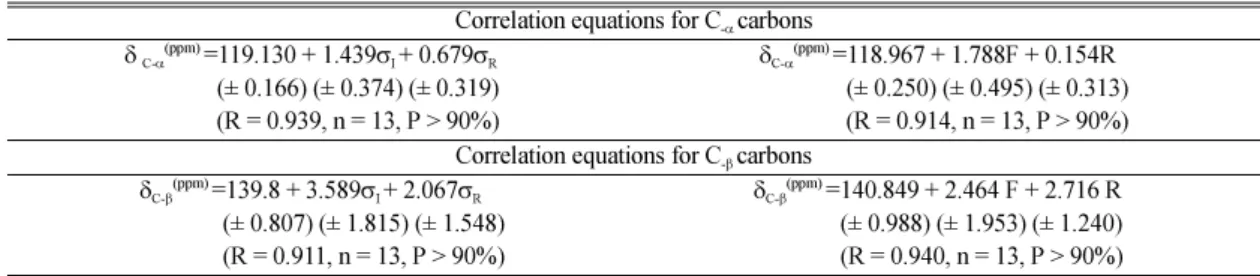
Uniformly σI and σR parameters or F and R values are adequately explain the substituent effects in all chalcones are evidenced from the correlation equa- tions which are given in Table 5.
In single parameter correlations, there are satis- factory correlations obtained with σ+ values for Cα
Fig. 3. Plot of δH-β (ppm) of substituted styryl 4-methoxy- 1-naphthyl ketones versus σ+.
Table 4. Results of statistical analysis of chemical shifts of C-α and C-β protons of substituted styryl 4-methoxy-1-naphthyl ketones Type of
carbons Constants for
correlation r I ρ s n Substituents in styryl part
σ 0.937 119.421 0.813 0.393 13 H, m-NH2,
p-NH2, m-Br, m-Cl, p-Cl, p-NMe2, p-OH, p-OCH3, p-CH3, o-NO2, m-NO2 ,
p-NO2
C-α σ+ 0.880 119.563 0.457 0.435 13
σI 0.907 118.915 1.819 0.333 13
σR 0.768 119.670 1.265 0.439 13
C-β σ 0.909 140.397 2.906 1.118 13
σ+ 0.907 140.834 1.875 1.096 13
σI 0.902 139.137 4.756 1.459 13
σR 0.724 141.144 3.574 2.501 13
Table 5. Results of statistical analysis of chemical shifts of C-α and C-β carbons of substituted styryl 4-methoxy-1-naphthyl ketones with σI and σR or F and R parameters
Correlation equations for C-α carbons
δC-α(ppm) =119.130 + 1.439σI + 0.679σR
(± 0.166) (± 0.374) (± 0.319) (R = 0.939, n = 13, P > 90%)
δC-α(ppm) =118.967 + 1.788F + 0.154R (± 0.250) (± 0.495) (± 0.313) (R = 0.914, n = 13, P > 90%) Correlation equations for C-βcarbons
δC-β(ppm) =139.8 + 3.589σI + 2.067σR
(± 0.807) (± 1.815) (± 1.548) (R = 0.911, n = 13, P > 90%)
δC-β(ppm) =140.849 + 2.464 F + 2.716 R (± 0.988) (± 1.953) (± 1.240) (R = 0.940, n = 13, P > 90%)
Fig. 4. Plot of δC-α (ppm) of substituted styryl 4-methoxy- 1-naphthyl ketones versus σ.
and Cβ carbons. This implies that one need not attach any significance to the correlations involving σ val- ues. A good single parameter correlation is shown in Fig. 4.
Acknowledgement. The authors are thanks to Dr.D.D.Sung, South Korea, financial support for recording NMR spectra of all chalcones.
REFERENCES
1. Tierney, J.; Lidstrom, P. “Microwave Assisted Organic Synthesis”, Blackwell publishing Ltd., Oxford, UK, 2005. 2. Zubieta, C.; He, X. Z.; Dixon, R. A.; Noel, J. P. Nat.
Struct Biol. 2001, 8(3), 271.
3. (a) Misra, S, S.; Tenavi, R. S. J. Indian Chem Soc.
1973,50, 68. (b) Lafen, L. Ger, pp. 2010180, 1970; CA.
1970, 73, 120342s. (c) Nakayama, M.; Hayashi, A.;
Goto, M. Pat, WO 8900989 CA 11157280f.
4. Dasharath, D.; Netaji, R.; Basheer, M. A.; Vibute, Y. B.
Ultra Science. 2005, 17(1), 89.
5. (a) Rajender, S. V.; George, N. K; Lau, T.; Richard, M.
Synth. Communn. 1985, 49, 279. (b) Cabello, J. A.;
Campelo, J. M.; Garcia, A.; Luna,D.; Marinas, J. M. J Org Chem, 1984, 49, 5195. (c) Sang-Yun, K.; Won, P.
S.; Kwon, T. W.; Synth. Communn.1997,27(4), 533.
(d) Fuentes, A.; Marinas, J. M.; Snisterra, J. V. Tetra- heran Lett.1987, 1089. (e) Shanthan Rao, P.; Venkat- aratnam, R. V.; Indian. J Chem.1993,32(B), 484. (f) Janc, H.; Hans,C. Tetrahedran Lett.1978,1089. (g) Sung, D. D.; Ananthakrishna Nadar, P.; Bull Korean Chem Soc.1999,20, 263. (h) Annunziata, R. Synth Communn.
1979,9,171. (i) Macooni, A.; Marongin, E. Ann Chim.
1960,50, 1806. (j) Yao-Zeng, H.; Grzejsz Czak, S.; Chen, C.; Yanchang, S. Synth Communn. 1989,19, 501.
6. Venkat Reddy, G.; Maitraie, D.; Narsaiah, B.; Rambabu, Y.; Shanthan Rao, D. Synth Communn, 2001,3(8), 2884.
7. (a) Hays, W.P.; Timmons, C. J.; Spectrochim Acta.
1968,24(A) 3239. (b) Misra, L.; Singh, A. K. Indian J Chem.2001,40(A), 1288.
8. (a) Hamer, G. K.; Peat, I. R.; Reynolds, W. F. Can J Chem.1973.51, 915. (b) Dhami, K. S.; Stothers, J. B.
Can J Chem. 1965,43, 510. (c) Wells, P. R.; Arnoid, D.
P. J. Chem. Soc. Perkins Trans 2, 1970,1745. (d) Dod- drell, D.; Wells, P. R. J. Chem. Soc, Perkins Trans 2,
1973, 1333. (e) Johnson, L. F.; Jonkowski, W. C. Car- bon-13 NMR Spectra, Wiley-Interscience, New York
1972. (f) Kitching.W.; Bullpitt, M.; Doddrell, D.; Adcock, W.; Org Magnetic Resonance. 1974,6, 289.
9. Kushawa, S. C.; Misra and Lal, J. B.; Indian.J. Appl.
Chem. 1971,34(6), 260.
10. Misra, S. S.; Tiewari, R. S. Indian. J. Appl. Chem. 1971, 34(5), 211.
11. (a) Perjessy, A.; Laucova, M.; Coll. Czech. Chem. Com- munn. 1971, 36, 2944. (b) Silver,N.L.; Boykin, D. W. J.
Org. Chem.1970,35,35.
12. Dass, G. K. Indian. J. Chem. 2001,40(A),223.
13. (a) Sharma, A.; Gupta, V. P.; Virdi, A. Indian J Pure Appl Phys. 2002, 40(4), 246. (b) Krishnakumar, V.;
Ramasamy, R. Indian. J. Pure. Appl. Phys.2002,40(4), 14. Dhami, K. S.; Stothers, J. B. 252. Can. J. Chem. 1965, 43, 15. Lauterbur, P. C. 479. J Am Chem Soc. 1961, 83, 1846.
16. Savin, V. I.; Gainullina, R. G.; Zuereu, V. V.; Kitaev, J.
P. Zh. Org Khim. 1975,11,1169.
17. (a) Solconiova, E.; Toma, S. Org Mag Resonance.1980, 14, 138. (b) Solconiova, E.; Toma, S. Org Mag Resonance.
1976, 8, 439.
18. Annapoorna, S. R.; Prasad Rao, M.; Sethuram, B. Indian J Chem. 2002, 41(A),1341.
19. Sung, D. D.; Ananthakrishna Nadar, P. Indian J Chem.
2000,39(A),1066.
20. (a) Rajasekaran, K.; Gnanasekaran, C. Indian J Chem.
1986,25(A), 223. (b) Rajasekaran, K.; Gnanasekaran, C. J Chem Soc. Perkin Trans 2. 1987, 263.