http://crossmark.crossref.org/dialog/?doi=10.14474/ptrs.2016.5.4.205&domain=pdf&date_stamp=2016-12-25
Received: 23 November, 2016 Revised: 13 December, 2016 Accepted: 13 December, 2016 Corresponding author: GyuChang Lee
Department of Physical Therapy, Kyungnam University, 7 Gyeongnamdaehak-ro, Masanhappo-gu, Changwon 51767, Republic of Korea Tel: 82-55-249-2739 Fax: 82-55-999-2173 E-mail: [email protected]
This is an Open-Access article distributed under the terms of the Creative Commons Attribution Non-Commercial License (http://creativecommons.org/licens es/by-nc/4.0) which permits unrestricted non-commercial use, distribution, and reproduction in any medium, provided the original work is properly cited.
Copyright © 2016 Korean Academy of Physical Therapy Rehabilitation Science
https://doi.org/10.14474/ptrs.2016.5.4.205 pISSN 2287-7576
eISSN 2287-7584
Phys Ther Rehabil Sci 2016, 5 (4), 205-209 www.jptrs.org
Effects of kinesio taping on the gait parameters of children with cerebral palsy: a pilot study
Sun-Hye Jung
a,b, Sun-Hae Song
b, Da-Rye Kim
c, Seul-Gi Kim
c, Ye-Jin Park
c, Yeon-Jung Son
c, GyuChang Lee
caJungWoo Children Development Center, Changwon, Republic of Korea
bDepartment of Physical Therapy, Graduate School of Kyungnam University, Changwon, Republic of Korea
cDepartment of Physical Therapy, Kyungnam University, Changwon, Republic of Korea
Objective: Children with spastic diplegic cerebral palsy show weakness especially in the lower-extremity rather than upper-ex- tremity muscles and display characteristics such as asymmetric alignment, deficits in postural control or balance ability, and slow walking speed. Various therapeutic interventions are applied to children with cerebral palsy, of which taping is widely used in the field of rehabilitation, however, there are few studies of the effects of kinesio taping on gait patterns of children with cerebral palsy.
The present study investigated the effects of kinesio taping on gait parameters of children with cerebral palsy.
Design: Cross-sectional study.
Methods: Four children with spastic diplegia participated in this study. The participants’ gait parameters while walking 10 m with and without kinesio taping (tibialis anterior, quadriceps femoris, and gluteus maximus) were recorded. Gait parameters including gait velocity, cadence, step length, stride length, single support time, and double support time were evaluated using the GAITRite.
Mean values were obtained after having the subjects walk three times in each condition with a 5-minute rest period between each condition. The order of each condition was assigned randomly.
Results: There were significant improvements in gait velocity, step length, stride length, and single support time of the right leg with kinesio taping condition compared to the without kinesio taping condition taping (p<0.05). However, there were no sig- nificant differences in cadence, single support time of the left leg, or double support time.
Conclusions: The results show that kinesio taping may have a positive effect for improving gait parameters of children with spastic diplegia. However, its usefulness in the rehabilitation of children with cerebral palsy needs to be further investigated.
Key Words: Cerebral palsy, Gait, Kinesio taping
Introduction
Recent advancements in medical technology have dra- matically increased the survival rate of premature and very- low-birth-weight infants, resulting in an increase in the in- cidence of children with cerebral palsy [1]. Cerebral palsy is a permanent nonprogressive disease affecting the develop- ment of the brain and can be caused by preterm birth, intra- uterine infection, periventricular leukomalacia or intra- ventricular hemorrhage, brain malformations, or head trau- ma caused by an accident occurring prenatally, during the
process of birth, or within 2 years after birth [2]. Children with cerebral palsy in particular, have motor dysfunction.
These problems are closely related to abnormal muscle tone, muscle weakness, contracture, and balance and gait [3] that inevitably result in a negative influence on independent dai- ly life [4].
Cerebral palsy is normally categorized into spastic, atax-
ic, athetoid, or flaccid according to the movement aspect of
children based on the degree of brain damage [5]. Of chil-
dren with cerebral palsy, more than 7% are spastic [6,7], and
children with spastic diplegic cerebral palsy especially show
Table 1. Characteristics of participants
Characteristic Value
Gender
Male 2
Female 2
Age (y) 11.25 (1.71)
Height (cm) 132.5 (5.57)
Weight (kg) 31.75 (4.57)
Leg length (cm)
Left 65.75 (7.46)
Right 63.25 (5.68)
Values are presented as number only or mean (SD).
weakness in lower-extremity rather than upper-extremity muscles and display characteristics such as asymmetric alignment, deficits in postural control or balance ability, and slow walking speed [8]. In previous studies, a meaningful difference was identified in the maximum muscular strength of knee extensor muscles between children with spastic di- plegic cerebral palsy and normal children, and such a differ- ence will influence gait [9,10]. Various therapeutic inter- ventions are applied to children with cerebral palsy, of which taping is widely used in the field of rehabilitation beyond sports for the purposes of strengthening muscle, increasing flexibility, and reducing pain [11]. Kinesio tape is accessible owing to its relatively low cost and noninvasive application methods [12]. When kinesio tape is attached to skin, it lifts the skin from the muscles and creates wrinkles that create a wider space between muscles and skin, thus improving the circulation of blood and lymph fluid [13].
Although the effects of taping have been suggested by previous studies, there are few studies of the effects of kine- sio taping on gait patterns of children with cerebral palsy.
Thus, this study investigated changes in gait pattern accord- ing to the application of taping targeting lower-extremity muscles in children with cerebral palsy.
Methods Subjects
Children with spastic diplegic cerebral palsy from a child development center were enrolled. The center’s message board was used to recruit volunteers who were enrolled and screened. The inclusion criteria were 1) attendance at a regu- lar school, 2) level 1-2 in the Gross Motor Function Classifi- cation System and Manual Ability Classification System, 3) able to walk independently at least 10 m, and 4) able to un- derstand and follow simple instructions. Exclusion criteria were 1) severe visual and hearing impairment, 2) uncon- trolled seizures, 3) genetic or syndromic conditions, and 4) botulinum toxin injection in the lower extremities within the previous 6 months. Table 1 shows participant character- istics.
Ethical considerations
All participants and their guardians provided signed in- formed consent after receiving an explanation of the study’s purpose and procedures. The study was approved by the Kyungnam University Institutional Review Board (1040460- A-2016-006).
Design and setting
The present study was a comparative cross-sectional study. Characteristics of the participants including age, sex, height, weight, and leg length were collected through brief interviews. Following the interviews, gait parameters with and without kinesio taping of the lower extremity were re- corded by research assistants. Kinesio taping was applied to each participant’s tibialis anterior, rectus femoris, and glu- teus maximus muscles. For the tibialis anterior muscle, the kinesio tape was attached along a line that passed the medial condyle of the ankle and the medial sole and went to the cen- terline of the instep with the ankle in a state of plantar flexion [14]. For the rectus femoris muscle, the tape was applied from 10 cm below the anterior superior iliac spine to the su- perior edge of the patella (without tension). The tape was then crossed from the edges of the patella (with maximum tension) and fixed below the inferior edge of the patella while the knee was flexed [15]. For the gluteus maximus muscle, two Y-shaped pieces of tape (approximately 35 cm long and 5 cm wide) were applied with the tails of the Y be- ing 30 cm long and 2.5 cm wide, leaving a base of 5 cm, which is the estimated distance between the participant’s greater trochanter and fifth lumber (L5) spinous process [16]
(Figure 1). In addition, the elasticity of the tape was set at 50%-70% of the available tension. The participants were asked to walk three times in each condition with and without kinesio taping, with a 5-minute rest between each condition.
The order of conditions to be performed was assigned ran-
domly by a researcher. Participants were asked to perform
under each condition while walking a 10-m distance. Parti-
cipants were shown a mark placed on the wall at eye level
approximately 10 m away and were instructed to walk to-
ward the mark. The participants were allowed to get plenty
A B
Figure 1. Kinesio taping on tibialis an- terior, rectus femoris, and gluteus maximus muscles. (A) Anterior view, (B) posterior view.
of rest when complaints over inconveniences were raised during the experiment. All the experiments were conducted in a quiet and spacious laboratory for physical therapy.
Measurements
The spatiotemporal parameters of gait were measured us- ing GAITRite (GAITRite Electronic Walkway; CIR Sys- tems Inc., Clifton, NJ, USA). Parameters including gait ve- locity, cadence, step length, stride length, single support time, and double support time were evaluated. The GAITRite is an electronic walkway (4.8 m long and 0.9 m wide) that contains sensors arranged in a pattern to measure the pressure exerted by the feet on the contact surface. The device acquires data that are transmitted via connections to a laptop; application software within the computer processes patterns from the soles of the feet. The GAITRite was in- stalled approximately 1 m past the starting line to reduce par- ticipants’ awareness of the device. Participants walked ap- proximately 10 m, which included the length of the GAITRite. The test-retest reliability of the GAITRite was 0.902-0.970, and the inter-rater reliability was 0.945-1.000 [17].
Data analysis
For data analysis, SPSS ver. 12.0 (SPSS Inc., Chicago, IL,
USA) was used. The normality of variables was assessed by the Shapiro-Wilk test. Data on spatiotemporal parameters of the gait were analyzed by using the paired t-test for compar- ison between parameters obtained with and without kinesio taping. The level of statistical significance was set at p
< 0.05.
Results
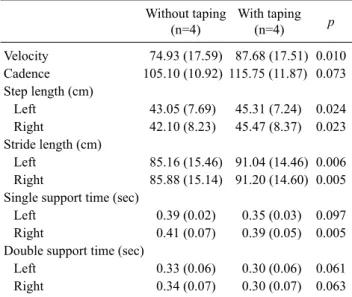
Significant differences were found between the following parameters obtained with and without kinesio taping: gait velocity, step length, stride length, and single support time of the right leg (p<0.05; Table 2). However, no significant dif- ferences were found between the two conditions in cadence, single support time of left leg, and double support time (Table 2).
Discussion
The present study investigated the changes in gait varia- bles of children with spastic diplegic cerebral palsy after ap- plying kinesio tape on lower-extremity muscles. Walking speed, step length of both legs, and stride length were im- proved, and single support time was meaningfully decreased.
Chinn et al. [18] and Deschamps et al. [19] reported that
Table 2. Comparison of gait parameters between without taping and with taping
Without taping (n=4)
With taping
(n=4) p
Velocity 74.93 (17.59) 87.68 (17.51) 0.010 Cadence 105.10 (10.92) 115.75 (11.87) 0.073 Step length (cm)
Left 43.05 (7.69) 45.31 (7.24) 0.024 Right 42.10 (8.23) 45.47 (8.37) 0.023 Stride length (cm)
Left 85.16 (15.46) 91.04 (14.46) 0.006 Right 85.88 (15.14) 91.20 (14.60) 0.005 Single support time (sec)
Left 0.39 (0.02) 0.35 (0.03) 0.097 Right 0.41 (0.07) 0.39 (0.05) 0.005 Double support time (sec)
Left 0.33 (0.06) 0.30 (0.06) 0.061 Right 0.34 (0.07) 0.30 (0.07) 0.063 Values are presented as mean (SD).
taping applied to patients with chronic ankle instability sig- nificantly improved stability of the ankle joint and gait.
According to Boguszewski et al. [20], taping applied to healthy adults significantly augmented the activation and strength of lower-extremity muscles. Furthermore, Ekiz et
al. [15] and Kim et al. [12] found an increase in walkingspeed after taping of stroke patients in a 10-meter walking test. Thus, previous studies have shown that taping im- proved muscle strength and functional movement along with ankle stability and muscle activation.
This study also found that taping on lower-extremity mus- cles resulted in a meaningful improvement in gait velocity, step length, stride length, and single support time of the right leg in children with spastic diplegic cerebral palsy. Children with spastic diplegic cerebral palsy display asymmetrical alignment due to weakness of the lower-extremity muscles [8,17]. Normally, because of weakness of the gluteus max- imus muscle during the stance phase, anterior tilt of the pel- vis, flexion-adduction of the hip, and internal rotation of the joint occur. Furthermore, owing to weakness of the quad- riceps femoris muscle, the flexion of the knee joint becomes augmented. In addition to that, during the swing phase, ow- ing to weakness of the tibialis anterior muscle, children with cerebral palsy show a gait pattern of asymmetric steps such as hyper-plantar flexion-eversion of the ankle. Previous studies analyzing the effects of lower-extremity taping on dynamic balance and gait ability in stroke patients showed meaningful differences in dynamic balance, gait velocity,
and cadence, which may have resulted from improvement in the stability of the joint on which the taping was applied [21]. This study also found that taping applied on the tibialis anterior, quadriceps femoris, and gluteus maximus muscles of children with cerebral palsy positively contributed to im- provement in the activation of the corresponding muscles and the stability of body posture resulting in a significant im- provement of gait variables including gait velocity, step length, stride length, and single support time of the right leg.
A limitation of this study is the small number of only four participants, making it difficult to generalize the results. In addition, regarding the selection of muscles on which taping was applied, this study focused on muscles involved in flex- ion of the hip joint according to foot drop, and did not in- clude muscles involved in full extension of the knee joint and hyper-anterior pelvic tilt, which also affect the gait of children with cerebral palsy. Taping was not attached to the gluteus medius, gluteus minimus, hamstring and iliopsoas muscles, even though they also influence gait.
However, this study showed that walking speed, step length, and stride length were meaningfully improved and right single support time was significantly reduced so that gait ability was increased by taping on lower-extremity mus- cles in children with spastic diplegic cerebral palsy. Such re- sults suggest the possibility of temporary effects of taping to improve the gait ability of children with spastic diplegic cer- ebral palsy. Further studies regarding the application and in- tervention of taping to supplement the asymmetric gait pat- tern of children with cerebral palsy would be worthwhile.
Conflict of Interest
The authors declared no potential conflicts of interest with respect to the authorship and/or publication of this article.
References
1. Khandaker G, Smithers-Sheedy H, Islam J, Alam M, Jung J, Novak I, et al. Bangladesh Cerebral Palsy Register (BCPR): a pi- lot study to develop a national cerebral palsy (CP) register with surveillance of children for CP. BMC Neurol 2015;15:173.
2. Nelson KB. Can we prevent cerebral palsy? N Engl J Med 2003;
349:1765-9.
3. Papavasiliou AS. Management of motor problems in cerebral palsy: a critical update for the clinician. Eur J Paediatr Neurol 2009;13:387-96.
4. Pirpiris M, Wilkinson AJ, Rodda J, Nguyen TC, Baker RJ, Nattrass GR, et al. Walking speed in children and young adults
with neuromuscular disease: comparison between two assess- ment methods. J Pediatr Orthop 2003;23:302-7.
5. Rethlefsen SA, Ryan DD, Kay RM. Classification systems in cerebral palsy. Orthop Clin North Am 2010;41:457-67.
6. Nelson KB. The epidemiology of cerebral palsy in term infants.
Ment Retard Dev Disabil Res Rev 2002;8:146-50.
7. Reddihough D. Cerebral palsy in childhood. Aust Fam Physician 2011;40:192-6.
8. Goh HT, Thompson M, Huang WB, Schafer S. Relationships among measures of knee musculoskeletal impairments, gross motor function, and walking efficiency in children with cerebral palsy. Pediatr Phys Ther 2006;18:253-61.
9. Thompson N, Stebbins J, Seniorou M, Newham D. Muscle strength and walking ability in diplegic cerebral palsy: implica- tions for assessment and management. Gait Posture 2011;33:
321-5.
10. Aisen ML, Kerkovich D, Mast J, Mulroy S, Wren TA, Kay RM, et al. Cerebral palsy: clinical care and neurological rehabilita- tion. Lancet Neurol 2011;10:844-52.
11. Lewis JS, Wright C, Green A. Subacromial impingement syn- drome: the effect of changing posture on shoulder range of movement. J Orthop Sports Phys Ther 2005;35:72-87.
12. Kim WI, Choi YK, Lee JH, Park YH. The effect of muscle facili- tation using kinesio taping on walking and balance of stroke patients. J Phys Ther Sci 2014;26:1831-4.
13. Kase K, Wallis J, Kase T. Clinical therapeutic applications of the Kinesio Taping method. 2nd ed. Tokyo: Ken Ikai Co Ltd.; 2003.
14. Lee K, Yi CW, Lee S. The effects of kinesiology taping therapy
on degenerative knee arthritis patients' pain, function, and joint range of motion. J Phys Ther Sci 2016;28:63-6.
15. Ekiz T, Aslan MD, Özgirgin N. Effects of Kinesio Tape applica- tion to quadriceps muscles on isokinetic muscle strength, gait, and functional parameters in patients with stroke. J Rehabil Res Dev 2015;52:323-31.
16. Mostert-Wentzel K, Swart JJ, Masenyetse LJ, Sihlali BH, Cilliers R, Clarke L, et al. Effect of kinesio taping on explosive muscle power of gluteus maximus of male athletes. South Afr J Sport Med 2012;24:75-80.
17. Woollacott MH, Shumway-Cook A. Postural dysfunction during standing and walking in children with cerebral palsy: what are the underlying problems and what new therapies might improve balance? Neural Plast 2005;12:211-9.
18. Chinn L, Dicharry J, Hart JM, Saliba S, Wilder R, Hertel J. Gait kinematics after taping in participants with chronic ankle instability. J Athl Train 2014;49:322-30.
19. Deschamps K, Dingenen B, Pans F, Van Bavel I, Matricali GA, Staes F. Effect of taping on foot kinematics in persons with chronic ankle instability. J Sci Med Sport 2016;19:541-6.
20. Boguszewski D, Tomaszewska I, Adamczyk JG, Białoszewski D. Evaluation of effectiveness of kinesiology taping as an ad- junct to rehabilitation following anterior cruciate ligament re- construction. Preliminary report. Ortop Traumatol Rehabil 2013;
15:469-78.
21. Hyun KH, Cho HY, Lim CG. The effect of knee joint Mulligan taping on balance and gait in subacute stroke patients. J Phys Ther Sci 2015;27:3545-7.