뇌성마비 아동의 참여증진을 목표로 한 중재연구에 관한 체계적 고찰
우석대학교 물리치료학과 교수김세연
A Systematic Review of the Intervention Study to Improve Participation of Children With Cerebral Palsy
Se-Yun Kim
Professor, Department of Physical Therapy, Woosuk University
요 약 본 연구의 목적은 체계적 고찰을 통해 뇌성마비 아동의 참여 향상을 목표로 한 중재를 확인하고자 하였다. 문헌 분석을 위해 “뇌성마비, 아동, 참여, 중재”등의 검색어를 사용하여 EBSCohost를 포함한 6개의 데이터베이스에서 검색 하여 총 11편의 연구를 선정하였다. 연구결과 근거수준Ⅰ단계는 6편(54.5%)이었으며, 신체구조와 기능에 초점을 둔 중 재방법의 연구는 7편(63.7%), 활동과 참여에 초점을 둔 중재방법의 연구는 각각 2편(18.2%)이었다. 종속변인이 참여와 신체구조와 기능, 활동 모두인 경우는 2편(18.2%), 참여와 함께 신체구조와 기능인 연구는 4편(36.4%), 참여와 활동인 연구는 3편(27.3%), 참여만 종속변인인 연구는 2편(18.2%)이었다. 측정도구로 가장 많이 사용된 도구는 COPM으로 5편(45.5%)의 연구에서 사용되었다. 본 연구는 뇌성마비 아동의 참여를 향상시키기 위한 효과적인 중재방법과 측정도 구를 확인했다는 데 의의가 있다.
주제어 : 국제 기능장애건강 분류, 뇌성마비, 아동, 활동, 참여
Abstract The purpose of this study was to identify article measuring treatment outcome for children with Cerebral Palsy in participation. The 6 database included EBSCohost was used for literature search.
Key words for search strategy were “Cerebral Palsy and Children and Participation and Interventions”.
A total of 11 studies were searched and studies of evidence level Ⅰ was 6(54.5%), studies of intervention method focused on physical function, activity and participation was 7(63.7%). The dependent variables of 2 studies(18.2%) were body structure and function, activity and participation, that of 4 studies(36.4%) were both body structure and function and participation, that of 3 studies(27.3%) were activity and participation, that of 2 studies(18.2%) were only participation. The COPM were used in 5 studies(45.5%).
Key Words : Activities, Cerebral Palsy, Children, ICF, Participation
*This paper was supported by Woosuk University
*Corresponding Author : Se-Yun Kim([email protected]) Received January 16, 2020
Accepted February 20, 2020 Revised February 7, 2020 Published February 28, 2020
1. 서론
뇌성마비는 출생전․후 미성숙한 뇌 손상으로 인해 움 직임과 자세에 영구적 장애로 활동에 제한을 가져오는 비진행성 질환이다. 뇌성마비 발병률은 전체 인구의 0.2
∼1.2%, 신생아 출산 1,000명당 2.7명으로 보고되었다[1].
국제 기능장애건강분류(International Classification of Functioning, Disability and Health: ICF)는 참여 를 ‘실제생활에서 참여’로 정의하고 참여 제한은 ‘개인이 실제생활에 참여하기 위해 경험할 수 있는 문제’로 정의 한다[2]. 복잡하고 다양한 요인에 의해 결정되어지는 참 여의 개념을 설명하기 위한 핵심요소는 수행하는 활동과 활동을 할 때 느끼는 주관적 경험이다[3]. 수행하고 있는 활동은 활동의 횟수, 활동의 범위 또는 활동의 다양성으 로 설명할 수 있다. 많은 연구들은 뇌성마비 아동이 활동 의 다양성, 횟수, 참여의 관점에서 감소된 참여의 위험을 보인다고 보고한다. 신체적 장애가 있는 아동의 약 3.6%
가 여가활동에 제한을 받음으로써 사회적 참여가 어렵다 [4]. 장애아동은 장애가 없는 아동과 비교해 여가활동과 사회적 활동에 참여하는 경향이 적고[5], 참여의 다양성 이 청소년기로 갈수록 확연히 감소하게 된다[5-6].
ICF에 따르면, 참여제한은 그 문화 또는 사회에서 장 애가 없는 아동에게 기대되는 참여와 비교를 통해 결정 되어진다[2]. ICF 아동청소년 버전(International Classification of Functioning, Disability and Health-Child and Youth version; ICF-CY)[7]은 아 동이 참여하는데 있어 불공평한 차이를 최소화하기 위해 평가와 중재 방법을 안내하기 만들어졌다. 뇌성마비 아동 을 포함해 발달장애 아동의 참여와 참여제한에 초점을 둔 연구들은 과거 20년 동안 눈에 띄게 증가하였다. 참여 가 중요해짐에 따라 2000년대 초 참여를 측정하기 위해 많은 평가도구들이 개발되었으며[8-11], 평가도구를 활 용하여 장애아동의 참여 수준을 평가하고 아동의 치료계 획을 수행하는데 활용되었다. 최근에는 가정, 학교, 지역 사회 환경에서 장애아동의 참여에 영향을 미치는 촉진요 인과 방해요인을 확인하는 연구들이 진행되었다[12]. 더 불어 참여에 미치는 요인뿐만 아니라 환경을 측정하는 CFFS(Child and Family Follow-up Survey)[13]가 개 발되어 장애아동의 생태학적 평가를 가능하게 하였다.
위와 같이 장애아동의 참여와 관련된 연구는 참여평가 도구 개발, 참여에 영향을 미치는 환경적 요인을 확인하 는 연구들은 꾸준히 제시되고 있지만 참여향상에 초점을 둔 연구는 제한적이다. 오늘날 참여를 강화하는 것은 다
양한 장애를 가진 아동을 위한 재활치료의 궁극적인 목 표이다[14]. 작업치료사는 클라이언트 중심 참여를 치료 목표로 설정해야 하며, 물리적 및 사회적 환경에서 장애 물을 파악하고 실제 생활에서 경험을 통해 작업을 수행할 수 있는 생태학적인 중재를 사용해야 한다[15]. 그럼에도 불구하고 국내연구는 참여를 측정하는 도구를 개발하는 수준에 머물고 있다. 따라서 본 연구의 목적은 첫째, 체계 적 고찰을 통해 2010년 이후 뇌성마비 아동의 참여 향상 을 목표로 한 중재연구를 확인하고자 한다. 둘째, 선정된 연구에서 뇌성마비 아동의 연령, 신체적 기능, 마비 부위 등을 확인하고자 한다. 셋째, 뇌성마비 아동의 참여 향상 을 위해 사용된 중재유형, 종속변수의 ICF 영역과 종속 변수의 측정방법 등을 분석함으로써 뇌성마비 아동의 참 여를 증진시키는데 효과적인 중재방법을 소개하고자 한다.
2. 연구방법 2.1 논문검색 및 자료수집
문헌검색은 2010년 1월부터 2019년 9월까지 해외 학회지에 게재된 연구를 대상으로 하였다. 문헌검색을 위한 데이터베이스로 EBSCOhost, CINAHL, Google Scholar, PubMed, ProQuest, Cochrane Library를 사용하였 다. 주요 검색어는 “Cerebral Palsy AND Children or child or adolescents or youth or teenager AND participation AND Interventions or strategies or best practices or therapy or approach or training”이었다. 분석 대상 논문의 검색 기준은 (1) 연 구 참여자가 뇌성마비 아동 및 청소년인 연구, (2) 참여를 종속변수로 중재가 실시된 실험연구, (3) 전문을 볼 수 있 는 연구, (4) 영어로 출판된 연구이며, 배제기준은 (1) 조 사연구, 사례연구 및 질적연구, (2) 고찰 또는 학위논문, (3) 단행본으로 한 연구이다. 효과적이고 신뢰할만한 중 재를 확인하기 위하여 조사연구, 사례연구 및 질적 연구 는 배제하였다. 이상의 검색기준을 사용하여 아래와 같이 문헌검색의 흐름도를 구체화하였다.
검색어를 연구초록에 모두 포함되도록 설정한 후 검색 한 결과 총 1,658편의 논문이 검색되었다. 검색된 연구 는 먼저 제목과 초록을 검토한 후, 필요시 원문을 확인하 였다. 연구자의 의견 중 일치하지 않은 경우는 토론을 거 쳐 결정하였으며, 검색기준에 부합하지 않은 논문 1,071 편을 제외한 후 중복 검색된 논문 26편을 제외하였다. 이 러한 과정을 거쳐 총 11편의 논문을 선정하였다. Fig. 1
Characteristics Frequency n (%) Age(yr)
Children(3-12) 13-18 Mix(5-18)
total
8(72.7) 2(18.2) 1(9.1) 11(100.0) GMFCS
(duplicate response)
ⅠⅡ
ⅢⅣ totalⅤ
10(30.3) 10(30.3) 8(24.3)
3(9.1) 2(6.1) 33(100.0) (duplicate MACS
response)
ⅠⅡ
ⅢⅣ
22 21 Table 2. Participant Characteristics
Fig. 1. Flowchart for study selection
2.2 대상연구의 질적수준
논문 연구의 질적 수준을 평가하기 위해 5 단계로 분 석하는 질적 근거기반 연구의 수준(Hierarchy of levels of evidence for evidence-based practice) 분류표를 사용하였다[16]. Ⅰ단계 수준은 체계적 고찰, 메타분석, 무작위 임상실험연구가 해당되며, Ⅱ단계 수준은 두 집단 비무작위 연구, Ⅲ단계 수준은 단일그룹 비무작위 실험연 구, Ⅳ단계 수준은 단일대상 연구 및 설문조사 연구, Ⅴ단 계 수준은 사례연구, 서술연구, 질적연구가 해당되며, Ⅴ 단계로 갈수록 근거수준은 낮아진다.
2.3 자료제시 방법
분석대상 논문들은 연구자 외 아동 작업치료분야 경력 이 10년 이상인 작업치료사 1인이 문항 표에 따라 각각 분류하였으며, 분류한 자료를 토대로 일치하지 않은 문항 은 일치할 때까지 논의를 통해 분류하였다. 분류 문항은 전반적인 특성을 파악하기 위해 연구설계 방법, 근거수 준, 연구참여자, 중재, 종속변수, 평가도구로 선정하였으 며, 빈도분석으로 데이터를 작성하였다.
3. 연구결과 3.1 연구의 질적수준
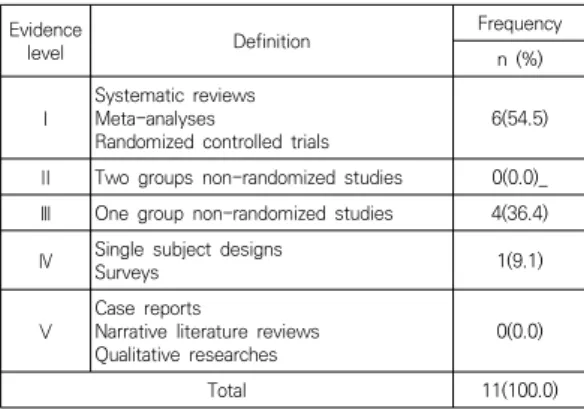
대상연구를 분석한 결과 수준 Ⅰ단계에 해당하는 무작 위 대조연구는 6편(54.6%)이었고, 단일그룹 비무작위 임 상실험 연구인 수준 Ⅲ단계는 4편(36.4%), 단일대상 연 구인 수준 Ⅳ단계는 1편(9.1%)으로 나타났다. Table 1
Evidence
level Definition Frequency
n (%)
Ⅰ Systematic reviews Meta-analyses
Randomized controlled trials 6(54.5)
Ⅱ Two groups non-randomized studies 0(0.0)_
Ⅲ One group non-randomized studies 4(36.4)
Ⅳ Single subject designs
Surveys 1(9.1)
Ⅴ Case reports
Narrative literature reviews
Qualitative researches 0(0.0)
Total 11(100.0)
Table 1. Level of Quality Among Each Study
3.2 연구 참여자의 특성
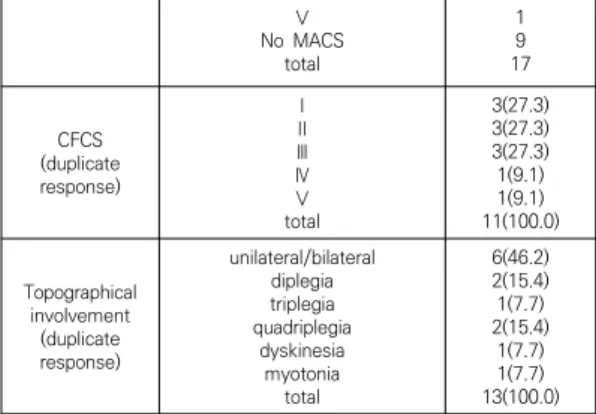
연구 참여자의 특성은 연령, 대근육기능분류체계(GMFCS), 손기능 분류체계인 MACS(manual ability classification system), CFCS(communication function classification system), 장애유형으로 나누어 분석하였다. 참여자의 연 령을 살펴보면 아동을 대상으로 하는 연구 8편, 청소년 대상 연구 2편, 아동과 청소년 모두를 대상으로 한 논문 1편으로 나타났다. 뇌성마비 아동을 대근육기능분류체계 (GMFCS)로 분류한 결과 중복응답을 허용하여 Ⅰ, Ⅱ 단 계인 아동이 20편으로 전체 연구의 약 60% 이상을 차지 하였으며, 손기능 분류체계인 MACS(manual ability classification system)로 분류한 결과 Ⅰ-Ⅲ단계가 각 각 2편로 나타났으나 9편의 논문에서는 제시되지 않았 다. CFCS(communication function classification system)로 분류한 결과 Ⅰ-Ⅲ단계가 각각 3편으로 나타 났으며, 뇌성마비 유형으로 분류한 결과 편측마비가 6편 (46.2%)으로 가장 많았다. Table 2.
No MACSⅤ total
19 17
(duplicate CFCS response)
ⅠⅡ
ⅢⅣ totalⅤ
3(27.3) 3(27.3) 3(27.3) 1(9.1) 1(9.1) 11(100.0) Topographical
involvement (duplicate response)
unilateral/bilateral diplegia triplegia quadriplegia
dyskinesia myotonia
total
6(46.2) 2(15.4) 1(7.7) 2(15.4)
1(7.7) 1(7.7) 13(100.0)
Refer ence
no.
domainICF Dependent variables Measurements
[17]
Activity Participatiand
on
-Performance and satisfaction with individualized participation goals -Community-based walking
activity level -Fall/trip
-Care-giver and child satisfaction
-COPM, Step Activity Monitor questionnaire, satisfaction questionnaire
[18]
BSF Activity participatiand
on
-Activities and participation -Body functions and structures -Environmental and personal
factors
-ECWT, SAM, CAPE, 3D-gait analysis.
physical fitness test, physical examination, Gait pattern, Intake questionnaire, BSS, FMS, FAQ, GMFCS [19]
Participati on
-Participation -Quality of life -Self-concept -Goal attainment and
satisfaction
-CAPE, PedsQLCP, Piers-Harris Children’s Self-Concept Scale, COPM
Table 4. Dependent variable and measurements
3.3 참여를 향상시키기 위한 중재유형
본 연구에 선정된 11개 논문을 분석한 결과 참여능력 을 향상시키기 위해 사용된 중재접근은 신체적 기능, 활 동과 참여 3가지 범주에 총 6개로 나타났다. 신체구조와 기능에 초점을 둔 중재를 사용한 연구는 7편으로 가장 많았으며 중재방법은 보조기, 승마치료, 트레드밀(treadmill) 훈련, 달리기(running), 파워훈련(power training), 저 항운동(resistance exercise) 등이 있다[17-23]. 활동에 초점을 둔 중재연구는 2편으로 상담을 통해 신체적 활동 수준을 파악한 후 클라이언트에 수준에 맞게 신체적 자 극 활동(운동치료 및 휘트니스 훈련)을 제공한다[24-25].
참여에 초점을 둔 중재는 2편으로 신체적 활동의 수행과 만족도(performance and satisfaction of physical activity)를 확인하고 신체적 활동 참여를 위해 장애물을 확인한 후 목표를 설정하고 목표 달성 및 목표수행과 만 족도를 확인하는 중재 방법이다[26-27]. Table 3.
domainICF Types of intervention Referen ce no. Frequency
n (%)
Body structur e &
function
neuroprosthesis use, ankle foot orthosis [17],[18] 2(18.2) supported speed treadmill training ex.
program vs strengthening program, Home-based progressive resistance or high intensity circuit training, functional power-training
[19], [20],
[21] 3(27.3)
running intervention [22] 1(9.1)
hippotherapy-therapeutic riding center
of taiwan [23] 1(9.1)
Activity
Physical activity on prescription (PAP), physical activity stimulation program(counselling, home-based physiotherapy, fitness training)
[24], [25] 2(18.2) Participa
tion participation-focused therapy [26], [27] 2(18.2) Table 3. Types of Intervention for Participation
3.4 참여와 함께 측정된 종속변인
종속변인을 ICF 도메인에 의해 분류한 결과 종속변인 이 참여와 신체구조와 기능, 활동 모두인 경우는 2편 (18.2%), 참여와 함께 신체구조와 기능인 연구는 4편 (36.4%)이었으며, 참여와 활동인 연구는 3편(27.3%), 참 여만 종속변인인 연구는 2편(18.2%)이었다. 신체구조와 기능을 함께 측정한 연구는 참여 이외 달리기 능력, 이동 성 향상, 대근육 기능, 근력, 근파워, 보행능력, 걷기능력 등을 측정하였다. 활동과 참여를 종속변인으로 측정한 연 구는 참여 이외 수행과 만족도, 지역사회에서 걷기 활동, 낙상, 삶의 질, 자존감, 목표달성, 환경과 개인적 요인, 동 기 등으로 나타났다. Table 4
3.5 종속변인 측정도구 분석
참여와 다른 종속변인들의 효과를 측정하기 위해 사용 된 평가도구는 연구마다 매우 다양하게 나타났다. 측정 도구 중 작업수행을 측정하는 COPM(Canadian Occupational Performance Measure)이 5개 논문에 서 사용되어 가장 많았으며[17-18.22-24], 목표달성 척 도인 GAS는 4개의 논문에서 사용되었고[21-22.24.26], 뒤를 이어 아동의 참여와 즐거움을 측정하는 CAPE[18-19,25]와 뇌성마비 아동의 삶의 질을 측정하 는 CP-QOL child[25-27], 아동과 청소년의 참여와 환 경을 측정하는 PEM-CY[22],[26-27]가 3개로 많았다.
Table 4.
[20]
BSF participati
on
-Muscle strength -Muscle power sprint test -Times stairs test -Gait Profile Score(GPS) -Timed Up and go test(TUGT) -Participation
-MPST, TST, GPS, TUGT, Participation questionnaires
[21]
participatiBSF on
-Goal attainment focusing ADL participation
-Mobility performance -GAS, FMS, MobQues
[22]
BSF participati
on
-Achievement of running ability or improvement
-Improvements in high level mobility
-Change of participation -Running capacity -Agility
-GAS, HiMAT, PEM-CY, SRT, MPST,10x5 meter sprint test
[23]
Activity BSF participatiand
on
-Body functions, activities, and
participation -ICF-CY assessment
[24] BSF participati
on
-Performance and satisfaction -Goal attainment
-Gross motor function
-COPM, GAS, GMFM 66
[25] Participati
on -Social participation -Self-perception -Quality of Life
-Life-H children, CAPE, Harter’s Self-Perception Profile for Children, CP-QOL Child
[26]
Activity participatiand
on
-Performance and satisfaction -Habitual physical activity -Barriers to participation in
Physical Activities -Quality of Life
-Participation and Environment Measure
-Problems in Schools -Motives for Physical Activities
Measure
-Physical Activity Climate -Goal Attainment
-COPM, ActiGraph wGT3X-BT, BPPA-Q, CP-QOL Child, PEM-CY, PISQ, MPAM-R, PACQ, GAS
[27]
Activity participatiand
on
-Goal performance and satisfaction
-Habitual Physical Activity -Barriers to Participation in
Physical Activities
-Participation and Environment Measure
-Quality of Life
-COPM, ActiGraph wGT3X-BT, BPPA-Q, PEM-CY, CP-QOL Child
BPPA-Q(Barriers to Participation in Physical Activities Questionnaire;
BSF: Body Structure and Function; BSS: Bronnen van Steun en Spanning; CAPE: Children’s Assessment of Participation and Enjoyment; COPM: Canadian Occupational Performance Measure;
CP-QOL Child: Cerebral Palsy Quality of Life Questionnaire for Children; ECWT: Energy cost of Walking Test; FAQ: Functional Assessment Questionnaire; FMS: Functional mobility scale; GAS: Goal Attainment Scaling; GMFCS: Gross Motor Function Classification System; GPS: Gait Profile Score; GMFM: Gross motor function Measure; HiMAT: High Level Mobility Assessment Tool; Life-H children: Life-Habites for Children questionnaire; MI: Motivational Interviewing; MobQues: Mobility Questionnaire; MPAM-R: Motives for Physical Activities Measure-Revised; MPST: Muscle Power Sprint Test;
PACQ: Physical Activity Climate Questionnaire; PedsQLCP: Pediatric Quality of Life Inventory-CP Module; PEM-CY: Participation and Environment Measure for Children and Youth; PISQ: Problems in Schools Questionnaire; SAM: Step Activity Monitor Questionnaire;
SPPC: Harter’s Self-Perception Profile for Children; SRT: Shuttle Run Test; TST: Times Stairs Test: TUGT: Timed Up and Go Test
4. 논의 및 제언
본 연구의 목적은 장애아동의 참여가 중요해짐에 따라 체계적 고찰을 통해 2010년 이후 뇌성마비 아동의 참여 향상을 목표로 한 중재연구를 확인하고자 하였다.
체계적 고찰을 위해 분석에 사용된 논문은 총 11개였 다. 11개 논문 모두 2010년 이후 발행된 논문으로 세계 보건기구에서 제시한 ICF 아동청소년 버전(International Classification of Functioning, Disability and Health-Child and Youth version; ICF-CY)[7] 이후 뇌성마비 아동의 참여 증진을 위한 연구들이 진행되어 왔음을 알 수 있다.
대상연구의 질적 수준을 분석한 결과 근거수준 Ⅰ단계 에 해당하는 무작위 대조연구가 가장 많았다. 무작위 대 조연구는 중재효과를 평가하기 위한 가장 신뢰할 만한 방법으로 본 연구에서 이러한 실험설계를 사용한 연구들 은 뇌성마비 아동의 참여향상을 위해 효과적이고 신뢰할 만한 중재방법을 제공해 줄 수 있다.
연구대상자 연령을 살펴보면 3-12세에 해당하는 아동 이 8편으로 가장 많았으며, 청소년에 해당하는 13-18세 인 연구는 2편에 불과하였다. Law 등[28]은 14세 이상 지체장애 아동의 경우 14세미만 아동과 비교했을 때 참 여의 다양성과 빈도가 낮다고 하였다. 따라서 참여향상을 측정하기 위해서는 다양한 활동에 참여하고 있는 14세 미만 아동을 대상으로 하는 연구가 많은 것으로 판단된 다. 하지만 대부분 아동이 청소년으로 전환됨에 따라 여 가활동과 교과외 활동 등에 참여는 감소하는[29] 반면, 사회적 활동은 강조되기 때문에[30] 청소년의 사회참여 를 향상시킬 수 있는 중재방법을 적용한 연구들이 수행 될 필요가 있다.
연구대상자는 대부분 걷기가 가능한 대근육기능분류 체계(GMFCS) Ⅰ, Ⅱ 단계가 약 60% 이상을 차지하였으며, 손기능 분류체계인 MACS(manual ability classification system)로 분류한 결과 손으로 물체를 쉽게 성공적으로 다루는 Ⅰ단계 2편, 손으로 물체를 다루지만 다루는 속도 와 능력이 미숙한 Ⅱ단계 2편, 손으로 물체를 다루기 어 렵고 물체를 다루기 위해 준비나 수정이 필요한 Ⅲ단계 2편으로 나타났으나 9편의 논문에서는 제시되지 않았다.
대동작 기능과 소동작 기능 등 운동손상은 참여에 영향 을 미치는 중요한 예측변인으로 알려졌다[31-32]. 따라 서 뇌성마비 참여자의 대근육 뿐만 아니라 소근육 기능 상태를 명확하게 명시함으로써 운동손상에 따른 뇌성마 비 아동의 참여향상을 위한 효과적인 중재방법을 확인하
는 것이 필요할 것으로 판단된다.
본 연구에 사용된 중재유형은 신체구조와 기능 향상에 초점을 둔 연구가 7편으로 가장 많았다. 그 이유는 뇌성 마비의 특성이 움직임과 자세조절의 어려움을 보이기 때 문에 신체적 구조와 기능을 향상시킴으로써 참여에 영향 을 미치는 요인을 개선하기 위한 것으로 판단된다. 신체 구조와 기능 향상을 위한 중재방법으로는 보조기, 승마치 료, 트레드밀(treadmill) 훈련, 달리기(running), 파워훈 련(power training), 저항운동(resistance exercise) 등을 통해 움직임과 자세조절, 근력강화를 통해 보행이 가능하게 함으로써 참여를 강화하고자 하였다[17-23].
보행 또한 뇌성마비 아동의 참여에 영향을 미치는 주요 예측 변인으로써[31], 신체적 기능에 초점을 둔 중재방법 이 참여를 향상시키는 데 효과적인 중재방법임을 알 수 있었다. 반면 활동과 참여향상에 초점을 둔 중재연구는 총 4편에 불과하지만[24-27] 2000년대 이후 참여에 영 향을 미치는 요인을 확인하고 환경을 측정하는 평가도구 등이 개발됨에 따라[13] 생태학적 평가를 통해 목표를 설 정하고 수행하는 중재방법들이 사용되고 있음을 알 수 있었다. 참여에 초점을 둔 중재방법[26-27]의 특성을 살 펴보면 아동과 보호자를 중재에 참여시키고 생태학적 평 가를 통해 환경적 맥락에 맞는 목표를 설정하고, 그 목표 는 클라이언트에 맞게 개별화되었다. 또한 손상과 활동제 한을 가져오는 장애물을 확인하고 참여목표를 향상시키 기 위한 다양한 방법으로 중재를 적용시키며, 아동과 가 족의 의견을 존중하여 중재방법을 결정하였다. 위와 같이 참여향상을 위한 중재 방법은 임상에서 뇌성마비 아동을 치료하는 재활전문가에게 유용한 정보가 될 수 있다.
참여는 복잡하고 다양한 요인에 의해 결정되어지기 때 문에 참여향상을 측정하는 것은 쉬운 일이 아니다. 하지 만 체계적 고찰을 통해 참여를 측정하는 종속변인으로서 참여 이외 ‘수행과 만족도, 삶의 질, 자존감, 목표달성, 환 경과 개인적 요인, 동기’ 등이 사용되는 것을 알 수 있었 으며, 참여향상을 측정하기 위해 수행과 만족도를 측정하 는 반구조화된 클라이언트 중심 측정도구로 잘 알려진 COPM과 GAS, CAPE, 아동용 CP-QOL 등이 효과적으 로 사용될 수 있음을 알 수 있었다. 본 연구의 제한점으 로는 2010년 이후 논문만을 검색하였으므로 2010년 전 과 비교하여 뇌성마비 아동의 참여를 향상시키기 위한 연구의 변화를 알아볼 수 없었다. 따라서 추후 연구에서 는 2010년 전후로 더 광범위한 논문 검색을 통해 뇌성마 비 아동의 참여향상을 위한 중재연구의 동향을 살펴볼 필요가 있다. 또한 메타분석을 사용하여 중재방법의 효과
를 측정함으로써 뇌성마비 아동의 참여향상을 위한 효 과적인 중재방법에 대해 임상현장의 치료사들에게 도움 을 줄 수 있을 것이다.
5. 결론
2010년 이후 CP 아동의 치료효과를 참여로 측정한 연구는 11개가 있었으며, 그 중 6개 논문이 근거수준 1 단계 이상의 질 높은 연구들이었다. 참여를 향상시키기 위한 중재유형은 뇌성마비 아동의 신체 기능을 강화하여 참여를 촉진하는 연구가 7편으로 가장 많았으며, 활동과 참여중재가 각각 2편으로 나타났다. 종속변인은 참여 이 외 수행과 만족도, 삶의 질 등이 자주 사용되었으며 가장 많이 사용된 측정도구는 COPM이었다. 본 연구는 2000 년대 ICF에서 참여를 강조한 이후 뇌성마비 아동의 참여 향상에 효과적인 중재유형과 치료효과를 측정하는 도구 를 알아보았다는데 의의가 있다.
REFERENCES
[1] C. Y. Hong. (1999). Pediatric science, Daehangyugaseo Corp.
[2] World Health Organization. (2001). International classification of functioning, disability, and health (ICF). Geneva, Swtizerland: Author.
[3] C. Imms, S. Mathews, K. Nicola Richmond, M. Law &
A. Ullenhag. (2016). Optimising leisure participation: a pilot intervention study for adolescents with physical impairments. Disability and rehabilitation 38(10), 963-971.
[4] J. McDougall, G. King, D. DeWit, L. Miller, S. Hong, D.
Offord, J. LaPorta & K. Meyer. (2004). Chronic physical health conditions and disability among Canadian school-aged children: A national profile.
Disability and Rehabilitation, 26(1), 35-45.
[5] M. Brown & W. A. Gordon. (1987). Impact of impairment on activity patterns of children. Archives of Physical Medicine and Rehabilitation, 68, 828-832.
[6] C. J. Stevenson, P. O. D. Pharoah & R. Stevenson.
(1997). Cerebral palsy-the transition from youth to adulthood. Developmental Medicine and Child Neurology, 39, 336-342.
[7] World Health Organization. (2007). International classification of Functioning, Disability, and Health:
Children and Youth Version. Geneva, Swtizerland:
Author.
[8]1A. D. Henry. (2000). Pediatric interest profiles: Surveys of play for children and adolescents. San Antonia, TX:
Therapy Skill Builders.
[9] G. King et al. (2004). Children's Assessment of Participation and Enjoyment (CAPE) and Preferences for Activities of Children (PAC). San Antonio, TX:
Harcourt Assessment.
[10] S. Rosenblum, D. Sachs & N. Schreuer. (2010).
Reliability and validity of the children's leisure assessment scale. American Journal of Occupational Therapy, 64, 633-641.
[11] K. Bowman. (1999). Development of Activity Card Sort for children: Does parental report on the Activity Card Sort reflect similar results of their children.
Unpublished master's degree, University of Western Ontario, London.
[12] D. Anaby, C. Hand, L. Bradley, B. DiRezze, M. Forhan, A. DiGiacomo & M. Law. (2013). The effect of the environment on participation of children and youth with disabilities: A scoping review. Disability and Rehabilitation, 35, 1589-98.
[13] G. Bedell. (2004). Developing a follow-up survey focused on participation of children and youth with acquired brain injuries after inpatient rehabilitation.
NeuroRehabilitation, 19, 191-205.
[14] L. Rosenberg, T. Jarus & O. Bart. (2010). Development and initial validation of the Children Participation Questionnaire (CPQ). Disability and Rehabilitation, 32(20), 1633-1644.
[15] G. A. King, P. J. Baldwin, M.Currie & J. Evans. (2005).
Planning successful transitions from school to adult roles foryouth with disabilities. Children’s Health Care, 34, 93-216.
[16] M. Arbesman, J. Scheer & D. Lieberman. (2008). Using AOTA's Critically Appraised Topic(CAT) and Critically Appraised Paper (CAP) series to link evidence to practise. OT Practise, 13(5), 18-22.
[17] A. F. Bailes, C. Cadwell, M. Clay, M. Tremper, K. Dunning
& J. Long. (2017). Participation and community-based walking activity after neuroprosthesis use in children with hemiplegic cerebral palsy: A pilot study. Journal of Pediatric Rehabilitation Medicine: An Interdisciplinary Approach 10, 71-79.
[18] Y. L. Kerkum, J. Harlaar, A. l. Buizer, J. C. van den Noort, J. G. Becher & M. A. Brehm. (2013). Optimising ankle foot orthoses for children with cerebral palsy walking with excessive knee flexion to improve their mobility and participation; protocol of the AFO-CP study. BMC Pediatircs, 13(17), 13-21.
[19] P. E. Gates, D. Banks, T. E. Johnson, S. R. Campbell, J.
P. Gaughan, S. A. Ross, J. R. Engsberg & C. Tucker. (2012).
Randomized controlled trial assessing participation and quality of life in a supported speed treadmill training exercise program vs. a strengthening program for children with cerebral palsy. Journal of
Pediatric Rehabilitation Medicine: An Interdisciplinary Approach, 5, 75-88.
[20] C. Schranz, A. Kruse, T. Nelohlavek, G. Steinwender, M. G., Tilp, T. Pieber & M. Svehlik. (2018). Does home-based progressive resistance or high-intensity circuit training improve strength, function, activity or participation in children with cerebral palsy. Archives of Physical Medicine and Rehabilitation, 99, 2457-64.
[21] L. F. van Vulpen, S. de Groot, E. A. Rameckers, J. G.
Becher & A. J. Dallmeijer. (2018). Improved parent-reported mobility and achievement of individual goals on activity and participation level after functional power-training in young children with cerebral palsy: a double-baseline controlled trial.
European Journal of Physical and Rehabilitation Medicine, 54(5), 730-7.
[22] N. Gibson, A. Chappell, A. M. Blackmore, S. Morris, G.
Williams, N. Bear & G. Allison. (2018). The effect of a running intervention on running ability and participation in children with cerebral palsy: a randomized controlled trial. Disability and Rehabilitation, 40(25), 3041-3049.
[23] Y. L. Hsieh, C. C. Yang, S. H. Sun, S. Y, Chan, T. H.
Wang & H. J. Luo. (2017). Effects of hippotherapy on body functions, activities and participation in children with cerebral palsy based on ICF-CY assesments.
Disability and Rehabilitation, 39(17), 1703-1713.
[24] K. Lauruschkus, I. Hallstrom, L. Westbom, A. Tornberg
& E. Nordmark. (2017). Participation in physical activities for children with cerebral palsy: feasibility and effectiveness of physical activity on prescription.
Archives of Physiotherapy, 7-13.
[25] L. van Wely, A. C. J., Balemans, J. G. Becher & A. J.
Dallmeijer. (2014). The effectiveness of a physical activity stimulation program for children with cerebral palsy on social participation, self-perception and quality of life: A randomized controlled trial.
Clinical Rehabilitation, 28(10), 972-982.
[26] S. E. Reedman, R. N. Boyd, C. Elliott & L. Sakzewski.
(2017). ParticiPAte CP: a protocol of randomized waitlist controlled trial of a motivational and behavior change therapy intervention to increase physical activity through meaningful participation in children with cerebral palsy. BMJ open, 7(7), e015918.
[27] S. E. Reedman, R. N. Boyd, S. G. Trost, C. Elliott & L.
Sakzewski. (2019). Efficacy of Participation-focused therapy on performance of physical activity participation goals and habitual physical activity in children with cerebral palsy: A randomized controlled trial. Archives of Physical Medicine and Rehabilitation, 100, 676-686.
[28] M. Law et al. (2006). Patterns of participation in recreational and leisure activities among children with complex physical disabilities. Developmental Medicine and Child Neurology, 48, 337-342.
[29] J. L. Mahoney, H. Lord & E. Carry. (2005). An Ecological analysis of after‐school program participation and the
development of academic performance and motivational attributes for disadvantaged children.
Child Development, 76(4), 811-825.
[30] A. D. Henry. (1998). Pediatric interest profiles: Surveys of play for children and adolescents. San Antonia, TX:
Therapy Skill Builders.
[31] R. J. Palisano, L. J. Kang, L. A. chiarello, M. Orlin, D.
Oeffinger & J. Maggs. (2009). Social and community participation of children and youth with cerebral palsy is associated with age and gross motor function classification. Physical Therapy, 89(12), 1304-1314.
[32] V. Manus, P. Corcoran & I. J. Perry. (2008).
Participation in everyday activities and quality of life in pre-teenage children living with cerebral palsy in South West Ireland. BMC Pediatrics, 8, 50.
김 세 연(Se-Yun Kim) [정회원]
․ 2001년 2월 : 연세대학교 작업치료학 과(이학사)
․ 2007년 8월 : 이화여자대학교 교육대 학원 특수교육전공(교육학석사)
․ 2013년 2월 : 연세대학교 작업치료학 과(이학박사)
․ 2009년 3월 ~ 2019년 2월 : 우석대 학교 작업치료학과 교수
․ 2019년 3월 ~ 현재 : 우석대학교 물리치료학과 교수
․ 관심분야 : 아동, 보조공학, 치매
․ E-Mail : [email protected]