• 검색 결과가 없습니다.

Effects of Goal-Oriented Functional Tasks on Gross Motor Function and Activities of Daily Living in Children with Cerebral Palsy -A Single Case Study-

N/A
N/A
Protected

Academic year: 2021

Share "Effects of Goal-Oriented Functional Tasks on Gross Motor Function and Activities of Daily Living in Children with Cerebral Palsy -A Single Case Study-"

Copied!
14
0
0

로드 중.... (전체 텍스트 보기)

전체 글

(1)

| Abstract |

Purpose: The study sought to determine whether goal achievement, performance, satisfaction, activities of daily living, and gross motor function in children with spastic cerebral palsy are positive affected by goal-oriented functional task training.

Methods: In a single case study, two 7-year-old girls diagnosed with spastic cerebral palsy were given functional task training based on individualized goals for 24 60-minute sessions over a period of 6 months. The individualized goals reflected the needs of both children and parents. The Canadian occupational performance measure (COPM) and the goal attainment scale (GAS) were used to measure goal performance and satisfaction before and after intervention. Independence of activities of daily living before and after intervention were assessed using the functional independence measure for children (Wee-FIM). And change of gross motor function were assessed using gross motor function measure (GMFM).

Results: Clinically significant changes were observed in COPM and GAS, as well as positive changes in independence of gross motor function and activities of daily living.

Conclusion: The findings indicate that goal-oriented functional task training addresses the needs of children with spastic cerebral palsy, which increases treatment satisfaction and has a positive effect on independent activities and participation in daily life.

Key Words: Cerebral palsy, Goal-oriented functional task training, Gross motor function, Wee-FIM

†Corresponding Author : Hae-Yeon Kwon ([email protected])

Case study Open Access

Effects of Goal-Oriented Functional Tasks on Gross Motor Function and Activities of Daily Living in Children with Cerebral Palsy

-A Single Case Study-

Eun-Jung Lee, P.T., M.S⋅Hae-Yeon Kwon, P.T., Ph.D. 1†

1)

Ulsan Community Rehabilitation Center, Department of Biomedical Health Science, Graduate School, Dong-Eui University

1 Department of Physical Therapy, College of Nersing and Healthcare Sciences, Dong-Eui University Received: April 28, 2020 / Revised: June 4, 2020 / Accepted: June 18, 2020

ⓒ 2020 Journal of Korea Proprioceptive Neuromuscular Facilitation Association

This is an Open Access article distributed under the terms of the Creative Commons Attribution Non-Commercial License

(http://creativecommons.org/licenses/by-nc/3.0) which permits unrestricted non-commercial use, distribution, and reproduction

in any medium, provided the original work is properly cited.

(2)

Ⅰ. Introduction

Cerebral palsy is a non-progressive lesion of immature brain that occurs from the prenatal stage to within 2 years after birth, and an clinical syndrome accompanied by disabilities in motor, posture sensory, cognition, expression of opinions and action functions. In particular, motor disorder is accompanied by musculoskeletal and sensory problems, which affect the cognitive actions (Rosenbaum et al., 2007). Movement impairment of cerebral palsy induces overall development delays including concept of sensory, perception and movements as well as social function issues, etc. by being associated with limitations in the physical activities and lack of movement experiences (Ostensjo et al., 2003), thereby affecting not only daily life activities but also school life and social participation. Since the extent of their movement impairments manifest differently for each child, activity limitations and participation restrictions in their daily lives will also be manifested diversely (Johnson, 2002).

Since majority of cerebral palsy children complain of difficulties in independent walking and daily life activities due to abnormal muscle tones including muscle weakness, ataxia, physical coordination disorder and spasticity (Tecklin, 1999), treatment for cerebral palsy children is generally executed by therapists with focus on the recovery from such physical movement impairment.

Neurodevelopment treatment and Vojta therapy are traditionally used extensively as physiotherapy approach for cerebral palsy children (Kim, et al., 2000).

Neurodevelopment treatment suppresses atypical muscle tone and abnormal posture, and promotes typical development and movements (Schoen & Anderson, 1999).

Vojta therapy is a method that utilizes finger compression at specific stimulation points of the body to induce exercising of the central nervous system (Vojta & Peters,

2007). Recently, there have been a lot of preceding studies on the intervention of cerebral palsy children with focus predominantly on the physical impairments including those associated with the posture control, muscle strength, gross motor function and balance, etc. (Hong, 2014; Park

& Hong, 2015; Stubbs & Diong 2016; Taylor et al., 2004).

These therapeutic approaches have been made to normalize motor functions by reducing neurological damage in children (Valvano, 2004). It has focused on the problems of daily activities due to physical limitations and has provided treatment access to improve children’s posture and movements to solve these problems. However, there is little evidence that the treatment centered on neurological impairment recovery in children with cerebral palsy affects their level of participation in daily life.

A study comparing the quality of life according to the level of physical function of children with cerebral palsy confirmed that no significant differences were found in areas where their physical functions were directly related to social functions. This is a result that does not reflect past views that the lower the level of functioning of children with cerebral palsy, the lower the quality of life will be (Cho et al., 2009).

The World Health Organization (WHO) is based on

restrictions on social activities and participation

determined by the interaction of an individual’s physical

characteristics and environment in assessing disability,

indicating the importance of daily activities as well as

physical impairment to children with cerebral palsy

(WHO, 2001). Therefore, the concept that the intervention

of children with cerebral palsy should aim for functional

enhancement in the natural environment of real life is

emphasized (Ketelaar et al., 1998). Thus it is desirable

to render treatments for cerebral palsy children with the

goal of evidence-based functional optimization with

execution of intervention that leads to activities and

(3)

participation rather than focusing on the impairments themselves. In particular, it is important to include the assertive opinions of the children and their family when making decision on the activities of intervention (Bamm et al., 2008).

Goal-oriented treatment is based on the latest theories on motor control, motor development, and motor learning (Valvano, 2004; Shumway-Cook, 2007), which allows children to practice motor skills in a child’s actual environment as a treatment approach that emphasizes learning about the goals that children or their families think (Ketelar, 2001). The latest theories on control, motor development, and motor learning support the basis for goal-oriented treatment approaches (Shumway-Cook, 2007; Valvano, 2004).

Accordingly, this study applied intervention program through direct and individualized functional task performance activities that are appropriate for the attainment of the treatment goals, which are set by means of individual needs assessment, for the school-age children with spastic cerebral palsy. Then, the extents of the goal performance and satisfaction of the cerebral palsy children were measured, and their effects on the daily life activities and gross motor function changes of the children were analyzed. Through this analysis, this study will provide basic clinical data for the intervention programs that are realistically helpful for the activities and participations that are necessary for spastic cerebral palsy children’s adaption to their daily and school lives.

Ⅱ. Method 1. Subjects

The study subjects were two 7 years old girls diagnosed with spastic cerebral palsy, and children and parents

agreed to understand the purpose and contents of this study and participate voluntarily according to the research procedure. Detailed criteria for the selection of the study subjects are as follows. First, Children of school age who were diagnosed with cerebral palsy spastic diplegia.

Second, children capable of executing tasks according to the instructions of and communication with the researcher.

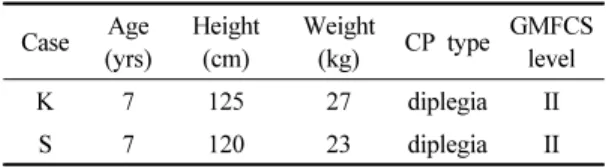
Third, children capable of expressing their desires and opinions, thereby enabling reflecting of their opinions in the setting of the treatment goals. Lastly, children who underwent chemical neuroblocking such as the use of botulinum or surgical procedures such as tendonectomy and tendon extension over the last 6 months and during the experimental intervention period were excluded. The general characteristics of the study subjects are presented in the below (Table 1).

Case Age

(yrs) Height

(cm) Weight

(kg) CP type GMFCS level

K 7 125 27 diplegia Ⅱ

S 7 120 23 diplegia Ⅱ

Table 1. General characteristics of subjects (n=2)

2. Measurement tools and method

1) Canadian occupational performance measure (COPM)

Canadian occupational performance measure (COPM)

is a tool applied to individual children to find the problems

in task performance and to measure the effects on the

changes prior to and after the intervention by measuring

the extent of the performance, activities and satisfaction

on the activities to determine the priorities in the task

performance (Ha, 2014). COPM selects what the children

want, need and anticipate through individual interview,

and computes the average score by evaluating the extent

(4)

of performance (COPM-P) and satisfaction (COPM-S) on the task execution collected on the basis of 1∼10 points scale. At this time, if the score change is more than 2 points, it can be said to be a clinically significant change (Carpenter et al., 2001). This is a standardized measurement tool with high level of confidence between test and re-test of 0.84 (Pan et al., 2003). In this study, the extent of performance (COPM-P) and extent of satisfaction (COPM-S) on the goal attainment were measured directly through individual interview with children K and S, and the contents thereof were shared and agreed through consultation with mothers who are the principals for rearing the children.

2) Goal attainment scale (GAS)

Goal attainment scale (GAS) is a tool for measurement of the level of attainment for the individualized activities goals of the children and was developed to measure and evaluate the intervention effects (Heavlin et al., 1982).

It is capable of quantification of the results of individualized intervention as an individualized measurement tool (Malec, et al 1991), and can be used as standard-reference measurement tool for the changes.

Each score is evaluated with the score agreed through children, main care-giver and family consultation and given as –2 points (degradation level with possibility) to 2 points (attainment level that can be anticipated maximally). Scores allocated is converted by means of T-score with scores higher than 50 signifying goal attainment exceeding the anticipated level while scores lower than 50 signifying goal attainment below the anticipated level (Ottenbacher & Cusick, 1993). The validity of GAS as standardized evaluation tool was verified and, in particular, it has the advantage of application as a more objective measurement tool if used with COPM evaluation tool concurrently (Ostensjo et al.,

2008). In this study, GAS scale is used to measure the changes in the treatment goal attainment prior to and after the intervention.

3) Gross motor function measure (GMFM)

Gross motor function measure (GMFM) is a useful tool in the evaluation of the motor functions in cerebral palsy children (Nordmark et al., 1997) and the questions are composed with those at the typical development level of children at 5 years of age (Damiano et al., 1996).

There are a total of 5 domains with a total of 88 items, A. Laying & rolling 17 items, B. Sitting 20 items, C.

Crawling & kneeling 14 items, D. Sitting 13 items and E. Walking, running and jumping 24 items, respectively.

Each item is given a score based on 4-point scale. Total score for each item is converted into percentage, which is then divided by 5 to make measurement in terms of percentage of the total score. In this study, 100%

performance was possible in the A, B and C domains of GMFM at the time of the preliminary assessment of the study subjects, D and E domains of GMFM and the percentage of the total score were compared and analyzed to confirm the changes in the gross motor function prior to and after the intervention. It is a standardized motor function evaluation tool with very high confidence coefficient in the range of 0.76∼0.96 for each of the domains of GMFM, and confidence level between the investigators taking measurements of 0.94 (Lee et al., 1995).

4) Evaluation of the daily life activities (functional independent measure for children: Wee-FIM)

Function activity of daily living evaluation for children

(functional independent measure for children: Wee-FIM)

was used to measure the changes in the independence

(5)

of children in conducting their activity of daily living.

Wee-FIM is compose of 18 items in a total of 6 domains (self-care, sphincter control, mobility: transfer, locomotion, communication and social cognition). Measurements are taken by allocating scores for each item by using 7-point scale with 1 point given for full assistance and 7 points for full independence, thereby resulting in the total score in the range of 18∼126 points. Wee-FIM is a daily life activity evaluation took with high levels of confidence between the examiners in the range of 0.74∼ 0.96 and that between test and re-test in the range of 0.83∼0.99 (Msall et al., 1994).

3. Measurement method

This is a single case study conducted on 2 spastic cerebral palsy children. After having applied intervention

of goal-oriented functional task activities over 24 sessions with each session lasting 60 minutes to cerebral palsy children once a week over a period of 6 months, extent of the goal attainment (GAS), extent of goal performance (COPM-P) and level of satisfaction (COPM-S) were measured. In addition, physical motor ability was measured by means of gross motor function evaluation (GMFM) while the changes in the independence in daily life were confirmed through functional daily life activities evaluation (Wee-FIM) for children. Intervention programs for the cerebral palsy children are the activities that are necessary for adaption to daily life and school life. In this study, it was composed of goal-oriented functional task activities by reflecting the individualized desires selected through COPM. The procedures for the execution of the intervention program are given in the below (Table 2).

Individualized goals for the 2 children are given in

Stages Contents

Preparation

Explain the purpose and procedures of the study through interview with the guardians Preparation of informed consent to study participation and personal information Preparation of COPM through interview with children

Conformation and sharing of COPM contents with mothers Preliminary evaluation (COPM, GAS GMFM, Wee-FIM)

Intervention Total of 24 sessions for 60 minutes for each session for 6 months Goal-oriented functional task training

Finishing Follow-up assessment (COPM, GAS, GMFM, Wee-FIM)

Confirmation and sharing of the evaluation results with the children and mothers Table 2. Procedures for execution of intervention program

Subjects Priority COPM goal

K

Goal 1 Skipping rope with friends Goal 2Running without falling down

Goal 3 Participation in activities during physical education classes Goal 4 Playing board game with friends

S

Goal 1 Skipping rope with friends

Goal 2Walking up and down stairs without falling down Goal 3 Going to bathroom alone

Goal 4 Playing board game with friends

Table 3. Individualization goal in accordance with COPM

(6)

the Table 3 and the priorities for each goal were determined in accordance with the level of importance of COPM by reflecting the desires of the children.

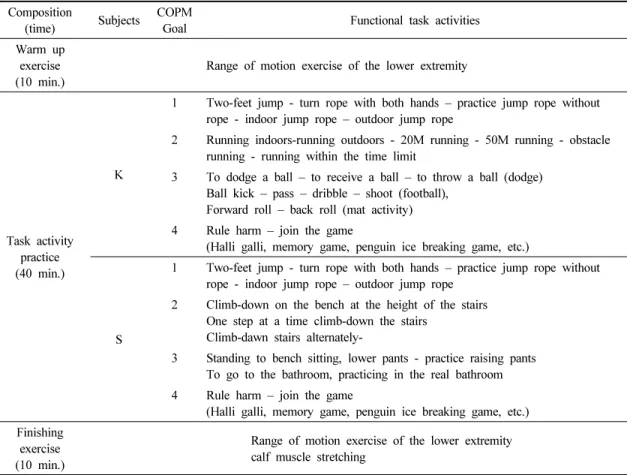
Intervention program was composed with focus on the functional task activities in accordance with the COPM goal and adjusted for each session by reflecting the physical conditions of the children.

The warm-up exercise allowed children to organize their own shoes and clothes and prepare to start exercising, and range of motion exercise of the lower extremity. Main exercise directly practiced task activities according to each child’s individual goals, and practiced motions by step for each task activity to achieve goals. At this time, the physical therapist demonstrated the movements directly to the children, and the posture guidance allowed them

to minimize unnecessary movements and reduce muscle fatigue that may appear in the early stages of exercise learning. However, if the child felt pain or uncomfortable with the activity, the intervention was stopped and the child was allowed to rest for more than 5 minutes. In all activities, intervention was conducted in an assistance-supervising-independent performance stage, and was fully supported through audiovisual feedback so that the child could take the necessary actions for the activity. The finishing exercises included range of motion exercise of the lower extremity and calf muscle stretching, allowing children to breathe and relax their body. Details of the functional task activities program in accordance with COPM goal are given in the below (Table 4).

Composition

(time) Subjects COPM

Goal Functional task activities

Warm up exercise

(10 min.) Range of motion exercise of the lower extremity

Task activity practice (40 min.)

K

1 Two-feet jump - turn rope with both hands – practice jump rope without rope - indoor jump rope – outdoor jump rope

2Running indoors-running outdoors - 2 0M running - 50M running - obstacle running - running within the time limit

3 To dodge a ball – to receive a ball – to throw a ball (dodge) Ball kick – pass – dribble – shoot (football),

Forward roll – back roll (mat activity) 4 Rule harm – join the game

(Halli galli, memory game, penguin ice breaking game, etc.)

S

1 Two-feet jump - turn rope with both hands – practice jump rope without rope - indoor jump rope – outdoor jump rope

2Climb-down on the bench at the height of the stairs One step at a time climb-down the stairs

Climb-dawn stairs alternately-

3 Standing to bench sitting, lower pants - practice raising pants To go to the bathroom, practicing in the real bathroom 4 Rule harm – join the game

(Halli galli, memory game, penguin ice breaking game, etc.) Finishing

exercise (10 min.)

Range of motion exercise of the lower extremity calf muscle stretching

Table 4. Functional task activity programs in accordance with COPM goal

(7)

Ⅲ. Result

1. Goal attainment scale (GAS), goal performance (COPM-P) and satisfaction (COPM-S)

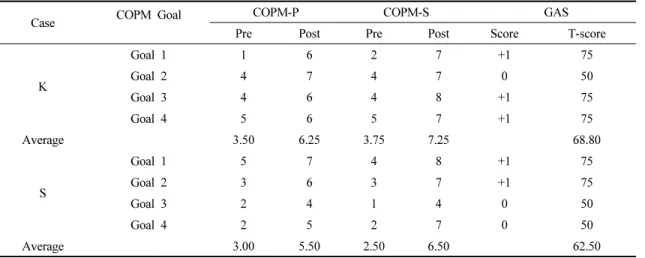
Results of the measurement of the goal attainment scale (GAS), and the extent of goal performance (COPM-P) and the level of satisfaction (COPM-S) are given in the Table 5.

First, T-Score conversion scores for the extent of goal attainment for both children were higher than 50 with 68.8 for child K and 62.5 for child S, thereby illustrating that they attained goals in excess of the anticipated level.

The extent of goal performance (COPM-P) through COMP resulted in the averages of 2.75 and 2.5 points for child K and S, respectively, while the levels of satisfaction (COPM-S) were 3.5 and 4 points for child K and S, respectively, thereby illustrating clinically significant changes. In particular, child K had priority goal of wanting to engage in skipping rope with friends during the free-game period at the school and managed to improve the capability for more than 15 skipping of rope through stepwise skipping rope practices after intervention from the level of not being able to perform

even a single skipping of rope prior to the intervention.

Accordingly, there has been significant changes including GAS +1, T-conversion score of 75 with COPM-P point increasing from 1 to 6 and COPM-S point increasing from 2 to 7. In the case of child S who had limitations in the school life due to failure to independently execute hygienic finishing in washroom and tidying up clothes displayed high level of satisfaction by both the child and the parents as the child could perform these tasks independently after the intervention. In addition, as the results of having executed task training with the goal of safe walking up and down the stairs when moving to the cafeteria in the school, there was clinically significant changes in all of intervention GAS, COPM-P and COPM-S after the intervention.

2. Changes in the gross motor function

As the results of the GMFM measurement prior to and after the intervention of the gross motor function, child K displayed 5% improvement in standing in the D domain and 6% in walking, running and jumping in the E domain along with 2% improvement in the total score. Meanwhile, child S displayed 2%, 5% and 1%

Case COPM Goal COPM-P COPM-S GAS

Pre Post Pre Post Score T-score

K

Goal 1 1 6 27 +1 75

Goal 24 7 4 7 0 50

Goal 3 4 6 4 8 +1 75

Goal 4 5 6 5 7 +1 75

Average 3.50 6.25 3.75 7.25 68.80

S

Goal 1 5 7 4 8 +1 75

Goal 23 6 3 7 +1 75

Goal 3 2 4 1 4 0 50

Goal 4 2 5 2 7 0 50

Average 3.00 5.50 2.50 6.50 62.50

Table 5. COPM and GAS score change after intervention

(8)

improvements in standing in D domain, walking, running and jumping in E domain, and in total score, respectively (Table 6).

Case GMFM D GMFM E GMFM total

Pre Post Pre Post Pre Post

K 9297 8288 95 97

S 95 97 83 88 96 97

Table 6. GMFM change after intervention

3. Functional independent measure for children:

Wee-FIM

In the Wee-FIM measurement for the independence in activities of daily living prior to and after the intervention, child K and S displayed changes of 4 points and 6 points, respectively. Moreover, both children displayed affirmative changes in the self-help management, movement and social cognition domains, as illustrated in the Table 7.

4. Results of interview with the children and guardians

In the evaluation through individual interview with the children, child K expressed the highest level of satisfaction on being able to perform skipping rope independently and engaging in skipping rope with friends during the free-game hours in the school. Meanwhile, child S expressed the highest level of satisfaction on being able to use the washroom independently and participate in

board games with friends with thorough knowledge of the relevant rules of the games.

Ⅳ. Discussion

Treatments for cerebral palsy children must be considered with focus on the activities and participation with considerations for the daily life environment of the children rather than fragmentary perspective of only the recovery from physical impairment. Therefore, this study was executed to check the effectiveness of the intervention programs by setting the treatment goals by reflecting the individual desires of the 2 spastic cerebral palsy children selected as the subjects and applying the intervention programs with focus on the functional task performance.

Polatajko and Cantin (2006) proposed task-oriented approach method on the basis of the results of diversified studies while Choi and Kim (2008) asserted that although the interventions for the children with development coordination disorder were traditionally procedure- oriented, they now display task-oriented tendencies. The World Health Organization (WHO) stated that impairment of body structure and functions interact with daily life activities and social participation, and personal and environmental factors impart additional effects on them by introducing the international functional disability health classification (ICF) model for the disability (2001). This signifies that the motor disabilities of the cerebral palsy children due to the impairment of the central nervous system affect the functional roles of individuals such as

Case Selfcare Sphincter

control Mobility:

transfer Locomotion Communication Social

cognition Total

Pre Post Pre Post Pre Post Pre Post Pre Post Pre Post Pre Post

K 33 35 14 14 21 21 12 13 14 14 18 19 112 116

S 29 32 14 14 21 21 12 13 13 13 16 18 105 111

Table 7. Wee--FIM change after intervention

(9)

activity limitations and participation restrictions. As such, it can be interpreted that if it is possible to conceptualize and design intervention programs through their mutual relationship, it is possible to provide affirmative effects.

Up until now, majority of the therapeutic intervention approaches to the cerebral palsy children have been studied with focus on the recovery from the impairments of the body structure and functions (Franki et al., 2012;

Stubbs & Diong, 2016).

Almhdawi el al. (2016), Task‐oriented is a highly individualized, client‐centred, occupational therapy, functional‐based intervention compatible with motor learning and motor control principles such as intensive motor training, variable practice and intermittent feedback. In addition, it has been asserted that activity-oriented intervention refers to establishment of plans with focus on the optimized activities in daily life (Valvano et al., 2006) and provision of diversified opportunities for the purpose of acquiring skills that can be applied to daily life activities (Gibson et al., 2000).

From the perspective that the treatment goals for the cerebral palsy children need to be related to the daily life activities of the children and that the activity tasks for the attainment of treatment goals also need to be functional that comply with the desires of individual, it can be deemed that the task-oriented intervention and activity-oriented approach method are in the same context as the intervention program of this study.

Sorsdahl et al. (2010), as the results of having applied activity-oriented programs to 22 cerebral palsy children 5 times a week for 3 weeks, reported that the quality of daily life activities and movements of the children in the Stage I∼II GMFCS improve substantially more in comparison to the children in the Stage III∼V and, in particular, there was improvement in the basic motor functions and self-management capabilities. This study also displayed affirmative changes in the gross motor

functions with improvement in the total score of GMFM, and D and E domains of GMFM with cerebral palsy children in the Stage II GMFCS. Moreover, both the children K and S displayed similar results of improvement in the self-help management domain of the daily life activities (Wee-FIM).

In this study, both the children K and S included execution of skipping rope with their peers during the school life in the priority list for the GAS attainment goals. Since it was not just the goal for improvement in performing skipping rope but, rather, a goal related to participation in games in their relationship with the peers, it provided substantially greater motivation to the children. Accordingly, it is deemed that this led to high level of satisfaction (COPM-S) when associated with the high extent of performance (COPM-P). The jump rope movement requires both hands to cooperate to turn the rope in a balanced manner and jump on both feet. Because this movement influenced the lower elements (muscle, body coordination, balance, etc.) related to body function in the process of completion, it is thought to have had a positive effect on the performance of items such as running two steps simultaneously, jumping one step, and walking a narrow step.

According to studies by De Vreed et al. (2004) the

group that executed more functional task training

displayed higher ability to perform various methodical

daily life tasks more functionally in comparison to the

group that executed only progressive resistance muscle

exercise. This is in concordance with the clinically

significant results achieved in this study by confirming

the extent of goal performances and level of satisfaction

by applying the tasks related to daily life activities as

the intervention program. Orellano et al. (2012) reported

the effectiveness of the method that uses activities that

reproduce the situations in which daily life tasks are

executed through functional task training as an

(10)

intervention to enhance the capabilities of elderly people, who has degraded functions, to execute daily life activities.

In addition, Manini et al. (2007) emphasized that functional task training on elderly people is effective in the reduction of the time taken for the execution of methodical daily life activities and correction of the task.

This can be deemed as a study result that supports the effectiveness of the intervention approach method of this study.

Children K and S, who are the subjects of this study, was led to acquire the habit of putting on and taking off as well as tidying up clothes prior to and after the program throughout the 24 sessions of the intervention program, and increased their execution capabilities through training on walking up and down stairs with diversified heights in order to move around in the school more stably. In addition, the subjects underwent direct training for actual functional task activities in daily life including learning the rules of board games and practices that would provide assistance in understanding the rules and learning the method of expressing opinions in order for the children to participate in the games with the peers.

Such intervention by means of functional task activities is in compliance with the GAS priority goal list through assessment of the individual desires of COPM, and specific functional goals that include 5 elements of ABCDE (actor, behavior, condition, degree and expected time) were set. The extent of performance, level of satisfaction and extent of goal attainment for the activity tasks in accordance with the goals set were checked by means of COPM-P, COPM-S and GAS measurement values prior to and after the intervention. Both children K and S displayed clinically significant changes in the COPM-P and COPM-S prior to and after the intervention.

Moreover, it was confirmed that the attainment of the goals was higher than anticipated with the T-Score conversion value of GAS measurement, which is the scale

for attainment of goals, at 68.8 and 62.5 for the children.

This is in concordance with the results of the study by Kim (2016) that displayed significant difference between the 2 groups as the result of having compared the participation of the experimental and control group in leisurely activities after having provided activity-oriented intervention program with spastic cerebral palsy children as the subjects. Moreover, it can be deemed similar to the results of the study by Lowing et al. (2009) that displayed affirmative effects in the daily life activities, gross motor function and extent of goal attainment in the goal-oriented treatment group presented with specific goals appropriate for the environment for 12 weeks.

Kang (2011) asserted that physical function among the ability to perform functional tasks in the school imparted significant effect on self-respect and that this implies that self-respect can be affected not only by the extent of execution of physical motor functions but also by activities that require physical functions within the school environment. This can lead to the understanding that the ability to execute tasks necessary by individuals in their daily lives rather than the fragmented recovery from the impairments of the body structure and functions is important for the therapeutic intervention for the children, and that it also imparts effects on psychological functions.

In this study, both children, K and S, displayed

improvement in the domains of self-care, movement and

social cognition of Wee-FIM prior to and after the

intervention through training for the execution of

functional tasks related to daily life activities, and in the

overall Wee-FIM scores. In particular, child S, who had

to rely on the mother for hygienic finishing after the use

of the toilet prior to the intervention, was able to use

toilet independently through actual task training

intervention. It is deemed that the child displayed

significant changes in all of the COPM-P, COPM-S, GAS

and Wee-FIM scores as the result.

(11)

Limitations of this study include the difficulties in generalization of the study results due to the small subject number since qualitative changes were confirmed through a single case study with children K and S. In addition, it is not possible to standardize the effectiveness of the contents of the intervention program since the details of the functional task activities focused on the goals in accordance with the individual desires of the cerebral palsy children can differ between individuals. However, this study can be deemed significant in that therapeutic interventive approach method for the cerebral palsy children was not limited to the recovery from the impairments of the body structure and function. But rather, it lead to the affirmative changes in the functional activities and participation of the children in their daily lives. Even the execution of the same task can have different significance depending on the environmental factors and desires of individuals. From this perspective, it can be deemed that establishment of goals in accordance with the assessment of the individual desires and execution of functional activity tasks affect the endowment of motivation for therapeutic intervention.

Therefore, it is hoped that more diversified studies on more diversified intervention programs will be carried out in the future to enhance the ability of the cerebral palsy children to execute a wider range of functions.

Moreover, it is hoped that the results of this study will be helpful in expanding the opportunities for the cerebral palsy children to participate in daily and social life activities by being utilized as basic clinical data for designing of effective intervention method for spastic cerebral palsy children.

Ⅴ. Conclusion

This study examined the effects of application of

functional task activities based on individualized goal attainment to which the desires of the children and parents have been reflected as the intervention program on the spastic cerebral palsy children. As the results of having applied 24 sessions of intervention programs to cerebral palsy children for 6 months, significant changes in the extent of goal attainment and goal performances, and level of satisfaction were confirmed along with manifestation of affirmative changes in the independence of gross motor function and daily life activities. This study can be deemed significant in having demonstrated that goal-oriented functional task training not only led to recovery from impairments of the cerebral palsy children but also imparted affirmative effects on the independent activities in daily life and social participation as well as increased the level of satisfaction on the treatment by reflecting the desires of the children on the treatment goal.

References

Allen J, Dodd KJ, Taylor NF, et al. Strength training can be enjoyable and beneficial for adults with cerebral palsy. Disability and Rehabilitation. 2004;26(19):

1121-1127.

Almhdawi KA, Mathiowetz VG, White M, et al. Efficacy of occupational therapy task-oriented approach in upper extremity post-stroke rehabilitation.

Occupational Therapy International. 2016;23(4):

444-456.

Bamm EL, Rosenbaum P. Family-centered theory: origins, development, barriers, and supports to implementation in rehabilitation medicine. Archives of physical medicine and rehabilitation. 2008;89(8):1618-1624.

Carpenter L, Baker GA, Tyldesley B. The use of the Canadian

occupational performance measure as an outcome

of a pain management program. Canadian Journal

(12)

of Occupational Therapy.2001;68(1):16-22.

Cho SM, Oh DW, Kim SY. Comparison of parent-reported quality of life associated with functional levels in school-aged children with cerebral palsy. The Journal of Korean Society of Occupational Therapy.2009;

17(1):29-37.

Choi YJ, Kim KM. A review on the use of a goal attainment scale as measurement tool for the effectiveness of rehabilitation intervention of children. Journal of Korean Society of Occupational Therapy. 2009;

17(2):105-114.

Damiano DL, Abel MF. Relation of gait analysis to gross motor function in cerebral palsy. Developmental Medicine & Child Neurology. 1996;38(5):389-96.

De Vreede PL, Samson MM, van Meeteren NL, et al. Functional tasks exercise versus resistance exercise to improve daily function in older women: a feasibility study.

Archives of Physical Medicine and Rehabilitation.

2004;85(12):1952–1961.

Franki I, Desloovere K, De Cat J, et al. Christine the evidence-base for basic physical therapy techniques targeting lower limb function in children with cerebral palsy: a systematic review using the international classification of functioning, disability and health as a conceptual framework. Journal of Rehabilitation Medicine. 2012;44(5):385-395.

Gibson E, Pick A. An ecological approach to perceptual learning and development. New York. Oxford University Press.

Heavlin WD, Le-Merow SW, Lewis VM. The psychometric foundations of goal attainment scaling. Community Mental Health Journal. 1982;18(3):230-241.

Hong ME. The effects of combined aquatic and land exercise program on gross motor function and balance and trunk control ability in young children with cerebral palsy patients. Sahmyook University. Dissertation of Master’s Degree. 2015.

Johnson A. Prevalence and characteristics of children with

cerebral palsy in Europe. Developmental Medicine and Child Neurology. 2002;44(9):633-640.

Kang EM. Relationship between functional activities in school and self-esteem for school-aged children with cerebral palsy. Dan-kook University. Dissertation of Master’s Degree. 2011.

Ketelaar M, Vermer A, Hart H, et al. Effects of a functional therapy program on motor abilities of children with cerebral palsy. Physical Therapy. 2001;81(9):

1534-1545.

Ketelaar M, Vermer A, Helders PJ. Functional motor abilities of children with cerebral palsy: a systematic literature review of assessment measures. Clinical rehabilitation. 1998;12(5):369-380.

Kim JJ. Effects of an activity focused intervention program on the daily life of children with cerebral palsy.

Catholic University of Pusan. Dissertation of Doctorate Degree. 2016.

Kim SJ, Lee CH, Na JK. Current physical therapy status for the children with cerebral palsy in Korea. Journal of Korean Academy of Rehabilitation Medicine.

2000;24(2):200-207.

Lee CH, Hwang SG, Choi HS. Inter-rater reliability of the gross motor function measure. Korean Research Society of Physical Therapy. 1995;2(1):1-13.

Löwing K, Bexelius A, Carlberg EB. Activity focused and goal directed therapy for children with cerebral palsy-do goals make a difference? Disability and Rehabilitation. 2009;31(2):1808-1816.

Malec JF, Smigielski JS, Depompolo RW. Goal attainment scaling and outcome measurement in postacute brain injury rehabilitation. Archives of Physical Medicine and Rehabilitation. 1991;72(2):138-143.

Manini T, Marko M, Vanarnam T, et al. Efficacy of resistance

and task-specific exercise in older adults who modify

tasks of everyday life. Journal of Gerontology, Series

A: Biological sciences and medical sciences.

(13)

2007;62(6):616-639.

Msall ME, DiGaudio K, Duffy LC, et al. WeeFIM normative sample of an instrument for tracking functional independence in children. Clinical Pediatrics.

1994;33(7):431-438.

Nordmark E, Hagglund G, Jarnlo GB. Reliability of the gross motor function measure in cerebral palsy.

Scandinavian Journal of rehabilitation medicine.

1997;29(1):25-28.

Orellano E, Colon WI, Arbesman M. Effect of occupation-and activity-based interventions on instrumental activities of daily living performance among community dwelling older adults: a systematic review. The American Journal of Occupational Therapy. 2012;

66(3):292-300.

Ostensjo S, Brogren Carlberg E, Vollestad NK. Everyday functioning in young children with cerebral palsy:

functional skills, caregiver assistance, and modifications of the environment. Developmental Medicine and Child Neurology. 2003;45(9):603-615.

Ostensjo S, Oien I, Fallang B. Goal-oriented rehabilitation of prescholers with cerebral palsy-a multi-case study of combined use of the Canadian occupational performance measure (COPM) and the goal attainment scaling (GAS). Developmental Neurorehabilitation.

2008;1(4): 252-259.

Ottenbacher KJ, Cusick A. Discriminative versus evaluative assessment; some observations on goal attainment scaling. American Journal of Occupational Therapy.

1993;47(4): 349-354.

Pan AW, Chung L, Hsin-Hwei G. Reliability and validity of the Canadian occupational performance measure for clients with psychiatric disorders in Taiwan.

Occupational Therapy International. 2003;10(4):

269-277.

Park YJ, Hong EK. Effects of exercise interventions on postural control for children with cerebral palsy in Korea:

a systematic review. The Journal of Korean Academy of Sensory Integration. 2016;14(2):46-57.

Polatajko HJ, Cantin N. Developmental coordination disorder (dyspraxia): an overview of the state of the art.

Seminars in Pediatric Neurology. 2006;12(4):

250-258.

Polatajko HJ, Mandich A. Enabling occupation in children:

the cognitive orientation to daily occupational performance (CO-OP) approach. The Israeli Journal of Occupational Therapy. 2005;14(1):46-47.

Rosenbaum P, Paneth N, Leviton A, et al. A report: the definition and classification of cerebral palsy april 2006.

Developmental medicine and child neurology.

Supplement. 2007;109(109):8-14.

Schoen S, Anderson J. Neurodevelopmental treatment frame of reference. Philadelphia. Lippincott Williams &

Wilkins. 1999.

Shumway-cook A. Woollacott M. Motor control: translating research into clinical practice, 3rd ed. Maryland.

Lipincott Williams & Wilkins, 2007.

Sorsdahl AB, Moe-Nilssen R, Kaale H, et al. Change in basic motor abilities quality of movement and everyday activities following intensive, goal-directed, activity focused physio therapy in group setting for children with cerebral palsy. BioMed Central pediatrics.

2010;10(26):1-11.

Stubbs PW, Diong J. The effect of strengthening interventions on strength and physical performance in people with cerebral palsy (PEDro synthesis). British journal of sports Medicine. 2016;50(3):189-279.

Taylor NF, Dodd KJ, Larkin H. Adults with cerebral palsy benefit from participating in a strength training programme at a community gymnasium. Disability and Rehabilitation. 2004;26(19):1128-1134.

Tecklin JS. Pediatric physical therapy, 3rd ed. Philadelphia.

Lippincoff Williams & Wilkins. 1999.

Valvano J, Jane RM. Activity-focused motor interventions for

(14)

infants and young children with neurological conditions. Infants and Young Children. 2006;19(4):

292-307.

Valvano J. Activity-focused motor interventions for children with neurological conditions. Physical & occupational therapy in pediatrics. 2004;24(1-2):79-107.

Vojta V, Peters A. Vojta-prinzip muskelspiele in reflexfortbewegung und motorischer ontogenese, 3rd ed. Heidelberg. Springer Medizin Verlag. 2007.

World Health Organization. World health organization

international classification of functioning disability,

and health. Geneva, Switzerland. 2001.

수치

Table  1.  General  characteristics  of  subjects          (n=2)
Table  4.  Functional  task  activity  programs  in  accordance  with  COPM  goal
Table  5.  COPM  and  GAS  score  change  after  intervention
Table  7.  Wee--FIM  change  after  intervention

참조

관련 문서

The purpose of this study was to determine the effect of massage program on muscle strength (MMT), range of motion (ROM) and activities of daily living (ADL) in children with spastic

The effect of lower extremity selective voluntary motor control on interjoint coordination during gait in children with spastic diplegic cerebral palsy.. Gait

PURPOSE: This study aimed to quantify the effects of whole body vibration (WBV) stimulation training on the muscle thickness and gross motor function in children with

The effects of combined aquatic and land exercise program on gross motor function and balance and trunk control ability in young children with cerebral palsy

task-oriented activities based on neurodevelopmental therapy principles on trunk control, balance, and gross motor function in children with spastic diplegic cerebral palsy:

The effects of cranio-cervical flexion based trunk stabilization exercise on gross motor function and posture alignment change in children with

Key words : cerebral palsy, balance abilities, gross motor performance, spastic diplegia, task-oriented training,

The changes of gross motor function and balance ability in children with spastic diplegic cerebral palsy by trunk muscle strengthening exercise: Single group