• 검색 결과가 없습니다.

Effects of Strengthening Exercise on Gait Ability and GMFM in Cerebral Palsy : A Systematic Review and Meta-Analysis

N/A
N/A
Protected

Academic year: 2021

Share "Effects of Strengthening Exercise on Gait Ability and GMFM in Cerebral Palsy : A Systematic Review and Meta-Analysis"

Copied!
9
0
0

로드 중.... (전체 텍스트 보기)

전체 글

(1)

Research Article Open Access

근력강화훈련이 뇌성마비 아동의 보행능력과 대동작 기능에 미치는 영향에 대한 체계적 고찰과 메타분석

허성경⋅이한숙 1† ⋅박선욱 2

성남시장애인종합복지관, 1 을지대학교 물리치료학과, 2 삼성서울병원

Effects of Strengthening Exercise on Gait Ability and GMFM in Cerebral Palsy : A Systematic Review and Meta-Analysis

Seong-Gyeong Heo, PT⋅Han-Suk Lee, PT, Ph.D 1† ⋅Sun-Wook Park, PT, Ph.D 2 Department of Physical Therapy, Seonam Welfare Center for the Disabled

1 Department of Physical Therapy, Eulji University

2 Department of Physical Therapy, Samsung Medical Center

Received: June 18, 2018 / Revised: June 21, 2018 / Accepted: July 27, 2018

ⓒ 2018 J Korean Soc Phys Med


| Abstract |

1)

PURPOSE: The purpose of this investigation was to conduct a systemic review of studies that examine the effects of strengthening exercise on gait ability and GMFM in children with cerebral palsy and propose a standard for cerebral palsy therapy based on a meta-analysis of the studies.

METHODS: An extensive literature search was conducted using databases including the KISS (Korean studies Information Service System), RISS, DBpia, PubMed and ScienceDirect, with the following search terms: ‘Strengthening Exercise,’ ‘Resistance Exercise,’ ‘Gait ability,’ ‘GMFM’ or

‘cerebral palsy’.

†Corresponding Author : Han-Suk Lee

[email protected], https://orcid.org/0000-0002-9336-0894 This is an Open Access article distributed under the terms of the Creative Commons Attribution Non-Commercial License (http://creativecommons.org/licenses/by-nc/3.0) which permits unrestricted non-commercial use, distribution, and reproduction in any medium, provided the original work is properly cited.

RESULTS: Eleven studies were included in this review and the duration of the intervention varied from 5 to 24 weeks. The number of application per week was mostly 2-3 times, while 5 intervention per week was adopted in a few cases. The total number of intervention applied varied from 18 to 36 and the respective effect sizes of GMFM on crawling and sitting were very high (1.075 and .881) while those of GMFM on standing and walking were very low(.206 and .125). The effect size was for gait speed was only .221.

CONCLUSION: Trunk exercise and lower limb exercise effectively improved GMFM in children with cerebral palsy, resulting in improved outcomes in sitting and crawling. The results of this study will be useful for designing evidence- based cerebral palsy therapy programs.

Key Words: Cerebral palsy, Gait ability, GMFM, Resistance

exercise, Strengthening exercise

(2)

Ⅰ. 서 론

뇌성마비는 뇌에 발생하는 비진행적 손상으로 운동 능력 및 자세조절 능력에 영구적인 장애를

유발하고(Rosenbaum 등, 2007), 비정상적인 근 긴장 도와 자세조절 장애, 감각입력에 대한 통합의 오류로 비대칭적 신체정렬 및 흔들리는 자세 등 신체적 문제를 야기한다(Krigger, 2006). 뇌성마비 아동은 발달이 왕성 하게 이루어져야 할 시기에 문제가 발생하여 결국 신체 발육이 지연되고 원시반사가 사라지지 않으며 정상 발 달을 경험하지 못하게 된다(Jahnsen 등, 2004).

뇌성마비 아동들은 척추측만증과 같은 신체정렬의 장애, 연하곤란, 인지, 언어장애 등 많은 질환을 가지고 평생을 살아가게 되며(Rosenbaum 등, 2007), 지체된 운 동발달로 인해 항중력자세(antigravity posture)를 유지 하는데 어려움을 보이며 이로 인해 체간의 안정성 및 운동기능이 떨어지게 된다(Gudjonsdottir과 Mercer, 1997). 특히 운동기능 손상의 결과로 균형능력, 운동조 절능력 감소 등의 문제를 야기하며 근육약화로 생체역 학적 문제를 야기한다(Eek 등, 2008). 또한 대동작기능 과 보행에도 많은 영향을 미치게 되는데(Eek 등, 2011), 대동작기능과 보행의 시공간적 변수 중 속도, 분속수, 보폭은 서로 연관성을 가진다(Park 등, 2004). 이러한 변수들은 근력 강화를 통해 대동작기능과 보행의 향상 을 기대할 수 있다(Damiano과 Abel, 1998).

근력강화 훈련이란 근력약화에 대한 중재로 인정되 어 왔으며 수행능력을 증진시키기 위해 고안된 방법이 다(Verschuren 등, 2011). 하지근력강화 선행연구로 Andersson 등, 2003)은 경직성 양하지 뇌성마비를 대상 으로 주 2회, 10주간 하지 근력강화 훈련을 실시한 결과 보행속도의 향상을 보고하였고, (Damiano과 Abel, 1998) 의 연구에서는 주 3회, 6주간 양쪽 하지의 근력강 화 훈련을 실시한 결과 대동작기능의 향상을 보고 하였 다. 체간근력강화 관련 선행연구는 Kim (2012)가 NSCA (national strength and conditioning association)와 NGC (national guideline clearinghourse) 훈련지침을 준수하여 주 2회, 12주간 신장 운동, 유산소 운동, 저항 운동으로 구성된 기능적 체간근력강화 훈련을 실시한 결과 대동 작기능의 향상을 보고 하였고, Kim (2015)는 주 3회,

7주간 체간근의 근육강화 훈련을 통해 대동작기능의 향상을 보고 하였다.

이처럼 다수의 선행연구에서 뇌성마비 아동을 대상 으로 근력강화 훈련을 통해 운동 능력 및 기타 능력이 향상되었음을 보고하였다.

메타분석이란 양적 연구들을 통합하고 분석함으로 써 결론을 체계적이고 정확하게 내릴 수 있는 효과적인 분석방법으로(Borenstein 등, 2009), 의료분야에서도 다 양한 치료중재들의 과학적 근거를 제시하기 위해 이용 되고 있다(Oh, 2009). 현재까지 뇌성마비 아동을 대상으 로 근력강화의 효과에 대한 메타분석 연구가 일부 진행 되어 왔다. Park 등(2004)은 뇌성마비 아동을 대상으로 근력강화가 보행에 미치는 영향을 분석하였는데 근력 운동 유형을 세분화하지 못했고 보행과의 연관성만을 분석한 한계가 있었다. Verschuren 등(2011)은 뇌성마비 아동에게 근력강화 훈련이 효과가 있었는지에 대한 고 찰 연구를 진행하였는데 근력강화가 운동기능 및 보행 등과 같은 기능에 미치는 영향을 분석하지는 못하였다.

Aline 등(2009)은 근력강화 운동이 뇌성마비 아동에게 긍정적인 효과가 없다는 종설 연구를 발표하기도 하였 다. 이와 같이 뇌성마비 아동의 근력강화에 관한 메타 분석 및 고찰연구들이 발표되고 있지만 근력강화가 보 행능력과 운동기능 개선에 미치는 영향에 대한 연구는 미미한 실정이다. 뇌성마비 아동은 평생을 장애를 안고 살아가야 하며 보행능력과 운동기능의 개선 및 유지를 위해 많은 노력이 필요하다. 뇌성마비 아동에게 어떤 운동중재를 어떻게 얼마나 적용하는지 확인하는 것은 이들에게 매우 가치 있고 반드시 필요한 연구과제이다.

이에 본 연구는 국내외 실험논문의 결과를 중심으로 체 간과 하지의 근력강화 운동이 보행 및 운동기능에 미치 는 효과를 검증하고 이 결과를 바탕으로 치료실 및 가정 에서도 손쉽게 적용이 가능한 근력강화 프로그램의 종 류 및 효과적인 적용 방법 등을 확인하고자 한다.

Ⅱ. 연구방법

1. 문헌 선택 과정

본 연구는 두 명의 연구자가 검색된 자료를 본 연구

에서 제시하고 있는 핵심질문(PICO) 및 논문 선정기중

(3)

Study Method 1 2 3 4 5 6 7 8 9 10 11 score

Byeon 2006 Clinical trial Y Y Y N N N Y Y Y Y Y 7

Kim 2012 Clinical trial Y Y N Y N N Y N Y Y Y 6

Hong 2012 Clinical trial Y Y Y Y N N Y Y Y Y Y 8

Lee 2015 Clinical trial Y Y Y Y N N Y Y Y Y Y 8

Kim 2015 Clinical trial Y Y Y Y N N Y N Y Y Y 7

Karen 2003 Clinical trial Y Y Y N N N Y Y Y Y Y 7

Jack 2006 Clinical trial Y Y N N N N N N N Y Y 3

Liao 2007 Clinical trial Y Y N Y N N Y N N Y Y 5

Yasser 2009 Clinical trial Y Y Y Y N N Y N N Y Y 6

Vanessa 2012 Clinical trial Y Y Y Y N N Y Y Y Y Y 8

Nicholas 2013 Clinical trial Y Y Y Y N N Y Y Y Y Y 8

PEDro items: 1 Eligibility criteria; 2 Random allocation; 3 Concealed allocation; 4 Baseline comparability; 5 Blind subjects; 6 Blind therapist; 7 Blind assessor; 8 Adequate follow-up; 9 Intention to treat analysis; 10 Between-group statistical comparisons;

11 Point estimates and variability.

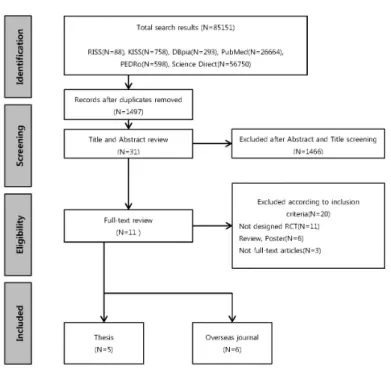
Table 1. Methodological Quality of Trials (PEDro Score) 에 부합하는 자료를 선정하였다. 검색어는 Mesh를 사 용하였고, AND/OR, [TI] 연산자를 이용하여(cerebral palsy or strength* exercise or resistance exercise or gait ability or GMFM) 로 검색 하였고 국내 데이터베이스에 서는 뇌성마비로 최초 검색을 실시하고 이후 근력강화, 대동작기능, 보행능력으로 결과 내 재 검색을 실시 하였 다. 그 결과 최초 검색에서 총 85,151편의 논문이 검색되 었다. 이후 결과 내재검색으로 총 1,497(국내: 18편, 국 외: 1,479)이 검색되었다. 2차 선별 과정을 통해서 검색 된1,497편의 논문 중에서 중복 논문을 제외(국내: 0편, 해외: 7편) 총 1,490편 선정, 3차 선별 과정을 통해 제목 및 초록을 분석한 뒤 연구 목적과 부합하지 않는 논문을 제외(국내: 10편, 국외: 1,449편) 총 31편 선정, 최종 선별 과정을 통해 논문 전문을 분석한 뒤 연구 목적과 부합하 지 않는 논문을 제외(국내: 3편, 해외: 17편), 11편의 연구 가 최종단계에 선정되었다. 문헌 제외 기준은 본 연구의 목적과 맞지 않는 연구, 국문 또는 영어로 기술되지 않은 연구, 성인을 대상으로 한 연구, 중재 기간이 4주 미만인 경우, 초록만 제시된 경우는 제외하였다.

2. 자료 추출과정

자료는 핵심질문(PICO)를 중심으로 하였으며 다음 과 같다. 연구대상자(participants)는 뇌성마비로 진단받

은 만 18세 미만의 영유아 및 청소년을 대상으로 하였 다. 본 연구의 중재(intervention)는 체간 및 하지 근력강 화 중재 연구를 선정하였다. 비교중재(comparator)는 뇌 성마비 아동에게 적용하는 일반적인 운동치료인 중추 신경계 발달치료를 시행하는 비교 중재군을 선정하여 비교하였다. 결과는(outcome) 근력운동이 뇌성마비 아 동의 보행능력 및 대동작기능에 미치는 영향을 알아보 기 위해 보행속도(speed), 대동작기능평가(GMFM)을 측정한 연구를 선정하였다.

3. 자료분석

본 연구에서는 문헌 선정 기준에 부합하는 자료를 이용하여 뇌성마비 아동을 대상으로 체간 및 하지의 근 력강화가 보행관련 변수인 속도와 대동작기능에 미치는 영향을 분석하여 효과크기를 산출 하기 위하여 CMA 2.0 (software)을 이용하였다. 메타분석의 효과 크기에 대 해 해석하기 위해 Cohen (1977)의 기준을 사용하였다.

Ⅲ. 연구결과

1. 선정된 연구 자료의 특성

본 연구의 선정 기준에 부합된 문헌은 모두 11개의

무작위 대조군 실험 연구이다. 국내 학위 논문 5편, 국외

(4)

Study Type of

Intervention Items of Intervention Outcome

Duration of session

No.

session per week

No.

weeks treatment

Total No.

session

Byeon (2006)

Lower limbs Strength

squat, leg curt, leg extension, sit-up, hyperextension, ankle dorsi flexion, ankle planta flexion:

using a thera-band

(pre) Speed : 88.43±18.29(cm/s)

(post) Speed : 94.12±21.15(cm/s) N/A 3 8 24

Kim

(2012) Trunk Strength

Abdominal crunch, Superman prone exercise, Lateral leg raising, Pelvic bridging, Modified bird – dog exercise.

(pre) GMFM(siting) : 84.16±7.87 (post) GMFM(sitting) : 96.1±2.5 (pre) GMFM(supine) : 96.4±4 (post) GMFM(supine) : 99.34±1.01 (pre) GMFM(crawling) : 69.44±13.75 (post) GMFM(crawling) : 83.73±8.83 (pre) GMFM(standing) : 14.53±17.05 (post) GMFM(standing) : 23.93±20.99 (pre) GMFM(walking) : 11.34±4.6 (post) GMFM(walking) : 13.42±4.27

60 2 12 24

Hong (2012)

Lower limbs Strength

NSCA(National Strength and Conditioning Association, NSCA

(pre) GMFM(standing) : 84.75±9.86 (post) GMFM(standing) : 89.67±7.95 (pre) GMFM(walking) : 70.17±22.91 (post) GMFM(walking) : 74.17±21.01 (pre) Speed : 88.43±18.29(cm/s) : 78.63±20.07 (post) Speed : 94.12±21.15(cm/s) : 88.48±26.12

30 3 6 18

Lee (2013)

Lower limbs Strength

sit to standing (pre) GMFM(walking) : 78.06±19.15

(post) GMFM(walking) : 81.96±16.15 30 3 6 18

Kim

(2015) Trunk Strength

Strength (Trunk) :

Core muscle, Abdominal muscle, paraspinal muscle, glutear muscle: using a Pressure biofeedback unit

(pre) GMFM(siting) : 84.16±7.87 : 79.5±3.96

(post) GMFM(sitting) : 96.1±2.5 : 85.75±3.36 40 3 7 21

Karen (2003)

Lower limbs Strength

Strength (Lower limbs) : ankle plantarflexors, knee extensors, and hip extensors: using a hand-held dynamometer

(pre) GMFM(standing) : 75.2±14.4 (post) GMFM(standing) : 80.4±13.2 (pre) GMFM(walking) : 52.8±31.3 (post) GMFM(walking) : 58.2±31.3 (pre) Speed : 47.4±23.3(cm/s):

(post) Speed : 48.6±23.3(cm/s)

30 5 6 30

Engsberg (2006)

Lower limbs Strength

Strength (Lower limbs) : Ankle joint: using a isokinetic dynamometer.

(pre) Speed : 85.9±31.1 (cm/s)

(post) Speed : 91±34.6(cm/s) 30 3 12 36

Liao (2007)

Lower limbs Strength

Strength (Lower limbs) : hip adductors, ankle plantarflexors, hamstring muscles, and lumbar extensors: loaded Sit to Stand exercise

(pre) Speed : 56.9±5.1(m/s)

(post) Speed : 58.4±5(m/s) 30 3 6 18

Yasser (2007)

Lower limbs Strength

Strength (Lower limbs) :

(1) walking: forward, backward, sideways, (2) stairs: stepping forward, backward (3) Standing balance,

(4) standing up from a chair, (5) performing single leg stance, (6) kicking a ball.

(pre) GMFM(standing) (post) GMFM(standing) (pre) GMFM(walking)

(post) GMFM(walking) N/A 2 5 10

Vanessa (2012)

Lower limbs Strength

Strength (Lower limbs) : sit-to-stand, lateral step-up, half knee-rise

(pre) Speed : .94±.29(m/s)

(post) Speed : 1±.28(m/s) 60 3 12 36

Nicholas (2013)

Lower limbs Strength

Strength (Lower limbs) : lower extremity: supervision of a physiotherapist

(pre) GMFM(standing) : 70.2±22.6 (post) GMFM(standing) : 71.9±23.4 (pre) GMFM(walking) : 81.4±13 (post) GMFM(walking) : 83.7±12.6 (pre) Speed : .94±.34 (m/s) (post) Speed : .93±.33 (m/s)

30 2 24 48

Table 2. Characteristics of Included Trials

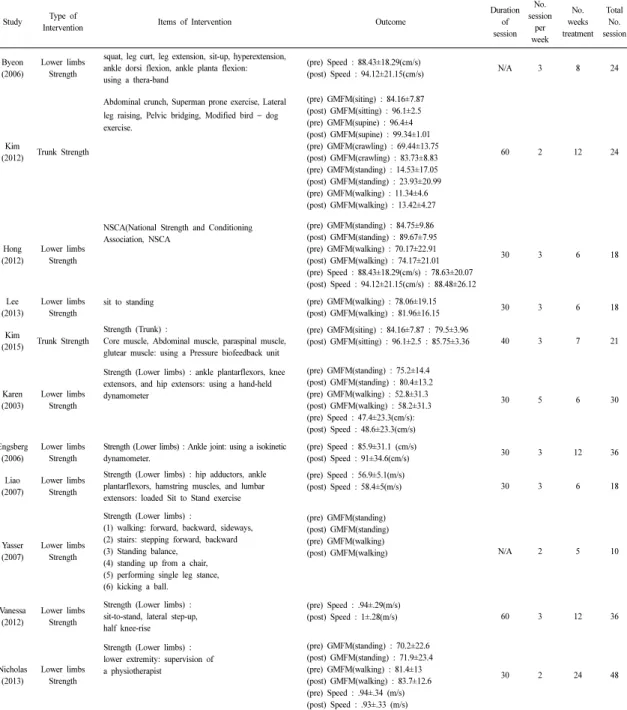
학술지 논문 6편으로 이루어져 있으며, PEDro Scale을 이용하여 질 평가를 실시하였다(Table 1). PRISMA flow diagram을 이용하여 선정된 연구물들의 근력운동 중재 는 크게 체간 근력 강화 운동과 하지 근력강화 운동으로 구분하였고 세부적인 방법은 저항을 이용한 점진적 근

력 강화, 기능적 동작이 강조된 운동프로그램을 시행하

였다. 중재 적용기간은 5~24주로 다양하였으며 주당

적용 횟수는 대부분 2~3회가 대부분이며 5회를 적용한

경우는 1편(karen, 2003)이었다. 중재의 총 적용 횟수는

18~36회로 다양하게 적용되었다(Table 2).

(5)

Fig. 1. Study flow diagram of systematic review.

K Q value p-value

11 3.853 .921

K : Number of studies

Table 3. Result of Homogeneity Test

Studies Trimmed ES 95% CI Observed

Values .27 .02-.53

Adjusted

Values 0 .27 .02-.53

ES: Effective size, CI: Confidence interval

Table 4. Publication Bias Verification (Trim and Fill)

2. 동질성 검정에 따른 분석모형 선택

본 연구에서 분석한 총 연구대상 연구물은 총 11편으 로 구성되었으며, 동질성 검증을 실시한 결과 Q (11)=3.853, p=.921 (>.05) 수준에서 동질 하다고 판단하 여 고정효과 모형을 사용하여 결과를 도출하였다.

3. 출판편향 분석

Duval, Tweedie’s trim and fill의 방법에 따라 출판편

향을 검증한 결과 관측 값(observation values)과 조정 값(sdjusted values)이 동일하게 분석되어 본 연구의 출 판편향은 없는 것으로 판단된다.

4. 근력 강화 운동이 걷기 속도와 GMFM에 미치는 효과분석

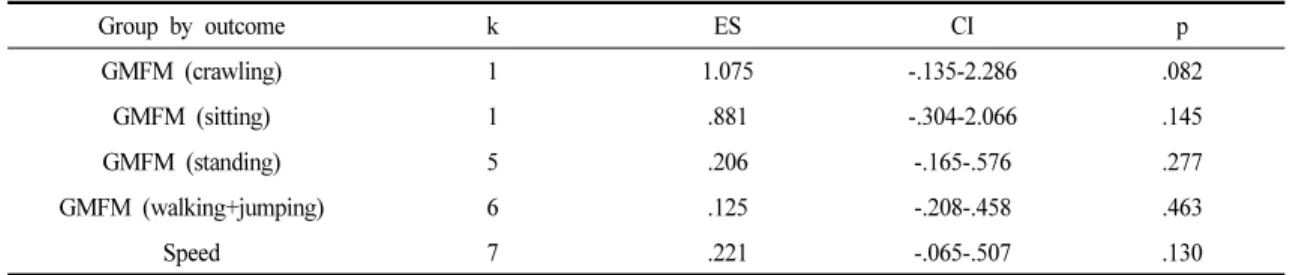
근력 강화 운동이 걷는 속도와 운동 발달을 반영하는 GMFM 에 효과적인지 알아보기 위하여 검증한 결과 속 도에서는 효과 크기가 .221로 낮은 효과를 가졌으며, 신 뢰구간이 0을 포함하지만 통계적으로 유의하지 않았다.

운동 발달의 효과를 살펴본 결과 GMFM (기기)와 GMFM ( 앉기)는 효과 크기가 1.075, .881로 매우 높았으 나 GMFM (서기), GMFM (걷기)의 경우 각각 효과크기 가 .206과 .125로 매우 낮았다. 또한 이들 모두의 신뢰구 간은 0을 포함하지만 통계적으로는 유의하지 않았다 (Table 5).

5. 근력운동의 유형에 따른 효과분석

근력운동 유형에 따른 효과가 차이가 있는지 살펴본

결과 하지 운동을 한 경우의 효과 크기는 .179로 효과가

낮게 나타났으며 신뢰구간이 0을 포함하였으나 통계적

(6)

Fig. 2. Meta-Analysis by type of outcome

Group by outcome k ES CI p

GMFM (crawling) 1 1.075 -.135-2.286 .082

GMFM (sitting) 1 .881 -.304-2.066 .145

GMFM (standing) 5 .206 -.165-.576 .277

GMFM (walking+jumping) 6 .125 -.208-.458 .463

Speed 7 .221 -.065-.507 .130

Table 5. Effects of Muscle Strengthening Exercise on Gait Velocity and GMFM Scale

Group k ES CI p

Lower limbs 16 .179 -.013-.372 .068

Trunk 4 .630 .046-1.215 .034*

K: Number of studies, ES: Effective size, CI: Confidence interval Table 6. Effects of type of muscle strength exercise

으로 유의하지는 않았다. 체간 운동을 한 경우의 효과 크기는 .63으로 효과 크기도 높았다. 또한 신뢰구간이 0을 포함하지는 않지만 통계적으로 유의하였다(Table 6).

Ⅳ. 고 찰

본 연구는 뇌성마비아동의 체간과 하지의 근력강화 운동이 보행 및 운동기능에 미치는 영향에 관한 국내

․ 외 논문 총 11편을 분석하여 근력 강화 중재 유형에 따른 효과를 분석하였다. 11편의 연구 중 국내 학위논 문 5편, 국외 학술지 논문 6편이었다. 또한 체간 근력 강화 연구는 2편, 하지 근력 강화 연구 9편으로 구성되

었다. 이 중 4편은 보행속도의 향상을 보고하였고, 3편 은 보행속도와 대동작기능의 향상을, 4편은 대동작기 능의 향상을 보고하였다. 운동의 적용 기간 5~24주, 주 당 2~5회, 회 당 30분~60분으로 다양하였으며 총 18 회~48회 시행하였다.

근력 강화 운동이 걷기 속도 및 운동 발달에 미치는 효과를 살펴본 결과 GMFM (기기)와 GMFM (앉기)에 서 효과 크기가 1.075, .881로 매우 높았으나, 걷는 속도 및 GMFM (서기), GMFM (걷기)에서는 효과 크기가 각각 .221, .206, .125로 매우 낮았다.

선행연구를 살펴보면 Jin과 Jeon (2012); Kwon 등

(2014)은 성인 편마비 환자에게 하지 근력 강화 훈련만

(7)

으로도 걷기 능력의 향상을 확인하였다. 반면에 이와 반대로 Ryu와 Son (2011)의 연구에 따르면, 하지근력강 화 훈련으로 뇌성마비 아동의 균형능력과 보행 능력의 변화를 확인한 결과 활보장과, TUG에서는 통계적으로 유의한 향상을 보고하였지만 보행속도에서는 유의한 향상을 확인할 수 없었다고 하였다. 해당 연구들을 분 석해보면 뇌성마비 아동에 비해 체간의 안정성이 보다 확보된 성인 편마비 환자에게 적용된 하지 근력 강화 훈련이 효과적인 것으로 생각된다.

Yoon (2003)은 뇌성마비 아동을 운동치료 할 경우 뇌성마비 아동의 근본적인 문제인 체간의 안정성 부족 으로 인해 정상동작이 어렵다는 사실을 간과 해서는 안 된다고 지적 하였다. 뇌성마비 아동은 상대적으로 체간의 안정성이나 균형 능력의 문제를 많이 가지고 있다(Gudjonsdottir과 Mercer, 1997). 이러한 문제는 서기 및 걷기 능력에 중요한 영향을 미치게 되는데(Eek 등, 2011) 단순히 하지의 근력 강화 훈련만으로는 이러한 균형능력이나 체간의 안정성 확보가 어려워 걷기 능력 을 직접적으로 개선하기 어렵고 또한 체간 안정화 훈련 만 적용해서는 보행능력의 개선까지 확인하기는 어려 울 것으로 생각된다. 체간의 근력강화 없이 하지 근력 강화 훈련만을 적용한 Jin과 Jeon (2012); Kwon 등(2014) 의 성인 편마비 환자 대상 연구와 Ryu와 Son (2011)의 뇌성마비 아동 대상 연구에서 확인할 수 있듯이 정상아 동에 비해 상대적으로 불안정한 체간에 안정화 훈련을 적용하면 운동기능 개선에 긍정적 영향을 미칠 것으로 예상 된다.

근력운동의 유형에 따른 효과분석에서는 하지 운동 이 효과 크기 .179로 낮은 효과 크기를 보인 것에 비해 체간 운동은 .63으로 효과 크기도 높았고 통계적으로도 유의하였다.

이러한 결과는 체간 운동이 하지의 운동기능과 관련 된 서기, 걷기에는 효과를 미치지 못하지만 신체의 균 형과 관련된 GMFM (기기) 및 GMFM (앉기)에는 영향 을 미치는 것으로 판단된다.

본 연구의 자료로 수집된 Kim (2012)의 연구는 체간 안정화 운동프로그램 운동을 회당 90분씩 주 2회, 총 12 주간 실시한 결과 GMFM (앉기)가 운동 전 84.16±7.78

에서 운동 후 96.10±2.50으로 향상됨을 보고하였고 통 계적으로도 p=.027으로 유의한 차이를 보고하였다. 하 지만 GMFM (구르기), GMFM (걷기)에서는 유의한 향 상을 보고하지 못하였다. Kim (2015)의 연구에서는 회 당 40분씩 주 3회, 총 7주간 체간 안정화 운동 프로그램 을 실시한 결과 GMFM (앉기)가 운동 전 79.5±3.96에서 운동 후 85.75±3.36으로 향상됨을 보고 하였고 통계적 으로도 유의한 차이를 보고 하였다. Yoon (2003)은 공을 이용한 체간의 안정화 훈련을 6주간 주 2회, 회당 30분 씩 적용한 결과 대동작 기능척도에서 눕기와 뒤집기, 앉기, 네발기기와 무릎서기 영역에서 통계적으로 유의 한 향상을 보고 하였다. 하지만 보행과 관련된 서기 영역에서는 유의한 향상을 확인할 수 없었다. Byeon (2006)의 연구에서 하지 근력 강화 훈련이 보행속도의 향상을 보고하였으며 Jack (2006); Liao 등(2007);

Vanessa 등(2012)의 연구에서도 같은 결과를 보고하고 있다. 또한 하지 근력 강화 운동으로 GMFM (서기), GMFM ( 서기) 능력이 향상되었다는 결과는 Hong (2012)과 Lee (2013) 등 많은 연구에서 같은 결과를 보고 하고 있다.

이처럼 여러 연구에서 하지근력강화가 운동기능에 긍정적인 영향을 미친다는 결과를 보고하고 있다. 하지 만 해당 연구들을 살펴보면 Vanessa 등(2012); Liao 등 (2007); Hong (2012)은 하지의 근력 강화 훈련 프로그램 을 실시할 때 체간의 근력 강화 및 안정성 확보에 기여 할 수 있는 1RM의 50% 정도의 중량 조끼를 입고 훈련 을 진행하였으며, Lee (2013)는 하지 근력 강화 프로그 램을 실시하는 과정에서 체간의 근활성도에 영향을 줄 수 있는 요소인 기저면과 체중심의 변화를 다양하게 적용하였다. 여기서 유의 깊게 살펴보아야 할 부분은 해당 연구들은 단순히 하지의 근력강화만 적용한 것이 아니라 체간의 안정화에도 도움이 되는 중재들을 적용 해 하지와 체간의 전반적인 근력 향상을 가져왔을 것으 로 생각된다.

종합적으로 분석해 보았을 때 단순히 하지나 체간의

근력 강화 만으로는 운동기능과 보행속도 모두의 향상

을 기대하기는 힘들며 Verschuren 등(2011)이 제시한

것처럼 단순한 근력강화 훈련이 아닌 다양한 부위에

(8)

효과가 있는 훈련의 프로토콜이 중요하다고 판단된다.

즉 체간과 하지 등 전체적인 근력 강화가 적용된 운동 프로그램의 적용이 보행속도 및 운동기능 향상에 보다 효과적이라고 볼 수 있다.

하지만, 본 연구의 결과 해석은 제한적일 수 있다고 생각된다. 그 이유는 뇌성마비 아동을 대상으로 근력 강화 효과를 본 연구들 중 선정 기준에 부합된 논문만을 선택하였기 때문에 연구대상이 된 논문의 편수는 11편 으로 적기 때문이다. 따라서, 추후 더 많은 연구들이 이루어진 후 다시 한번 체계적 문헌 고찰을 해 볼 필요 가 있을 것이다.

Ⅴ. 결 론

본 연구는 뇌성마비 아동을 대상으로 체간과 하지의 근력강화 운동이 보행 및 운동기능에 미치는 효과를 검증함으로써 가정에서도 손쉽게 적용 가능한 운동치 료 중재법을 개발하고 치료를 위한 기초자료로써 활용 하고자 관련 연구들을 수집 후 체계적 고찰 및 분석하였 다. 분석 결과 체간 운동 또는 하지 운동 모두 운동의 효과 측면에서는 대동작기능 중 기기와 앉기에서 좋은 결과를 확인하였고, 체간근력강화 훈련이 하지 근력강 화 훈련보다 효과가 좋았다. 다만 분석된 자료의 양이 부족하여 통계적으로 유의한 차이를 확인할 수는 없었 다. 또한 향후에는 본 연구의 결과를 바탕으로 뇌성마 비 아동을 대상으로 한 다양한 근력 강화 훈련 중재를 적용한 연구들이 진행되어야 하겠다.

References

Aline S, Jane M, Louise A, et al. Muscle strengthening is not effective in children and adolescents with cerebral palsy: a systematic review. Australian Journal of Physiotherapy. 2009;55(2):81-7.

Andersson, Grooten W, Hellsten M, et al. Adults with cerebral palsy: walking ability after progressive strength training. Developmental Medicine and Child Neurology. 2003;45(4):220-8.

Borenstein M, Hedges LV, Higgins JPT, et al. Introduction to meta-analysis. John Wiley & Sons ltd. 2009.

Byeon JH. Effects of 8-week thera-band training on the isokinetic strength and the gait patterns of the cerebral palsy children. Doctor’s Degree. Kyung Hee University.

2006.

Cohen J. Statistical power analysis for the behavioral sciences.

New York. Academic Press. 1977.

Damiano DL, Abel MF. Functional outcomes of strength training in spastic cerebral palsy. Archives of Physical Medicine and Rehabilitation. 1998;79(2):119-25.

Eek MN, Tranberg R, Beckung E. Muscle strength and kinetic gait pattern in children with bilateral spastic CP. Gait

& Posture. 2011;33(3):333-7.

Eek MN, Tranberg R, Zügner R, et al. Muscle strength training to improve gait function in children with cerebral palsy. Developmental Medicine & Child Neurology 2008;50:759-64.

Engsberg J, Ross SA, Collins R. Increasing ankle strength to improve gait and function in children with cerebral palsy: A Pilot Study. Pediatric Physical Therapy.

2006;18(4):266-75.

Gudjonsdottir B, Mercer VS. Hip and spine in children with cerebral palsy: musculoskeletal development and clinical implications. Pediatric Physical Therapy.

1997;9(4):179-85.

Hong MH. The effects of lower extremity strengthening exercise training on the spatiotemporal variables of gross motor functions and gaits for the children with motor impairment. Master’s Degree. Hallym University.

2012.

Jack R, Sandy A, David R. Increasing ankle strength to improve gait and function in children with cerebral palsy:

a pilot study. Pediatric Physical Therapy. 2006;

18(4):266-75

Jahnsen R, Villien L, Aamodt G, et al. Musculoskeletal pain

in adults with cerebral palsy compared with the general

population. J Rehabil Med. 2004; 36(2):78-84.

(9)

Jin HM, Jeon IG. The change of sport gait and lower limb function with the aquatic lower limb muscle strengthening program in hemiplegia stroke patients.

Korea Association of Physical Education and Sports for Girls and Women. 2012;26(4):85-96.

Karen J, Nicholas FT, Kerr G. A randomized clinical trial of strength training in young people with cerebral palsy. Developmental Medicine and Child Neurology.

2003;45(10):652-7.

Kim JH, Yoon SM. Evidence based aquatic programs for students with disabilities: systemic literature review. The Korean Journal of Physical Education. 2016;55(2):

689-700.

Kim JH. Effects of functional trunk strengthening program for children with spastic cerebral palsy. Master’s Degree. Daegu University. 2012.

Kim CJ. Comparison of the impact of balance training, trunk stability exercise, and horse-riding stimulator exercise on the sitting position balance, posture control, and upper limb function of children with spastic cerebral palsy. Doctor’s Degree., Daegu University. 2015.

Krigger KW. Cerebral palsy: an overview. American Family Physician. 2006;73(1):91-100.

Kwon JH, Song SH, Lee SH. Effects of muscle power exercise on gait, balance and muscle activity in stroke patients.

DanKuk Univ. 2014;53(1):373-84.

Lee MH. The effects of progressive functional training on lower limb muscle architecture and motor function in children with spastic cerebral palsy. Master’s Degree. Sahmyook University. 2013.

Liao HF, Liu VC, Lin YT. Effectiveness of loaded sit-to-stand resistance exercise for children with mild spastic diplegia: A randomized clinical trial. Physical Medicine and Rehabilitation. 2007;88(1):25-31.

Nicholas FT, Karen JD, Richard JB, et al. Progressive resistance training and mobility-related function in young people with cerebral palsy: a randomized controlled trial.

Developmental Medicine & Child Neurology. 2013;

55(9):806-12.

Oh SS. meta-analysis: theory and practice. Seoul, KunKuk Univ. 2009.

Oh YJ, Jo BH, Lee JS. The effects of modified constraint-induced movement therapy on hand functions of children with hemiplegia cerebral palsy: meta-analysis. J Korean Soc Occupational Med. 2014:22(3):69-83.

Park SY, Ko MS, Yi CH. Correlations among GMFM, GMPM, and the spatiotemporal gait parameters. J Korean Soc Phys Med. 2004;11(2):63-70.

Rosenbaum P, Paneth N, Leviton A, et al. A report: the definition and classification of cerebral palsy April 2006. Dev Med Child Neurol Suppl. 2007;109(suppl 109):8-14.

Ryu IJ, Son kh. The effects of the lower extremity muscle strengthening exercise on walking and balance of children with cerebral palsy. Journal of Korean Physical Therapy Science. 2011;18(2):17-28.

Sin HJ. The present meta-analysis systematically reviewed empirical studies on effect of therapeutic horseback riding in children with cerebral palsy or intellectual disability. Vocational Rehabilitation. 2015;19(3):

31-49.

Vanessa AS, Jules GB, Yvonne JJ, et al. Effectiveness of functional progressive resistance exercise training on walking on ability in children with cerebral palsy:

A randomized controlled trial. Research in Developmental Disabilities. 2012;33(1):181-8.

Verschuren O, Ada L, Maltais DB, et al. Muscle strengthening in children and adolescents with spastic cerebral palsy:

consideration for future resistance training protocols.

Physical Therapy. 2011;91(7):1130-9.

Yasser S, Godwin EM. Effects of task-orientated training on mobility function in children with cerebral palsy.

Neurorehabilitation. 2009;24(4):307-13.

Yoon JY. The effects of trunk strengthening exercise using therapeutic ball on the gross functional movements for the cerebral palsy children with spastic type.

Master’s Degree. Dankuk Univ. 2003.

수치

Table 1. Methodological Quality of Trials (PEDro Score) 에 부합하는 자료를 선정하였다. 검색어는 Mesh를 사 용하였고, AND/OR, [TI] 연산자를 이용하여(cerebral  palsy or strength* exercise or resistance exercise or gait ability or GMFM)로 검색 하였고 국내 데이터베이스에서는 뇌성마비로 최초 검색을 실시하고 이후 근력강화, 대동작기능,
Table 2. Characteristics of Included Trials
Fig. 1. Study flow diagram of systematic review.
Table 5. Effects of Muscle Strengthening Exercise on Gait Velocity and GMFM Scale

참조

관련 문서

Therefore, in this study, in children with cerebral palsy with characteristic cerebral spastic diplegia with difficulty in controlling the trunk muscle, the effect of combined

Purpose :The purpose of this study was to examine the effects of lower trunk muscles strengthening in athetosis children with cerebral palsy.. Methods :One children

Objective : The purpose of this study is to examine the effects of therapeutic interventions on upper extremity function of children with cerebral palsy using systematic review

A meta-analysis of robot gait training in patients with cerebral palsy [14] and a systematic review of robot- assisted gait training for pediatric gait disorders have

The Effects of Submerged Constraint-Induced Movement Therapy on Upper Limb Function and Activities of Daily Living for Children With Hemiplegic Cerebral

Comparison between the Effect of Aquatic Exercise Program and Land Exercise Program in Spastic Cerebral Palsy on Motor Function and Balance.. Sung-Hoon Kang, PT, MS 1 ,

Purpose : The purpose of this study was to evaluate the effect of craniocervical flexion exercise on deep cervical flexor thickness and gait in children with

The Effects of Visual Perception Training Program on Writing Intelligibility and Visual Perception Ability of Children with Spastic Cerebral Palsy.. Kim Eunhye, OT⋅Bae