Ⅰ. 서 론
뇌성마비는 뇌의 비 진행성 적응손상으로 비정상적인 근 긴장도, 근력약화, 선택적 운동능력의 장애, 협응장 애, 그리고 운동능력에서 복합적인 손상이 나타난다 (Papavasiliou, 2009). 특히 뇌성마비는 아동의 신체장 애를 일으키는 주요 원인으로, 평형감각 및 중력에 대항 한 자세조절 능력을 제한시킨다(Oskoui, Coutinho, Dykeman, Jett, & Pringsheim, 2013).
자세조절은 신체를 안정화시키기 위해 공간 안에서 몸 의 위치를 조절하는 능력으로(Massion, 1994) 앉기, 서 기, 그리고 적절한 움직임을 일으키는 다양한 활동에 영 향을 미친다(Chung et al., 2008). 또한 체간의 불안정 성 및 낮은 자세조절 능력은 보행 및 일상생활활동 수행 에 제한을 미친다. 뇌성마비 아동은 관절의 변형, 근육의 단축, 고유수용성 감각의 손상, 시각 장애등으로 인해 균 형과 자세조절에서 낮은 수행을 보인다(Kim & Song, 2004). 특히 뇌성마비 아동은 일반 아동에 비해 자세 조 대한감각통합치료학회지 제14권 제2호
The Journal Korean Academy of Sensory Integration 2016 Vol. 14, No. 2
https://doi.org/10.18064/JKASI.2016.14.2.046
국내 뇌성마비 아동의 자세조절 향상을 위한 운동 중재 효과: 체계적 고찰
박영주*, 홍은경**
*세한대학교 작업치료학과, **신성대학교 작업치료과
국문초록
목적 : 뇌성마비 아동의 자세조절을 향상시키기 위해 국내에서 사용되는 운동 중재의 방법과 효과를 알아보기 위해 체계적 고찰을 사용하여 근거를 제시하고자 하였다.
연구방법 : 누리미디어(DBpia), 학술연구정보서비스(RISS) 그리고 한국학술정보(KISS)의 데이터베이스를 사용하 여 2006년 10월 이후로 게재된 국내학회지를 검색하였다. ‘뇌성마비’, ‘자세조절’, ‘균형’를 키워드로 검색하여 총 18개의 연구가 연구대상으로 선정되었다. 각 연구는 근거의 질적 수준과 방법론적 질적 수준으로 분석하였고 그 결과는 대상자, 중재, 대조군, 결과에 따라 Patient, Intervention, Comparison, Outcome(PICO)로 분석하였 다.
결과 : 본 연구의 분석에 사용된 연구의 근거수준은 수준 Ⅰ이 8개, 수준 Ⅲ이 5개, 수준 Ⅳ가 2개, 수준 Ⅴ가 3개이었고, 방법론적 질적 수준은 ‘우수’의 연구가 가장 많았다. 대상자는 경직형 양하지 마비, 실험설계는 무작위 대조군 실험 연구가 가장 많았다. 분석결과 국내에서 사용되는 자세조절 운동 중재는 뇌성마비 아동의 운동능력과 균형능력 향상에 긍정적인 영향을 보였다.
결론 : 국내에서 사용되는 운동 중재는 뇌성마비 아동의 자세조절 능력을 향상시켰다. 앞으로 뇌성마비 아동의 유형별 자세조절 향상을 위한 연구가 이루어져야 할 것이다.
주제어 : 뇌성마비, 자세조절, 중재, 체계적 고찰
교신저자: 홍은경([email protected]) ∥ * 이 연구는 2016년도 세한대학교 연구 지원에 의해 이루어졌음.
접수일: 2016.11.23. ∥ 심사일: (1차: 2016.11.29. / 2차: 2016.12.08.) ∥ 게재확정일: 2016.12.21.
절에 필요한 감각기능, 근골격계 기능뿐만 아니라 반응 적 자세 적응능력에서 낮은 수행을 보인다. 이러한 수행 은 아동이 먹기, 말하기와 같은 구강운동 활동을 수행할 때, 뻗기와 같은 상지의 움직임을 수행할 때, 걷기와 같 은 대근육 움직임이 필요한 활동을 수행 시 움직임에 제 한이 발생한다(Dewar, Love, & Johnston, 2014). 뇌성 마비 아동의 움직임 제한은 아동이 자조활동, 교육 및 여 가활동을 수행할 때 전반적인 작업영역에서 활동참여에 제한을 받는다(Imms, 2008).
뇌성마비 아동의 자세조절 향상을 위한 다양한 중재적 접근이 이루어지고 있다. 근력 향상 운동(Choi, Park, Lee, & Kim, 2013), 균형능력 향상 운동(Kim & Lee, 2015), 수중 운동(Jeon & Oh, 2015), 기능적인 전기 자 극(Jung & Song, 2012), 시지각 자극(Lee & Kong, 2012), 가상현실 프로그램(Han, Hur, Lee, Ko, & An, 2009), 그리고 감각통합(Kim, Hwang, Yoo, & Jang, 2011; Kim & Park, 2006; Kwon, 2001) 등이 중재로 사용되고 있다. 감각통합 중재는 적응반응을 이끌어내기 위해 뇌에서 감각정보를 조직화하는 과정으로 신체를 통 해 다양한 감각을 수용하고 환경에서 효과적으로 그 감 각을 사용하는 능력이다(Ayres, 1979). 특히 아동을 대 상으로 한 감각통합 중재에서 전정-고유감각의 통합은 아동의 균형능력과 자세조절 향상에 매우 중요하다 (Hong & Kim, 2007). 국내에서 뇌성마비 아동의 자세 조절 향상을 위해 감각통합 중재를 사용한 연구가 점차 적으로 이루어지고 있다(Kim et al., 2011; Kim et al., 2006; Kwon, 2001).
아동을 치료하는 임상가들은 현시대의 흐름에 맞고 효 과적인 중재 방법을 찾고자 한다. 그러나 많은 임상가들 이 이러한 연구들을 분석하기에는 시간적, 물리적, 경제 적인 측면에서 많은 제약이 따른다. 그들의 노력을 줄이 고 임상에서 쉽게 접근할 수 있는 효과적인 근거중심 중 재방법의 제시가 필요하다. 특정 영역에서 중재효과를 제시하는 것은 그 분야에서 치료의 필요성을 정당화시키 고 치료의 효과를 증명하는데 매우 효과적이다(Jung, Choi, & Kim, 2013). 체계적 고찰 연구는 효과적으로 중재효과를 제시하는 연구방법의 하나로 특정 주제에 대 해 적용 가능한 높은 질적 근거를 제시하기 때문에 많은 임상가들에게 유용하다(Hackett et al., 2014).
뇌성마비 아동의 중재방법 중 임상에서 비교적 쉽게
접근이 가능하고, 특별한 기기 없이 적용이 가능한 중재 방법의 하나로 운동치료가 있다. 국내에서 뇌성마비 아 동을 대상으로 운동능력에 대한 여러 체계적 고찰연구가 이루어져 왔다. 그러나 이러한 선행연구는 상지운동이나 양손 협응에 대한 연구였다(Byun, 2015; Jo, 2013). 자 세조절에 대한 연구는 문헌고찰 형태의 연구로 이루어져 왔고(Jun & Lee, 2006), 최근 10년간 자세조절 운동에 대한 체계적 고찰연구는 이루어지지 않았다. 시대에 따 라 중재방법이 변화하고 새로운 중재방법이 제시되기 때 문에 뇌성마비 아동의 자세조절 운동에 대한 최신경향을 반영하는 고찰 연구가 필요하다. 따라서 본 연구에서는 뇌성마비 아동의 자세조절을 향상시키기 위해 국내에서 사용되는 중재방법과 그 효과를 체계적으로 고찰하여 최 근의 임상적 치료경향을 제시하고자 한다.
Ⅱ. 연구 방법 1. 검색전략
연구를 선정하기 위해 2016년 7월부터 2016년 9월동 안 학술연구정보서비스(RISS), 한국학술정보(KISS), 그 리고 누리미디어(DBpia)의 데이터베이스를 사용하였다.
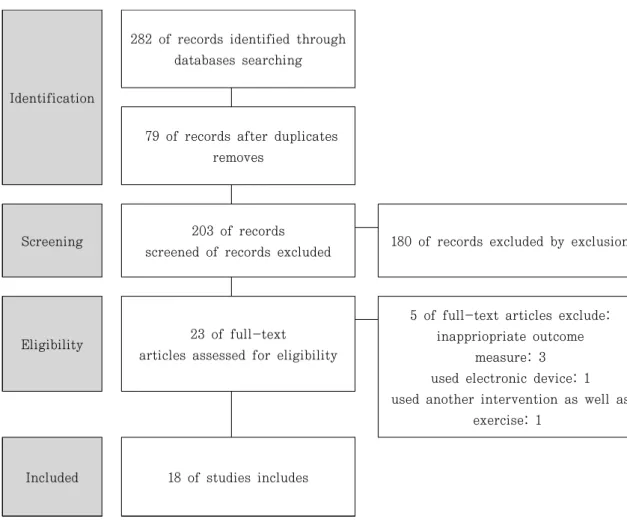
최근 10년 동안 게재된 연구는 연구검색 기간을 기점으 로 2006년 10월부터 2016년 9월까지 게재된 연구를 연 구대상으로 하였다. 검색어는 ‘뇌성마비’, ‘자세조절’, ‘균 형’을 키워드로 문헌을 검색하였다. 검색된 연구를 토대 로 두 명의 저자가 각각 독립적으로 제목과 초록을 검토 하였고 포함기준 충족여부를 결정하고 추가적인 확인이 필요할 경우 원문보기를 실시하였다. 본 연구에서 체계 적 고찰의 연구절차는 Preferred Reporting Items for Systematic Reviews and Meta-Analyses(PLISMA)의 가이드라인에 따라 진행하였다(Moher, Liberati, Tetzlaff,
& Altman, 2009)(Figure 1). 본 연구는 인간을 대상으 로 한 연구가 아니므로 윤리 위원회의 승인을 받지 않 았다.
2. 연구대상
대상연구의 포함기준과 배제기준은 다음과 같다.
1) 포함기준
(1) 뇌성마비로 진단받은 18세 이하를 대상으로 한 연구 (2) 균형능력을 포함한 자세조절 운동에 대한 중재를
사용한 연구
(3) 최근 10년 안에 게재된 연구
2) 배제기준
(1) 보조기를 중재로 사용한 연구
(2) 전자기기나 컴퓨터 기반 운동 프로그램을 중재로 사용한 연구
(3) 의학적인 혹은 외과적인 중재를 사용한 연구 (4) 자세조절 이외의 운동능력에 대한 연구 (5) 체계적 고찰 및 메타분석에 대한 연구 (6) 평가도구 개발 및 상관관계 연구
3. 분석방법
1) 근거의 질적 수준
연구의 저자는 대상연구의 질적 수준을 평가하기 위해 Arbesman, Scheer와 Lieberman(2008)의 근거기반 실 습(Evidence-based practice)의 근거기준을 사용하였 다. 근거수준은 수준 Ⅰ에서 수준 Ⅴ로 계층화 되어있다.
체계적 고찰, 메타분석 및 무작위 대조 실험이 포함된 수 준 Ⅰ이 연구의 질적 수준이 가장 높고, 사례연구와 질적 연구가 포함된 수준 Ⅴ가 가장 낮은 수준을 의미한다.
2) 방법론적 질적 수준
Downs와 Black(1998)의 Downs & Black Criteria를 사용하여 대상연구의 방법론적 질적 수준을 분석하였다.
Identification
282 of records identified through databases searching
79 of records after duplicates removes
Screening 203 of records
screened of records excluded 180 of records excluded by exclusion
Eligibility 23 of full-text articles assessed for eligibility
5 of full-text articles exclude:
inappriopriate outcome measure: 3 used electronic device: 1 used another intervention as well as
exercise: 1
Included 18 of studies includes
Figure 1. Diagram on process about searching process
Downs & Black Criteria는 높은 수준의 무작위 실험설 계 뿐만 아니라 낮은 수준의 연구까지 모든 양적 연구의 방법론적 질적 수준을 측정할 수 있다. 총 27개의 항목으 로 보고(reporting) 10문항, 외적 타당도(external validity) 3문항, 내적 타당도(internal validity) 13문 항, 그리고 파워(power) 1문항으로 구성되어 있다. 파워 는 0∼5점, 그 외 항목은 ‘예’ 일 때 1점을 ‘아니오’ 혹은
‘판단하기 어려움’ 일 때는 0점으로 측정된다. 방법론적 질적 수준의 분석결과는 총점이 26점 이상일 때 ‘완벽’, 20∼25점일 경우 ‘우수’, 15점∼19점일 경우 ‘보통’, 그리 고 0∼14점일 경우는 ‘나쁨’ (Strong, Jutai, Elizabeth,
& Evans, 2008)으로 해석된다.
Ⅲ. 연구 결과
1. 연구근거의 질적 수준
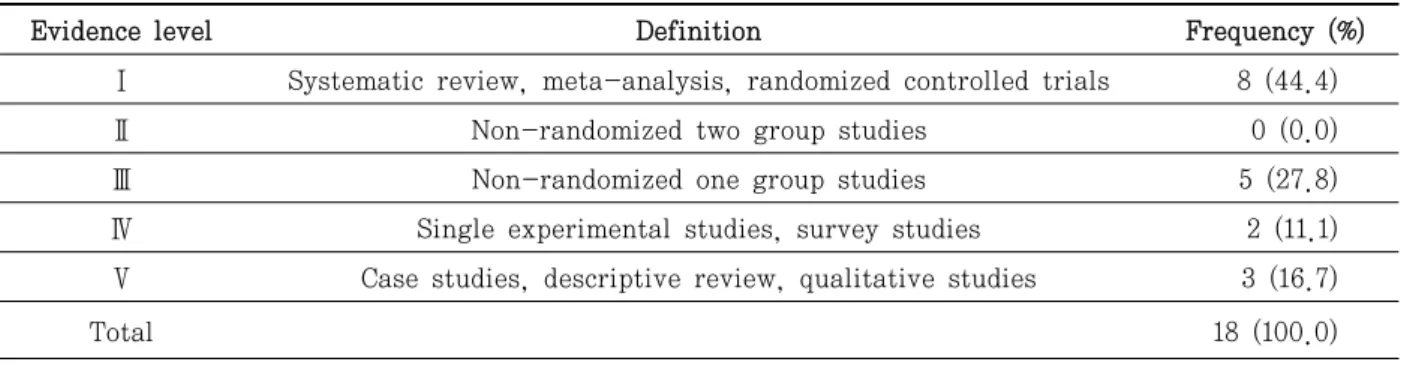
본 연구에서 분석에 사용된 대상연구는 모두 18개로, 근거의 질적 수준은 수준 Ⅰ이 8개, 수준 Ⅲ이 5개, 수준
Ⅴ가 3개, 그리고 수준 Ⅳ가 2개이었다. 연구 설계로 살 펴보았을 때 무작위 실험 대조군이 44.4%로 가장 높았 고, 한 그룹 전후 비교연구가 약 27.8%, 사례연구가약 16.7%, 그리고 단일대상연구가 11.1%이었다(Table 1).
2. 연구근거의 질적 수준 및 방법론적 질적 수준
뇌성마비 아동의 자세조절 운동 중재에 대한 최근 경
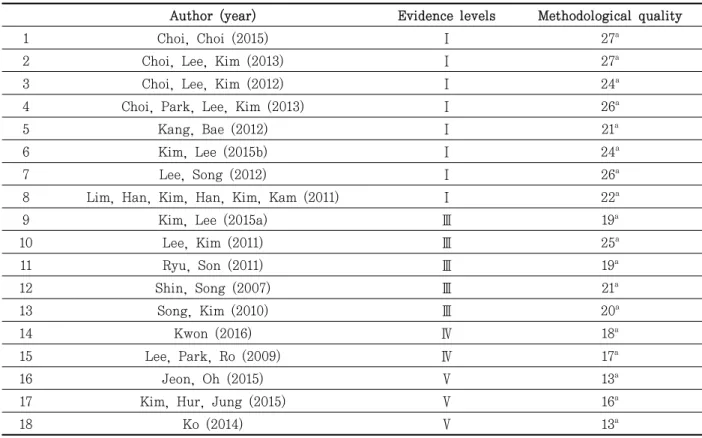
향을 알아보기 위해 2006년 10월 이후에 게재된 논문이 연구대상으로 포함되었다. 특히 최근 5년 동안 비교적 많은 연구가 이루어졌고, 2011년을 기점으로 높은 수준 의 연구가 활발히 이루어져왔다. Downs & Black Criteria의 방법론적 질적 수준을 분석한 결과는 다음과 같다. ‘완벽’ 연구는 4개, ‘우수’ 연구는 7개, ‘보통’ 연구는 5개, 그리고 ‘나쁨’ 연구가 2개이었다(Table 2).
3. 연구 설계 및 대상자
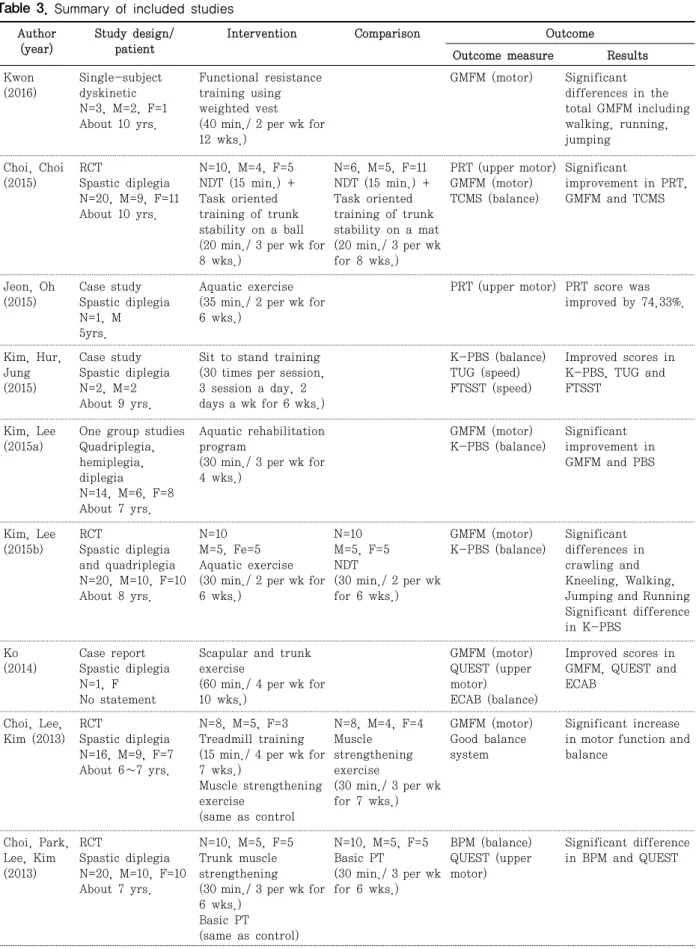
포함연구의 연구 설계는 무작위 대조군 실험 연구가 8개로 가장 많았고, 한 그룹 전후 비교연구가 5개, 단일 대상연구가 2개, 그리고 사례연구가 3개이었다. 연구대 상자의 뇌성마비 유형은 경직형 양하지 마비가 18개 중 15개의 연구에서 나타나 가장 높은 빈도를 보였다(83.3%) (Table 3).
4. 뇌성마비 아동의 자세조절 운동 중재 및 결과 측정
대상자들은 모두 자세조절을 향상시키기 위해 다양한 중재를 받았다. 중재회기는 주 2∼4회이었고, 각 회기 당 소요된 중재 시간은 30∼60분이었다. 총 중재기간은 4∼12주로, 6주(6개)와 8주(5개)동안 중재한 연구가 가 장 높은 빈도를 차지하였다. 자세조절 향상을 위해 사용 된 중재는 체간과 하지를 포함한 근력강화운동(7개), 수 중운동(4개), 균형운동(3개), 그리고 저항운동, 안구운 동, 트레드밀운동, 신경발달치료가 사용되었다. 결과측 정에서는 여러 영역에 대한 평가를 다양한 평가도구로
Table 1. Hierarchy of levels of evidence for evidence-based practice
Evidence level Definition Frequency (%)
Ⅰ Systematic review, meta-analysis, randomized controlled trials 8 (44.4)
Ⅱ Non-randomized two group studies 0 (0.0)
Ⅲ Non-randomized one group studies 5 (27.8)
Ⅳ Single experimental studies, survey studies 2 (11.1)
Ⅴ Case studies, descriptive review, qualitative studies 3 (16.7)
Total 18 (100.0)
실시하였다. 본 연구의 목적에 맞게 운동능력과 균형에 관련된 평가도구를 살펴보았을 때, 전반적인 운동능력은 대동작 기능 평가(Gross Motor Function Measure:
GMFM)의 사용빈도가 가장 높았고(12개), 균형능력은 아동 균형 척도(Pediatric Berg’s balance Scale: PBS) 의 사용 빈도가 가장 높았다(9개). 결과는 한 연구를 제 외한 모든 연구에서 운동기능과 균형능력에서 유의한 향 상 및 긍정적인 증가를 보였다. Lee와 Song (2012)의 연 구에서 운동능력과 속도에서 유의한 향상을 보였으나 균 형능력에서는 유의한 차이가 없었다(Table 3)
Ⅳ. 고 찰
본 연구에서는 뇌성마비 아동의 자세조절을 향상시키 기 위해 국내에서 사용되는 중재방법과 그 효과를 체계 적으로 고찰하였다. 체계적 고찰은 목적에 맞게 대상연 구를 선별하고 분석연구에 대한 근거를 포괄적으로 판단
해야 한다(Hackett et al., 2014). 비무작위 대조군 실험 설계는 연구의 방법론적 질을 평가하기에 큰 어려움이 있기 때문에 체계적 고찰 연구에서는 일반적으로 무작위 대조군 실험 설계를 선호한다. 그러나 대부분의 보건관 리 분야에서 무작위 대조군 실험 연구는 많이 이루어지 지 않고 있다(Black & Downs, 1996). 따라서 비무작위 실험설계에 대한 근거 수준의 평가도 필요하다.
본 연구에서는 근거의 질적 수준을 평가하기 위해 Arbesman, Scheer와 Lieberman(2008)의 근거기반 실 습(Evidence-based practice)으로 포함연구의 질적 수 준을 평가하였고, 방법론적 질적 수준을 평가하기 위해 Downs & Black Criteria를 사용하였다. Downs &
Black Criteria는 무작위 실험설계뿐만 아니라 비무작위 실험설계의 방법론적 수준을 평가하는 척도로 대상연구 의 방법론적 강점과 약점에 대한 정보를 제공한다 (Downs et al., 1998). 또한 이 척도는 작업치료와 응용 행동 분석에서 근거를 평가하는 기준으로 체계적 고찰 연구에서 빈번히 사용되고 있다(Hackett et al., 2014).
Table 2. Evidence level and methodological quality of included studies
Author (year) Evidence levels Methodological quality
1 Choi, Choi (2015) Ⅰ 27a
2 Choi, Lee, Kim (2013) Ⅰ 27a
3 Choi, Lee, Kim (2012) Ⅰ 24a
4 Choi, Park, Lee, Kim (2013) Ⅰ 26a
5 Kang, Bae (2012) Ⅰ 21a
6 Kim, Lee (2015b) Ⅰ 24a
7 Lee, Song (2012) Ⅰ 26a
8 Lim, Han, Kim, Han, Kim, Kam (2011) Ⅰ 22a
9 Kim, Lee (2015a) Ⅲ 19a
10 Lee, Kim (2011) Ⅲ 25a
11 Ryu, Son (2011) Ⅲ 19a
12 Shin, Song (2007) Ⅲ 21a
13 Song, Kim (2010) Ⅲ 20a
14 Kwon (2016) Ⅳ 18a
15 Lee, Park, Ro (2009) Ⅳ 17a
16 Jeon, Oh (2015) Ⅴ 13a
17 Kim, Hur, Jung (2015) Ⅴ 16a
18 Ko (2014) Ⅴ 13a
aDawn & Black’s criteria
Table 3. Summary of included studies Author
(year)
Study design/
patient
Intervention Comparison Outcome
Outcome measure Results Kwon
(2016)
Single-subject dyskinetic N=3, M=2, F=1 About 10 yrs.
Functional resistance training using weighted vest
(40 min./ 2 per wk for 12 wks.)
GMFM (motor) Significant differences in the total GMFM including walking, running, jumping
Choi, Choi (2015)
RCT
Spastic diplegia N=20, M=9, F=11 About 10 yrs.
N=10, M=4, F=5 NDT (15 min.) + Task oriented training of trunk stability on a ball (20 min./ 3 per wk for 8 wks.)
N=6, M=5, F=11 NDT (15 min.) + Task oriented training of trunk stability on a mat (20 min./ 3 per wk for 8 wks.)
PRT (upper motor) GMFM (motor) TCMS (balance)
Significant
improvement in PRT, GMFM and TCMS
Jeon, Oh (2015)
Case study Spastic diplegia N=1, M 5yrs.
Aquatic exercise (35 min./ 2 per wk for 6 wks.)
PRT (upper motor) PRT score was improved by 74.33%.
Kim, Hur, Jung (2015)
Case study Spastic diplegia N=2, M=2 About 9 yrs.
Sit to stand training (30 times per session, 3 session a day, 2 days a wk for 6 wks.)
K-PBS (balance) TUG (speed) FTSST (speed)
Improved scores in K-PBS, TUG and FTSST
Kim, Lee (2015a)
One group studies Quadriplegia, hemiplegia, diplegia N=14, M=6, F=8 About 7 yrs.
Aquatic rehabilitation program
(30 min./ 3 per wk for 4 wks.)
GMFM (motor) K-PBS (balance)
Significant improvement in GMFM and PBS
Kim, Lee (2015b)
RCT
Spastic diplegia and quadriplegia N=20, M=10, F=10 About 8 yrs.
N=10 M=5, Fe=5 Aquatic exercise (30 min./ 2 per wk for 6 wks.)
N=10 M=5, F=5 NDT
(30 min./ 2 per wk for 6 wks.)
GMFM (motor) K-PBS (balance)
Significant differences in crawling and Kneeling, Walking, Jumping and Running Significant difference in K-PBS
Ko (2014)
Case report Spastic diplegia N=1, F
No statement
Scapular and trunk exercise
(60 min./ 4 per wk for 10 wks.)
GMFM (motor) QUEST (upper motor)
ECAB (balance)
Improved scores in GMFM, QUEST and ECAB
Choi, Lee, Kim (2013)
RCT
Spastic diplegia N=16, M=9, F=7 About 6∼7 yrs.
N=8, M=5, F=3 Treadmill training (15 min./ 4 per wk for 7 wks.)
Muscle strengthening exercise
(same as control
N=8, M=4, F=4 Muscle strengthening exercise
(30 min./ 3 per wk for 7 wks.)
GMFM (motor) Good balance system
Significant increase in motor function and balance
Choi, Park, Lee, Kim (2013)
RCT
Spastic diplegia N=20, M=10, F=10 About 7 yrs.
N=10, M=5, F=5 Trunk muscle strengthening (30 min./ 3 per wk for 6 wks.)
Basic PT (same as control)
N=10, M=5, F=5 Basic PT
(30 min./ 3 per wk for 6 wks.)
BPM (balance) QUEST (upper motor)
Significant difference in BPM and QUEST
Choi, Lee, Kim (2012)
RCT
Spastic diplegia N=16, M=10, F=6 About 9 yrs.
N=8, M=5, F=3 Trunk muscle strengthening (30 min./ 3 per wk for 6 wks.)
Basic PT (same as control)
N=8, M=5, F=3 Basic PT
(30 min./ 3 per wk for 6 wks.)
BPM (balance) MMAS (muscle tone)
Significant
improvement in BPM
Kang, Bae (2012)
RCT
Spastic diplegia and quadriplegia N=30, M=19, F=11 About 8 yrs.
N=15, M=11, F=4 Aquatic exercise (30 min./ 3 per wk for 8 wks.)
N=15, M=8, F=7 Land exercise (30 min./ 3 per wk for 8 wks.)
GMFM (motor) ROM of ankle MAS (muscle tone)
PBS (balance)
Significant differences in GMFM, ROM while ankle dorsi flexed and PBS
Lee, Song (2012)
RCT
Spastic diplegia N=10, M=5, F=5 About 10 yrs.
N=5, M=2, F=3 Balance exercise (30 min./ 2 per wk for 12 wks.)
N=5, M=3, F=2 General exercise (30 min./ 2 per wk for 12 wks.)
GMFM (motor) PBS (balance)
Significant differences in GMFM and PBS
Lee, Kim (2011)
One group studies Spastic diplegia N=8, M=4, F=4 About 8 yrs.
Trunk strengthening exercise and NDT (40 min./ 2 per wk for 8 wks.)
GMFM (motor) PBS (balance)
Significantly increased in GMFM and PBS
Lim et al.
(2011)
RCT
Spastic diplegia N=10, M=6, F=4 About 5 yrs.
N=5, M=2, F=3 Eye movement training and conventional OT (40 min./ 3 per wk for 8 wks.)
N=5, M=4, F=1 Conventional OT (30 min./ 2 per wk for 12 wks.)
GMFM (motor) PBS (balance) PRT (upper motor)
K-DTVP (visual perception)
Significant differences in GMFM, PBS, PRT and K-DTVP except visual closure
Ryu, Son (2011)
One group studies Paraplegia and hemiplegia N=10, M=6, F=4 5∼15 yrs.
Lower extremity muscle strengthening exercise
(40 min./ 2 per wk for 12 wks.)
BBS (balance) TUG (speed)
Significantly increased in BBS and
significantly decreased in TUG
Song, Kim (2010)
One group studies Spastic paraplegia and hemiplegia N=9, M=2, F=7 About 7 yrs.
Vojta’s reflex forward movement
(30 min./ 4 per wk for 6 wks.)
OSPL (locomotion) FEV1 (vital), Jebsen-Taylor hand function test
PBS (balance) TUG (speed)
Significantly improved in OSPL, FEV1, Jebsen-Taylor hand function test, PBS and TUG.
Lee, Park, Ro (2009)
Single-Subject Spastic diplegia N=3, F=3 About 6 yrs.
Muscle strengthening exercise with thera band
(30 min./ 3 per wk for 4 wks.)
GMFM (motor) PBS (balance)
Improved scores in GMFM and PBS
Shin, Song (2007)
One group studies Spastic paraplegia N=10, M=4, F=6 9∼12 yrs.
Task oriented circuit program
(50 min./ 2 per wk for 8 wks.)
GMFM (motor) Gait speed GPS (balance)
Significantly improved in GMFM and Gait speed, and not in GPS
BBS: Berg balance scale, BPM: Balance performance monitor, ECAB: Early clinical assessment of balance, F: Female, FEV1:
Forced expiratory volume 1sec, FTSST: Five times sit to stand test, GMPM: Gross motor function measure, GPS: Global postural system, K-DTVP: Korean developmental test of visual perception, K-PBS: Korean-pediatric balance scale, M: Male, MAS:
Modified ashworth scale, min.: minute, MMAS: Modified modified ashworth scale, N: Number, NDT: Neurodevelopmental treatment, OSPL: Ontogenesis spontaneous pathologic locomotion, OT: Occupational therapy, PBS: Pediatric Berg’s balance Scale, PRT: Pediatric reach test, PT: Physical therapy, QUEST: Quality of upper extremity skills test, RCT: Randomized controlled trials, ROM: Range of motion, TCMS: Trunk control measurement scale, TUG: Time up and go test, wk.: week, wks.: weeks, yrs.: years
연구대상에 포함된 연구는 총 18개이었다. 체계적 고찰 연구에서 삐뚤림을 최소화하기 위해 연구 흐름의 각 단 계에서 최소한 연구자 2명 이상의 일치가 이루어져야 한 다(Hackett et al., 2014). 본 연구에서는 2명의 저자가 분석할 대상연구를 선정하였다. 포함연구 선정과정에서 연구자 간 이견이 경우 충분한 분석과 토의를 통해 최종 적으로 대상연구를 선정하였다.
뇌성마비 아동의 자세조절을 향상시키는 사용된 중재 방법과 그 효과는 대상자, 중재, 대조군, 결과의 Patient, Intervention, Comparison, Outcome(PICO) 순으로 제시하였다. 분석결과 실험설계는 수준 Ⅰ인 무작위 대 조군 실험이 44.4%, 대상자 유형은 경직성 양하지 마비 가 83.3%로 가장 높았다. 국외 뇌성마비 아동의 자세조 절 향상을 위한 고찰연구에서 근거수준이 Ⅲ, 대상자는 경직성 양하지 마비의 비율이 가장 높았다(Dewar et al., 2014).
본 연구에서 제공된 중재는 근력강화운동과 수중운동 의 비율이 높았다. 많은 선행연구에서 근력강화 운동이 경직성 뇌성마비 아동의 자세조절을 위한 운동능력을 향 상시킨다고 보고하였다(Choi, Lee, & Kim, 2013). 또한 수중운동은 대상자들의 동기를 부여하고 안전한 환경에 서 중재가 가능한 이점과 근력강화 및 균형능력을 증진 시키는데 효과적이라고 보고하였다(Fragala-Pinkham, Duma, Barlow, & Pasternak, 2009). 국외 고찰 연구 에서는 수중치료와 트레드밀운동의 중재적 접근이 비교 적 높게 나타났다(Dewar et al., 2014).
본 연구의 결과측정은 주로 상지, 체간, 대근육 운동 능력과 균형능력에 대해 평가하였다. 국외 고찰 연구에 서도 자세정렬, 앉기와 서기 균형능력, 걷기, 대근육 운 동, 소근육 운동 영역에서 결과를 측정하였다(Dewar et al., 2014). 본 연구의 중재결과는 다수의 연구에서 통계 학적으로 유의한 효과나 긍정적인 향상을 보였다. 국외 고찰 연구에서는 수중치료, 균형운동, 대근육 운동, 기 능적 전기 자극 중재방법이 뇌성마비 아동의 자세조절에 비교적 효과적으로 나타났으나, 가상현실을 사용한 중재 에서는 효과가 없었다(Dewar et al., 2014).
그밖에 국내에서 뇌성마비 아동의 운동능력을 향상시 키기 위해 감각통합중재를 사용한 몇몇 연구가 있다. 단 일대상연구에서 촉각과 전정감각을 중심으로 한 감각통 합프로그램이 뇌성마비아동의 균형 및 시각 주의 집중
행동의 변화에 긍정적인 효과를 보였다(Kim et al., 2006). 환자대조군 유사 실험설계에서 감각통합중재가 뇌성마비 아동의 기기, 서기, 양측통합의 운동영역에서 통계학적으로 유의한 효과를 보였다(Kim et al., 2011).
그러나 감각통합치료가 뇌성마비 아동의 운동발달영역 에서 점수증가는 보였으나 통계학적으로 유의한 효과가 없는 연구도 있었다(Kwon, 2001).
본 연구의 제한점은 다음과 같다. 첫째, 뇌성마비 아 동에 대한 전반적인 자세조절 운동 중재를 제시하여 개 별 유형에 따른 중재방법 제시가 부족하였다. 뇌성마비 아동은 자세긴장도와 손상부위에 따라 여러 유형으로 분 류되고 각 유형에 따라 중재접근 방식이 다를 수 있다.
따라서 본 연구의 결과를 모든 뇌성마비 아동에게 일반 화하기에 제한점이 있다. 둘째, 자세조절에 대한 중재뿐 만 아니라 배제기준에 포함되는 복합적인 중재를 제시한 경우 대상연구에서 제외하였다. 이는 자세조절에 영향을 미치는 몇몇 효과적인 중재방법이 본 연구에서 제시되지 않았을 가능성이 있다. 셋째, 포함연구에서 높은 근거수 준의 연구가 부족하였다. 보건 분야에서 아동을 대상으 로 높은 수준의 연구를 진행하기 다소 어려움이 있으나, 신뢰할 수 있는 근거를 제시하기 위해서는 높은 근거수 준의 연구가 이루어져야 한다.
Ⅳ. 결 론
국내에서 사용되고 있는 뇌성마비 아동의 자세조절 향 상을 위한 중재방법의 특징을 제시하여 관련 분야 전문 가들이 이에 대한 정보를 활용하여 임상에서 적용할 수 있도록 도움을 주고자 하였다. 본 연구는 최근 10년 동안 국내에서 뇌성마비 아동의 자세조절 향상을 위한 중재효 과에 대한 연구를 체계적으로 고찰하였다.
국내에서 진행된 뇌성마비 아동의 자세조절 운동 중재 의 근거 수준은 Ⅰ, Ⅲ, Ⅳ, Ⅴ로 수준Ⅰ과 수준 Ⅲ의 연 구가 가장 빈번히 이루어졌다. 방법론적 질적 수준은 ‘우 수’, ‘보통’, ‘완벽’, ‘나쁨’의 순으로 나타났다. 실험설계는 무작위 대조군 실험과 단일그룹 전후 비교가 가장 많았 고, 대상자 유형은 경직형 양하지 마비가 가장 높은 비중 을 차지하였다. 중재는 근력강화운동과 수중운동의 비중
이 높았고, 결과측정 시 대부분의 연구에서 자세조절에 관련된 균형능력과 운동능력에서 유의한 향상 혹은 긍정 적인 증가를 보였다.
앞으로 뇌성마비 아동의 유형별 자세조절 운동 향상을 위한 중재방법에 대한 연구가 이루어져야 할 것이다. 그 리고 자세조절 운동 중재뿐만 아니라 높은 수준의 실험 설계를 바탕으로 한 다양한 중재를 제시하는 연구가 지 속적으로 이루어져야 할 것이다.
참 고 문 헌
Arbesman, M., Scheeler, J., & Lieberman, D. (2008).
Using AOTA’s critically appraised topic (CAT) and critically appraised paper (CAP) series to link evidence to practice. OT practice, 13(5), 18-22.
Ayres, A. J. (1979). Sensory integration and the child.
Los Angeles: Western psychological services.
Black, N. A., & Downs, S. H. (1996). The effectiveness of surgery for stress incontinence in women: A systematic review. British Journal of Urology, 78(4), 497-510.
Byun, E. J. (2015). A systematic review of the bimanual intensive training to improve bilateral coordina- tion for children with hemiplegic cerebral palsy. Therapeutic Science for Neurorehabilitation, 4(1), 7-17.
Choi, H. J., Lee, D. Y., & Kim, Y. (2013). The effect of balance and function in children with spastic cerebral palsy using motor learning training with treadmill. Journal of The Korea Academia- Industrial Cooperation Society, 14(2), 804-810.
Choi, Y. C., Lee, J. H., & Kim, J. S. (2012). The effects of trunk muscle strengthening exercises on balance performance of sitting posture and muscle tone of children with cerebral palsy.
Journal of The Korea Academia-Industrial Cooperation Society, 13(9), 4098-4106.
Choi, Y. C., Park, S. J., Lee, M. H., & Kim, J. S. (2013).
The effects of trunk muscle strengthening exercises on balance performance of sitting posture and upper extremity function of children with spastic diplegic cerebral palsy.
Journal of the Korean Society of Physical Medicine, 8(1), 117-125.
Choi, Y. J., & Choi, J. D. (2015). Effects of task oriented training of trunk stability on a swiss ball in sitting position on trunk stability and balance in children with spastic cerebral palsy.
Korea Journal of Neural Rehabilitation, 5(2), 22-33.
Chung, J., Evans, J., Lee, C., Lee, J., Rabbani, Y., Roxborough, L., et al. (2008). Effectiveness of adaptive seating on sitting posture and postural control in children with cerebral palsy. Pediatric Physical Therapy, 20(4), 303-317. http://dx.doi.org/10.1097/PEP.0b013e 31818b7bdd
Dewar, R., Love, S., & Johnston, L. M. (2014). Exercise interventions improve postural control in children with cerebral palsy: A systematic review. Developmental Medicine and Child Neurology, 57(6), 504-520. http://dx.doi.org/10.
1111/ dmcn.12660
Downs, S. H., & Black, N. (1998). The feasibility of creating a checklist for the assessment of the methodological quality both of randomized and non-randomized studies of health care interventions. Journal of Epidemiology Comm- unity Health, 52, 377-384.
Fragala-Pinkham, M. A., Duma, H. M., Barlow, C.
A., & Pasternak, A. (2009). An aquatic physical therapy program at a pediatric rehabilitation hospital: A case series. Pediatric Physical Therapy, 21(1), 68-78. http://dx.doi.org/10.1097/
PEP.0b013e318196eb37
Hackett, K., Newton, J., Rapley, T., Deane, K., Deary, V., & Ng, W. (2014). Systematic reviews of
occupational therapy interventions: Summariz- ing research evidence and highlighting the gaps. British Journal of Occupational Therapy, 77(9), 479-482.
Han, J. H., Hur, J. G., Lee, J. S., Ko, J. Y., & An, C. S. (2009). The effects of virtual reality program on postural control in children with cerebral palsy. Korean Society of Medicine &
Therapy Science, 1(1), 5-14.
Hong, E. K., & Kim, K. M. (2007). The improvement of the postural control by sensory integration intervention: Single-subject research. Journal of Special education & Rehabilitation Science, 46(3), 175-190.
Imms, C. (2008). Children with cerebral palsy participate: A review of the literature. Disability and Rehabilitation, 30(24), 1867-1884.
http://dx.doi.org/10.1080/0963828070167 3542 Jeon, Y. J., & Oh, D. W. (2015). Effects of 6-week aquatic
exercise program on postural control in spastic diplegic cerebral palsy: A case report. Korea Journal of Neural Rehabilitation, 5(2), 7-13.
Jo, S. Y. (2013). A Review of the plasticity and constraint induced movement therapy:
Children with spastic hemiplegic cerebral palsy.
Therapeutic Science for Neurorehabilitation, 2(1), 13-23.
Jung, H. R., Choi, Y. W., & Kim, K. M. (2013). A systemic review on sensory integration intervention in Korea: Focusing on Ayres sensory integration. The Journal Korean Academy of Sensory Integration, 11(2), 27-40.
Jun, H. S., & Lee, P. S. (2006). A literature review on postural control characteristics of children with cerebral palsy. Korean Journal of Physical, Multiple, & Health Disabilities, 47(1), 1-23.
Jung, J. H., & Song, S. (2012). The effects of neuromuscular electrical stimulation over trunk muscles on gross motor function and trunk muscle activity in children with cerebral
palsy. Journal of Rehabilitation Research, 16(1), 293-314.
Kang, S. H., & Bae, Y. H. (2012). Comparison between the effect of aquatic exercise program and land exercise program in spastic cerebral palsy on motor function and balance. Korean Society of Sports Medicine, 30(2), 116-122.
Kim, B., & Lee, H. (2015a). Effects of aquatic rehabilitation program on gross motor function and balance in children with cerebral palsy.
Korea Society of Integration Medicine, 3(3), 35-42.
Kim, B. O., & Lee, H. J. (2015b). Effects of aquatic exercise therapy on motor function and balance in children with spastic cerebral palsy. Journal of Special education & Rehabilitation Science, 54(1), 75-94.
Kim, H. H., Hwang, G., Yoo, B. K., & Jang, C. H.
(2011). The effect of sensory-integration motor program on motor control of children with cerebral palsy. Journal of Exercise Rehabilitation, 7(3), 15-26.
Kim, J. H., Hur, J. G., & Jung, J. W. (2015). Effects of sit to stand training on functional balance in children with cerebral palsy. Journal of Korean Academy of Medicine & Therapy Science, 7(1), 5-11.
Kim, M. G., & Park, J. K (2006). The effect of balance and visual attention concentration behaviors in child with cerebral palsy who receive sensory integration program. Journal of Korean Society of Occupational Therapy, 14(1), 81-90.
Kim, S. S., & Song, C. J. (2004). Trunk muscle activity of standing and sitting posture in children with cerebral palsy. Journal of Korean Society of Physical Therapy, 16(2), 363-372.
Ko, J. E. (2014). Effects of scapular and trunk exercise program on upper limb function, trunk control, and gross motor in cerebral palsy. Korea Journal of Neural Rehabilitation,
4(2), 18-27.
Kwon, H. (2016). Effects of functional resistance training on gross motor and balance abilities in children with dyskinetic cerebral palsy: Single case design. Journal of Korean Society of Integrative Medicine, 4(3), 109-119.
Kwon, H. J. (2001). Effects of sensory integration therapy on sensory, motor development and adaptive behavior of cerebral palsy children.
The Journal of Korean Academy of Physical Therapy Science, 8(2), 977-987.
Lee, E. J., & Kim, J. S. (2011). The changes of gross motor function and balance ability in children with spastic diplegic cerebral palsy by trunk muscle strengthening exercise: Single group repeated measure study. Journal of the Korean Society of Physical Medicine, 6(2), 189-197.
Lee, E. J., Park, R. J., & Ro, H. L. (2009). The effects of thera-band for the gross motor function and balance of children with cerebral palsy. Journal of Adapted Physical Activity &
Exercise, 17(4), 249-267.
Lee, E. J., & Song, J. M. (2012). The effect of balance exercise on various support surfaces on the gross motor function and balance ability of children with cerebral palsy. Journal of the Korean Society of Physical Medicine, 7(3), 357-365.
Lee, H. K., & Kong, N. H. (2012). The effect of postural control exercise using visual perception on visual motor integration ability and posture change of spastic cerebral palsy children.
Journal of Korean Health & Fundamental Medical Science, 5(2), 64-71.
Lim, A. J., Han, S. H., Kim, S. R., Han, Y. H., Kim, J. Y., & Kam, K. Y. (2011). The effect of eye movement program on postural control and visual perceptual ability of children with spastic cerebral palsy. Journal of Korean Society of Occupational Therapy, 19(2), 85-96.
Massion, J. (1994). Postural control system. Current Opinion of Neurobiology, 4(6), 877–887.
Moher, D., Liberati, A., Tetzlaff, J., & Altman, D.
G. (2009). Preferred reporting items for systematic reviews and meta-analyses: The PRISMA statement. Physical Therapy, 89, 870- 880.
Oskoui, M., Coutinho, F., Dykeman, J., Jett, N., &
Pringsheim, T. (2013). An update on the prevalence of cerebral palsy: A systematic review and meta-analysis. Developmental Medicine and Child Neurology, 55(6), 509-519.
http://dx.doi.org/10.1111/dmcn.12080
Papavasiliou, A. S. (2009). Management of motor problems in cerebral palsy: A critical update for the clinician. European Journal of Paediatric Neurology, 3(5), 387-396. http://dx.
doi.org/10.1016/j.ejpn.2008.07.009
Ryu, I. J., & Son, K. H. (2011). The effects of the lower extremity muscle strengthening exercise on walking and balance of children with cerebral palsy. The Journal of Korean Academy of Physical Therapy Science, 18(2), 17-28.
Shin, E. K., & Song, B. H. (2007). The effects of task-oriented circuit program on motor function for the children with cerebral palsy.
Children with Special Education Needs, 19(1), 69-91.
Song, C. H., & Kim, H. J. (2010). The effect of vojta’s reflex forward movement on the ontogenesis spontaneous pathologic locomotion, vital capacity, hand function, balance and gait in children with spastic cerebral palsy. Journal of Special education & Rehabilitation Science, 49(1), 89-111.
Strong, J. G., Jutai, J. W., Elizabeth, R. M., & Evans, M. (2008). Driving and low vision: An evidence- based review of rehabilitation. Journal of Visual Impairment and Blindness, 102, 410- 419. http://dx.doi.org/10.5014/ ajot.2013.005660
Abstract
Effects of Exercise Interventions on Postural Control for Children With Cerebral Palsy in Korea: A Systematic Review
Park, Young-Ju*, M.S., O.T., Hong, Eunkyoung**, Ph.D., O.T.
*Department of Occupational Therapy, Sehan University,
**Department of Occupational Therapy, Shinsung University
Objective : The purpose of this study is to prove the effects of exercise intervention on postural control of children with cerebral palsy in Korea by systematic review.
Methods : Total 18 studies were selected through Korean research database engine such as DBpia, KISS and RISS for the systematic review in this study. Key words used were ‘cerebral palsy’, ‘postural control’ and 'balance' and publication time period was limited only after October 2006 in the research selection. All the selected studies were reviewed in terms of quality level of evidence and methodological quality level, and then the results were analyzed with Patient, Intervention, Comparison, Outcome (PICO).
Results : For the level of evidence, it is found that 8 studies show Grade Ⅰ, 5 studies show Grade Ⅲ, and 2 studies show Grade Ⅴ. In terms of Methodological quality, majority of the studies showed ‘Fare’ level.
Majority of target population of the studies was children with spastic diplegia. Most research design of the studies were randomized controlled trials. The results in several suited showed that the postural control exercise used in Korea has positive impact on improvement of motor and balance ability.
Conclusion : Impact of the exercise intervention used in Korea for postural control of children with cerebral palsy has been evidenced in this study. It is proposed that further research need to be done considering several types of cerebral palsy.
Key words : cerebral palsy, intervention, postural control, systematic review