Identification of Uncharacterized Anti-microbial Peptides Derived from the European Honeybee
Park Hee Geun, Dong Won Kim, Man-Young Lee and Yong Soo Choi*
Department of Agricultural Biology, National Academy of Agricultural Science, RDA, Suwon 441-100, Korea Received October 24, 2019 /Revised November 26, 2019 /Accepted December 18, 2019
The European honeybee (Apis mellifera L.) has multiple anti-microbial peptides, but many were un- known and demands for their characterization have increased. This study therefore focused on identi- fying novel anti-microbial peptides (AMPs) from A. mellifera L. To obtain high-throughput tran- scriptome data of the honeybee, we implemented next-generation sequencing (NGS), isolating novel AMPs from total RNA, and generated 15,314 peptide sequences, including 44 known, using Illumina HiSeq 2500 technology. The uncharacterized peptides were identified based on specific features of pos- sible AMPs predicted in the sequencing analysis. AMP5, one such uncharacterized peptide, was ex- pressed in the epidermis, body fat, and venom gland of the honeybee. We chemically synthesized this peptide and tested its anti-bacterial activity against Gram-negative Escherichia coli (KACC 10005) and Gram-positive Bacillus thuringiensis (KACC 10168) by anti-microbial assay. AMP5 exhibited anti-bacte- rial activity against E. coli (MIC50=22.04±0.66 μM) but not against B. thuringiensis. When worker bees were injected with E. coli, AMP5 was up-regulated in the body fat. This study therefore identified AMP5 in adult European honeybees and confirmed its anti-bacterial activity against Gram-negative E.
coli.
Key words : Antibacterial activity, antimicrobial Peptides (AMPs), Apis mellifera L., honeybee, next- generation sequencing (NGS)
*Corresponding author
*Tel : +82-63-238-2889, Fax : +82-63-238-2882
*E-mail : [email protected]
This is an Open-Access article distributed under the terms of the Creative Commons Attribution Non-Commercial License (http://creativecommons.org/licenses/by-nc/3.0) which permits unrestricted non-commercial use, distribution, and reproduction in any medium, provided the original work is properly cited.
Journal of Life Science 2020 Vol. 30. No. 1. 64~69 DOI : https://doi.org/10.5352/JLS.2020.30.1.64
서 론
병원체와 기생충 침입에 대한 곤충의 첫번째 방어체계는 표피이지만 일단 표피의 뚫고 침입하게 되면 선천적 면역반응 의 복잡한 상호 작용에 의해 미생물 침입으로부터 방어 한다 [2]. 이러한 미생물 침입으로부터 방어하기 위해 지방체와 혈 구에서 체액성 인자가 분비 된다[13]. 선천성 면역 반응에 의해 분비 된 체액성 인자 중 하나인 항균성 펩티드(AMP)는 세균, 곰팡이, 바이러스 감염으로부터 숙주를 보호한다[22].
항균성 펩티드 데이터 베이스(http://aps.unmc.edu/AP/) 에서 많은 곤충 종 에서 발견되어진 항균 펩티드를 확인 할 수 있다[17]. 아미노산 서열 또는 구조에 기초하여, AMP는 4 가지 유형으로 분류 된다; α-helical peptides (cecropin and moricin), cysteine-rich peptides (insect defensin and droso- mycin), proline-rich peptides (apidaecin, drosocin, and leb- ocin), and glycine-rich peptides (attacin and glocerin) [22].
defensin, cecropin, proline-rich peptides 및 glycine-rich pep-
tides와 같은 AMPs 두 가지 이상의 곤충 종 에서 발견 됬지만, moricin, gloverin은 나비목에서만 발견 되었다[22]. 선천성 면 역계의 AMP 유전자는 파리, 모기, 벌 및 애벌레에서 Toll 및 면역 결핍 신호에 의해 조절된다[4, 5, 7, 14].
꿀벌은 식물에서 꽃가루와 꿀을 수집하는 동안 미생물과 접촉 하게 되고, 접촉에 의한 감염으로부터 보호하기 위해 선 천성 면역 반응에 의한 apidaecin과 defensin과 같은 항균성 펩티드가 지방체에서 합성된다[19]. 합성 및 분비 된 항균성 펩 티드는 미생물 세포벽에 결합하여 세포벽을 붕괴시킨다[1, 8].
이러한 항균성 펩티드의 발견에도 불구하고, 펩티드의 길이 에 따라 항균 활성 변화 등의 연구[9, 18] 비롯한 신규 항균 펩티드를 발굴하기 위한 연구가 진행되고 있다. 이 외에 꿀벌 유전체 연구의 결과로 아직 기능이 알려지지 않은 많은 펩티 드가 존재한다. 본 연구에서는 서양종 꿀벌(A. mellifera L.)의 유전체 분석 (NGS, Next Generation Sequencing) 분석 결과, 기존에 알려 있지 않은 항균 펩티드인 AMP5의 기능을 연구 하였다.
재료 및 방법
꿀벌(A. mellifera L.) 전사체 분석
서양종꿀벌 (Apis mellifera L.)의 많은 전사체 데이터를 얻기 위해 Illumina 기반 NGS sequencing을 실시하였다(3BIGS CO., LTD). 항균 단백질 및 펩티드의 과 발현(over expre-
ssion)을 유도(up-regulation)하기 위하여 국립농업과학원 미 생물은행에서 분양 받은 대장균(E. coli; KACC10005)을 Luria –Bertan I (LB) 배지에 배양하고 3,000 rpm으로 원심 분리 후 pellet을 멸균수로 희석 하여 5 μl (1×10⁴)를 일벌 복부에 주사 하였고 대조군은 멸균수를 주사하였다. 대장균 및 멸균 수를 주사한 샘플(주사 후 18시간)로부터 RNA를 분리 하였다.
RNA를 Nano-drop 분광 광도계(Thermo Scientific, USA)를 사용하여 정량화 하고 RNA 6000 Nano 분석 키트(Agilent, USA) 및 Bioanalyser2100 (Agilent, USA)을 사용하여 품질을 평가하였다. 제조사의 프로토콜에 따라 TruSeq RNA 샘플 준 비 키트(Illumina, USA)를 사용하여 1 μg의 RNA로부터 NGS sequencing libraries를 생성 하였다. 요약하면, poly-A-con- taining RNA 분자는 poly-T oligo 부착된 자성 비드를 사용하 여 정제 하였다. 정제 후, 총 poly A + RNA를 높은 온도에서 2가 양이온을 사용하여 작은 조각으로 단편화 하였다. 절단 된 mRNA 단편을 랜덤 프라이머를 사용하여 제 1 가닥 cDNA 로 역전사 시켰다. 짧은 단편을 sequencing 어댑터와 연결 하 였다. 각 libraries는 서로 다른 MID 이용하여 분리 하였다.
생성 된 cDNA libraries를 Illumina HiSeq ™ 2500 시스템과 paired-end sequenced (2×101 bp)하였다.
De novo assembly과 기능 주석
ASCII Q-score offset 이 64인 CASAVA v.1.8.2을 기본 소프 트웨어를 사용하여 이미지에서 개별적인 FASTQ 파일 (forward and reverse)로 완전한 paired-end sequences 확인 하였다. PHRED가있는 Adaptor sequences 및 저 품질 베이스 점수 (Q) ≤ 20을 제거하였다. 선발 된 서열은 NCBI GenBank 로부터 구축 된 박테리아 데이터베이스를 사용하여 박테리아 오염 여부를 확인 하였다. 전처리 된 sequences를 기본 매개 변수와 함께 Bowtie2를 사용하여 박테리아 데이터베이스에 mapping하였고 mapping 된 sequences는 제거 하였다. HiSeq 2500으로부터의 전처리 된 전체 서열을 pooled 하고 assem- bled 하여 Trinity assembler ver. 2.0.6 [6] 기본값으로 사용하 였다. 95% 유사 서열 제거하기 위해 CD-HIT-EST [10]를 사용 하였다. 기준 전사체에 포함시키기 위해 500 bp 초과의 전사체 를 선택 하였다.
디지털 유전자 발현 프로파일링
개별 서열의 정량적 발현 패턴을 특성화하기 위해, TopHat (1.3.3 Ver)의 기본 parameters 와 함께 Bowtie (Ver.0.12.7)를 사용하여 두 libraries (Control, E. coli-immunized)로부터의 서열 판독 값을 참조하여 전사체에 개별적으로 mapping 하였 다. Cufflink (Ver.1.3.0) 및 Cuffdiff (Ver. 2.0.2)를 사용하여 RPKM (kilobase per million) 정규화로 판독 프로파일을 계산 하였다[15]. 최소 2 배의 상향 및 하향 조절을 나타내는 유전자 를 1 ≤ log2 (fold-change [FC]) 값으로 isoforms expression
dataset에서 필터링하고 WEON 웹 서버를 사용하여 Gene Ontology (GO) 주석을 분류하였다[21].
항균 펩티드 예측 및 분류
추론 된 아미노산 서열은 생물 정보학 전략을 사용하여 항 균 펩티드 예측 분석에 적용하였다. 물리 화학적 특성에 기초 한 분자 성향 및 응집성 성향의 펩티드 특성을 결정하였고, 항균 펩티드는 정의 되어진 parameters를 갖는 생물 정보학 전략을 사용하여 확인하였다[23]. 항균 펩티드는 CAMP 데이 터베이스[16]와 mapping되었고 신규 및 알려진 AMP로 분류 하였다. 예측 된 항균 펩티드를 신규로 분류하기 위해, 서열은 길이가 20 bp 이하인 서열에 대한 PatMatch 및 길이가 20 bps 이상인 서열에 대한 BLASTP (1E-05)의 두 프로그램을 사용하 여 CAMP 데이터베이스에 서열을 일치시켰다[16]. BLAST 결 과는 유사성 점수 ≥ 90으로 필터링 하였다. 주어진 컷오프 값에서 유사성이 관찰 된 시퀀스는 알려진 AMP로 간주되고 다른 것은 새로운 AMP로 간주 하였다.
cDNA 클로닝 및 genomic DNA 서열 분석
제조사의 프로토콜에 따라 RNeasy Mini Kit (Qiagen, German)를 사용하여 Apis mellifera L. 일벌 RNA를 분리 하였 다. 분리한 RNA는 사용하여 Ecodry (Takara, Japan)를 사용 하여 cDNA을 합성하였다. 합성한 cDNA로부터 AMP5를 클 로닝 하기 위해 RT-PCR을 하였다. RT-PCR 반응에 사용한 프 라이머는 다음과 같다; A. mellifera AMP5 (GenBank accession no XM 006572501) forward 5‘-ATGAGACATACTAAAATTT CTA-3’, reverse 5‘-TTATATAAATAATTTCATTATTT-3’.
A. mellifera일벌의 Genomic DNA는 Genomic plus DNA prep kit (Inclone biotech, korea)을 사용하여 분리 하였다.
Genomic DNA PCR 반응 프라이머는 다음과 같다: forward 5‘-TTGAGTCAAATGATTTCTCCGC-3’, reverse 5‘-TTAATT TGTGAATTCATATAATAGC-3’. PCR 증폭에는 AccuPower Host-start PCR premix (Bioneer, korea)가 사용하였고, 제조 사의 프로토콜에 따라 반응을 진행 하였다.
RT-PCR 을 이용한 Apis mellifera L. 조직에서의 유전 발현 분석
무작위로 선택된 Apis mellifera L. 일벌을 얼음 위에서 해부 하고 표피, 지방체, 중장, 근육 및 독낭을 샘플링 하였다[12].
제조사의 프로토콜을 따라 RNeasy Mini Kit (Qiagen, Ger- man)를 사용하여 조직 샘플로부터 RNA를 분리하고 cDNA Ecodry (Takara, Japan)를 이용하여 cDNA 합성하였다. RT- PCR 반응에 사용한 프라이머는 다음과 같다 : A. mellifera AMP5 forward 5'- TCGTGCAATGTCTGTCAATGA-3 ', re- verse 5'-TTTGGGTCATCGTCACTGGT-3'. β-actin forward 5ˈ- TGCCAACACTGTCCTTTCTG-3‘ 및 reverse 5’-AGAATTG
Table 2. The antimicrobial activity of AMP5 against bacteria Microorganism MIC50 (μM) Gram- negative bacterium
Gram- positive bacterium
E. coli B. thuringiensis
22.04±0.66 ND ND, not detected
Table 1. Amino acid sequences of the novel peptide AMP5
Peptides Amino acid sequences Peptide length Description Source
Melittin AMP5
GIGAVLKVLTTGLPALISWIKRKRQQ-NH2
RDKKTLKIKMKLFI
26 13
known protein unknown protein
Apis mellifera Apis mellifera Melittin using as control.
ACCCACCAATC-3‘. β-actin 은 RT-PCR의 대조군으로 사용 하였다. RT-PCR은 다음과 같이 수행되었다 : 94℃에서 2분, 30 cycle 증폭(94℃에서 1분, 53℃에서 1분, 72℃에서 2분), 7 2℃에서 10분. PCR 완료 후 1.0% agarose gel 전기 영동으로 확인 하였다.
항균 활성 검증
방사형 확산 검정을 사용하여 박테리아에 대한 합성한 AMP5 및 양성 대조군 melittin을 시험 하였다. 50 ml sodium phosphate 에5 ml의 Luria–Bertani (LB) 배지와 5 g agarose 를 첨가하여 물을 사용하여 500 ml의 underlay gels을 제조 하였다(pH 7.4). overlay gels 은 1 l 물에 LB 60 g 및 10 g agarose를 혼합하여 제조 하였다. underlay gels 10 ml에 Gram-positive bacterium B. thuringiensis 및 Gram-negative bacterium E. coli (106 cfu/ml) 첨가 하여 petri dishes 에 분주 한다. 분주한 petri dishes 에 구멍을 내고 합성한 AMP5 (40~
2.5 μg/well) 및 melittin (40 μg)을 로딩 하고 3시간 배양하였 다. 10 ml overlay gels 로 덮고 24시간 동안 37℃에서 배양하 였다.
합성한 AMP5의 항균 활성은 [3, 24]에서 설명한 방법에 따 라 측정하였다. 96 well 플레이트에 박테리아를 접종하고(105 cfu/well) 합성한 AMP5를 처리 하였다[11]. 37℃에서 24시간 동안 플레이트 배양하고 microplate reader (Biotek synergy HT Multi-Detection)를 사용하여 흡광도를 측정 하였다. 최소 억제 농도(MIC)는 50% 박테리아 성장 억제를 나타내는 합성 한 AMP5의 최저 농도로서 계산하였다. MIC 값은 평균 ± 표준 편차(SD)로 표시 하였다.
E. coli 감염 및 RT-PCR 분석
E. coli 주사는 [12]에 기술 된 바와 같이 수행하였다. PBS 주사 그룹을 대조군으로 사용 하였다. Apis mellifera L. 일벌 복부에 주사하고, 감염 후 1, 3, 6, 9 또는 12시간에 Apis melli- fera L. 일벌 지방 체를 수집 하였다. 지방체로부터 RNA 추출 및 합성 cDNA를 합성 하였다. A. mellifera에서 AMP5와 면역 계 사이의 상호 작용을 확인하기 위해 세균감염에 대한 반응 으로 알려진 유전자를 선택 하였다. AMP5, apidaecin, defensin 에 대한 cDNA를 RT-PCR에 의해 cDNA로부터 증폭시켰다.
PCR 프라이머를 RT-PCR 반응에 사용 하였다 : AMP5 for- ward 5'-TCGTGCAATGTCTGTCAATGA-3', reverse 5'-TT TGGGTCATCGTCACTGGT-3', apidaecin forward 5'-AGACC
ACCTCATCCGCGTCT-3', reverse 5'-CCGGGTTCAGCTTC CGGTTT-3'; 및 defensin forward 5'-GAACCGCTGCTACC ACTACG-3', reverse 5'-CCATTTCTGCAACTACCGC-3'. β- actin 프라이머는 forward 5'-TGCCAACACTGTCCTTTCTG- 3' 및 reverse 5'-AGAATTG ACCCACCAATC-3'. β-actin을 RT-PCR의 대조군으로 사용 하였다. RT-PCR은 다음과 같이 수행되었다 : 94℃에서 2분, 30 사이클의 증폭 (94℃에서 1분, 53℃에서 1분, 72℃에서 2분), 72℃에서 10분. PCR 완료 후 1.0% agarose gel 전기 영동으로 확인 하였다.
결과 및 고찰
항균 펩티드 후보 선발
꿀벌(Apis mellifera L.)에 세균 감염 시켜 유전체 분석을 하 였고 발현이 증가 하는 유전자를 선발 하였다. 그 중 보고 된 항균 펩티드 유전자를 제외하고 아직 그 기능을 밝혀 지지 않은 유전자를 선발 하였다. 그 중 기존에 보고 되어진 항균 펩티드 서열과 비교 하여 후보 군을 선발 하였다. 이 중 펩티드 서열이 짧은 펩티드 선발 하였다. 선발 된 후보 펩티드는 13개 의 아미노산으로 구성 되어져 있으며 사이즈는 약 1.6 kDa 이다(Table 1).
성장 억제 및 항균 활성
합성한 항균 펩티드 후보 물질인 AMP5의 균 성장 억제 와 항균 활성을 확인 하였다. 대조군으로 벌독 유래 항균 펩티 드인 melittin을 사용 하였다. 방사형 확산법을 통해 균 성장 억제를 확인 하였다. 합성한 AMP5를 40~2.5 μg/well을 처리 하고 melittin은 40 μg/well을 처리 하여 확인 하였다. 그 결과 Gram negative bacteria인 E. coli 의 성장을 억제하는 것을 확인 하였고, Gram positive bacteria인 B. thuringlensis는 성장 억제 효과를 나타내지 않았다(Fig. 1). 또한 항균 활성을 확인 한 결과 Gram negative bacteria인 E. coli에 대한 22.04±0.66 μM의 MIC50 값을 보이며 Gram positive bacteria인 B. thur- ingiensis에서는 항균 활성이 없음을 확인 하였다(Table 2).
Fig. 1. Growth inhibition of E. coli caused by peptides isolated from Apis mellifera L. The growth inhibitory effect of AMP5 started at 2.5 μg/well with inhibition zones of 6mm against E. coli. At concentration of 40µg/well, AMP5 and melittin suppressed bacterial growth with inhibition zone of 9 mm and 10 mm respectively.
A
B
Fig. 2. cDNA sequence and structure of the AMP5 gene. (A) The nucleotide and deduced protein sequence of AMP5 cDNA. The ATG start codon is boxed and the termination codon is indicated by an asterisk. In the cDNA sequence, the novel antimicrobial sequence is underlined. The GenBank accession number is XM 006572501. (B) Organization of the AMP5 gene. Numbers indicate the position in the genomic sequences. The GenBank accession number is NW 003380237.
Fig. 3. Transcriptional expression profiles of the AMP5 gene.
Expression of AMP5 in A. mellifera worker bees. The ex- pression profile of AMP5 in the epidermis, fat body, and venom gland of A. mellifera worker bees were analyzed using RT-PCR analysis.
AMP5는 Gram negative bacteria인 E. coli 항균 활성을 나타내 므로 항균 펩티드임을 확인 하였다. AMP5는 기존에 알려진 항균 펩티드와 유사 하게 세포벽에 결합 하고 세포벽 붕괴를 유도 하여 항균 활성을 나타내는 것으로 사료된다[1, 8].
AMP5 와 같은 새로운 항균 펩티드를 선발 함으로써 항생 제 내성을 가진 미생물에 대한 새로운 항균제 대안으로 사용 가능할 것으로 기대 된다.
AMP5 동정 및 Apis mellifera L. 조직내 발현 Apis mellifera L. cDNA로부터 AMP5유전자를 동정 하였다.
Amp5는 총 393의 염기 서열로 이루어져 있고 130개의 아미노 산으로 구성되어져 있다. C-terminal 영역에 합성한 항균 펩티 드의 13개 아미노산 서열을 확인 하였다(Fig. 2A). 또한 AMP5 genomic structure분석한 결과 개시 코돈을 시작으로 종결 코
돈까지 총 678 bp로 이루어져 있으며 2개의 exon과 1개의 in- tron으로 구성 되어져 있다(Fig. 2B).
벌 조직 내에서의 AMP5의 발현을 확인 하기 위해 표피,
A
B
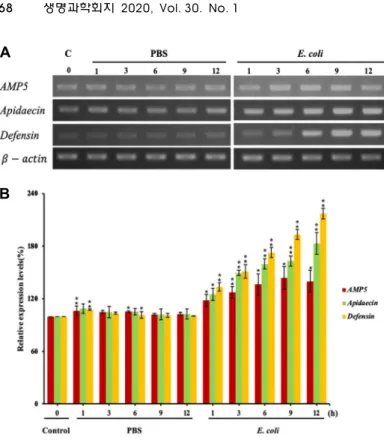
Fig. 4. Transcriptional expression profiles of AMP5 in re- sponse to microbial infection in A. mellifera L. work- er bees. (A) Transcriptional expression profiles of the AMP5 gene in the fat body of A. mellifera worker bees injected with PBS, or E. coli (n=3). Untreated and PBS-injected A. mellifera L. worker bees were used as controls. Total RNA was isolated from the fat body of worker bees at 1, 3, 6, or 12 hr post infection. AMP5, apidaecin, or defensin transcripts were analyzed using RT-PCR. transcripts were used as an internal control. (B) The levels of AMP5, apidaecin, or defensin mRNA were calculated relative to the lev- els at 0 h before PBS, or E. coli injection (shown as 100%). The bars represent the means ± SD. Signifi- cant differences are indicated with one asterisk at p<0.05 and with two asterisks at p<0.01.
지방체, 중장, 근육, 독낭 조직을 이용하여 RT-PCR로 확인 한 결과(Fig. 3) 표피, 지방체, 독낭에서 AMP5 유전자가 발현 되 는 것을 확인 하였다. 합성된AMP5의 항균 활성 결과로 보았 을 때 조직에서 발현되는 AMP5 유전자는 면역반응에 의해 발현되는 유전자로 사료된다.
E. coli 감염에 의한 AMP5 유전자 발현 양상
면역반응에 유무 및 조직내에서의 AMP5의 발현 양상을 확 인 하기 위해 E. coli를 A. mellifera에 감염 시켜 지방체을 채취 하여 발현 양상 RT-PCR을 통해 비교 하였다. 대조군으로 선천 성 면역반응 유전자인 apidaecin 과 defensin을 사용하였다. 그 결과 apidaecin과 defensin의 발현이 증가 하였고[19], AMP5 유 전자의 발현 양상 또한 증가 하는 양상을 보였다(Fig. 4A, Fig.
4B). 이는 세균 감염으로 인해 유도되어지는 선천성 면역 반응 으로 apidaecin, defensin의 발현이 증가 하고 이와 더불어 AMP5 발현 양상 또한 증가한다. AMP5는 지방체에서 발현 되어지는 항균 펩티드로서 apidaecin, defensin과 함께 발현이 증가 함으로써 세균 감염으로부터 보호하기 위한 선천성 면역 반응이다.
이 결과로 새로운 항균 펩티드 및 선천성 면역반응 유전자 인 AMP5를 확인 하였다.
감사의 글
본 연구는 농촌진흥청 차세대바이오그린21사업(PJ01456301) 에 의하여 수행 되었음.
The Conflict of Interest Statement
The authors declare that they have no conflicts of interest with the contents of this article.
References
1. Brogden, K. A. 2005. Antimicrobial peptides: pore formers or metabolic inhibitors in bacteria? Nat. Rev. Microbiol. 3, 238.
2. Bulet, P., Hetru, C., Dimarcq, J. L. and Hoffmann, D. 1999.
Antimicrobial peptides in insects; structure and function.
Dev. Comp. Immunol. 23, 329-344.
3. Choo, Y. M., Lee, K. S., Yoon, H. J., Je, Y. H., Lee, S. W., Sohn, H. D. and Jin, B. R. 2010. Molecular cloning and anti- microbial activity of bombolitin, a component of bumblebee Bombus ignitus venom. Comp. Biochem. Physiol. B Biochem.
Mol. Biol. 156, 168-173.
4. Christophides, G. K., Zdobnov, E., Barillas-Mury, C., Birney, E., Blandin, S., Blass, C., Brey, P. T., Collins, F. H., Danielli, A. and Dimopoulos, G. 2002. Immunity-related genes and gene families in Anopheles gambiae. Science 298, 159-165.
5. Evans, J., Aronstein, K., Chen, Y. P., Hetru, C., Imler, J. L., Jiang, H., Kanost, M., Thompson, G., Zou, Z. and Hultmark, D. 2006. Immune pathways and defence me- chanisms in honey bees Apis mellifera. Insect Mol. Biol. 15, 645-656.
6. Grabherr, M. G., Haas, B. J., Yassour, M., Levin, J. Z., Thompson, D. A., Amit, I. and Regev, A. 2011. Full-length transcriptome assembly from RNA-Seq data without a refer- ence genome. Nat. Biotechnol. 29, 644-652.
7. Hetru, C. and Hoffmann, J. A. 2009. NF-κB in the immune
초록:꿀벌 Apis mellifera에서 유래 한 특성화 되지 않은 항균성 펩티드의 동정
박희근․김동원․이만영․최용수*
(농촌진흥청 국립농업과학원 잠사양봉소재과)
꿀벌(Apis mellifera)에는 많은 항균성 펩티드가 있습니다. 그러나 아직 많은 종류의 펩티드를 기능을 알려지지 않았다. 따라서, 알려지지 않은 기능성 펩티드의 특성화가 필요하다. 그래서 우리는 새로운 항균성 펩티드(AMP) 를 분석 하였다. 우리는 Apis mellifera에서 total RNA를 분리하고 Illumina HiSeq 2500 차세대 시퀀싱(NGS) 기술 을 사용하여 15,314 개의 펩티드 서열을 생성하여 새로운 AMP를 선발 하였다. AMP로서 기능을 가지는 AMP를 선발 하기 위해 AMP 서열의 특성 과 특징을 분석을 기초로 하여 알려지지 않은 펩티드 및 알려진 44 개의 펩티 드가 확인 되었다. 그 중에서도 AMP5라는 특성화 되지 않은 펩티드를 선발 하였다. AMP5는 표피, 지방체, 독낭 에서 발현된다. 항균 활성을 분석하기 위해 Gram-negative bacteria Escherichia coli KACC 10005 및 Bacillus thur- ingiensis KACC 10168에 대한 항균 활성을 합성한 AMP5 처리하여 시험 하였다. AMP5는 Gram-negative bacteria Escherichia coli에 대한 항균 활성을 나타냈다(MIC50 = 22.04±0.66 µM). 일벌에 Escherichia coli을 주사했을 때 AMP5는 체내에서 항균성 펩티드로 발현이 높아졌다. 이러한 결과는 Escherichia coli에 대한 항균 활성을 나타냄을 확인하였다.
response of Drosophila. Cold Spring Harb. Perspect. Biol. 1, a000232.
8. Jenssen, H., Hamill, P. and Hancock, R. E. 2006. Peptide antimicrobial agents. Clin. Microbiol. Rev. 19, 491-511.
9. Kim, B. Y., Lee, K. S., Ok, M. and Jin, B. R. 2017. Synthetic secapin bee venom peptide exerts an anti-microbial effect but not a cytotoxic or inflammatory response. J. Asia Pac.
Entomol. 20, 151-155.
10. Li, W. and Godzik, A. 2006. Cd-hit: a fast program for clus- tering and comparing large sets of protein or nucleotide sequences. Bioinformatics 22, 1658-1659.
11. Park, H. G., Kyung, S. S., Lee, K. S., Kim, B. Y., Choi, Y.
S., Yoon, H. J. and Jin, B. R. 2014. Dual function of a bee (Apis cerana) inhibitor cysteine knot peptide that acts as an antifungal peptide and insecticidal venom toxin. Dev. Comp.
Immunol. 47, 247-253.
12. Park, H. G., Lee, K. S., Kim, B. Y., Yoon, H. J., Choi, Y.
S., Lee, K. Y. and Jin, B. R. 2018. Honeybee (Apis cerana) vitellogenin acts as an antimicrobial and antioxidant agent in the body and venom. Dev. Comp. Immunol. 85, 51-60.
13. Pasupuleti, M., Schmidtchen, A. and Malmsten, M. 2012.
Antimicrobial peptides: key components of the innate im- mune system. Crit. Rev. Biotechnol. 32, 143-171.
14. Tanaka, H. and Yamakawa, M. 2011. Regulation of the in- nate immune responses in the silkworm, Bombyx mori. ISJ Invertebr. Surviv. J. 8, 59-69.
15. Trapnell, C., Roberts, A., Goff, L., Pertea, G., Kim, D., Kelley, D. R. and Pachter, L. 2012. Differential gene and transcript expression analysis of RNA-seq experiments with TopHat and Cufflinks. Nat. Protoc. 7, 562.
16. Waghu, F. H., Gopi, L., Barai, R. S., Ramteke, P., Nizami,
B. and Idicula-Thomas, S. 2014. CAMP: Collection of se- quences and structures of antimicrobial peptides. Nucleic Acids Res. 42, D1154-D1158.
17. Wang, G., Li, X. and Wang, Z. 2016. APD3: the antimicrobial peptide database as a tool for research and education.
Nucleic Acids Res. 44, D1087-D1093.
18. Wu, Y., Han, M. F., Liu, C., Liu, T. Y., Feng, Y. F., Zou, Y., and Liao, H. L. 2017. Design, synthesis, and antiproliferative activities of stapled melittin peptides. RSC Advances 7, 17514- 17518.
19. Xu, P., Shi, M. and Chen, X. X. 2009. Antimicrobial peptide evolution in the Asiatic honey bee Apis cerana. PloS One 4, e4239.
20. Yan, T., Yoo, D., Berardini, T. Z., Mueller, L. A., Weems, D. C., Weng, S. and Rhee, S. Y. 2005. PatMatch: a program for finding patterns in peptide and nucleotide sequences.
Nucleic Acids Res. 33, W262-W266.
21. Ye, J., Fang, L., Zheng, H., Zhang, Y., Chen, J., Zhang, Z., and Wang, J. 2006. WEGO: a web tool for plotting GO annotations. Nucleic Acids Res. 34, W293-W297.
22. Yi, H. Y., Chowdhury, M., Huang, Y. D. and Yu, X. Q. 2014.
Insect antimicrobial peptides and their applications. Appl.
Microbiol. Biotechnol. 98, 5807-5822.
23. Yoo, W. G., Lee, J. H., Shin, Y., Shim, J. Y., Jung, M., Kang, B. C. and Song, K. D. 2014. Antimicrobial peptides in the centipede Scolopendra subspinipes mutilans. Funct. Integr.
Genomics 14, 275-283.
24. You, H., Wan, H., Li, J. and Jin, B. R. 2010. Molecular cloning and characterization of a short peptidoglycan recognition protein (PGRP-S) with antibacterial activity from the bum- blebee Bombus ignitus. Dev. Comp. Immunol. 34, 977-985.