Original article KOREAN JOURNAL OF APPLIED ENTOMOLOGY
한국응용곤충학회지 ⓒ The Korean Society of Applied Entomology
Korean J. Appl. Entomol. 53(2): 171-175 (2014) pISSN 1225-0171, eISSN 2287-545X
DOI: http://dx.doi.org/10.5656/KSAE.2014.03.0.009
Taxonomy of the Genus Eudectus Redtenbacher (Coleoptera: Staphylinidae: Omaliinae) in Korea
Tae-Kyu Kim and Kee-Jeong Ahn*
Department of Biology, Chungnam National University, Daejeon 305-764, Republic of Korea
한국산 넓은가슴네눈반날개속의 분류학적 연구
김태규ㆍ안기정*
대전 충남대학교 생물과학과
ABSTRACT: A taxonomic study of the genus Eudectus Redtenbacher in Korea is presented. Two species, E. japonicus Zerche and E.
rufulus Weise, are newly added to the Korean fauna. Redescriptions, illustrations of the diagnostic features, and a key to the species are provided.
Key words: Coleoptera, Staphylinidae, Omaliinae, Eudectus, Korea.
초 록: 한국 미기록속인 넓은가슴네눈반날개속(Eudectus Redtenbacher) (신칭)의 분류학적 연구 결과, 넓은가슴네눈반날개(E. japonicus Zerche) (신칭)와 배무늬넓은가슴네눈반날개(E. rufulus Weise) (신칭) 두 종을 국내에 처음 보고한다. 두 종에 대한 재기재, 진단 형질의 그림, 그리고 검색 표를 제시한다.
검색어: 딱정벌레목, 반날개과, 네눈반날개아과, 넓은가슴네눈반날개속, 대한민국
*Corresponding author: [email protected]
Received February 10 2014; Revised March 3 2014 Accepted April 10 2014
The genus Eudectus Redtenbacher containing seven species are distributed in the Holarctic region. Four species have been recorded in East Asia (Zerche, 1990, 1993; Herman, 2001;
Smetana, 2004). Little is known about the habitat and ecology of Eudectus species, but they are usually found in cold place (Zerche, 1990) and overwinter as a larva (Steel, 1970). Our specimens were collected by a net while they were flying in a group or by sifting leaf litters.
Members of the Eudectus are characterized by the combination of following characters: body parallel-sided, gently convex, covered with coarse punctures and fine pubescence; eyes large and protruded, ocelli distinct; pair of dorsal tentorial pits present
deeply; gular sutures divergent posteriorly; labrum transverse;
mandible elongate and curved inwardly with large internal tooth;
maxillary palpomere 3 oval and expanded, palpomere 4 glabrous, much smaller and slender than 3; pronotum hexagonal, more or less convex and transverse, broader than head, lateral margin crenulated and angulated around middle; postcoxal process tetragonal, protrochantin almost concealed; abdomen more or less broad and flat; tergite III covered with spicules almost all over; anterior three fourth of paratergite III covered with distinctly coriaceous sculpture; pair of oval patches of wing-folding spicules present on medial part of tergite IV; tergite VII with apical palisade fringe; front tarsus broad in male; lateral part of sternite III with oblique carina (Watanabe, 1990; Zerche, 1990).
In this paper, we report E. japonicus Zerche and E. rufulus for the first time in Korea. We also provide habitus photographs, redescriptions of these two species with illustrations of
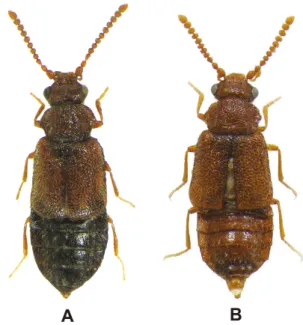
Fig. 1 Habitus. A, Eudectus japonicus Zerche, male, 2.6 mm; B, E.
rufulus Weise, male, 2.5 mm.
diagnostic features, and a key to Korean species. The specimens for this study are deposited in the Chungnam National University Insect Collection (CNUIC), Daejeon, Korea.
Taxonomic accounts
Genus Eudectus Redtenbacher 넓은가슴네눈반날개속(신칭) Eudectus Redtenbacher, 1857: 245; Zanetti, 1987: 424;
Watanabe, 1990: 351; Zerche, 1990: 142; Newton et al., 2000:
342.
Eudectoides Campbell, 1978: 11 (synonymized by Zerche, 1990: 144).
Type species: Eudectus giraudi Redtenbacher
Key to Korean species of the genus Eudectus Redtenbacher 1. Head, thorax and elytra brown to reddish brown, abdomen
dark brown (Fig. 1A); antennomere 3 more or less gradually dilated apically and longer than wide, 4–8 less transverse (Fig. 2F); postero-lateral margin of pronotum clearly emarginated (Fig. 2G); metaventrite without marking; median lobe of aedeagus longer than paramere (Figs. 2L–M) ···
··· E. japonicus Zerche - Head, thorax and elytra yellowish brown, abdomen brown but
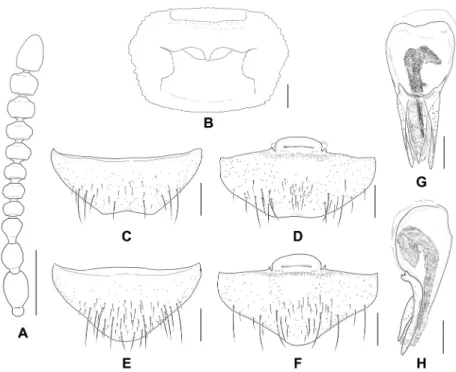
basal and apical segments darker (Fig. 1B); antennomere 3 more or less abruptly dilated apically and slightly longer than wide, 4–8 strongly transverse (Fig. 3A); postero-lateral margin of pronotum almost straight or obscurely emarginated (Fig. 3B); metaventrite with dark tri-markings; median lobe of aedeagus slightly shorter than paramere (Figs. 3G–H) ····
··· E. rufulus Weise
Eudectus japonicus Zerche, 1990 넓은가슴네눈반날개(신칭) (Figs 1A, 2)
Eudectus japonicus Zerche, 1990: 157; Herman, 2001: 402;
Smetana, 2004: 254; Watanabe, 2013: 77.
Description. Body length 2.5–2.7 mm. Body (Fig. 1A) more or less convex and parallel-sided, covered with coarse punctures and pubescence; reddish brown to dark brown, more or less glossy. Head pentagonal transversely, punctate coarsely and sparsely, about 1.4 times wider than long; eye about 2.0 times longer than temple; distance between ocelli about 1.4
times longer than distance between outside of ocellus and inner margin of eye; antennae (Fig. 2F) relatively short and stout, gradually incrassate distally, reaching to just below pronotum, antennomeres 1–5 more or less glossy; scape robust, about 1.3 times longer than wide; pedicel suboval, about 1.2 times longer than wide, slightly narrower and shorter than scape; antennomere 3 about 1.5 times longer than wide, slightly narrower and longer than pedicel; 4–6 suboval, 7 subpentangular and 8–10 subquadrate, 4–10 slightly transverse and getting larger distally; 4 about 1.14 times wider than long and 0.69 times shorter than 3; 7 about 1.11 times wider than long; 9 about 1.15 times wider than long; 11 about 1.64 times longer than wide. Pronotum subhexagonal transversely, more or less convex medially and deplanate laterally, covered with coarse punctures; lateral margins more or less serrate; widest around middle, about 1.5 times wider than long, about 1.3 times wider and 1.2 times longer than head; anterior and posterior margins crenulated weakly, anterior margin almost straight and posterior one more or less arcuate;
anterior angles round and posterior one more or less angulate obtusely; elytra more or less flat, covered with coarse punctures;
lateral margins almost straight with weak crenulation and slightly dilated posteriorly; about 1.1 times wider than long, about 1.5 times wider and 1.8 times longer than pronotum;
posterior margin truncated.
Fig. 2. Eudectus japonicus. A, labrum, dorsal aspect; B, right mandible, ventral aspect; C, left mandible, ventral aspect; D, left maxilla, ventral aspect; E, labium and mentum, ventral aspect; F, antenna; G, prothorax, ventral aspect; H, male tergite VIII, dorsal aspect; I, male sternite VIII, ventral aspect; J, female tergite VIII, dorsal aspect; K, female sternite VIII, ventral aspect; L, aedeagus, dorsal aspect; M, aedeagus, lateral aspect. Scales = 0.1 mm.
Male. Abdominal tergite VIII (Fig. 2H) with more or less emarginated posterior margin; more or less sclerotized setae present on medial part of sternite VII; posterior margin of sternite VIII roundly emarginated weakly (Fig. 2I). Aedeagus (Figs. 2L–M) trilobed and almost symmetrical; median lobe narrowed apically with acute apex rather sclerotized, lateral margin almost straight, much longer than basal bulb and paramere, dorsal surface covered with few scattered punctures;
paramere more or less stout, more or less curved inwardly in apical half, covered with scattered punctures.
Female. Abdominal tergite VIII (Fig. 2J) with narrowly
truncated posterior margin; posterior margin of sternite VIII more or less prolonged with round apex (Fig. 2K).
Materials examined. Total 312 specimens. KOREA:
Chungbuk Prov.: Cheongju-si, Heungdeok-gu, Biha-dong, Mt.
Bumosan, N36˚38´4.8˝ E127˚24´43.1˝ 172 m, 29 IV 2009, YH Kim, YG Ban, SG Lee, sweeping [165♂♂144♀♀ (4♂♂2
♀♀ on slide), CNUIC]; same data except for under bark (1♀, CNUIC); Chungnam Prov.: Nonsan-si, Beolgok-myeon, Surak-ri, Mt. Daedunsan, Surak-valley, N36˚08´04.2˝ E127˚18´29.1˝
362 m, 19 IV 2013, SG Lee, JS Lee, MA Cho, leaf litter (1♂,
Fig. 3. Eudectus rufulus. A, antenna; B, prothorax, ventral aspect; C, male tergite VIII, dorsal aspect; D, male sternite VIII, ventral aspect; E, female tergite VIII, dorsal aspect; F, female sternite VIII, ventral aspect; G, aedeagus, dorsal aspect; H, aedeagus, lateral aspect. Scales = 0.1 mm.
CNUIC); Jeju Prov.: Jeju-si, Chuja-myeon, Is. Hachujado, 22 VIII 2002, YB Cho [original label as ‘Korea, Jejudo Chujado Island (hachujado) VIII. 22. 2002. Y. B. Cho’] (1♀, CNUIC).
Distribution. Korea, Japan.
Eudectus rufulus Weise, 1877 배무늬넓은가슴네눈반날개 (신칭)
(Figs 1B, 3)
Eudectus giraudi var. rufulus Weise, 1877: 96.
Eudectus rufulus: Weise, 1884: 270; Sharp, 1889: 473;
Nakane, 1971: 83; Zerche, 1988: 362; 1990: 146; 1993:343;
Watanabe, 1990: 353; 2013: 77; Herman, 2001: 402; Smetana, 2004: 254.
Description. Body length 2.4–2.6 mm. Body (Fig. 1B) more or less convex and parallel-sided, covered with coarse punctures and pubescence; yellowish brown to brown, more or less glossy. Head pentagonal transversely, punctate coarsely and sparsely, about 1.6 times wider than long; eye about 2.1 times longer than temple; distance between ocelli about 2.0 times longer than distance between outside of ocellus and inner
margin of eye; antennae (Fig. 3A) relatively short and stout, gradually incrassate distally, reaching to posterior margin of pronotum, antennomeres 1–5 more or less glossy; scape robust, about 1.4 times longer than wide; pedicel suboval, about 1.2 times longer than wide, slightly narrower but rather shorter than scape; antennomere 3 about 1.1 times longer than wide, slightly narrower and shorter than pedicel; 4–8 subpentangular and 9–10 subquadrate, 4–10 transverse and getting larger distally; 4 about 1.36 times wider than long; 7 about 1.35 times wider than long; 9 about 1.24 times wider than long; 11 about 1.41 times longer than wide. Pronotum subhexagonal transversely, more or less convex medially and deplanate laterally, covered with coarse punctures; lateral margins more or less serrate;
widest around anterior two fifth, about 1.5 times wider than long, about 1.3 times wider and longer than head; anterior and posterior margins crenulated weakly; anterior margin almost straight and posterior one more or less arcuate, anterior angles round and posterior one more or less angulate obtusely; elytra more or less flat, covered with coarse punctures, lateral margins almost straight with weak crenulation and slightly dilated posteriorly; about 1.2 times wider than long, about 1.4 times wider and 1.8 times longer than pronotum; posterior margin
truncated.
Male. Abdominal tergite VIII (Fig. 3C) with more or less emarginated posterior margin; more or less sclerotized setae present on medial part of sternite VII; posterior margin of sternite VIII weakly emarginated roundly (Fig. 3D). Aedeagus (Figs. 3G–H) trilobed and almost symmetrical; median lobe slightly shorter than basal bulb and paramere, lateral margin in basal three fourth almost straight and parallel-sided, apical fourth narrowed apically with acute apex; paramere more or less stout, curved inwardly in apical two third, covered with scattered punctures.
Female. Abdominal tergite VIII (Fig. 3E) with more or less rounded posterior margin; posterior margin of sternite VIII more or less prolonged with round apex (Fig. 3F).
Materials examined. Total 7 specimens. KOREA: Gangwon Prov.: Pyeongchang-gun, Jinbu-myeon, Mt. Odaesan, Sangwonsa, 15 IX–14 XI 2001, KJ Ahn, CW Shin ex FIT (1♀, CNUIC);
Chungnam Prov.: Daejeon-si, Seo-gu, Jangan-dong, Mt.
Jangtaesan, N36˚13´03.3˝ E127˚20´36.2˝ 258 m, 28 III 2012, DH Lee, TK Kim, SG Lee, leaf litter (1♂1♀, CNUIC);
Gyeongnam Prov.: Geoje-si, Dongbu-myeon, Geoje Natural Recreation Forest, N34˚47´16.9˝ E128˚37´23.4˝ 213 m, 14 IV 2011, YH Kim, sifting, flood debris [3♂♂1♀ (2♂♂1♀ on slide), CNUIC].
Distribution. Korea, Japan.
Acknowledgements
We thank Margaret Thayer and James Boone (FMNH, Chicago) for arranging the loan of the specimens. Financial support was partially provided by a grant from the National Institute of Biological Resources (NIBR), funded by the Ministry of Environment (MOE) of the Republic of Korea (NIBR No. 2013-02-001) and the National Institute of Biological Resources (NIBR) of Ministry of Environment, KOREA (1834-302).
Literature Cited
Campbell, J.M., 1978. A Revision of the North American Omaliinae
(Coleoptera: Staphylinidae). 1. The Genera Haida Keen, Pseudohaida Hatch, and Eudectoides New Genus. Mem. Entomol.
Soc. Can. 106, 1-19.
Herman, L.H., 2001. Catalog of the Staphylinidae (Insecta:
Coleoptera). 1758 to the end of the second millennium. I.
Introduction, History, Biographical Sketches, and Omaliine Group.
Bull. Am. Mus. Nat. Hist. 265, 1-650.
Nakane, T., 1971. Staphylinidae, in: Nakane, T., Ohbayashi, K., Nomura, S., Kurosawa, Y. (Eds.), Iconographia Insectorum Japonicorum, Colore naturali edita Volumen II (Coleoptera), 4th ed., Hokuryu-kan Publishing, Tokyo, pp. 81-100.
Newton, A.F., Thayer, M.K., Ashe, J.S., Chandler, D.S., 2000. 22.
Staphylinidae, in: Arnett, R.H., Thomas, M.C. (Eds.), American beetles, Vol. 1, Archostemata, Myxophaga, Adephaga, Polyphaga:
Staphyliniformia. CRC Press, Boca Raton, pp. 272-342.
Redtenbacher, L., 1857. Fauna austriaca, Die Käfer, Nach der ana- lytischen Methode bearbeitet, Druck und Verlag von Carl Gerold’s Sohn, Wien.
Sharp, D., 1889. The Staphylinidae of Japan. Ann. Mag. Nat. Hist.
(6)3, 28-44; 108-121; 249-267; 319-334; 406-419; 463-476.
Smetana, A., 2004. Staphylinidae, subfamily Omaliinae, in: Löbl, I., Smetana, A. (Eds.), Catalogue of Palaearctic Coleoptera, Volume 2, Hydrophiloidea-Histeroidea-Staphylinoidea. Apollo Books, Stenstrup, pp. 237-268.
Steel, W.O., 1970. The larvae of the genera of the Omaliinae (Coleoptera: Staphylinidae) with particular reference to the British fauna. Trans. R. Entomol. Soc. London. 122, 1-47.
Watanabe, Y., 1990. A Taxonomic Study on the Subfamily Omaliinae from Japan (Coleoptera, Staphylinidae). Mem. Tokyo Univ. Agric.
31, 55-391
Watanabe, Y., 2013. Subfamily Omaliinae MacLeay, 1825, in:
Shibata, Y., Maruyama, M. (Eds.), Catalogue of Japanese Staphylinidae (Insecta: Coleoptera). Bull. Kyushu Univ. Museum.
11, 73-80.
Weise, J., 1877. Japanische Staphilinidae und Pselaphidae. Dtsch.
Entomol. Z. 21, 88-100.
Weise, J., 1884. Ueber Eudectus rufulus n. sp. aus Japan. Dtsch.
Entomol. Z. 28, 270-271.
Zanetti, A., 1987. Fauna d’Italia, Vol. XXV, Coleoptera, Staphylinidae, Omaliinae, Edizioni Calderini, Bologna.
Zerche, L., 1988. Die Typen der von Julius Weise (1844–1925) bes- chriebenen Staphylinidae-Arten (Coleoptera). Beitr. Ent. 38, 361-364.
Zerche, L., 1990. Monograhie der paläarktischen Coryphiini (Coleoptera, Staphylinidae, Omaliinae), Akademie der Landwirtschaftswissenschaften der Deutschen Demokratischen Republik, Berlin.
Zerche, L., 1993. Monographie der paläarktischen Coryphiini (Coleoptera, Staphylinidae, Omaliinae). Supplementum 1. Beitr.
Ent. 43, 319-374.