서 론
자기공명분광(NMR)은 자기장 속에 놓인 원자핵에 공명
주파수인 라디오 전자기파를 입사하여 발생되는 유도전류 를 분석함으로 화합물의 화학적 구조를 분석할 수 있는 고 해상력을 가지는 분석 방법이다(Aasly et al. 1999; Aaronson et al. 2010). 자기공명분광을 통한 분석은 생체 내외(in-vivo, in-vitro)의 대사물질을 정량적으로 분석이 가능할 뿐만 아 니라, 목적에 따라 대상원소를 선택하여 인체의 생화학적 대사 상태에 대한 특유의 정보를 알 수 있다(Casanova et al. 2016). 따라서 조직병리학적 또는 생리학적 변화를 쉽게 관찰할 수 있으며 조직의 구조적인 변화가 오기 전에 세포 기능의 변화를 미리 발견할 수 있다. 따라서 자기공명분광 법은 질병을 조기 예방할 수 있는 장점을 가지고 있으며 추 적적으로 관찰이 가능하여 의료나 각종 연구에 많이 활용되 고 있다(Quintero et al. 2007; Shao et al. 2014).
최근 들어 학재 간 융합 등으로 인하여 의료용으로 인식
Seung-Man Yu
1,*
1Department of Radiological Science, College of Health Science, Gimcheon University, 214, Daehak-ro, Gimcheon-si, Gyeongsangbuk-do 39528, Republic of Korea
Abstract - The aim of this study was to evaluate possibility for chemical changes analysis of the Soybean and Olive oil using a medical magnetic resonance imaging/spectrometer. The two edible oils including soybean and olive oil were selected for manufacturing the phantom series. For the
acquisition of data without any physical environment change, 5ml was transferred to a sealed
plastic vial. All MRI and 1H-MRS experiments were performed on a 3.0Tesla MRI scanner using
a 32-channel brain array coil. The total lipid ((-CH2-)n/noise), total saturated fatty acid, total
unsaturated fatty acid, total unsaturated bond, and poly unsaturated bond were quantified by
separating each peak area of -CH3, (-CH2-)n, -CH2-C=C-CH2-, =C-CH2-C=, and
-CH=CH-by-CH3 by MRS analysis. Soybean oil had the highest concentration of methyl protons and methane
protons, expressed as 0.9 and 5.3ppm compared to olive oil. However, its methylene protons at 1.3
ppm were the lowest. Olive oil had the highest amount of methylene protons and allylic protons and the lowest amount of methyl protons. Through the magnetic resonance spectroscopic analysis it was to analyze the chemical characteristics of Olive oil and soybean oil. And it was confirmed that it is possible to proceed to an extended study using magnetic resonance spectroscopy.
Key words : Magnetic resonance spectroscopy, Fatty acid, Analysis
─ 133 ─ * Corresponding author: Seung-Man Yu, Tel. +82-54-420-4246,
되던 장비에서 다양한 학술적 연구의 시도들이 이루어지고 있다. Cheung의 연구에 의하면 1H-MRS(proton-magnetic resonance spectroscopy)를 4종류 fatty acid 즉, total saturated fatty acid(TSFA), total unsaturated fatty acid(TUSFA), total unsaturated bond(TUSB), poly unsaturated bond(PUSB)를 lipid proton의 적분 비를 이용하여 분석할 수 있는 방법을 제안하였다(Cheung et al. 2011). 이것은 지방의 성분 분석 을 의료용 자기공명 분광장치를 통하여 분석이 가능하다는 것을 의미한다. 현대 음식 문화에서는 식용 유지를 이용한 튀김 요리의 비중이 나날이 증가되고 있다. 특히 청소년시기 튀김 요리 의 과잉 섭취는 호르몬의 불균형을 일으켜 사회적 문제와 국가적 경제력 저하 등이 유발될 수 있다(Guallar-Castillon et al. 2007; Cahill et al. 2014). 이러한 문제를 해결하기 위
해서 화학적 변성이 적고, 불포화 지방산이 많이 포함된 식 용 유지를 사용하는 소비자들이 점점 늘어나고 있다. 식물 성 유지는 필수 지방산이 다량 함유되어 있어 성장을 촉진 하고, 혈중 콜레스테롤 경감시키는 효과가 있어서 그 사용 이 점점 늘어나고 있다. 그러나 식물성 유지도 여러 환경에 따라 지방산의 변화가 일어날 수 있기 때문에 식용 유지의 산패에 대한 연구가 과거부터 많이 이루어졌다. 식용 유지 의 산패에 대한 변화를 관찰하기 위해서는 여러 가지 분석 방법을 통하여 밝혀낼 수 있다. 자기공명분광 분석은 화학 적 구조 중 수소 원자의 화학적 변화를 통하여 발생하는 화 학적 이동현상을 표현하는 분석 방법으로 지질에서의 화학 적 변화를 잘 표현할 수 있다. 이러한 특성을 이용하여 지방 간의 정량적 분석과 간에서의 지방산 정량적 분석에 대한 연구들이 선행되었다. 따라서 자기공명 분광장치를 이용한 다면 기름의 화학적 변성과 같은 원인규명에 대한 분석을 쉽게 관찰할 수 있다. 따라서 본 연구에서는 현재 시중에 판매되고 있는 식용 유지 중 그 성분의 차이가 이미 밝혀진 Soybean oil과 Olive oil을 이용하여 의료용 자기공명영상/분광장치에서 식용 유 지의 지방산 조성비의 표현이 가능한지를 알아보고자 하였 다.
대상 및 방법
1. Oil phantom manufacture
식용 오일의 다양한 물리적 환경을 관찰하기 위해서 2가
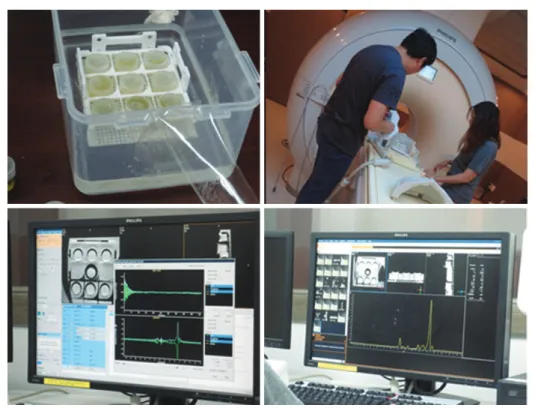
지 식용 오일인 Soybean, Olive oil을 선정하였다. Fig. 1과
같이 선정된 2가지 오일을 준비한 후 물리 화학적 변화에
줄 수 있는 요소를 제거하고 5ml를 덜어서 9개의 plastic vial(식용 오일당 9개의 vial)로 총 18개의 phantom series를 제작하였다.
Fig. 1. The phantom series image and MRS acquisition procedure in 3T human MRI. The upper two image(left, right) were 9 vial oil phan-tom test tube and mounted the phamphan-tom series in MRI iso-center. The below two image were MRS acquisition procedure.
획득된 T2 강조영상을 이용하여 point-resolved spectroscopy (PRESS) sequence를 통해 TR=1,500msec, TE=35msec, NEX =64, total scan time =10 minute, 10 ×10 ×10mm3 voxel의 조건으로 각각 18개의 오일 팬텀의 1H-MRS를 획 득하였다.
CH2-CH =CH-; 2.77ppm), methane protons(-CH =CH-; 5.30ppm)이며, 이 lipid proton을 통하여 total saturated fatty acid(TSFA), total unsaturated fatty acid(TUSFA), total unsaturated bond(TUSB), polyunsaturated bond(PUSB)를 Table 1과 같이 계산하였다. 각각의 lipid proton의 농도 차 이는 통계프로그램인 SPSS version18(SPSS Incorporated, Chicago, IL, USA)를 이용하여 Kruskal-wallis H test를 시행 하였으며 유의수준을 p-vale 0.05 미만으로 설정하였습니다.
결 과
2종류의 식용 오일의 MRS 분석을 통한 lipid proton의 비
Table 1. Peak area ratios of various metabolite indices measured by 1H-MRS
Index Peak area ratio Frequency
Total saturated fatty acid Total unsaturated fatty acid Total unsaturated bond Polyunsaturated bond 3(-CH2-)/2(-CH3) 3(-CH2-CH=CH-CH2-)/4(-CH3) 3(-CH=CH-)/2(-CH3) 3(-CH=CH-CH2-CH=CH-)/2(-CH3) 1.30/0.90ppm 2.02/0.90ppm 5.30/0.90ppm 2.77/0.90ppm
Fig. 2. The typical olive oil test tube MRS profile. The TL, TSFA, TUSFA, TUSB, and PUSB can be calculated with liver
fat-ty acid analysis using 1H-MRS through signal integration
of lipid methylprotons(-CH3, 0.9ppm), methyleneprotons
[(-CH2-)n, 1.3ppm], allylic protons(-CH2-C =C-CH2-,
2.0ppm), diallylic protons(=C-CH2-C=, 2.8ppm), and
methene protons(-CH=CH-, 5.3ppm).
7.0 6.0 5.0 4.0 3.0 2.0 1.0 0.0
Chemical shift(ppm)
Fig. 3. The percentage of lipid proton concentration. The 1.3ppm lipid proton of soybean oil was lower concentration than Olive oil, but The 0.9 and 5.3 was higher concentration than olive oil almost twice.
0.9 1.3 2.1 2.3 2.8 5.3 Chemical shift(ppm) 100.00 80.00 60.00 40.00 20.00 0.00 Soybean oil Olive oil Per centage (%)
는 Fig. 3과 같이 나타났다. 실험에 사용된 2종류 oil의 met-hyl protons(-CH3, 0.9ppm)와 methylene protons[(-CH2-)n, 1.3ppm]가 큰 비중으로 차지하고 있었다. 그 외 나머지 약 25% 정도가 allylic protons(-CH2-C =C-CH2-, 2.1ppm), diallylic protons(=C-CH2-C=, 2.8ppm), methane protons (-CH=CH-, 5.3ppm)가 차지하는 것으로 나타났다. Fig. 3과 같이 lipid proton 중 Soybean oil은 Olive oil과 비교하였을 때 methyl protons(-CH3, 0.9ppm)와 methane protons(-CH= CH-, 5.3ppm)가 Olive oil보다 높은 농도의 함량을 보인 반 면, methylene protons[(-CH2-)n, 1.3ppm]는 낮은 농도를 보였다(p<0.01). Olive oil은 methylene protons와 allylic protons가 가장 높은 농도비를 보였으며, methyl protons는 가장 낮게 관찰되었다(p<0.01).
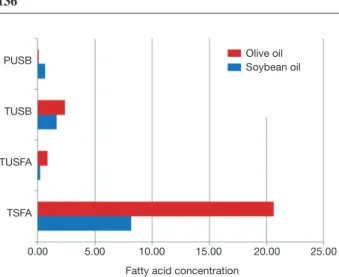
두 oil에 따른 fatty acid의 농도의 비는 Fig. 4와 같이 나
타났다. 전체적으로 두 오일에서 TSFA의 농도가 가장 높은
농도임을 확인할 수 있었다. 특히 Olive oil의 경우 TSFA가 20.62로 가장 높게 나타났으며, Soybean oil은 8.18로 Olive oil보다 그 농도가 낮게 나타났다(p<0.01). 반면 PUSB는 Soybean oil이 Olive oil보다 매우 높게 관찰된 것이 특징이 었다(p<0.01).
고 찰
본 연구에서는 일반 식생활에서 주로 사용되고 있는 식용 오일의 지방산을 평가함으로써 의료용으로 사용되고 있는 자기공명분광 방법을 통하여 화학적인 환경을 평가할 수 있 는지를 알아보고자 하였다. 식품영양학에서는 식용 오일의 화학적 변성 즉 산패의 주요 요인을 평가하는 것이 하나의 큰 연구분야로 자리 잡고 있다(Rodrigo et al. 1999; Whit-field et al. 2009; Hao et al. 2016). 특히 포화 지방산의 경우인체 내에 침착은 혈관질환 및 성인병의 주요 인자로 많은 연구들이 지속되고 있다(Vodoevich, 1983; Oda et al. 2005; Hunter et al. 2010). 따라서 본 연구의 시작으로 식용 오일의 산패의 연구 방법이 자기공명분광 분석 등과 같이 다양하게 시도될 수 있고, 포화/불포화 지방산의 증감을 좀더 쉽고 정 확하게 관찰할 수 있다. 자기공명분광 방법은 생체 내/외의 대사물질을 정량적인 분석방법을 통해 매우 정확하게 추적 관찰할 수 있는 검사 방법으로 지금도 의학을 비롯한 다양 한 분야에서 활발히 연구되고 있다. 본 연구에서는 식생활 에 자주 이용되는 식용 오일 팬텀을 자체 제작하여 구조적 분석을 통하여 fatty acid를 자기공명분광 분석을 이용하여 관찰하는 최초의 실험이기에 큰 의미가 있다고 할 수 있다.
본 실험에서 Soybean oil은 methyl protons와 methane protons(-CH=CH-, 5.3ppm)가 가장 높은 농도의 함량을 보였고, methylene protons[(-CH2-)n, 1.3ppm]는 가장 낮은 농도를 보였다. 즉 이중 결합으로 이루어진 methane protons 는 열과 산화 작용으로 인하여 그 결합력이 약화되어 화학 적 변화가 크게 이루어질 수 있는 구조적 특성이 있음을 알 수 있었다(Malashenko Iu et al. 2006). 반면 Olive oil은 met-hyl protons가 가장 낮은 함량을 보였고 metmet-hylene protons 는 가장 높아 화학적 구조가 Soybean oil과 비교하였을 때 안정된 fatty acid의 함량의 비중이 높은 것으로 밝혀졌다. 따라서 Soybean oil의 경우 열과 공기 중의 산화로 그 화학 적 변성의 가능성이 큰 오일임을 본 연구를 통하여 확인할 수 있었다. 본 연구의 제한점으로는 선정한 식용 오일이 다 양하지 못하고 2가지 식용 오일만을 선정하였으며, 식용 오 일의 산패에 영향을 주는 요인을 연출하지 못하여 fatty acid 의 산패과정에서의 변화를 관찰하지 못하였다. 이러한 제한 점을 극복하기 위해서 현재 더 세밀한 실험 디자인과 더 많 은 샘플 수, 그리고 다양한 식용 오일을 선택하여 식용 오일 의 산패 연구를 진행 중에 있다.
결 론
본 연구에서는 의료용으로 사용되고 있는 자기공명분광 분석을 통하여 식용으로 사용되는 Soybean oil과 Olive oil 의 화학적 특성을 분석할 수 있었고, 특히 식품영양학에서 중요시 여기는 식용 오일의 화학적 변성에 대한 연구를 자 기공명분광 분석을 이용하여 확장된 연구를 진행할 수 있음 을 확인하였다.사 사
본 연구는 김천대학교 2015년 교내 연구비 지원 사업에 의한 것임(gc15004).Fig. 4. The base-line concentration of saturated/unsaturated fatty
ac-ids(bond) in soybean and olive oil phantom. The TSFA
con-centration in soybean oil had the lowest level, while olive oil had the highest level among the 2 oil phantom series. 0.00 5.00 10.00 15.00 20.00 25.00
Fatty acid concentration PUSB TUSB TUSFA TSFA Olive oil Soybean oil
Rimm EB. 2014. Fried-food consumption and risk of type 2 diabetes and coronary artery disease: a prospective study in 2 cohorts of US women and men. Am. J. Clin. Nutr. 100 (2):667-675.
Casanova LM, Espindola-Netto JM, Tinoco LW, Sola-Penna M and Costa SS. 2016. The Use of NMR Metabolite Pro-filing and in vivo Hypoglycemic Assay for Comparison of Unfractionated Aqueous Leaf Extracts of Two Ocimum Species. Chem. Biodivers 13(6):686-694.
Cheung JS, Fan SJ, Gao DS, Chow AM, Yang J, Man K and Wu EX. 2011. In vivo lipid profiling using proton magnetic resonance spectroscopy in an experimental liver fibrosis model. Acad. Radiol. 18(3):377-383.
Guallar-Castillon P, Rodriguez-Artalejo F, Fornes NS, Banegas JR, Etxezarreta PA, Ardanaz E, Barricarte A, Chirlaque MD, Iraeta MD, Larranaga NL, Losada A, Mendez M, Martinez C, Qiros JR, Navarro C, Jakszyn P, Sanchez MJ, Tormo MJ and Gonza CA. 2007. Intake of fried foods is associated with obesity in the cohort of Spanish adults from the Euro-pean Prospective Investigation into Cancer and Nutrition. Am. J. Clin. Nutr. 86(1):198-205.
Hao S, Chen K, Cao L, Zhu X, Luo G, Zhang S and Chen J. 2016. Separation of high-purity syringol and acetosyrin-gone from rice straw-derived bio-oil by combining the bas-ification-acidification process and column chromatography.
Heart J. 46(6):975-985.
Quintero M, Cabanas ME and Arus C. 2007. A possible cellular explanation for the NMR-visible mobile lipid(ML) changes in cultured C6 glioma cells with growth. Biochim. Biophys. Acta 1771(1):31-44.
Rodrigo F, Rodrigo C, Fernandez PS, Rodrigo M and Marti-nez A. 1999. Effect of acidification and oil on the thermal resistance of Bacillus stearothermophilus spores heated in food substrate. Int. J. Food Microbiol. 52(3):197-201. Shao W, Gu J, Huang C, Liu D, Huang H, Huang Z, Lin Z,
Yang W, Liu K, Lin D andJi T. 2014. Malignancy-associ-ated metabolic profiling of human glioma cell lines using 1H NMR spectroscopy. Mol. Cancer 13:197.
Vodoevich VP. 1983. Effect of lipoic acid, biotin and pyridox-ine on blood content of saturated and unsaturated fatty acids in ischemic heart disease and hypertension. Vopr. Pitan. Sep-Oct(5):14-16.
Whitfield CJ, Aherne J and Watmough SA. 2009. Modeling soil acidification in the Athabasca Oil Sands region, Alber-ta, Canada. Environ. Sci. Technol. 43(15):5844-5850.
Received: 2 August 2016 Revised: 24 August 2016 Revision accepted: 1 September 2016