IMPROVEMENT OF LAND SURFACE TEMPERATURE RETRIEVAL ALGORITHHM FROM THE COMS DATA
Ki-Ok Hong, Myoung-Seok Suh, Jeon-Ho Kang
Department of Atmospheric Science, Kongju National University, 182 Shinkwan-dong, Gongju-city 314-701, Chung Cheongnam-do, Korea, [email protected]
ABSTRACT: Land surface Temperature (LST) is a very useful surface parameter for the wide range of applications, such as agriculture, numerical and climate modelling community. However, operational observation of LST is unsatisfactory for the needs of the various application communities in the spatial/temporal resolutions and accuracy. So,
we developed a split window-type LST retrieval algorithm to estimate the LST from COMS data. The coefficients of the split-window algorithm were obtained by means of a statistical regression analysis by using a synthetic match-up database. The database was made through radiative transfer simulations using MODTRAN 4 for wide range of atmospheric profiles(TIGR databases), spectral emissivity, satellite zenith angle (SZA), and various lapse-rate conditions, including surface inversions. The sensitivity analysis showed that the LST algorithm reproduces LST with a reasonable quality. However, the algorithm has a tendency to overestimate and underestimate the LST for surface inversion and superadiabatic conditions, respectively. To minimize the overestimation and underestimation of LST, we also developed day/night LST algorithms separately based on the surface lapse rate and retrieved final LST by using the weighted combination of day/night LST algorithm. The results showed that the bias and RMSE of original LST algorithm are significantly reduced for the various sensor-target geometric conditions.
KEY WORDS: Land surface temperature, COMS, MODTRAN 4, day/night algorithm
1.
INTRODUCTION
KMA (Korea Meteorological Administration) has been developing the COMS (Communication, Ocean and Meteorological Satellite) meteorological data processing system (CMDPS) for the successful operation and efficient use of the satellite data. The COMS is the first geostationary multipurpose satellite of Korea, which will be launched at the end of 2009. Various meteorological variables, such as clouds, aerosol, sea surface temperature and land surface temperature (LST) will be derived automatically by the CMDPS from the level-1b data.
LST is a key environmental variable in a wide range of applications, such as weather, climate, hydrology, and ecology. But it is one of the most difficult surface variables to observe regularly due to the strong spatio- temporal variations.
Theoretical possibility for the retrieval of LST using split-window method has been shown by Becker and Li (1990), and many others. Numerous works have been made to retrieve the LST from the satellite data, especially polar orbit satellite (NOAA/AVHRR, Terra/MODIS, Landsat/TM (e.g., Kerr et al., 1992;
Ulivieri et al., 1994; Wan and Dozier, 1996). However, operational retrieval of LST from the satellite data is very limited due to the poor accuracy of retrieved LST, particularly using geostationary satellite. The lower quality of retrieved LST is mainly caused by the combined effects of spectrally and temporally varying emissivity and atmospheric conditions.
Recently, the various background data (e.g., land cover, vegetation index) and methods (vegetation coverage
method: Valor and Caselles, 1996) for the estimation of spectral emissivity are developed. And the quality of geostationary satellite (e.g., MSG/SEVIRI, MTSAT-1R) has been greatly improved recently. As a result, the quality of LST retrieved from geostationary satellite data, such as MSG/SEVIRI, has been significantly improved.
As in the MODIS LST group, the LST over Africa and Europe retrieved operationally by the EUMETSAT LSA SAF (Land Surface Analysis Science Application Facility). Hong et al.(2009) developed a split-window type LST algorithm by using MTSAT-1R data. And they evaluate the accuracy of LST over East Asia with MODIS LST data.
Recently, basic information including spectral response functions and sub-satellite point of the COMS are released. In this study, we developed 3 sets (total, day and night LST algorithms) of split-window type LST retrieval algorithms to improve the quality of estimated LST from COMS data. And the relative accuracy of LST algorithms is analyzed.
2.
RADIATIVE TRANSFER MODEL SIMULATION
To retrieve the LST using a split-window method,
ground match-up data are needed for the coefficients of
regression equation. However, unlike the sea surface
temperature, available match-up data over East Asia are
severely limited in LST. So, we performed radiative
transfer model simulations using MODTRAN 4 with
various atmospheric and satellite viewing conditions. The
main factors affecting the retrieved LST using split-
window method are atmospheric profiles, spectral
emissivity, satellite zenith angle and lapse rate at surface layer. The radiative transfer simulations are designed to include all the impacting factors (Table 1).
In order to consider the atmospheric effects, 441 TIGR databases were used within
60˚of satellite zenith angle from the COMS location (see Fig. 1). LST is subscribed to consider the strong diurnal variation, from Ta – 12 K to Ta + 16 K in steps of 2 K. And the IR1 emissivity is prescribed from
0.9478 to 0.9968in steps of 0.0014 and the emissivity difference between IR1 and IR2 is also prescribed from
-0.02 to 0.012 in steps of 0.004. The number of total simulation is 441 × 15 × 11 × 9 = 654885Table 1.
Atmospheric and sensor-target conditions used in RTM simulations.
Factors Conditions
Atmospheric Profile 441 TIGR database Satellite Zenith Angle SZA of TIGR point (0˚~60˚ )
Land Surface Temperature
Total : Ta–12K ~ Ta+16K Day : Ta–2K ~ Ta+16K Night: Ta–12K ~ Ta+2K
(a step of 2K) Emissivity
IR1: 0.9478~ 0.9968 (a step of 0.0049) -0.02 ≤ Δε ≤ 0.012
(a step of 0.004)
Where T
ais the lowest layer air temperature of TIGR data.
Figure 1. Spatial distribution of TIGR data used in this study. The location of COMS is represented by ‘★’.
3.
DEVELOPMENT OF LST ALGORITHM
3.1Development of 3 sets of LST algorithms
Brightness temperature are produced by radiance generated through RTM simulation and COMS spectral response function using inverse Planck equation. The LST retrieval algorithm has been developed by using a statistical regression method in the form of eq. (1).
ε ε θ − + − + Δ +
Δ + Δ + +
=
g f
e
T d T c bT a
LST
IR) 1 ( ) 1 (sec
2
1
(1)
where T
IR1= brightness temperature of IR1,
θ = satellite zenith angle,
2
1 IR
IR
T
T T = − Δ
2
2
1 IR
IR
ε
ε = ε +
2
1 IR
IR
ε
ε ε = − Δ
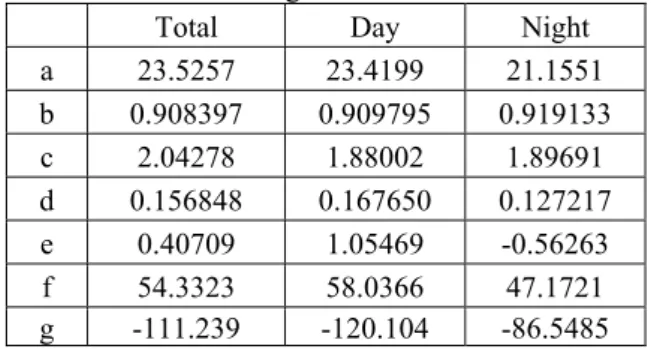
First, we developed the LST retrieval algorithm (Tot_LST) by using the total simulation data set. And we also developed day/night LST algorithms (Day_LST, Ngt_LST) separately by using the different simulated data set under the Day and Night conditions. The impacting conditions in the day/night time simulations are same as in the total simulations except for the LST condition. The derived coefficients for the three sets of LST algorithms are in Table 2.
Table 2. Coefficients for the three sets of LST retrieval algorithm.
Total Day Night a 23.5257 23.4199 21.1551 b 0.908397 0.909795 0.919133 c 2.04278 1.88002 1.89691 d 0.156848 0.167650 0.127217 e 0.40709 1.05469 -0.56263 f 54.3323 58.0366 47.1721 g -111.239 -120.104 -86.5485
3.2
Improvement of the estimated LST
To improve the quality of estimated LST for the various conditions, the final LST is recalculated by using the weighted sum of two LST estimated separately by the day and night LST algorithms. The weighted sum of two LST is performed using eq. (2)
LST DA LST
NA wei
LST
_ = ω × _ + ( 1 − ω ) × _ (2)
Ngt_LST = nighttime LST algorithm Day_LST= daytime LST algorithm
ω is the function of the difference between Ts and Ta.
If the difference between Ts and Ta is smaller than -6 K,
ω is 1.0 because it can be regarded as a nighttime
condition. In contrast when Δ is large than +6 K,
Tω is
0.0 since it can be regard as daytime condition. If Δ is
Tbetween -6 K and +6 K, ω changes from 0.0 and 1.0 as a function of Δ (Eq. (3)).
T2 1 12
1 × Δ +
−
=
Tω (3)
0 . 0
0 . 1
min max
=
= ω ω
) 6 (
) 6 (
K Ta Ts
K Ta Ts
+
≥
−
−
≤
−
After COMS launched, local solar zenith angle will be used, instead of Δ , in the calculation of
Tω for operational LST retrieval from COMS data.
3.3
Performance test
To evaluate the relative performance of the two LST algorithm, bias and RMSE of two LST algorithms (original: org and weighted combination: wei) under the various conditions were compared. The distribution of biases of two LST algorithms is very similar (Fig. 2). The majority of biases are ranged from -3 K and + 3 K.
Figure 2. Distribution of biases of two LST algorithms
Figure 3 shows a scatter plot of the retrieved LST (LST) by the two types of algorithms and prescribed LST (Ref_T) according to the surface lapse-rate. The figures show that two LST algorithms estimate LST very reasonably when the surface lapse rate is neutral.
However, the two LST algorithms overestimate and under estimate the LST for the strong inversion and superadiabatic conditions, respectively. Compared to the original LST, the weighted LST is clearly improved for the various conditions (RMSE was improved by 0.14 K (1.8501→1.7130), 0.042 K (0.9296→0.8580), and 0.04 K (1.8270→1.7891 when the Δ is -12 K, 0 K, and +16
TK). The improvement is more significant at nighttime than daytime.
a) Org_ LST
b) Wei_LST
Figure 3. Scatter plots of retrieved LST (ordinate; LST) and prescribed LST (abscissa; Ref_T) according to the
surface lapse rate
Figure 4 shows biases of two LST algorithms according to Δ . As in the RMSE, the bias of weighted
TLST is clearly reduced for the all surface lapse rate conditions.
Figure 4. Biases of two LST algorithms according to Δ
TFigure 5 shows RMSE and difference of RMSE between two LST algorithms according to the Δ .
TRMSE of original LST algorithm is clearly dependent on the surface lapse rate conditions, small at the neutral conditions and large in the strong inversion and adiabatic conditions. The RMSE is significantly decreased in the weighted summed LST especially at the strong inversion conditions.
Figure 5. RMSE and difference of RMSE according to
Δ
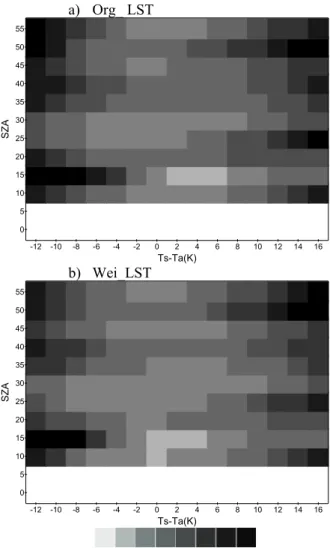
TIn general, the performance of LST algorithm is also impacted by the SZA. Figure 6 shows the distribution off RMSE according to the SZA and surface lapse rate. In gernal, the RMSE of LST is largest when SZA is large and surface lapse rate is inversion and superadiabatic.
This is due to the combined effects of increased optical path length and deviation from the standard weighting functions of IR1 and IR2. The relatively large RMSE for small SZAs, especially for strong inversion conditions, is related to relatively poor representation due to the small number of TIGR data sets and their coastal location. The number of TIGR stations is zero at the 0° ~ 10°(white color) and only four and one at 5° ~ 10° and 10° ~ 15°, respectively. This figure indicates that the performance of current LST algorithm is relatively low for the early morning and midday conditions especially at the high latitude region. Within the COMS observing area, these conditions are matched over the desert area of northern China and Mongolia during summer. When we take into consider the relatively large emissivity errors over bare soil or land with sparse vegetation, the LST over such areas will be used with caution (Momeni and Saradjian, 2007).
a) Org_ LST
-12 -10 -8 -6 -4 -2 0 2 4 6 8 10 12 14 16
Ts-Ta(K) 0
5 10 15 20 25 30 35 40 45 50 55
SZA
b) Wei_LST
-12 -10 -8 -6 -4 -2 0 2 4 6 8 10 12 14 16
Ts-Ta(K) 0
5 10 15 20 25 30 35 40 45 50 55
SZA
0.3
0 0.6 0.9 1.2 1.5 1.8 2.1~
Figure 6. Distribution of RMSE according to the SZA and the surface lapse rate (Ts – Ta)
4.
SUMMARY
In this study, we have developed the LST retrieval algorithm from COMS data through the radiative transfer simulations under various atmospheric profiles (TIGR data), SZA and surface lapse rate conditions using MODTRAN 4. To improve the quality of estimated LST, we developed daytime and nighttime LST algorithms separately by using the different match-up data base and the weighted summed the LST estimated the two LST algorithms.
In general, Sensitivity analysis showed that the three sets of LST algorithms estimated LST very reasonably for the various impacting conditions. The comparison of estimated LST showed that the quality of weighted summed LST of day/night LST algorithms is superior to that of LST estimated by original algorithm for the various SZA and surface lapse rate conditions.
This results showed that the quality of LST estimated from the COMS data can be greatly improved by using the weighted sum of two LST estimated by day/night algorithms based on the local solar zenith angle.
5.
REFERENCES
Becker, F., and Z. L. Li, 1990: Toward a local split window method over land surface. Int. J. Remote Sens., 3, 369-393.
Hong, K. O., M. S. Suh, and J. H. Kang, 2009:
Development of a Land Surface Temperature-retrieval Algorithm from MTSAT-1R data. APJAS.
Kerr, Y. H., J. P. Lagouarde, and J. Imbernon, 1992:
Accurate land surface temperature retrieval from AVHRR data with use of an improved split window.
Remote Sens. Env., 41, 197-209.
Ulivieri, C., M. M. Castronouvo, R. Francioni, and A.
Cardillo, 1994: A split-window algorithm for estimating land surface temperature from satellites, Adv. Space Res., 14, 59-65.
Valor, E., and V. Caselles, 1996: Mapping land surface emissivity from NDVI: Application to European, African, and South American areas. Remote Sens. Env., 57, 164- 184.
Wan Z., and J. Dozier, 1996: A generalized split-window algorithm for retrieval of land surface temperature from space. IEEE Trans. Geosci. Remote Sens., 34, 892-905.
6.