SPATIAL AND TEMPORAL DISTRIBUTIONS OF ATMOSPHERIC GASES AND AEROSOL USING THE PASSIVE DIFFERENTIAL OPTICAL ABSORPTION
SPECTROSCOPY TECHNIQUE
Hanlim Lee
1, Jhoon Kim
1, Young M. Noh
2, Young J. Kim
21
Dept. of Atmospheric Sciences, Yonsei University, Seoul 120-749, Korea
2
Dept. of Environmental Science and Engineering, Gwangju Institute of Science and Technology, Gwangju 500-712, Korea
Corresponding author: Hanlim Lee, Email: [email protected] Fax: 02-365-5163
Abstract…Passive differential optical absorption spectroscopy (DOAS) techniques at various platforms have recently been applied for investigation of chemical and physical quantities and properties of atmospheric constituents such as trace gases, greenhouse gases, and aerosols. Passive DOAS techniques generally utilize scattered sunlight as a light source taking advantage of ubiquitous presence of Sun radiation sources. The method uses a spectrometer combined with a detector that records the scattered sunlight at specific wavelength intervals with a certain spectral resolution. The measured spectra are evaluated utilizing the specific absorption features of individual gas species in the ultra violet, visible, or near IR regions. This study shows, in particular, examples of ground based Imaging-DOAS techniques that enables the remote measurement of the two dimensional spatial distributions of ambient trace gases including NO2, SO2, and BrO in the plumes emitted from volcanic sites, power plants, and a mega city site. The study also discusses about the capability of Multi-Axis (MAX)-DOAS of retrieving information on atmospheric aerosol vertical profiles based on O4 slant column densities measured at UV and visible regions. MAX-DOAS based aerosol extinction coefficient and aerosol optical depth (AOD) obtained for the lower surface layers were compared with those obtained by lidar and sunphotometer measurements at Anmyun, Gwangju, and Fresno supersites. The advantages and shortcomings of MAX-DOAS measurement for aerosol extinction retrieval are also discussed in detail. Future research plans will be discussed especially focusing on development of a NIR and Vis scanning absorption spectrograph system and a data analysis method for remote sensing of CO2 and CH4 vertical profiles in the troposphere.
KEY WORDS: passive DOAS, plume dispersion, NO
2, SO
2, aerosol
1.
INTRODUCTION
The passive Differential Optical Absorption Spectroscopy (DOAS) remote sensing technique, adapting scattered sunlight as a light source, has been used to measure both stratospheric and tropospheric trace gases (e.g., NO2 and SO2) and halogen compounds at various sites (Sanders et al., 1993; ArpaG et al., 1994;
Miller et al., 1997; Richter et al., 1999; Lee et al., 2005;
Leigh et al., 2006; Leigh et al., 2007; Lee et al., 2008).
The ground-based Multi-Axis DOAS (MAX-DOAS) technique (HÖnninger et al., 2004), one of the most recently developed passive DOAS remote sensing techniques, has been employed in recent studies of BrO, ClO, and SO2 in volcanic plumes (Bobrowski et al., 2003, 2007; Lee et al., 2005), motorway NO2 emissions (von Friedeburg et al., 2005), HCHO (Heckel et al., 2005), and CHOCHO (Sinreich et al., 2007). While MAX-DOAS measurements enable the retrieval of the distribution of trace gases in one dimension (the vertical), recently developed imaging DOAS (I-DOAS) (Lohberger et al., 2004) can be used to obtain trace gas information resolved in two dimensions, thus allowing for a better understanding of atmospheric emissions, their transport,
and relevant chemical reactions. This study investigated performance of passive DOAS techniques for understanding spatial and temporal characteristics of NO2, SO2 and aerosol at various sites.
2.
METHOD
Two passive DOAS systems were used in this study.
The GIST I-DOAS instrument was used to retrieve 2- dimensional distributions of trace gases. Before reaching a collecting mirror, sunlight passing through the two targeted plumes is attenuated by absorption and scattering arising from interactions with aerosols, air molecules, and absorbing gases in the atmosphere. The light is received by a moving mirror that scans the target horizontally; the scanned light is reflected onto a focusing lens (plano-convex quartz lens; f = 100 mm, Ø
= 25.4 mm) that focuses the scanned light onto the entrance slit of an imaging spectrometer (Triax 180;
Czerny Turner type, f/# 3.9, Horiba Jobin Yvon Inc,
Edison, USA) that contains three flat holographic
gratings. The vertical field of view of the current
instrument setup is 4.5 °, and a minimum vertical
resolution of 0.008 ° can be achieved depending on the
binning status of the vertical CCD pixels. The slit width of 50 μm leads to the horizontal minimum resolution of 0.028o. We used a grating with 1200 grooves per mm–1 blazed at 330 nm. A cooled 2-D CCD detector (Jobin- Yvon Symphony; back-illuminated chip) is attached to the spectrometer, which has 40–60% photon quantum efficiency in the UV region. The spectrograph simultaneously images one spatial direction and spectrally disperses the light to generate a spectrum at a resolution of 2048 (spectral) × 512 (spatial) on a detector of 26.6 × 6.9 mm in size (pixel size: 13.5 × 13.5 μm).
Consecutive horizontal scans by the mirror provide spatial and spectral information regarding the area of interest.
Others used in this study are UV/Vis MAX-DOAS systems. Each MAX-DOAS system used in this study mainly consists of a small aluminum box containing a mini-spectrograph and an entrance optic (quartz lens with a focal length of 40 mm and lens diameter of 20 mm) coupled to a quartz fiber. The fiber transmits the focused light into the miniature spectrograph (Ocean Optics USB2000, cross Czerny-Turner type, 1/f = 2.2) with a spectral resolution of 0.7 nm in the spectral region between 289 and 431 nm. The MAX-DOAS body is connected to a stepper motor gear, enabling the sequential measurement of scattered sunlight at various ELs between 0 ° and 90° above the horizon.
The measured spectra are evaluated based on the DOAS technique (Platt and Stutz, 2008) utilizing the specific absorption features of individual gas species in the ultra violet, visible, or near IR regions.
3.
RESULTS
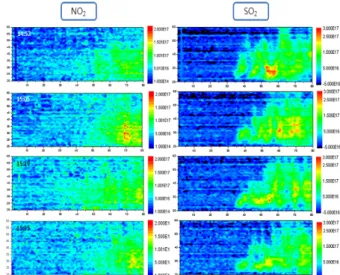
Measured SCDs were converted to mixing ratios in calculating the rate of NO2 increase at the center of the plume. This study presents quantitative measurements of the rate of NO2 increase in a rising plume. NO2 increase rates of 60 and 70 ppb s
–1were observed at distances of about 45 m from the two stacks of the Pyeongtaek Power Plant, northwest South Korea.
Figure 1. Temporal and spatial variations of NO
2and SO
2SCDs measured from the power plant plume
Detailed images of the near-surface NO2 Differential Slant Column Density (DSCD) distribution over Beijing were obtained in Figure 2. Images with less than a 30- min temporal resolution showed both horizontal and vertical variations in NO2 distributions. The vertical and horizontal plume dispersion at rush hours was also observed in Figure 2.
Figure
3shows the capability of Multi-Axis (MAX)- DOAS of retrieving information on atmospheric aerosol
Figure 2. Temporal and spatial variations of NO
2SCDs measured from over Beijing, China. The measurement was taken at Beijing University on September 9th 2008.
Figure 3. Temporal variations of aerosol vertical distributions measured at Fresno, USA using UV MAX- DOAS during the Asian dust period in 2008.
vertical profiles based on O4 slant column densities
measured at a visible region. MAX-DOAS based aerosol
extinction coefficient and aerosol optical depth (AOD)
obtained for the lower surface layers were compared with those obtained by lidar and sunphotometer measurements at Anmyun, Gwangju, and Fresno supersites as shown in Figure 3. The advantages and shortcomings of MAX- DOAS measurement for aerosol extinction retrieval are also discussed in detail.
4.