2018 Oct 1. [Epub ahead of print]
https://doi.org/10.3904/kjim.2018.133
1Division of Cardiology, Department of Internal Medicine, Keimyung University Dongsan Medical Center, Daegu; 2Department of Internal Medicine, Inje University Busan Paik Hospital, Busan, Korea; 3Sanofi R&D, Shanghai, China; 4Sanofi R&D, Montpellier, France; 5Sanofi Korea, Seoul; 6Department of Internal Medicine, Kyung Hee University Hospital at Gangdong, Seoul, Korea
Received : April 9, 2018 Revised : April 26, 2018 Accepted : April 30, 2018 Correspondence to Chong-Jin Kim, M.D.
Department of Internal Medicine, Kyung Hee University Hospital at Gangdong, 892 Dongnam-ro, Gangdong-gu, Seoul 05278, Korea Tel: +82-2-440-6106
Fax: +82-2-440-7699
E-mail: [email protected] Chang-Wook Nam, M.D.
Division of Cardiology, Department of Internal Medicine, Keimyung University Dongsan Medical Center, 56 Dalseong-ro, Jung-gu, Daegu 41931, Korea
Tel: +82-53-250-8015 Fax: +82-53-250-7034 E-mail: [email protected]
Background/Aims: Efficacy and safety data of alirocumab, a fully human mono- clonal antibody to proprotein convertase subtilisin/kexin type 9 (PCSK9), is not yet well established in the Korean population. We assessed them in ODYSSEY-KT through the pre-specified Korean subanalysis.
Methods: In the ODYSSEY-KT study, South Korean and Taiwanese patients with hypercholesterolemia and high cardiovascular risks were randomized (1:1) to ali- rocumab or placebo. Alirocumab was self-administered subcutaneously at 75 mg every 2 weeks with a maximally tolerated statin dose with or without other lip- id-modifying therapies. Alirocumab dose was increased to 150 mg every 2 weeks at week 12 if low density lipoprotein cholesterol (LDL-C) ≥ 70 mg/dL at week 8.
Primary endpoint was percent change in LDL-C from baseline to week 24. Re- sults from Korean cohort (n = 83: 40 for alirocumab and 43 for placebo, respective- ly) analyses are reported here.
Results: In alirocumab group, the least square of mean change percent in LDL-C levels was –65.7% (placebo: 11.1%; p < 0.0001) and 92.0% of them achieved LDL-C
< 70 mg/dL (placebo: 12.7%; p < 0.0001) at week 24. Alirocumab also showed sig- nificantly greater improvements in high density lipoprotein cholesterol (HDL-C), non-HDL-C, total cholesterol, lipoprotein(a), and apolipoprotein B than placebo (p < 0.05). Two consecutive calculated LDL-C values < 25 mg/dL were observed in 37.5% of alirocumab-treated patients. Overall, 45.0% alirocumab-treated and 51.2% placebo-treated patients experienced treatment-emergent adverse events (TEAEs) without discontinuation of treatment due to TEAEs.
Conclusions: Alirocumab has demonstrated to be effective in improvement of LDL-C and related lipid profiles in Korean cohort. Alirocumab was generally well tolerated with no significant safety signals.
Keywords: PCSK9; Cholesterol, LDL; ODYSSEY; Hypercholesterolemia
Efficacy and safety of alirocumab in Korean patients with hypercholesterolemia and high cardiovascular risk: subanalysis of the ODYSSEY-KT study
Chang-Wook Nam1, Dong-Soo Kim2, Jianyong Li3, Marie T. Baccara-Dinet4, Ivy Li3, Ji-Hyun Kim5, and Chong-Jin Kim6
INTRODUCTION
Dyslipidemia is a major risk factor for cardiovascular disease (CVD), the second-leading cause of mortality in
Korea [1-3] and is also associated with increased preva- lence of metabolic syndrome. In recent years, the prev- alence of dyslipidemia has been increasing steadily in Korea [4,5]. The association between higher low density
lipoprotein cholesterol (LDL-C) level and CVD is well established and guidelines recommend < 70 or < 100 mg/dL as target levels in patients with very high or high CV risk, respectively [6,7].
Guidelines for the management of dyslipidemia in Korea were established in 2015 [8]. These guidelines rec- ommend lifestyle modification and pharmacological management of dyslipidemia for prevention of CVD.
The CEPHEUS Pan-Asian survey showed suboptimal achievement of target LDL-C and total cholesterol (TC) with existing treatments in Korea [9].
Among several lipid lowering therapies (LLTs), pro- protein convertase subtilisin/kexin type 9 (PCSK9) in- hibitors modulate cholesterol homeostasis via its ability to upregulate LDL receptor expression on hepatocyte cell membrane and by decreasing plasma LDL-C levels [10]. Recent consensus statements from both the Ameri- can College of Cardiology and European Society of Car- diology/European Atherosclerosis Society recommend the use of PCSK9 inhibitors or ezetimibe in patients with very high or high cardiovascular (CV) risk who have high baseline LDL-C levels (70 to 189 mg/dL) uncon- trolled by maximally tolerated doses of statins [11,12].
Alirocumab is a fully human monoclonal antibody that inhibits PCSK9 and has been clinically evaluated for its ability to reduce LDL-C levels. Several ODYSSEY phase 3 studies have demonstrated that alirocumab can reduce LDL-C levels substantially when used as monotherapy or when combined with background statin therapy with or without other LLTs [13-21].
However, the safety and efficacy of alirocumab has not been established in the Korean population. The ODYS- SEY KT study was performed to assess the safety and efficacy of alirocumab among Korean and Taiwanese patients with uncontrolled serum cholesterol levels and coronary heart disease (CHD) or those at risk for CHD [22]. Here we present a pre-specified subanalysis for Ko- rean patients.
METHODS
Study designThe ODYSSEY KT study (NCT02289963) was a random- ized, double-blind, placebo-controlled, parallel-group, and multicenter study [22]. The Korean cohort study was
conducted in 16 study centers across Korea between Jan- uary 2015 and April 2016. The protocol was approved by the relevant independent Institutional Review Boards (Keimyung University Dongsan Medical Center IRB 2014-09-009). The study was performed according to the principles of the Declaration of Helsinki and appli- cable amendments and the International Conference on Harmonisation guidelines for Good Clinical Practice.
All participating patients provided written informed consent.
Patients
Eligible patients (aged ≥ 18 years) had established CHD or CHD risk equivalents and hypercholesterolemia that was inadequately controlled with a maximally tolerated statin dose (with or without other LLTs) at a stable dose ≥ 4 weeks prior to screening. CHD risk equivalents were defined as history of CVD, moderate chronic kidney disease, or dia- betes with multiple risk factors. Inadequately controlled hypercholesterolemia was defined as LDL-C ≥ 70 mg/dL in patients with documented CVD history or ≥ 100 mg/dL in patients without CVD history. The following were con- sidered maximally tolerated statin doses: atorvastatin, 40 to 80 mg/day; rosuvastatin, 20 mg/day; and simvastatin, 40 mg/day. Patients receiving daily dose of atorvastatin, rosuvastatin, or simvastatin dose and considered appro- priate by the investigator were also eligible to participate.
Exclusion criteria for this study are described in Supple- mentary Table 1.
Treatment regimen
The total study duration was 35 weeks, consisting of a 3-week screening period, 24 weeks of double-blind treat- ment, and an 8-week follow-up period. Eligible patients were randomized 1:1 to receive either alirocumab 75 mg every 2 weeks or placebo every 2 weeks using an auto-in- jector device through the subcutaneous route. Study vis- its were on weeks 0, 4, 8, 12, 16, and 24. Follow visit was done 8 weeks after the end of treatment visit. Patients on alirocumab who did not achieve LDL-C < 70 mg/dL at week 8 were uptitrated to alirocumab 150 mg every 2 weeks from week 12 onwards. Blinding was maintained in these patients.
Endpoints
The primary efficacy endpoint was the percent change
in calculated LDL-C values between baseline and week 24 in the intent-to-treat (ITT) population. Other key endpoints included the percent change from baseline to week 24 in non-high density lipoprotein cholesterol (non-HDL-C), TC, HDL-C, fasting triglycerides (TGs), lipoprotein(a) (Lp(a)), apolipoprotein A1 and apolipopro- tein B (Apo B) and the proportion of patients reaching a calculated LDL-C < 70 mg/dL at week 24. Analyses of lip- id samples were performed by a central laboratory using standard procedures and individual site laboratory tests for lipid parameters were not allowed during the study period. LDL-C levels were calculated using the Friede- wald formula. LDL-C levels were reflexively measured via β-quantification when TG levels were > 400 mg/dL.
In addition, LDL-C levels were systematically measured (via the β-quantification method) at weeks 0 and 24 for efficacy analysis purposes.
Safety was assessed throughout the study by moni- toring treatment-emergent adverse events (TEAEs), se- rious adverse events (SAEs), laboratory data, and vital signs. TEAEs were defined as adverse events (AEs) that occurred during the time from first administration of blinded study drug to 10 weeks after last administration of blinded study drug.
Statistical analysis
The sample size calculation has been described previ- ously [22]. Briefly, a total sample size of 40 patients (20 patients in each group) was required to achieve 95%
power to detect a mean percent change difference in LDL-C of 30% with a 0.05 two-sided significance level and assuming a common standard deviation (SD) of 25%
with all patients having an evaluable primary endpoint.
At last, total sample size (n = 83) was bigger than the esti- mated minimum size to satisfy the requirement because we also intended to identify the safety data as well as effi- cacy. Calculations were done using nQuery Advisor ver- sion 7.0 (Statsols, Cork, Ireland).
The primary efficacy endpoint was analyzed using a mixed effect model with repeated measures (MMRM) with all post-baseline data available and missing data accounted for. Fixed categorical effects of treatment group (alirocumab vs. placebo), time (weeks 4, 8, 12, 16, and 24), randomization strata, treatment-by-time point interaction, strata-by-time point interaction, and con- tinuous fixed covariates of baseline LDL-C value and
baseline value-by-time point interaction were included in the MMRM. The 95% confidence intervals (CIs) of the differences were estimated from the model.
Other key endpoints were analyzed in a sequential order using a hierarchical inferential approach when the primary endpoint was significant at 5% α level.
Continuous secondary endpoints with an anticipat- ed normal distribution were analyzed using MMRM.
Continuous secondary endpoints with a normal dis- tribution (lipids other than Lp(a) and TGs) were ana- lyzed as for the primary endpoint while those with- out normal distribution (Lp(a) and TGs) and binary secondary endpoints were analyzed using multiple imputation approach followed by robust regression.
Target achievement for LDL-C was analyzed by mul- tiple imputations followed by logistic regression. The ITT population included all randomized patients with LDL-C values available at baseline and at least one other post-randomization time point till the end of study. The modified intent-to-treat (mITT) includ- ed the randomized patients who had received at least one dose or part of the study with an evaluable prima- ry endpoint during the treatment period and within one of the analysis windows. All randomized patients who received at least one dose or part of a dose of the alirocumab comprised the safety set. Safety data were analyzed by descriptive statistics and were focused on the TEAE period. All statistical analyses were con- ducted using SAS version 9.4 (SAS Institute Inc., Cary, NC, USA).
RESULTS
Patient characteristics
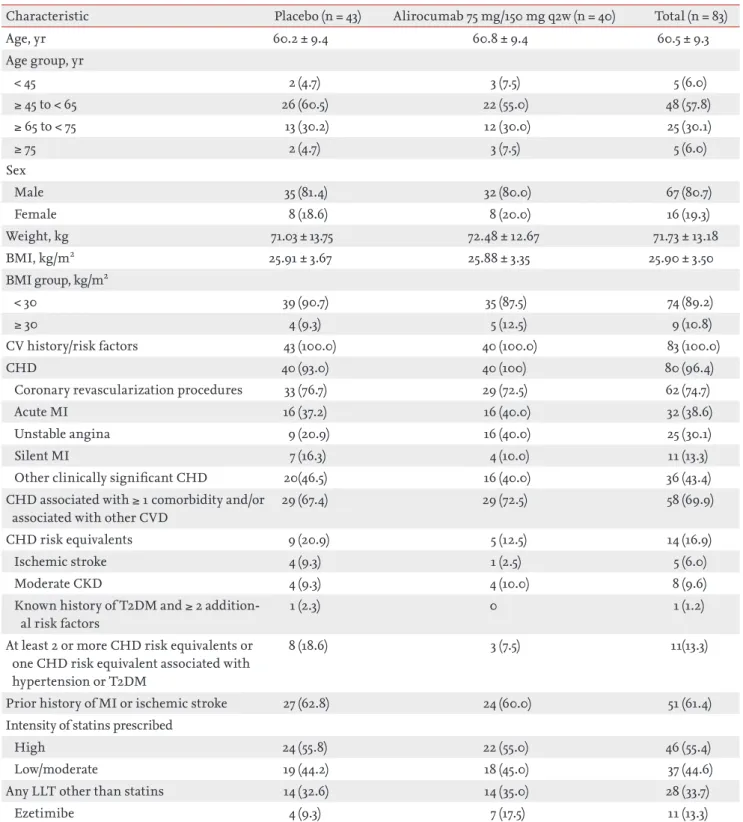
A total of 83 patients were enrolled in the Korean sub- group of the ODYSSEY KT study. Both the ITT and safe- ty populations consisted of 83 patients (40 patients in the alirocumab group and 43 patients in the placebo group) while the mITT population comprised 82 patients (40 patients in the alirocumab group and 42 patients in the placebo group) (Fig. 1). Both treatment groups were matched for age, gender, weight, body mass index, med- ical history, and statin type by intensity. More patients in alirocumab group were taking ezetimibe than those in placebo group (n = 7, 17.5%; and n = 4, 9.3%, respec- tively), but it did not reach the significance level of 0.05
in the post hoc chi-square test (Table 1). Additionally, no significant differences were found in lipid parameters between alirocumab and placebo groups at baseline (p >
0.05; post hoc t tests) (Table 2).
Efficacy analyses
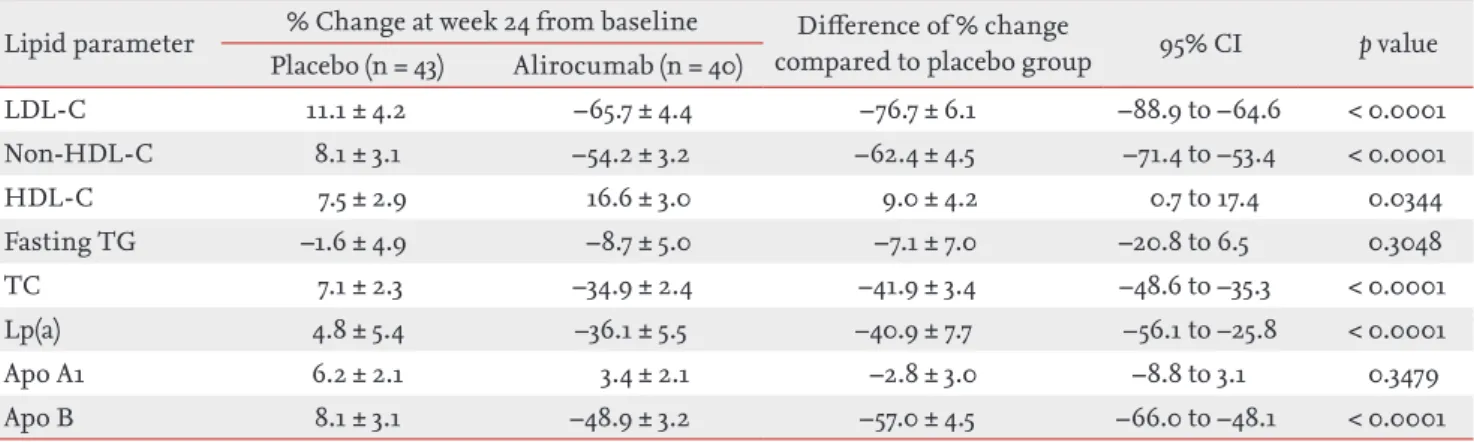
There was a reduction in LDL-C levels at week 4 and it was maintained till week 24. The calculated least squares mean (LSM) ± standard error (SE) of LDL-C levels in the ITT population receiving alirocumab decreased from 90.7 ± 3.6 mg/dL at baseline to 33.8 ± 4.5 mg/dL at week 24 (Fig. 2). In comparison, LSM ± SE of LDL-C levels in- creased from 95.1 ± 4.1 at baseline to 102.9 ± 4.4 at week 24 in patients receiving placebo. The percent change in LSM ± SE of LDL-C from baseline to week 24 was –65.7% ± 4.4% in the alirocumab group in comparison with 11.1% ± 4.2%) in the placebo group. The difference in LSM ± SE for alirocumab versus placebo was –76.7% ± 6.1% (95% CI, –88.9 to –64.6; p < 0.0001) (Table 3 and Fig.
3). Similarly, the percent change in LDL-C from baseline for the mITT population given as LSM ± SE was –67.3%
± 4.4% in the alirocumab group in comparison with 11.1% ± 4.2% in the placebo group and the difference in LSM ± SE for alirocumab versus placebo was –78.5% ± 6.1% (95% CI, –90.6 to –66.3; p < 0.0001) (Fig. 4).
Significant differences in LSM ± SE for alirocumab versus placebo were observed at week 24 in the follow- ing lipid parameters: non-HDL-C (–62.4% ± 4.5%; 95%
CI, –71.4 to –53.4; p < 0.0001), HDL-C (9.0% ± 4.2%; 95%
CI, 0.7 to 17.4; p = 0.034), TC (–41.9% ± 3.4%; 95% CI, –48.6 to –35.3; p < 0.0001), Lp(a) (–40.9% ± 7.7%; 95% CI, –56.1 to –25.7; p < 0.0001), and ApoB (–57.0% ± 4.5%; 95% CI, –66.0 to –48.1; p < 0.0001) (Table 3 and Fig. 3). The same trend was found in mITT comparisons (Supplementary Table 2).
The proportion of patients achieving LDL-C < 70 mg/
dL at week 24 was 92.0% in the alirocumab group and 12.7% in the placebo group (combined estimate for odds ratio, 157.4; 95% CI, 19.0 to 1,306.7; p < 0.0001). Three alirocumab-treated patients (7.5%) had LDL-C values ≥ 70 mg/dL at week 8 and were uptitrated to alirocumab 150 mg every 2 weeks at week 12. During the treatment period, 15 alirocumab-treated patients (37.5%) had two consecutive calculated LDL-C values < 25 mg/dL, among whom four patients (10.0%) displayed two consecutive LDL-C values < 15 mg/dL.
Safety analysis
A total of 18 patients (45.0%) in the alirocumab group and 22 patients (51.2%) in the placebo group experienced a TEAE. The most commonly reported TEAEs in the alirocumab group by system organ class (SOC) and pre- ferred term (PT) classification were nervous system dis- orders (n = 5, 12.5%), majority of which were headaches (n = 4, 10.0%); followed by infections and infestations (n
= 4, 10.0%), majority of which were nasopharyngitis (n = 3, 7.5%); and injury, poisoning, and procedural compli- cations (n = 4, 10.0%), majority of which were due to fall (n = 2, 5.0%) (Table 4). The most commonly reported TE- AEs in placebo group by SOC and PT classification were infections and infestations (n = 6, 14.0%), followed by gastrointestinal disorders (n = 5, 11.6%) and general dis- orders and administration site conditions (n = 5, 11.6%) (Table 4). Among alirocumab-treated patients who had two consecutive calculated LDL-C < 25 mg/dL (n = 15), one case of hepatobiliary disorders (hepatitis acute) and one case of injury, poisoning and procedural compli- cations (fall and radius fracture for the same case) were identified.
316 Assessed for eligibility (Korea + Taiwan)
83 Randomized in Korea
43 Placebo control 40 Alirocumab 75mg/150mg 117 Screen failure 116 Randomized to Taiwan
43 Completed study treatment 40 Completed study treatment
43 Analyzed in safety population 43 Analyzed in ITT population 42 Analyzed in mITT population
40 Analyzed in safety population 40 Analyzed in ITT population 40 Analyzed in mITT population Figure 1. Patient flow: CONSORT diagram. ITT, intent-to- treat; mITT, modified intent-to-treat.
Table 1. Patient characteristics at baseline
Characteristic Placebo (n = 43) Alirocumab 75 mg/150 mg q2w (n = 40) Total (n = 83)
Age, yr 60.2 ± 9.4 60.8 ± 9.4 60.5 ± 9.3
Age group, yr
< 45 2 (4.7) 3 (7.5) 5 (6.0)
≥ 45 to < 65 26 (60.5) 22 (55.0) 48 (57.8)
≥ 65 to < 75 13 (30.2) 12 (30.0) 25 (30.1)
≥ 75 2 (4.7) 3 (7.5) 5 (6.0)
Sex
Male 35 (81.4) 32 (80.0) 67 (80.7)
Female 8 (18.6) 8 (20.0) 16 (19.3)
Weight, kg 71.03 ± 13.75 72.48 ± 12.67 71.73 ± 13.18
BMI, kg/m2 25.91 ± 3.67 25.88 ± 3.35 25.90 ± 3.50
BMI group, kg/m2
< 30 39 (90.7) 35 (87.5) 74 (89.2)
≥ 30 4 (9.3) 5 (12.5) 9 (10.8)
CV history/risk factors 43 (100.0) 40 (100.0) 83 (100.0)
CHD 40 (93.0) 40 (100) 80 (96.4)
Coronary revascularization procedures 33 (76.7) 29 (72.5) 62 (74.7)
Acute MI 16 (37.2) 16 (40.0) 32 (38.6)
Unstable angina 9 (20.9) 16 (40.0) 25 (30.1)
Silent MI 7 (16.3) 4 (10.0) 11 (13.3)
Other clinically significant CHD 20(46.5) 16 (40.0) 36 (43.4)
CHD associated with ≥ 1 comorbidity and/or associated with other CVD
29 (67.4) 29 (72.5) 58 (69.9)
CHD risk equivalents 9 (20.9) 5 (12.5) 14 (16.9)
Ischemic stroke 4 (9.3) 1 (2.5) 5 (6.0)
Moderate CKD 4 (9.3) 4 (10.0) 8 (9.6)
Known history of T2DM and ≥ 2 addition- al risk factors
1 (2.3) 0 1 (1.2)
At least 2 or more CHD risk equivalents or one CHD risk equivalent associated with hypertension or T2DM
8 (18.6) 3 (7.5) 11(13.3)
Prior history of MI or ischemic stroke 27 (62.8) 24 (60.0) 51 (61.4)
Intensity of statins prescribed
High 24 (55.8) 22 (55.0) 46 (55.4)
Low/moderate 19 (44.2) 18 (45.0) 37 (44.6)
Any LLT other than statins 14 (32.6) 14 (35.0) 28 (33.7)
Ezetimibe 4 (9.3) 7 (17.5) 11 (13.3)
Values are presented as mean ± SD or number (%).
q2w, every 2 weeks; BMI, body mass index; CV, cardiovascular; CHD, coronary heart disease; MI, myocardial infarction; CVD, cardiovascular disease; CKD, chronic kidney disease; T2DM, type 2 diabetes mellitus; LLT, lipid lowering therapy.
Eight treatment-emergent SAEs were experienced by five patients (12.5%) from the alirocumab group. These SAEs were unstable angina, brachiocephalic artery ste- nosis, traumatic fracture, radius fracture (one patient each) and two ligament sprains and two muscle strains (one patient). Eight treatment-emergent SAEs were experienced by five patients (11.6%) from the placebo group. These SAEs were road traffic accident and arterial injury (one patient); acute myocardial infarction on two occasions (one patient); unstable angina and peripher- al arterial disease (one patient); pulmonary tuberculosis (one patient) and coronary artery stenosis (one patient).
None of the reported SAEs were deemed related to study drug by both the investigator and the sponsor. No treat-
ment-related discontinuation or death was reported due to TEAEs in either group.
DISCUSSION
The ODYSSEY KT study was the first to evaluate the safety and efficacy of alirocumab 75 mg (with a provi- sion to uptitrate the dose to 150 mg) every 2 weeks for 24 weeks in Korean patients with inadequately controlled hypercholesterolemia and at high risk of CVD. The main findings are as follows. (1) The percent change of LDL-C from baseline in the ITT population was –65.7% in the alirocumab group and the difference of LDL-C versus placebo was –76.7% (p < 0.0001). (2) Alirocumab treat- ment additionally improved lipid parameters including HDL-C, non-HDL-C, TC, Lp(a), and Apo B versus pla- cebo in the Korean cohort (p < 0.05). (3) Alirocumab did not induce higher rates of TEAEs and SAEs than place- bo. None of the eight treatment-emergent SAEs in the alirocumab group, were deemed related to alirocumab.
In recent years, improvements in laboratory lipid measurements through PCSK9 inhibition have revealed to be associated with better clinical prognosis. Evolo- cumab reduced the risk of CV events (composite of CV death, myocardial infarction, stroke, hospitalization for unstable angina, or coronary revascularization) by 15%
at 3 years of follow-up in FOURIER clinical trial [23].
Most recently in ODYSSEY outcomes trial, alirocumab proved 15% reduction in CV events (composite of CHD death, non-fatal myocardial infarction, fatal or non-fatal Table 2. Baseline lipid profile of study patients
Variable Placebo (n = 43) Alirocumab 75 mg/ 150 mg q2w (n = 40) Total (n = 83)
LDL-C, mg/dL 95.1 ± 27.0 90.7 ± 22.9 93.0 ± 25.0
Non-HDL-C, mg/dL 124.4 ± 32.6 117.4 ± 27.0 121.0 ± 30.1
HDL-C, mg/dL 48.5 ± 13.1 45.9 ± 10.6 47.3 ± 11.9
Fasting TG, mg/dL 146.2 ± 67.9 144.2 ± 117.1 145.3 ± 94.3
TC, mg/dL 172.9 ± 28.4 163.3 ± 28.0 168.3 ± 28.4
Lp(a), mg/dL 43.4 ± 36.4 37.0 ± 36.8 40.4 ± 36.5
Apo A1, mg/dL 136.2 ± 25.1 134.0 ± 16.9 135.1 ± 21.5
Apo B, mg/dL 84.6 ± 18.2 79.3 ± 14.7 82.1 ± 16.7
Values are presented as mean ± SD.
q2w, every 2 weeks; LDL-C, low density lipoprotein cholesterol; HDL-C, high density lipoprotein cholesterol; TG, triglyceride;
TC, total cholesterol; Lp(a), lipoprotein(a); Apo A1, apolipoprotein A1; Apo B, apolipoprotein B.
120 100 80 60 40 20 0
Placebo
95.1 99.6 103.3 101.5 97.7 102.9
90.7
40.4
32.1 35.7 32.9 33.8
Alirocumab 75mg/150mg q2w
Baseline Week 4 Week 8 Week 12 Week 16 Week 24
Least-squares mean (mg/dL)
Figure 2. Calculated low density lipoprotein cholesterol lev- els (least-squares mean ± standard error) in intent-to-treat population during treatment phase. q2w, every 2 weeks.
ischemic stroke, or unstable angina requiring hospital- ization) and appeared associated with 15% lower rate of all-cause death at 4 years of follow-up among patients with “recent acute coronary syndrome” defined as an index hospitalization for acute myocardial infarction or unstable angina 1 to 12 months before the enrollment [24]. In summary, it can be implicated that the improve-
ments in LDL-C and related lipid parameters observed in current study might lead to clinical benefits in CV morbidity and mortality among Korean population. It requires further investigation.
There were several findings in the current Korean co- hort that were unique relative to the entire ODYSSEY KT population [22]. The use of high-intensity statins was Table 3. Least squares mean differences (vs. placebo) in LDL-C and secondary lipid parameters in patients of alirocumab group in intent-to-treat population
Lipid parameter % Change at week 24 from baseline Difference of % change
compared to placebo group 95% CI p value Placebo (n = 43) Alirocumab (n = 40)
LDL-C 11.1 ± 4.2 –65.7 ± 4.4 –76.7 ± 6.1 –88.9 to –64.6 < 0.0001
Non-HDL-C 8.1 ± 3.1 –54.2 ± 3.2 –62.4 ± 4.5 –71.4 to –53.4 < 0.0001
HDL-C 7.5 ± 2.9 16.6 ± 3.0 9.0 ± 4.2 0.7 to 17.4 0.0344
Fasting TG –1.6 ± 4.9 –8.7 ± 5.0 –7.1 ± 7.0 –20.8 to 6.5 0.3048
TC 7.1 ± 2.3 –34.9 ± 2.4 –41.9 ± 3.4 –48.6 to –35.3 < 0.0001
Lp(a) 4.8 ± 5.4 –36.1 ± 5.5 –40.9 ± 7.7 –56.1 to –25.8 < 0.0001
Apo A1 6.2 ± 2.1 3.4 ± 2.1 –2.8 ± 3.0 –8.8 to 3.1 0.3479
Apo B 8.1 ± 3.1 –48.9 ± 3.2 –57.0 ± 4.5 –66.0 to –48.1 < 0.0001
Values are presented as mean ± SE.
LDL-C, low density lipoprotein cholesterol; CI, confidence interval; HDL-C, high density lipoprotein cholesterol; TG, tri- glyceride; TC, total cholesterol; Lp(a), lipoprotein(a); Apo A1, apolipoprotein A1; Apo B, apolipoprotein B.
20 0 –20 –40 –60 –80
–100 LDL-C Non-HDL-C HDL-C TG TC Lp(a) Apo A1 Apo B –78.5
–64.1 8.7
–8.4
–43 –42.3 –3.5
–58.2
Percentage change from baseline in leastsquares of mean
Figure 4. Least squares mean difference (vs. placebo) in low density lipoprotein cholesterol (LDL-C) and secondary lipid parameters in patients in the alirocumab group in modified intent-to-treat population. LDL-C levels given were calculat- ed values. Triglyceride levels were ascertained under fasting conditions. HDL-C, high density lipoprotein cholesterol;
TG, triglyceride; TC, total cholesterol; Lp(a), lipoprotein(a);
Apo A1, apolipoprotein A1; Apo B, apolipoprotein B.
20 0 –20 –40 –60 –80
–100 LDL-C Non-HDL-C HDL-C TG TC Lp(a) Apo A1 Apo B –76.7
–62.4 9
–7.1
–41.9 –40.9 –2.8
–57
Percentage change from baseline in leastsquares of mean
Figure 3. Least squares mean difference (vs. placebo) in low density lipoprotein cholesterol (LDL-C) and secondary lipid parameters in patients in the alirocumab group in intent- to-treat population. LDL-C levels given were calculated values. Triglyceride levels were ascertained under fasting conditions. HDL-C, high density lipoprotein cholesterol;
TG, triglyceride; TC, total cholesterol; Lp(a), lipoprotein(a);
Apo A1, apolipoprotein A1; Apo B, apolipoprotein B.
lower in the Korean cohort in comparison to the entire KT population (55.4% vs. 72.4%). In contrast, the use of LLTs other than statins were higher in the Korean co- hort that in the study population (33.7% vs. 23.1%). Addi- tionally, baseline Lp(a) and fasting TG levels were higher in the Korean cohort. Compared to the entire ODYSSEY KT study population, nominally larger percent change in LDL-C from baseline in the alirocumab group ap- peared at week 12 (–62.3% vs. –57.9%) and was maintained week 24 (–65.7% vs. –57.1%) in the Korean cohort. Similar- ly, among alirocumab group, the proportion of patients achieving LDL-C values < 70 mg/dL (92.0% vs. 85.8%) and the proportion of patients with two consecutive LDL-C values < 15 mg/dL (10.0% vs. 9.3%) or < 25 mg/dL (37.5% vs.
27.8%) were nominally higher in the Korean cohort. In short, LDL-C reduction through alirocumab treatment in Korean cohort appeared at least consistent with the results from whole ODYSSEY KT cohort. With regards to safety data, a smaller proportion of overall patients in the Korean cohort displayed TEAEs in comparison to the ODYSSEY KT study population (48.2% vs. 60.3%).
Similarly, the incidence of TEAEs in the alirocum- ab-treated patients was lower in the Korean cohort in comparison to those in the ODYSSEY KT population (45.0% vs. 58.8%). In addition, neither death nor perma- nent discontinuation due to TEAE were observed in the Korean cohort, whereas one death (influenza A infec- tion) and three permanent discontinuations due to TE- AEs (one in placebo group and two in alirocumab group) were reported in the Taiwanese study population.
The results show that, with similar design and in- clusion criteria, Korean patients exhibited consistent LDL-C reduction with previous ODYSSEY trials. In the ODYSSEY COMBO I and II studies, treatment with add- on alirocumab to background statin therapy reduced LDL-C levels by at least 48.2% [14,17]. In the ODYSSEY OPTIONS I and II studies, add-on alirocumab to ator- vastatin 20 or 40 mg resulted in a reduction of LDL-C levels of 44.1% and 54%, respectively [13], while add-on alirocumab to rosuvastatin 10 or 20 mg resulted in a reduction of LDL-C levels of 50.6% and 36.3%, respec- tively [15]. In patients with heterozygous familial hyper- cholesterolemia (heFH), alirocumab treatment reduced LDL-C levels by at least 51.4% [16]. In patients with statin intolerance, alirocumab treatment reduced LDL-C lev- els by 45% [18]. Another study reported that 150 mg of
alirocumab every 2 weeks induced –62.0% of change in LDL-C level at week 24 from baseline [19]. Considering that only three out of 40 patients were uptitrated to 150 mg in Korean cohort, it might suggest that 75 mg every 2 weeks is enough for the majority of Korean dyslipid- emic patients. In studies on Japanese patients (with or without heFH), alirocumab treatment reduced LDL-C levels by at least 40% [20,21]. Similar to the results ob- served in this Korean population, a pooled analysis of eight ODYSSEY phase 3 trials (n = 4,629) indicated that alirocumab provided consistent reductions in LDL-C regardless of the statin dose and type [25]. In the ODYS- SEY LONG TERM trial (n = 2,341), TEAEs were observed Table 4. Adverse events and laboratory evaluations in safety population (with incidence of ≥ 5.0% in alirocumab group)
Variable Placebo
(n = 43)
Alirocumab 75 mg/150 mg q2w
(n = 40) Patients with any TEAE 22 (51.2) 18 (45.0) Patients with any
treatment-emergent SAE
5 (11.6) 5 (12.5)
Classification according to SOC and PT
Nervous system disorders 2 (4.7) 5 (12.5)
Headache 0 4 (10.0)
Dizziness 0 1 (2.5)
Infections and infestations 6 (14.0) 4 (10.0)
Nasopharyngitis 2 (4.7) 3 (7.5)
URTI 0 1 (2.5)
Injury, fall, and procedural complications
3 (7.0) 4 (10.0)
Fall 1 (2.3) 2 (5.0)
Facial bones fracture 0 1 (2.5)
Gastrointestinal disorders 5 (11.6) 2 (5.0)
Chronic gastritis 0 1 (2.5)
Dyspepsia 0 1 (2.5)
Skin and subcutaneous tissue disorders
1 (2.3) 2 (5.0)
Eczema 0 1 (2.5)
Rash 0 1 (2.5)
Values are presented as number (%).
q2w, every 2 weeks; TEAE, treatment-emergent adverse event;
SAE, serious adverse event; SOC, system organ class; PT, pre- ferred term; URTI, upper respiratory tract infection.
in 81% of alirocumab-treated patients [19], which is more than that observed in the Korean cohort (45%). The most common TEAEs in the ODYSSEY LONG TERM trial of alirocumab-treated patients were general allergic reactions (10.1%) and local injection-site reactions (5.9%) [19], while the most common TEAEs in the Korean co- hort were headache (10.0%) and nasopharyngitis (7.5%) (Table 4).
While the patients in the ODYSSEY KT study were receiving background statin therapy, it is important to note that high-dose statins are known to upregulate PCSK9 expression [26] and could therefore interfere with PCSK9 inhibitors.
Although several reports suggested that low-to-mod- erate dose statins are sufficient in Korean population [27,28], it still appears to be inadequate in achieving the goal of LDL-C < 70 mg/dL in patients with very high CV risk [6-8]. Further investigations are needed to assess the necessity of more aggressive treatment policy including combination of alirocumab for Korean dyslipidemic pa- tients.
There are several limitations to this study. The rel- atively small number of patients (n = 40) in the aliro- cumab group may not be representative of the relevant Korean population. There was a 4:1 ratio of males to fe- males in the study, and very few patients were < 45 or > 75 years. As this study recruited patients already on statins or other LLTs, it is not known how the Korean popula- tion would respond to alirocumab as monotherapy. The small number of patients and the limited trial period may be insufficient to capture all relevant AEs.
In conclusion, this study demonstrated that alirocum- ab showed significantly greater efficacy in reduction of LDL-C levels, as well as improvements in HDL-C, non- HDL-C, TC, Lp(a), and Apo B than placebo in Korean patients. In addition, alirocumab was generally well tol- erated. These results indicate that Korean dyslipidemic patients could achieve higher efficacy in LDL-C reduc- tion with alirocumab augmentation than with conven- tional LLTs only.
Conflict of interest
This study was funded by Sanofi and Regeneron Phar- maceuticals, Inc.
Acknowledgments
This study was supported by Sanofi and Regeneron in data collection and analysis, assistance with statisti- cal analysis, and critical review of the article. Medical writing and editorial support in the preparation of this publication was provided by Satyendra Shenoy from De- scribe Scientific Writing & Communications and Derek Ho who were paid for by Sanofi and Anahita Gouri and Rohan Mitra from Sanofi. The authors, individually and collectively, are responsible for all content and editorial decisions. Chang-Wook Nam, Dong-Soo Kim, Chong- Jin Kim received payment from neither Sanofi nor Regeneron Pharmaceuticals, Inc. directly or indirectly (through a third party) related to the development/pre- sentation of this publication.
REFERENCES
1. Jeong JS, Kwon HS. Prevalence and clinical characteris- tics of dyslipidemia in Koreans. Endocrinol Metab (Seoul) 2017;32:30-35.
2. Lim D, Ha M, Song I. Trends in the leading causes of death in Korea, 1983-2012. J Korean Med Sci 2014;29:1597-1603.
3. Korea Centers for Disease Control and Prevention.
Program for prevention and management of a car- dio-cerebrovascular disease [Internet]. Cheongju (KR):
KEY MESSAGE
1. Alirocumab add on treatment can make an ad- ditional low density lipoprotein cholesterol level
reduction up to 65% to 75% compared with statin only therapy.
2. Alirocumab treatment additionally improved lip- id parameters including high density lipoprotein cholesterol (HDL-C), non-HDL-C, total choles- terol, lipoprotein(a), and apolipopro tein B versus placebo in the Korean patients.
3. Although alirocumab showed stronger effect on lipid modification than placebo, alirocumab did not induce higher rates of treatment-emergent adverse events and serious adverse events than statin only therapy.
KCDC, 2017 [cited 2018 Aug 11]. Available from: http://
www.cdc.go.kr/CDC/eng/contents/CdcEngContent- View.jsp?cid=74261&menuIds=HOME002-MNU0576- MNU0582.
4. Lim S, Shin H, Song JH, et al. Increasing prevalence of metabolic syndrome in Korea: the Korean National Health and Nutrition Examination Survey for 1998-2007.
Diabetes Care 2011;34:1323-1328.
5. Korean Society of Lipidology and Atherosclerosis. Dyslip- idemia fact sheet in Korea [Internet]. Seoul (KR): Korean Society of Lipidology and Atherosclerosis, c2015 [cited 2018 Aug 11]. Available from: http://www.lipid.or.kr/file/
Dyslipidemia%20fact%20sheet_eng_Final.pdf.
6. Authors/Task Force Members, Catapano AL, Graham I, et al. 2016 ESC/EAS guidelines for the management of dys- lipidaemias: the task force for the management of dyslip- idaemias of the European Society of Cardiology (ESC) and European Atherosclerosis Society (EAS) developed with the special contribution of the European Association for Cardiovascular Prevention & Rehabilitation (EACPR).
Atherosclerosis 2016;253:281-344.
7. Jacobson TA, Ito MK, Maki KC, et al. National lipid asso- ciation recommendations for patient-centered manage- ment of dyslipidemia: part 1: full report. J Clin Lipidol 2015;9:129-169.
8. Committee for the Korean Guidelines for the Manage- ment of Dyslipidemia. 2015 Korean guidelines for the management of dyslipidemia: executive summary (En- glish translation). Korean Circ J 2016;46:275-306.
9. Park JE, Chiang CE, Munawar M, et al. Lipid-lowering treat- ment in hypercholesterolaemic patients: the CEPHEUS Pan-Asian survey. Eur J Prev Cardiol 2012;19:781-794.
10. Seidah NG. New developments in proprotein convertase subtilisin-kexin 9's biology and clinical implications.
Curr Opin Lipidol 2016;27:274-281.
11. Landmesser U, Chapman MJ, Farnier M, et al. European Society of Cardiology/European Atherosclerosis Society Task Force consensus statement on proprotein conver- tase subtilisin/kexin type 9 inhibitors: practical guidance for use in patients at very high cardiovascular risk. Eur Heart J 2017;38:2245-2255.
12. Writing Committee, Lloyd-Jones DM, Morris PB, et al.
2016 ACC expert consensus decision pathway on the role of non-statin therapies for LDL-cholesterol lowering in the management of atherosclerotic cardiovascular disease
risk: a report of the American College of Cardiology task force on clinical expert consensus documents. J Am Coll Cardiol 2016;68:92-125.
13. Bays H, Gaudet D, Weiss R, et al. Alirocumab as add-on to atorvastatin versus other lipid treatment strategies: OD- YSSEY OPTIONS I randomized trial. J Clin Endocrinol Metab 2015;100:3140-3148.
14. Cannon CP, Cariou B, Blom D, et al. Efficacy and safety of alirocumab in high cardiovascular risk patients with inadequately controlled hypercholesterolaemia on max- imally tolerated doses of statins: the ODYSSEY COMBO II randomized controlled trial. Eur Heart J 2015;36:1186-1194.
15. Farnier M, Jones P, Severance R, et al. Efficacy and safe- ty of adding alirocumab to rosuvastatin versus adding ezetimibe or doubling the rosuvastatin dose in high cardiovascular-risk patients: the ODYSSEY OPTIONS II randomized trial. Atherosclerosis 2016;244:138-146.
16. Kastelein JJ, Ginsberg HN, Langslet G, et al. ODYSSEY FH I and FH II: 78 week results with alirocumab treatment in 735 patients with heterozygous familial hypercholestero- laemia. Eur Heart J 2015;36:2996-3003.
17. Kereiakes DJ, Robinson JG, Cannon CP, et al. Efficacy and safety of the proprotein convertase subtilisin/kexin type 9 inhibitor alirocumab among high cardiovascular risk patients on maximally tolerated statin therapy: the OD- YSSEY COMBO I study. Am Heart J 2015;169:906-915.
18. Moriarty PM, Thompson PD, Cannon CP, et al. Efficacy and safety of alirocumab vs ezetimibe in statin-intolerant patients, with a statin rechallenge arm: the ODYSSEY AL- TERNATIVE randomized trial. J Clin Lipidol 2015;9:758-769.
19. Robinson JG, Farnier M, Krempf M, et al. Efficacy and safety of alirocumab in reducing lipids and cardiovascu- lar events. N Engl J Med 2015;372:1489-1499.
20. Teramoto T, Kobayashi M, Tasaki H, et al. Efficacy and safety of alirocumab in Japanese patients with hetero- zygous familial hypercholesterolemia or at high cardio- vascular risk with hypercholesterolemia not adequately controlled with statins: ODYSSEY Japan randomized controlled trial. Circ J 2016;80:1980-1987.
21. Teramoto T, Kobayashi M, Uno K, et al. Efficacy and safe- ty of alirocumab in Japanese subjects (phase 1 and 2 stud- ies). Am J Cardiol 2016;118:56-63.
22. Koh KK, Nam CW, Chao TH, et al. A randomized tri- al evaluating the efficacy and safety of alirocumab in South Korea and Taiwan (ODYSSEY KT). J Clin Lipidol
2018;12:162-172.
23. Sabatine MS, Giugliano RP, Keech AC, et al. Evolocumab and clinical outcomes in patients with cardiovascular disease. N Engl J Med 2017;376:1713-1722.
24. American College of Cardiology. ACC.18 Joint ACC/JACC late-breaking clinical trials [Internet]. Washington, DC:
American College of Cardiology, c2018 [cited 2018 Aug 11]. Available from: https://accscientificsession.acc.org/
features/2018/03/video-sanofi-regeneron.
25. Catapano AL, Lee LV, Louie MJ, Thompson D, Bergeron J, Krempf M. Efficacy of alirocumab according to back- ground statin type and dose: pooled analysis of 8 ODYS-
SEY phase 3 clinical trials. Sci Rep 2017;7:45788.
26. Dubuc G, Chamberland A, Wassef H, et al. Statins upreg- ulate PCSK9, the gene encoding the proprotein conver- tase neural apoptosis-regulated convertase-1 implicated in familial hypercholesterolemia. Arterioscler Thromb Vasc Biol 2004;24:1454-1459.
27. Kwon JE, Kim Y, Hyun S, et al. Cholesterol lowering ef- fects of low-dose statins in Korean patients. J Lipid Ath- eroscler 2014;3:21-28.
28. Kim SK. Re-evaluation of efficacy of moderate-intensity statins in Korean patients with type 2 diabetes mellitus.
Diabetes Metab J 2017;41:20-22.
Supplementary Table 1. Exclusion criteria
1 Patients without established CHD or CHD risk equivalents
2 LDL-C,70 mg/dL at the screening visit in patients with a history of documented CVD 3 LDL-C, 100 mg/dL at the screening visit in patients without history of documented CVD
4 Not on a stable dose of lipid lowering therapy (including statin) for ≥ 4 weeks before the screening visit or between screening and randomization visits
5 Currently taking a statin that is not atorvastatin, rosuvastatin, or simvastatin
6 Atorvastatin, rosuvastatin, or simvastatin is not taken daily or not taken at a registered dose 7 Daily dose above atorvastatin 80 mg, rosuvastatin 20 mg, or simvastatin 40 mg
8 Use of fibrates, other than fenofibrate in the past 4 weeks before screening visit or between screening and randomiza- tion visits
9 Use of nutraceutical products or over-the-counter therapies that may affect lipids which have not been at a stable dose/
amount for ≥ 4 weeks before the screening visit or between screening and randomization visits
10 Use of red yeast rice products within 4 weeks of the screening visit or between screening and randomization visits 11 Patient who has received plasmapheresis treatment within 2 months before the screening visit or has plans to receive
this during the study
12 History of a MI, unstable angina leading to hospitalization, CABG, PCI, uncontrolled cardiac arrhythmia, carotid surgery or stenting, stroke, transient ischemic attack, carotid revascularization, endovascular procedure, or surgical intervention for peripheral vascular disease within 3 months before the screening visit
13 Planned to undergo scheduled PCI or CABG, or carotid or peripheral revascularization, during the study
14 Systolic blood pressure (160 mmHg) or diastolic blood pressure (100 mmHg) at screening visit or randomization visit 15 History of New York Heart Association Class III or IV heart failure within the past 12 months
16 Known history of hemorrhagic stroke
17 Age, 18 years or legal age of majority at the screening visit, whichever is greater
18 Patients not previously instructed on a cholesterol-lowering diet before the screening visit
19 Newly diagnosed (within 3 months before randomization visit) or poorly controlled (HbA1c > 9% at the screening visit) diabetes
20 Presence of any clinically significant uncontrolled endocrine disease known to influence serum lipids or lipoproteins 21 History of bariatric surgery within 12 months before the screening visit
22 Unstable weight defined by a variation > 5 kg within 2 months before the screening visit 23 Known history of homozygous or heterozygous familial hypercholesterolemia
24 Known history of loss of function of PCSK9 (i.e., genetic mutation or sequence variation)
25 Use of systemic corticosteroids, unless used as replacement therapy for pituitary/adrenal disease with a stable regimen for at least 6 weeks before randomization
26 Use of continuous estrogen or testosterone hormone replacement therapy unless the regimen has been stable in the past 6 weeks before the screening visit and no plans to change the regimen during the study
27 History of cancer within the past 5 years, except for adequately treated basal cell skin cancer, squamous cell skin can- cer, or in situ cervical cancer
28 Known history of a positive HIV test
29 Patient who has taken any investigational drugs other than the alirocumab training placebo kits within 1 month or 5 half-lives, whichever is longer
30 Patient who has been previously treated with at least 1 dose of alirocumab or any other anti-PCSK9 monoclonal anti- body in other clinical trials
31 Patient who withdraws consent during the screening period (patient who is not willing to continue or fails to return)
32 Conditions/situations such as:
Any clinically significant abnormality identified at the time of screening that in the judgment of the investigator or any sub-investigator would preclude safe completion of the study or constrain endpoints assessment such as major systemic diseases or patients with a short life expectancy.
Considered by the investigator or any sub-investigator as inappropriate for this study for any reason, e.g., Deemed unable to meet specific protocol requirements, such as scheduled visits
Deemed unable to administer or tolerate long-term injections as per the patient or the investigator
Investigator or any sub-investigator, pharmacist, study coordinator, other study staff, or relative thereof directly involved in the conduct of the protocol, etc.
Presence of any other conditions (e.g., geographic, social), actual or anticipated, that the investigator feels would re- strict or limit the patient’s participation for the duration of the study
33 Laboratory findings during the screening period:
Positive test for hepatitis B surface antigen or hepatitis C antibody (confirmed by reflexive testing)
Positive serum β-human chorionic gonadotropin or urine pregnancy test in women of childbearing potential Triglycerides > 400 mg/dL (1 repeat laboratory is allowed)
eGFR < 30 mL/min/1.73 m2
ALT or AST > 3 × ULN (1 repeat laboratory is allowed) CPK > 3 × ULN (1 repeat laboratory is allowed)
TSH < lower limit of normal or > ULN (1 repeat laboratory is allowed)
34 All contraindications to the background therapies or warning/precaution of use (when appropriate) as displayed in the respective National Product Labeling
35 Known hypersensitivity to monoclonal antibody or any component of the drug products 36 Pregnant or breastfeeding women
37 Women of childbearing potential not protected by highly effective method(s) of birth control and/or who are unwill- ing or unable to be tested for pregnancy
CHD, coronary heart disease; LDL-C, low density lipoprotein cholesterol; CVD, cardiovascular disease; MI, myocardial in- farction; CABG, coronary artery bypass graft; PCI, percutaneous coronary intervention; HbA1c, glycated hemoglobin; PCSK9, proprotein convertase subtilisin/kexin type 9; HIV, human immunodeficiency virus; eGFR, estimated glomerular filtration rate; ALT, alanine aminotransferase; AST, aspartate transferase; ULN, upper limit of normal; CPK, creatine phosphokinase;
TSH, thyroid stimulating hormone.
Supplementary Table 1. Continued
Supplementary Table 2. Least squares mean differences (vs. placebo) in LDL-C and secondary lipid parameters in patients of alirocumab group in modified intent-to-treat population
Lipid parameter
% Change at week 24 from baseline Difference of % change compared
to placebo group
95% CI p value
Placebo (n = 43)
Alirocumab (n = 40)
LDL-C 11.1 ± 4.2 –67.3 ± 4.4 –78.5 ± 6.1 –90.6 to –66.3 < 0.0001
non-HDL-C 8.2 ± 3.1 –55.9 ± 3.2 –64.1 ± 4.4 –72.9 to –55.3 < 0.0001
HDL-C 8.1 ± 2.9 16.9 ± 3.0 8.7 ± 4.2 0.4 to 17.1 0.0412
Fasting TG –0.05 ± 4.9 –8.3 ± 5.0 –8.3 ± 7.0 –22.0 to 5.3 0.2298
TC 7.1 ± 2.3 –35.9 ± 2.4 –43.0 ± 3.3 –49.7 to –36.4 < 0.0001
Lp(a) 5.3 ± 5.7 –37.0 ± 5.6 –42.3 ± 8.0 –58.0 to –26.6 < 0.0001
Apo A1 7.2 ± 2.1 3.7 ± 2.2 –3.5 ± 3.0 –9.6 to 2.5 0.2482
Apo B 7.9 ± 3.1 –50.4 ± 3.2 –58.2 ± 4.5 –67.2 to –49.2 < 0.0001
Values are presented as mean ± SE.
LDL-C, low density lipoprotein cholesterol; CI, confidence interval; HDL-C, high density lipoprotein cholesterol; TG, tri- glyceride; TC, total cholesterol; Lp(a), lipoprotein(a); Apo A1, apolipoprotein A1; Apo B, apolipoprotein B.