• 검색 결과가 없습니다.

Efficacy and safety of dose escalation in male patients with overactive bladder showing poor efficacy after low-dose antimuscarinic treatment: A retrospective multicenter study

N/A
N/A
Protected

Academic year: 2021

Share "Efficacy and safety of dose escalation in male patients with overactive bladder showing poor efficacy after low-dose antimuscarinic treatment: A retrospective multicenter study"

Copied!
7
0
0

로드 중.... (전체 텍스트 보기)

전체 글

(1)

Efficacy and safety of dose escalation in male patients with overactive bladder showing poor efficacy after low-dose antimuscarinic treatment:

A retrospective multicenter study

Myungsun Shim

1

, Jong Keun Kim

2

, Woo Jin Bang

1

, Yong Seong Lee

1

, Sung Tae Cho

3

, Jin Seon Cho

1

, Kwan Joong Joo

4

, Jae Seog Hyun

5

, Byung Hoon Kim

6

, Jong Bok Lee

7

, Young Jin Seo

8

, Cheol Young Oh

1

1

Department of Urology, Hallym University Sacred Heart Hospital, Hallym University College of Medicine, Anyang,

2

Department of Urology, Dongtan Sacred Heart Hospital, Hallym University College of Medicine, Hwaseong,

3

Department of Urology, Kangnam Sacred Heart Hospital, Hallym University College of Medicine, Seoul,

4

Department of Urology, Kangbuk Samsung Hospital, Sungkyunkwan University School of Medicine, Seoul,

5

Department of Urology, Gyeongsang National University School of Medicine, Jinju,

6

Department of Urology, Keimyung University School of Medicine, Daegu,

7

Department of Urology, National Medical Center, Seoul,

8

Department of Urology, Dongguk University College of Medicine, Gyeongju, Korea

Purpose: To analyze the efficacy and safety of standard-dose antimuscarinic treatment on male patients with overactive bladder (OAB) symptoms showing poor efficacy after low-dose antimuscarinics.

Materials and Methods: We retrospectively reviewed the data of 566 male patients aged ≥40 with OAB symptoms between Janu- ary 2017 and June 2018. They were treated with low-dose antimuscarinics for at least 4 weeks and showed poor efficacy; therefore, they were switched to standard dose antimuscarinic treatment (5 mg of solifenacin) for ≥12 weeks. The international prostate symptom score (IPSS) and overactive bladder symptom score (OABSS) at baseline (V0), 4 weeks (V1), and 12 weeks (V2) were ana- lyzed. Post void residual urine volume (PVR) was also recorded.

Results: The median age, body mass index, and prostate-specific antigen levels were 69.0 years, 24.2 kg/m

2

, and 1.24 ng/dL, re- spectively. The mean value of the total IPSS and OABSS significantly decreased between V0 and V2 (from 16.73 to 13.69 and 7.33 to 5.34, respectively, all p<0.001). All component scores from each questionnaire demonstrated a significant decrease except for numbers three and six on the IPSS questionnaire. PVR was increased from V0 to V2 (36.40 to 68.90 mL, p=0.015). Four and nine pa- tients experienced constipation and thirst, respectively, and all adverse effects were graded as ≤2.

Conclusions: Standard dose antimuscarinic treatment using solifenacin (5 mg) may be a safe and effective treatment for patients with OAB symptoms refractory to low-dose antimuscarinic treatment.

Keywords: Muscarinic antagonists; Prostatic hyperplasia; Treatment outcome; Urinary bladder, overactive

This is an Open Access article distributed under the terms of the Creative Commons Attribution Non-Commercial License (http://creativecommons.org/licenses/by-nc/4.0) which permits unrestricted non-commercial use, distribution, and reproduction in any medium, provided the original work is properly cited.

Received: 14 February, 2020 • Revised: 21 April, 2020 • Accepted: 11 June, 2020 • Published online: 18 September, 2020 Corresponding Author: Cheol Young Oh https://orcid.org/0000-0001-8794-1855

Department of Urology, Hallym University Sacred Heart Hospital, 22 Gwanpyeong-ro 170beon-gil, Dongan-gu, Anyang 14068, Korea TEL: +82-31-380-3850, FAX: +82-31-380-3852, E-mail: [email protected]

ⓒ The Korean Urological Association www.icurology.org

Investig Clin Urol 2020;61:600-606.

https://doi.org/10.4111/icu.20200053

pISSN 2466-0493 • eISSN 2466-054X

(2)

INTRODUCTION

In 2002, the International Continence Society defined overactive bladder (OAB) as the presence of urgency, regard- less of urge incontinence, usually accompanied by urinary frequency and nocturia [1]. Although there are insufficient data on OAB prevalence according to this definition, OAB may occur in any age group; similar incidence rates are observed in males and females, with a tendency to increase with age [2]. A European research group reported that 16.6%

(15.6% males and 16.4% females) of the population aged ≥40 years demonstrated OAB symptoms [3] and similar results were reported by a study in the United States [4]. These studies indicate that a significant proportion of the adult population appears to be suffering from OAB symptoms that may lower daily quality of life (QoL). Previous stud- ies have reported that the influence of OAB on QoL may be greater than that of diabetes mellitus [5,6], and patients with OAB may have difficulties in interpersonal relation- ships and have a higher risk of depression than controls [7,8].

In addition, the risk of falling down and related fractures is 30% higher in patients with OAB than in those without OAB [9].

Although it is known that both male and female pa- tients may share similar OAB pathophysiology [3], elderly male patients may particularly suffer from OAB symptoms attributable to degeneration of bladder function caused by bladder outlet obstruction. This is due to benign prostatic hyperplasia (BPH), which increases with age [10]. Therefore, while OAB is more common in female than in male patients in their 40s, the incidence rapidly increases in male patients in their 50s and reaches similar levels or becomes even more common in male than female patients in their 60s [11]. In male patients with OAB concurrent with BPH, α-blocker monotherapy or α-blocker plus low-dose anticholinergic com- bination therapy is often preferred instead of administering a standard dose of anticholinergics, because of the possibil- ity of encountering acute urinary obstruction and increased amount of residual urine. However, with low-dose anticho- linergic treatment, patients frequently experience unsatis- factory improvements of their symptoms related to OAB, such as frequency, urgency, and nocturia, making it difficult to improve overall lower urinary tract symptoms (LUTS).

In this study, we therefore aimed to investigate the clinical efficacy and safety of standard dose antimusca- rinic treatment on male patients with OAB symptoms who showed poor efficacy after low-dose antimuscarinic treat- ments by reviewing symptom scores recorded throughout the study period.

MATERIALS AND METHODS

1. Patients and inclusion/exclusion criteria

The protocol of this study was conducted in accordance with good clinical practice guidelines and the Declaration of Helsinki and was approved by the Institutional Review Board Committee for Human Subjects at Hallym University Hospital (approval number: 2016-I011). The requirement for written informed consent was waived due to the retrospec- tive nature of the study. The sponsors of this study were not involved in conducting the study in any way, including its design, data collection, data analysis or interpretation or writing the report. This study was conducted of 1,150 pa- tients with OAB symptoms between January 2017 and June 2018. A total of 566 patients with LUTS including OAB symptoms (both voiding and storage symptoms) who visited outpatient clinics and undergoing pharmacologic therapy were included in this study. Inclusion criteria were men of

≥40 years of age showing poor efficacy in OAB symptoms improvement after at least 4 weeks of low-dose antimusca- rinic treatment (propiverine, 10 mg or tolterodine, 2 mg) [12].

Due to this, treatment was changed to standard dose anti- muscarinic treatment [13] using solifenacin (5 mg) for more than 12 weeks. ‘Poor efficacy’ was defined as a total overac- tive bladder symptom score (OABSS) of ≥3, and/or ≥2 points in the OABSS questionnaire number 2 with the reference to the definition of OAB [14]. All patients included in the analysis were able to answer to each questionnaire required for the study. Exclusion criteria were patients being changed to an α-blocker and/or 5α reductase inhibitor regimen during the study period, previous history of acute urinary reten- tion (AUR), urethral stricture, moderate to severe liver and/

or renal disease, bladder cancer, prostate cancer, neurogenic bladder, interstitial cystitis, urinary tract infections, urinary tract stones, previous radiation of the pelvis, and other cur- rent or past malignancies of the pelvic organs.

2. Outcome measurement

Baseline evaluations included a detailed medical and

medication history, physical examination, urinalysis, and

blood tests including total serum prostate-specific antigen

levels. All eligible patients showing poor efficacy after low-

dose treatment were prescribed a standard dose antimus-

carinics (solifenacin, 5 mg) as they were enrolled in the

study. Both international prostate symptom score (IPSS) and

OABSS were recorded at the patients’ first visit of enrol-

ment (V0), and after 4 (V1) and 12 weeks (V2) of solifenacin

(5 mg) therapy. The changing trend of the mean values for

the total and for each component of the IPSS and OABSS

(3)

questionnaires (Q1–Q7 and a QoL questionnaire for IPSS, and Q1–Q4 for OABSS) throughout the study period was analyzed. Because post void residual urine (PVR) was not checked in all patients, or the timing of the measurement was not constant among the patients, we included the PVR records at V0, V1, and V2 in only 323 patients. In addition, adverse drug reactions were monitored at all visits and the seriousness or severity was recorded according to the com- mon terminology criteria for adverse events version 4.0 (CT- CAE ver. 4.0). Intervention with respect to adverse effects, along with any association with solifenacin therapy, was also described.

3. Statistical analysis

Continuous variables are represented as median values, and interquartile ranges were calculated for each variable.

Differences in the mean IPSS and OABSS between V0 and V1 or V0 and V2 were analyzed using paired Student t-test.

Changes in the mean IPSS and OABSS from V0 (baseline) to V1 or V2 were analyzed using mixed-model repeated measures as post hoc analyses. All statistical analyses were performed using SPSS for Windows, version 15.0 (SPSS Inc., Chicago, IL, USA); all tests of significance were two-tailed and p-values <0.05 were considered statistically significant.

RESULTS

The median age, body mass index, serum PSA levels, and total IPSS and OABSS of the 566 patients were 69.0 years, 24.2 kg/m

2

, 1.24 ng/dL, and 15.0 and 6.0 points, respectively (Table 1). The average duration of low-dose anticholinergic treatment before enrolment was 23.1 (range, 4–312) weeks.

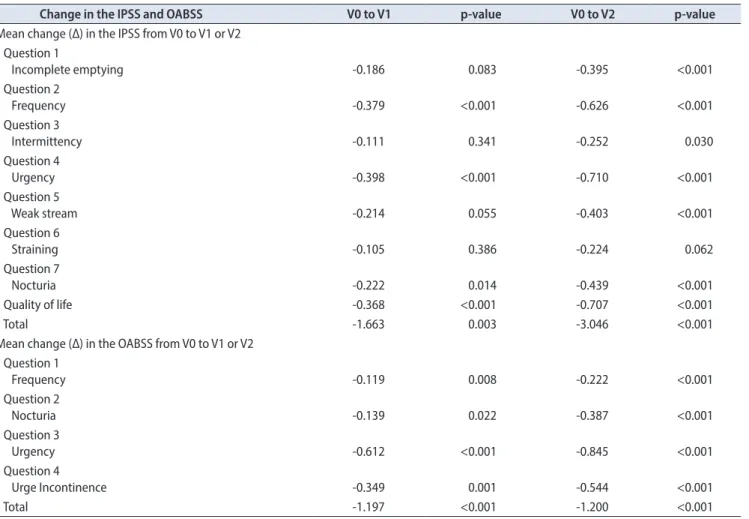
All questions in the IPSS questionnaire relating to stor- age symptoms (Q2, 4, and 7) and some questions relating to obstructive symptoms (Q1 and 5), along with the QoL and IPSS total score, showed significant improvement; converse- ly, Q3 and 6, questions relating to intermittency and strain- ing, respectively, showed no significant improvement during the study period (Fig. 1A). Regarding the OABSS question- naire, all four questions and the total OABSS revealed sig- nificant improvement over the study period (Fig. 1B). For questions related to obstructive symptoms which showed an improvement in IPSS (Q1, Q3, and 5), only the scores of V2 demonstrated a significant decrease compared with those of V0 (p<0.001 [Q1], p=0.030 [Q3], and p<0.001 [Q5]), whereas those of V1 were not statistically significant compared with Table 1. Patient demographics and clinical characteristics

Variable Median (IQR)

Age (y) 69.0 (60.0–75.0)

BMI (kg/m

2

) 24.2 (22.4–25.7)

PSA (ng/dL) 1.24 (0.49–2.64)

IPSS total 15.0 (10.0–22.0)

IPSS-QoL 3.0 (3.0–4.0)

OABSS total 6.0 (4.0–8.0)

OABSS Q2 (nocturia) 3.0 (2.0–5.0)

OABSS Q3 (urgency) 2.0 (2.0–4.0)

IQR, interquartile range; BMI, body mass index; PSA, prostate-specific antigen; IPSS, international prostate symptom score; IPSS-QoL, IPSS- quality of life; OABSS, overactive bladder symptom score.

Fig. 1. Mean values of scores recorded at baseline (V0), 4 weeks (V1), and 12 weeks (V2) after initiation of solifenacin (5 mg) therapy. (A) Inter- national prostatic symptom score (IPSS). (B) Overactive bladder symptom score (OABSS). All p-values are from mixed-model repeated measures.

QoL, quality of life.

Q1 25

20

15

10

5

IPSS

0

V0 V1 V2 p-value

Q2 Q3 Q4 Q5 Q6 Q7 QoL Total 2.37

2.18 1.98 0.001

2.65 2.27 2.03 0.001

2.14 2.03 1.89 0.065

2.54 2.14 1.83

<0.001 2.68 2.47 2.28 0.003

2.04 1.94 1.83 0.173

2.28 2.06 1.85 0.002

3.42 3.05 2.72

<0.001 16.73 15.06 13.69

<0.001 V0

V1 V2

Q1 15

10

5

OABSS

0

V0 V1 V2 p-value

Q2 Q3 Q4 Total

0.88 0.76 0.66 0.002

1.89 1.77 1.50 0.001

2.87 2.25 2.02

<0.001

1.70 1.35 1.16

<0.001

7.33 6.14 5.34

<0.001 V0

V1 V2

A B

(4)

those of V0 (p=0.083 [Q1], 0.341 [Q3], and 0.055 [Q5]) (Table 2).

On the contrary, all questions related to storage symptoms (Q2, 4, and 7) in IPSS and all four questions in the OABSS recorded at either V1 or V2 showed significant improve- ments compared with V0 (Table 2). Overall, 54.6% and 71.6%

of patients showed improvements with respect to Q4 (related to urgency) and total IPSS respectively, whereas 60.4% and 70.7% of patients showed improvements with respect to Q3 (related to urgency) and total OABSS, respectively (Table 3).

In 323 patients who had records on PVR, the mean PVR

at V0, V1, and V2 was 36.40±98.85, 66.45±102.7, and 68.90±118.3 mL, respectively (Fig. 2). Among the total of 566 patients, nine and four patients experienced thirst and constipation, respectively. For those who complained of thirst, none re- quired intervention and were graded 1 according to CTCAE Table 2. Changes in IPSS and OABSS from baseline (V0) to 4 (V1) and 12 (V2) weeks after initiation of solifenacin (5 mg) therapy

Change in the IPSS and OABSS V0 to V1 p-value V0 to V2 p-value

Mean change (Δ) in the IPSS from V0 to V1 or V2 Question 1

Incomplete emptying -0.186 0.083 -0.395 <0.001

Question 2

Frequency -0.379 <0.001 -0.626 <0.001

Question 3

Intermittency -0.111 0.341 -0.252 0.030

Question 4

Urgency -0.398 <0.001 -0.710 <0.001

Question 5

Weak stream -0.214 0.055 -0.403 <0.001

Question 6

Straining -0.105 0.386 -0.224 0.062

Question 7

Nocturia -0.222 0.014 -0.439 <0.001

Quality of life -0.368 <0.001 -0.707 <0.001

Total -1.663 0.003 -3.046 <0.001

Mean change (Δ) in the OABSS from V0 to V1 or V2 Question 1

Frequency -0.119 0.008 -0.222 <0.001

Question 2

Nocturia -0.139 0.022 -0.387 <0.001

Question 3

Urgency -0.612 <0.001 -0.845 <0.001

Question 4

Urge Incontinence -0.349 0.001 -0.544 <0.001

Total -1.197 <0.001 -1.200 <0.001

IPSS, international prostatic symptom score; OABSS, overactive bladder symptom score.

Table 3. Number of patients showing improvement, no change, or ag- gravation of IPSS and OABSS and comparing at baseline to 12 weeks of solifenacin (5 mg) therapy (n=566)

Change in symptom

IPSS OABSS

IPSS Q4 IPSS total OABSS Q3 OABSS total Improved 309 (54.6) 405 (71.6) 342 (60.4) 400 (70.7) No change 196 (34.6) 47 (8.3) 177 (31.3) 95 (16.8) Aggravated 61 (10.8) 114 (20.1) 47 (8.3) 71 (12.5) Values are presented as number (%).

IPSS, international prostatic symptom score; OABSS, overactive blad- der symptom score.

80 70 60 50 40 30 20 10

12 weeks (V2)

mL

0

4 weeks (V1) Baseline (V0)

p=0.015

p=0.021 p=0.250

Fig. 2. Mean values of postvoid residual urine volume at baseline (V0),

4 weeks (V1), and 12 weeks (V2) after initiation of solifenacin (5 mg)

therapy.

(5)

ver. 4.0. However, for those who complained of constipation, one patient was administered with magnesium sulfate, and was therefore graded 2. No patients showed serious adverse events necessitating procedures, such as catheterization to manage AUR. All patients enrolled in the study had good compliance with the medication regimen.

DISCUSSION

LUTS encompasses a variety of symptoms that can be divided into three groups, including voiding symptoms (weak stream, intermittency, and straining to void), storage symp- toms (frequency, urgency, and nocturia), and postvoid symp- toms (incomplete bladder emptying, and terminal dribbling) [1]. Therefore, various pharmacological options are available for different groups of symptoms. The primary treatment option for symptoms relating to BPH is α-blockers, which can be used in combination with 5-α-reductase inhibitors in men with enlarged prostate gland (>40 mL) [15]. However, these drugs are usually effective in treating only voiding symptoms and they have a limited role with respect to stor- age symptoms [3,4,16]. Thus, the current European Associa- tion of Urology guidelines recommend that when symptom relief is insufficient with α-blocker alone, they can be used in combination with anticholinergics [15]. Singh et al. [5]

reported that IPSS in patients receiving α-blocker plus anti- cholinergics was significantly reduced by 7.90 versus a 6.27 decrease in α-blocker monotherapy group and asserted that this may be associated with increased bladder capacity due to anticholinergic treatment. Only 30% of BPH patients with OAB symptoms have been shown to improve with α-blocker monotherapy, whereas 75% of patients undergoing treat- ment with an additional anticholinergic agent were found to show improvement of OAB symptoms [7].

Despite the high prevalence of OAB symptoms in men with BPH, these symptoms are commonly under- or inap- propriately treated with anticholinergics in daily practice [2]. The reasons for this are probably because, firstly, it is difficult to clinically distinguish between symptoms related to OAB and BPH, and secondly, there is a perceived risk of developing AUR [2]. Therefore, in this study we investigated the efficacy and safety of a standard dose of an anticho- linergic in patients who had previously received low doses of anticholinergics and showed poor efficacy. Numerous previous studies have demonstrated the efficacy and safety of several doses of anticholinergics in treating men with OAB symptoms related to BPH. However, to the best of our knowledge, this study is the first to demonstrate the effec- tiveness and safety of an anticholinergic, when the dose was

increased in the same patients who had previously received a low dose.

Particularly in our study, nocturia has been importantly considered as an inclusion criterion for ‘poor efficacy’ by adding ‘≥2 points’ in the OABSS Q2, because nocturia has been known as the most bothersome symptom among the voiding symptoms and refractory to medical therapy [17].

The most important and meaningful result of this study is that IPSS questions relating to storage symptoms (Q2, 4, and 7) showed a stronger tendency toward improvement than those relating to voiding symptoms (Q1, 3, 5, and 6).

Decreases in all four voiding symptom subscores at V1 (4 weeks after initiation of treatment with a standard dose anticholinergic) were not statistically significant, whereas the subscores of the storage symptoms showed significant decreases. Moreover, most OABSS questions at either at V1, or V2 (12 weeks after initiation of treatment with a stan- dard dose anticholinergic) showed significant improvements (Table 2). Our findings are similar to the results reported by the NEPTUNE study group, where combination of solifena- cin (6 mg) plus tamsulosin was only noninferior to tamsulo- sin monotherapy in reducing the mean total IPSS, whereas combination therapy resulted in significant improvement in the IPSS storage subscore compared with tamsulosin mono- therapy [6]. Based on these findings, it can be assumed that anticholinergic therapy may specifically improve storage symptoms by increasing functional bladder capacity.

It is certainly the case that not all patients with BPH would benefit from anticholinergic therapy. In the SAT- URN study, solifenacin therapy did not result in significant additional benefits to the total IPSS in the overall study population, it showed significant improvements in the to- tal IPSS, along with the IPSS storage subscore, micturition frequency, and urgency episodes in patients with two or more urgency episodes per 24 hours and eight or more mic- turitions per 24 hours [18]. Therefore, in this study, we only included patients showing poor efficacy in OAB symptoms improvement on the basis of OABSS, regardless of prostate pathology or prostate size, to highlight storage symptoms.

Indeed, there were significant improvements in the total IPSS, along with the storage subscore and OABSS, in our patient cohort. The results here may provide a useful guide on when to use anticholinergics in patients with BPH based on OABSS questionnaires. On the contrary, our results do not show that OAB symptoms are fully recovered by dose escalation alone. But rather, it shows only that the standard dose anticholinergic treatment can improve symptoms when compared to those with initial low dose treatment.

In our study, we primarily investigated the effect of

(6)

increasing dose from low-dose to standard dose anticho- linergics (solifenacin 5 mg) in the same patient. It would be interesting to raise the dose of solifenacin to 10 mg and observe the efficacy and safety of the medication. Lee et al.

[19] previously reported an increase of 17% and 4% in the in- cidence of dry mouth and AUR respectively, when the dose of solifenacin was raised from 5 mg to 10 mg. Conversely, the SATURN study also reported that patients receiving all three solifenacin doses (3, 6, and 9 mg) showed good tolerance with respect to adverse effects, as there were no significant increases in PVR or the rate of AUR necessitating catheter- ization [18]. However, the NEPTUNE study revealed that no additional benefits were seen in patients receiving 9 mg solifenacin compared with those receiving 6 mg, regarding frequency, urgency, and total IPSS [6]. These findings may be due to a possible plateau of the efficacy and tolerable adverse effects of solifenacin at 6 mg. It can be explained by the fact that anticholinergic agent inhibits muscarinic receptors in the bladder that may result in decreased detru- sor pressure owing to decreased bladder contractions [5]. In our patient cohort, although an increase in PVR was seen from V0 to V2 (36.40 to 68.90, p=0.015), the amount of in- crease might not be considered to be serious enough to cease the dose escalation. In addition, no patient experienced AUR following administration of 5 mg solifenacin, with only a small minority experiencing minor adverse effects including thirst and constipation. Based on our results and previous data, it can be assumed that standard dose (5 mg) solifenacin may effectively improve OAB symptoms without the risk of AUR, and there may be no need to further increase the dose as this may not provide additional benefits. However, as dose escalation of anticholinergic drug may possibly increase the amount of PVR as seen in our results, the PVR should be monitored with caution during the follow-up.

The major limitation of this study is first, its retrospec- tive design, and therefore, risk of selection bias may exist.

Second is that the study design cannot exclude the possibil- ity of symptom improvement due to the use of different kinds of anticholinergics. Because this study is not a pro- spective randomized clinical trial, but rather a retrospective, observational study based on the real practice data, it was difficult to collect data from patients who received the same agent with increased dose after unsatisfactory improvement with lose dose anticholinergic treatment. Because solifenacin 5 mg is widely prescribed in Korea, we investigated the ef- fect of solifenacin 5 mg in patients with unsuccessful results after lose dose treatment for convenience. Third, it is also a limitation that the prostate volume was not included in the analysis. Lastly, there might be risk of bias related to differ-

ent duration of low-dose anticholinergic treatment, although almost half of the patients (272 patients) were within 1 to 11 months of low-dose treatment. A large scale, randomized, double-blind phase 2 study is mandated to adjust certain flaws of the study design to confirm our data. However, our preliminary data have their own importance in a unique design that demonstrates the effect of increasing an anti- cholinergic drug dose in patients with OAB symptoms while taking a low-dose of an anticholinergic agent.

CONCLUSIONS

This large retrospective study confirmed that the use of standard doses of anticholinergic drugs could improve especially the storage symptoms without increasing the likelihood of adverse events in male patients with LUTS who showed poor efficacy following low-dose anticholinergic treatments. However, post void urine should be monitored during the follow-up.

CONFLICTS OF INTEREST

The authors have nothing to disclose.

ACKNOWLEDGMENTS

This study was supported by Astellas Pharm Korea, Co.

AUTHORS’ CONTRIBUTIONS

Research conception and design: Myungsun Shim and Cheol Young Oh. Data acquisition: Myungsun Shim, Jong Keun Kim, Woo Jin Bang, Yong Seong Lee, Sung Tae Cho, Jin Seon Cho, Kwan Joong Joo, Jae Seog Hyun, Byung Hoon Kim, Jong Bok Lee, Young Jin Seo, and Cheol Young Oh.

Statistical analysis: Myungsun Shim. Drafting the manu- script: Myungsun Shim. Critical revision of the manuscript:

Myungsun Shim and Cheol Young Oh. Obtaining funding:

Cheol Young Oh. Administrative, technical, or material sup- port: Myungsun Shim and Cheol Young Oh. Statistical anal- ysis: Myungsun Shim. Supervision: Jin Seon Cho and Cheol Young Oh.

REFERENCES

1. Abrams P, Cardozo L, Fall M, Griffiths D, Rosier P, Ulmsten U,

et al. The standardisation of terminology in lower urinary tract

function: report from the standardisation sub-committee of

the International Continence Society. Urology 2003;61:37-49.

(7)

2. Cartwright R, Srikrishna S, Cardozo L, Robinson D. Validity and reliability of the patient’s perception of intensity of urgency scale in overactive bladder. BJU Int 2011;107:1612-7.

3. Cho KJ, Kang SH, Kim HS, Koh JS, Kim JC. Effect of 5-alpha reductase inhibitor on storage symptoms in patients with be- nign prostatic hyperplasia. Int Neurourol J 2011;15:152-7.

4. Montorsi F, Roehrborn C, Garcia-Penit J, Borre M, Roeleveld TA, Alimi JC, et al. The effects of dutasteride or tamsulosin alone and in combination on storage and voiding symptoms in men with lower urinary tract symptoms (LUTS) and benign prostatic hyperplasia (BPH): 4-year data from the Combina- tion of Avodart and Tamsulosin (CombAT) study. BJU Int 2011;107:1426-31.

5. Singh I, Agarwal V, Garg G. ‘Tamsulosin and darifenacin’ ver- sus ‘tamsulosin monotherapy’ for ‘BPH with accompanying overactive bladder’. J Clin Diagn Res 2015;9:PC08-11.

6. van Kerrebroeck P, Chapple C, Drogendijk T, Klaver M, Sokol R, Speakman M, et al. Combination therapy with solifenacin and tamsulosin oral controlled absorption system in a single tablet for lower urinary tract symptoms in men: efficacy and safety results from the randomised controlled NEPTUNE trial.

Eur Urol 2013;64:1003-12.

7. Lee JY, Kim HW, Lee SJ, Koh JS, Suh HJ, Chancellor MB.

Comparison of doxazosin with or without tolterodine in men with symptomatic bladder outlet obstruction and an overactive bladder. BJU Int 2004;94:817-20.

8. Lai HH, Shen B, Rawal A, Vetter J. The relationship between depression and overactive bladder/urinary incontinence symp- toms in the clinical OAB population. BMC Urol 2016;16:60.

9. Hu TW, Wagner TH, Bentkover JD, Leblanc K, Zhou SZ, Hunt T. Costs of urinary incontinence and overactive bladder in the United States: a comparative study. Urology 2004;63:461-5.

10. Kaplan SA, He W, Koltun WD, Cummings J, Schneider T, Fak- houry A. Solifenacin plus tamsulosin combination treatment in men with lower urinary tract symptoms and bladder outlet ob- struction: a randomized controlled trial. Eur Urol 2013;63:158- 65.

11. Eapen RS, Radomski SB. Review of the epidemiology of over- active bladder. Res Rep Urol 2016;8:71-6.

12. Jünemann KP, Halaska M, Rittstein T, Mürtz G, Schnabel F, Brünjes R, et al. Propiverine versus tolterodine: efficacy and tolerability in patients with overactive bladder. Eur Urol 2005;

48:478-82.

13. Lee SD, Chung JM, Kang DI, Ryu DS, Cho WY, Park S. Effi- cacy and tolerability of solifenacin 5 mg fixed dose in Korean children with newly diagnosed idiopathic overactive bladder: a multicenter prospective study. J Korean Med Sci 2017;32:329- 34.

14. Lightner DJ, Gomelsky A, Souter L, Vasavada SP. Diagnosis and treatment of overactive bladder (non-neurogenic) in adults: AUA/SUFU guideline amendment 2019. J Urol 2019;

202:558-63.

15. Oelke M, Bachmann A, Descazeaud A, Emberton M, Gravas S, Michel MC, et al. EAU guidelines on the treatment and follow- up of non-neurogenic male lower urinary tract symptoms in- cluding benign prostatic obstruction. Eur Urol 2013;64:118-40.

16. Irwin DE, Milsom I, Hunskaar S, Reilly K, Kopp Z, Herschorn S, et al. Population-based survey of urinary incontinence, over- active bladder, and other lower urinary tract symptoms in five countries: results of the EPIC study. Eur Urol 2006;50:1306-14;

discussion 1314-5.

17. Yazici CM, Kurt O. Combination therapies for the management of nocturia and its comorbidities. Res Rep Urol 2015;7:57-63.

18. Van Kerrebroeck P, Haab F, Angulo JC, Vik V, Katona F, Garcia-Hernandez A, et al. Efficacy and safety of solifenacin plus tamsulosin OCAS in men with voiding and storage lower urinary tract symptoms: results from a phase 2, dose-finding study (SATURN). Eur Urol 2013;64:398-407.

19. Lee KW, Hur KJ, Kim SH, Cho SY, Bae SR, Park BH, et al. Ini- tial use of high-dose anticholinergics combined with alpha- blockers for male lower urinary tract symptoms with overac- tive bladder: a prospective, randomized preliminary study.

Low Urin Tract Symptoms 2017;9:129-33.

수치

Fig. 1. Mean values of scores recorded at baseline (V0), 4 weeks (V1), and 12 weeks (V2) after initiation of solifenacin (5 mg) therapy
Table 3. Number of patients showing improvement, no change, or ag- ag-gravation of IPSS and OABSS and comparing at baseline to 12 weeks of  solifenacin (5 mg) therapy (n=566)

참조

관련 문서

Purpose: We investigated the impact of treatment on electroencephalogram (EEG) findings, and determined efficacy of antiepileptic drugs according to EEG findings

For my study, this being diagnosed with prostate cancer receiving treatment in patients with complementary and alternative therapies for their experience

The study on the clinical efficacy of korean red ginseng extract on postmenopausal syndrome..

In this study, we determined the Ce of remifentanil for preventing emergence cough following extubation in male and female elderly patients and evaluated the

In elderly metastatic colon cancer patients, the treatment results of combination therapy with targeted treatment showed similar results to those reported in clinical trials

Placebo-controlled double-blind dose-response study of the non-purine-selective xanthine oxidase inhibitor febuxostat (TMX-67) in patients with hyperuricemia (including

6 Division of Endocrinology and Metabolism, Department of Internal Medicine, Soonchunhyang University Seoul Hospital, Soonchunhyang University College of Medicine, Seoul,..

The ratio of clinical nurses with good health (the group with a high health status score in the survey) and clinical nurses with poor health (the group with a low health status