Chemotherapy
Infect Chemother 2017;49(3):205-212
ISSN 2093-2340 (Print) · ISSN 2092-6448 (Online)
Received: June 16, 2017 Accepted: July 28, 2017 Publised online: September 14, 2017 Corresponding Author : Shin-Woo Kim, MD, PhD
Department of Internal Medicine, School of Medicine, Kyungpook National University, 130 Dongdeok-ro, Jung-gu, Daegu 41944, Korea
Tel: +82-53-200-6525, Fax: +82-53-422-9195, 420-9937 Email: [email protected]
This is an Open Access article distributed under the terms of the Creative Commons Attribution Non-Commercial License (http://creativecommons.org/licenses/by-nc/3.0) which permits unrestricted non-commercial use, distribution, and repro- duction in any medium, provided the original work is properly cited.
Copyrights © 2017 by The Korean Society of Infectious Diseases | Korean Society for Chemotherapy
www.icjournal.org
Safety and Efficacy of Ziagen (Abacavir Sulfate) in HIV-Infected Korean Patients
Heawon Ann
1, Ki-Hyon Kim
1, Hyun-Young Choi
1, Hyun-Ha Chang
2, Sang Hoon Han
3, Kye- Hyung Kim
4, Jin-Soo Lee
5, Yeon-Sook Kim
6, Kyung-Hwa Park
7, Young Keun Kim
8, Jang Wook Sohn
9, Na-Ra Yun
10, Chang-Seop Lee
11, Young Wha Choi
12, Yil-Seob Lee
1, and Shin-Woo Kim
21GlaxoSmithKline Korea, Seoul; 2Department of Internal Medicine, Kyungpook National University School of Medicine, Daegu; 3Department of Internal Medicine, Yonsei University College of Medicine, Seoul; 4Department of Internal Medicine, Pusan National University School of Medicine, Busan; 5Division of Infectious Diseases, Department of Internal Medicine, Inha University College of Medicine, Incheon; 6Division of Infectious Diseases, Department of Internal Medicine, Chungnam National University School of Medicine, Daejon; 7Department of Infectious Disease, Chonnam National University Medical School, Gwangju; 8Department of Internal Medicine, Wonju College of Medicine, Yonsei Uni- versity, Wonju; 9Division of Infectious Diseases, Department of Internal Medicine, Korea University College of Medicine, Seoul; 10Department of Internal Medicine, Chosun University School of Medicine, Gwangju; 11Department of Internal Medicine and Research Institute of Clinical Medicine, Chonbuk National University Medical School and Hospital, Jeonju; 12Department of Infectious Disease, Ajou University School of Medicine, Suwon, Korea
Background: Abacavir is a widely-used nucleoside reverse transcriptase inhibitor for the treatment of human immunodeficiency virus (HIV) infection. Mandatory postmarketing surveillance was conducted in Korea to monitor the safety and evaluate the ef- fectiveness of Ziagen® (abacavir sulfate 300 mg; ViiV Healthcare, Middlesex, UK).
Materials and Methods: An open-label, multi-center, non-interventional postmarketing surveillance study was conducted from June 2010 to June 2016 to monitor the safety and effectiveness of Ziagen across 12 hospitals in Korea. Subjects older than 18 years taking Ziagen according to prescribing information were enrolled. The primary outcome was defined as the occurrence of any adverse events after Ziagen administration. Secondary outcomes included the occurrence of adverse drug reactions, occur- rence of serious adverse events, and effectiveness of Ziagen administration.
Results: A total of 669 patients were enrolled in this study, with a total observation period of 1047.8 person-years. Of these, 90.7% of patients were male. The mean age of patients was 45.8±11.9 years. One-hundred ninety-six (29.3%) patients reported 315 adverse events, and four patients reported seven serious adverse events, without any fatal events. There was one potential case of an abacavir hypersensitivity reaction. Among the 97 adverse drug reactions that were reported from 75 patients, the most frequent adverse drug reactions included diarrhea (12 events), dyspepsia (10 events), and rash (9 events). No ischemic heart disease was observed. In the effectiveness analysis, 91% of patients achieved HIV-1 RNA under 50 copies/mL after 24 months of observation with abacavir administration.
Introduction
Abacavir is a nucleoside reverse transcriptase inhibitor (NRTI) used for the treatment of human immunodeficiency virus (HIV) infection. In combination with other antiretroviral agents, abacavir has proven antiretroviral efficacy, which is at- tributable to its ability to reduce HIV-1 replication and improve immunologic parameters [1-4]. Abacavir is one of the first-line recommendations among NRTIs in many international treat- ment guidelines [5-7]. It can cause hypersensitivity reactions, especially in patients who are positive for the HLA-B*5701 al- lele, and the association of abacavir and ischemic heart disease remains inconclusive based on available data [8-12]. Zia- gen®(abacavir sulfate 300 mg; ViiV Healthcare, Middlesex, UK) was first approved in Korea in 2001 as an orphan drug and lat- er became available on the market in 2010. We carried out a postmarketing surveillance study to evaluate the safety and ef- fectiveness of Ziagen in a real-world setting.
Materials and Methods
1. Study design and population
An open-label, multi-center, non-interventional postmarket- ing surveillance study was conducted from June 2010 to June 2016 to monitor the safety and effectiveness of Ziagen across 12 hospitals in Korea. Patients with confirmed HIV infection taking Ziagen according to prescribing information were in- cluded. Subjects who started Ziagen before the study period were also included, and the observation started on the day consent was obtained. Patients with contraindications for aba- cavir described in the prescribing information, such as moder- ate to severe hepatic impairment (Child-Pugh class B or C), end-stage renal diseases (estimated glomerular filtration rate
≤15 mL/min/1.73 m2 or those receiving renal replacement treatments), or confirmed HLA-B*5701 carriers, were exclud- ed. The primary outcome was defined as the occurrence of any
adverse events (AEs) following Ziagen administration. Sec- ondary outcomes included the occurrence of unexpected ad- verse drug reactions (ADRs), occurrence of serious adverse events (SAEs), and the effectiveness of Ziagen administration.
Effectiveness was assessed via measurement of changes in plasma HIV-1 RNA viral load and CD4+ T-cell counts for each participant during the study period. Regarding the non-inter- ventional study design, a subjective assessment of clinical im- provement was also included for the subjects whose observa- tion period on the study was over 24 weeks. A total of 780 subjects were planned to be enrolled, with an estimated 20%
drop out rate, in order to provide 600 evaluable subjects for the primary analysis. This study was approved by the Institutional Review Board of each participating hospitals.
2. Definitions
Based on WHO-ART 092, an AE was defined as any untow- ard medical occurrence in a subject temporarily associated with the use of Ziagen, whether or not considered related to the medicinal product. An SAE was defined as any untoward medical occurrence at any dose that (1) results in death, (2) is life-threatening, (3) requires inpatient hospitalization or pro- longation of existing hospitalization, (4) results in persistent or significant disability/incapacity, or (5) results in a congenital anomaly/birth defect. An ADR was defined as all noxious and unintended responses related to Ziagen. Physicians classified the relatedness of the event to the drug into 6 categories (cer- tain, probable/likely, possible, unlikely, conditional/unclassi- fied, and unassessable/unclassifiable) by WHO-UMC causality categories [13]. If the causality between Ziagen and AEs is con- sidered certain, probable/likely, possible, conditional/unclas- sified, or unassessable/unclassifiable, the AEs were classified as ADRs. ADRs that are not listed in the Korean prescribing in- formation were classified as unexpected ADRs.
3. Demographic and clinical data
Physician visits were scheduled in accordance with each Conclusion: Our data showed the safety and effectiveness of Ziagen in a real-world setting. During the study period, Ziagen was well-tolerated, with one incident of a clinically suspected abacavir hypersensitivity reaction. The postmarketing surveil- lance of Ziagen did not highlight any new safety information. These data may be helpful in understanding abacavir and the HIV treatment practices in Korea.
Key Words: Abacavir; Human immunodeficiency virus; Drug-related side effects and adverse reactions; Pharmacoepidemiology
physician’s routine practice. At the initial visit, demographic information (including subject’s sex, age, height, body weight, and pregnancy status); medical history (including allergy his- tory, renal impairment, hepatic impairment, other concomi- tant diseases, treatment duration of Ziagen, time since HIV di- agnosis, and HIV treatment history); concomitant medications;
laboratory values (including viral load); and CD4+ T-cell counts were recorded. Physicians were guided to record any treat- ment-emergent AEs during the follow-up visits. Results of all HIV-1 RNA viral loads and CD4+ T-cell counts performed with- in the study period were collected. At the final study visit, the effectiveness of Ziagen was subjectively evaluated as improved, no change, worsened, or not assessed based on the investiga- tor’s medical judgment.
4. Statistical analysis
Continuous variables were expressed as the mean ± one stan- dard deviation, and discrete variables were expressed as the frequency and rate. Once all AEs were classified by preferred terms and system-organ classes, the frequency and percentage of each AE were calculated. Because of the non-interventional design of the study, not all subjects had their HIV-1 RNA viral loads and CD4+ T-cell counts evaluated every 3 months. Test results without an exact date and invalid test results were ex- cluded from the analysis. The available values were collected for each 3-month time frame, and the ratio of participants with HIV-1 RNA <50 copies/mL and mean CD4+ T-cell counts were calculated. Statistical calculation was carried out using SAS ver- sion 9.0 (SAS Institute Inc, Cary, NC, USA).
Results
1. Characteristics of study participants
Data were collected from 671 patients; however, due to 2 cas- es of protocol deviation, 669 patients were included in safety analysis. The total observation period was 1047.8 person-years.
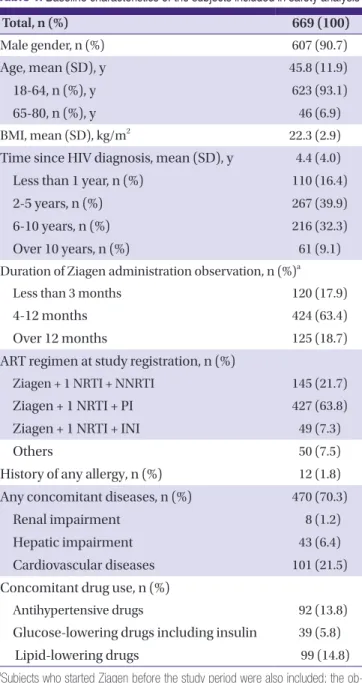
The majority (90.7%) of included patients were male. The mean age of patients was 45.8 ± 11.9 years. Patients older than 65 years and those diagnosed with HIV infection within the past year represented 6.9% and 16.4% of the population, re- spectively. The majority of patients (63.8%) took abacavir with another NRTI plus a boosted protease inhibitor (PI). Patients with concomitant diseases represented 70.3% of the popula- tion; eight patients had renal impairment (chronic kidney dis- ease stage 2 to 3 [14]); 43 patients had hepatic impairment (Child-Pugh class A score; Table 1).
2. Safety and tolerability
One-hundred ninety-six patients reported 315 adverse events.
The incidence of diarrhea (23/669, 3.4%) was the highest, fol- lowed by that of dyspepsia (19/669, 2.8%), dizziness (18/669, 2.7%), pharyngitis (15/669, 2.2%), and rash (14/669, 2.1%).
Four patients reported SAEs. A 72-year-old man presented with nausea, vomiting, fever, and lethargy after 54 days of Zia- gen administration. His symptoms resolved within 24 hours of stopping Ziagen use. HLA-B*5701 allele status was not avail- able. The investigator reported that this case may possibly be
Table 1. Baseline characteristics of the subjects included in safety analysis
Total, n (%) 669 (100)
Male gender, n (%) 607 (90.7)
Age, mean (SD), y 45.8 (11.9)
18-64, n (%), y 623 (93.1)
65-80, n (%), y 46 (6.9)
BMI, mean (SD), kg/m2 22.3 (2.9)
Time since HIV diagnosis, mean (SD), y 4.4 (4.0)
Less than 1 year, n (%) 110 (16.4)
2-5 years, n (%) 267 (39.9)
6-10 years, n (%) 216 (32.3)
Over 10 years, n (%) 61 (9.1)
Duration of Ziagen administration observation, n (%)a
Less than 3 months 120 (17.9)
4-12 months 424 (63.4)
Over 12 months 125 (18.7)
ART regimen at study registration, n (%)
Ziagen + 1 NRTI + NNRTI 145 (21.7)
Ziagen + 1 NRTI + PI 427 (63.8)
Ziagen + 1 NRTI + INI 49 (7.3)
Others 50 (7.5)
History of any allergy, n (%) 12 (1.8) Any concomitant diseases, n (%) 470 (70.3)
Renal impairment 8 (1.2)
Hepatic impairment 43 (6.4)
Cardiovascular diseases 101 (21.5)
Concomitant drug use, n (%)
Antihypertensive drugs 92 (13.8)
Glucose-lowering drugs including insulin 39 (5.8)
Lipid-lowering drugs 99 (14.8)
aSubjects who started Ziagen before the study period were also included; the ob- servation began on the day of consent.
SD, standard deviation; BMI, body mass index; ART, antiretroviral therapy; NRTI, nucleoside reverse transcriptase inhibitor; NNRTI, non-nucleoside reverse tran- scriptase inhibitor; PI, protease inhibitor; INI, integrase inhibitor
an abacavir hypersensitivity reaction. Other presentations of cellulitis, abscess formation, and general weakness were deter- mined to not be associated with use of the study drug (Table 2).
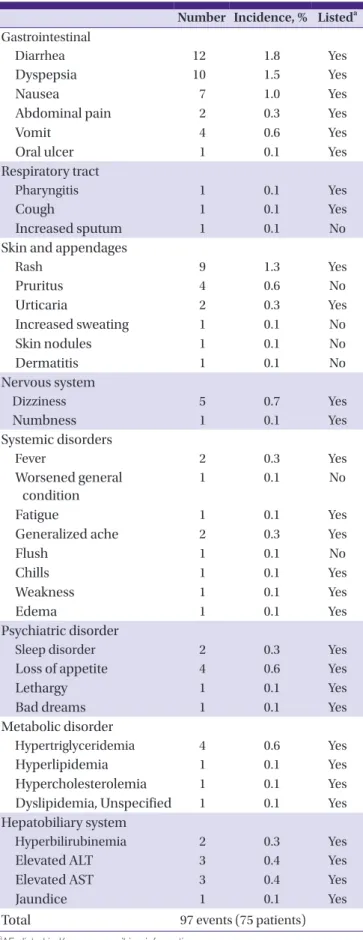
Seventy-five patients reported 97 ADRs. Diarrhea was the most common ADR (12/669, 1.8%), followed by that of dys- pepsia (10/669, 1.5%), rash (9/669, 1.3%), nausea (7/669, 1.0%), and dizziness (5/669, 0.7%; Table 3).
In addition to the one possible case of abacavir hypersensi- tivity reaction, no further cases of abacavir hypersensitivity re- action were reported in this study. No cases of ischemic heart disease were reported.
3. Effectiveness
The proportion of patients who achieved HIV-1 RNA <50 copies/mL increased over time during Ziagen treatment (Fig.
1). A total of 669 patients had initial HIV-1 RNA viral loads. Ini- tially, 44.6% of patients had viral loads below 50 copies/mL;
but, after 24 months of abacavir administration, 90.8% of the 76 patients who had a 24-month HIV-1 RNA blood test achieved HIV-1 RNA under 50 copies/mL. In addition, the mean CD4+ T-cell count increased from 334.7 cells/mm3 at baseline to 577.6 cells/mm3 after 24 months of abacavir treat- ment (Fig. 2). Excluding 158 subjects whose observation dura- tion was less than 24 weeks, 511 of the 669 patients were eligi- ble for the subjective effectiveness analysis. Three-hundred sixty-nine patients (72.2%) were rated as improved, 30 (5.9%) were rated as unchanged; 5 (1.0%) were rated as worsened; and 107 (21%) were non-assessed.
Discussion
This was a postmarketing surveillance study of 669 patients in Korea designed to observe the safety and effectiveness of Ziagen.
A 3-drug regimen with a 2-NRTI backbone plus one core agent (non-nucleoside reverse transcriptase inhibitor [NNRTI],
PI, integrase inhibitor [INI]) has become the standard treat- ment of HIV infection. Abacavir is one of the most commonly used NRTI backbones, which is recommended in major inter- national treatment guidelines in combination with dolutegra- vir and lamivudine [6, 7, 15]. Abacavir is also available as a fixed-dose combination as abacavir/lamivudine and dolute- gravir/abacavir/lamivudine.
A total of 669 patients were included in the 6-year postmar- keting surveillance study. Due to the introduction of the aba- cavir/lamivudine fixed-dose combination in 2012 in Korea, re- cruitment of subjects has been slow since 2014. Most patients were recruited between 2011 and 2013. Male patients account- ed for 90.7% of the total study population, reflecting a male-dominant sex ratio in Korea [16, 17]. In terms of the an- tiretroviral therapy regimen (Table 1), 63.8% of patients used abacavir with another NRTI and a PI. In comparison with oth- er NNRTI dominance in other Asian countries during the study period, our data reflect the popular use of PI-based regi- mens in Korea [18, 19]. Since INIs were only introduced in 2010, a small portion of patients was taking an INI with abaca- vir in Korea. Although we set HLA-B*5701 carrier status as an exclusion criterion, HLA-B*5701 allele status was unknown in all subjects.
Although generally well tolerated, there have been reports of AEs related to abacavir [1, 20]. In this study, there were four SAEs; however, none of the SAEs were certain or probable/like- ly linked to the use of Ziagen by investigator assessment. There was one patient (Case 1 in Table 2) presenting with nausea, vomiting, fever, and lethargy on the 54th day of abacavir ad- ministration whose condition improved within 24 hours of drug cessation. This case is a clinically suspected abacavir hy- persensitivity reaction based on the presenting symptoms and time of resolution after abacavir cessation. Abacavir hypersen- sitivity may occur in 5% to 8% of patients and requires careful attention, as it can be life threatening without appropriate management [21, 22]. Abacavir hypersensitivity is strongly as- sociated with the HLA-B*5701 allele; thus, genotypic screening
Table 2. Clinical characteristics of cases with serious adverse events
Age Gender Adverse event Treatment duration Outcome Drug cessation Association with Ziagen
1 72 M Nausea, vomiting, fever,
lethargy
54 days Resolved Yes Possible
2 80 M Foot cellulitis 209 days Resolved No Unlikely
3 44 M Liver abscess 282 days Resolved No Unlikely
4 40 M General weakness 7 days Resolved No Unassessable
M, male.
is recommended before the use of abacavir-containing prod- ucts [8, 23-25]. Research reporting the incidence of HLA-B*5701 varies considerably by ethnicity, and its prevalence can be as low as 0.3% to 0.5% in Korea [26-28]. A report showed no HLA-B*5701-positive HIV-infected patients in a study of 534 Korean subjects (95% confidence interval [CI], 0.00-0.69) [28].
This report raised a question about the cost-effectiveness of HLA-B*5701 testing versus careful patient monitoring for aba- cavir hypersensitivity reactions after prescribing abacavir in re- gions with a very low incidence of the HLA-B*5701 allele. In our study, the incidence of abacavir hypersensitivity was 0.09 (95% CI, 0.0048-0.4700) per 100 person-years of follow-up.
Although the risk of ischemic heart disease and the use of abacavir were not associated in several recent meta-analyses [10, 11], the overall evidence is inconclusive [9, 12]. In the pres- ent study, no patients using abacavir had evidence of ischemic heart disease. Similarly, no abacavir-related cardiovascular events were observed in the postmarketing surveillance study Table 3. Frequency and expectedness of adverse drug reactions
Number Incidence, % Listeda Gastrointestinal
Diarrhea 12 1.8 Yes
Dyspepsia 10 1.5 Yes
Nausea 7 1.0 Yes
Abdominal pain 2 0.3 Yes
Vomit 4 0.6 Yes
Oral ulcer 1 0.1 Yes
Respiratory tract
Pharyngitis 1 0.1 Yes
Cough 1 0.1 Yes
Increased sputum 1 0.1 No
Skin and appendages
Rash 9 1.3 Yes
Pruritus 4 0.6 No
Urticaria 2 0.3 Yes
Increased sweating 1 0.1 No
Skin nodules 1 0.1 No
Dermatitis 1 0.1 No
Nervous system
Dizziness 5 0.7 Yes
Numbness 1 0.1 Yes
Systemic disorders
Fever 2 0.3 Yes
Worsened general condition
1 0.1 No
Fatigue 1 0.1 Yes
Generalized ache 2 0.3 Yes
Flush 1 0.1 No
Chills 1 0.1 Yes
Weakness 1 0.1 Yes
Edema 1 0.1 Yes
Psychiatric disorder
Sleep disorder 2 0.3 Yes
Loss of appetite 4 0.6 Yes
Lethargy 1 0.1 Yes
Bad dreams 1 0.1 Yes
Metabolic disorder
Hypertriglyceridemia 4 0.6 Yes
Hyperlipidemia 1 0.1 Yes
Hypercholesterolemia 1 0.1 Yes
Dyslipidemia, Unspecified 1 0.1 Yes Hepatobiliary system
Hyperbilirubinemia 2 0.3 Yes
Elevated ALT 3 0.4 Yes
Elevated AST 3 0.4 Yes
Jaundice 1 0.1 Yes
Total 97 events (75 patients)
aAEs listed in Korean prescribing information.
ALT, alanine transaminase; AST, aspartate transaminase; AE, adverse event.
Figure 1. Proportion achieving HIV-1 RNA <50 copies/mL.
aMissing test date or unknown test results.
Figure 2. Changes in CD4+ T-cell counts.
aMissing test date or unknown test results.
of abacavir and abacavir/lamivudine in Japan [20, 29].
The incidences of ADRs were considerably low in our study.
The most frequent ADRs reported were gastrointestinal (GI) disturbance, including diarrhea (12 cases, 1.8%), dyspepsia (10 cases, 1.5%), and nausea (7 cases, 1.0%). It is difficult to identify abacavir-specific AEs, since abacavir was used in combination with other medications including antiretroviral drugs and oth- er concomitant drugs. It is interesting to note the low incidence of GI AEs, despite the high proportion of subjects (63.8%) tak- ing boosted PI–based regimens in Korea, which is lower than the 10% reported incidence of GI disturbance in the postmar- keting surveillance report in Japan [20]. The lower incidence of GI-related AEs in Korea may require further investigation.
In the effectiveness analysis, we assessed the proportion of patients achieving plasma HIV-1 RNA <50 copies/mL. There were 44.6% of 669 patients with suppressed viral load at the start of study. After 24 months of an abacavir-containing treat- ment regimen, 90.8% out of 76 patients who had HIV-1 RNA results at 24 months achieved plasma HIV-1 RNA under 50 copies/mL. The mean CD4+ T-cell count increased from 334.7 cells/mm3 at baseline to 577.6 cell/mm3 after 24 months of an abacavir-containing treatment regimen. Without a well-con- trolled comparator arm, it is hard to evaluate the effectiveness of abacavir as a single agent; however, we could observe a nu- merically positive virologic and immunologic effect of abaca- vir-containing antiretroviral therapy from this study.
This study has several limitations. Firstly, it is a postmarketing surveillance study with limited variables. We could not collect actual laboratory results such as serum creatinine and liver en- zymes. Secondly, due to the observational study design, inter- ventions for study participants, including prescheduled blood test intervals, were not allowed; the data were inconsistent with regard to the duration of abacavir use or specific intervals of in- dividual viral load testing. Lastly, the study does not include a comparator arm; thus, it is hard to directly attribute the positive effectiveness data solely to the antiviral activity of abacavir.
These data may provide supportive information to healthcare practitioners, as our study results reflect positive real-world data of HIV treatment using an abacavir-containing regimen.
In conclusion, we report in a postmarketing surveillance study the real-world data from 669 patients using abacavir. Ab- acavir was generally well tolerated. The incidence of abacavir hypersensitivity was rare. Cardiovascular AEs were not report- ed with the use of abacavir in this study. More patients achieved plasma HIV-1 RNA <50 copies/mL with abacavir ad- ministration than baseline, and the CD4+ T-cell count was in- creased from baseline. These results may be helpful for under-
standing abacavir use and HIV treatment patterns in Korea.
We are collecting further safety and effectiveness information for abacavir from spontaneous reports and postmarketing sur- veillance of other drugs containing abacavir.
Funding
This work was funded by GlaxoSmithKline Korea.
Acknowledgements
Heawon Ann, Hyun-Young Choi, Ki-Hyon Kim, and Yil-Seob Lee are employees of GlaxoSmithKline Korea. Editorial assis- tance was provided under the direction of the authors by MedThink SciCom.
Conflicts of Interest
No conflicts of interest.
ORCID
Heawon Ann https://orcid.org/0000-0003-3170-0109 Shin-Woo Kim https://orcid.org/0000-0002-3755-8249
REFERENCES
1. Staszewski S, Katlama C, Harrer T, Massip P, Yeni P, Cutrell A, Tortell SM, Harrigan RP, Steel H, Lanier RE, Pearce G. A dose-ranging study to evaluate the safety and efficacy of abacavir alone or in combination with zidovudine and lamivudine in antiretroviral treatment-naive subjects.
AIDS 1998;12:F197-F202.
2. Staszewski S, Keiser P, Montaner J, Raffi F, Gathe J, Brotas V, Hicks C, Hammer SM, Cooper D, Johnson M, Tortell S, Cutrell A, Thorborn D, Isaacs R, Hetherington S, Steel H, Spreen W; CNAAB3005 International Study Team. Abaca- vir-lamivudine-zidovudine vs indinavir-lamivudine-zid- ovudine in antiretroviral-naive HIV-infected adults: A ran- domized equivalence trial. JAMA 2001;285:1155-63.
3. Walmsley SL, Antela A, Clumeck N, Duiculescu D, Eber- hard A, Gutiérrez F, Hocqueloux L, Maggiolo F, Sand- kovsky U, Granier C, Pappa K, Wynne B, Min S, Nichols G;
SINGLE Investigators. Dolutegravir plus abacavir-lamivu- dine for the treatment of HIV-1 infection. N Engl J Med
2013;369:1807-18.
4. DeJesus E, Herrera G, Teofilo E, Gerstoft J, Buendia CB, Brand JD, Brothers CH, Hernandez J, Castillo SA, Bonny T, Lanier ER, Scott TR; CNA30024 Study Team. Abacavir ver- sus zidovudine combined with lamivudine and efavirenz, for the treatment of antiretroviral-naive HIV-infected adults. Clin Infect Dis 2004;39:1038-46.
5. The Korean Society for AIDS. Clinical guidelines for the diagnosis and treatment of HIV/AIDS in HIV-infected Ko- reans. Infect Chemother 2011;43:89-128.
6. AIDS info. Guidelines for the use of antiretroviral agents in HIV-1-infected adults and adolescents. Available at: https://
aidsinfo.nih.gov/contentfiles/lvguidelines/AdultandAdo- lescentGL.pdf. Accessed 14 June, 2017.
7. Günthard HF, Saag MS, Benson CA, del Rio C, Eron JJ, Gal- lant JE, Hoy JF, Mugavero MJ, Sax PE, Thompson MA, Gandhi RT, Landovitz RJ, Smith DM, Jacobsen DM, Vol- berding PA. Antiretroviral drugs for treatment and preven- tion of HIV infection in adults: 2016 recommendations of the international antiviral society-USA panel. JAMA 2016;316:191-210.
8. Mallal S, Phillips E, Carosi G, Molina JM, Workman C, Tomazic J, Jägel-Guedes E, Rugina S, Kozyrev O, Cid JF, Hay P, Nolan D, Hughes S, Hughes A, Ryan S, Fitch N, Thorborn D, Benbow A; PREDICT-1 Study Team.
HLA-B*5701 screening for hypersensitivity to abacavir. N Engl J Med 2008;358:568-79.
9. Choi AI, Vittinghoff E, Deeks SG, Weekley CC, Li Y, Shlipak MG. Cardiovascular risks associated with abacavir and tenofovir exposure in HIV-infected persons. AIDS 2011;25:1289-98.
10. Cruciani M, Zanichelli V, Serpelloni G, Bosco O, Malena M, Mazzi R, Mengoli C, Parisi SG, Moyle G. Abacavir use and cardiovascular disease events: a meta-analysis of pub- lished and unpublished data. AIDS 2011;25:1993-2004.
11. Ding X, Andraca-Carrera E, Cooper C, Miele P, Kornegay C, Soukup M, Marcus KA. No association of abacavir use with myocardial infarction: findings of an FDA meta-anal- ysis. J Acquir Immune Defic Syndr 2012;61:441-7.
12. Rasmussen LD, Engsig FN, Christensen H, Gerstoft J, Kro- nborg G, Pedersen C, Obel N. Risk of cerebrovascular events in persons with and without HIV: a Danish nation- wide population-based cohort study. AIDS 2011;25:1637- 46.
13. The Uppsala Monitoring Centre. The use of the WHO- UMC system for standardised case causality assessment.
Available at: http://www.who.int/medicines/areas/quali-
ty_safety/safety_efficacy/WHOcausality_assessment.pdf.
Accessed 14 June, 2017.
14. National Kidney Foundation. KDOQI clinical practice guideline for hemodialysis adequacy: 2015 update. Am J Kidney Dis 2015;66:884-930.
15. Korean Society for AIDS. The 2015 clinical guidelines for the diagnosis and treatment of HIV/AIDS in HIV-infected Koreans. Infect Chemother 2015;47:205-11.
16. Korea Centers for Disease Control and Prevention (KCDC).
Annual report on the notified HIV/AIDS in Korea. Avail- able at : http://cdc.go.kr/CDC/cms/content/mo- bile/59/19359_view.html. Accessed 14 June, 2017.
17. Korea Centers for Disease Control and Prevention (KCDC). Annual report on the notified HIV/AIDS in Ko- rea. Available at: http://cdc.go.kr/CDC/info/CdcKrIn- fo0128.jsp?menuIds=HOME001-MNU1130-MNU1156- MNU1426-MNU1448&cid=28485. Accessed 14 June, 2017.
18. Boettiger DC, Kerr S, Ditangco R, Merati TP, Pham TT, Chaiwarith R, Kiertiburanakul S, Li CK, Kumarasamy N, Vonthanak S, Lee C, Van Kinh N, Pujari S, Wong WW, Ka- marulzaman A, Zhang F, Yunihastuti E, Choi JY, Oka S, Ng OT, Kantipong P, Mustafa M, Ratanasuwan W, Sohn A, Law M. Trends in first-line antiretroviral therapy in Asia: results from the TREAT Asia HIV observational database. PLoS One 2014;9:e106525.
19. Kim MJ, Kim SW, Chang HH, Kim Y, Jin S, Jung H, Park JH, Kim S, Lee JM. Comparison of antiretroviral regimens: ad- verse effects and tolerability failure that cause regimen switching. Infect Chemother 2015;47:231-8.
20. Kurita T, Kitaichi T, Nagao T, Miura T, Kitazono Y. Safety analysis of Ziagen® (abacavir sulfate) in postmarketing surveillance in Japan. Pharmacoepidemiol Drug Saf 2014;23:361-71.
21. Bannister WP, Friis-Møller N, Mocroft A, Viard JP, van Lunzen J, Kirk O, Gargalianos P, Bánhegyi D, Chiesi A, Lundgren JD; EuroSIDA Study Group. Incidence of abaca- vir hypersensitivity reactions in euroSIDA. Antivir Ther 2008;13:687-96.
22. Hetherington S, McGuirk S, Powell G, Cutrell A, Naderer O, Spreen B, Lafon S, Pearce G, Steel H. Hypersensitivity re- actions during therapy with the nucleoside reverse tran- scriptase inhibitor abacavir. Clin Ther 2001;23:1603-14.
23. Saag M, Balu R, Phillips E, Brachman P, Martorell C, Bur- man W, Stancil B, Mosteller M, Brothers C, Wannamaker P, Hughes A, Sutherland-Phillips D, Mallal S, Shaefer M;
Study of Hypersensitivity to Abacavir and Pharmacoge- netic Evaluation Study Team. High sensitivity of human
leukocyte antigen-b*5701 as a marker for immunological- ly confirmed abacavir hypersensitivity in white and black patients. Clin Infect Dis 2008;46:1111-8.
24. Young B, Squires K, Patel P, Dejesus E, Bellos N, Berger D, Sutherland-Phillips DH, Liao Q, Shaefer M, Wannamaker P. First large, multicenter, open-label study utilizing HLA-B*5701 screening for abacavir hypersensitivity in North America. AIDS 2008;22:1673-5.
25. Rauch A, Nolan D, Martin A, McKinnon E, Almeida C, Mal- lal S. Prospective genetic screening decreases the incidence of abacavir hypersensitivity reactions in the Western Aus- tralian HIV cohort study. Clin Infect Dis 2006;43:99-102.
26. Sun HY, Hung CC, Lin PH, Chang SF, Yang CY, Chang SY, Chang SC. Incidence of abacavir hypersensitivity and its
relationship with HLA-B*5701 in HIV-infected patients in Taiwan. J Antimicrob Chemother 2007;60:599-604.
27. Phillips EJ. Genetic screening to prevent abacavir hyper- sensitivity reaction: are we there yet? Clin Infect Dis 2006;43:103-5.
28. Park WB, Choe PG, Song KH, Lee S, Jang HC, Jeon JH, Park SW, Park MH, Oh MD, Choe KW. Should HLA-B*5701 screening be performed in every ethnic group before starting abacavir? Clin Infect Dis 2009;48:365-367.
29. Kurita T, Kitaichi T, Nagao T, Miura T, Kitazono Y. Safety analysis of Epzicom® (lamivudine/abacavir sulfate) in post-marketing surveillance in Japan. Pharmacoepidemi- ol Drug Saf 2014;23:372-81.