INTRODUCTION
Benign prostatic hyperplasia (BPH) is the most common uro- logical disorder in older men, and its incidence is expected to rise with increasing life expectancy. Hypertension is also a
common disease in older age adults. Studies suggest that age- related increases in sympathetic noradrenergic activity may be a common pathophysiologic component in BPH and hyper- tension.1-4 Even disregarding the possibility of a common pa- thology, it is estimated that at least one in four men aged >60 years could have concomitant BPH and hypertension.4,5
Selective α1-adrenoceptor (AR) antagonists are well known to be an effective, non-invasive treatment option for patients with BPH. Lower urinary tract symptoms (LUTS) can be improved by reduction of urethral pressure and prostatic smooth muscle tone by blocking the motor sympathetic adrenergic nerve supply to the prostrate. These agents are currently considered as first-line medical therapy for BPH patients,5-7 and numerous studies re- garding their efficacy and tolerability have been reported.
Of these agents, naftopidil is an α1-AR antagonist that has high selectivity for the α1D subtype, showing 3- and 17-fold higher
Clinical Efficacy and Safety of Naftopidil Treatment for Patients with Benign Prostatic Hyperplasia and Hypertension: A Prospective, Open-Label Study
Mun Su Chung1, Byung Il Yoon1, and Seung Hwan Lee2
1Department of Urology, Catholic Kwandong University, International St. Mary’s Hospital, Incheon;
2Department of Urology, Urological Science Institute, Yonsei University College of Medicine, Seoul, Korea.
Purpose: To investigate the efficacy and safety of naftopidil for benign prostatic hyperplasia (BPH) patients, mainly focusing on changes in blood pressure (BP).
Materials and Methods: Of a total of 118 patients, 90 normotensive (NT) and 28 hypertensive (HT) patients were randomly as- signed to be treated with naftopidil 50 mg or 75 mg for 12 weeks, once-daily. Safety and efficacy were assessed by analyzing changes from baseline in systolic/diastolic BP and total International Prostate Symptom Score (IPSS) at 4 and 12 weeks. Adverse events (AEs), obstructive/irritative subscores, quality of life (QoL) score, maximum urinary flow rate (Qmax), and benefit, satisfac- tion with treatment, and willingness to continue treatment (BSW) questionnaire were also analyzed.
Results: Naftopidil treatment decreased mean systolic BP by 18.7 mm Hg for the HT 50 mg group (p<0.001) and by 18.3 mm Hg for the HT 75 mg group (p<0.001) and mean diastolic BP by 17.5 mm Hg for the HT 50 mg group (p<0.001) and by 14.7 mm Hg for the HT 75 mg group (p=0.022). In the NT groups (both naftopidil 50 mg and 75 mg), naftopidil elicited no significant changes in BP from baseline values. After 12 weeks, naftopidil 50 and 75 mg groups showed significant improvements in IPSS scores (total, obstructive/irritative subscores, QoL score) and Qmax from baseline. AEs were reported in 7.8% (50 mg group) and 2.9% (75 mg group) of patients. In both the 50 mg and 75 mg groups, >86% of all patients agreed to continue their current medications.
Conclusion: Our results suggest that naftopidil treatment in BPH patients with hypertension allows for optimal management of BP within the normal range.
Key Words: α-adrenoceptor antagonists, BPH, hypertension, naftopidil
pISSN: 0513-5796 · eISSN: 1976-2437
Received: February 24, 2017 Revised: April 5, 2017 Accepted: April 6, 2017
Corresponding author: Dr. Seung Hwan Lee, Department of Urology, Urological Science Institute, Yonsei University College of Medicine, 50-1 Yonsei-ro, Seodae- mun-gu, Seoul 03722, Korea.
Tel: 82-2-2019-3470, Fax: 82-2-3462-8887, E-mail: [email protected]
•The authors have no financial conflicts of interest.
© Copyright: Yonsei University College of Medicine 2017
This is an Open Access article distributed under the terms of the Creative Com- mons Attribution Non-Commercial License (http://creativecommons.org/licenses/
by-nc/4.0) which permits unrestricted non-commercial use, distribution, and repro- duction in any medium, provided the original work is properly cited.
Yonsei Med J 2017 Jul;58(4):800-806 https://doi.org/10.3349/ymj.2017.58.4.800
affinity for this subtype than for α1A and α1B subtypes, respec- tively.8,9 Although several clinical trials9-12 demonstrating the efficacy of this drug for BPH patients have been reported, there are few reports of the cardiovascular responses associated with this drug during BPH treatment. Here, we aimed to determine the efficacy and safety of naftopidil for BPH/LUTS patients, fo- cusing on 1) changes in blood pressure (BP) and 2) patient sat- isfaction and compliance.
MATERIALS AND METHODS
Study design
This study was designed as a prospective, open-label study to determine the efficacy and safety of naftopidil (Flivas, Dong-A Pharmaceutical Co., Ltd., Seoul, Korea) at a single center (Yon- sei University Health System, Severance Hospital, Seoul, Ko- rea). The study protocol was approved by our Institutional Re- view Board (IRB approval No. 4-2014-0503, Yonsei University Health System). Patients provided written consent to participate in the study after having received an explanation of the proto- col, including awareness of possible side effects.
Based on an assumption of a mean improvement in total in- ternational prostate symptom score (IPSS) from baseline of 3.0, a standard deviation of 5.3, and the assumption that 20% of pa- tients will not be valid for inclusion in the per-protocol popula- tion, a sample size of at least 120 patients was required to ob- tain a power of 90%, with type 1 error of 0.05 (for a two-sided test). Results are reported for the intention to treat (ITT) popu- lation (all patients with a baseline BP and IPSS assessment and at least one valid post-baseline BP and IPSS assessment).
The enrolled patients suffered from LUTS and were consid- ered fit for α1-AR antagonist treatment based on the decision of our physician. Patients who met the inclusion criteria were assigned into the normotensive (NT) group (defined as diastol- ic BP <90 mm Hg in a sitting position) or hypertensive (HT) group (diastolic BP ≥90 mm Hg in a sitting position) and then randomly assigned by computer-generated random numbers into the naftopidil 50 mg group or 75 mg group for 12-week, once- daily treatment.
BP was measured according to previous published guide- lines:13,14 1) patients were seated quietly for at least 5 minutes in a chair with their feet on the floor and arms at the level of the heart, 2) at least two measurements at 1–2 minute intervals were made, 3) we used a standard bladder (12–13×35 cm), a larger one for big arms, and 4) we deflated the cuff slowly (2 mm Hg/
sec). Patient visits occurred at study entry and after 4 weeks and 12 weeks of treatment. Adverse events (AEs) were defined as symptoms that required discontinuation or change of the cur- rent medication.
Study population
The inclusion criteria included male ambulatory patients over
50 years of age with LUTS (total IPSS greater than 8). Patients with the following conditions were excluded: allergic drug reaction to α1-AR antagonists, orthostatic hypotension, a history of pros- tate-related surgery (open or endoscopic), suspicious prostate malignant condition on digital rectal examination and/or pros- tate-specific antigen (PSA) >10 ng/mL, a history of recurrent urinary tract infection or bladder stones, renal impairment (creatinine clearance rate <30 mL/min), severe hepatic disor- ders, the use of anticholinergic or cholinergic agents, the use of other α1-AR antagonists (tamsulosin, silodosin, alfuzosin, doxazocin, terazocin) within the previous 4 weeks, or the use of 5-reductase inhibitors or antiandrogens within the previous 3 months. Patients who were currently receiving or were plan- ning to take any α-receptor agonists or β-receptor antagonists were also excluded.
Study end-points and assessments
The primary end-point of this study was to determine the safe- ty and efficacy of naftopidil 50 and 75 mg treatment. This measure was assessed by analyzing changes from baseline in systolic/diastolic BP and total IPSS at 4 and 12 weeks. Second- ary aims were to analyze 1) AEs; 2) improvement in IPSS obstruc- tive/irritative subscores, IPSS quality of life (QoL) score, and maximum urinary flow rate (Qmax); and 3) benefit, satisfaction with treatment, and willingness to continue treatment (BSW) questionnaire with naftopidil 50 and 75 mg treatment at 4 and 12 weeks. The safety population was all patients who were random- ized and who received at least one dose of study medication.
Statistical analysis
The two-sample t-test and Wilcoxon rank sum test were con- ducted to analyze continuous variables, and the chi-square test was used to analyze categorical variables. Comparison of the efficacy variables was performed using an RM-ANOVA model with baseline values of the response variable as covariates for absolute change in IPSS from baseline. For efficacy evalua- tions, the last observation carried forward was applied to ana- lyze the ITT population. Statistical analysis was performed with Prism software (version 5.00; GraphPad Instat, San Diego, CA, USA). Results were considered significant at p<0.05.
RESULTS
Study design
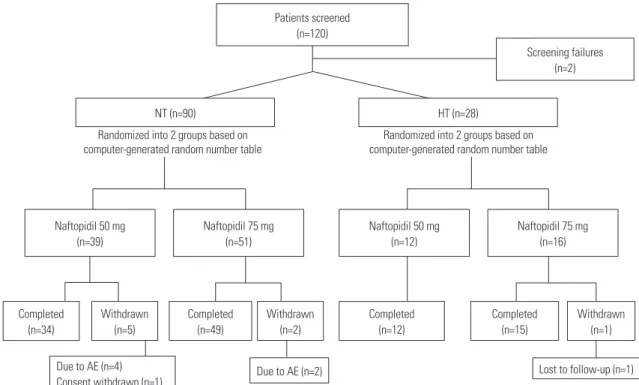
A total of 120 patients were screened and 118 were enrolled in this study (Fig. 1). Of these, 90 NT patients and 28 HT patients were randomized to receive naftopidil 50 mg or naftopidil 75 mg (group 1, NT 50 mg naftopidil; group 2, NT 75 mg naftopi- dil; group 3, HT 50 mg naftopidil, group 4, HT 75 mg naftopi- dil). In the NT group, 83 patients completed the study. The main reason for study discontinuation was AEs (6 patients, 6.6%), and one patient withdrew informed consent. In the HT group,
27 patients completed the study, and one discontinued because of loss during follow-up.
Patient demographics and characteristics
Baseline demographics and characteristics for all patients in the ITT population are shown in Table 1. There were no significant
Fig. 1. Patient disposition. A total of 120 patients were screened and 118 were enrolled in this study. Ninety normotensive (NT) patients and 28 hyper- tensive (HT) patients were randomly assigned into the naftopidil 50 mg or naftopidil 75 mg group for 12-week, once-daily treatment. In the NT group, 83 patients completed the study. The main reason for study discontinuation was AEs (6 patients, 6.6%). In the HT group, 27 patients completed the study, and one discontinued because of loss during follow-up. AE, adverse event.
Randomized into 2 groups based on
computer-generated random number table Randomized into 2 groups based on computer-generated random number table
Due to AE (n=4)
Consent withdrawn (n=1) Due to AE (n=2) Lost to follow-up (n=1)
Completed (n=34)
Completed (n=49)
Completed (n=12)
Completed (n=15)
Withdrawn (n=1) Withdrawn
(n=2) Withdrawn
(n=5) Naftopidil 50 mg
(n=39)
Naftopidil 50 mg (n=12)
HT (n=28) NT (n=90)
Patients screened (n=120)
Screening failures (n=2)
Naftopidil 75 mg (n=51)
Naftopidil 75 mg (n=16)
Table 1. Patient Demographics and Baseline Characteristics
Normotension Hypertension
p value Group 1
(naftopidil 50 mg) Group 2
(naftopidil 75 mg) Group 3
(naftopidil 50 mg) Group 4 (naftopidil 75 mg)
No. of patients 39 51 12 16 -
Mean (SD)
Age, yr 65.5 (7.0)0 67.2 (6.5)0 62.2 (4.3)0 64.1 (7.4)0 0.151
Height, cm 168.4 (4.2) 166.9 (7.2) 168.4 (4.2) 170.7 (6.3) 0.382
Weight, kg 65.6 (7.0)0 67.8 (11)0. 69.2 (6.9)0 70.5 (10.2) 0.548
SBP, mm Hg 123.1 (10.1) 124.9 (12.4) 144.4 (21.0) 145.3 (6.6) <0.001
DBP, mmHg 78.1 (6.5)0 77.1 (9.7)0 4.0 (3.0)0 93.5 (2.8)0 <0.001
Prostate volume, mL 30.4 (9.9) 31.9 (8.4) 7.5 (7.3) 35.0 (10.6) 0.394
PSA, ng/mL 1.5 (1.1)0 1.9 (2.2)0 1.3 (1.3)0 1.9 (1.7)0 0.703
IPSS (baseline)
Total 18.8 (5.2)0 19.8 (6.5)0 17.4 (5.6)0 17.5 (3.1)0 0.595
Obstructive subscore 13.3 (4.3) 13.5 (5.1) 12.1 (4.2) 12.2 (3.9) 0.822
Irritative subscore 5.3 (2.2)0 6.3 (2.7)0 5.2 (3.0)0 5.3 (1.9)0 0.425
QoL score 4.1 (0.7) 4.5 (0.7) 4.0 (0.8) 4.2 (0.8) 0.169
Qmax, mL/sec 11.7 (2.8)0 10.8 (2.7)0 11.6 (3.3)0 9.6 (3.0)0 0.260
PVR, mL 26.1 (27.5) 30.7 (38.3) 20.0 (19.7) 44.2 (55.6) 0.532
Race (%)
Asian 100 100 100 100 -
SD, standard deviation; SBP, systolic blood pressure; DBP, diastolic blood pressure; PSA, prostate specific antigen; IPSS, international prostate symptom score;
QoL, quality of life; Qmax, maximum urinary flow rate; PVR, post-void residual urine volume.
differences between the four treatment groups in regards to age, height, weight, prostate volume, level of PSA, total IPSS scores, IPSS obstructive or irritative subscore, QoL due to urinary symp- toms, Qmax, or post-void residual urine volume. Systolic and diastolic BP were significantly different between groups 1 and 2 and groups 3 and 4 (p<0.001).
Influence on BP
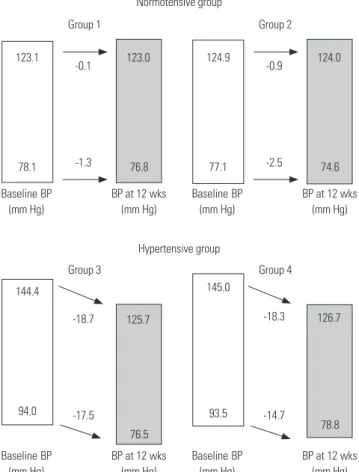
Naftopidil treatment decreased the mean systolic BP by 18.7 mm Hg for group 3 (p<0.001) and by 18.3 mm Hg for group 4 (p<0.001) and the mean diastolic BP by 17.5 mm Hg for group 3 (p<0.001) and by 14.7 mm Hg for group 4 (p=0.022) (Fig. 2). How- ever, in the NT groups (both naftopidil 50 and 75 mg), naftopi- dil caused no significant changes in BP from baseline values.
After adjusting for age, significant changes in mean systolic and diastolic BPs from baseline values were found in group 3 and group 4 vs. group 1 and group 2 (Fig. 2).
Efficacy
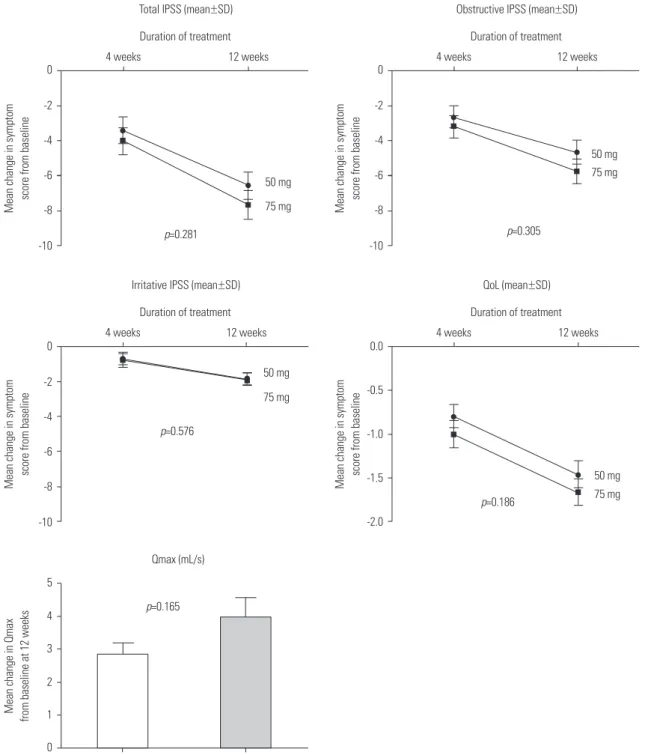
The efficacy of naftopidil 50 and 75 mg on LUTS is summa- rized in Fig. 3. After 12 weeks of treatment, both groups showed significant improvements from baseline in total IPSS score (p<0.001). For both obstructive and irritative subscores, there were significant improvements from baseline to the final visit
for both 50 and 75 mg doses (p<0.001 and p=0.028, respective- ly). Also, IPSS QoL scores after treatment with both drug doses improved significantly at 12 weeks (p<0.001). Both groups showed significant improvement in Qmax from baseline at 12 weeks (p=0.034 in naftopidil 50 mg group and p<0.001 in 75 mg group).
Safety
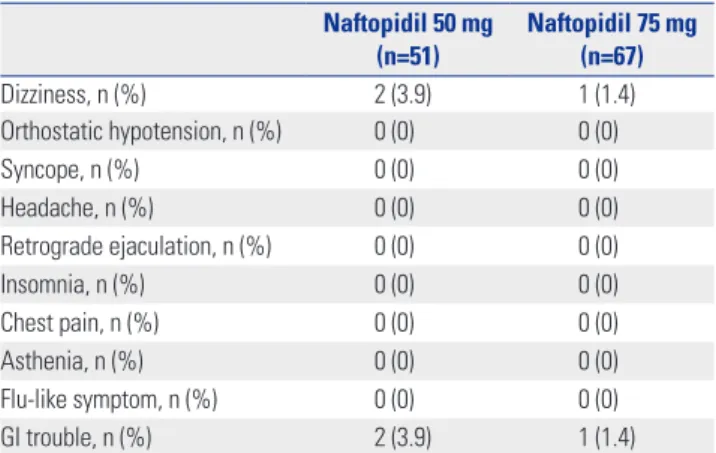
AEs were reported in four of 51 patients (7.8%) receiving naftopi- dil 50 mg and in two of 67 (2.9%) receiving naftopidil 75 mg (Table 2). No syncope was reported for either group. None of the patients reported retrograde ejaculation. Most AEs were mild or moderate in severity.
Satisfaction and compliance
After completion of 12 weeks of treatment with naftopidil, sat- isfaction and compliance with this drug were assessed using the BSW questionnaire (Table 3). In both the 50 and 75 mg group,
>76.6% of all patients felt they benefited from the treatment and were satisfied therewith. Moreover, 95.7% of patients in the naftopidil 50 mg group and 86% in the 75 mg group agreed to continue their current medications. The reasons for discon- tinuation were gastrointestinal trouble (n=2 in naftopidil 50 mg group and n=5 in 75 mg group) and dizziness (n=4 in naftopidil 75 mg group).
DISCUSSION
Considering the high incidence of patients with concomitant BPH and hypertension, physicians are concerned about the influence of BP changes during α1-AR antagonist treatment in such cases. Many studies regarding BP change in patients with BPH/hypertension treated with α1-AR antagonist have been reported. In 1995, Kirby15 reported that 12 weeks of treatment with doxazosin resulted in significant reductions in BP in HT patients, whereas minimal reductions were found in placebo- treated patients. Kaplan, et al.16 showed that doxazosin treatment did not cause a clinically significant BP change in NT patients.
Chung and Hong5 reported that doxazosin gastrointestinal therapeutic system (GITS) treatment for 1 year resulted in a sig- nificantly greater reduction in BP in HT patients, compared with NT patients. Lee, et al.3 compared the BP-lowering effect of α1- AR antagonists in patients with or without concomitant antihy- pertensive drug treatment and reported that doxazosin GITS treatment resulted in optimal management of BP within the normal range, especially in baseline HT BP patients, irrespective of concomitant antihypertensive medication. Fawzy, et al.4 dem- onstrated that doxazosin is especially beneficial in the treat- ment of concomitant BPH and hypertension. Considering that older men might already be taking multiple medications for oth- er diseases, the use of a single drug for two diseases might be valuable.
Fig. 2. Comparison of the mean changes in BP from baseline value ac- cording to group. BP, blood pressure.
Normotensive group
Baseline BP (mm Hg)
BP at 12 wks (mm Hg)
76.8 78.1
123.0 123.1
Group 1
-0.1
-1.3
Baseline BP (mm Hg)
BP at 12 wks (mm Hg)
74.6 77.1
124.0 124.9
Group 2
-0.9
-2.5
Hypertensive group
Baseline BP (mm Hg)
BP at 12 wks (mm Hg)
76.5 94.0
125.7 144.4
Group 3
-18.7
-17.5
Baseline BP (mm Hg)
BP at 12 wks (mm Hg) 93.5 78.8
126.7 145.0
Group 4
-18.3
-14.7
The majority of these reports, however, concern doxazosin treatment. Because doxazosin is a non-uroselective α1-AR an- tagonist, its influence on BP might be understandable. Howev- er, there are few reports on BP change with naftopidil, an α1-AR antagonist that has a high affinity for the α1D subtype. In our institution, we experienced stabilization of BP during naftopi- dil treatment for BPH/LUTS. From our experience, we think that this additional benefit of BPH medication results in increased satisfaction and compliance of the patients with this drug. There-
fore, we aimed to further investigate the influence of naftopidil, mainly focusing on the cardiovascular aspects (i.e., BP change), as well as its efficacy for LUTS and patient satisfaction/compli- ance.
In terms of BP change with uroselective α1-AR antagonist in HT patients, a previous report3 showed that treatment with tamsulosin and alfuzosin resulted in only a slight reduction in systolic BP. However, in the present study, treatment with naf- topidil 50 mg or 75 mg resulted in significant reductions in sys-
Fig. 3. Change in efficacy parameters from baseline to each visit in the ITT population. IPSS, international prostate symptom score; SD, standard devi- ation; QoL, quality of life; Qmax, maximum urinary flow rate; ITT, intention to treat.
0
-2
-4
-6
-8
-10 Mean change in symptom score from baseline
50 mg 75 mg
p=0.305
4 weeks 12 weeks
Obstructive IPSS (mean±SD) Duration of treatment 0
-2
-4
-6
-8
-10
Mean change in symptom score from baseline 50 mg
75 mg p=0.281
4 weeks 12 weeks
Total IPSS (mean±SD) Duration of treatment
0
-2
-4
-6
-8
-10 Mean change in symptom score from baseline
50 mg 75 mg
p=0.576
4 weeks 12 weeks
Irritative IPSS (mean±SD) Duration of treatment
0.0
-0.5
-1.0
-1.5
-2.0
Mean change in symptom score from baseline 50 mg
75 mg p=0.186
4 weeks 12 weeks
QoL (mean±SD) Duration of treatment
5 4 3 2 1 0 Mean change in Qmax from baseline at 12 weeks
50 mg 75 mg
p=0.165 Qmax (mL/s)
tolic and diastolic BP in baseline HT patients (Fig. 2). In NT pa- tients, systolic and diastolic BP were optimally managed with naftopidil.
The pharmacological mechanism of the BP-lowering effect associated with naftopidil could be related to calcium-chan- nel-blocking activity. In 1991, Himmel, et al.17 reported that naf- topidil could act as a weak ligand for L-type calcium channels, leading to ca2+ antagonistic effects. Similarly, several reports18,19 demonstrated that naftopidil has both α-AR and calcium-block- ing activity. We think further studies are needed to address this.
In the present study, results from the BSW questionnaire sug- gested that treatment with naftopidil also shows increased sat- isfaction and compliance with this drug among patients. In both the 50 and 75 mg groups, the majority of patients felt benefit with satisfaction and agreed to continue this drug (Table 3).
Analysis of the BP-lowering effect of naftopidil with or with- out concomitant antihypertensive medication revealed signifi- cant reductions in systolic and diastolic BP in baseline HT pa-
tients, irrespective of concomitant antihypertensive medication (data not shown). These results are consistent with the previous report by Lee, et al.3 Regarding efficacy, the overall efficacy of BPH treatment with naftopidil for 12 weeks in the present study was similar to the results of a previous study.9 When comparing naftopidil 50 mg vs. 75 mg groups, overall efficacy parameters were superior with the higher dose (75 mg), although the dif- ferences were not statistically significant (Fig. 3). In addition, several studies10,20-23 on naftopidil treatment reported improve- ment of irritative symptoms with this drug. Nishino, et al.10 re- ported that naftopidil was better than tamsulosin for nocturia.
Other series24-26 suggested that upregulation of α1D-AR in the bladder contributes to the storage symptoms observed in blad- der outlet obstruction and that targeting the α1D-AR with naf- topidil may provide a new therapeutic approach for controlling storage symptoms in patients with BPH. However, in our study, we noted little difference in improvement in storage symptoms, compared with other α1-AR antagonists.
There are several limitation in our study. First, the study in- cluded a relatively small number of patients and a short peri- od of follow-up. Second, we measured BP only with the patient in the seated position. We acknowledge the methodological flaw of not measuring BP in a supine position, in addition to the sitting position, to rule out any orthostatic hypotension that might be present. Finally, we were unable to determine why the naftopidil treatment lowered BP in HT patients, compared with NT patients, and future studies to elucidate the underlying mechanism will be needed. However, we think that our results provide adequate preliminary data to support the additional benefit (optimal management of BP within the normal range) of naftopidil treatment in BPH/LUTS patients.
ACKNOWLEDGEMENTS
This study was sponsored by Dong-A Pharmaceutical Co., Ltd., Seoul, Korea.
REFERENCES
1. Boyle P, Napalkov P. The epidemiology of benign prostatic hyper- plasia and observations on concomitant hypertension. Scand J Urol Nephrol Suppl 1995;168:7-12.
2. Parsons JK. Modifiable risk factors for benign prostatic hyperpla- sia and lower urinary tract symptoms: new approaches to old prob- lems. J Urol 2007;178:395-401.
3. Lee SH, Park KK, Mah SY, Chung BH. Effects of α-blocker ‘add on’
treatment on blood pressure in symptomatic BPH with or without concomitant hypertension. Prostate Cancer Prostatic Dis 2010;13:
333-7.
4. Fawzy A, Hendry A, Cook E, Gonzalez F. Long-term (4 year) effica- cy and tolerability of doxazosin for the treatment of concurrent be- nign prostatic hyperplasia and hypertension. Int J Urol 1999;6:346- 54.
5. Chung BH, Hong SJ. Long-term follow-up study to evaluate the ef- ficacy and safety of the doxazosin gastrointestinal therapeutic Table 2. Summary of Adverse Events*
Naftopidil 50 mg
(n=51) Naftopidil 75 mg (n=67)
Dizziness, n (%) 2 (3.9) 1 (1.4)
Orthostatic hypotension, n (%) 0 (0) 0 (0)
Syncope, n (%) 0 (0) 0 (0)
Headache, n (%) 0 (0) 0 (0)
Retrograde ejaculation, n (%) 0 (0) 0 (0)
Insomnia, n (%) 0 (0) 0 (0)
Chest pain, n (%) 0 (0) 0 (0)
Asthenia, n (%) 0 (0) 0 (0)
Flu-like symptom, n (%) 0 (0) 0 (0)
GI trouble, n (%) 2 (3.9) 1 (1.4)
*The safety population comprised all subjects who were randomized and re- ceived at least one dose of the study medication.
Table 3. Results of the BSW Questionnaire Naftopidil 50 mg
group (n=46) Naftopidil 75 mg group (n=64) Subscales, n (%)
Patient perception of treatment benefit (BSW-1)
No benefit 07 (15.2) 14 (21.9)
Little benefit 0 (0) 0 (0)
Much benefit 39 (84.8) 50 (78.1)
Patient satisfaction with treatment (BSW-2)
Dissatisfied 06 (13.0) 15 (23.4)
Satisfied 40 (87.0) 49 (76.6)
Patient willingness to continue with treatment (BSW-3)
Unwilling 2 (4.3) 9 (14.0)
Willing 44 (95.7) 55 (86.0)
BSW, benefit, satisfaction with treatment, and willingness to continue treat- ment.
system in patients with benign prostatic hyperplasia with or with- out concomitant hypertension. BJU Int 2006;97:90-5.
6. McConnell JD, Roehrborn CG, Bautista OM, Andriole GL Jr, Dixon CM, Kusek JW, et al. The long-term effect of doxazosin, finasteride, and combination therapy on the clinical progression of benign prostatic hyperplasia. N Engl J Med 2003;349:2387-98.
7. Kirby RS, Roehrborn C, Boyle P, Bartsch G, Jardin A, Cary MM, et al. Efficacy and tolerability of doxazosin and finasteride, alone or in combination, in treatment of symptomatic benign prostatic hy- perplasia: the Prospective European Doxazosin and Combination Therapy (PREDICT) trial. Urology 2003;61:119-26.
8. Takei R, Ikegaki I, Shibata K, Tsujimoto G, Asano T. Naftopidil, a novel alpha1-adrenoceptor antagonist, displays selective inhibi- tion of canine prostatic pressure and high affinity binding to cloned human alpha1-adrenoceptors. Jpn J Pharmacol 1999;79:447-54.
9. Gotoh M, Kamihira O, Kinukawa T, Ono Y, Ohshima S, Origasa H;
Tokai Urological Clinical Trial Group. Comparison of tamsulosin and naftopidil for efficacy and safety in the treatment of benign pros- tatic hyperplasia: a randomized controlled trial. BJU Int 2005;96:
581-6.
10. Nishino Y, Masue T, Miwa K, Takahashi Y, Ishihara S, Deguchi T.
Comparison of two alpha1-adrenoceptor antagonists, naftopidil and tamsulosin hydrochloride, in the treatment of lower urinary tract symptoms with benign prostatic hyperplasia: a randomized crossover study. BJU Int 2006;97:747-51.
11. Perumal C, Chowdhury PS, Ananthakrishnan N, Nayak P, Guru- murthy S. A comparison of the efficacy of naftopidil and tamsulo- sin hydrochloride in medical treatment of benign prostatic enlarge- ment. Urol Ann 2015;7:74-8.
12. Komiya A, Suzuki H, Awa Y, Egoshi K, Onishi T, Nakatsu H, et al.
Clinical effect of naftopidil on the quality of life of patients with lower urinary tract symptoms suggestive of benign prostatic hyper- plasia: a prospective study. Int J Urol 2010;17:555-62.
13. Chobanian AV, Bakris GL, Black HR, Cushman WC, Green LA, Izzo JL Jr, et al. Seventh report of the Joint National Committee on Pre- vention, Detection, Evaluation, and Treatment of High Blood Pres- sure. Hypertension 2003;42:1206-52.
14. Cifkova R, Erdine S, Fagard R, Farsang C, Heagerty AM, Kiowski W, et al. Practice guidelines for primary care physicians: 2003 ESH/
ESC hypertension guidelines. J Hypertens 2003;21:1779-86.
15. Kirby RS. Doxazosin in benign prostatic hyperplasia: effects on blood pressure and urinary flow in normotensive and hyperten-
sive men. Urology 1995;46:182-6.
16. Kaplan SA, Meade-D’Alisera P, Quiñones S, Soldo KA. Doxazosin in physiologically and pharmacologically normotensive men with benign prostatic hyperplasia. Urology 1995;46:512-7.
17. Himmel HM, Glossmann H, Ravens U. Naftopidil, a new alpha-ad- renoceptor blocking agent with calcium antagonistic properties:
characterization of Ca2+ antagonistic effects. J Cardiovasc Pharma- col 1991;17:213-21.
18. Sponer G, Borbe HO, Müller-Beckmann B, Freud P, Jakob B. Naftopi- dil, a new adrenoceptor blocking agent with Ca(2+)-antagonistic properties: interaction with adrenoceptors. J Cardiovasc Pharmacol 1992;20:1006-13.
19. Grundke M, Himmel HM, Wettwer E, Borbe HO, Ravens U. Charac- terization of Ca(2+)-antagonistic effects of three metabolites of the new antihypertensive agent naftopidil, (naphthyl)hydroxy-naftop- idil, (phenyl)hydroxy-naftopidil, and O-desmethyl-naftopidil. J Cardiovasc Pharmacol 1991;18:918-25.
20. Sugaya K, Nishijima S, Miyazato M, Ashitomi K, Hatano T, Ogawa Y. Effects of intrathecal injection of tamsulosin and naftopidil, al- pha-1A and -1D adrenergic receptor antagonists, on bladder activ- ity in rats. Neurosci Lett 2002;328:74-6.
21. Utsunomiya N, Matsumoto K, Tsunemori H, Muguruma K, Kawaki- ta M, Kamiyama Y, et al. [A crossover comparison study on lower urinary tract symptoms with overactive bladder secondary to be- nign prostatic hyperplasia: naftopidil versus tamsulosin with soli- fenacin]. Hinyokika Kiyo 2016;62:341-7.
22. Sakai H, Igawa T, Onita T, Furukawa M, Hakariya T, Hayashi M, et al. [Efficacy of naftopidil in patients with overactive bladder asso- ciated with benign prostatic hyperplasia: prospective randomized controlled study to compare differences in efficacy between morn- ing and evening medication]. Hinyokika Kiyo 2011;57:7-13.
23. Oh-oka H. Effect of naftopidil on nocturia after failure of tamsulo- sin. Urology 2008;72:1051-5.
24. Hampel C, Dolber PC, Smith MP, Savic SL, Th roff JW, Thor KB, et al. Modulation of bladder alpha1-adrenergic receptor subtype ex- pression by bladder outlet obstruction. J Urol 2002;167:1513-21.
25. Schwinn DA. The role of alpha1-adrenergic receptor subtypes in lower urinary tract symptoms. BJU Int 2001;88 Suppl 2:27-34.
26. Malloy BJ, Price DT, Price RR, Bienstock AM, Dole MK, Funk BL, et al. Alpha1-adrenergic receptor subtypes in human detrusor. J Urol 1998;160(3 Pt 1):937-43.