DOI 10.3349/ymj.2007.48.6.994
Purpose: We determined the efficacy and safety of a relatively high dose of terazosin (5 mg) in Korean patients with lower urinary tract symptoms (LUTS), with or without concomitant hypertension. Materials and Methods: From July to December 2006, 200 men who consecutively presented with LUTS were prospectively studied. Eight weeks after treatment, blood pressure (BP), uroflowmetry, and International Prostate Symptom Score (I-PSS) were assessed. For analysis purposes, patients were stratified according to concomitant hypertension.
Of the 200 patients, 173 completed the scheduled eight-week treatment period. Results: At baseline, no differences were evident in the two groups in terms of I-PSS, Qmax, PVR and BP. After eight weeks of treatment-although I-PSS and uro- flowmetry parameters were not significantly different in the two groups-systolic and diastolic BP in the non-hypertensive control group were higher than in the hypertensive group (p=
0.001 and p = 0.0100, respectively). Changes in I-PSS, uro- flowmetry parameters, and BPs measured at week eight post- treatment commencement did not significantly differ between the two groups. Moreover, the addition of 5 mg of terazosin to antihypertensives did not cause a significant reduction in either systolic or diastolic BP in either group. Conclusion:
Adding terazosin to existing antihypertensive regimens did not seem to increase the incidence of adverse events. Our findings suggest that 5 mg terazosin is effective and that it has an acceptable safety profile as an add-on therapy for patients with LUTS and concomitant hypertension.
Key Words: Hypertension, prostate, lower urinary tract symp- toms, terazosin
INTRODUCTION
Benign prostatic hyperplasia (BPH) is often encountered in aging men with, usually, one or more co-morbidities. BPH and hypertension occur concomitantly in an estimated 25% of men aged 60 years and older.
1In addition to their frequent coexistence, BPH and hypertension may have a common etiology in the sympathetic nervous system. Alpha1-adrenoceptor antagonists are the most commonly used first-line drugs for the management of symptomatic BPH. However, alpha1-adrenoceptor antagonists are not first-line therapies for hypertension, and the majority of hypertensive BPH patients will be receiving other antihypertensive agents that may increase the risk of drug interactions and side-effects. In addition, hypertension may reduce the effect of an alpha1- adrenoceptor antagonist on lower urinary tract symptoms (LUTS).
2Furthermore, although 5 or 10 mg terazosin daily been routinely used in North America and Europe, terazosin is equally effective for treating symptomatic BPH in Asian patients at lower doses than those used in the West.
3-5In the present study, we sought to determine the efficacy and safety of a relatively high dose of terazosin (5 mg) in Korean patients with LUTS, with or without concomitant hypertension.
MATERIALS AND METHODS
From July to December 2006, 200 men who presented consecutively with LUTS and who were eligible and willing to participate in this study
High-Dose Terazosin Therapy (5 mg) in Korean Patients with Lower Urinary Tract Symptoms with or without Concomitant Hypertension: A Prospective, Open-Label Study
Cheol Kwak,
1Jeong Ki Lee,
2and Ja Hyeon Ku
11
Department of Urology, Seoul National University College of Medicine, and
2Seoul Veterans Hospital, Seoul, Korea.
Received March 6, 2007 Accepted May 3, 2007
This study was supported by the Ilyang Pharmaceuticals Co., Ltd., Korea.
Reprint address: requests to Dr. Ja Hyeon Ku, Department of Urology, Seoul National University College of Medicine, 28 Yongon- dong, Jongno-gu, Seoul 110-744, Korea. Tel: 82-2-2072-0361, Fax:
82-2-742-4665, E-mail: [email protected]
were prospectively studied. Before inclusion in this study, all patients provided written informed consent. The Institutional Review Board of our hospital approved the protocol. The study inclusion criteria were as follows: age of at least 45 years, moderate to severe LUTS [International Prostate Symptom Score (I-PSS) 8], and a reduced maximum flow rate (Qmax; 15 mL/sec). Exclu- sion criteria included a recent history of cardio- vascular or cerebrovascular disease, hypotension or a history of fainting spells, restricted mobility, bladder cancer, prostate cancer, neurogenic bladder dysfunction, urinary stones, urethral strictures, acute or chronic urethritis, urinary tract history of bladder or prostate surgery or radio- therapy, acute urinary retention, or an indwelling catheter. Patients were also excluded from the analysis if they had a documented history of prostatic intraepithelial neoplasia by biopsy or a serum prostate-specific antigen (PSA) level in excess of 20 ng/mL. Concomitant administration of diuretics, angiotensin-converting enzyme inhibitors, beta-blockers, and/or calcium channel blockers was allowed, but verapamil, alpha- adrenergic antagonists, alpha-agonists, antiandrogen therapy, anticholinergic agents, or androgens were not allowed.
Patients were evaluated with respect to the following: detailed medical history, physical ex- amination, blood pressure (BP), urinalysis, serum PSA, transrectal ultrasonography, uroflowmetry, post-voiding residual (PVR) urine volume by bladder scanning (BVI-3000, Diagnostic Ultrasound Co., Redmond, WA, USA), and I-PSS evaluation.
Histories regarding concomitant diseases and all current medications were obtained from each patient. Terazosin was initiated at a dose of 1 mg once daily for the first seven days, 2 mg once daily for the next seven days, and 5 mg once daily for the following six weeks. After treatment, BP, uroflowmetry, PVR, and I-PSS were assessed.
The primary outcome of efficacy (symptom severity) was determined base on changes in LUTS. Baseline symptom severity and treatment efficacy were determined using I-PSS. Changes in Qmax, PVR, and BP were used as secondary out- comes of efficacy. Potentially important changes in BP were analyzed by counting the number of subjects (outliers) with a supine systolic BP of <
85 mm Hg and a diastolic BP of < 45 mm Hg, and subjects with a decrease in supine systolic BP of
> 30 mm Hg or in diastolic BP of > 20 mm Hg.
These changes in BP were considered clinically important because they represent changes expected to produce hypotensive symptoms including dizziness, flushing, or syncope in some patients.
6Adverse events were captured at eight weeks (at the end of the study) via interview. Safety was analyzed on an intent-to-treat (ITT) basis on subjects who took the study drug at least once and who were assessed for relevant variables at least once.
For analysis purposes, patients were stratified according to concomitant hypertension. Survey responses were coded and analyzed using descriptive statistics. All values are expressed as medians (5 - 95th percentiles) or numbers (%). The two groups were compared with respect to medians of each domain using the Mann-Whitney U-test or the Kruskal-Wallis test. Categorical variables were compared using the Fisher's exact test. The Wilcoxon signed-rank test was used to compare values before and after treatment in each group. A 5% level of significance was used for all statistical testing, and statistical analyses were performed using a commercially available analysis program, SPSS (SPSS Inc., Chicago, IL, USA).
RESULTS
Of the 200 patients, 190 patients received treat- ment, including 111 in the non-hypertensive control group and 79 in the hypertensive group.
Of the 190 treated patients, 173 completed the
eight weeks of treatment. Patient clinical charac-
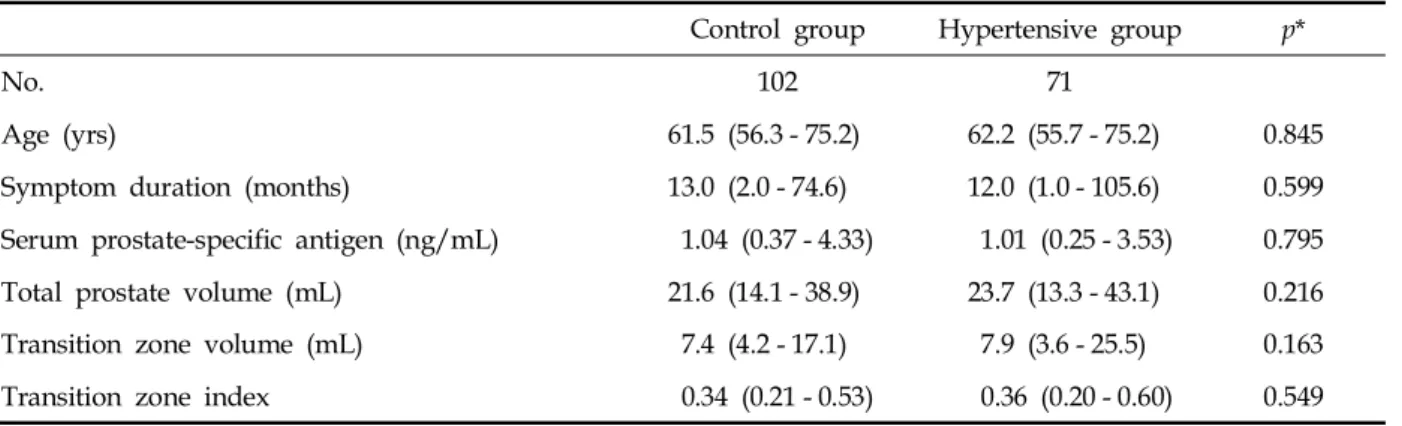
teristics were comparable in the two groups
(Table 1). Baseline and post-treatment clinical
parameters are shown in Table 2. At baseline, no
differences were evident in the two groups with
respect to I-PSS, Qmax, PVR, and BP. After eight
weeks of treatment, I-PSS and uroflowmetry
parameters and BP were not significantly different
in the two groups. Terazosin treatment was asso-
ciated with a significant improvement in subjective
symptoms and most objective parameters in both
groups. However, values of PVR and BVE did not
change with treatment in either group, and
changes in I-PSS, uroflowmetry parameters, and BP due to treatment were not significantly dif- ferent between the groups (Table 3). Changes in BP according to the class of concomitant an- tihypertensives received are shown in Table 4. The addition of 5 mg terazosin to antihypertensives did not cause a significant reduction in either sys- tolic or diastolic BP in either group, and adding terazosin to existing antihypertensive regimens did not increase the incidence of adverse events.
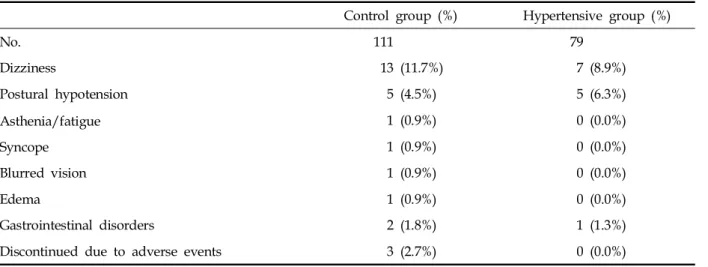
The incidences of withdrawal because of adverse
events were 0% in the hypertensive group and 2.7% in the control group (Table 5).
DISCUSSION
To the best to our knowledge, this is the first study to evaluate the safety and effectiveness of 5 mg terazosin in Korean men with LUTS, with or without concomitant hypertension. Two of the results obtained are of note. First, in the present Table 2. Data at Baseline and Post-Treatment
Baseline After treatment p*
International Prostate Symptom Score (item no.)
Total sum (1 - 7) 23.0 (18.0 - 27.0) 14.0 (9.0 - 19.5) < 0.001
Voiding symptoms (1,3,5,6) 13.0 (10.0 - 16.0) 9.0 (5.0 - 12.5) < 0.001
Storage symptoms (2,4,7) 9.0 (6.5 - 11.0) 5.0 (3.0 - 7.0) < 0.001
Quality of life index 5.0 (4.0 - 6.0) 3.0 (2.5 - 4.0) < 0.001
Uroflowmetry
Maximum flow rate (mL/s) 11.0 (9.0 - 13.0) 16.0 (14.0 - 19.0) < 0.001
Post-void residual (mL) 10.0 (0.0 - 30.0) 10.0 (0.0 - 30.0) 0.538
Bladder voiding efficiency (%) 94.5 (88.6 - 100.0) 95.6 (90.1 - 100.0) 0.152 Blood pressure
Systolic (mmHg) 133.0 (125.0 - 143.0) 129.0 (119.5 - 138.0) < 0.001
Diastolic (mmHg) 79.0 (70.5 - 83.0) 72.0 (65.5 - 77.0) < 0.001
*Wilcoxon signed rank test.
Data presented are medians (5th-95th percentiles).
Table 1. Patients’ Clinical Characteristics
Control group Hypertensive group p*
No. 102 71
Age (yrs) 61.5 (56.3 - 75.2) 62.2 (55.7 - 75.2) 0.845
Symptom duration (months) 13.0 (2.0 - 74.6) 12.0 (1.0 - 105.6) 0.599
Serum prostate-specific antigen (ng/mL) 1.04 (0.37 - 4.33) 1.01 (0.25 - 3.53) 0.795
Total prostate volume (mL) 21.6 (14.1 - 38.9) 23.7 (13.3 - 43.1) 0.216
Transition zone volume (mL) 7.4 (4.2 - 17.1) 7.9 (3.6 - 25.5) 0.163
Transition zone index 0.34 (0.21 - 0.53) 0.36 (0.20 - 0.60) 0.549
*Mann Whitney U-test.
Data presented are medians (5th-95th percentiles).
study, 5 mg terazosin was found to be safe in Korean men with LUTS with or without hyper- tension, and second, subjective and objective parameters improved in both the hypertensive and the non-hypertensive control groups.
Optimal alpha-blocker doses vary by race, constitution, and socio-economic status. Lepor et al.
6reported that 2 mg terazosin daily did not improve obstructive or irritative symptoms as compared with placebo. However, a placebo- controlled double-blind study in Japan showed that a four-week treatment with 2 mg terazosin daily improved subjective symptoms.
7Lee and Lee
5found that 0.2 mg tamsulosin was better than 1 - 5 mg terazosin, because although no difference in efficacy was found between them a more favor- able adverse reaction profile was found for tamsulosin. Okada et al.
4reported that reducing terazosin to 1 - 2 mg daily caused adverse reac- tions to fall to minimal levels, and that terazosin appeared to be as well-tolerated as tamsulosin.
These findings suggest that careful studies on alpha-blockers are required to establish ideal
therapeutic strategies for symptomatic BPH on a country-by-country basis, and are needed to establish differences between therapeutic agents for the treatment of BPH.
A previous study showed that hypertensive BPH patients have more severe LUTS than nor- motensive BPH patients, and that hypertension worsens LUTS and may reduce the efficacy of terazosin.
2However, in the present study, clinical parameters at baseline were similar in the two study groups. In addition, I-PSS and uroflo- wmetry parameters improved in both groups after terazosin administration, and the two groups were similar with respect to these parameters. In the present study, patients were given 1 mg terazosin once daily for the first week, 2 mg once daily for the second week, and 5 mg once daily for the following six weeks. Nakamura et al.
8investigated the effect of terazosin at 2 mg/day for one week on Qmax, and reported a significant improvement after only two days of treatment.
Thus, the dose of terazosin appears to be lower, and the duration of treatment necessary to achieve Table 3. Differences Attributed to Treatment
Control group Hypertensive group p*
No. 102 71
International Prostate Symptom Score (item no.)
Total sum (1 - 7) - 8.0 (- 16.9, 0.0) - 7.0 (- 19.0, 1.0) 0.313
Voiding symptoms (1,3,5,6) - 5.0 (- 10.9, 2.0) - 4.0 (- 12.0, 2.0) 0.339
Storage symptoms (2,4,7) - 4.0 (- 7.9, 1.0) - 3.0 (- 8.0, 1.4) 0.432
Quality of life index - 2.0 (- 3.0, 0.0) - 2.0 (- 3.0, 0.0) 0.980
Uroflowmetry
Maximum flow rate (mL/s) 6.0 (0.0, 11.9) 5.0 (0.0, 16.0) 0.730
Post-void residual (mL) 0.0 (- 64.3, 49.0) 0.0 (- 91.6, 73.2) 0.444
Bladder voiding efficiency (%) 0.0 (- 18.1, 18.3) 0.0 (- 18.6, 22.1) 0.135 Blood pressure
Systolic (mmHg) - 6.0 (-3 0.0, 14.9) - 4.0 (- 20.6, 24.0) 0.109
Diastolic (mmHg) - 6.0 (- 20.0, 4.9) - 4.0 (- 19.4, 14.4) 0.124
Potentially clinically important changes 3 (2.9%) 2 (2.8%) 1.000
* Mann Whitney U-test.
Fisher’s exact test.
Data presented are medians (5th-95th percentiles).
Table 5. Adverse Effects
Control group (%) Hypertensive group (%)
No. 111 79
Dizziness 13 (11.7%) 7 (8.9%)
Postural hypotension 5 (4.5%) 5 (6.3%)
Asthenia/fatigue 1 (0.9%) 0 (0.0%)
Syncope 1 (0.9%) 0 (0.0%)
Blurred vision 1 (0.9%) 0 (0.0%)
Edema 1 (0.9%) 0 (0.0%)
Gastrointestinal disorders 2 (1.8%) 1 (1.3%)
Discontinued due to adverse events 3 (2.7%) 0 (0.0%)
Data presented are numbers (%).
Table 4. Baseline and Post-Treatment Values, and Difference between the Two for Blood Pressures in Hypertensive Patients
No. Baseline Post-treatment Difference p*
Systolic BP (mmHg)
Diuretics 18 140.0 (112.0 - 164.0) 133.5 (109.0 - 157.0) - 6.0 (- 24.0, 22.0) 0.127 ACE inhibitors 3 140.0 (137.0 - 180.0) 140.0 (125.0 - 168.0) - 12.0 (- 15.0, 3.0) 0.285 Beta-blockers 11 133.0 (108.0 - 161.0) 130.0 (110.0 - 170.0) - 2.0 (- 31.0, 16.0) 0.755 Calcium antagonist 19 132.0 (100.0 - 168.0) 133.0 (112.0 - 176.0) - 2.0 (- 23.0, 32.0) 0.948 Combination A 13 131.0 (120.0 - 170.0) 130.0 (107.0 - 156.0) - 6.0 (- 17.0, 24.0) 0.346 Combination B
§7 136.0 (108.0 - 149.0) 133.0 (110.0 - 145.0) - 8.0 (- 16.0, 30.0) 0.600
p value 0.496 0.821 0.739
Diastolic BP (mmHg)
Diuretics 18 78.5 (63.0 - 92.0) 75.5 (60.0 - 86.0) - 3.0 (- 18.0, 13.0) 0.138 ACE inhibitors 3 76.0 (74.0 - 88.0) 71.0 (70.0 - 77.0) - 4.0 (- 17.0, 1.0) 0.285 Beta-blockers 11 80.0 (64.0 - 94.0) 70.0 (60.0 - 93.0) - 4.0 (- 22.0, 8.0) 0.061 Calcium antagonist 19 80.0 (58.0 - 95.0) 74.0 (56.0 - 95.0) - 4.0 (- 26.0, 22.0) 0.227 Combination A 13 74.0 (67.0 - 90.0) 72.0 (60.0 - 89.0) - 5.0 (- 20.0, 14.0) 0.327 Combination B
§7 80.0 (65.0 - 90.0) 75.0 (65.0 - 80.0) - 1.0 (- 19.0, 15.0) 0.343
p value 0.943 0.932 0.964
BP, blood pressure; ACE, angiotensin-converting enzyme.
Data presented are medians (5th-95th percentiles).
* Wilcoxon signed rank test.
Kruskal-Wallis test.
A diuretic and another.
§