• 검색 결과가 없습니다.

The effect of abdominal drawing-in maneuver and pelvic floor muscle contraction in individuals with and without low back pain

N/A
N/A
Protected

Academic year: 2021

Share "The effect of abdominal drawing-in maneuver and pelvic floor muscle contraction in individuals with and without low back pain"

Copied!
8
0
0

로드 중.... (전체 텍스트 보기)

전체 글

(1)

J Korean Soc Phys Med, 2016; 11(1): 53-60 http://dx.doi.org/10.13066/kspm.2016.11.1.53

Online ISSN:

Print ISSN:

2287-7215 1975-311X

Research Article Open Access

요통유무에 따른 복부 드로우인과 골반바닥근 수축훈련이 배가로근과 골반바닥근에 미치는 영향

윤혜진⋅김지선 1†

보니파시오요양병원 물리치료실, 1 경운대학교 보건대학 물리치료학과

The effect of abdominal drawing-in maneuver and pelvic floor muscle contraction in individuals with and without low back pain

Hye-Jin Youn, PT, MSc⋅Ji-Seon Kim, PT, PhD 1†

Department of Physical Therapy, Bonifacio Hospital

1 Department of Physical Therapy, College of Health, Kyungwoon University

Received: October 15, 2015 / Revised: October 16, 2015 / Accepted: November 10, 2015

ⓒ 2015 J Korean Soc Phys Med

| Abstract |

1)

PURPOSE: This study aimed to identify differences in the thickness of the transverse abdominis (TrA) and pelvic floor muscles (PFM) between those with (LBP) and without low back pain (non-LBP). The standardized methods of contraction for the TrA and PFM were used to perform the abdominal draw-in maneuver (ADIM) and pelvic floor muscle contraction (PFC), respectively.

METHODS: This study included 27 young men and women, who were verbally instructed regarding the maneuvers (LBP, n=14; non-LBP, n=13). For all subjects, TrA and PFM thickness were evaluated by ultrasonography during ADIM and PFC.

RESULTS: The results of this study showed that TrA

†Corresponding Author : [email protected]

This is an Open Access article distributed under the terms of the Creative Commons Attribution Non-Commercial License (http://creativecommons.org/licenses/by-nc/3.0) which permits unrestricted non-commercial use, distribution, and reproduction in any medium, provided the original work is properly cited.

thickness increased during ADIM and PFC to a greater degree in the non-LBP group than in the LBP group (p < 0.01). PFM thickness increased more during PFC in the non-LBP group than in the LBP group (p < 0.05). Both groups showed greater increases in TrA thickness during ADIM than during PFC (p

< 0.01), and greater increases in PFM thickness during PFC than during ADIM (p < 0.05).

CONCLUSION: These results suggest that receiving verbal instructions on how to use each muscle for a specific maneuver was more beneficial than other verbal instruction.

Further studies are needed determine how our results may be applied beneficially in research on this topic.

Key Words: Abdominal drawing-in maneuver, Low back

pain, Pelvic floor muscle, Transverse abdominis,

Ultrasonography

(2)

Ⅰ. 서 론

요통은 근골격계의 이상으로 인한 요추부의 국소적 인 통증으로 현대 사회에서 가장 일반적인 근골격계 질환 중 하나이다(Waddell, 1996). 성인 4명 중 1명은 최근 3개월 이내에 요통을 경험한 적이 있고(Deyo 등, 2006), 70~85%는 일생에 한 번은 요통을 경험하며 현대 인들의 신체 기능과 구조의 손상, 활동의 제한, 참여의 제약을 야기시킨다(Ehrlich, 2003).

요통의 원인은 아직까지 명확하지 않지만, 근골격계 손상으로 인한 생체역학적 요인이 요통을 유발하는 가 장 큰 원인으로 거론되고 있으며, 체간의 안정성 유지 및 균형 조절에 중요한 역할을 하는 요추부의 근육약화 는 요통 발생의 주요 원인으로 보고되고 있다(Graves 등, 1990). 요추부의 근육약화는 통증 및 지구력 감소, 유연성 감소, 관절운동범위의 제한을 유발할 뿐만 아니 라(Fordyce 등, 1986; Gill 등, 1988; Shumway-Cook과 Horak, 1990), 통증으로 인한 체간 움직임의 감소로 인 해 추가적인 근육 약화를 야기하며, 정상인에 비해 근 육의 위축 정도가 더 심하다고 보고되고 있다(Tertti 등, 1991; Cooper 등, 1992).

체간의 조절 및 안정성은 복부-골반 근육들의 협응 과 깊은 관련이 있으며, 체간 안정성과 관련된 이전의 연구에서는 배곧은근(rectus abdominis), 배가로근 (transverse abdominis) 및 뭇갈래근(multifidus)의 기능 및 협응에 대한 연구가 주로 이루어졌으나(Barr 등, 2005; Barr 등, 2007), 최근에는 척추의 안정성과 관련하 여 골반바닥근(pelvic floor muscle)의 기능이 중요시 되 고 있다(Sapsford와 Hodges, 2001; Hodges 등, 2007). 골 반바닥근은 배가로근, 요추부 뭇갈래근과 함께 체간의 안정을 제공하는 앞먹임(feedforward) 작용을 하는 근육 으로(Arab 등, 2010), 골반바닥근과 배가로근의 상호 활성화는 복강내압 상승시켜 요추부를 안정화시키고 요추부에 대한 부하를 감소시킨다(Neumann과 Gill, 2002; Sapsford, 2004; Hodges 등, 2005; Loukas 등, 2008).

임상에서 배가로근과 골반바닥근의 선택적인 재교 육을 위한 방법으로 복부 드로우-인(abdominal draw-in maneuver)과 골반바닥근 수축훈련을 자주 사용한다

(Macedo 등, 2009). 복부 드로우-인은 체간 심부근의 조절을 위해 일반적으로 사용되는 체간 심부근 안정화 기법으로 배속빗근과 같은 다른 복부근육의 수축을 최 소화하면서 선택적으로 배가로근을 수축시킬 수 있는 방법이며, 골반바닥근 수축훈련은 골반바닥근과 배가 로근의 상호 활성화를 통해 체간 안정성을 제공하는 방법이다(Hodges와 Richardson, 1996; Hodges 등, 2005).

요통환자들에게 배가로근과 골반바닥근의 기능 및 요통의 감소를 위한 복부 드로우-인과 골반바닥근 수축 훈련의 효과를 나타낸 연구들이 보고되고 있지만 (Teyhen 등, 2005), 서로 다른 연구디자인과 측정방법으 로 인한 논쟁이 있다 . 최근에는 배가로근과 골반바닥근 의 정확한 측정을 위해 실시간 초음파 영상 진단기 (real-time ultrasonic diagnostic imaging system)를 이용한 측정이 제안되고 있다 . 초음파는 비 침습적인 방법으로 심부 근육의 위축과 비대를 직접적으로 평가할 수 있다 (Hodges, 2005).

이에 본 연구에서는 요통군과 비요통군을 대상으로 복부 드로우-인과 골반바닥근 수축훈련을 구두로 지시 한 후 초음파를 이용하여 근 두께를 측정하였다. 요통 군과 비요통군 간에 배가로근과 골반바닥근의 두께비 차이를 알아보고, 복부 드로우-인과 골반바닥근 수축 훈련 시 정확한 근육의 수축을 유도하기 위한 효율적인 구두지시를 알아보고자 하였다.

Ⅱ. 연구 방법

1. 연구대상

본 연구는 대전광역시에 거주하고 있는 20-30대 성

인 남녀 27명(비요통군 13, 요통군 14)을 그 대상으로

하였다. 요통군은 요통으로 인해 치료를 받은 경험이

있는 대상자로 선정하였으며, 비요통군은 요통군과 동

일한 연령층에서 대상자를 선정하였다 . 요통군은 실험

참여 이전에 최소 6주 이상 요통을 경험한 적이 있는

자를 대상으로 하였다(Nourbakhsh와 Arab, 2002). 비요

통군은 요추, 흉추, 골반에 통증이나 기능이상

(dysfunction)을 경험한 적이 없는 자를 대상으로 하였다

(3)

⎒⺳␞ᠲ⋎ԨሮᙶԨ᧳᩾Ԩᇚᕚ⎮⑶৺Ԩ০ᤖᤒ࿣ૺԨ἖⪓㏆ᔦ⑲Ԩ᤮ࣾᕚૺ৺Ԩ০ᤖᤒ࿣ૺ⋎Ԩ᣶⭖ྒԨ⋿㊣ | 55

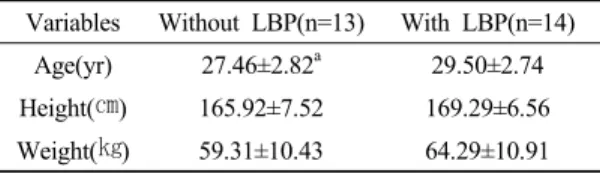
(Arab 등, 2010). 모든 연구대상자의 제외기준은 다음과 같다. 척주나 골반에 수술 경험이 있는 자, 신경학적 질환이 있는 자는 제외하였다 . 실험 전 본 연구의 목적 과 방법에 대해 충분히 설명한 후 실험 참여에 동의한 자를 대상으로 진행하였다 . 대상자들의 일반적인 특성 은 Table 1에 제시하였다.

(N=27) Variables Without LBP(n=13) With LBP(n=14)

Age(yr) 27.46±2.82 a 29.50±2.74 Height(㎝) 165.92±7.52 169.29±6.56 Weight(㎏) 59.31±10.43 64.29±10.91

a M±SD

LBP : Low back pain

Table 1. Characteristics of subjects

2. 측정도구 및 방법

배가로근의 두께와 골반바닥근의 기능을 알아보기 위해 초음파 기기(Acuson X150, Siemens Medical Solutions, USA)를 사용하였다. 배가로근의 두께 측정 은 7.5 MHz 선형탐촉자(linear transducer)를 사용하였으 며, 골반바닥근의 기능을 알아보기 위한 방광바닥의 움직임 길이 측정은 3.5 MHz 볼록형탐촉자(curved array transducer)를 사용하였다. 배가로근의 측정은 머리에 베개를 베고 엉덩관절(hip joint)과 무릎관절(knee joint) 을 60도 굽힘(flexion)하고 바로 누운 자세(crook-lying) 에서 실시하였다. 양팔은 체간과 평행하게 침대 위에 나란히 두거나 가슴 위에 올리도록 하였다. 요추는 중 립 위치(neutral position)를 유지하도록 하였다. 초음파 탐촉자는 12번째 갈비뼈와 엉덩뼈능선(iliac crest) 사이 겨드랑선(axillary line)에서 2.5cm 안쪽에 횡으로 위치 하도록 하였다. 요통군은 통증이 있는 쪽의 복부에서, 비요통군은 오른쪽 복부에서 측정을 실시하였다 (Beazell 등, 2011). 배가로근의 두께는 초음파 모니터 영상에서 배가로근 근막 끝(muscle–fascia junction)에서 수평으로 1.5cm 부분에서 측정하였다(Hodges 등, 2003). 골반바닥근의 측정 자세는 배가로근과 동일한 자세에서 실시하였다. 골반바닥근의 기능 평가를 위한

초음파 측정 방법은 골반바닥근의 수축 시 나타나게 되는 방광 바닥부 움직임의 길이를 측정하는 방법을 이용하였다. 모든 대상자들에게 측정 1시간 이전에 방 광이 차오르는 느낌이 있을 때까지 물 600~750ml를 섭취하도록 하였으며 측정 전에 배설을 하지 않도록 지시하였다. 초음파 탐촉자는 치골 위 하복부의 중앙선 에 횡으로 위치하도록 하였으며, 그 면이 뒤쪽(posterior) 과 꼬리쪽(caudal)을 향하도록 15~30°각도로 기울여 측 정을 실시하였다(Fig. 1). 방광 바닥부 움직임의 길이는 측정된 초음파 모니터 영상에서 휴식 시 방광 바닥에 초음파 켈리퍼를 위치와 각각 골반바닥근 수축훈련과 복부 드로우-인 시 방광 바닥의 초음파 켈리퍼 위치의 이동 길이를 측정하였다. 휴식 시와 골반바닥근 수축훈 련 , 복부 드로우-인 시에 측정된 두 켈리퍼 사이의 길이 차이값을 분석하였다(Bo 등, 2003; Bo와 Sherburn, 2005;

Sherburn 등, 2005; Kelly 등, 2007; Thompson 등, 2007;

Arab 등, 2009)(Fig. 2). 배가로근과 골반바닥근의 초음 파 측정은 휴식 시, 골반바닥근 수축훈련, 복부 드로우- 인 시에 실시하였다. 휴식 시 측정은 대상자가 호기 후 1-3초 정도 자세를 그대로 유지한 상태에서 초음파 이미지 영상을 저장하였다(Beazell 등, 2011). 골반바닥 근 수축훈련은 대상자들에게 “소변을 멈추는 때처럼 힘을 주세요.”라고 지시하였다(Henderson 등, 2013). 복 부 드로우-인은 “숨을 내쉰 후 배꼽이 등쪽으로 움직이 도록 힘을 주세요.”라고 지시한 후 초음파 이미지 영상 을 저장하였다(Richardson과 Jull, 1995). 측정 이전에 각 동작에 대한 근육의 학습 효과를 최소화하기 위하여 사전 연습없이 측정을 실시하였다(Beazell 등, 2011).

근육과 동작 별로 각각 3회씩 측정하였다. 동작은 무작

위로 실시하였고 근 피로도를 최소화하기 위해 한 동작

측정 후 3분간 휴식시간을 갖도록 하였다(Teyhen 등,

2005). 모든 측정은 한 명의 측정자가 실시하였다. 휴식

시 측정된 배가로근과 골반바닥근의 값은 다른 동작과

비교하여 변화된 값을 알아보기 위한 기초값으로 사용

하였다. 골반바닥근 수축훈련, 복부 드로우-인 시 배가

로근의 두께 변화 비를 알아보기 위하여 골반바닥근

수축훈련 /휴식, 복부 드로우-인 /휴식의 계산방법을

사용하였다.

(4)

Figure 2. Ultrasonography images of bladder base (A) resting position (B) pelvic floor muscle contraction Figure 1. Position of transducer

3. 통계처리

통계분석은 윈도우용 SPSS 18.0을 이용하여 분석하 였다. 대상자들의 일반적인 특성은 평균과 표준편차로 나타냈다. 각 근육 별 동작에 따른 두 그룹 간 비교를 위해 독립 t 검정(independent t-test)을 실시하였고, 각 그룹 별 동작에 따른 근육 간 비교를 위해 대응 t 검정 (paired t-test)을 실시하였다. 자료의 통계학적 유의수준 은 0.05로 하였다.

Ⅲ. 결 과

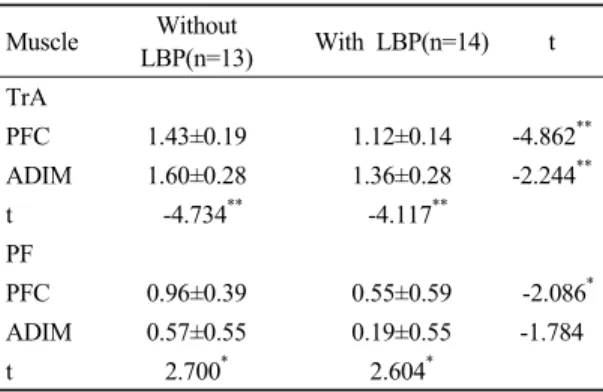
각 근육 별 동작에 따른 두 그룹의 비교 결과 배가로

근은 비요통군이 요통군에 비해 골반바닥근 수축훈련 과 복부 드로우-인 시 근육의 두께비가 유의하게 증가 하였다(p<.01). 골반바닥근은 비요통군이 요통군에 비 해 두 동작 모두 근수축을 잘 하는 경향을 보였으나 통계학적으로 골반바닥근 수축훈련 시에만 유의한 차 이를 보였다(p<.05). 각 그룹 별 동작에 따른 근육 간 비교 결과 배가로근은 두 그룹 모두 골반바닥근 수축훈 련 보다 복부 드로우-인을 실시했을 때 근육의 두께비 가 유의하게 증가하였다(p<.01). 골반바닥근은 두 그룹 모두 복부 드로우 -인보다 골반바닥근 수축훈련을 위한 동작을 실시하였을 때 골반바닥근의 근수축이 유의하 게 증가하였다(p<.05)[Table 2].

Muscle Without

LBP(n=13) With LBP(n=14) t TrA

PFC 1.43±0.19 1.12±0.14 -4.862 **

ADIM 1.60±0.28 1.36±0.28 -2.244 **

t -4.734 ** -4.117 **

PF

PFC 0.96±0.39 0.55±0.59 -2.086 * ADIM 0.57±0.55 0.19±0.55 -1.784

t 2.700 * 2.604 *

Values are mean±SD, * p<0.05, ** p<0.01

TrA : Transverse abdominal muscle. PF : Pelvic floor.

PFC : Pelvic floor conteraction. ADIM : Abdominal draw-in maneuver. LBP : Low back pain

Table 2. Comparison of difference ratio between each

contraction method in both groups

(5)

⎒⺳␞ᠲ⋎ԨሮᙶԨ᧳᩾Ԩᇚᕚ⎮⑶৺Ԩ০ᤖᤒ࿣ૺԨ἖⪓㏆ᔦ⑲Ԩ᤮ࣾᕚૺ৺Ԩ০ᤖᤒ࿣ૺ⋎Ԩ᣶⭖ྒԨ⋿㊣ | 57

Ⅳ. 고 찰

요통은 배가로근과 밀접한 관련이 있으며 요통을 위한 치료에 있어 배가로근의 기능 회복의 중요성에관 한 연구들이 많이 시행되어 왔다. 최근 배가로근의 단 독 작용이 아닌 골반바닥근과의 상호 작용 시 기능 회복 에 더 효과적이라는 연구 결과들이 제시되고 있다 (Neumann과 Gill, 2002; Sapsford, 2004; Hodges 등, 2005;

Loukas 등, 2008). 그러나 아직까지 요통과 골반바닥근, 배가로근에 관련성 그리고 이들의 기능 회복을 위한 효과적인 중재 방법 등에 대해서는 논란의 여지가 있 다 . 본 연구는 요통군과 비요통군을 대상으로 골반바닥 근 수축훈련과 복부 드로우-인 동작 시 골반바닥근과 배가로근의 두께비 차이를 비교하고, 골반바닥근과 배 가로근의 기능 회복을 위한 효율적인 중재 방법을 알아 보고자 하였다.

본 연구에서는 비요통군과 요통군에게 골반바닥근 수축훈련과 복부 드로우-인을 시행하였다. 요통은 요 추부 근육의 근력과 지구력에 영향을 미쳐 요추부 불안 정성과 기능장애의 원인이 될 수 있으며, 요통환자는 정상인에 비해 심부 근육의 반응속도가 느려지고 위축 또한 심하다(Johansen 등, 1995; Hodges와 Gandervia, 2000). 골반바닥근 수축훈련과 복부 드로우-인은 다른 근육의 수축을 최소화하며 각각 골반바닥근과 배가로 근을 선택적으로 수축하는 방법이라고 알려져 있다 (Hodges와 Richardson, 1996; Hodges 등, 2005; Teyhen 등 , 2005; Urquhart 등, 2005). 이러한 이유로 본 연구에서 는 요통이 골반바닥근과 배가로근의 두께에 미치는 영 향과 골반바닥근 수축훈련과 복부 드로우 -인의 효과를 알아보고자 연구를 진행하였다.

본 연구의 결과 요통군이 골반바닥근과 배가로근 모두 골반바닥근 수축훈련과 복부 드로우 -인 시 두께비 가 비요통군에 비해 작은 경향을 보였다. 또한 두 군 모두에서 골반바닥근 수축훈련 시 배가로근보다 골반 바닥근이 복부 드로우-인 시에는 골반바닥근보다 배가 로근이 더 많이 두꺼워지는 것으로 나타났다. 요통은 요부의 굽힘근과 폄근의 근력을 약화시키는데 (Johansen 등, 1995) 특히 요통 환자들은 정상인에 비해

배가로근의 근력이 약해진다(Hodges, 1999). 골반바닥 근은 골반강과 복강의 바닥부를 구성하는 근육으로 요 골반부에 안정성을 제공하는 것으로 알려져 있으며 (Sapsford, 2004), Arab 등(2009)은 골반바닥근의 기능 장애는 배뇨질환 또는 요골반부 통증과 밀접한 관련이 있다고 하였다 . 또한 골반바닥근과 배가로근은 척주와 골반에 기계적인 지지를 제공하는 것으로 알려져 있으 며 이들 근육이 적절한 타이밍에 수축되지 않으면 체간 의 불안정성을 초래하게 된다(Hodges와 Gandervia, 2000; Sapsford 등, 2001). 즉 요통은 골반바닥근, 배가로 근과 같은 심부 근육의 손상을 일으키며 이들 근육의 운동 조절(motor control) 능력 상실을 발생시킨다(Jull 과 Richardson, 2000). 이는 요통군이 비요통군보다 골반 바닥근과 배가로근의 두께비가 작게 나타난 본 연구의 결과와 일치하는 것이다 . Henderson 등(2013)은 대부분 의 여성들이 정확한 골반바닥근 수축훈련을 수행하는 것이 불가능하며 이와 같은 여성들에게 골반바닥근 수 축훈련을 유도하는 간단한 구두 지시만으로도 정확한 골반바닥근 수축훈련이 가능하다고 하였다 . 이는 골반 바닥근 수축훈련을 위한 구두 지시를 주었을 때 배가로 근보다 골반바닥근의 증가가 더 크고 복부 드로우-인을 위한 구두 지시를 주었을 때에는 골반바닥근보다 배가 로근이 더 큰 증가를 보인 본 연구의 결과를 지지하는 것이다.

배가로근과 골반바닥근 측정을 위해 초음파 기기를

사용하였다. 배가로근과 같은 심부 근육의 측정은 표면

근전도(surface electromyography)보다 침근전도(needle

electromyography)와 같은 침습적인 방법을 이용할 때

정확한 측정이 가능하다. 침근전도를 이용한 측정은

측정부위에 통증 유발과 같은 단점이 있다(Hodges와

Richardson, 1997). 골반바닥근의 측정은 질내로 삽입하

는 근전도 또는 질내압 검사 등을 이용하였으나 이와

같은 방법은 대상자의 탈의와 함께 질내 삽입으로 인한

불편감 호소 등과 같은 단점이 있다(Thompson 등,

2005). 그러나 초음파 기기를 이용한 측정은 골격근을

관찰함에 있어 적용 절차가 간편하고 비 침습적이며

안전하여 최근 물리치료사들에게 근활성도를 측정을

위한 방법으로 권해지고 있다(Maurits 등, 2004;

(6)

McMeeken 등, 2004). 또한 초음파 측정은 근전도 검사 와 달리 심부근의 위치와 형태를 직접 육안으로 확인이 가능하고 근전도 측정 시 인접한 근육들에 의한 잡신호 (crosstalk)의 영향 없이 측정이 이루어지기 때문에 보다 객관성 있고 신뢰성 높은 정보를 얻을 수 있는 새로운 방법이라 할 수 있다(Richardson 등, 2004; Hides 등, 2006).

본 연구는 비요통군 13명과 요통군 14명의 젊은 성인 남녀를 대상으로 실시하였다. 각 집단의 대상자 수가 많지 않았으며 젊은 성인 남녀를 대상으로 하여 연령에 따른 변화와 차이를 반영할 수 없어 본 연구의 결과를 일반화시키는 데에는 다소 어려움이 있다. 또한 골반바 닥근과 배가로근의 수축 유도를 위한 동작으로 골반바 닥근 수축훈련과 복부 드로우-인을 실시하였다. 개인 에 따라 근수축에 대한 반응과 근피로의 회복 능력에 대한 차이를 반영할 수 없었다. 그러므로 향후에는 이 와 같은 제한점을 보완하여 지속적인 연구가 시행되어 야 할 것이다.

Ⅴ. 결 론

요추부 근육의 약화는 요통의 주요 원인으로 알려져 있으며 이와 같은 근육 약화로 인해 요추부의 불안정성 이 증가하게 된다. 골반바닥근과 배가로근은 요추부 안정에 중요한 역할을 하는 근육들로 이들 근육의 강화 를 목적으로 골반바닥근 수축훈련과 복부 드로우 -인을 시행한다. 골반바닥근 수축훈련과 복부 드로우-인은 각각 골반바닥근과 배가로근을 선택적 수축을 위한 방 법이나 임상에서는 혼용되어 사용하고 있다 . 본 연구의 결과 비요통군과 요통군에게 골반바닥근 수축훈련과 복부 드로우-인을 시행했을 때 골반바닥근 수축훈련은 골반바닥근을 복부 드로우-인은 배가로근을 더 강화시 키는 것으로 나타났다. 따라서 임상에서 골반바닥근과 배가로근 수축을 위한 구두 지시만으로도 이들 근육의 수축 유도에 긍정적인 영향을 미칠 수 있다는 것을 의미 한다 . 본 연구의 결과를 바탕으로 향후 이에 대한 연구 가 지속되어야 할 것이다.

References

Arab AM, Behbahani RB, Lorestani L et al. Assessment of pelvic floor muscle function in women with and without low back pain using transabdominal ultrasound. Man Ther. 2010;15(3):235-9.

Arab AM, Behbahani RB, Lorestani L et al. Correlation of digital palpation and transabdominal ultrasound for assessment of pelvic floor muscle contraction. J Man Manip Ther. 2009;17(3):e75-9.

Barr KP, Griggs M, Cadby T. Lumbar stabilization: a review of core concepts and current literature, part 2. Am J Phys Med Rehabil. 2007;86(1):72-80.

Barr KP, Griggs M, Cadby T. Lumbar stabilization: core concepts and current literature, Part 1. Am J Phys Med Rehabil. 2005;84(6):473-80.

Beazell JR, Grindstaff TL, Hart JM et al. Changes in lateral abdominal muscle thickness during an abdominal drawing-in maneuver in individuals with and without low back pain. Res Sports Med. 2011;19(4):271-82.

Bø K, Sherburn M, Allen T. Transabdominal ultrasound measurement of pelvic floor muscle activity when activated directly or via a transversus abdominis muscle contraction. Neurourol Urodyn. 2003;22(6):

582-8.

Bø K, Sherburn M. Evaluation of female pelvic-floor muscle function and strength. Phys Ther. 2005;85(3):269-82.

Cooper RG, St Clair Forbes W, Jayson MI. Radiographic demonstration of paraspinal muscle wasting in patients with chronic low back pain. Br J Rheumatol. 1992;

31(6):389-94.

Deyo RA, Mirza SK, Martin BI. Back pain prevalence and visit rates: estimates from U.S. national surveys, 2002.

Spine. 2006;31(23):2724-7.

Ehrlich GE. Low back pain. Bull World Health Organ.

2003;81(9):671-6.

Fordyce WE, Brockway JA, Bergman JA et al. Acute back

pain: a control-group comparison of behavioral vs

(7)

⎒⺳␞ᠲ⋎ԨሮᙶԨ᧳᩾Ԩᇚᕚ⎮⑶৺Ԩ০ᤖᤒ࿣ૺԨ἖⪓㏆ᔦ⑲Ԩ᤮ࣾᕚૺ৺Ԩ০ᤖᤒ࿣ૺ⋎Ԩ᣶⭖ྒԨ⋿㊣ | 59

traditional management methods. J Behav Med.

1986;9(2):127-40.

Gill K, Krag MH, Johnson GB et al. Repeatability of four clinical methods for assessment of lumbar spinal motion. Spine. 1988;13(1):50-3.

Graves JE, Pollock ML, Carpenter DM et al. Quantitative assessment of full range-of-motion isometric lumbar extension strength. Spine. 1990;15(4):289-94.

Henderson JW, Wang S, Egger MJ et al. Can women correctly contract their pelvic floor muscles without formal instruction? Female Pelvic Med Reconstr Surg.

2013;19(1):8-12.

Hides J, Wilson S, Stanton W et al. An MRI investigation into the function of the transversus abdominis muscle during “drawing-in” of the abdominal wall. Spine.

2006;31(6):E175-8.

Hodges PW, Eriksson AE, Shirley D et al. Intra-abdominal pressure increases stiffness of the lumbar spine. J Biomech. 2005;38(9):1873-80.

Hodges PW, Gandevia SC. Activation of the human diaphragm during a repetitive postural task. J Physiol. 2000;522 Pt 1:165-75.

Hodges PW, Pengel LH, Herbert RD et al. Measurement of muscle contraction with ultrasound imaging. Muscle Nerve. 2003;27(6):682-92.

Hodges PW, Richardson CA. Contraction of the abdominal muscles associated with movement of the lower limb.

Phys Ther. 1997;77(2):132-42; discussion 142-4.

Hodges PW, Richardson CA. Inefficient muscular stabilization of the lumbar spine associated with low back pain.

A motor control evaluation of transversus abdominis.

Spine. 1996;21(22):2640-50.

Hodges PW, Sapsford R, Pengel LH. Postural and respiratory functions of the pelvic floor muscles. Neurourol Urodyn. 2007;26(3):362-71.

Hodges PW. Is there a role for transversus abdominis in lumbo-pelvic stability? Man Ther. 1999;4(2):74-86.

Hodges PW. Ultrasound imaging in rehabilitation: just a fad?

J Orthop Sports Phys Ther. 2005;35(6):333-7.

Johannsen F, Remvig L, Kryger P et al. Exercises for chronic low back pain: a clinical trial. J Orthop Sports Phys Ther. 1995;22(2):52-9.

Jull GA, Richardson CA. Motor control problems in patients with spinal pain: a new direction for therapeutic exercise. J Manipulative Physiol Ther. 2000;23(2):

115-7.

Kelly M, Tan BK, Thompson J et al. Healthy adults can more easily elevate the pelvic floor in standing than in crook-lying: an experimental study. Aust J Physiother.

2007;53(3):187-91.

Loukas M, Shoja MM, Thurston T et al. Anatomy and biomechanics of the vertebral aponeurosis part of the posterior layer of the thoracolumbar fascia. Surg Radiol Anat. 2008;30(2):125-9.

Macedo LG, Maher CG, Latimer J et al. Motor control exercise for persistent, nonspecific low back pain: a systematic review. Phys Ther. 2009;89(1):9-25.

Maurits NM, Beenakker EA, van Schaik DE et al. Muscle ultrasound in children: normal values and application to neuromuscular disorders. Ultrasound Med Biol.

2004;30(8):1017-27.

McMeeken JM, Beith ID, Newham DJ et al. The relationship between EMG and change in thickness of transversus abdominis. Clin Biomech (Bristol, Avon). 2004;

19(4):337-42.

Neumann P, Gill V. Pelvic floor and abdominal muscle interaction: EMG activity and intra-abdominal pressure. Int Urogynecol J Pelvic Floor Dysfunct.

2002;13(2):125-32.

Nourbakhsh MR, Arab AM. Relationship between mechanical factors and incidence of low back pain. J Orthop Sports Phys Ther. 2002;32(9):447-60.

Richardson CA, Hides JA, Wilson S et al. Lumbo-pelvic joint

protection against antigravity forces: motor control

and segmental stiffness assessed with magnetic

resonance imaging. J Gravit Physiol. 2004;11(2):pp.

(8)

119-22.

Richardson CA, Jull GA. Muscle control-pain control. What exercises would you prescribe? Man Ther. 1995;

1(1):2-10.

Sapsford R. Rehabilitation of pelvic floor muscles utilizing trunk stabilization. Man Ther. 2004;9(1):3-12.

Sapsford RR, Hodges PW. Contraction of the pelvic floor muscles during abdominal maneuvers. Arch Phys Med Rehabil. 2001;82(8):1081-8.

Sapsford RR, Hodges PW, Richardson CA et al. Co-activation of the abdominal and pelvic floor muscles during voluntary exercises. Neurourol Urodyn. 2001;20(1):

31-42.

Sherburn M, Murphy CA, Carroll S et al. Investigation of transabdominal real-time ultrasound to visualise the muscles of the pelvic floor. Aust J Physiother.

2005;51(3):167-70.

Shumway-Cook A, Horak FB. Rehabilitation strategies for patients with vestibular deficits. Neurol Clin.

1990;8(2):441-57.

Tertti MO, Salminen JJ, Paajanen HE et al. Low-back pain and disk degeneration in children: a case-control MR

imaging study. Radiology. 1991;180(2):503-7.

Teyhen DS, Miltenberger CE, Deiters HM et al. The use of ultrasound imaging of the abdominal drawing-in maneuver in subjects with low back pain. Orthop Sports Phys Ther. 2005;35(6):346-55.

Thompson JA, O’Sullivan PB, Briffa K et al. Assessment of pelvic floor movement using transabdominal and transperineal ultrasound. Int Urogynecol J Pelvic Floor Dysfunct. 2005;16(4):285-92.

Thompson JA, O’Sullivan PB, Briffa NK et al. Comparison of transperineal and transabdominal ultrasound in the assessment of voluntary pelvic floor muscle contractions and functional manoeuvres in continent and incontinent women. Int Urogynecol J Pelvic Floor Dysfunct. 2007;18(7):779-86.

Urquhart DM, Hodges PW, Story IH. Postural activity of the abdominal muscles varies between regions of these muscles and between body positions. Gait Posture.

2005;22(4):295-301.

Waddell G. Low back pain: a twentieth century health care

enigma. Spine. 1996;21(24):2820-5.

수치

Table 1. Characteristics of subjects
Table 2. Comparison of difference ratio between each  contraction method in both groups

참조

관련 문서

복장뼈,

반지층 (Basement Floor) 1층 (Ground Floor)... Nishizawa

고관절 : 관골의 관골구(acetabulum)과 femur head sacroiliac joint: sacrum + ilium.. pubic symphysis : pubic + pubic

Preoperative evaluation of pelvic lateral lymph node of patients with lower rectal cancer: comparison study of MR imaging and CT in 53 patients?.

Effects of Nitroglycerin(Ni) on Spontaneous Activity(S.A) and Oxytocin (OT) Induced Contractions in the Uterine Smooth Muscle. Data are expressed as mean

In the change of physical strength, The exercise group showed statistically significant differences in muscle strength(right), muscle strength(left),

The improvement factors of the performance showed significant increase in muscle strength, muscle endurance, cardiovascular endurance, power, agility and

In the health fitness category of the adult women who underwent instrument pilates exercise, they were statistically significant in muscle strength,