1
Writing in APA Style 7th Edition Example Paper
Student Name
Antioch University Santa Barbara Course Name
Instructor Name January 8, 2020
Title in bold, Capitalize All of the Major Words; no word limit.
Student Name, Institution, Course Name & Number, Instructor, and Due Date, all on separate lines Change from APA 6: No Running head Every page has a page number in the header
Student Paper Example
Based on the Seventh Ed. of the Publication Manual of the American Psychological Association
Use same font size for everything in the entire document
APA 7 no longer requires 12-pt. Times New Roman.
Permitted fonts:
12-pt. Times New Roman
11-pt. Georgia
11-pt. Calibri
11-pt. Arial
10-pt. Lucida Sans Unicode
One blank double-spaced line under title.
Entire document should be double-spaced.
2
Abstract
This paper describes some basic parts of writing in APA style 7th Edition. These components include seven major areas: the title page, abstract, formatting concerns for student writing, use of language, in-text citations, the references page, and titles and figures. This paper also
provides examples of specific changes that are required by APA style 7th Edition.
Keywords: APA style, citations, frustration
Level 1 heading (see box below)
An abstract is a brief
comprehensive summary of the contents of the paper, typically no more than 250 words.
Abstracts are not usually required for student papers.
Check with your instructor to see if an abstract and/or keywords are required for your paper.
If you’re not required to include an abstract, begin the main text on this page.
Keywords are words, phrases, or acronyms that describe the most important aspects of your paper. They are used for indexing in databases and help readers find your work during a search.
If required for your paper, provide 3–5 keywords.
Keywords can be listed in any order.
Indent ½ inch.
No period
Page number 1 inch margin
Headings: Use headings in your paper to distinguish between main sections and sub-sections.
Format for the Five Levels of Headings in APA Style Level Format
1 Centered, Bold, Capitalize Major Words Text begins as a new indented paragraph.
2 Left Align, Bold, Capitalize Major Words Text begins as a new indented paragraph.
3 Left Align, Bold Italic, Capitalize Major Words Text begins as a new indented paragraph.
4 Indented, Bold, Capitalize Major Words. After a period, text begins on the same line and continues.
5 Indented, Bold Italic, Capitalize Major Words. After a period, text begins on the same line and continues.
Main sections (divisions) of the body of your paper
Sub-sections
3
Writing in APA Style 7th Edition Example Paper
Writing in the style of the American Psychological Association (APA) is a regular practice for students of higher degree programs in psychology and many programs in science. The new edition of the manual has made several changes, such as endorsing the use of the singular they, as exemplified in the next sentence. Each student writer who applies the new APA student writing standards may encounter different challenges, however, they may use the resources provided by the AUSB Writing Center for support in learning the relevant new rules.
According to the seventh edition of the Publication Manual of the American
Psychological Association (2019), the style’s broad applicability “helps authors present their ideas in a clear, concise, and organized manner” that “uniformity and consistency enables readers to (a) focus on the ideas being presented rather than formatting and (b) scan works quickly for key points” (p. xvii). Since this paper is mostly written in the seventh edition of APA style, attentive readers will note that it has many examples of changes from the sixth edition.
Most of the rules demonstrated here are those a student will need to have some acquaintance with in order to write easily according to the student writing guidelines, which are distinct from APA’s new journal article reporting standards (Paiz et al., 2013).
The Structure of a Paper in APA Style
The APA style guidelines are designed for primary research papers that usually contain the following sections: (a) introduction, (b) method, (c) results, (d) discussion, and (e)
references. However, the actual headings may vary depending on the type of paper one is writing (American Psychological Association, 2019). For example, papers that do not describe primary research or original experimental data may omit the method, results, and discussion
Level 1 heading (see p. 2)
Use singular
“they”
New in APA 7:
Use “et al.” for three or more authors Title is bolded and
centered, Capitalize All of the Major Words
Level 1 heading (a main section)
One space after a period 1 inch margins on all sides Repeat title from Title page
4
sections (Xyers, Young, Zucherman, & Anne, 2019, p. 291). Some sections may be broken into subsections, in which case the authors must use the appropriate headings and subheadings (Xyers, Young, Zucherman, & Roberts, 2019, para. 4).
Organizing the Main Body
Most APA style papers written by students are not experimental; the organization of headings and subheadings within the main body of the paper is therefore particularly
important. In certain cases, the author might use additional major sections, such as a literature review, to introduce their own material.
Organizing the Main Body When There are Additional Content Concerns
In some common graduate assignments, students are instructed to compare therapeutic models, provide possible interventions given specific presenting problems, or engage in case study analyses. These papers may have particular sections (such as presenting problem, or socio-cultural considerations of a given model).
Language Concerns in the Body of the Paper. Sometimes, writers who are just
becoming comfortable with APA style, or with academic writing in general, will mimic academic language in ways subtly less clear than writers who use academic register fluently. For example, one might write the following sentence, which sounds academic to the mental ear, but in which almost everything is done poorly:
during the preparatory process of elucidating the critical and fundamental elements of this theory for analysis, it would be observed that certain subjective elements of the theory would be excessively situational to the point of being non-applicable outside of the theorists’ particular circumstances. (Goodwin, 2012a)
Exception to “et al.” rule for 3 or more authors:
Include as many authors as needed to distinguish between sources with the same first author(s).
Level 2 heading (a sub- section)
Level 3 heading (a sub-section of the Level 2 sub-section)
Level 4 heading (see p. 2)
If a quotation is 40 words or more, use a block quote format: new line, indent ½ inch, double space, no quotation marks.
Short papers usually only need Level 1 and 2 headings
For block quotes, period comes before citation.
5
We observe that such a sentence serves little use beyond parody. The same sentiment can be expressed in appropriate academic register in the following fashion: this theory is based on subjective components and thus is not widely applicable (Goodwin, 2012b).
Language Concerns as Issues of Unstated Academic Expectation. Writers for whom the distinction between the two earlier examples is unintuitive should not be dismayed. Graham and Harris (1997) have shown that an academic style of writing is slowly learned, and is not often intuitive. Often, the rules of academic English, and American academic English in
particular, are presented as assumptions rather than with explicit guidance (Graham & Harris, 1997). A student may look at their peers and see no one else asking questions about unclear elements of an assignment, or unclear expectations, and try to muddle through on their own rather than raising the issue. However, most academic expectations need to be explicitly taught at some point, so students should not feel bad asking for clarification. Often, if one writer has a question about the expectations, many others do also (S. Harter, personal communication, September 30, 2018).
In-Text Citations and References
The American Psychological Association (APA) encourages authors to cite any works that have impacted their own (APA, 2019). In general, the style guide recommends
paraphrasing sources rather than using too many direct quotes, “because paraphrasing allows you to fit material to the context of your paper and writing style” (APA, 2019, p. 270).
A direct quote is best employed when the original author has stated a point particular memorably, concisely, or effectively, or when the original author is providing a technical
Personal communication formatting example. Cite in text but not on References page. (see p. 7)
Cite the specific page number of direct quotes.
Narrative citation style
Parenthetical citation style 2 Styles of In- text Citations:
Narrative &
Parenthetical:
Level 4 heading
Level 1 heading Para- phrase
About page numbers:
Use for direct quotes
Use for paraphrases of information on a specific page o Otherwise, optional for paraphrases
No page # (see box below)
6
definition or explanation of a term. Under other circumstances, a paraphrase is usually more efficient than a direct quotation. Both paraphrased ideas as well as quotations need to be cited, though; only common knowledge does not require a citation. A good general rule of thumb might be: “when in doubt, cite it, and if you don’t have a citation, double-check” (S. Chase, personal communication, August 12, 2017).
Writers using APA style should be careful to format their citations appropriately. Most in-text citations follow the format of author and year in parentheses, providing page numbers (or paragraph numbers) for every direct quotation. For paraphrases/summaries in your own words, include a page number when information is from a specific page of a source; otherwise a page number is optional, but may be helpful. The formatting of references in the references list, however, is more complicated, and writers should check their work to ensure that they have used the appropriate format for each citation, depending on the type of source.
Figures and Tables
As shown in Table 1, the seventh edition of APA has made some changes to the formatting of figures and tables. For example, figures now use the same title format as tables (see Figure 1).
Final Recommendations
APA style is an effective way of formatting and presenting complex material. APA can be time-consuming to learn; visit us in the AUSB Writing Center for help with any of your APA questions.
Personal communication formatting example. Cite in text but not on References page. (see p. 7)
Use table and figure numbers to refer the reader to tables and figures. Do not write “see the table above/below”.
7
References
American Psychological Association. (2019). Publication manual of the American Psychological Association (7th ed.).
Goodwin, J. (2012a). Made up examples of bad academic writing. Academic Writing, 343(1), 1006–1010. http://doi.org/11.1136/acadbad.12345
Goodwin, J. (2012b). Good reading is hard writing: Another made-up journal article about academic writing. Reading & Writing, 25(3), 143–152.
http://doi.org/10.1234/readwrite.123456789
Graham, S., & Harris, K. R. (1997). It can be taught, but it does not develop naturally: Myths and realities in writing instruction. School Psychology Review, 26(6), 414–424.
Paiz, J. M., Angeli, E., Wagner, J., Lawrick, E., Moore, K., Anderson, G., Franks, M., Paul, R., Keech, E., Ruiz, G., Allison, A., Caterelli, B., Zhou, M., Soong, R., Nguyen, Y., Bedo, O., Sanders, B., Howard, C., Denny, H., … Keck, R. (2013). Online writing: The challenges of learning APA. Journal of Psychotherapy. http://doi.org/10.4567/apa-style.67810
Xyers, K., Young, G., Zucherman, F., and Anne, A. (2019). Example with multiple authors. In G. Y.
Iwamasa & P. A. Hays (Eds.), Big Book of Examples (2nd ed., pp. 287–314). CRC Press.
Xyers, K., Young, G., Zucherman, F., and Roberts, B. (2019, June 1). Example citation for multiple authors. BBC News. http://www.bbcnews.com/example-for-multiple-authors.html
New in APA 7:
No place of publication for books Leave hyperlinks
Do not use “retrieved from” or a retrieval date unless the website content updates often by design (e.g., social media)
Level 1 heading
When publisher & author are the same, omit that info.
Include DOI as hyperlinked URL
Capitalize only the first word of a journal article and subtitle.
Include up to 20 authors References should be in
alphabetical order and double spaced.
Exception: Do not include personal communication on your References page, e.g., emails or interviews, since they are not recoverable. Instead, cite them in-text. (See p. 6.) The References provides the information necessary for a reader to
locate and retrieve any source you cite.
Every source you cite must appear on your References page.
References page only includes sources cited in the body of your paper.
Same author, same year:
use a & b
Use a hanging indent
8
Table 1
An Example of an APA Style Table
Table or Figure Change from 6th Edition
Table Mostly the same for simple tables, but avoid unnecessary borders or shading in a table
Figure Now uses same title format as tables
Note. A table note may optionally be included under the table to clarify the contents of the table for the readers of the manuscript.
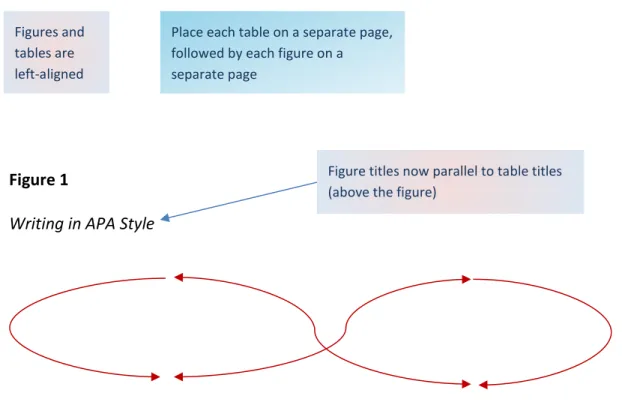
Figure 1
Writing in APA Style
Note. A figure note may optionally be included under the figure to clarify the contents of the figure for the readers of the manuscript.
Limited shading and borders now preferred. (Do not use vertical borders to separate data.)
Figure titles now parallel to table titles (above the figure)
Figures and tables are left-aligned
Place each table on a separate page, followed by each figure on a separate page