Yonsei Med J http://www.eymj.org Volume 56 Number 4 July 2015 1163
A Rare Case of Bleeding Ectopic Lingual Thyroid Presenting as Hematemesis
Min Kwan Baek,
1Eun Young Kim,
2Soong Gong Lee,
2Sang Min Lee,
3and Young Sil Eom
3Departments of 1Otolaryngology-Head & Neck Surgery, 2Radiology, and 3Internal Medicine, Gachon University Gil Hospital, Incheon, Korea.
Received: February 10, 2015 Revised: March 3, 2015 Accepted: March 11, 2015
Corresponding author: Dr. Eun Young Kim, Department of Radiology,
Gachon University Gil Hospital,
21 Namdong-daero 774beon-gil, Namdong-gu, Incheon 405-760, Korea.
Tel: 82-32-460-3060, Fax: 82-32-460-3065 E-mail: [email protected]
∙ The authors have no financial conflicts of interest.
© Copyright:
Yonsei University College of Medicine 2015 This is an Open Access article distributed under the terms of the Creative Commons Attribution Non- Commercial License (http://creativecommons.org/
licenses/by-nc/3.0) which permits unrestricted non- commercial use, distribution, and reproduction in any medium, provided the original work is properly cited.
To the Editor:
Lingual thyroid is a rare embryological anomaly caused by failure of the gland to descend from the foramen cecum to its normal site in the pre-laryngeal area. Its pre- cise pathogenesis is unknown, and has been found to be more prevalent in females (female:male ratio, 7:1).1 Although bleeding from an ectopic lingual thyroid is rare, life-threatening massive hemorrhage is possible, since the lingual thyroid may have prominent large blood vessels on its surface.2-4 We present a rare case of bleeding from an ectopic lingual thyroid presenting as hematemesis.
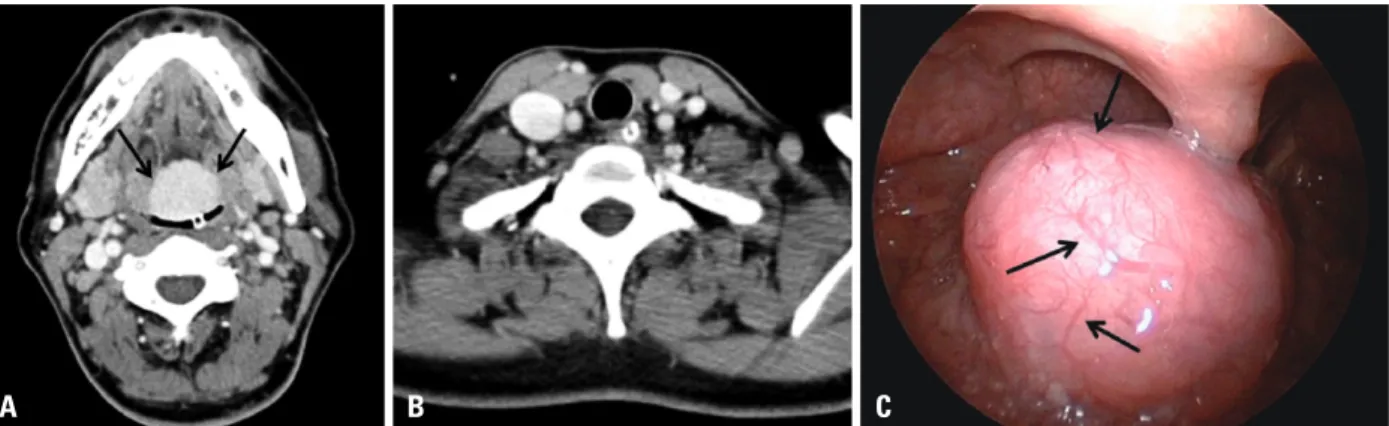
A 42-year-old woman visited the emergency room of our hospital complaining of hematemesis. Her blood pressure was 110/70 mm Hg and pulse rate was 80 beats per minute. Given a history of recent drinking and vomiting, the initial im- pression was Mallory-Weiss syndrome. Initial emergency gastroendoscopic exam- ination revealed fresh blood in the stomach, without any evidence of mucosal ab- normalities in the esophagus and stomach. Under supportive care, the hematemesis spontaneously stopped two days later, and a follow-up gastroendoscopic examina- tion showed no blood in the stomach. Neck computed tomography (CT) examina- tion revealed a 3-cm enhancing mass on the midline base of the tongue and no pres- ence of thyroid tissue in the normal thyroid position. On laryngoscopic examination, the mass had a smooth surface with engorged vessels, and the lesion was more clearly visualized when the tongue was pulled forward, which are characteristic find- ings of an ectopic lingual thyroid (Fig. 1). Thyroid ultrasonography revealed ab- sence of the thyroid gland. Technetium (Tc99m) thyroid scan was performed and demonstrated isotope uptake at the base of the tongue and no uptake in the normal thyroid location (not shown here). A thyroid function test showed subclinical hypo- thyroidism: free thyroxine (fT4), 1.52 ng/dL (normal range, 0.89‒1.78 ng/dL); T3, 95 ng/dL (normal range, 60‒180 ng/dL); and thyroid-stimulating hormone, 6.43 mIU/mL (normal range, 0.17‒4.78 mIU/mL). Although surgical removal was rec- ommended due to the risk of re-bleeding, the patient refused surgery and opted for a wait and see approach.
Ectopic thyroid is a rare developmental anomaly and is caused by aberrant em- bryogenesis during the descent of the thyroid gland to the neck. Thyroid tissue may be found anywhere along the course of the thyroglossal duct (i.e., oropharynx, infra- hyoid area, trachea, mediastinum, esophagus, and cervical lymph nodes).2,5 Among these, lingual thyroid, complete arrest of thyroid tissue at the base of tongue, is the most common form, with a reported prevalence of 1 in 100000 to 1 in 300000 (90%
of all cases of ectopic thyroid).6 Many patients are asymptomatic and a diagnosis
Letter to the Editor
http://dx.doi.org/10.3349/ymj.2015.56.4.1163pISSN: 0513-5796, eISSN: 1976-2437 Yonsei Med J 56(4):1163-1164, 2015
Min Kwan Baek, et al.
Yonsei Med J http://www.eymj.org Volume 56 Number 4 July 2015 1164
if malignancy is suspected.2,3,6 In patients being considered for surgical excision, it is essential to establish if any normal thyroid tissue is present elsewhere, because removal of a lingual thyroid will in most cases render the patient profo- undly hypothyroidal.
After ruling out common causes of acute gastrointestinal bleeding by gastroendoscopic examination, bleeding ectopic lingual thyroid could be considered as a rare cause of he- matemesis in emergency situations.
REFERENCES
1. Amr B, Monib S. Lingual thyroid: a case report. Int J Surg Case Rep 2011;2:313-5.
2. Chiu TT, Su CY, Hwang CF, Chien CY, Eng HL. Massive bleeding from an ectopic lingual thyroid follicular adenoma during preg- nancy. Am J Otolaryngol 2002;23:185-8.
3. Kansal P, Sakati N, Rifai A, Woodhouse N. Lingual thyroid. Diag- nosis and treatment. Arch Intern Med 1987;147:2046-8.
4. Sauk JJ Jr. Ectopic lingual thyroid. J Pathol 1970;102:239-43.
5. Strickland AL, Macfie JA, Van Wyk JJ, French FS. Ectopic thyroid glands simulating thyroglossal duct cysts. Hypothyroidism fol- lowing surgical excision. JAMA 1969;208:307-10.
6. Williams JD, Sclafani AP, Slupchinskij O, Douge C. Evaluation and management of the lingual thyroid gland. Ann Otol Rhinol Laryn- gol 1996;105:312-6.
is made incidentally as a result of neck imaging for local- ization of an ectopic thyroid tissue and to confirm the absen- ce of thyroid tissue in the normal position (the pretracheal region of the second to fourth tracheal rings). In symptom- atic patients, the lingual mass may result in dysphagia, for- eign body sensation in the neck, dyspnea, and oropharyn- geal obstruction. Although bleeding from an ectopic lingual thyroid is rare, it can be life-threatening, as massive hemor- rhage is possible, since the surface of a lingual thyroid may be covered by engorged and irregular blood vessels.2-4 Mean age at clinical presentation is 40 years, with two peaks at 12 and 50 years of age.2,3 In our case, neck CT helped demon- strate that the lingual thyroid was the only functioning thy- roid tissue, and a thyroid function test indicated mild hypo- thyroidism. Accordingly, we recommended thyroxine sup- pression therapy to prevent subsequent enlargement of the lingual thyroid and to reduce the risk of malignancy.3 Treat- ment of a lingual thyroid depends on the size, the presence of symptoms, and the presence of complications, such as ulcer- ation, hemorrhage, and malignancy. Treatment of an ecto- pic thyroid is not necessary when the mass is asymptomatic and thyroid function and cytology are normal. However, sur- gery is considered when a mass produces obstructive symp- toms or bleeding, demonstrates a sudden increase in size, or
Fig. 1. (A) CT image showing a 3.0×2.5 cm enhancing mass (arrows) at the midline base of the tongue, above the epiglottis. (B) CT image showing no thyroid tissue in the neck or pretracheal area of the second to fourth tracheal rings (normal thyroid position). (C) Laryngoscopic examination reveals a well-defined protruding mass with a smooth surface with prominent vessels (arrows) at the midline base of the tongue.
A B C