Clinical Characteristics of the Suicide Attempters Who Refused to Participate in a Suicide Prevention Case Management Program
Case management interventions for suicide attempters aimed at helping adjust their social life to prevent reattempts have high nonparticipation and dropout rates. We analyzed the clinical characteristics of the group who refused to participate in the suicide prevention program in Korea. A total of 489 patients with a suicide attempt who visited Uijeongbu St.
Mary’s Hospital, the Catholic University of Korea, from December 2009 to December 2013 were analyzed. All patients were divided into the participation group (n = 262) and the refusal group (n = 227) according to their participation in the case management program.
Demographic and clinical characteristics of each group were examined. Results showed that the refusal group had low risks for suicide in terms of risk factors related with psychopathologies and presenting suicide behavior. That is, the refusal group had less patients with co-morbid medical illnesses and more patients with mild severity of depression compared to the participation group. However, the refusal group had more interpersonal conflict, more isolation of social integrity, and more impaired insight about suicide attempt. The results suggest that nonparticipation in the case management program may depend upon the patient’s impaired insight about the riskiness of suicide and lack of social support.
Keywords: Suicide; Case Management; Prevention; Nonparticipation Soyoung Park,1,2 Kyoung Ho Choi,3
Youngmin Oh,3 Hae-Kook Lee,1 Yong-Sil Kweon,1 Chung Tai Lee,1 and Kyoung-Uk Lee1
1Department of Psychiatry, Uijeongbu St. Mary’s Hospital, College of Medicine, The Catholic University of Korea, Seoul; 2Department of Psychology, Sogang University, Seoul; 3Department of Emergency Medicine Uijeongbu St. Mary’s Hospital, College of Medicine, The Catholic University of Korea, Seoul, Korea Received: 24 December 2014 Accepted: 7 July 2015 Address for Correspondence:
Kyoung-Uk Lee, MD
Department of Psychiatry, Uijeongbu St. Mary’s Hospital, College of Medicine, The Catholic University of Korea, 222 Banpo-daero, Seocho-gu, Seoul 06591, Korea
Tel: +82.31-820-3609, Fax: +82.31-847-3630 E-mail: [email protected]
http://dx.doi.org/10.3346/jkms.2015.30.10.1490 • J Korean Med Sci 2015; 30: 1490-1495
INTRODUCTION
Suicide is one of the significant cause of death in the world (1).
An estimated 29.1 persons per 100,000 population die from sui
cide in South Korea, which is the highest among the Organiza
tion for Economic Cooperation and Development (OECD) coun
tries (Korean National Statistical Office, 2012). Many previous studies have investigated for the epidemiological phenomena and the risk factors associated with suicide behavior (27). Pa
tients who had a previous suicide attempt have a greater possi
bility to reattempt suicide and also complete suicide (8, 9). That is, the history of attempted suicide is one of the important risk factors for predicting suicide.
In addition, several studies have examined the effect of sui
cide treatment and suicide prevention programs (1013). The case management intervention program shed new light on the suicide prevention program for suicide attempters. For exam
ple, Szanto, Kalmar (14) examined the effectiveness of general practitioners (GPs)based depressionmanagement education
al program and found that the GPbased program had an effect of decreased suicide rates. In France, 13 emergency departments participated in the study to examine the effects of over one year of contacting patients by telephone (15). They had contacted
the patients by telephone at one month or three months after leaving the emergency department (ED) for suicide behavior.
Contacting patients by telephone after one month might help reduce the number of suicide reattempts over a year. In Spain, a similar study was also conducted. The study investigated the ef
fectiveness over one year of a telephone management program on patients who attempted suicide (16). The study suggested that a telephone management program would be effective to delay further suicide attempts and reduce the rate of suicide re
attempts.
Despite the fact that the suicide prevention case management program is very effective in preventing reattempts, the preven
tion approaches have shown a major limitation in terms of low participation rates. For example, Vaiva et al.’s (15) study report
ed a high refusal rate (237/842; 28%), but there were no descrip
tions about the characteristics of the refusal group. This raised the research necessity to further understand the characteristics of the refusal group. To our understanding, however, no studies have examined characteristics of patients who refused to parti
cipate in the case management program after a suicide attempt.
Therefore, the present study compared the characteristics of the refusal group with those of the participation group for the suicide prevention case management program in Korea.
MATERIALS AND METHODS Study population
A total of 489 suicide attempters who visited Uijeongbu St. Mary’s Hospital, the Catholic University of Korea, from December 2009 to December 2013 were included in this study. Patients were el
igible if their behavior was confirmed as a suicide attempt by information from the patients themselves, or objective infor
mation given by their family, guardians, or rescuers confirmed that the patients had attempted suicide although patients de
nied a suicide attempt. Patients were excluded if they refused to participate in psychiatric interview, or they could not be inter
viewed owing to a critical condition caused by their suicide be
havior. There was no age limit. All participants consented to in
terview with a psychiatric resident in the emergency ward. After diagnostic interview by psychiatry residents, patients were in
troduced to the case management program for suicide attempt
ers. The case management program included information, ed
ucation, and practical advice through brief interventions with the maintenance of longterm followup telephone contact on a regular basis.
Among them, 262 patients agreed to participate in the case management program (participation group) and 227 patients refused to participate (refusal group).
Procedures and assessment instruments
All patients were assessed in the emergency room using the Brief Emergency Room Suicide Risk Assessment (BESRA) (57).
It contains patient’s demographic variables (age, sex, marriage, religion, psychiatric family history), clinical characteristics (agi
tation, medical illness, severity depression, nature of suicide ideation), and factors related to the presenting suicide behavior (number of suicide attempts, planning, precipitating events, in
sight of suicide attempt, hopelessness/helplessness, intention, regret, interpersonal relationship, and social integrity). Medical severity was assessed by a clinician using the ‘method and le
thality of method’ item of Suicide Attempt SelfInjury Interview (SASII) developed by Linehan (17). The score of items measur
ing medical severity ranged from level 1 to 6 (1 = very low, 2 = low, 3 = moderate, 4 = high, 5 = very high, and 6 = severe). The clinician also assessed lethality by measuring riskrescue rating developed by Weisman and Worden (18). Psychiatric residents in the emergency ward conducted the psychiatric interview us
ing DSMIVTR and BESRA. To ensure that all the psychiatry residents were well informed of the BESRA and performed apt
ly, two psychiatry specialists (a professor and a clinical instruc
tor of psychiatry) instructed them. Furthermore, consensus meet
ings were held biweekly under the supervision of the same two psychiatry specialists.
Statistical analysis
Demographic and clinical characteristics of each group were summarized and are presented as mean ± standard deviation, frequency or percentage depending on the variable types. Pa
tients were divided into two groups (participation vs. refusal group) based on the patients’ agreement on the case manage
ment program. Ttests and chisquare analyses were conducted on all variables comparing two groups. All statistical analyses were performed by SAS/PC version 9.2 (SAS Institute Inc., Cary, NC, USA).
Ethics statement
The institutional review board of The Catholic University of Ko
rea, Uijeongbu St. Mary’s Hospital (IRB No. XC12RIME0141U) approved this study. The participants provided informed consent.
RESULTS
Demographic characteristics
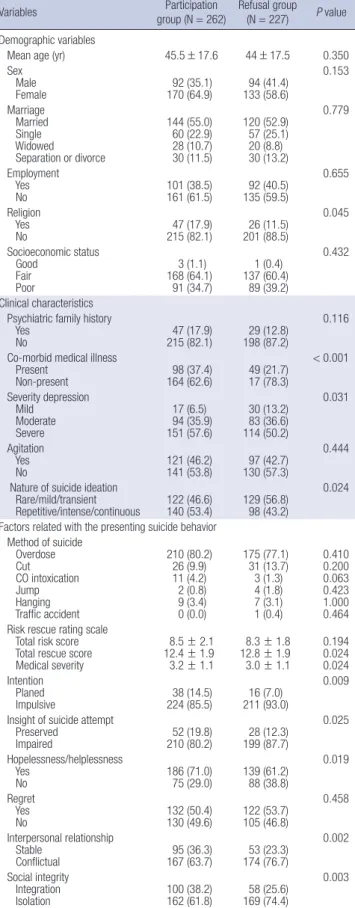
All data of the 489 patients were analyzed. Table 1 shows the over
all characteristics of the data. The mean age between the two groups was not different (45.5 ± 17.6 vs. 44 ± 17.5 yr, the partici
pation vs. the refusal group, respectively). A total of 262 (53.6%) patients were included in the participation group and 227 (46.4%) patients were in the refusal group. In the participation group, 92 patients (35.1%) were male, and 170 patients (64.9%) were fe
male. Ninetyfour males (41.4%) and 133 females (58.6%) were in the refusal group. The refusal group had more patients who did not have religion (88.5% vs. 82.1%, the participation group vs. the refusal group, respectively, P = 0.045). Sex, marriage, em
ployment and socioeconomic status had no significant differ
ences between the two groups.
Clinical characteristics
In total, the most common psychiatric diagnosis was major de
pressive disorder (n = 259, 45.9%) followed by depressive disor
der (n = 115, 20.4%), adjustment disorder (n = 91, 16.1%), alco
holrelated disorder (n = 38, 6.7%), bipolar depression (n = 20, 3.5%), schizophrenia and other psychotic disorder (n = 18, 3.1%) and others including anxiety disorder, impulse control disor
ders, somatoform disorders, sleep disorders, eating disorders, and childhood psychiatric disorders. There were no significant differences on the psychiatric diagnoses between the two groups.
However, the refusal group tended to include less percentage of patients with major depressive disorder 111 (41.9%) vs. 148 (49.5%), the refusal vs. participation group (P = 0.07).
The refusal group had significantly less comorbid medical illnesses compared to the participation group (21.7% vs. 37.4%, the refusal vs. participation group, respectively, P < 0.001). Re
garding the severity of depression, more patients with mild de
pression were included in the refusal group than the participa
tion group (13.2% vs. 6.5%, the refusal vs. participation group, respectively, P = 0.031). ‘Rare/mild/transient’ nature of suicide ideation was more common in the refusal group than the par
ticipation group (56.8% vs. 46.6%, the refusal vs. participation group, respectively, P = 0.024), while ‘repetitive/intense/con
tinuous’ nature of suicide ideation was more common in the participation group than the refusal group (53.4% vs. 43.2%, the participation vs. refusal group, respectively, P = 0.024).
Factors related with the presenting suicide behaviors The most common method of suicide attempt was overdose (n = 385, 80.4%) followed by cut (n = 57, 11.9%), hanging (n = 16, 3.3%), CO poisoning (n = 14, 2.9%), jumping (n = 6, 1.3%), and traffic accident (n = 1, 0.2%). Although there were no sig
nificant differences on the suicide methods between the two groups, CO intoxication tended to be a less frequent method of suicide for the refusal group than the participation group 3 (1.3%) vs. 11 (4.2%), for the refusal vs. participation group, (P = 0.063).
The mean of the total rescue scores for the refusal group was significantly higher than that of the participation group (12.8 ± 1.9 vs. 12.4 ± 1.9, the refusal vs. participation group, respective
ly, P = 0.024), whereas the mean of the total risk scores was not different between the two groups. Medical severity of the refus
al group was significantly lower than that of the participation group (3.0 ± 1.1 vs. 3.2 ± 1.1, the refusal vs. participation group, respectively, P = 0.024).
More patients in the refusal group than the participation group had impulsive suicide attempts (93% vs. 85.5%, the refusal vs.
participation group, respectively, P = 0.009) and impaired in
sight about their suicide behavior (87.7% vs. 80.2%, the refusal vs. participation group, respectively, P = 0.025). The refusal group was less likely than the participation group to have hopelessness/
helplessness (61.2% vs. 71%, the refusal vs. participation group, respectively, P = 0.019).
In addition, the refusal group had more common conflictual interpersonal relationships (76.7% vs. 63.7%, the refusal vs. par
ticipation group, respectively, P = 0.002) and social isolation (74.4% vs. 61.8%, the refusal vs. participation group, respective
ly, P = 0.003).
Reasons for the refusal
Analysis of reasons for the refusal of participation in the case management program was conducted only for the refusal group.
Fig. 1 shows the reasons for the refusal of participation. “Request later in case of necessity” (24%) was the most common reasons for the refusal to participate in the case management program.
“Regret suicide attempt” (23%) was the second reason for the refusal, followed by “denial of suicide attempt” (14%), “refusal of psychiatric record due to stigma” (8%) and “cumbersome” (8%).
Other reasons (23%) were “want to visit clinic near home”, “want to visit clinic where patients already followed up” and “no reason.”
Table 1. Comparisons of variables between patients who agreed to participate in the suicide prevention case management program and those who refused to participate in the program
Variables Participation
group (N = 262) Refusal group (N = 227) P value Demographic variables
Mean age (yr) 45.5 ± 17.6 44 ± 17.5 0.350
Sex Male
Female 92 (35.1)
170 (64.9) 94 (41.4) 133 (58.6)
0.153
Marriage Married Single Widowed
Separation or divorce
144 (55.0) 60 (22.9) 28 (10.7) 30 (11.5)
120 (52.9) 57 (25.1) 20 (8.8) 30 (13.2)
0.779
Employment Yes
No 101 (38.5)
161 (61.5) 92 (40.5) 135 (59.5)
0.655
Religion Yes
No 47 (17.9)
215 (82.1) 26 (11.5) 201 (88.5)
0.045
Socioeconomic status Good
Fair Poor
3 (1.1) 168 (64.1)
91 (34.7)
1 (0.4) 137 (60.4)
89 (39.2)
0.432
Clinical characteristics Psychiatric family history Yes
No 47 (17.9)
215 (82.1) 29 (12.8) 198 (87.2)
0.116
Co-morbid medical illness Present
Non-present 98 (37.4)
164 (62.6) 49 (21.7) 17 (78.3)
< 0.001
Severity depression Mild
Moderate Severe
17 (6.5) 94 (35.9) 151 (57.6)
30 (13.2) 83 (36.6) 114 (50.2)
0.031
Agitation Yes
No 121 (46.2)
141 (53.8) 97 (42.7) 130 (57.3)
0.444
Nature of suicide ideation Rare/mild/transient
Repetitive/intense/continuous 122 (46.6)
140 (53.4) 129 (56.8) 98 (43.2)
0.024
Factors related with the presenting suicide behavior Method of suicide
Overdose Cut CO intoxication Jump Hanging Traffic accident
210 (80.2) 26 (9.9) 11 (4.2) 2 (0.8) 9 (3.4) 0 (0.0)
175 (77.1) 31 (13.7) 3 (1.3) 4 (1.8) 7 (3.1) 1 (0.4)
0.410 0.200 0.063 0.423 1.000 0.464 Risk rescue rating scale
Total risk score Total rescue score Medical severity
8.5 ± 2.1 12.4 ± 1.9 3.2 ± 1.1
8.3 ± 1.8 12.8 ± 1.9 3.0 ± 1.1
0.194 0.024 0.024 Intention
Planed
Impulsive 38 (14.5)
224 (85.5) 16 (7.0) 211 (93.0)
0.009
Insight of suicide attempt Preserved
Impaired 52 (19.8)
210 (80.2) 28 (12.3) 199 (87.7)
0.025
Hopelessness/helplessness Yes
No 186 (71.0)
75 (29.0) 139 (61.2) 88 (38.8)
0.019
Regret Yes
No 132 (50.4)
130 (49.6) 122 (53.7) 105 (46.8)
0.458
Interpersonal relationship Stable
Conflictual 95 (36.3)
167 (63.7) 53 (23.3) 174 (76.7)
0.002
Social integrity Integration
Isolation 100 (38.2)
162 (61.8) 58 (25.6) 169 (74.4)
0.003 Numbers represent mean ± S.D. (range), or N (%).
DISCUSSION
The present study revealed characteristic features of patients who refused to participate in the suicide prevention case man
agement program after attempting suicide in Korea. The pres
ent study showed a high rate (46.4%) of nonparticipation in the case management program. Given that previous studies have demonstrated the effectiveness of case management programs (1416), the high rate of nonparticipation in the case manage
ment program is disappointing. The nonparticipation rate of the present study was higher compared to 28% of Vaiva et al.’s study (15). It is difficult to compare reasons for this discrepancy because no information is available from Vaiva et al.’s study (15).
However, this might be explained by multiple compliance fac
tors such as patientcentered factors, therapyrelated factors, social and economic factors, healthcare system, and disease factors (19).
Interestingly, the present study revealed low risks for suicide in the refusal group in terms of risk factors related with psycho
pathologies and presenting suicide behavior. That is, the refusal group had less comorbid medical illnesses and more patients with mild severity of depression compared to the participation group. In addition, they had less serious suicide ideation that was rare, mild and transient. The refusal group attempted sui
cide in a more rescuable way and less severe way in medical se
verity.
Given that serious psychopathologies and medical illnesses increased the risk of suicide (5), the findings of the present study may suggest more favorable outcomes of the refusal group in terms of the current suicide attempt and future suicide reattem
pts. However, the risk for suicide reattempt may not be less in
the refusal group, since previous history of suicide attempt in
creases the risk for suicide reattempt (8, 9) and only less than half of the refusal group regretted their suicide attempt and want
ed followup at their previous clinic (Fig. 1). Over half of the pa
tients in the refusal group had reasons for nonparticipation the suicide prevention case management program related to poor insight. Such reasons for nonparticipation were ‘request later in case of necessity’, ‘denial of suicide attempt’, ‘refusal of psychiat
ric medical record due to stigma’, and ‘cumbersome’. This find
ing explains why more patients in the refusal group showed poor insight about their suicide attempt (Table 1). The lack of insight about the suicide attempt may lead to the refusal of participa
tion in the suicide prevention case management program. In
sight has an important role in psychological treatment in vari
ous mental disorders (2022). Patients having insight are more likely to accept treatment than those without insight. Treatment compliance has been considered in most studies to be strongly correlated to insight. In other words, poor insight leads to poor compliance and further influences poor therapeutic outcomes as well (23). Therefore, emergency suicide interviews focused on improving insight of the patients may facilitate patients’ par
ticipation in the case management program and thus improve the outcome.
The current finding that more patients in the refusal group had conflictual interpersonal relationships may also suggest poor outcomes of this group. More patients in the refusal group had not only conflictual interpersonal relationships but also isolation in social integrity. These difficulties imply the lack of social support for the refusal group. Social support plays a key role as the protective factor to improve resilience in the context of daily stress (24). In this respect, the refusal group with lack of social support may have higher possibility to reattempt suicide.
Previous studies have also suggested that interpersonal relation
ship problems may significantly increase the risk for suicide re
attempt (25). Thus, furthermore, suicide prevention case man
agement programs that provide social support may contribute to reduce suicide reattempts (26).
The present study has some limitations. The population of the present study is limited to one university hospital in a spe
cific area in Korea, which may limit generalization of the find
ings of the current study. In addition, caution should be made when interpreting the findings of the current study, since there was selection bias due to patients who refused to consent to psychiatric interviews. The authors focused on the demograph
ic, clinical characteristics that might impact nonparticipation in the case management program. Thus, investigating other fac
tors that might influence compliance may further expand our understanding of the refusal group for the suicide prevention program. Given the above limitations of the current study, we believe the findings of the current study may shed more light on the understanding of the suicide behavior and provide more Fig. 1. Reasons for the refusal to participate in the suicide prevention case manage-
ment program. *Numbers do not sum up to total numbers of the refusal group, since multiple reasons were allowed.
Request later in case of necessity
(n = 58) 24%
Regret suicide attempt (n = 56)
23%
Denial of suicide attempt (n = 34) 14%
Refusal of psychiatric record
(stigma) (n = 20) 8%
Cumbersome (n = 19)
8%
Others (n = 54) 23%
insights on planning suicide prevention programs.
In conclusion, patients with a suicide attempt who refused to participate in the suicide prevention case management program showed less serious suicide attempts and medical and psychi
atric problems. However, impaired insight of the suicide attempt and lack of social support may suggest poor outcomes of the refusal group.
DISCLOSURE
The authors have no conflicts of interest to disclose.
AUTHOR CONTRIBUTION
Conception of the study: Park S, Choi KH, Oh Y, Lee HK, Kweon YS, Lee CT, Lee KW. Acquisition of data: Choi KH, Oh Y, Lee HK, Kweon YS, Lee CT, Lee KU. Statistical analysis: Park S, Lee KU.
Manuscript preparation: Park S, Lee KU. Manuscript approval:
all authors.
ORCID
Soyoung Park http://orcid.org/0000-0003-3050-7980 Kyoung Ho Choi http://orcid.org/0000-0003-0402-9911 Youngmin Oh http://orcid.org/0000-0001-8271-0150 HaeKook Lee http://orcid.org/0000-0002-4985-001X YongSil Kweon http://orcid.org/0000-0001-5638-6350 Chung Tai Lee http://orcid.org/0000-0002-7795-9688 KyoungUk Lee http://orcid.org/0000-0002-4505-9722
REFERENCES
1. Rudd MD, Goulding JM, Carlisle CJ. Stigma and suicide warning signs.
Arch Suicide Res 2013; 17: 313-8.
2. Lee HS, Kim S, Choi I, Lee KU. Prevalence and risk factors associated with suicide ideation and attempts in korean college students. Psychia- try Investig 2008; 5: 86-93.
3. Chastang F, Rioux P, Dupont I, Baranger E, Kovess V, Zarifian E. Risk factors associated with suicide attempt in young French people. Acta Psy- chiatr Scand 1998; 98: 474-9.
4. Meszaros K, FischerDanzinger D. Extended suicide attempt: psychopa- thology, personality and risk factors. Psychopathology 2000; 33: 5-10.
5. Choi KH, Wang SM, Yeon B, Suh SY, Oh Y, Lee HK, Kweon YS, Lee CT, Lee KU. Risk and protective factors predicting multiple suicide attempts.
Psychiatry Res 2013; 210: 957-61.
6. Kweon YS, Hwang S, Yeon B, Choi KH, Oh Y, Lee HK, Lee CT, Lee KU.
Characteristics of drug overdose in young suicide attempters. Clin Psy- chopharmacol Neurosci 2012; 10: 180-4.
7. Kim YR, Choi KH, Oh Y, Lee HK, Kweon YS, Lee CT, Lee KU. Elderly sui- cide attempters by self-poisoning in Korea. Int Psychogeriatr 2011; 23:
979-85.
8. Roberts RE, Roberts CR, Chen YR. Suicidal thinking among adolescents
with a history of attempted suicide. J Am Acad Child Adolesc Psychiatry 1998; 37: 1294-300.
9. Suominen K, Isometsä E, Suokas J, Haukka J, Achte K, Lönnqvist J. Com- pleted suicide after a suicide attempt: a 37-year follow-up study. Am J Psychiatry 2004; 161: 562-3.
10. Maniam T, Chinna K, Lim CH, Kadir AB, Nurashikin I, Salina AA, Mari
apun J. Suicide prevention program for at-risk groups: pointers from an epidemiological study. Prev Med 2013; 57: S45-6.
11. Donald M, Dower J, Bush R. Evaluation of a suicide prevention training program for mental health services staff. Community Ment Health J 2013;
49: 86-94.
12. Haring C, Sonneck G. Suicide Prevention Austria (SUPRA) : the imple- mentation of a national suicide prevention program. Neuropsychiatr 2012; 26: 91-4.
13. Shim RS, Compton MT. Pilot testing and preliminary evaluation of a suicide prevention education program for emergency department per- sonnel. Community Ment Health J 2010; 46: 585-90.
14. Szanto K, Kalmar S, Hendin H, Rihmer Z, Mann JJ. A suicide prevention program in a region with a very high suicide rate. Arch Gen Psychiatry 2007; 64: 914-20.
15. Vaiva G, Vaiva G, Ducrocq F, Meyer P, Mathieu D, Philippe A, Libersa C, Goudemand M. Effect of telephone contact on further suicide attempts in patients discharged from an emergency department: randomised con- trolled study. BMJ 2006; 332: 1241-5.
16. Cebrià AI, Parra I, Pàmias M, Escayola A, GarcíaParés G, Puntí J, Lare
do A, Vallès V, Cavero M, Oliva JC, et al. Effectiveness of a telephone man- agement programme for patients discharged from an emergency depart- ment after a suicide attempt: controlled study in a Spanish population. J Affect Disord 2013; 147: 269-76.
17. Linehan MM, Comtois KA, Brown MZ, Heard HL, Wagner A. Suicide Attempt Self-Injury Interview (SASII): development, reliability, and va- lidity of a scale to assess suicide attempts and intentional self-injury. Psy- chol Assess 2006; 18: 303-12.
18. Weisman AD, Worden JW. Risk-rescue rating in suicide assessment. Arch Gen Psychiatry 1972; 26: 553-60.
19. Jin J, Sklar GE, Min Sen Oh V, Chuen Li S. Factors affecting therapeutic compliance: A review from the patient’s perspective. Ther Clin Risk Man- ag 2008; 4: 269-86.
20. Eisen JL, Rasmussen SA, Phillips KA, Price LH, Davidson J, Lydiard RB, Ninan P, Piggott T. Insight and treatment outcome in obsessive-compul- sive disorder. Compr Psychiatry 2001; 42: 494-7.
21. Marková IS, Berrios GE. Insight in clinical psychiatry revisited. Compr Psychiatry 1995; 36: 367-76.
22. Lysaker P, Bell M, Milstein R, Bryson G, BeamGoulet J. Insight and psy- chosocial treatment compliance in schizophrenia. Psychiatry 1994; 57:
307-15.
23. Lincoln TM, Lüllmann E, Rief W. Correlates and long-term consequenc- es of poor insight in patients with schizophrenia. A systematic review.
Schizophr Bull 2007; 33: 1324-42.
24. Compton MT, Thompson NJ, Kaslow NJ. Social environment factors as- sociated with suicide attempt among low-income African Americans:
the protective role of family relationships and social support. Soc Psychi- atry Psychiatr Epidemiol 2005; 40: 175-85.
25. Fairweather AK, Anstey KJ, Rodgers B, Butterworth P. Factors distingui- shing suicide attempters from suicide ideators in a community sample:
social issues and physical health problems. Psychol Med 2006; 36: 1235- 45.
26. De Leo D, Carollo G, Dello Buono M. Lower suicide rates associated with
a Tele-Help/Tele-Check service for the elderly at home. Am J Psychiatry 1995; 152: 632-4.