191
Copyright © 2020 The Korean Society of Fisheries and Aquatic Science pISSN:0374-8111, eISSN:2287-8815
서 론
Phytochemical
은과일,
야채,
대두등다양한종류의식물에 서추출된화합물을총칭하며,
대표적으로steroids, alkaloids, flavonoids, terpenoids
등이알려져있다.
사료내phytochemi- cal
의첨가는잉어(Cyprinus carpio) (Yuan et al., 2007),
틸라 피아(Oreochromis mossambicus) (Divyagnaneswari et al., 2007),
무지개송어(Oncorhynchus mykiss) (Citarasu, 2010),
참돔(Pagrus major) (Ji et al., 2007a)
의비특이적면역력을증 진시키는데효과가있다고보고되었다.
또한Aeromonas hy- drophila (Pachanawan et al., 2008), Vibrio harveyi (Punitha et
al., 2008), Ichthyophthirius multifiliis (Ekanem et al., 2004), viral haemorrhagic septicaemia virus (VHSV) (Micol et al.,
2005)
에대한어류의질병저항성을향상시키는것으로보고되었다
.
그중phytosterol
은phytochemical
의한종류로sterol
형 태의식물성화합물을말하며, phytosterol
의함량은식물의씨 앗에서높은것으로알려져있다(Moreau et al., 2002; Mackay and Jones, 2011). Phytosterol
은식물세포에서세포벽의구성 성분으로 작용하며,
포유류에서는세포내에서cholesterol
과 유사한기능을한다(Ostlund, 2002). Phytosterol
은다양한생 리활성을띄는데,
인간의혈중cholesterol
의농도를효과적으 로저하시켜심혈관질환을예방하는데도움을주고,
암세포의넙치(Paralichthys olivaceus) 사료 내 phytosterol의 이용 가능성 평가
신재형·이초롱·김유정·신재범·임현운·윤관식
2·이경준
1*
제주대학교 해양생명과학과, 1제주대학교 해양과학연구소, 2(주)시너젠
Dietary Supplementation of Phytosterol for Olive Flounder Paralichthys olivaceus
Jaehyeong Shin, Chorong Lee, Youjeong Kim, Jaebeom Shin, Hyunwoon Lim, Kawn-Sik Yun2 and Kyeong-Jun Lee1*
Department of Marine Life Sciences, Jeju National University, Jeju Self-Governing Province 63243, Korea
1Marine Science Institute, Jeju National University, Jeju Self-Governing Province 63333, Korea
2SynergenInc., Bucheon 14574, Korea
We evaluated the effects of dietary supplementation of phytosterol on the growth, feed utilization, immunity, digest- ibility, wound healing ability and disease resistance of olive flounder Paralichthys olivaceus . We conducted two con- secutive feeding trials at different growth stages of the fish: EXP-1 (68.9 g) and EXP-2 (16.5 g). The experimental diets were supplemented with graded levels of phytosterol (1% ecdysteroid extracted from Achyranthis radix ) at 0, 0.025, 0.05, 0.1, 0.2 and 0.4% (designated as Con, PHY0.025, PHY0.05, PHY0.1, PHY0.2 and PHY0.4, respec- tively). Dietary phytosterol did not significantly affect growth and cholesterol concentration. Feed utilization was higher in fish fed phytosterol-supplemented diets than in fish fed the control diet. Dietary phytosterol increased innate immunity and digestibility of protein and dry matter. Wound healing ability was also increased by the phytosterol supplementation. The survival against Edwardsiella tarda challenge was higher in fish fed low-phytosterol diets than in fish fed the control diet. The optimum dietary level of phytosterol seems to be approximately 0.05%. The results in this study indicate that the phytosterol could be used as a functional supplement in diets to improve feed utilization, immunity, digestibility and wound healing ability of olive flounder.
Keywords: Phytosterol, Phytochemical, Immune-stimulant, Olive flounder, Feeds
*Corresponding author: Tel: +82. 64. 754. 3423 Fax: +82. 64. 756. 3493 E-mail address: [email protected]
This is an Open Access article distributed under the terms of the Creative Commons Attribution Non-Commercial Licens (http://creativecommons.org/licenses/by-nc/3.0/) which permits unrestricted non-commercial use, distribution, and reproduction in any medium, provided the original work is properly cited.
Received 2 March 2020; Revised 7 April 2020; Accepted 14 April 2020
저자 직위: 신재형(대학원생), 이초롱(대학원생), 김유정(대학원생), 신재범(대 학원생), 임현운(대학원생), 윤관식(대표), 이경준(교수)
https://doi.org/10.5657/KFAS.2020.0191
Korean J Fish Aquat Sci 53(2), 191-202, April 2020
증식을 억제하는 효과가 있다고 보고되었다
(Ostlund, 2002;
Ostlund, 2004; Kritchevsky and Chen, 2005).
어류사료내phytosterol
의첨가에관한연구는European sea bass (Dicen- trarchus labrax) (Couto et al., 2015a; b), gilthead sea bream (Sparus aurata) (Couto et al., 2014a; b),
대서양연어(Salmo sa- lar L.) (Liland et al., 2013; Sissener et al., 2017)
를대상으로일 부진행되었으나전반적으로미흡한실정이다.
수생생물의 피부는외부의병원체가 체내로유입되는 것을 막기때문에면역체계에있어매우중요한역할을한다
(Wahli et al., 2003).
양식어류의피부에상처가발생하면질병에쉽 게노출되어폐사율이증가하고(Nolan et al., 1999),
상품가치 를훼손시켜경제적손실을유발한다(Chakraborty and Hancz,
2011).
최근양식어류는주로고밀도로사육되고있다.
사육밀도가높을경우피부에상처가발생할확률이높아진다
.
어류 를선별하고운송하는과정에서도피부에상처가발생하기쉽 다. Phytochemical
은동물의상처치유능력을향상시키는것으 로보고되었다(Nath and Dutta, 1997; Ghosh and Gaba, 2013).
그러나
,
어류사료내phytochemical
혹은phytosterol
의첨가에 따른상처치유능력에관한연구는전무한실정이다.
넙치는우리나라의대표적인 양식어종이다
. 2018
년넙치의 국내양식생산량은37,238
톤으로,
전체어류양식생산량의약46%
를차지한다(KOSIS, 2019).
국내양식어가에서는넙치의 질병을예방하거나치료할목적으로항생제를무분별하게사 용하고있다. 2018
년국내축∙
수산용항생제의판매량은총984
톤으로,
그중 수산분야는25% (242
톤)
를 차지한다(KFDA,
2019).
항생제의광범위한사용은내성균을증가시켜,
약제의효율을감소시키고환경적으로도많은문제를일으킨다
(Allen et al., 2010).
최근들어,
항생제의무분별한사용을줄일수있 는방안으로천연유래추출물인phytochemical
의사료내사용 이주목받고있다.
따라서본연구는사료내phytosterol
의농 도별첨가가넙치의성장,
비특이적면역력,
상처치유능력및 질병저항성에미치는영향을조사하고자수행되었다.
재료 및 방법
실험어와 사육관리
사육실험에사용된넙치는
5
일간상업사료(CJ CheilJedang, Seoul, Korea)
를공급하며실험환경에순치되었다.
사육실험은 실험어의무게에따라총2
회에걸쳐진행되었다.
실험어의초 기무게는양식장내에서분주가이루어지는시기(
실험1, 68.9 g)
와종묘장에서양식장으로이동되는시기(
실험2, 16.5 g)
를 고려하여선정되었다.
실험1
에사용된넙치(
평균무게, 68.9 g)
는총24
개의acrylonitrile butadiene styrene (ABS)
수조(300 L)
에각30
마리씩,
실험사료구당4
반복으로배치되었다.
사육 실험기간중평균수온은23.1±2.4°C
였고,
사육실험은총12
주 간진행되었다.
사육수는모래여과해수를사용하여3 L/min/
tank
의유수량이되도록조절하였고,
수조의용존산소를유지 하기위해공기발생기(aeration)
를설치하였다.
광주기는형광 등을이용하여12 light: 12 dark
로유지되었다.
실험사료는1
일2
회(08:30, 18:00 h)
에걸쳐만복공급하였다.
실험
2
에사용된넙치(
평균무게, 16.5 g)
는총20
개의ABS
수 조(300 L)
에수조당각28
마리씩실험사료구당4
반복으로배 치되었다.
사육실험기간중평균수온은18.7±1.5°C
로자연수 온에의존하였으며,
실험은총8
주간진행되었다.
그외의실험 조건은실험1
과동일하였다.
사육실험은제주대학교동물실험 윤리위원회의윤리규정(
승인번호, 2019-0043)
을준수하였다. 실험사료
실험에사용된
phytosterol (ecdysteroid 1%)
은우슬(Achy- ranthis radix)
에서 추출 되었고,
분말형태로(
주)
시너젠(Bu- cheon, Korea)
에서제공받아 사용하였다.
실험1
과2
에는동 일한대조사료(control)
를사용하였으며,
조단백질이53%,
조 지질이8.8%
로분석되었다(Table 1).
실험1
에서는어분을기 초로한대조사료에phytosterol
이각각0.025, 0.05, 0.1, 0.2, 0.4% (PHY0.025, PHY0.05, PHY0.1, PHY0.2, PHY0.4)
첨 가된총5
개의실험사료를제작하였다.
실험2
에서는어분을기 초로한대조사료에phytosterol
를각각0.025, 0.05, 0.1, 0.2%
(PHY0.025, PHY 0.05, PHY 0.1, PHY 0.2)
첨가한4
개의실험 사료를제작하였다.
분말형태의phytosterol
은농도에따라각 사료에혼합되었고,
사료의조성은밀가루로조절되었다.
실험 사료는사료원을조성표에따라혼합한후,
대구간유(cod liver oil)
와증류수(
사료원료총중량의15%)
를첨가하여펠렛성형 기(SP-50, Gumgang ENG, Daegu, Korea)
를이용해2-4 mm
크기로성형되었다.
성형된사료는25°C
에서8
시간건조시킨 후사료공급전까지냉동(-20°C)
보관하였다.
Sampling과 분석
실험어의증체율
(weight gain, WG)
과생존율(survival)
을측 정하기위해무게측정24
시간전부터실험사료의공급을중단 하였다.
사료공급량을조사하여사료계수(feed conversion ra- tio, FCR)
와단백질이용효율(protein efficiency ratio, PER)
을 계산하였다.
무게측정후,
수조당8
마리의실험어를무작위로 선별하여2-phenoxyethanol
용액(200 mg/L)
으로마취시킨후,
주사기를이용하여미부정맥에서채혈하였다. 8
마리중4
마리 의전혈은헤파린을처리하여hematocrit, hemoglobin,
대식세 포활성(nitro blue tetrazolium, NBT)
을측정하는데사용되었 다.
남은혈액은원심분리(5,000 g, 10 min)
후혈장(plasma)
을 이용하여immunoglobulin (Ig)
분석에사용되었다.
나머지4
마 리의혈액은상온에서30
분동안응고시켜원심분리(5,000 g, 10 min)
후혈청(serum)
을분리하는데사용되었다.
혈액sam-
pling
후고무주걱을이용하여실험어피부의점액질을수집하여
Tris-Buffered Saline (TBS, 50 mM Tris-HCl, pH 8.0, 150
mM NaCl)
에혼합하였다.
샘플은원심분리(4000 rpm, 4°C, 30
min)
후동결건조하여alkaline phosphate (ALP)
분석에사용 되었다.
실험어의비특이적면역력을조사하기위해총
6
가지항목을 분석하였다. NBT
활성은Kumari and Sahoo (2006)
의방법을, Ig
분석은Siwicki and Anderson (1993)
의방법을, lysozyme
활 성은Hultmark (1980)
의방법으로분석하였다. SOD (super- oxide dismutase)
활성은SOD kit (19160, Sigma-Aldrich, ST Louis, USA)
를사용하였고, GPx (glutathione peroxidase)
활 성은GPx kit (K762-100, Biovision, Milpitas, USA)
를이용 하여분석하였다.
점액의ALP
활성은Ross et al. (2000)
의방 법으로분석하였다. Hematocrit
은원심분리기(Micro hemato- crit VS-12000, Vision Scientific, Daejeon, Korea) (10 min)
를 이용하여 측정하였고, hemoglobin, aspartate aminotransfer- ase (AST), total protein, cholesterol
은생화학분석기(SLIM, SEAC Inc, Florence, Italy)
를이용하여분석되었다.
실험사료와분
(feces)
의일반성분분석은AOAC (2005)
의방 법에따라수분은상압가열건조법(125°C, 3 h),
조회분은직접회화법
(550°C, 4 h),
단백질은자동조단백질분석기(Kjeltec
TM2300, FOSS analytical, Hilleroed, Denmark)
로분석하였으며,
조지방은Folch et al. (1957)
의방법에따라soxhlet
추출장치(SOX406 fat analyzer, Jinan Hanon Instruments, Shandong, China)
를이용하여분석되었다.
외관상 소화율 측정
평균무게
120 g
내외의넙치를이용하여외관상소화율을조사하였다
.
소화율사료는실험1
의실험사료에산화크롬(Cr
2O
3, Daejung, Siheung, Korea)
을1%
첨가하여 제조하였다.
실험 어의분은소화율전용분수집수조(Guelph system)
를이용하 여수집되었다.
분수집은1
주동안분수집수조에실험어를적 응시킨후실시되었다.
사육수는cartridge filter
를이용해여과 하여사용되었다.
넙치는수조당40
마리씩배치되었고,
실험사 료는분수집16
시간전에만복공급되었다.
사료공급30
분후,
환수를통해수조에남아있는사료찌꺼기와이물질을제거하 였다.
수집된분은여과지를이용하여해수를제거하고냉동보 관(-40°C)
되었다.
실험사료와분내산화크롬의함량은Diva- karan et al. (2002)
의방법으로분석되었다.
실험사료에대한 외관상소화율은아래의식에따라계산되었다.
Apparent digestibility coefficient of dry matter (%, ADCd)
= 100-100×(% of Cr
2O
3in diet/% of Cr
2O
3in feces) Apparent digestibility coefficient of protein (%, ADCp)
= 100-100×(% of Cr
2O
3in diet/% of Cr
2O
3in feces)
×(% of protein in feces/% of protein in diet)
상처치유능력
상처치유능력실험은
Wahli et al. (2003)
의방법을기초로 진행되었다.
사육실험1
종료후,
넙치는총6
개의ABS
수조(215 L)
에각16
마리씩배치되었다.
실험사료는1
일2
회(08:30, 18:00 h)
에걸쳐만복공급하였다.
실험어는2-phenoxyethanol
용액(200 mg/L)
으로마취시킨후,
등부위를동일한조건(
길 이1 cm,
깊이0.5 cm)
으로절개하였다.
절개후경과시간에따 라총6
회(0, 1, 3, 7, 9, 16
일)
에걸쳐수조당2
마리의절개부위 를채취하였다.
절개된조직은Bouin’s solution
에담궈24
시간 보관되었다.
고정된조직은tissue processor (TP1020, Leica, Wetzlar, Germany)
를이용하여탈수과정을거쳐,
파라핀(par- affin)
작업후harris hematoxylin
과0.5% eosin
을사용하여염 색되었다.
염색된슬라이드는광학현미경(Olympus CKX41, Tokyo, Japan)
과전용프로그램(Image J 1.44 software)
을이용 하여관찰하였다.
공격실험
사육실험
2
종료후, 120 L acryl
수조에각11
마리(
사료구당33
미)
의실험어를배치하였다(3
반복, 15
개수조). Edwardsiella
Table 1. Dietary formulation and proximate composition of thebasal diet (% of dry matter)
Ingredients g/kg
Fish meal, sardine1 500.0
Soybean meal 80.0
Corn gluten meal 80.0
Wheat flour2 230.0
Cod liver oil3 40.0
Mineral premix4 10.0
Vitamin premix5 10.0
Starch 20.0
Choline chloride (50%) 20.0
Mono calcium phosphate 10.0
Proximate composition (%)
Crude protein 52.7
Crude lipid 8.82
Crude ash 10.5
1Orizon S.A., Corp., Santiago, Chile (crude protein, 69%; crude lipid, 8.6%). 2Deahan Flour Co. Ltd, Incheon, Korea. 3E-wha oil &
fat Industry Corp., Busan, Korea. 4Mineral premixcontains(g kg-
1):MgSO4∙7H2O, 80; NaH2PO4∙2H2O, 370; KCl, 130; Ferriccitrate, 40; ZnSO4∙7H2O, 20; Ca-lactate, 357; CuCl, 0.2; AlCl3∙6H2O, 0.15; Na2Se2O3, 0.01; MnSO4∙H2O, 2; CoCl2∙6H2O, 1.0. 5Vitamin premixcontains (g kg-1):L-ascorbic acid, 121; DL-α tocopheryl acetate, 19; thiamin hydrochloride, 2.7; riboflavin, 9.1; pyridox- ine hydrochloride, 1.8; niacin, 36; Ca-D-pantothenate, 12.7; myo- inositol, 182; D-biotin, 0.27; folic acid, 0.68; p-aminobenzoic acid, 18; menadione, 1.8; retinyl acetate, 0.73; cholecalciferol, 0.003;
cyanocobalamin, 0.003.
tarda
는salmonella-shigella (SS, Difco)
배지에서배양(25°C, 48 h)
되었다.
생성된colony
는tryptic soy agar (TSA)
에도말 하여배양한다음(27°C, 24 h)
공격실험에사용되었다. Bacteria
는Sakai et al. (2007)
에따라kit (Higene genomic DNA prep kit, BIO-FACT, Daegu, Korea)
를사용하여사용된균의종을 재확인하였다. E. tarda
현탁액(1×10
3CFU/mL)
은넙치의복 강내에100 µL
씩주입되었다.
균이주입된실험어를대상으로 총12
일간누적폐사율을관찰하였다.
통계학적 분석
실험사료의배치는완전확률계획법
(completely randomized design)
을실시하였으며,
분석결과는SPSS (Version 18.0)
프 로그램을이용하여One-way ANOVA
로통계분석하였다.
데 이터값의유의차는Duncan’s multiple test (P<0.05)
로비교하 였다.
데이터는평균값±
표준편차(mean±SD)
로나타내었다.
백분율데이터는arcsine
변형값으로통계분석하였다.
결 과
사육실험
1
의 혈액 내Ig
활성은PHY0.1
구가 대조구와PHY0.4
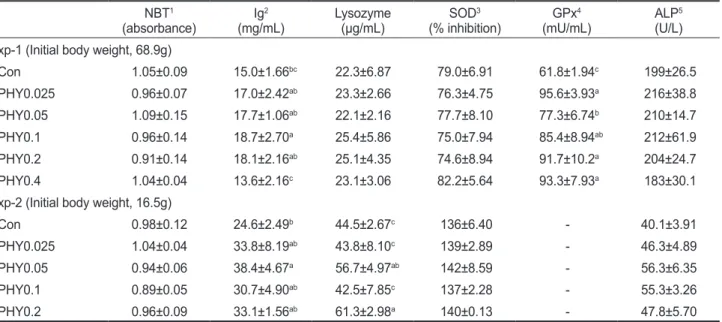
구에비해 유의적으로높았다(Table 2). GPx
활성은 모든phytosterol
첨가구가대조구에비해유의적으로높았다. NBT, lysozyme, SOD, ALP
의활성은모든실험구사이에유의 적인차이를보이지않았다.
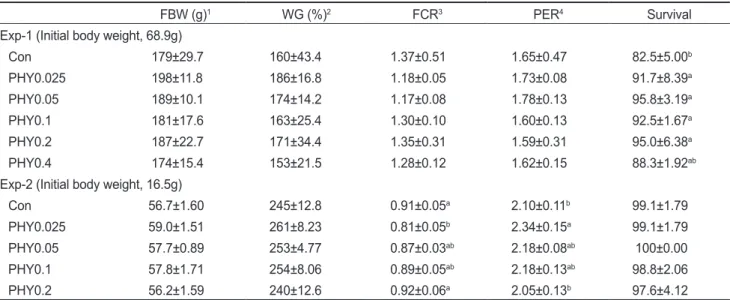
성장률과사료계수,
단백질이용효율은모든실험구사이에유의적인차이를보이지않았다
(Table
3).
생존율은PHY0.4
구를제외한phytosterol
첨가구가대조 구에비해유의적으로높게나타났다.
혈액내AST
의농도는PHY0.04
구를제외한phytosterol
첨가구가대조구에비해유 의적으로낮게나타났다(Table 4).
혈액내hematocrit, hemo- globin, total protein
의농도는모든실험구사이에유의적차 이를보이지않았다.
혈장내cholesterol
의농도는PHY0.025
구가
PHY0.2
구에 비해 유의적으로 높았다.
건물소화율은PHY0.05, 0.2, 0.4
구가대조구에비해유의적으로높았다(Ta- ble 5).
단백질소화율은PHY0.025
를제외한모든phytosterol
첨가구가대조구에비해유의적으로높았다.
상처치유능력실 험은절개3
일후,
모든실험구에서표피(epidermis)
의바깥쪽 상처부위가 봉합되는것으로나타났다.
절개7
일후, phytos-
terol
첨가구의근육층이대조구에비해빠르게회복되는것으로나타났다
(Fig. 1).
절개16
일후,
모든실험구에서진피(der-
mis)
를제외한표피와근육층이모두회복된것으로나타났다.
사육실험
2
의혈액내Ig
활성은PHY0.05
구가대조구에비해 유의적으로높았다(Table 2). Lysozyme
활성은PHY0.05
와0.2
구가대조구에비해유의적으로높았다. NBT, SOD, ALP
활성 은실험구사이에유의적인차이를보이지않았다.
성장률은모 든실험구사이에유의적인차이를보이지않았다(Table 3).
사 료계수는PHY0.025
구가대조구에비해유의적으로낮았다.
단 백질이용효율은PHY0.025
구가대조구에비해유의적으로높 았다.
혈액내hematocrit, hemoglobin, AST, total protein
의농Table 2. Non-specific immune responses and antioxidant activities of olive flounder Paralichthys olivaceus fed the experimental diets for 12 (Exp-1) and 8 weeks (Exp-2), respectively. The experimental diets were prepared with supplementing phytosterol by 0, 0.025, 0.05, 0.1, 0.2 and 0.4% (Con, PHY0.025, PHY0.05, PHY0.1, PHY0.2 and PHY0.4)
NBT1
(absorbance) Ig2
(mg/mL) Lysozyme
(µg/mL) SOD3
(% inhibition) GPx4
(mU/mL) ALP5
(U/L) Exp-1 (Initial body weight, 68.9g)
Con 1.05±0.09 15.0±1.66bc 22.3±6.87 79.0±6.91 61.8±1.94c 199±26.5
PHY0.025 0.96±0.07 17.0±2.42ab 23.3±2.66 76.3±4.75 95.6±3.93a 216±38.8
PHY0.05 1.09±0.15 17.7±1.06ab 22.1±2.16 77.7±8.10 77.3±6.74b 210±14.7
PHY0.1 0.96±0.14 18.7±2.70a 25.4±5.86 75.0±7.94 85.4±8.94ab 212±61.9
PHY0.2 0.91±0.14 18.1±2.16ab 25.1±4.35 74.6±8.94 91.7±10.2a 204±24.7
PHY0.4 1.04±0.04 13.6±2.16c 23.1±3.06 82.2±5.64 93.3±7.93a 183±30.1
Exp-2 (Initial body weight, 16.5g)
Con 0.98±0.12 24.6±2.49b 44.5±2.67c 136±6.40 - 40.1±3.91
PHY0.025 1.04±0.04 33.8±8.19ab 43.8±8.10c 139±2.89 - 46.3±4.89
PHY0.05 0.94±0.06 38.4±4.67a 56.7±4.97ab 142±8.59 - 56.3±6.35
PHY0.1 0.89±0.05 30.7±4.90ab 42.5±7.85c 137±2.28 - 55.3±3.26
PHY0.2 0.96±0.09 33.1±1.56ab 61.3±2.98a 140±0.13 - 47.8±5.70
1NBT, Nitro-blue tetrazolium. 2Ig, Immunoglobulin. 3SOD, Superoxide dismutase. 4GPx, Glutathione Peroxidase. 5Alkaline Phosphatase.
Values are mean of quadruplicates and presented as mean±SD. Values with different superscripts in the same column are significantly dif- ferent (P<0.05). The lack of superscript letter indicates no significant differences among treatments.
EL DL
ML
EL DL 3 days16 days0 day7 days ML
(A) (B)
(C) (D)
(E) (F)
(G) (H)
Fig. 1. Photomicrograph of cross-section of skin incision of olive flounder Paralichthys olivaceus fed the experimental diets. A, initial before incision; B, immediately after incision; C, 3 days after incision of the control fish; D, 3 days after incision of PHY0.025% fish; E, 7 days after incision of the control fish; F, 7 days after incision of PHY0.025% fish; G, 16 days after incision of the control fish; H, 16 days after incision of PHY0.025% fish; EI, epidermis layer; DI, dermis layer; ML, muscle layer; Arrows point to incision site; Staining AB-PAS (pH 2.5). Scale bars=200 µm.
도는모든실험구사이에유의적인차이가없었다
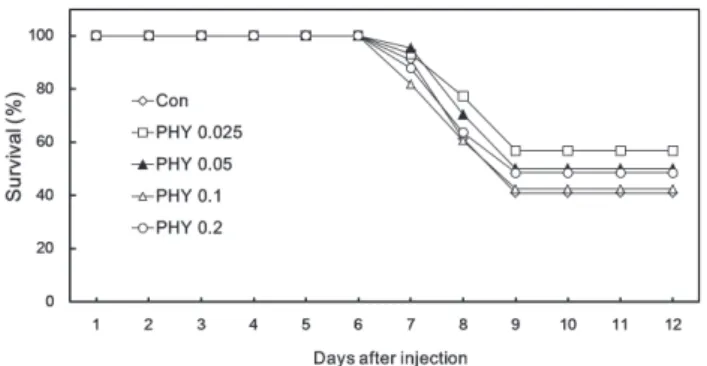
(Table 4). E.
tarda
에대한넙치의생존율은PHY0.025
구(56.8%)
가대조구(40.9%)
에비해높은경향을보였다(Fig. 2).
고 찰
흥미롭게도본연구에서사료내
phytosterol
의첨가는넙치 의혈중Ig, lysozyme, GPx
의활성을증진시키는것으로나타Table 4. Hematological parameters of olive flounder Paralichthys olivaceus fed the experimental diets for 12 (Exp-1) and 8 weeks (Exp-2), respectively. The experimental diets were prepared with supplementing phytosterol by 0, 0.025, 0.05, 0.1, 0.2 and 0.4% (Con, PHY0.025, PHY0.05, PHY0.1, PHY0.2 and PHY0.4)
Hematocrit (%) Hemoglobin (g/dL) AST1 (U/L) Total protein (g/dL) Cholesterol (mg/dL) Exp-1 (Initial body weight, 68.9g)
Con 35.2±3.68 4.44±0.30 40.4±7.99a 6.08±0.35 210±12.6ab
PHY0.025 33.4±5.46 4.57±0.36 26.7±10.0bc 6.33±0.74 240±38.5a
PHY0.05 33.8±4.92 4.99±0.45 20.5±6.01c 6.58±0.10 228±7.91ab
PHY0.1 37.2±3.33 5.11±0.45 24.3±3.10bc 6.69±0.86 219±26.5ab
PHY0.2 37.1±4.35 4.55±0.51 27.1±1.41bc 6.45±0.41 200±19.7b
PHY0.4 35.0±8.92 4.35±0.83 36.1±12.8ab 6.38±0.49 223±18.2ab
Exp-2 (Initial body weight, 16.5g)
Con 21.4±1.79 3.86±0.44 20.0±2.87 4.04±0.34 -
PHY0.025 24.1±2.14 4.04±0.32 18.9±6.40 4.04±0.30 -
PHY0.05 23.1±1.94 3.91±0.36 23.6±4.29 3.91±0.38 -
PHY0.1 24.1±1.04 4.11±1.00 30.0±1.76 4.38±0.56 -
PHY0.2 22.9±0.76 5.15±2.13 24.7±9.01 4.11±0.06 -
1Aspartate aminotransferase. Values are mean of quadruplicates and presented as mean±SD. Values with different superscripts in the same column are significantly different (P<0.05). The lack of superscript letter indicates no significant differences among treatments.
Table 3. Growth performance and feed utilization of olive flounder Paralichthys olivaceus fed the experimental diets for 12 (Exp-1) and 8 weeks (Exp-2), respectively. The experimental diets were prepared with supplementing phytosterol by 0, 0.025, 0.05, 0.1, 0.2 and 0.4%
(Con, PHY0.025, PHY0.05, PHY0.1, PHY0.2 and PHY0.4)
FBW (g)1 WG (%)2 FCR3 PER4 Survival
Exp-1 (Initial body weight, 68.9g)
Con 179±29.7 160±43.4 1.37±0.51 1.65±0.47 82.5±5.00b
PHY0.025 198±11.8 186±16.8 1.18±0.05 1.73±0.08 91.7±8.39a
PHY0.05 189±10.1 174±14.2 1.17±0.08 1.78±0.13 95.8±3.19a
PHY0.1 181±17.6 163±25.4 1.30±0.10 1.60±0.13 92.5±1.67a
PHY0.2 187±22.7 171±34.4 1.35±0.31 1.59±0.31 95.0±6.38a
PHY0.4 174±15.4 153±21.5 1.28±0.12 1.62±0.15 88.3±1.92ab
Exp-2 (Initial body weight, 16.5g)
Con 56.7±1.60 245±12.8 0.91±0.05a 2.10±0.11b 99.1±1.79
PHY0.025 59.0±1.51 261±8.23 0.81±0.05b 2.34±0.15a 99.1±1.79
PHY0.05 57.7±0.89 253±4.77 0.87±0.03ab 2.18±0.08ab 100±0.00
PHY0.1 57.8±1.71 254±8.06 0.89±0.05ab 2.18±0.13ab 98.8±2.06
PHY0.2 56.2±1.59 240±12.6 0.92±0.06a 2.05±0.13b 97.6±4.12
1Final body weight. 2Weight gain (%)=(final weight-initial weight)×100/initial weight. 3Feed conversion ratio=feed intake/wet weight gain.
4Protein efficiency ratio=wet weight gain/total protein given. Values are mean of quadruplicates and presented as mean±SD. Values with different superscripts in the same column are significantly different (P<0.05). The lack of superscript letter indicates no significant differ- ences among treatments.
났다
. Phytosterol
의종류에는β-sitosterol, campesterol, stig- masterol, stigmastanol
이 있다고알려져있다(Gilman et al., 2003).
그중β-sitosterol
은식물성유지내phytosterol
중함 량(50-55%)
이 가장 높은 성분으로(Orrego et al., 2010),
면 역조절(Desai et al., 2009),
항염증효과(Gupta et al., 1980;
Bouic, 2001; Nirmal et al., 2012),
항산화활성(Yoshida and Niki, 2003)
을높이며,
암세포의성장을저하시킬수있다고보 고되었다(Zhao et al., 2009). β-sitosterol
은T
림프구의증식을 촉진시켜생물의면역활성을증진시키는것으로알려져있다(Bouic et al., 1996). Phytosterol
은pro-inflammatory cytokine
인TNF-α
의 발현을 감소시키고(Gupta et al., 1980, Bouic, 1996, Bouic and Lamprecht, 1999), anti-inflammatory cyto- kines (IL-10, NF-kB)
의발현을증가(Valerio and Awad, 2011)
시킨다고보고되었다.
어류의경우,
사료내phytosterol
이함유 된식물추출물의첨가는넙치(Kim et al., 2007),
잉어(Yuan et al., 2007),
틸라피아(Wu et al., 2010)
의비특이적면역력과항 산화능력을증진시킨다고보고되었다.
또한분말phytosterol
의 첨가는돼지사료에서간과혈장내활성산소의발생을저하시 키는것으로나타났다(Hu et al., 2017).
본연구에서도phytos-
terol
의첨가는넙치의비특이적면역력과항산화능력을증진시키는것으로보아사료내면역증강제로써의이용가능성이매 우높다고판단된다
.
대두사포닌 등의 식물추출물
(extract)
을 다량으로 사용하게되면오히려생물에부정적인영향을끼칠수있다
(Gathumbi
et al., 2002; Flaoyen et al., 2004; Makkar et al., 2007). Eu- ropean sea bass (27-283 g)
사료에phytosterol
을적정량으 로첨가
(0.5-1%)
했을때는어류의성장저하,
사료섭취율의저 하와장내염증반응을유발하지않는다고보고되었다(Couto
et al., 2015a, 2015b). Gilthead sea bream (12.5-112 g)
의경 우에도사료내phytosterol
의적정량첨가(0.5-1%)
는어류에 게부정적인영향을미치지않았다고보고되었다(Couto et al., 2014a, 2014b).
대서양연어에서도phytosterol
을적정량첨가(0.14-0.19%)
할경우성장과사료계수에부정적인영향을미치지않는것으로보고되었다
(Liland et al., 2013).
본연구에 서도phytosterol (0.025-0.4%, 86
일)
은어류의성장과건강도(hematocrit, hemoglobin, total protein)
에영향을미치지않았 다.
뿐만아니라phytosterol
을저농도(0.025-0.2%)
로첨가할경우넙치의혈중
AST
농도를오히려감소시키는것으로나타났다
(
실험1). AST
는주로간과신장에분포하며,
어류의아미노산대사에관여하는효소이다
.
혈중AST
는어류에서간세포의괴사가일어날경우증가하는것으로알려져있다
(Yousafzai
and Shakoori, 2011). Phytochemical
을African catfish Clarias
lazera
사료에첨가할경우간세포의회복을촉진시키는것으로보고되었다
(Mahmoud and AI-Salahy, 2004).
또한잉어의 건강도(total serum protein, globulin, albumin)
를증진시키고 고밀도사육에 대한스트레스를 감소시키는 것으로나타났다(Wu et al., 2007; Xie et al., 2008). Ji et al. (2007a)
은사료내phytochemical (herb extracts)
의첨가는넙치의생존율과스트 레스회복능력을증진시킨다고보고하였다.
참돔에서도공기 노출과마취에따른스트레스를줄일수있다고보고되었다(Ji et al., 2009).
따라서사료내phytosterol (0.025-0.4%)
은넙치 의건강도에부정적인영향을미치지않으며,
어류의스트레스 를감소시키는데효과가있다고판단된다.
본연구에서사료내
phytosterol
의첨가는넙치의초기상처 회복시간을 단축시키는것으로나타났다.
어류의피부는크Table 5. Apparent digestibility coefficients (ADC) of dry matter and protein in diets for olive flounder (Exp-1) (% of ADC). The experimental diets were prepared with supplementing phytosterol by 0, 0.025, 0.05, 0.1, 0.2 and 0.4% (Con, PHY0.025, PHY0.05, PHY0.1, PHY0.2 and PHY0.4).
ADCd1 ADCp2
Con 73.9±0.27d 87.5±0.53d
PHY0.025 72.9±0.58d 88.1±0.25cd
PHY0.05 77.1±0.71c 89.1±0.38ab
PHY0.1 71.1±1.15e 88.4±0.46c
PHY0.2 80.4±0.11a 88.7±0.16bc
PHY0.4 78.8±0.33b 89.4±0.19a
1Apparent digestibility coefficient of dry matter (%)=100-100×(%
of Cr2O3 in diet/% of Cr2O3 in feces). 2Apparent digestibility coef- ficient of protein (%)=100-100×(% of Cr2O3 in diet/% of Cr2O3 in feces)×(% of protein in feces/% of protein in diet). Mean values of triplicate groups. Values are presented as mean±SD. Values in the same column having different superscript letters are significantly different (P<0.05).
Fig. 2. Survival of olive flounder Paralichthys olivaceus fed the ex- perimental diets for 8 weeks during the challenge with Edwardsi- ella tarda (Exp-2). The fish were injected with E. tarda suspension containing 1×10³ CFU mL-1. Quadruplicate groups of fish were fed with one of the experimental diets two times a day during the chal- lenge period. The diets were added with graded levels of phytoster- ol by 0, 0.025, 0.05, 0.1 and 0.2% (designated as Con, PHY0.025, PHY0.05, PHY0.1 and PHY0.2, respectively).