49
Copyright © 2019 The Korean Society of Fisheries and Aquatic Science pISSN:0374-8111, eISSN:2287-8815
서 론
넙치
(Paralichthys olivaceus)
는우리나라의대표적인양식어종으로
1980
년대부터양식생산량이증가되어최근에는국내해수어류양식생산량의
40%
전후를차지하고있다(Kim et al., 2012; Jee et al., 2014).
또한,
넙치는국내소비자들에게회나 매운탕으로기호도가높아서어체품질향상에관한지속적인 연구가필요한어종이다.
양식어류의생산성과어체의품질은 공급되는사료의영양성분과기능성영양소로조절이가능한 것으로보고되고 있다(Aminikhoei et al., 2013; Pham et al., 2014).
사료영양소중지질은어류의에너지원으로서중요할뿐만
아니라에너지가
(value)
가높아값비싼사료단백질을절감시킬수있는중요한영양소이다
(Lee and Kim, 2009; Rahimnejad et al., 2015).
사료단가를절감시키기위한단백질절약효과차 원에서사료지질함량에관한연구와다양한지질원료에따른 어류의성장및체성분변화에대한효과를조사한연구가계속 수행되고있다(Mugrditchian et al., 1981; Beamish and Med- land, 1986; Greene and Selivonchick, 1990; De Silva et al.,
1991).
이러한연구들은그어종이요구하는지방산의종류와함량이사료에함유된지질에서충족되는가에초점을두었다
.
어류의정상적인성장과생존을위해사료내필수적으로공급 해주어야하는지방산을필수지방산이라하는데,
어종및서식 환경에따라필수지방산의종류및요구량이다른것으로알려Linoleic acid, EPA 및 DHA 조성이 다른 배합사료 공급에 따른 넙치 ( Paralichthys olivaceus)의 성장 및 어체 지방산 조성
김에스더·이상민*
강릉원주대학교 해양생물공학과
Effect of Different Dietary Composition of Linoleic Acid,
Eicosapentaenoic Acid and Docosahexaenoic Acid on the Growth and Fatty Acid Profile of Olive Flounder Paralichthys olivaceus
Esther Kim and Sang-Min Lee*
Department of Marine Biotechnology Gangneung-Wonju National University, Gangneung 25457, Korea
This study was conducted to investigate the effects of different dietary lipid sources on the growth, feed utilization, body composition and tissue fatty acid profile of olive flounder Paralichthys olivaceus . Five isonitrogenous and isocaloric diets were formulated by adding various lipid sources including soybean oil (SO), eicosapentaenoic acid triglyceride (EPATG) and ethyl ester (EPAEE) forms, docosahexaenoic acid triglycerides (DHATG) and a 1:1 blend of soybean oil and DHATG. Triplicate groups of fish (6.8±0.01 g) were fed one of the experimental diets to apparent satiation twice daily for 8 weeks. Fish fed the DHATG diet had the highest growth, protein efficiency ratio and feed efficiency values which were significantly higher than those fed the SO and EPAEE diets. Whole body proximate composition and somatic parameters were not influenced by the dietary treatments. Muscle of fish fed with SO diets were rich in 18:1n-9, 18:2n-6 and 18:3n-3, whereas those of fish fed with EPATG, EPAEE and DHATG diets were rich in n-3 highly unsaturated fatty acids (HUFA). These findings indicated that the inclusion of n-3HUFA oils in olive flounder feed could be beneficial for the fish while simultaneously increasing the concentration of beneficial n- 3HUFA in fish fillets destined for the human consumer.
Key words: Paralichthys olivaceus , Flounder, Lipid, Fatty acid
*Corresponding author: Tel: +82. 33. 640. 2414 Fax: +82. 33. 640. 2955 E-mail address: [email protected]
This is an Open Access article distributed under the terms of the Creative Commons Attribution Non-Commercial Licens (http://creativecommons.org/licenses/by-nc/3.0/) which permits unrestricted non-commercial use, distribution, and reproduction in any medium, provided the original work is properly cited.
Received 9 January 2019; Revised 24 January 2019; Accepted 13 February 2019 저자 직위: 김에스더(연구원), 이상민(교수)
https://doi.org/10.5657/KFAS.2019.0049
Korean J Fish Aquat Sci 52(1), 49-58, February 2019
져있다
.
일반적으로담수어류는사료내linoleic acid (18:2n- 6)
와linolenic acid (18:3n-3)
를단독또는두가지모두를필 요로하며,
해산어류는사료내에EPA (eicosapentaenoic acid, 20:5n-3)
또는DHA (docosahexaenoc acid, 22:6n-3)
와 같은n-3
계고도불포화지방산(n-3 highly unsaturated fatty acids, n- 3HUFA)
을필요로한다(Webster and Lovell, 1990; Ruyter et al., 2000; Lee et al., 2003; Fonseca-Madrigal et al., 2005; Kim and Lee, 2005; Mourente et al., 2005).
넙치의경우EPA
와DHA
가사료에부족하면여러가지결핍증상이초래되고,
요구량이상의
EPA
와DHA
공급은어류의성장을더이상개선시키지못한다고보고된바있다
(Bell et al., 2003; Kim and Lee, 2004; Piedecausa et al., 2007; Aminikhoei et al., 2013).
어유에 는해산어류가요구하는EPA
와DHA
와같은n-3HUFA
가다량함유되어있을뿐아니라
EPA/DHA
비가적절히함유되어있으므로어류의
n-3HUFA
요구를충족시켜주기위해그들의사료지질원으로어유를많이사용하고있다
(Kalogeropoulos et al., 1992; Lee, 2001).
지질의주성분인지방산은주로
ethyl ester (EE)
또는triglyc- eride (TG)
형태이며,
어유의경우가공과정에따라서로다른 형태로결합된다.
어유의제조공정중오염원을제거하기위한 가장효과적인방법중의하나는증류공정(distillation process)
이다.
증류공정은원유(crude fish oil)
를에탄올과반응시켜구 조적으로변화시킨후감압하에서분자증류(molecular distil- lation)
하여오염원을제거하는방법으로,
이공정에서EE
형의 지방산이농축된다.
농축오메가-3
제품의경우, EE
를함유하는 원료를직접제품화했거나, triglyceride
로재조합(re-esterified
Table 1. Ingredients and proximate composition of experimental diets
Diets
SO EPA90TG EPA70EE DHA85TG SO+DHA85TG
Ingredients (%)
Herring meal 50.0 50.0 50.0 50.0 50.0
Soybean meal 5.0 5.0 5.0 5.0 5.0
Wheat flour 19.3 19.3 19.3 19.3 19.3
Corn gluten meal 10.0 10.0 10.0 10.0 10.0
Potato-starch 5.0 5.0 2.7 5.0 5.0
Soybean oil 8.0 4.0
EPA90TG1 8.0
EPA70EE2 10.3
DHA85TG3 8.0 4.0
Vitamin premix4 1.0 1.0 1.0 1.0 1.0
Mineral premix5 1.0 1.0 1.0 1.0 1.0
Vitamin C (50%) 0.3 0.3 0.3 0.3 0.3
Vitamin E (25%) 0.2 0.2 0.2 0.2 0.2
Choline (50%) 0.2 0.2 0.2 0.2 0.2
Nutrient content (%, dry matter basis)
Crude protein 49.5 48.8 49.6 46.5 48.0
Crude lipid 14.7 15.0 16.9 14.3 14.7
Ash 10.2 10.1 10.2 9.6 9.3
Linolenic acid 3.8 0.9 0.8 1.0 2.1
EPA 0.5 7.2 6.8 0.9 0.0
DHA 0.7 0.7 0.5 5.8 4.1
n-3HUFA6 1.8 8.5 8.4 7.0 4.4
1,2,3EPA90TG, EPA70EE, DHA85TG: provided by Chemport, Seoul, Korea. 4Vitamin mix contained the following amount which were diluted in cellulose (g/kg mix): DL-α-tocopheryl acetate, 20; thiamin hydrochloride, 5; riboflavin, 8; pyridoxine hydrochloride, 2; nicin, 40;
Ca-D-pantothenate, 12; myo-inositol, 200; D-biotin, 0.4; folic acid (98%), 1.5; p-aminobenjoic acid, 20; menadione, 4; retinyl acetate, 1.5;
cholecalciferol, 0.003; cyanocobalamin, 0.003. 5Mineral mix contained the following ingredients (g/kg mix): NaCl, 10, MgSO4 7H2O, 150;
NaH2PO4·2H2O, 250; KH2PO4, 320; CaH4 (PO4)2·H2O, 200; Ferric citrate, 25; ZnSO4·7H2O, 4; Ca-lactate, 38.5; CuCl, 0.3; AlCl3·6H2O, 0.15; KIO3, 0.03; Na2Se2O3,0.01; MnSO4·H2O,2; CoCl2·6H2O, 0.1. 6Highly unsaturated fatty acids (C≥20).
triglyceride, rTG)
한것이다(Jiankang et al., 2010).
이두유형 에대한인체의안전성및흡수성등에관련한연구에따르면EE
형보다는TG
형이인체에더유용하고안전성면에서장점이있지만
,
가격이비싸다는단점이있다(Arne et al., 1991).
본연구는넙치에적합한배합사료개발을위한영양연구와 어체의품질향상에관한연구의일환으로지방산조성이다른 사료지질원으로대두유및농축된오메가
-3
계지방산첨가가넙치치어의성장
,
체조성및어체지방산조성에미치는영향 을조사하였다.
재료 및 방법
실험사료
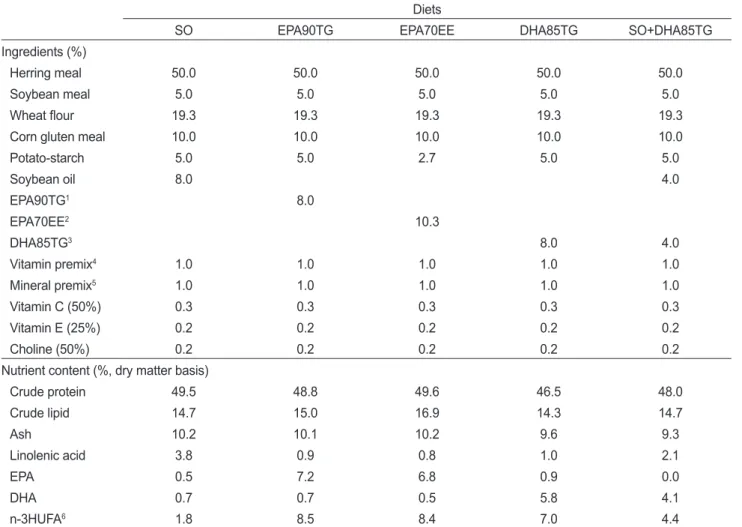
실험사료의원료 조성물과영양성분을
Table 1
에 나타내었 다.
실험사료의단백질원으로칠레산청어분을사용하였으며,
지질원으로 대두유(SO), triglyceride
형태의EPA (EPATG), ethyl ester
형태의EPA (EPAEE)
및triglyceride
형태의DHA (DHATG)
를사용하였다. TG
형및EE
형의EPA
및DHA
는㈜
켐포트(Seoul, Korea)
에서분리,
정제한것을사용하였다.
각 각의지질원을첨가한배합사료(SO, EPA90TG, EPA70EE
및DHA85TG)
와DHA
와대두유를1:1
비율로혼합한배합사료(SO+DHA85TG)
를설계한총5
가지의실험사료를준비하였다
.
이와같이설계된원료들을실험구별로정량하여잘혼합 한후,
원료1 kg
당물300 g
을첨가하여펠렛제조기로압출 성형한후,
실온에서24
시간건조한후-30℃
냉동고에보관 하면서사용하였다.
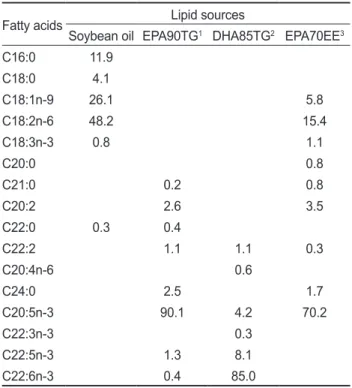
지질원으로사용된원료의지방산조성은Table 2
에나타내었으며,
실험사료지방산조성은Table 3
에나 타내었다.
실험어 및 사육관리
실험어류는통영에위치한개인양식장에서구입한넙치치어 를사용하였으며
,
상품사료를2
주간공급하면서예비사육하였 다.
외형적으로건강한평균체중6.8 g
전후의넙치치어를50 L
사각수조에각각30
마리씩3
반복으로수용하여8
주간사육실 험을진행하였다.
실험사료는1
일2
회(09:00, 17:00)
만복으로 공급하였으며,
매일실험수조를청소하여배설물및찌꺼기를 제거해주었다.
실험수조내에여과된해수를2 L/min
공급하였 Table 2. Major fatty acid composition (% of total fatty acids) ofdietary lipid sources
Fatty acids Lipid sources
Soybean oil EPA90TG1 DHA85TG2 EPA70EE3
C16:0 11.9
C18:0 4.1
C18:1n-9 26.1 5.8
C18:2n-6 48.2 15.4
C18:3n-3 0.8 1.1
C20:0 0.8
C21:0 0.2 0.8
C20:2 2.6 3.5
C22:0 0.3 0.4
C22:2 1.1 1.1 0.3
C20:4n-6 0.6
C24:0 2.5 1.7
C20:5n-3 90.1 4.2 70.2
C22:3n-3 0.3
C22:5n-3 1.3 8.1
C22:6n-3 0.4 85.0
1,2,3EPA90TG, EPA70EE, DHA85TG. provided by Chemport, Seoul, Korea.
Table 3. Fatty acid composition (% of total fatty acids) of the experimental diets
Fatty acids Diets
SO EPA90TG EPA70EE DHA85TG SO+ DHA85TG
C14:0 2.10 1.41 1.04 1.84 2.10
C16:0 20.23 10.25 6.90 13.31 15.88
C16:1 3.26 1.87 1.93 2.87 3.17
C18:0 3.18 1.78 6.02 1.72 2.19
C18:1n-9 21.02 10.32 16.38 12.03 14.95
C18:2n-6 29.03 6.60 5.18 8.11 15.76
C18:3n-3 1.94 1.16 2.16 1.55 1.54
C20:4n-6 2.26 4.14 7.17 1.60 1.57
C20:5n-3 3.97 53.47 44.69 6.82 0.09
C22:5n-3 7.19 0.28 0.17 0.91 0.68
C22:6n-3 0.21 5.23 3.29 44.96 30.82
으며
,
사육기간동안평균수온은17.1±2.71℃
였다. 어체 측정 및 성분분석
어체측정은사육실험시작시와종료시에측정전일절식시킨 후
tricaine methanesulfonate (MS 222, Sigma, St. Louis, MO,
USA) 100 ppm
수용액에마취시켜실험어의무게를측정하였다
.
어체성분분석을위하여실험종료시각실험수조에서어 체성분분석용으로10
마리를샘플로취하여냉동보관(-25℃)
하였다.
실험사료및어체의일반성분은AOAC (1995)
방법 에 따라조단백질(N×6.25)
은auto Kjeldahl system (Buchi B-324/435/412, Switzerland)
을사용하여분석하였고,
조지질 은ether
를사용하여추출하였다.
수분은105℃ dry oven
에서6
시간동안건조후측정하였고,
회분은600℃
회화로에서4
시 간동안태운후정량하였다.
지방산은
Folch et al. (1957)
의방법에따라클로로포름과메 탄올혼합액(2:1)
으로총지질을추출하여14% BF3-methanol (Sigma, USA)
용액으로지방산을methylation
시킨후, capil- lary column (SPTM-2560, 100 m×0.25 mm i.d., film thick- ness 0.20 µm, USA)
이장착된gas chromatography (Perkin Elmer, Clarus 600, USA)
로지방산을분석하였다. Carrier gas
는헬륨을사용하였으며, oven
온도는최초140℃
에서240℃
까지
4℃/min
증가시켰다.
이때, injector
온도는240℃, detec- tor (FID)
온도는240℃
로각각설정하였으며,
표준지방산으로37
개지방산혼합물(PUFA 37 Component FAME Mix, USA)
을사용하였다.
통계처리
결과의통계처리는
SPSS version 20.0 (SPSS Inc., Chicago, IL, USA)
을 사용하여one-way ANOVA-test
를 실시한 후, Duncan’s multiple range test (Duncan, 1955)
로평균간의유의 성(P<0.05)
을검정하였다.
결 과
대두유 및 농축 오메가
-3
계열 지방산 첨가 배합사료로 넙 치 치어를8
주간사육한후의성장및사료이용효율을Table 4
와Table 5
에각각나타내었다.
어류릐
생존율은사료지질 원에영향을받지않았으며(P>0.05),
증체율,
일간성장률,
사 료효율및단백질효율은사료에혼합된지질원의종류에영향 을받았다(P<0.05).
증체율및일간성장률은DHA85TG
실험 구가다른실험구보다유의적으로 높았으며(P<0.05),
사료효 율은DHA85TG
실험구가SO
및EPA70EE
실험구보다높았 으나(P<0.05), EPA90TG
및SO+DHA85TG
실험구와는 유의차가 없었다
(P>0.05).
일일사료섭취율 및 일일단백질섭취율은사료지질원에영향을받지않았다
(P>0.05).
단백질효율은
DHA85TG
실험구가다른실험구보다유의적으로높았다Table 5. Feed utilization of juvenile flounder Paralichthys olivaceus fed the experimental diets for 8 weeks1
Diets FE (%)2 DFI (%)3 DPI (%)4 PER (%)5
SO 73±7.1a 1.51±0.06ns 0.76±0.03ns 1.46±0.14a
EPA90TG 84±2.5ab 1.43±0.02 0.70±0.01 1.72±0.05a
EPA70EE 74±5.4a 1.45±0.09 0.72±0.05 1.49±0.11a
DHA85TG 96±3.9b 1.45±0.15 0.68±0.07 2.01±0.08b
SO+DHA85TG 83±0.3ab 1.47±0.07 0.70±0.03 1.72±0.01a
1Values (means±SE of three replications) in the same column not having a common superscript are significantly different (P<0.05). 2Feed efficiency=wet weight gain×100/feed intake. 3Daily feed intake=feed intake×100/[(initial fish wt.+final fish wt.+dead fish wt.)×days reared/2]. 4Daily protein intake=protein intake×100/[(initial fish wt.+final fish wt.+dead fish wt.)×days reared/2]. 5Protein efficiency ratio=(wet weight gain/protein intake)×100. ns Not significant (P>0.05).
Table 4. Growth performance of juvenile flounder Paralichthys olivaceus fed the experimental diets for 8 weeks1
Diets Initial wt (g/fish) Survival (%) WG (%)2 SGR (%)3
SO 6.8±0.03 89±5.7ns 134±11.9 a 1.21±0.07a
EPA90TG 6.9±0.05 90±4.0 152±3.4 a 1.32±0.02 a
EPA70EE 6.8±0.03 87±6.7 125±5.1 a 1.16±0.03 a
DHA85TG 6.8±0.02 87±11.8 203±13.8b 1.58±0.06b
SO+DHA85TG 6.9±0.03 88±6.2 154±9.5 a 1.33±0.05 a
1Values (means±SE of three replications) in the same column not having a common superscript are significantly different (P<0.05). 2Weight gain=(final fish wt.-initial fish wt.)×100/initial fish weight. 3Specific growth rate=[(ln (final fish wt.)-ln (initial fish wt.)]×100/days of feed- ing. nsNot significant (P>0.05).
(P<0.05).
어체의비만도
,
간중량지수및내장중량지수를Table 6
에나 타내었다.
어체의비만도,
간중량지수및내장중량지수는사 료지질원의종류에영향을받지않아모든실험구에서유의차 가나타나지않았다(P>0.05).
사육실험종료후
,
등근육및전어체의일반성분분석결과를Table 7
에나타내었다.
등근육및전어체의수분,
조단백질,
조 지질및회분은사료지질원에영향을받지않아모든실험구에 서유의차가나타나지않았다(P>0.05).
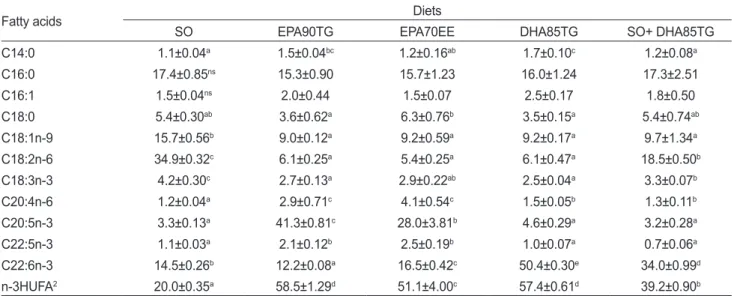
실험종료시넙치의등근육지방산조성을
Table 8
에나타내었다
.
등근육의 지방산조성은사료의지질원에 영향을받았 다. 18:2n-6
및18:3n-3
은대두유첨가실험구에서, 20:5n-3
은EPA
첨가실험구에서, 22:6n-3
은DHA
첨가실험구에서다른 실험구보다유의하게높은값을나타내었다(P<0.05).
등근육의20:5n-3
은EPA90TG
및EPA70EE
실험구가다른실험구보다 유의적으로높은값을나타내었으며(P<0.05), EPA90TG
실험 구가EPA70EE
실험구보다유의하게높았다(P<0.05).
고 찰
본연구의성장및사료이용효율결과에서
DHA85TG
실험 구가가장좋았는데,
이는넙치체내에축적된DHA
에의한생 체기능향상에따른것으로생각된다. Kim and Lee (2004)
는EPA
를단독으로사용한것보다EPA
와DHA
를혼합하여사용 했을때넙치치어의성장에더효과적이었다고보고하고있으 며,
다른어종에서도비슷한경향을보였다(Watanabe, 1993;
Bell et al., 1995; Rodriguez et al., 1997; Furuita et al., 1999;
Lee, 2001). DHA
는망막과뇌의주요구성성분이며,
특히치 어기때에성장과생존에매우중요한역할을담당하는영양소 이다(Navarro et al., 1988; Mourente et al., 1991; Mourente and Tocher, 1992; Bell et al., 1995). Kim and Lee (2004)
는DHA
가 세포막의 효소활성과 생리학적 균형을 유지하는데EPA
보다더중요한역할을한다고추측했으며, red seabream
및striped jack
에서도유사한결과가보고되었다(Kanazawa, 1985; Watanabe et al., 1989a; Watanabe et al., 1989b; Takeu-
Table 6. Morphological parameters of juvenile flounder Paralichthys olivaceus fed the experimental diets for 8 weeks1
Diets CF2 HSI3 VSI4
SO 0.9±0.08ns 1.26±0.06ns 5.17±0.25ns
EPA90TG 0.9±0.06 1.15±0.11 4.50±0.47
EPA70EE 0.9±0.02 1.31±0.10 4.86±0.13
DHA85TG 0.9±0.06 1.24±0.12 4.68±0.41
SO+DHA85TG 1.0±0.01 1.59±0.07 5.01±0.39
1Values are mean±SE of three replications. 2Condition factor=100×[fish weight/fish length (cm)3]. 3Hepatosomatic index=100×(liver weight/
body weight). 4Visceralsomatic index=100×(viscera weight/body weight). nsNot significant (P>0.05).
Table 7. Proximate composition (%) of the dorsal muscle and whole body of juvenile flounder Paralichthys olivaceus fed the experimental diets for 8 weeks1
Diets Proximate composition (%)
Moisture Crude protein Crude lipid Ash
Dorsal muscle
SO 75.4±2.11ns 21.0±0.54ns 1.2±0.24 ns 1.3±0.06 ns
EPA90TG 77.1±1.05 20.5±1.31 1.6±0.28 1.2±0.15
EPA70EE 76.4±0.43 20.5±0.21 1.1±0.14 1.1±0.21
DHA85TG 76.3±1.01 19.6±0.49 1.8±0.47 1.3±0.05
SO+DHA85TG 76.3±0.61 20.9±0.24 0.9±0.15 1.2±0.25
Whole body
SO 72.9±0.86 ns 16.6±0.51 ns 4.1±0.80 ns 4.8±0.54 ns
EPA90TG 72.5±0.78 17.5±0.22 4.1±0.42 4.6±0.22
EPA70EE 74.7±0.64 16.7±0.73 3.4±0.77 4.5±0.30
DHA85TG 72.3±0.67 16.4±0.71 5.5±0.09 4.2±0.55
SO+DHA85TG 69.9±2.04 17.1±0.76 4.9±0.17 5.2±0.52
1Values are mean±SE of three replications. nsNot significant (P>0.05).
chi et al., 1990).
이러한결과들은EPA
와DHA
가해양어류의 생체막에서각각다른기능을가지고있음을의미하고있으며,
DHA
가EPA
보다어류의성장과발달에더중요한역할을담당하는것으로생각된다
.
DHA85TG
실험구를제외하고다른모든실험구간들의성장과사료이용효율이차이가없는것은실험사료에함유된필수
지방산의종류
(EPA, DHA)
와요구량이넙치의요구에만족되었기때문으로판단된다
.
넙치와가자미류의필수지방산으로n-3HUFA
요구량은0.8-1.0%
로알려져있는데(Gatesoupe et al., 1977; Lee et al., 2003; Kim and Lee, 2004),
타어종에서도 필수지방산요구량이만족된사료를섭취하면본연구와비슷 하게성장및사료이용효율이사료지질의종류에영향을받지 않는것으로보고되었다(Bell et al., 2003; Peiedecausa et al., 2007; Aminikhoei et al., 2013).
반면
n-3HUFA
를 과잉으로 공급해주었을 경우 넙치 치어의성장이저하되었다는보고가있는데
(Kim and Lee, 2004),
이와비슷한현상은다른연구에서도관찰된다(Stickney and Andrews, 1972; Takeuchi and Watanabe, 1979; Satoh et al., 1989; Lochman and Gatlin, 1993; Furuita et al., 2002).
그러나본실험에서
n-3HUFA
과잉공급으로생각되는실험구들(4.4-
8.5% n-3 HUFA)
에서성장저하는나타나지않았다.
해산어류 인조피볼락(Lee, 2001)
과강도다리(Lee et al., 2003)
의필수 지방산에관한연구에서도사료의n-3HUFA
과잉으로인한어 류의성장이나체형에부정적인징후는관찰되지않았다.
필수 지방산으로n-3HUFA
가과잉으로공급된어류들에서각각다 르게반응하는것에대한이유는명확하지않지만,
사료의지 질종류나결합형태,
지질산화정도또는사육환경의차이에서기인될수있으며
,
이에대한연구가추가적으로필요하다 고판단된다.
이러한결과들을종합하여판단하여보면
,
대상어종에공급 되는사료의필수지방산요구량이만족되는경우에는값싼지 질원료들을사료에혼합하여사용할수있을것으로판단되며,
이는경제적인사료제조에좋은정보가될것으로전망된다.
등근육과전어체의일반성분분석결과를살펴보면
,
사료지질 원에영향을받지않아모든실험구에서유의차가나타나지않 았는데,
일반적으로필수지방산함량이충족된사료를섭취한 실험어류의일반성분은사료의지질원에영향을받지않는다 고알려져있다(Aminikhoei et al., 2013). African catfish (Ng et al., 2003), channel catfish (Gatlin and Stickney, 1982)
와far eastern catfish (Kim et al., 2010)
를대상으로사료지질원을달 리하여사육한어류의일반성분은모든실험구에서차이를보 이지않아본연구와유사한결과를보였다.
본연구에서어체의지방산조성은사료지질의지방산조성 과유사한경향을보였다
.
일반적으로사료지질의지방산조성 은대상생물의지방산조성에영향을미친다고보고되어있다(Geurden et al., 1997; Lee and Lim, 2005).
비단잉어,
뱀장어,
자주복,
돔, Channel catfish, Atlantic halibut
등의다양한어종 에서도사료지방산조성이어체지방산조성에영향을미친다 고보고된바있다(Ibeas et al., 1996; Bae et al., 2004; Bowden et al., 2004; Piedecausa et al., 2007; Aksoy et al., 2009; Koi- zumi and Hiratsuka, 2009; Kikuchi et al., 2011; Kim and Lee, 2016).
본연구에서등근육의oleic acid (18:1n-9)
함량은대두 유첨가실험구가다른실험구보다높게나타났다. Oleic acid
는단일불포화지방산으로서다량섭취시혈중중성지방이나Table 8. Fatty acid composition (% of total fatty acids) of the dorsal muscle in juvenile flounder Paralichthys olivaceus fed the experimental diets for 8 weeks1
Fatty acids Diets
SO EPA90TG EPA70EE DHA85TG SO+ DHA85TG
C14:0 1.1±0.04a 1.5±0.04bc 1.2±0.16ab 1.7±0.10c 1.2±0.08a
C16:0 17.4±0.85ns 15.3±0.90 15.7±1.23 16.0±1.24 17.3±2.51
C16:1 1.5±0.04ns 2.0±0.44 1.5±0.07 2.5±0.17 1.8±0.50
C18:0 5.4±0.30ab 3.6±0.62a 6.3±0.76b 3.5±0.15a 5.4±0.74ab
C18:1n-9 15.7±0.56b 9.0±0.12a 9.2±0.59a 9.2±0.17a 9.7±1.34a
C18:2n-6 34.9±0.32c 6.1±0.25a 5.4±0.25a 6.1±0.47a 18.5±0.50b
C18:3n-3 4.2±0.30c 2.7±0.13a 2.9±0.22ab 2.5±0.04a 3.3±0.07b
C20:4n-6 1.2±0.04a 2.9±0.71c 4.1±0.54c 1.5±0.05b 1.3±0.11b
C20:5n-3 3.3±0.13a 41.3±0.81c 28.0±3.81b 4.6±0.29a 3.2±0.28a
C22:5n-3 1.1±0.03a 2.1±0.12b 2.5±0.19b 1.0±0.07a 0.7±0.06a
C22:6n-3 14.5±0.26b 12.2±0.08a 16.5±0.42c 50.4±0.30e 34.0±0.99d
n-3HUFA2 20.0±0.35a 58.5±1.29d 51.1±4.00c 57.4±0.61d 39.2±0.90b
1Values (means±SE of three replications) in the same row not having a common superscript are significantly different (P<0.05). 2Highly unsaturated fatty acids (C≥20). nsNot significant (P>0.05).
콜레스테롤을낮춤으로서동맥경화증과같은성인병에유익한 효과가있는것으로보고되었으며
(Grundy, 1986), oleic acid
의함량이높으면식육의맛을좋게한다고보고되어있다
(Lunt
and Smith, 1991).
본연구에서등근육의
18:2n-6, 18:3n-3, 20:5n-3
및22:6n-3
과같은탄소수18
개이상의다불포화지방산들의조성이사료 의지방산조성에직접적인영향을받았는데,
다른연구에서도 유사한경향을보였다(Kim et al., 2012; Kim and Lee, 2016).
이는어체내지방산전환능력과관련된것으로생각되는데
,
포 화지방산과단일불포화지방산들은체내에서신장되거나불포 화되어생성될수있지만,
대부분의해산어류들은고도불포화 지방산을자체적으로합성할수있는능력이매우낮다.
이러한이유로인하여
EPA
함유사료를섭취한어류의체내에EPA
로부터합성되는
DHA
함량이상대적으로낮게나타나고있다.
또한체내에서
DHA
를EPA
로역으로전환하는능력도매우 제한적이라는것을알수있는데, DHA
가함유된사료를섭취한넙치의생체내에
EPA
함량이증가되지않은것으로부터이를증명하고있다
.
EPA
는혈액중의콜레스테롤및중성지질의농도를현저히 저하시키고,
혈전증,
동맥경화증등의순환기계통질환방지및 특정한종양의발육억제기능을가지는것으로알려져있으며, EPA
를주요성분으로하는각종제품이건강기능식품으로널 리시판되고있다(Yoon, 1993).
본연구에서등근육의지방산 분석결과에서EPA
함량은TG
실험구가EE
실험구보다유의 적으로높은값을나타내었다. EE
형및TG
형건강기능성제품 에대한인체의안전성,
흡수성등에관련한연구에따르면EE
형의제품보다는TG
형의제품이인체에더유용하고안전하다 는보고가있다(Arne et al., 1991).
또한고도불포화지방산의생 체이용률,
생리작용의지속성및새로운기능의발현또한TG
구조가EE
구조보다생체이용률에더우수하다고보고되어있 다(Yasuhiro and Keiichi 2002).
본연구에서넙치의EPA
함량 이지방산형태에따라다르게나타난것은넙치체내에서EPA
의흡수성및이용성이EE
보다는TG
구조에서더우수하기때 문으로추측되며,
넙치를대상으로지방산형태에따른지질이 용성에관한상세한연구는추후계속되어야할것이다.
이상의결과에서
,
사료에혼합되는지질원은넙치의성장및 사료이용율에영향을미쳤으며, TG
형태의DHA
첨가실험구 가성장에가장좋은효과가있었다.
또한사료에사용하는지 질원의종류나지방산결합형태에따라어체의지방산조성 이달라짐을알수있다.
이러한결과들은추후기능성을가지 는특정지방산이축적된어류생산에중요한정보가될것으 로전망된다.
사 사
이연구는정부
(
해양수산부)
의재원으로해양수산과학기술진 흥원에서 지원하는 해양바이오지역특화선도기술개발사업(
동해안해양생물자원유래의기능성생물소재개발
)
의지원을받 아수행되었으며(No.20140441),
이에감사드립니다.
References
Aminikhoei Z, Choi J, Lee SM and Kim KD. 2013. Effects of different dietary lipid sources on growth performance, fatty acid composition and antioxidant enzyme activity of juve- nile rockfish, Sebastes schlegeli. J World Aquacult Soc 44, 716-725. https://doi.org/10.1111/jwas.12070.
AOAC (Association of Official Analytical Chemists). 1995. Of- ficial methods of analysis of the association 16th ed. Associ- ation of Official Analytical Chemists Arlington, VA, U.S.A.
Arne N, Louise B, William EC and Lauren H. 1991. Absorption of the n-3 eicosapentaenoic and docosahexaenoic acids as ethyl esters and triglycerides by humans. Am J Clin Nutr 53,1185-1190. https://doi.org/10.1093/ajcn/53.5.1185.
Aksoy MY, Lim C, Shelby R and Klesius PH. 2009. Increasing fish oil levels in commercial diets influences hematological and immunological responses of channel catfish, Ictalurus
punctatus. J World Aquacult Soc 40, 76-86. https://doi.
org/10.1111/j.1749-7345.2008.00228.x.
Bae JY, Han KM, Park GJ and Bai SC. 2004. Studies on require- ments of optimum dietary essential fatty acids in juvenile eel, Anguilla japonica. J Aquaculture 17, 275-281.
Beamish FWH and Medland TE. 1986. Protein sparing effects in large rainbow trout, Salmo gairdneri. Aquaculture 55, 35- 42. https://doi.org/10.1016/0044-8486(86)90053-0.
Bell MV, Batty RS, Dick JR, Fretwell K, Navarro JC and Sar- gent JR. 1995. Dietary deficiency of docosahexaenoic acid impairs vision at low light intensities in juvenile her- ring (Clupea harengus L.). Lipids 30, 443-449. https://doi.
org/10.1007/BF02536303.
Bell JG, McGhee F, Campbell PJ and Sargent JR. 2003. Rape- seed oil as an alternative to marine fish oil in diets of post- smolt Atlantic salmon Salmo salar: changes in flesh fatty acid composition and effectiveness of subsequent fish oil “wash out”. Aquaculture 218, 515-528. https://doi.
org/10.1016/S0044-8486(02)00462-3.
Bowden LA, Weitzel B, Ashton IP, Secombes CJ, Restall CJ, Walton TJ, Bell JG, Henderson RJ, Tocher DR and Sargent JR. 2004. Replacement of dietary fish oil with increasing levels of linseed oil: modification of flesh fatty acid com- positions in Atlantic salmon Salmo salar using a fish oil finishing diet. Lipids 39, 223-232. https://doi.org/10.1007/
s11745-004-1223-5.
De Silva SS, Gunasekera RM and Shim KF. 1991. Interactions of varying dietary protein and lipid levels in young red tila- pia: evidence of protein sparing. Aquaculture 95, 305-318.
https://doi.org/10.1016/0044-8486(91)90096-P.
Duncan DB. 1955. Multiple-range and multiple F tests. Biomet- rics 11, 1-42. https://www.jstor.org/stable/3001478.
Folch J, Lees M and Stanley GHS. 1957. A simple method for the isolation and purification of total lipids from animal tis- sues. J Biol Chem 226, 497-509.
Fonseca-Madrigal J, Karalazos V, Campbell PJ, Bell JG and Tocher DR. 2005. Influence of dietary palm oil on growth, tissue fatty acid compositions, and fatty acid metabolism in liver and intestine in rainbow trout (Oncorhynchus mykiss).
Aquacult Nutr 11, 241-250. https://doi.org/10.1111/j.1365- 2095.2005.00346.x.
Furuita H, Konishi K and Takeuchi T. 1999. Effects of different levels of eicosapentaenoic acid and docosahexaenoic acid in
Artemia nauplii on growth, survival and salinity tolerance
of larvae of the Japanese flounder, Paralichthys olivaceus.Aquaculture 170, 59-69. https://doi.org/10.1016/S0044- 8486(98)00386-x.
Furuita H, Tanaka H, Yamamoto Y, Suzuki N and Takeuchi T.
2002. Effects of high levels of n-3 HUFA in broodstock diet on egg quality and egg fatty acid composition of Japanese flounder, Paralichthys olivaceus. Aquaculture 210, 323- 333. https://doi.org/10.1016/S0044-8486(01)00855-9.
Gatesoupe FJ, Leger C, Boudon M, Metailler R and Luquet P.
1977. Lipid feeding of turbot (Scophthalmus maximus L.):
2. Influence on growth of supplementation with methyl es- ters of linolenic acid and fatty acids of the w 9 series. Ann Hydrobiol 8, 247- 254.
Gatlin DM and Stickney RR. 1982. Fall-winter growth of young channel catfish in response to quantity and source of dietary lipid. Amer Fish Soc 111, 90-93. https://doi.
org/10.1577/1548-8659(1982)111<90:FGOYCC>2.0.
CO;2.
Geurden I, Coutteau P and Sorgeloos P. 1997. Effect of a dietary phospholipid supplementation on growth and fatty acid composition of European sea bass Dicentrarchus labrax L.
and turbot Scophthalmus maximus L. juveniles from wean- ing onwards. Fish Phy Biochem 16, 259-272.
Greene DH and Selivonchick DP. 1990. Effects of dietary vege- table, animal and marine lipids on muscle lipid and hematol- ogy of rainbow trout (Oncorhynchus mykiss). Aquaculture 89, 165-182. https://doi.org/10.1016/0044-8486(90)90308- Grundy SM. 1986. Comparison of monounsaturated fatty acids A.
and carbohydrates for lowering plasma cholesterol. N Engl J Med 314, 2855-2856.
Ibeas C, Cejas J, Gomez T, Jerez S and Lorenze A. 1996. In- fluence of dietary n-3 highly unsaturated fatty acids levels on juvenile gilthead seabream (Sparus aurata) growth and tis\-sue fatty acid composition. Aquaculture 142, 221-235.
https://doi.org/10.1016/0044-8486(96)01251-3.
Jee BY, Shin KW, Lee DW, Kim YJ and Lee MK. 2014. Moni- toring of the mortalities and medications in the inland farms of olive flounder Paralichthys olivaceus, in South Korea. J Fish Pathol 27, 77-83. https://doi.org/10.7847/
jfp.2014.27.1.077.
Jiankang W, Erick RS, Jaroslay K and Fereidoon S. 2010. Effect of chemical randomization on positional distribution and stability of omega-3 oil triacylglycerol. J Agri Food Chem 58, 8842-8847.
Kalogeropoulos N, Alexis MN and Henderson RJ. 1992. Ef- fects of dietary soybean and cod-liver oil levels on growth and body composition of gilthead bream (Sparus aurata).
Aquaculture 104, 293-308. https://doi.org/10.1016/0044- 8486(92)90211-3.
Kanazawa A. 1985. Essential fatty acid and lipid requirement of fish. In: C. B. Cowey, A. M. Mackie and J.G. Bell (Eds), Nutrition and Feeding in Fish, Academic Press. New York, NY, U.S.A., 281-298.
Kikuchi K, Furuta T, Iwata N, Onuki K, Noguchi T and Sugita H. 2011. Effect of dietary fatty acid composition on the growth of the tiger puffer Takifugu rubripes. Fish Sci 77, 829-837. https://doi.org/10.1007/s12562-011-0393-0.
Kim DK, Kim KD, Seo JY and SM Lee. 2012. Effects of dietary lipid source and level on growth performance, blood param- eters and flesh quality of sub-adult olive flounder (Paralich-
thys olivaceus). Asian-Aust J Anim Sci 25, 869-879. https://
doi.org/10.5713/ajas.2011.11470.
Kim KD and Lee SM. 2004. Requirement of dietary n-3 highly unsaturated fatty acids for juvenile flounder (Para-
lichthys olivaceus). Aquaculture 229, 315-323. https://doi.
org/10.1016/S0044-8486(03)00356-9.
Kim IO and Lee SM. 2005. Effects of the dietary protein and lipid levels on growth and body composition of bagrid cat- fish, Pseudobagrus fulvidraco. Aquaculture 243, 323-329.
https://doi.org/j.aquaculture.2004.11.003.
Kim IO and Lee SM. 2016. Influences of different dietary lipid sources on the growth, body composition, and fatty acid pro- files of juvenile fancy carp, Cyprinus carpio var. koi. Ko- rean J Fish Aquat Sci 49, 317-322. https://doi.org/10.5657/
KFAS.2016.0317.
Kim KD, Lee SM, Park HG, Bai SC and Lee YH. 2002. Essenti- ality of dietary n-3 highly unsaturated fatty acids in juvenile Japanese flounder Paralichthys olivaceus. J World Aquacult Soc 33, 432-440. https://doi.org/10.1111/j.1749-7345.2002.
tb00022.x.
Kim KD, Kim JD, Lim SG, Kang YJ and Son MH. 2010. Ef- fects of dietary lipid sources on the growth and body compo- sition of the far eastern catfish, Silurus asotus. Korean J Fish Aquat Sci 43, 445-450.
Koizumi K and Hiratsuka S. 2009. Fatty acid compositions in muscles of wild and cultured ocellate puffer Takifugu ru-
bripes. Fish Sci 75, 1323-1328. https://doi.org/10.1007/
s12562-009-0151-8.
Lee SM. 2001. Review of the lipid and essential fatty acid re- quirements of rockfish (Sebastes schlegeli). Aquac Res 32, 8-17. https://doi.org/10.1046/j.1355-557x.2001.00047.x.