• 검색 결과가 없습니다.

Effects of Dietary Supplementation of Alga Mixtures (Hizikia fusiformis and Ecklonia cava) on Innate Immunity and Disease Resistance Against Edwardsiella tarda in Olive Flounder (Paralichthys olivaceus)

N/A
N/A
Protected

Academic year: 2021

Share "Effects of Dietary Supplementation of Alga Mixtures (Hizikia fusiformis and Ecklonia cava) on Innate Immunity and Disease Resistance Against Edwardsiella tarda in Olive Flounder (Paralichthys olivaceus)"

Copied!
7
0
0

로드 중.... (전체 텍스트 보기)

전체 글

(1)

614 Corresponding author: [email protected]

해조류 ( 톳 , 감태 ) 혼합물의 사료 내 첨가가 넙치의 선천성 면역과 질병저항성에 미치는 영향

김성삼

1

・장지웅

1

・송진우

1

・임세진

1

・정준범

1

이상민

2

・김강웅

3

・손맹현

3

・이경준

1

,

4✽

1

제주대학교 해양의생명과학부,

2

강릉원주대학교 해양생명공학부,

3

국립수산과학원 양식관리과,

4

제주대학교 해양과환경연구소

Effects of Dietary Supplementation of Alga Mixtures (Hizikia fusiformis and Ecklonia cava) on

Innate Immunity and Disease Resistance Against Edwardsiella tarda in Olive Flounder

(Paralichthys olivaceus)

Sung-Sam Kim

1

, Ji-Woong Jang

1

, Jin-Woo Song

1

, Se-Jin Lim

1

, Joon Bum Jeong

1

, Sang-Min Lee

2

, Kang-Woong Kim

3

,

Maeng-Hyun Son

3

and Kyeong-Jun Lee

1,4✽

1

Faculty of Marine Biomedical Science, Jeju National University, Jeju 690-756, Korea

2

Faculty of Marine Bioscience and Technology, Kangnung-Wonju National University, Gangneung 210-702, Korea

3

Aquaculture Management Division, National Fisheries Research and Development Institute, Pohang 791-802, Korea

4

Marine and Environmental Research Institute, Jeju National University, Jeju 695-814, Korea

We report non-specific immune responses and its disease resistance against Edwardsiella tarda by alga mixture (HE; Hizikia:Ecklonia) in olive flounder for the first time. Five isonitrogenous (44% crude protein) and isocaloric (17.1 MJ kg

-1

) diets were formulated to have 0%, 2%, 4%, 6% and 8% of the alga mixture.

One of five experimental diets was fed triplicate groups of fish (30 fish/group) to apparent satiation in a flow through system. After a two week feeding, blood was sampled at 3, 6, 12, 24 h after the last feeding for a kinetic measurement of nitroblue tetrazolium (NBT) activity and healthy fish with similar sizes in each tank were selected and injected with 1 mL of E. tarda suspension (1.0×10

7

CFU/mL) to evaluate the disease resistance of the fish. Dietary supplementation of alga mixtures resulted in significantly higher non-specific immune responses compared with the fish fed the control diet. The cumulative mortality was significantly lower in the fish groups fed alga mixture containing diets than control group in the challenge test with E. tarda. Therefore, the results in this study indicate that dietary supplementation of Hizikia and Ecklonia mixtures enhance the non-specific immune responses and a disease resistance of olive flounder.

Key words: Olive flounder, Hizikia fusiformis, Ecklonia cava, Edwardsiella tarda, Immune responses

서 론

최근 많은 국가에서 항생제 사용을 금지하고 있고 그 사용 량과 식품에서의 잔류 허용량 규제가 더욱 엄격해지고 있으 며, 최대잔류허용기준 (MRL, maximum residue level)을 설정 하여 규제하고 있다. 최근에는 항생제 내성세균에 대한 문제 도 제기되면서 항생제 사용의 법적인 규제가 이루어지고 있는 실정이다 (Vanbelle, 1989). 이에 따라 항생제 대체방안으로 부작용이 없는 천연물질을 사료첨가제로 개발하여 양식 어류

의 면역력 및 건강을 증진시키기 위한 양식산업의 기능적 브랜드화가 시도되고 있다 (Kim et al., 2006).

해조류의 다양한 생리활성 기능은 이미 잘 알려져 있으며

(Mayor and Hamann, 2002, 2004), 그 중 톳 (Hizikia fusiformis)

과 감태 (Ecklonia cava)는 갈조식물문 (Phaeophyta)에 속하는

갈조류로 매우 높은 생리활성 효능이 밝혀지면서 식품, 의약

품, 화장품, 축산업 및 양식산업 등 관련 분야에서 이에 대한

연구가 활발히 이루어지고 있다 (Kim and Lee, 2004; Bu et

al., 2006). 특히 양식산업 분야에서 Kim and Lee (2008)은

감태 (E. cava) 분말을 이용하여 넙치를 대상으로 비 특이적

면역반응을 증가시켜 사료 첨가제로써 가능성을 보고 하였다.

(2)

또한 Pham et al. (2006)은 톳 (H. fusiformis)을 이용하여 넙치의 비특이적 면역력 및 질병저항성을 증진시킬 수 있다고 보고하 였다. 감태는 최근 들어 국내에서도 식용화 연구에 관심을 보이고 있으며 높은 항산화 활성이 많은 연구를 통해 보고되 고 있고 (Kim and Lee, 2004; Athukorala et al., 2006), 항고혈압 제와 같은 약제로서의 가능성 (Hong et al., 2006) 및 발암성 니트로사민 생성인자의 하나인 아질산염을 효과적으로 분해 한다고 보고되었다 (Park, 2005). 톳도 감태와 마찬가지로 항산 화 활성, 면역반응 및 질병저항성에 관한 연구 (Shan et al., 1999; Okai et al., 1997; Okai et al., 1998) 등이 보고되었다.

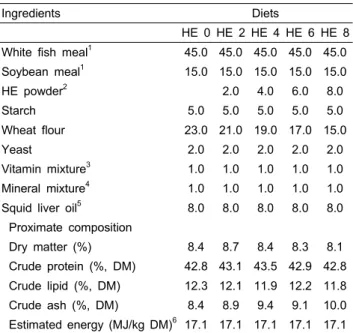
Table 1. Composition and proximate analysis of the basal diet (% of DM basis)

Ingredients Diets

HE 0 HE 2 HE 4 HE 6 HE 8 White fish meal

1

45.0 45.0 45.0 45.0 45.0 Soybean meal

1

15.0 15.0 15.0 15.0 15.0

HE powder

2

2.0 4.0 6.0 8.0

Starch 5.0 5.0 5.0 5.0 5.0

Wheat flour 23.0 21.0 19.0 17.0 15.0

Yeast 2.0 2.0 2.0 2.0 2.0

Vitamin mixture

3

1.0 1.0 1.0 1.0 1.0

Mineral mixture

4

1.0 1.0 1.0 1.0 1.0

Squid liver oil

5

8.0 8.0 8.0 8.0 8.0 Proximate composition

Dry matter (%) 8.4 8.7 8.4 8.3 8.1

Crude protein (%, DM) 42.8 43.1 43.5 42.9 42.8 Crude lipid (%, DM) 12.3 12.1 11.9 12.2 11.8 Crude ash (%, DM) 8.4 8.9 9.4 9.1 10.0 Estimated energy (MJ/kg DM)

6

17.1 17.1 17.1 17.1 17.1

1

Provided by Suhyup Feed Co. Ltd., Uiryeong, Korea.

2

HE powder: Hizikia fusiformis was purchased in the market.

(Dongmun public market, Jeju, Korea) and Eciklonia cava powder was kindly provided by Professor Jeon, Y.-J., Falculty of Marine Biomedical Science, Jeju National University. (Hizikia:Ecklonia, 1:1).

3

Vitamin premix (g/kg of mixture): L-ascorbic acid monophosphate, 100.0; DL-tocopheryl acetate, 20.0; thiamin hydrochloride, 4.0; riboflavin, 4.4; pyridoxine hydrochloride, 4.0; niacin, 30.0; D-pantothenic acid hemicalcium salt, 14.5; myo-inositol, 40.0; D-biotin, 0.2;

folic acid, 0.48; menadione, 0.2; retinyl acetate, 1.0;

cholecalficerol, 0.05; cyanocobalamin, 0.01.

4

Mineral mixture (g/kg of mixture): MgSO

4

.7H

2

O, 80.0;

NaH

2

PO

4

.2H

2

O, 370.0; KCl, 130.0; Ferric citrate, 40.0;

ZnSO

4

.7H

2

O, 20.0; Ca-lactate, 356.5; CuCl, 0.2;

AlCl

3

.6H

2

O, 0.15; Na

2

Se2O

3

. 0.01; MnSO

4

.H

2

O, 2.0;

CoCl

2

.6H

2

O, 1.0.

5

Squid liver oil was purchased from E-Wha oil Co. Ltd., Pusan, Korea.

6

Estimated energy was determined by using values of 16.7 KJ/g protein or carbohydrate and 37.6 KJ/g fat for dietary ingredients (Garling and Wilson, 1976).

Table 2. The proximate composition of major ingredients used in the experimental diets

Ingredients Moisture (%)

Protein (% DM)

Lipid (% DM)

Ash (% DM)

White fish meal 8.7 74.8 9.4 14.0

Soybean meal 8.1 46.8 2.5 6.5

Yeast 5.5 42.2 1.0 5.6

Hizikia powder

1

9.50 9.9 1.2 40.0

Ecklonia powder

2

8.8 10.0 0.7 17.4

1

Hizikia fusiformis was purchased in the market (Dongmun public market, Jeju, Korea).

2
Eciklonia cava powder were kindly provided by Professor Jeon, Y.-J., Falculty of Marine Biomedical Science, Jeju National University.

양식산업에서 주요 세균성 질병인 Edwardsiellosis는

Edwardsiella tarda가 원인균이다. 에드와드병은 초여름부터

늦가을까지 주로 고수온기에 발생하지만 최근에는 년 중 발생 하고 있다. 감염 시 증상은 복부팽만, 안구백탁, 체색흑화, 탈장, 출혈 및 조직 (간, 신장, 비장 및 아기미)에 흰색 결절이 형성되는 것으로 알려져 있다 (Mohanty and Sahoo, 2007).

주요 양식어종인 뱀장어 (Alcaide et al., 2006), 잉어 (Sae-Dui et al., 1984) 및 틸라피아 (Clavijo et al., 2002) 등과 같은 담수어 는 물론 해수어인 감성돔 (Kusuda et al., 1977), 넙치 (Bang et al., 1992) 등에 감염하여 막대한 경제적 손실을 일으키고 있다.

이미 톳과 감태는 넙치를 대상으로 사료첨가제로서 가능성 이 증명되었다 (Pham et al., 2006; Kim and Lee, 2008). 그러나 이런 사료 첨가제들은 어종, 사이즈, 사료조성 및 사료품질 등에 따라 차이가 있을 수 있다 (Lindsay et al., 1984; Shiau and Yu, 1999). 또한 많은 연구에서 그 우수성이 보고된 물질이 라 하더라도 그 농도를 적정농도 이상 사용하면 오히려 부작 용이 나타날 수 있으며 (Shiau and Yu, 1999), 적정농도 이하로 사용하면 그 효과가 미비할 수도 있다. 따라서 양식대상 어종 에 따라 첨가제의 종류 및 첨가농도를 고려하면서 연구되어야 할 것이다. 하지만 톳, 감태의 혼합첨가에 따른 면역증강 효과 및 어병세균 (E. tarda)에 대한 저항성을 높일 수 있을 것이라는 가설에 대한 in vivo 실험은 행해진 바가 없다.

따라서 이번 연구는 톳과 감태의 혼합물을 사료 내에 단계 별로 첨가하여 넙치에 있어서 적정 첨가함량 및 비 특이적 면역반응에 미치는 영향을 조사하고, 주요 어병세균 중에 하 나인 E. tarda에 대한 질병저항성에 미치는 영향을 알아보고자 수행되었다.

재료 및 방법

실험사료

총 5개의 실험사료는 조단백질 함량과 에너지 수준이 각각

44%와 17.1 MJ/kg을 갖도록 동일하게 조성되었다. 본 실험의

사료조성표는 Table 1에 나타내었으며, 실험사료원의 성분분

(3)

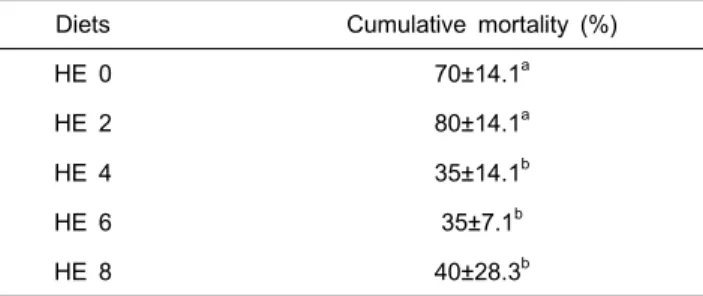
Table 3. Cumulative mortality in the challenge test with Edwardsiella tarda by intraperitoneal injection in olive flounder fed the experimental diets containing 0%, 2%, 4%, 6% and 8% of alga mixtures (Hizikia:Ecklonia, 1:1) for 2 weeks

Diets Cumulative mortality (%)

HE 0 70±14.1

a

HE 2 80±14.1

a

HE 4 35±14.1

b

HE 6 35±7.1

b

HE 8 40±28.3

b

Values are presented as mean ± SD (n=2). Values in the same column having different superscripts are significantly different.

석 결과는 Table 2에서 보여주고 있다. 이 실험에 사용된 톳 분말은 제주시에 위치한 동문시장에서 제주산 톳을 구입하여 줄기를 제거한 후, 동결건조하여 분말을 제조하였다. 감태 분말은 제주대학교 해양과학대학 해양생물자원이용공학연 구실로부터 지원받았다. 톳과 감태 분말의 일반성분 분석은 Table 2에 나타내었다. 우선 동결건조된 분말형태의 톳과 감태 를 1:1 비율로 혼합한 후, 사료 내 첨가함량이 각 0, 2, 4, 6 및 8%가 되도록 첨가하여 (HE 0, HE 2, HE 4, HE 6 및 HE 8) 실험사료를 제조하였다. 실험사료 제조는 우선 모든 사료원 들을 파쇄기를 이용하여 분말형태로 일정하게 만들고, 각 사 료원들을 사료조성표에 따라 정확히 무게를 잰 후, 잘 섞은 다음 사료원 총량의 30~40% 에 해당하는 증류수를 첨가하여 사료혼합기 (NVM-14-2P, KOREA)로 혼합, 반죽시켰다. 혼합 반죽물은 소형쵸파기 (SMC-12, KOREA)를 이용하여 직경 3 mm 크기로 성형되었다. 성형된 실험사료는 -70℃ 동결냉동 건조기에서 건조시켜, 시브 (Sieve)를 이용하여 적당한 크기의 사료로 가공되었으며, 사료 공급 전까지 -20℃ 냉동고에 보관 되었다.

실험어 및 사육관리

이번 실험에 사용된 실험어류는 제주도내 해수리수산에서 중간육성된 넙치로 제주대학교 소속 해양과환경연구소로 운 송되어, 4주 동안 시판 배합사료를 공급하면서 실험환경에 적응할 수 있도록 순치시킨 후 사료공급실험에 사용되었다.

예비사육 후 넙치치어 (초기 평균무게: 26.8±0.01 g)는 총 15개의 100 L 원형수조에 각 수조 당 30 마리씩 무작위로 선택하여 배치되었다. 사료공급실험은 실험구당 3 반복구를 두었으며, 사육수는 여과해수를 사용하여 2~3 L/min 의 유수 량이 공급되도록 조절되었고, 모든 실험수조에 용존산소 유지 와 원활한 사육수 순환을 위하여 에어스톤을 설치하였다. 광 주기는 자동타이머가 설치된 형광등을 이용하여 12L:12D 조 건으로 유지되었고, 전 실험기간 동안 평균 수온은 21℃에서 24℃ 범위로 자연수온에 의존되었다. 실험사료는 1일 2회 (오 전 09:00 hr 와 오후 16:00 hr)에 나눠서 2주 동안 만복공급을

실시하였다. 사료공급은 2주간 수행되었다.

샘플수 및 혈액분석

2주간의 사료공급 마지막 날 최후 사료 공급을 실시한 후, 시간대별로 나누어 혈액을 채취하였다. 시간은 마지막 사료공 급을 실시하고 3, 6, 12 및 24시간 후에 각 수조마다 3마리씩의 어류를 무작위로 선별하여 2-phenoxyethanol (100 ppm)용액으 로 마취시켜 주사기를 사용하여 미부동맥에서 채혈을 한 후, NBT (nitroblue tetrazolium) activity를 측정하였다. Nitroblue tetrazolium (NBT) 분석은 Anderson and Siwicki (1995)의 방법 을 응용하여 폭발호흡 동안에 neutrophils에 의한 oxidative radical 생산을 측정하였다. 분석방법은 혈액과 0.2% NBT 용 액을 1:1의 비율로 각각 50 μL씩 혼합한 후, 25℃에서 30분 동안 반응시킨 후, 50 μL을 취하여 유리튜브에 옮긴다. 그 후, Formazon 생성을 감소시키기 위해 1 mL의 dimethyl formamide를 첨가한 후, 2000 × g 에서 5분 동안 원심분리를 하여 최종적으로 상층액을 취한 후, NBT의 감소되는 범위를 spectrophotometer (Genesys 10 UV, Rochester, NY, USA)를 사용하여 최적의 흡광도인 540 nm에서 측정하였다. Blank는 dimethyl formamide를 사용하였다.

일반성분 분석

실험사료의 일반성분 분석은 AOAC (Association of Official Analytical Chemists) (1995) 방법에 따라 수분은 상압가열건조 법 (125℃, 3 hr), 조회분은 직접회화법 (550℃, 12 hr)으로 측정하였고, 단백질은 자동 조단백분석기 (Kejltec system 2300, Sweden)로 분석되었으며, 지방은 Folch et al. (1959)의 방법에 따라 Soxhlet 추출장치 (Soxhlet heater system C-SH6, Korea)를 이용하여 분석되었다.

폴리페놀 분석

실험사료에서의 총 폴리페놀 함량은 Skerget et al. (2005)의 방법을 기초로 약간 수정하여 비색 정량하였다. 먼저, 사료를 분쇄시킨 다음 각 사료의 1 g을 메탄올 50 mL에 넣은 후 40℃에서 2시간 동안 추출하였다. 추출된 용액은 상온에서 식힌 후, pore size 0.45 μm syringe용 여과필터 (Whatman Inc., Clifton, NJ)로 여과시켰다. 그런 다음 2.5 mL의 Folin- Ciocalteu (0.2 N, Sigma)시약을 첨가한 후에 상온에서 5분 동안 반응시킨 후, 2 mL의 sodium carbonate (Na

2

CO

3

) 포화용 액(75 g/L)을 첨가하였다. 혼합된 샘플을 50℃에서 5분간 반응 시킨 다음 상온에서 식힌 후, 분광광도계 (Genesys 10 UV, Rochester, NY, USA)를 사용하여 760 nm에서 흡광도를 측정 하였다. 표준시약으로는 gallic acid를 사용하였다.

DPPH (1,1-diphenyl-2-picrylhydrazyl) radical scavenging 분석

실험사료에서의 항산화효과를 분석하기 위한 DPPH radical

scavenging 분석방법은 다음과 같다. 먼저, 사료를 막자사발을

이용하여 분쇄시킨 다음 희석 메탄올용액(methanol:water, 4:1,

v:v)을 첨가하여 균질기 (CAT Homogenizer X120, Germany)로

1분 동안 균질화하였다. 균질화 된 혼합물을 1500 ul씩

eppendorf tube로 옮긴 후 원심분리기로 4℃에서 5000 rpm

(4)

속도로 10분 동안 원심분리하여 상층액을 0.45 ㎛ microfilter 주사기를 이용하여 여과하였다. 여과된 샘플은 다시 eppendorf tube로 옮긴 후 DPPH용액 (0.1 mM)과 샘플의 비율 이 각각 950 ㎕: 50 ㎕ 되도록 혼합된 후 분광광도계로 517 nm 파장에서 1분 간격으로 10분 동안 측정되었다. 측정된 값은 다음식을 통하여 계산되었다 (Sandoval et al., 2002).

Percent Inhibition = [(Ao-As)/Ao]+100(Ao:처음흡광도, As:

시간에 따른 517 nm에서의 흡광도)

공격실험

사료 내 톳․감태 혼합물의 첨가가 넙치의 항병력에 미치는 영향을 조사하기 위하여 Edwardsiella tarda을 이용하여 공격 실험을 하였다. 실험에 사용된 균주인 E. tarda (KCTC-12267) 는 한국유전자은행 (Korean Collection for Type Cultures, KCTC)에서 분양받아 1.5% NaCl이 첨가된 Brain Heart Infusion Broth (Difco. Co. USA) 배지 25℃에서 48시간 배양하 여 사용하였으며, 1.5% NaCl이 첨가된 Salmonella Shigella agar (Difco. Co. USA)에 균액을 접종하여 균의 집락을 확인하 였다. 균액의 농도를 McFarland No. 0.5로 맞추기 위하여 배양 된 균을 멸균생리식염수로 희석하였다. 2주간의 사료공급 후 24시간 절식시킨 다음, 각 수조마다 10마리의 실험어를 무작 위 선별하여 E. tarda 부유액 0.1 mL (1.0 ×10

7

CFU/mL)를 넙치 복강 내에 주사하였다. 병원균이 주입된 실험어는 총 10개의 20 L 수조에 그룹별로 2반복 무작위 배치되었다. 하루 2번 폐사를 형태적으로 관찰하면서 사육수를 여과해수로 교 환하였으며, 사망어류의 신장을 분리한 후 Salmonella Shigella agar에 배양하여 사망원인을 진단하였다.

통계학적 분석

실험사료군의 배치는 완전확률계획법 (Completely randomized design)에 따라 실시하였고, 성장 및 분석결과는 SPSS (Statistical package for the social sciences) (Version 12.0) 프로그램을 이용하여 One-way ANOVA로 통계 분석되었다.

데이터 값의 유의차는 Duncan’s multiple test (P≤0.05)로 비교 되었다. 데이터는 평균값 ± 표준편차(mean ± SD)로 나타내었 다. 백분율 데이터는 arcsine 변형 값으로 계산하여 통계 분석 되었다.

결과 및 고찰

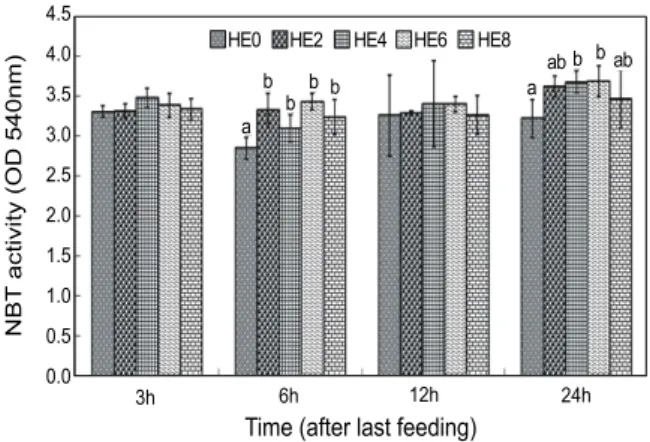
2주간의 사료공급 마지막 날 최후 사료공급을 실시한 후, 사료 내 톳․감태 혼합물이 비 특이적 면역반응에 어떠한 영향 을 미치는지 알아보기 위하여 시간대별 (먹이공급 후 3hr, 6hr, 12hr 및 24hr)로 혈액을 채취하여 NBT activity를 분석한 결과 6시간 후에서 톳․감태 혼합물을 첨가한 모든 실험구에서 대조구 보다 유의적으로 높은 활성을 보였다 (Fig 1). 24시간 후에는 4%와 6% 첨가구에서 대조구 보다 유의적으로 높은 활성을 보였으며, 다른 실험구에서는 대조구와 유의적인 차이 가 관찰되지 않았다. Kim et al. (2007)은 사료 내 두메꿀풀 열수추출액과 미생물 배양액을 사료 내 첨가하여 넙치를 대상 으로 시간대별(3hr, 24hr)로 NBT activity를 분석한 결과 3시간

Fig. 1. NBT activity of olive flounder fed the experimental diets containing 0%, 2%, 4%, 6% and 8% of alga mixtures (Hizikia:Ecklonia, 1:1). Values are presented as mean ± SD (n=3).

에서 유의적으로 높은 활성이 관찰되었고, 24시간 후에는 유

의적인 차이를 보이지 않았다고 보고하였다. 하지만 본 실험

에서는 6시간과 24시간 후 모두에서 NBT activity가 대조구

보다 유의적으로 높은 활성을 보였다. 이것은 첨가물질에 따

라서 생리활성 물질의 대사과정 시간과 그 효능이 면역반응에

미치는 효과가 다를 수 있다는 것을 의미한다. 이 연구에서

사용된 톳․감태 혼합물은 6시간과 24시간 후에 면역력을 증강

시킴으로서 다른 물질보다 더 지속적으로 면역력을 증강시키

는 것으로 판단된다. 시간에 따라 면역증강물질의 대사과정과

그 효능이 면역반응에 미치는 영향에 대한 연구는 거의 전무

한 실정이다. 하지만 이 연구에서는 시간에 따라서 면역증강

물질의 생리활성 성분이 어떻게 면역반응에 영향을 미치는지

를 시간대별로 조사함으로써 생리활성 성분의 대사과정 시간

과 효능을 보다 구체적으로 알아 볼 수 있었다. 이미 톳과

감태는 넙치를 대상으로 비특이적 면역반응을 증강시킨다고

보고되었다. Pham et al. (2006)은 넙치에서 NBT activity를

분석하여 톳의 면역증강 효과를 증명하였고, Kim and Lee

(2008)는 넙치에서 NBT activity를 분석하여 감태의 면역증강

효과를 증명하였다. 이 두 실험에서 면역증강 효과에 대한

메커니즘으로 사료 내 톳과 감태를 각각 첨가함에 따라 DPPH

radical scavenging activity 및 폴리페놀 함량과 같은 항산화

효과가 향상됨을 알 수 있었다. 톳, 감태와 같은 갈조류에는

많은 fucoidan이 존재하여 종양세포의 성장저해 (Yamamoto

et al., 1981; Cho et al., 1990) 및 항혈액응고 (Yoon et al.,

2000; Shim et al., 2002)에 효과가 있다고 보고되었으며, 해조

다당류는 대부분 카르복실기와 황산기를 많이 함유하여 유해

중금속을 비롯한 양이온과 결합하여 배출하는 효과가 있으며

(Kim et al., 2000), 장내 유해 미생물의 증식을 억제하는 동시에

유익한 균은 증식을 촉진시켜 정장효과 및 변비를 개선하는

효과 (Lee et al., 1994; Park and Lee, 1996) 그리고 항산화효과

(Park et al., 1991; Ko et al., 2002; Lim et al., 2002) 등의 다양한

생리활성이 있다고 보고되고 있다. 식물들에는 다양한 종류의

항산화물질이 존재하는데 토코페롤, 비타민 C, 카로티노이드,

(5)

플라보노이드, 폴리페놀 화합물 등이 채소와 과일 등 육상식 물에 존재하는 우수한 항산화 물질로 알려져 있다 (Larson, R.A, 1988). 톳과 감태를 비롯한 여러 종류의 해조류에서도 이러한 항산화효과에 대한 보고와 함께 이를 산업 및 의학적 으로 활용하고자 연구가 진행되고 있다 (Ruperez et al., 2002;

Haung and Wang, 2004). 본 연구에서는 사료 내 톳․감태 혼합물 을 첨가함에 따라 실험사료에서의 DPPH radical scavenging activity (Fig 2) 및 폴리페놀 함량 (Fig 3)이 농도 의존적으로 증가하였다. 따라서 톳․감태 혼합물이 넙치의 비특이적 면역 반응을 증강시킨 이유는 톳․감태 혼합물 첨가에 따른 항산화 효과와 함께 다양한 생리활성이 영향을 미쳤을 것으로 사료되 어 진다. 하지만 보다 더 구체적인 매커니즘은 장기간의 성장 실험과 톳․감태 혼합물의 생리활성 성분분석을 통한 충분한 해석이 필요할 것으로 판단된다.

Fig. 2. DPPH radical scavenging activity (DPPHRS) in the experimental diets containing 0%, 2%, 4%, 6% and 8% of alga mixtures (Hizikia:Ecklonia, 1:1). Values are presented as mean ± SD (n=3).

Fig. 3. Total polyphenolic compounds in the experimental diets supplemented with 0%, 2%, 4%, 6% and 8% of alga mixtures (Hizikia:Ecklonia, 1:1). Bars with different letters are significantly different (P≤0.05).

톳ㆍ감태 혼합물 첨가에 따라 어병세균에 대한 저항성을 알아보기 위해 실시한 공격실험 결과, 접종한지 3일 후에 급격 한 폐사를 보이고 그 이후에는 폐사하지 않았다 (Table 3).

톳ㆍ감태 혼합물이 가장 낮게 첨가된 2% 첨가구를 제외한 모든 첨가 실험구에서 대조구에 비해 초기폐사율이 유의적으 로 낮게 나타났다. Pham et al. (2006)의 연구에서 치어기 넙치 를 대상으로 사료 내 톳을 0%, 2%, 4% 및 6%를 각각 첨가하여 8주 동안 사육한 실험구에 Streptococcus iniae (10

6

CFU/mL)를 접종하여 공격실험을 수행한 결과 2%와 4% 실험구에서의 누적사망률은 대조구(0%)와 유의적인 차이를 보이지 않았으 나 (누적사망률, 33%, 33% 및 28.6%), 가장 높은 6% 첨가구에 서는 대조구 보다 유의적으로 높은 생존율을 보였다. 본 연구 에서도 이와 비슷하게 가장 낮은 2% 첨가구는 대조구와 유의 적인 차이를 보이지 않았고, 4%, 6%, 및 8% 첨가구에서는 대조구 보다 유의적으로 낮은 누적사망률을 보였다.

이 연구결과를 요약하면, 사료 내 톳ㆍ감태 혼합물의 첨가 는 톳․감태 혼합물에 포함된 생리활성 물질이 항산화 효과를 증진하여 넙치의 비 특이적 면역반응을 증강시켜 E. tarda에 대한 질병저항성을 향상시킨 것으로 사료된다. 따라서 톳․감 태 혼합물은 최근 많은 문제가 되고 있는 합성항생제를 대체 하여 어류의 면역력을 증강시킬 수 있는 천연 면역증강제로 사용 가능할 것으로 판단된다. 또한 비 특이적 면역반응과 질병저항성을 고려할 경우 가장 적절한 사료 내 첨가함량은 약 6%로 판단된다. 하지만 톳․감태 혼합물이 넙치의 성장에 미치는 효과는 사육기간이 짧은 관계로 조사되지 못했다. 이 전의 연구결과를 보면 톳의 사료 내 첨가는 넙치의 성장을 증진 시키는 경향을 보였지만, 사료 내 감태의 첨가는 넙치의 성장을 감소시켰다. 아무리 좋은 첨가제라도 성장에 부정적 영향을 끼친다면 성장에 따른 첨가함량이 고려되어야 한다.

따라서 톳․감태 혼합물의 최종적인 사료 내 첨가함량은 성장 실험에 초점을 둔 장기적인 사육실험을 실시하여 성장, 단백 질전환효율, 사료효율, 일간성장률, 먹이섭취율 등을 고려하 여 재조명 되어야 할 것으로 사료된다. 이번 연구에서는 갈조 류에 속하는 해조류인 톳․감태 혼합물을 1:1 비율로 혼합하여 사료 내에 첨가하였을 때 양식넙치의 면역력과 질병저항성을 증진시킬 수 있는 천연 사료첨가제로 사용 가능함을 보여 주었다.

사 사

본 연구는 국립수산과학원 (고효율 배합사료 개발 및 실용 화 연구, RP-2008-AQ-165)의 지원에 의해 수행되었으며, 이에 감사드립니다.

참고문헌

Alcaide E, Herraiz S and Esteve C. 2006. Occurrence of

Edwardsiella tarda in wild European eels Anguilla

anguilla from Mediterranean Spain. Dis Aquat Org,

73, 77-81.

(6)

Anderson DP and Siwicki AK. 1995. Basic haema- tology and serology for fish health programs. In: Diseases in Asian aquaculture Ⅱ. Shariff, M, JR Arthur and RP Subasinghe, eds. Asian Fisheries Society, Manila, Philippines pp. 185.

AOAC. 1995. Official methods of analysis. 16th ed.

Association of Official Analytical Chemists, Arl- ington, Virginia pp. 1298.

Athukorala Y, Kim KN and Jeon YJ. 2006. Antiproli- ferative and antioxidant properties of an enzymatic hydrolysate from brown alga, Ecklonia cava. Food and Chemical Toxicology 44, 1065-1074.

Bang JD, Chun SK, Park SI and Choi YJ. 1992. Studies on the biochemical and serological charac- teristics of Edwardsiella tarda isolated from cultured flounder, Paralichthys olivaceus. J Fish Pathol 5, 29-35.

Bu HJ, Ham YM, Kim JM, Lee SJ, Hyun JW and Lee NH. 2006. Elastase and hyaluronidase inhi- bition activities of phlorotannins isolated from Ecklonia cava. Kor J Pharmacogn 37, 92-96.

Cho KJ, Lee YS and Ryu BH. 1990. Antitumor effect and immunology activity of seaweeds toward sarcoma- 180. Bull Korean Fish Soc 23, 345- 352.

Clavijo AM, Conray G, Santander J and Aponte F. 2002.

First report of E. tarda from tilapias in Venezuela.

Bull Eur Assoc Fish Pathol 22, 280-282.

Folch J, Lee M and Sloane–Stanley GH. 1959. A simple method for the isolation and purification of total lipids from animal tissues. J Biol Chem 226, 497-509.

Garling DLJ and Wilson RP. 1976. Optimum dietary protein to energy ratio for channel catfish finger- lings, Ictalurus punctatus. J Nutr 106, 1368-1375.

Haung HL and Wang BG. 2004. Antioxidant capacity and lipophilic content seaweeds collected from the Quandao coastline. J Agric Food Chem 52, 4993- 4997.

Hong JH, Son BS, Kim BK, Chee HY, Song KS, Lee BH, Shin HC and Lee KB. 2006. Antihypertensive effect of Ecklonia cava extract. Kor J Pharmacogn 37, 200-205.

Kim JA and Lee JM. 2004. The changes of biologically functional compounds and antioxidant activities in Ecklonia cava with blanching times. Korean J Food Culture 19, 369-377.

Kim SS and Lee KJ. 2008. Effects of dietary kelp (Ecklonia cava) on growth and innate immunity in juvenile olive flounder Paralichthys olivaceus (Temminck et Schlegel). Aquac res 39, 1687-1690.

Kim SS, Galaz GB and Lee KJ and Lee YD. 2006. Effects of dietary supplementation of Spirulina and Astaxanthin for juvenile olive flounder, Paralichthys olivaceus in low temperature season. J Aquaculture 19, 57-63.

Kim YY, Lee KW, Kim GB and Cho YJ. 2000. Studies on physiochemical and biological properties of depolymerized alginate from sea tangle, Laminaria japonicus by thermal decomposition. J Kor Fish Soc 33, 393-398.

Ko MS, Shin KM and Lee MY. 2002. Effects of Hizikia fusiforme ethanol extract on antioxidative enzymes in ethanol-induced hepatotoxicity of rat liver. J Korean Soc Food Sci Nutr 31, 87-91.

Kusuda R, Itami T, Mumekiyo M and Nakajima H. 1997.

Characteristics of an Edwardsiella sp. from an epizootic of cultured crimson sea breams. Bull Jpn Soc Scient Fish 43, 129-134.

Larson RA. 1988. The antioxidants of higher plants.

Phytochemistry 27, 969-978.

Lee HA, Lee SS and Shin HK. 1994. Effect of dietary fiber source on the composition of intestinal microflora in rats. Korean J Nutr 27, 988-995.

Lim SN, Cheung PCK, Ooi VEC and Ang PO. 2002.

Evaluation of antioxidative activity of extracts from a brown seaweed, Sargassum siliquastrum. J Agric Food Chem 50, 3862-3866.

Lindsay GJH, Walton MJ, Adron JW, Fletcher TC, Cho CY and Cowey CB. 1984. The growth of rainbow

trout (Salmo gairdneri) given diets containing chitin and its relationship to chitinolytic enzymes and chitin digestibility. Aquaculture 37, 315-334.

Mayer AMS and Hamann MT. 2002. Marine pharmac- ology in 1999: compounds with antibacterial, anticoa- gulant, antifungal, anthelmintic, anti-inflammatory, antiplatelet, antiprotozoral and antiviral activities affecting the cardiovascular, endocrine, immune and nervous system, and other miscellaneous mechanisms of action. Comp Biochem Physiol Part C 132, 315-339.

Mayer AMS and Hamann MT. 2004. Marine pharmacology

(7)

620 in 2000: Marine compounds with antibacterial, anti- coagulant, antifungal, anthelmintic, anti-inflammatory, antiplatelet, antiprotozoral and antiviral activities affecting the cardiovascular, endocrine, immune and nervous system, and other miscellaneous mechanisms of action Mar Biotechnol 6, 37-52.

Mohanty BR and Sahoo PK. 2007. Edwardsiellosis in fish:

a brief review. J Biosci 32, 1331-1344.

Okai Y, Okai KH, Ishizaka S and Yamashita U. 1997.

Enhancing effect of polysaccharides from an edible brown alga, Hijikia fusiformes (Hijikia), on release of tumor necrosis factor alpha from macrophages of endotoxin-nonresponder C3H/HeJ mice. Nutr Cancer 27, 74-79.

Okai Y, Okai KH, Ishizaka S, Ohtani K, Yuasa IM and Yamashita U. 1998. Possible immunomodulating activities in an extract of edible brown algae, Hijikia fusiformes(Hijikia). J Sci Food Agric 76, 56-62.

Park EY and Lee SS. 1996. Effect of dietary fiber on the serum lipid level and bowel function in aged rats.

Korean J Nutr 29, 934-942.

Park JH, Kang KC, Baek SB, Lee YH and Rhee KS.

1991. Separation of antioxidant compounds from edible marine algae. Korean J Food Sci Technol 23, 256-261.

Park YB. 2005. Determination of nitrite-scavenging activity of seaweed. J. Korean Soc Food Sci Nutr 34, 1293-1296.

Pham MA, Lee KJ, Lee BJ, Lim SJ, Kim SS, Lee YD, Heo MS and Lee KW. 2006. Effects of dietary Hizikia fusiformis on growth and immune responses in juvenile olive flounder (Paralichthys olivaceus).

Asian-Aust. J Anim Sci 19, 1769-1775.

Ruperez P, Ahrazem O and Leal JA. 2002. Potential antioxidant capacity of sulfated polysaccharides from

the edible marine brown seaweed Fucus vesiculosus.

J Agric Food Chem 50, 840-845.

Sae-Dui D, Muroga K and Nakai T. 1984. A case of Edwardsiella tardain cultured colored carp, Cyprinius carpio. Fish Pathol 19, 197-199.

Shan BE, Yoshida Y, Koroda E and Yamashita U. 1999.

Immunomodulating activity of seaweed extract on human lymphocytes in vitro. Int. J Immunopharmaco 21, 59-70.

Shiau SY and Yu YP. 1999. Dietary supplementation of chitin and chitosan depresses growth in tilapia, Oreochromis niloticus × O aureus. Aquaculture 179, 439-436.

Shim YY, An JH, Cho WD, Chun H, Kim KI, Cho HY and Yang HC. 2002. Inhibitory mechanism of blood coagulation and in vivo anticoagulant activities of polysaccarides isolated from Codium fragile. J Korean Soc Food Sci Nutr 31, 917-923.

Skerget M, Kotnik P, Hadolin M, Hras AR, Simonic M and Knez Z. 2005. Phenols, proanthocyanidins, flavones and flavonols in some plant materials and the antioxidant activities. Food Chem 89, 191-198.

Yamamoto L, Nagumo T, Takahashi M, Fujihara M, Suzuki Y and Lizima N. 1981. Antimutagenic effect of seaweeds: Ⅲ. Antitumor effect of an extract from Sagassum. Jap J Exp Med 51, 187- 189.

Yoon JA, Yu KW, Jun WJ, Cho HY, Son YS and Yang HC. 2000. Screening of anticoagulant activity in the extracts of edible seaweeds and optimization of extraction condition. J Korean Soc Food Sci Nutr 29, 1098-1106.

2009년 9월 22일 접수

2009년 10월 22일 수정

2009년 11월 30일 수리

수치

Table  2.  The  proximate  composition  of  major  ingredients  used  in  the  experimental  diets
Table  3.  Cumulative  mortality  in  the  challenge  test  with  Edwardsiella  tarda  by  intraperitoneal  injection  in  olive  flounder  fed  the  experimental  diets  containing  0%,  2%,  4%,  6%  and  8%  of  alga  mixtures  (Hizikia:Ecklonia,  1:1)
Fig.  1.  NBT  activity  of  olive  flounder  fed  the  experimental  diets  containing  0%,  2%,  4%,  6%  and  8%  of  alga  mixtures  (Hizikia:Ecklonia,  1:1)
Fig.  3.  Total  polyphenolic  compounds  in  the  experimental  diets  supplemented  with  0%,  2%,  4%,  6%  and  8%  of  alga  mixtures  (Hizikia:Ecklonia,  1:1)

참조

관련 문서

Effects of Various Diets on Growth and Body Composition of Juvenile Olive Flounder, Paralichthys olivaceus by HaeYoung Moon Lee * and Hae-kyun Yoo (aquaculture

Stress responses such as HSP 70 and cortisol of olive flounder Paralichthys olivaceus exposed to different pH levels for 96 h.. Values with different superscript

Choi SM, Ko SH, Park GJ, Lim SR, Yu GY, Lee JH and Bai SC. Utilization of Song-Gang stone as the dietary additive in juvenile olive flounder, Paralichthys olivaceus.

Key words : Olive flounder, Paralichthys olivaceus, Emaciation, Osmoregulatory failure, Na + /K + /2Cl - (NKCC) cotransporter, Intestine.. 1990년대 들어서 일본

The pharmacokinetic properties of oxytetracycline (OTC) were studied after intramuscular injection to cultured olive flounder, Paralichthys olivaceus.. Plasma con- centrations of

Immune Response of Olive flounder Paralichthys olivaceus against Miamiensis avidus (Ciliophora: Scuticociliatida).. Sung-Ju Jung , Shin-Ichi Kitamura, Masato Aoyama, Jun-Young Song,

Effects of hypo-salinity on physiological response, survival and growth of cultured olive flounder (Paralichthys olivaceus).. Stress responses of olive flounder

A cDNA clone for CaM was isolated from a cDNA library of olive flounder Paralichthys olivaceus.. Semi-quantitative PCR analysis revealed that the CaM