769 서 론
해산어는담수어나육상동물과비교하여탄수화물에대한생 리적이용성이낮아단백질을많이이용하며이에대한의존도 가높다. 또한, 양식사료에서단백질원료의비용이차지하는비
율은약 40-70%로높기때문에단백질사료원료의선택은사
료단가에큰영향을미친다. 단백질사료원료중에서어분은높 은단백질함량과기호성으로양식사료에서가장많이사용되 어왔다. 우리나라주양식어종인넙치의경우배합사료내약
60% 정도의어분이사용되고있다. 최근국제어분의가격은
10년전대비 3배가량상승하였으며, 어분의수급부족및가 격상승으로인해어분에의존한양어용배합사료의생산은지 Article history;
Received 26 August; Revised 22 October 2013; Accepted 1 November 2013
*Corresponding author: Tel: +82. 54. 230. 3620 Fax: +82. 54. 230. 3699 E-mail address: [email protected]
Kor J Fish Aquat Sci 46(6) 769-776, December 2013 http://dx.doi.org/10.5657/KFAS.2013.0769 pISSN:0374-8111, eISSN:2287-8815
ⓒ The Korean Society of Fishereis and Aquatic Science. All rights reserved
치어기 넙치(Paralichthys olivaceus) 사료내 어분 대체원으로서 발효 대두박 이용성
김강웅*·김경덕·이봉주·이진혁·한현섭·구자완1·최윤희2·배승철3
국립수산과학원 사료연구센터, 1수협사료, 2부경대 수산과학연구원,
3부경대학교 해양바이오신소재학화/사료영양연구소
Dietary Fermented Soybean Meal as a Replacement for Fish Meal in Juvenile Olive Flounder Paralichthys olivaceus
Kang-Woong Kim*, Kyoung-Duck Kim, Bong-Joo Lee, Jin-Hyeok Lee, Hyon-Sob Han, Ja-Wan Koo1, Youn Hee Choi2 and Sungchul C. Bai3
Aquafeed Research Center, National Fisheries Research & Development Institute, Pohang 791-923, Korea
1National Federation of Fisheries Cooperatives Feed, Uiryeong, 636-801, Korea
2Institute of Fisheries Sciences, Pukyong National University, Busan, 619-911, Korea
3Department of Marine Bio-Materials and Aquaculture / FFNRC, Pukyong National University, Busan 608-737, Korea This study evaluated fermented soybean meal (FSM) as a fish meal (FM) replacement and determined the appropriate amount of FSM in juvenile olive flounder diet. Twenty-four aquaria with a flowing-water system were stocked with fish averaging 20.9 g at a density of 25 fish/tank. Five experimental diets were prepared replacing FM with 0, 10, 20, 30, or 40% FSM based on FM protein (designated FSM0, FM10, FSM20 FSM30, and FSM40, respectively). Two additional diets were prepared that replaced 30 or 40% of the FM with FSM with added amino acids (methionine and lysine) (designated FSM30+AA, and FSM40+AA, respectively). Fish (trip- licates) were fed one of the eight experimental diets (50% crude protein and 16.7 kJ available energy g-1 diet) for 8 weeks. Survival did not differ among the treatments during the feeding experiment. There were no significant differences in weight gain (WG) or specific growth rate (SGR) among the fish fed diets with up to 30% of the FM replaced. However, fish fed FSM40 or FSM40+AA had a reduced WG and SGR, as compared to FSM0 (control) (P < 0.05). The feed efficiency and apparent digestibility showed a similar trend (P < 0.05). The proximate composition in the whole body of fish differed only between the control and FSM40 for the crude protein level and between the control and FSM30+AA for the crude lipid level. The whole-body amino acid composition did not differ among treatments. No significant differences were found between the diet groups with and without amino acid supplementation, indicating that amino acid supplementation had no effect. The major finding of this study is that fermented soybean meal may replace up to 30% of fish meal without amino acid supplementation for normal growth of juvenile olive flounder.
Key words: Paralichthys olivaceus, Olive flounder, Fermented soybean meal, Replacement, Fish mea
속되기어려운상황이다(Olsen and Hasan, 2012). 대부분의어 분을수입에의존하고있는우리나라로서는큰위기가아닐수 없으며, 어분을대체할수있는단백질원료에대한연구가시 급한상태이다. 세계적으로이러한문제점을해결하기위해식 물성및동물성대체사료원료개발에대한연구를활발히진행 해오고있다(Burr et al., 2012; Collins et al., 2012; Deng et al., 2006; Luzier et al., 1995).
특히, 사료원료들중대두박은식물성단백질원으로단백질
함량이 40% 이상이고, 아미노산조성이비교적양호할뿐아
니라가격이 싸며공급이안정적이어서 많은 연구가수행되 었다. 그러나, 대두박의 경우필수아미노산조성의불균형및 phytic acid 및 trypsin inhibitor 등의항영양인자가성장을저하 시킨다고밝혀지면서대두박의생물학적이용성을높이기위 한연구가다양하게 이루어지고있다(Watanabe et al., 1988;
Dabrowski et al., 1989; Murai et al., 1989; Pongmaneerat and
Watanabe, 1993). 식물성원료내항영양인자의함량을낮추기
위한방법으로발효를통한원료이용성향상연구들이수행되 고있다(Gatlin et al., 2007). Yamamoto et al. (2010)의연구에 서는무지개송어용사료에서어분을발효대두박과콘글루테 밀로완전대체하였을때대조구와비슷한성장결과를나타내 었다고보고하였다. Lactic acid 발효는대두박내함유되어있 는 trypsin inhibitor 활성을낮추고 sucrose와비전분다당류인 raffinose 함량을떨어뜨리는것으로보고되었다(Refstie et al., 2005). 그러나, 국내넙치를대상으로한발효대두박연구는거 의없는실정이며, 이와관련된연구가시급한실정이다.
본연구에서는식물성단백질원의생물학적이용률을극대 화하고자발효시킨대두박(발효대두박)을사용하였으며, 또한 치어기넙치사료내발효대두박함량을달리하여실용배합사 료에어느정도까지어분을대체할수있는지규명하고자수 행하였다.
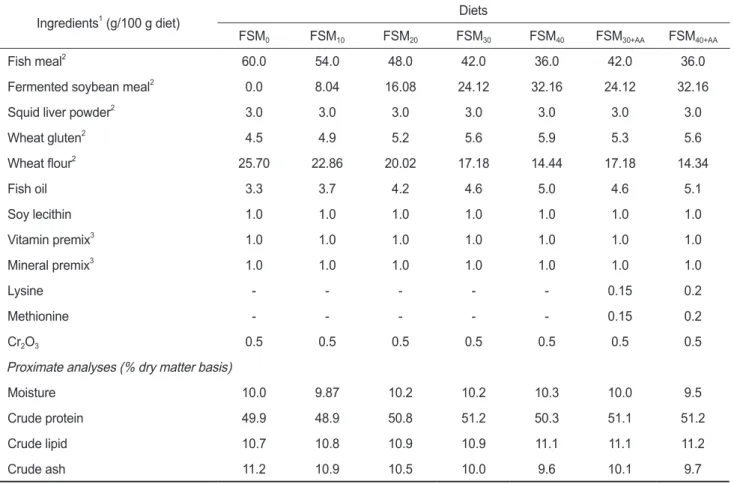
Table 1. Diet composition and proximate analysis of the experimental diets
Ingredients1 (g/100 g diet) Diets
FSM0 FSM10 FSM20 FSM30 FSM40 FSM30+AA FSM40+AA
Fish meal2 60.0 54.0 48.0 42.0 36.0 42.0 36.0
Fermented soybean meal2 0.0 8.04 16.08 24.12 32.16 24.12 32.16
Squid liver powder2 3.0 3.0 3.0 3.0 3.0 3.0 3.0
Wheat gluten2 4.5 4.9 5.2 5.6 5.9 5.3 5.6
Wheat flour2 25.70 22.86 20.02 17.18 14.44 17.18 14.34
Fish oil 3.3 3.7 4.2 4.6 5.0 4.6 5.1
Soy lecithin 1.0 1.0 1.0 1.0 1.0 1.0 1.0
Vitamin premix3 1.0 1.0 1.0 1.0 1.0 1.0 1.0
Mineral premix3 1.0 1.0 1.0 1.0 1.0 1.0 1.0
Lysine - - - - - 0.15 0.2
Methionine - - - - - 0.15 0.2
Cr2O3 0.5 0.5 0.5 0.5 0.5 0.5 0.5
Proximate analyses (% dry matter basis)
Moisture 10.0 9.87 10.2 10.2 10.3 10.0 9.5
Crude protein 49.9 48.9 50.8 51.2 50.3 51.1 51.2
Crude lipid 10.7 10.8 10.9 10.9 11.1 11.1 11.2
Crude ash 11.2 10.9 10.5 10.0 9.6 10.1 9.7
1 Feed stuffs not mentioned here are the same feed stuffs as the domestic aquaculture feed companies are using currently.
2 Provided by Suhyup Feed Co., Kyong-Nam, Korea.
3 Premix (mg/kg) : KI 250, MnSO4 H2O 2800, ZnSO4 H2O 2350, vitamin K 225, biotin (2%) 3500, niacin 4850, calcium pantothenate 11000, folic acid 2000, vitamin B1 1500, vitamin B2 2000, vitamin B6 2000 and vitamin C 50000.
재료 및 방법
실험사료
넙치실험에사용된실험사료의 사료원료와일반성분 조성 및구성아미노산은 Table 1과 2에나타내었다. 실험사료의단 백질원으로갈색어분(칠레산), 발효대두박(대만) 및오징어간 분을사용하였으며, 지질원으로어유를사용하였으며, 수협사 료에서자사제품생산을위해사용하는원료를구매하여사용 하였다. 이외에사료첨가제로서대두레시틴, 비타민및미네 랄혼합물을사용하였다. 모든실험사료의영양소함량은조단 백질 50%, 조지질 10% 전후가되도록설계하였다. 본실험의 사료원료인 발효대두박(DaBomb-P, DaBomb Protein Corp, Taiwan)은 Lactobacillus acidophilus 발효균주로가공처리되 었으며, 조단백질함량 52%, 주요항영양인자(anti-nutritional factor) 함량의경우, 트립신저해인자(trypsin inhibitor) 1 mg/g 이하, 렉틴(lectin) 41 ppm, 글라이시닌(glycinine) 7.9 g/100 g, 베타-콘글라이시닌(beta-conglycinin) 1.4 g/100 g, 유기산 3.0%로 나타났다(DaBomb Protein Corp, Taiwan). 발효 대 두박(Fermented soybean meal, FSM)을이용한어분대체효 과를조사하기위하여총 7종류의실험사료를제조하였다. 대 조구(FMS0)와 어분 단백질을 발효대두박(FSM)으로 10%, 20%, 30%, 40% 대체한실험사료 4종(FSM10, FSM20, FSM30,
FSM40)과 30%, 40% 발효대두박대체실험구(FSM30, FSM40) 에합성아미노산(methionine and lysine)을첨가한실험사료 2
종(FSM30+AA, FSM40+AA)인총 7종류의실험사료를익스트루더
(Twin extruder, ATX-Ⅱ, Fesco, Korea)를사용하여 EP사료형 태로제조하여본실험에사용하였다.
실험어 및 사육관리
실험어는평균무게 20.9±1.8 g (mean±SD)의넙치치어를 24개의 400 L polypropylene 원형수조에 25마리씩실험구별로 3반복으로무작위배치하였다. 각실험수조는유수식사육장치
로사육수가분당 20 L 가되도록흘려주었으며, 수조마다에어
를공급하였다. 사료공급은 1일 2회만복공급하였으며, 사육기 간중평균수온은 22.3±1.8℃ (17.7-25.0℃)였다.
소화율 측정
분샘플은실험실에서자체고안한분수집장치를이용하여 수집하였다. 6가지사료의외견상건물및단백질소화율측정 은산화크롬(Cr2O3) 방법(Hanley, 1987)을사용하였으며 Cho and Slinger (1979)와 Sugiura et al. (1998)의방법에의해서계 산하였다. 각영양소의소화율측정은간접방법으로지표물질 인산화크롬(Cr2O3)을이용하여사료와분의단백질을측정한 후사료와분내의산화크롬양을측정하여다음식에의하여각 Table 2. Amino acids composition (g/100 g amino acids) of the experimental diets
Amino acids (g/100g amino acids)
Diets
FSM0 FSM10 FSM20 FSM30 FSM40 FSM30+AA FSM40+AA
Alanine 6.1 5.7 5.2 5.4 5.2 5.4 5.0
Arginine 6.0 5.9 5.6 6.0 6.2 6.1 5.9
Aspartic acid 9.3 9.4 9.0 9.7 10.0 9.8 9.7
Glutamic acid 16.7 16.8 16.7 17.6 18.1 17.5 17.3
Glycine 6.0 5.6 5.1 5.3 5.1 5.3 4.9
Histidine 3.5 3.3 3.0 3.1 3.0 3.1 2.9
Isoleucine 4.5 4.4 4.2 4.5 4.5 4.5 4.4
Leucine 7.9 7.7 7.3 7.8 7.8 7.7 7.6
Lysine 8.0 7.7 7.1 7.1 7.0 7.4 7.1
Methionine 2.8 2.5 2.0 2.1 2.0 2.4 2.2
Phenylalanine 4.5 4.5 4.3 4.7 4.8 4.7 4.7
Serine 4.2 4.2 4.0 4.4 4.5 4.3 4.2
Threonine 4.5 4.3 4.0 4.1 4.1 4.1 3.9
Tyrosine 3.2 3.1 2.9 3.2 3.3 3.2 3.1
Valine 2.4 5.0 4.7 5.0 5.0 5.0 4.8
사료의단백질소화율을측정하였다.
건물소화율(%) = 100 × (사료중의 Cr2O3, % / 분중의 Cr2O3, %) 단백질소화율(%) = 100 × (사료중의 Cr2O3, % / 분중의 Cr2O3, %)
× (분중의단백질, % / 사료중의단백질, %) 어체측정 및 성분분석
어체측정은사육실험시작과종료시에측정전 48시간절식
시킨후 MS-222 100 ppm 수용액으로마취시켜수조에수용된
모든실험어의전체무게를측정하였다. 실험종료후생존율, 증 체율, 일간성장률, 사료효율, 일간사료섭취율등을조사하였다. 일반성분은실험사료와각수조별로실험어 5마리씩무작위로 샘플하여전어체를분석하였으며, AOAC (1995) 방법에따라 수분은상압가열건조법(135℃, 2시간), 조단백질은 kjeldahl 질
소정량법(N×6.25), 조회분은직접회화법으로분석하였다. 조
지질은조지질추출기(Velp SER148, Italy)를사용하여 ether로 추출한후, 측정하였다. 구성아미노산분석은시료 0.5 g을정
량하여시험관에넣고 6 N-HCl 15 mL를가하여감압밀봉한
후 110℃의 dry oven에서 24시간이상동안산가수분해시켰 다. Glass filter로분해액을여과하고얻은여액을 55℃에서감 압농축하여염산과물을완전히증발시킨다음, 농축된시료
를 sodium citrate buffer (pH 2.20)로 25 mL 정용플라스크에 정용하여 0.45 μm membrane filter로여과한시료액을아미 노산자동분석기(Biochrom 30, Biochrom Ltd., England)를 사용하여다음과같은조건으로분석하였다. Cation separation column (oxidised feedstuff column, 4.6 mm×200 mm)을사 용하였고 0.2 M sodium citrate buffer (pH 3.20, 4.25)와 1.2 M sodium citrate buffer (pH 6.45) 및 0.4 M sodium hydroxide solution을이동상으로사용하였다. 이동상의유속은 0.42 mL/
min, ninhydrin 용액의유속은 0.33 mL/min, column 온도는 48-95℃, 반응온도는 135℃로조절하여분석하였다. 통계처리
결과의통계처리는 SPSS program (Version 11.0)을사용하여 One-way ANOVA test를실시한후, Duncan’s multiple range test (Duncan, 1955)로평균간의유의성을검정하였다(유의수 준, P < 0.05).
결과 및 고찰
치어기넙치사료의조단백질함량및아미노산조성은대조 구와비교하여유사한수준을보였으며(Table 1 and 2), 이는 Table 3. Growth performance of olive flounder Paralichthys olivaceus fed the experimental diets for 8 weeks1
Diets Pooled
SEM10
FSM0 FSM10 FSM20 FSM30 FSM40 FSM30+AA FSM40+AA
IW2 21.0 20.9 20.9 21.0 20.9 21.0 20.8 0.81
FW3 98.9ab 109a 98.6ab 99.8ab 85.6c 93.8b 84.6c 2.11
WG4 372ab 421a 371ab 377ab 309c 347ab 306c 6.68
SGR5 2.59ab 2.74a 2.58ab 2.60ab 2.34c 2.49b 2.34c 0.09
FE6 120a 114ab 114ab 106b 96.4c 107b 98.7c 1.45
PER7 2.41a 2.34a 2.23ab 2.07b 1.91c 2.09bc 1.93c 0.09
DFI8 2.16 2.40 2.27 2.45 2.42 2.33 2.37 0.05
Survival9 100 97.3 98.7 93.3 94.0 97.3 97.3 1.26
1 Means of triplicate groups; Values in the same row with different superscripts are significantly different (P < 0.05).
2IW: Initial weight (g/fish)
3FW: Final weight (g/fish)
4WG: Weight gain (%) = (final wt - initial wt) × 100 / initial wt
5SGR: Specific growth rate (%/day) =〔(loge final wt - loge initial wt) / days〕×100
6FE: Feed efficiency (%) = (wet weight gain / dry feed intake) × 100
7PER: Protein efficiency ratio = wet weight gain / protein intake
8DFI: Daily feed intake (%) = Total dry feed intake × 100/{(initial wt. + final wt. + dead fish wt.)/2} × days fed.
9Survival (%) =Number of fish at end of experiment / Number of fish stocked × 100
10 Pooled standard error of mean: SD/√n.
사료내발효대두박으로인한성장이나아미노산중한가지또 는그이상이결핍되었을때나타나는증상은없는것으로판 단된다.
치어기넙치를대상으로 8주동안사료내어분대체원으로 서발효대두박의사육효과실험결과는 Table 3에나타내었다.
생존율은 93-100%로높은생존율을보였으며, 모든실험구에
서유의한차이가없었다(P>0.05). 증체율, 일간성장률및사 료효율은 FSM10, FSM20, FSM30 및 FSM30+AA실험구가 대조
구와비교하여 유의적인차이를보이지않았으며, FSM40및
FSM40+AA실험구는대조구보다유의하게낮은값을나타내었
다(P<0.05). 단백질전환효율은 FSM10및 FSM20 실험구가대조 구와비교하여유의적인차이가없었으며, 발효대두박 FSM30
및 FSM30+AA, FSM40 및 FSM40+AA실험구는대조구에비해유
의하게 낮았다(P<0.05). 일일사료섭취율은 모든 실험구에서
유의한차이가보이지않았다(P>0.05). 발효대두박첨가수준 에따라합성아미노산을보충한실험구들(FSM30 및 FSM30+AA,
FSM40및 FSM40+AA)의비교에있어서도증체율, 일간성장율
및사료효율등의유의적인차이는없었다(P>0.05). 이상의성 장결과를바탕으로판단하였을때, 넙치치어용사료에서어분 의 30%까지발효대두박으로대체가능할것으로보이며, 합성 아미노산첨가에따른성장및사료효율개선효과는없는것으 로나타났다.
일반적으로 식물성보다는 육식성 어류에서 사료내 식물성 원료의이용성이낮은 것으로보고되었다(Olsen and Hasan,
2012). 이는육식성어류가식물성원료에존재하는항영양인자
에보다민감하게반응하는것을나타내고있으며, 영양소흡수 와이용성을저하시키는것으로보고되고있다(Wee and Shu,
1989). 이전의연구에서대두박에의한어분대체율은조피볼
락(Lim et al., 2004), 방어(Shimeno et al., 1993), 쥐노래미(Lee and Lee, 1998)에서 10-30% 범위였으며, 넙치치어용사료에 서는사료내어분단백질의 20%까지탈피대두박으로대체할 수있었다(Choi et al., 2004). 식물성원료의이용성을높이기 위한방안으로발효를포함한사료가공법이있으며 (Gatlin et
al., 2007), 국내양식용어류를대상으로한연구는많지않은
편이다. Lim et al. (2010)의연구에서는 30%의어분단백질을 Aspergillus oryzae로발효시킨면실박과대두박으로대체할경 우넙치의성장이떨어진다고보고하였다. 반면본연구에서는 어분단백질 30% 대체(Lactobacillus acidophilus 발효대두박) 수준에서도유의적인성장감소가나타나지않았다. 따라서, 적 정발효균주의선택은식물성단백질원료의이용성을향상시 킬수있을것으로보이며, 발효과정중항영양인자의유의적인 감소에의해영양소흡수및이용성이향상된것으로판단된다. 특히본연구에서사용한발효대두박은항영양인자인 trypsin inhibitor (TI)가 1 mg/g이하로나타났으며, 이는양어용배합사 료로사용하는탈지대두박의 TI 수준인 1-3 mg/g보다도낮은 값을보여본연구의결과를뒷받침하고있다.
대두박을어분대체단백질원으로사용할때고려해야할것 은제한적인필수아미노산조성을들수있는데(NRC, 1993), 대두박의대체수준이높을수록사료내특정아미노산(제한아 미노산)의불균형으로어류의성장이저하된다고보고되고있 다(Jackson et al., 1982; Murai et al., 1989). 최근많은어종을 대상으로식물성단백질에의한어분대체연구가활발이이루 어지고있으며, 식물성원료의이용성을높이기위한방안으로 제한아미노산인 methionine 및 lysine을보충하여대체율향 Table 4. Apparent dry matter digestibility (AD) and apparent
protein digestibility (APD) of olive flounder Paralichthys olivaceus fed the experimental diets for 8 weeks1
Diets AD (%) APD (%)
FSM0 85.0a 94.2a
FSM10 84.2a 93.6a
FSM20 83.1a 93.1a
FSM30 82.2ab 92.5ab
FSM40 78.7c 90.9b
FSM30+AA 82.6ab 92.8ab
FSM40+AA 80.5b 91.3b
Pooled SEM2 0.66 0.68
1 Values (mean of triplicates) in the same column with different superscripts are significantly different (P < 0.05).
2 Pooled standard error of mean: SD/√n.
Table 5. Proximate composition of whole body in flounder Paralichthys olivaceus fed the experimental diets for 8 weeks1
Diets Moisture
(%) Crude
protein (%) Crude lipid
(%) Ash (%)
FSM0 74.9 18.5a 3.1a 3.3
FSM10 74.9 18.3a 3.2a 3.3
FSM20 75.1 18.5a 3.3a 3.4
FSM30 74.3 18.2a 3.0a 3.5
FSM40 74.2 17.5b 2.9a 3.3
FSM30+AA 75.3 18.3a 2.5b 3.3
FSM40+AA 75.2 18.1ab 3.0a 3.3
Pooled
SEM2 0.15 0.11 0.07 0.04
1 Values (mean of triplicates) in the same column with different superscripts are significantly different (P < 0.05).
2 Pooled standard error of mean: SD/√n.
상연구들이수행되고있다(Collins et al., 2012; Cheng et al., 2013; Deng et al., 2006; Murai et al., 1982; Shiau et al., 1988).
치어기넙치를대상으로사료내탈피대두박을사용하여어분 단백질의 20%까지대체하고, 합성아미노산(methionine and lysine)을첨가할경우어분단백질의 30%까지대체할수있다 고보고되었다(Choi et al., 2004). 그러나사료내제한아미노산 을보충하여도성장개선효과가없다는연구보고도있다(Mu- rai et al., 1982; Andrew and Page, 1974; Lim and Dominy, 1989).
실험사료의 외견상 소화율(AD)과 외견상 단백질 소화율 (ADP)은 Table 4에나타내었다. 외견상소화율및단백질소 화율은각각 78.7-85.0% 과 90.9-94.2% 범위였으며, FSM10,
FSM20, FSM30 및 FSM30+AA실험구는대조구와비교하여유의
적차이가없는반면에 FSM40 및 FSM40+AA 실험구는대조구보
다유의적으로낮은소화율가를나타내었다(P<0.05). 실험사료 의소화율은사료내발효대두박함량이증가함에따라낮아지 는경향을보였으며, 합성아미노산의첨가에따른소화율증 가는나타나지않았다. 본연구에서단백질소화율가는 90.9- 94.2% 범위였으며, Choi et al. (2004)의연구에서보고된단백
질소화율가(86.3%-93.7%) 보다높은값을보였다. 이결과는 실험에사용된대두박원료에의한것으로보이며, 본연구에서 사용된대두박의발효과정중미생물에의한이용및효소작용 을통해고분자단백질이저분자의폴리펩티드형태로분해되 어원료내단백질소화율가가높아진것으로사료된다(Ong et al., 2006).
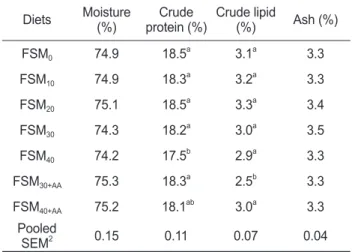
사육실험종료후, 실험사료를섭취한치어기넙치의전어체
일반분석 결과는 Table 5에 나타내었다. 조단백질 함량은
FSM40 실험구를제외한모든실험구에서대조구와 비교하여
유의적인 차이를나타내지 않았다. 조지질함량은 FSM30+AA
실험구를제외한모든실험구에서유의적인차이를나타내지 않았다.
실험사료를섭취한치어기넙치의구성아미노산분석결과는
Table 6에나타내었다. 본실험에서전어체구성아미노산함
량은 92.4-94.6 g/100 g amino acids로나타났으며, 각실험구 들사이의구성아미노산사이에는유의차가나타나지않았다 (P>0.05). 따라서, 아미노산의결핍에의한성장저해등의여러 요소들을배제할수있을것으로생각된다.
따라서본실험의결과를토대로치어기넙치에있어서어분 Table 6. Amino acid contents of whole body in flounder Paralichthys olivaceus fed the experimental diets for 8 weeks1
Amino acids (g/100g amino
acids)
Diets Pooled
FSM0 FSM10 FSM20 FSM30 FSM40 FSM30+AA FSM40+AA SEM
Alanine 7.0 7.3 7.2 7.1 7.1 7.2 7.3 0.03
Arginine 6.7 6.8 6.6 6.5 6.5 6.7 6.7 0.04
Aspartic acid 10.3 9.9 10.0 10.2 9.9 10.1 9.9 0.07
Glutamic acid 14.6 14.6 14.6 14.7 14.2 14.6 14.5 0.01
Glycine 7.5 8.1 7.6 7.2 7.4 7.7 7.9 0.06
Histidine 2.2 2.2 2.3 2.3 2.2 2.3 2.4 0.02
Isoleucine 4.3 4.3 4.3 4.4 4.2 4.3 4.3 0.05
Leucine 7.8 7.7 7.7 7.9 7.7 7.8 7.7 0.06
Lysine 9.3 9.3 9.3 9.3 9.0 9.2 9.2 0.04
Methionine 2.7 2.8 2.9 2.8 2.8 2.8 2.7 0.02
Phenylalanine 4.3 4.3 4.2 4.3 4.2 4.2 4.2 0.02
Serine 4.5 4.5 4.5 4.6 4.7 4.5 4.5 0.02
Threonine 4.5 4.4 4.4 4.5 4.3 4.4 4.5 0.06
Tyrosine 3.4 3.4 3.4 3.4 3.3 3.4 3.3 0.06
Valine 5.0 5.0 5.1 5.0 4.8 5.0 5.1 0.04
Total AA 94.1 94.6 94.1 94.2 92.3 94.2 94.2
1 Values (mean of triplicates) in the same column with different superscripts are significantly different (P < 0.05).
2 Pooled standard error of mean: SD/√n
대체원으로서발효대두박은합성아미노산의보충없이어분단 백질의 30%까지대체가가능할것으로보이며, 앞으로발효효 소의가공처리조건에따른발효대두박의이용성에대한연구 가추가적으로진행되어야할것이다.
사 사
이연구는국립수산과학원 (친환경실용배합사료개발및품 질관리연구, RP-2013-AQ-159)의지원에의해수행되었으며, 이에감사드립니다.
References
Andrews JW and Page JW. 1974. Growths factors in the fish- meal component of catfish diets. J Nutr 104, 1091-1096.
AOAC (Association of Official Analytical Chemists). 1995. Of- ficial methods of analysis. 16th ed. Association of Official Analytical Chemists. Arlington, VA.
Burr GS, Wolters WR, Barrows FT and Hardy RW. 2012.
Replacing fishmeal with blends of alternative proteins on growth performance of rainbow trout (Oncorhynchus mykiss), and early or late stage juvenile Atlantic salmon (Salmo salar). Aquaculture 334-337, 110-116. http://dx.doi.
org/10.1016/j.aquaculture.2011.12.044.
Cheng ZJ, Hardy RW and Usry JL. 2003. Effects of lysine supplementation in plant protein-based diets on the perfor- mance of rainbow trout (Oncorhynchus mykiss) and appar- ent digestibility coefficients of nutrients. Aquaculture 215, 255–265.
Cho CY and Slinger SJ. 1979. Apparent digestibility measure- ment in feedstuffs for rainbow trout. In: Halver, JH, Tiews K, (Eds.), Finfish Nutrition and Fishfeed Technology, Vol.
Ⅱ. Heenemann, Berlin, 239- 247.
Choi SM, Wang XJ, Park GJ, Lim SR, Kim KW, Bai SC and Shin IS. 2004. Dietary dehulled soybean meal as a replace- ment for fish meal in fingerling and growing olive flounder, Paralichthys olivaceus. Aquac Res 35, 410-418.
Collins SA, Desai AR, Mansfield GS, Hill JE, Kessel AGV and Drew MD. 2012. The effect of increasing inclusion rates of soybean, pea and canola meals and their protein concen- trates on the growth of rainbow trout: Concepts in diet for- mulation and experimental design for ingredient evaluation.
Aquaculture 344-349, 90-99. http://dx.doi.org/10.1016/j.
aquaculture.2012.02.018.
Dabrowski K, Poczyczynski P, Kock G and Berger B. 1989. Ef- fect of partially or totally replacing fish meal protein by soy- bean meal protein on growth, food utilization and proteo- lytic enzyme activities in rainbow trout (Salmo gairdneri).
New in vivo test exocrine pancreatic secretion. Aquaculture 77, 29-49.
Deng J, Mai K, Ai Q, Zhang W, Wang X, Xu W and Liufu Z.
2006. Effects of replacing fish meal with soy protein con- centrate on feed intake and growth of juvenile Japanese flounder, Paralichthys olivaceus. Aquaculture 258, 503-513.
Gatlin DM, Barrows FT, Brown P, Dabrowski K, Gaylord TG, Hardy RW, Herman E, Hu G, Krogdahl A, Nelson R, Over- turf K, Rust M, Sealey W, Skonberg D, Souza EJ, Stone D, Wilson R and Wurtele E. 2007. Expanding the utiliza- tion of sustainable plant products in aquafeeds: A review.
Aquac Res 38, 551–579. http://dx.doi.org/10.1111/j.1365- 2109.2007.01704.x.
Hanley F. 1987. The digestibility of foodstuffs and the effects of feeding selectivity on digestibility determinations in Tilapia (Oreochromis niloticus L.). Aquaculture 66, 163-179 Jackson AJ, Capper BS and Matty AJ. 1982. Evaluation of some
plant proteins in complete diets for the tilapia Sarotherodon massambicus. Aquaculture 27, 97-109.
Lee JK and Lee SM. 1998. Evaluation of soybean meal or feath- er meal as a partial substitute for fish meal in formulated diets for fat cod. J Aquacult 11, 421-428.
Lim C and Dominy W. 1989. Utilization of plant proteins by warm water fish. Proceedings of world congress on Vegeta- ble Protein Utilization in human food and animal feedstuffs:
2445-251. American Oil Chemists Society, Champaign, Il- linois.
Lim SJ, Kim SS, Pham MA, Song JW, Cha JH, Kim JD, Kim JU and Lee KJ. 2010. Effects of fermented cottonseed and soy- bean meal with phytase supplementation on gossypol deg- radation, phosphorus availability, and growth performance of olive flounder (Paralichthys olivaceus). Fish Aquat Sci 13, 284-293.
Lim SR, Choi SM, Wang XJ, Kim KW, Shin IS, Min TS and Bai SC. 2004. Effects of dehulled soybean meal as a fish meal replacer in diets for fingerling and growing Korean rockfish, Sebastes schlegeli. Aquaculture 231, 457-468.
Luzier JM, Summerfelt RC and Ketola HG. 1995. Partial re- placement of fish meal with spray-dried blood powder to reduce phosphorus concentrations in diets for juvenile rain- bow trout, Oncorhynvhus mykiss (Walbaum) Aquac Res 26, 577-587.
Murai T, Ogata H and Nose T. 1982. Methionine coated with various materials supplemented to soybean meal diet for fin- gerling carp Cyprinus carpio and channel catfish Ictalurus punctatus. B Jpn Soc Sci Fish 48, 85-88.
Murai T, Ogata H, Villaneda A and Watanabe T. 1989. Utiliza- tion of soy flour by fingerling rainbow trout having different body size. Nippon Suisan Gakk 55, 1067-1073.
NRC (National Research Council). 1993. Nutrient requirements of warm water fishes and shellfishes. National Academy Press, Washington, DC, USA.
Olsen RL and Hasan M. 2012. A limited supply of fishmeal:
Impact on future increases in global aquaculture produc- tion. Trends Food Sci Tech 27, 120-128. http://dx.doi.
org/10.1016/j.tifs.2012.06.003.
Ong L, Henriksson A and Shah NP. 2006. Development of pro- biotic Cheddar cheese containing Lactobacillus acidophilus, Lb. casei, Lb. paracasei and Bifidobacterium spp. and the influence of these bacteria on proteolytic patterns and pro- duction of organic acid. Int Dairy J 16, 446-456.
Pongmaneerat J and Watanabe T. 1993. Effect of extrusion pro- cessing on the utilization of soybean meal diets for rainbow trout. Nippon Suisan Gakk 59, 1407-1414.
Refstie S, Sahlstrom S, Brathen E, Baeverfjord G and Krogedal P. 2005. Lactic acid fermentation eliminates indigestible car- bohydrates and antinutritional factors in soybean meal for Atlantic salmon (Salmo salar). Aquaculture 246, 331-345.
Shiau SY, Pan BS, Chen S, Yu HL and Lin SL. 1988. Success- ful use of soybean meal with a methionine supplement to replace fish meal in diets fed to milkfish Chanos chanos For- skal. J World Aquacult Soc 19, 14-19.
Shimeno S, Mima T, Yamamoto O and Ando Y. 1993. Effects of fermented defatted soybean meal in diet on the growth, feed conversion, and body composition of juvenile yellowtail.
Nippon Suisan Gakk 59, 1883-1888.
Watanabe T, Shuichi S and Toshio T. 1988. Availability of min- eral in fish meal to fish. Asian Fish Sci 1, 175-195.
Wee KL and Shu SW. 1989. The nutritive value of boiled full- fat soybean in pelleted feed for Nile tilapia. Aquaculture 81, 303-312.
Yamamoto T, Iwashita Y. Matsunari H, Sugita T, Sugita T, Fu- ruita H, Akimoto A, Okamatsu K and Suzuki N. 2010. In- fluence of fermentation conditions for soybean meal in a non-fish meal diet on the growth performance and physi- ological condition of rainbow trout Oncorhynchus mykiss.
Aquaculture 309, 173-180. http://dx.doi.org/10.1016/j.aqua- culture.2010.09.021.