785
양식산 넙치( Paralichthys olivaceus)의 식품학적 품질 개선에 버섯추출물이 미치는 영향
심길보·김지회·윤호동·최혜승1✽·조영제2
국립수산과학원 식품안전과, 1국립수산과학원 병리연구과, 2부경대학교 식품공학과
The Effect of Mushroom Extract as a Dietary Additive on the Nutritive Quality of Cultured Olive Flounder
Paralichthys olivaceus
Kil Bo Shim, Ji Hoe Kim, Ho Dong Yoon, Hae Seung Choi
1✽and Young Je Cho
2Food and Safety Research Division , National Fisheries Research and Development Institute, Busan 619-705, Korea
1Aquatic Life Disease Control Division , National Fisheries Research and Development Institute, Busan 619-705, Korea
2Department of Food Science and Technology, Pukyung National University, Busan 608-737, Korea
This study investigated the nutritive quality of olive flounder
Paralichthys olivaceus
fed either moist pellet (MP) or moist pellet mixed with mushroom extract (MPME) for 6 months. There was no significant difference in crude pro- tein or extractive nitrogen in the muscle of flounder fed MP versus MPME (P
> 0.05). The total amino acid content in the muscle of flounder fed MP was 15.22±5.24 g/100 g, compared to 19.90±2.90 g/100 g for flounder fed MPME.Essential amino acid content was 7.04±2.21 g/100 g in the muscle of flounder fed MP versus 8.94±2.50 g/100 g for MPME. Total amino acid content was higher in the muscle of olive flounder fed MPME, while essential amino acid content was higher in flounder fed MP. The ratio of non-essential amino acids to essential amino acids was 0.86±
0.07 for flounder fed MP and 0.81±0.08 for flounder fed MPME. There was no significant difference in free amino acid content and fatty acid composition. The breaking strength of muscle of olive flounder fed MP was higher (1.44±
0.51 kg/cm2) than in flounder fed MPME (1.29±0.30 kg/cm2). There was no evidence that dietary additives, such as mushroom extract, increase growth rate or nutritive quality of olive flounder.
Key words: Moist pellet, Moist pellet mixed mushroom extract, Olive flounder, Nutritive quality
서 론
우리나라 넙치 양식은 1980년초 인공종묘 생산기술이 개발 된 이후 생산량과 생산금액이 지속적으로 상승하고 있으며, 연 평균 생산량 증가율은 16.2%, 생산금액 증가율은 12.4%를 차지 하고 있다(Hwang and Myeong, 2010). 특히 양식넙치 생산량은 양식 생산량의 4.2%, 양식 생산금액의 29.6%, 양식어류 생산량 의 49.9%로 매우 큰 비중을 차지하고 있다. 넙치는 육상에서 양 식할 수 있어 관리가 비교적 용이하며, 종묘입식부터 14개월이 후에는 상품크기로 성장이 가능하여 성장이 빠르고 육질과 맛이 좋아 고급어종으로 인정받고 있다.
어류 양식의 급속한 발달과 더불어 어류의 성장을 목적으로 한 관점에서 섭이 사료에 대한 영양성분, 사료효율 그리고 기능 성 등에 대한 필요성이 인식되어 왔다(Cho, 2011). 또한 양식과
정 중에 발생되는 질병에 대한 대책으로서 예방보다 항생제 및 화학요법제 등을 사용한 치료에 의존하고 있어 어류의 약제에 대한 내성을 증가시키며 어류의 성장도 저하와 스트레스의 요인 으로 작용하여 오히려 외부 병원체에 대한 면역력을 감소시킬 뿐만 아니라 환경오염 우려와 소비자들이 양식어류에 대한 불신 감을 제기시키고 있으며, 항생제 사용은 수출용 활어의 식품 안 전성에 위협을 주고 있다.
따라서 이러한 문제를 해결하기 위해서 천연물 중 항균력과 면역증강효과 등이 입증된 물질을 양식어류에 투여함으로 어체 의 내병성 증강 뿐만 아니라 사료효율과 성장촉진 그리고 식품 학적 품질을 향상시킬 수 있는 효율적인 기능성 물질의 개발이 절실히 요구된다. 최근 여러 가지 천연물에 기원한 유용물질을 양식어류에 첨가하여 어체의 생리적 기능이 향상된 연구가 보고 되고 있으며, 배합사료와 습사료를 공급한 넙치 근육의 품질 특 성(Kim et al., 2010)과 생약제, 송강약돌, 녹차, 고추냉이 추출 물, 크릴, 겔프 등을 배합사료 첨가제로 그 효능을 연구된 바 있
*Corresponding author: choihs@nfrdi. go.kr
<단보>
법, 조단백질은 semi-micro Kjeldahl법, 조지방은 Soxhlet 추출 법, 조회분은 건식회화법으로 각각 측정하였다(AOAC, 1995).
엑스분 질소함량은 Hoyle et al. (1994)에 의한 trichloroacetic acid (TCA)법으로 측정하였다.
총아미노산 함량 분석
시료 150 mg을 6 N-HCl로써 110℃의 heating block에서 24 시간 가수분해하였다. 시료용액을 감압 건고 시킨 후, pH 2.2 의 구연산 완충액으로 50 mL로 정용하여 0.20 µm membrane filter로 여과하여 아미노산 분석기(Hitachi 835, Hitachi, Japan) 를 이용하여 분석하였다.
유리아미노산 함량 분석
시료 5 g을 정확하게 취한 후 75% ethanol를 25 mL를 넣고 6시간 교반하여 준 다음 원심분리 (3,000×g, 15 min)하여 상 층액을 취하였다. 이 때, 상층액의 색이 무색이 될 때까지 75%
ethanol을 첨가하여 원심분리하였다. 이 상층액에서 ethanol을 완전히 제거시키기 위해 감압농축 후 탈이온수로 정용하고, 5 mL을 취하여 5'-sulfosalicylic acid 250 mg을 넣고 잘 혼합하 여 균질화시켜 제단백시킨 후 원심분리(3,000×g, 15 min)하여 얻은 상층액을 0.20 µm membrane filter로 여과한 다음 lithium citrate buffer (pH 2.2)로 일정량 희석하여 아미노산 자동분석기 (Sykam Amino acid analyzer S433, Sykam, Germany)로 분석 하였다.
지방산 분석
활어의 근육을 세절한 다음 Folch et al. (1957)의 방법에 의 하여 시료의 5배량의 chloroform : methanol (2:1 v/v)용액으 로 지질을 추출한 후, 14 % BF3-methanol을 이용하여 지방산 의 methyl ester하여, gas chromatography (Hewlett packard 6890A, Hewlett packard, USA)로써 분석하였다.
근육의 파괴강도
Ando et al. (1991)의 방법에 따라 어육을 일정크기로 절단하 여(20×20×10 mm3), 직경 8 mm cylinder plunger를 사용한 Rheometer (Compac-100, Sun, Japan)로 측정하였다.
통계처리
통계 처리는 SAS 프로그램을 이용한 분산분석표를 작성하 였으며, Duncan의 다중범위검정(Duncan's multiple range test) 다(Kim et al., 1998; Choi et al., 2004; Cho et al,. 2006; Seo et
al., 2009; Seo et al., 2010). 또한 이런 유용물질은 고밀도사육 에 의한 생산성 저하를 예방하고 내병성을 높이기 위한 건강한 어류의 안정적인 확보뿐만 아니라, 화학요법제가 축적되지 않은 어류 생산을 위해 면역증강을 위한 첨가제의 개발이 지속적이고 집중적인 연구를 통해 체계적으로 이루어지고 있다(Anderson, 1992; Sakai, 1999). 따라서 본 연구에서는 일반 습사료와 버섯 추출물을 혼합한 습사료가 양식산 넙치의 식품학적 품질에 미치 는 영향을 조사하고자 하였으며, 이들 통해 양식수산물의 이미 지 개선과 소비촉진을 위한 기능성 양식산 넙치 개발의 기초자 료로 활용하고자 하였다.
재료 및 방법
실험사료 제작
어분 20%와 생사료 80%를 혼합하는 배합공정을 거쳐 어류 가 먹을 수 있는 크기로 제작한 습사료(MP)와 경남 진주시 소재
㈜바이오허브에서 판매되고 있는 버섯추출물(영지, 표고, 느타 리 버섯 발효추출물, 유산균, 베타글루칸)이 함유되어 있는 바이 오허브1000과 글루타엠씨를 각각 2.5%와 1.0%를 첨가한 습사 료(이하 MPME)를 제작하였다.
실험어
실험에 사용된 넙치는 2009년 9월에 충청남도 태안군에 위 치한 종묘배양장에서 구입하여 경상남도 통영시 사량면 내지 소 재 안국수산으로 운반하여 배합사료(EP)를 투여하면서 예비 사 육하였다.
실험과정
실험구별로 수조 2개 (가로 16.7 m×세로 17.6 m×수심 0.7 m (205.7 m3), 가로 12 m×세로 12 m×수심 0.7 m (100.8 m3)) 에 각각 12,000 마리 및 4,000마리를 수용하였다. 실험구와 대 조구에 실험사료와 대조사료를 1일 1-2회 (오전, 오후) 같은 조 건으로 만복 공급하였다.
시험기간은 2010년 7월부터 12월까지(6개월) 사육하여 출하 단계 크기가 되는 11월과 12월의 2회에 넙치를 채취하였으며, 사용된 시료의 평균 전장, 전중 등은 Table 1과 같다.
일반성분 및 엑스분 질소 함량 분석
일반성분의 측정방법으로 수분은 105℃에서 상압가열 건조
Feed Body weight (g) Body length (cm) Body depth (cm) Body thick (cm)
Moist pellet 751.60±192.01 38.90±3.38 2.21±0.51 18.00±1.55
Moist pellet mixed mushroom extract 666.10±144.59 37.85±2.75 2.04±0.53 17.55±1.21
Table 1. The profile of olive flounder P. olivaceus fed moist pellet and moist pellet mixed mushroom extract for six month
Results are means±SD. 1) Different superscripts within a same column are significantly different by Duncan's multiple range at P<0.05.
의 수분함량은 75.89±0.54 g/100 g이었으며, MPME를 섭이 시킨 넙치 근육의 수분함량은 75.95±0.86 g/100 g이었다. 또 한 사료별에 따른 조지방과 회분함량은 MP를 섭이시킨 넙치근 육에서 각각 1.96±0.50 g/100과 1.17±0.15 g/100 g, MPME 를 섭이시킨 넙치근육에서는 각각 2.14±0.65 g/100 g, 1.37±
1.00 g/100 g이었으며, 사료에 따른 넙치근육의 수분, 조지방, 회분 함량은 유의적인 차이가 없었다(P>0.05). 그러나 조단백 질 함량은 MP를 섭이시킨 넙치근육에서 21.53±0.53 g/100 g, MPME를 섭이시킨 넙치 근육에서는 21.17±0.49 g/100 g으로 MP를 섭이시킨 넙치근육의 조단백질 함량보다는 다소 낮았다 (P<0.05). 그리고 어패류의 정미성분에 중요한 역할을 하는 함 질소 엑스성분 함량은 사료별로 각각 311.67±16.57 mg/100 g, 307.43±15.57 mg/100 g으로 유의적인 차이가 없었다 (P>0.05).
Kim et al. (2010)은 배합사료(EP)와 습사료(MP)를 공급한 넙치 근육에서의 일반성분 중 조지방 함량만이 차이가 나타났으 며, 넙치 성장별 사료내 지질 함량과 운동량에 따라 근육 내 지 질 축적과 밀접한 관계가 있다고 보고하였다. 또한 사료에 게박 을 첨가 식이시킨 넙치는 수분을 제외하고는 유의적인 차가 없 으며, 대서양연어에 게박 (5-14%) 첨가식이로 대체하였을 때 먹이 섭식률과 단백질 효율이 우수하다고 보고하였다(Lyons et al., 2001), 또한 향기 첨가제로써 오징어와 크릴 포함한 사료를 섭이시 노란민어의 섭식율을 증가시켰다는 보고(Gould et al., 2003) 등은 급이 사료의 섭식률과 성장률을 높이는 것으로 영양 적인 효과는 크지 않다고 판단되었다. 또한 양식어류의 성장 및 품질 개선을 위하여 사료 등에 고추냉이추출물, 키토산 첨가물, 김분말 등 각종 첨가제들의 효능을 연구자들은 수분 등이 다소 차이가 있으나 기타 일반성분의 유의적인 차이가 없다고 보고하 고 있다(Seo et al., 2009; Kim et al., 1998; Satoh et al., 1987).
또한 손바닥선인장, 프로폴리스, 젖산균, γ-poly-glutamic acid, 양파추출물, 유기유황, 바이오스톤, 무화과추출물 등을 어분에 첨가하여 6주 동안 넙치에 섭이시킨 결과, 일반 성분은 유의적 인 차이가 없었다(Cho, 2011).
총 아미노산 및 유리아미노산 함량 비교
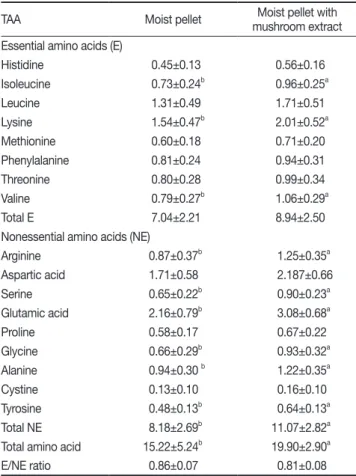
MP와 MPME를 섭이시킨 넙치 근육의 총 아미노산은 tryp- tophan을 제외한 17개가 분석되었으며, 사료별 넙치 근육의 총 아미노산 전체 함량은 각각 15.22±5.24 g/100 g (MP), 19.90
±2.90 g/100 g (MPME)이었으며, MPME를 섭이시킨 넙치 근 육에서 총 아미노산 함량이 다소 높았다(Table 3, P<0.05). 그 으로 P<0.05에서 결과간의 유의성을 검정하였다(Steel and Tor-
ries, 1980).
결과 및 고찰
일반성분 및 엑스분 질소 함량 비교
습사료(MP)와 버섯추출물 혼합습사료(MPME)를 6개월 동 안 섭이시킨 넙치 근육의 일반성분과 엑스분 질소 함량을 Table 2에 나타내었다. 사료별 수분함량은 MP를 섭이시킨 넙치 근육
Table 2. The proximate composition and extractive nitrogen content (g/100 g) on muscle in olive flounder P. olivaceus fed moist pellet and moist pellet mixed mushroom extract for six month
Results are means±SD (n=10). 1) Different superscripts within a same column are significantly different by Duncan's multiple range at P<0.05.
Feed Moisture Crude lipid Crude protein Crude ash Ex-N
Moist pellet 75.89±0.54 1.96±0.50 21.53±0.53a1) 1.17±0.15 311.67±16.57
Moist pellet mixed mushroom extract 75.95±0.86 2.14±0.65 21.17±0.49b 1.37±1.00 307.43±15.57
TAA Moist pellet Moist pellet with
mushroom extract Essential amino acids (E)
Histidine 0.45±0.13 0.56±0.16
Isoleucine 0.73±0.24b 0.96±0.25a
Leucine 1.31±0.49 1.71±0.51
Lysine 1.54±0.47b 2.01±0.52a
Methionine 0.60±0.18 0.71±0.20
Phenylalanine 0.81±0.24 0.94±0.31
Threonine 0.80±0.28 0.99±0.34
Valine 0.79±0.27b 1.06±0.29a
Total E 7.04±2.21 8.94±2.50
Nonessential amino acids (NE)
Arginine 0.87±0.37b 1.25±0.35a
Aspartic acid 1.71±0.58 2.187±0.66
Serine 0.65±0.22b 0.90±0.23a
Glutamic acid 2.16±0.79b 3.08±0.68a
Proline 0.58±0.17 0.67±0.22
Glycine 0.66±0.29b 0.93±0.32a
Alanine 0.94±0.30 b 1.22±0.35a
Cystine 0.13±0.10 0.16±0.10
Tyrosine 0.48±0.13b 0.64±0.13a
Total NE 8.18±2.69b 11.07±2.82a
Total amino acid 15.22±5.24b 19.90±2.90a
E/NE ratio 0.86±0.07 0.81±0.08
Table 3. The total amino acid content (g/100 g) on muscle in olive flounder P. olivaceus fed moist pellet and moist pellet mixed mushroom extract for six month
Results are means±SD (n=10). Different superscripts within a same row are significantly different by Duncan's multiple range at P<0.05.
러나 사료별에 따른 넙치 근육의 조단백질 함량이 MP를 섭이 시킨 넙치 근육에서 다소 높은 것과는 다소 차이가 있었다. 또 한 대부분의 구성아미노산은 사료별에 따라 유의적인 차이가 없었으나, isoleucine, lysine, valine, arginine, serine, glutamic acid, glycine, alanine, tyrosine 등은 MPME구가 MP구에 비하 여 다소 높은 함량이었다(P<0.05). 필수아미노산 함량은 MP구 는 7.04±2.21 g/100 g, MPME구는 8.94±2.50 g/100 g이었으 며, 총 아미노산 전체 함량에 대한 필수아미노산 함량의 비율은 두 개체군 모두 40% 내외로 사료별에 따른 유의적인 차이는 없 었다(P>0.05). 사료별 필수아미노산과 비필수아미노산 비율은 MP를 섭이시킨 넙치근육에서 0.86±0.07, MPME를 섭이시킨 넙치근육에서 0.81±0.08이었다. 이는 자연산과 양식산 참조기 에서 보고된 0.75-0.79와 대부분 수산물의 필수아미노산과 비필 수아미노산 일반적인 비율인 0.74보다는 다소 높았다(Iwasaki et al., 1985; Kang et al., 2009).
사료별에 따른 유리아미노산 함량은 145.29±25.42 mg/100 g, 172.55±33.31 mg/100 g이었으며, glutamic acid, taurine, glycine, tyrosine, lysine, anserine, arginine, alanine 등이 주요 아미노산이었다(Table 4). 전체 유리아미노산 함량의 67% 이상 을 차지하고 있는 taurine 함량, creatine 분해시 자연적으로 합 성되거나 형성되는 sarcosine 함량과 히스티딘계 저분자 펩타이 드인 anserine 함량이 MPME를 섭이시킨 넙치 근육이 다소 높 았다(P<0.05). 기타 유리아미노산 함량은 사료별에 따라 유의적 인 차이가 없었다(P>0.05).
지방산 조성 및 함량 비교
MP와 MPME를 섭이시킨 넙치 근육에서 추출한 지질의 지 Table 4. The free amino acid content (mg/100 g) on muscle
in olive flounder P. olivaceus fed moist pellet and moist pellet mixed mushroom extract for six month
Results are means±SD (n=10). Different superscripts within a same row are significantly different by Duncan's multiple range at P<0.05.
Free amino acid Moist pellet Moist pellet with mushroom extract
Phosphoserine ND 0.04±0.12
Taurine 87.14±7.82b 100.84±18.66a
Phosphoethanolamine 0.17±0.19 0.23±0.25
Aspartic acid 0.32±0.13a 0.13±0.12b
Threonine 4.17±2.77 3.89±1.59
Serine 3.79±2.26 3.65±2.35
Glutamic acid 4.20±2.55 2.79±0.97
Sarcosine 0.07±0.22b 2.56±3.27a
α-Aminoadipic 0.02±0.05 0.00±0.00
Proline 0.00±0.00 1.90±6.00
Glycine 2.79±1.42 5.05±3.09
Alanine 7.37±1.71 7.40±1.94
Citrulline 0.09±0.30 0.11±0.35
Cystathionine 0.68±0.70 0.55±0.60
Isoleucine ND 0.08±0.24
Leucine 0.36±0.36 1.35±2.33
Tyrosine 0.10 ±0.15 0.06±0.11
Ethanolamine 0.49±0.65 0.39±0.58
δ-Hydroxylysine ND 6.86±2.69
Ornithine 3.24±1.68 3.22±2.06
Lysine 16.44±10.55 14.97±9.33
Histidine 0.78±0.83 1.20±0.84
Anserine 9.32±1.94b 12.05±2.13a
Arginine 3.72±3.84 3.18±2.74
Total 145.29±25.42 172.55±33.31
Fatty acid Moist pellet Moist pellet with mushroom extract
C14:0 3.94±0.34 3.68±0.72
C15:0 0.55±0.05 0.53±0.07
C16:0 24.1±1.04 24.6±1.84
C17:0 0.47±0.07 0.47±0.05
C18:0 6.60±0.39 6.79±0.76
∑Saturates 35.6±1.46 36.2±2.28
C16:1 7.51±0.46 6.91±1.08
C17:1 0.29±0.11 0.36±0.25
C18:1 18.6±0.80 18.0±2.34
C20:1 0.23±0.62 0.00±0.00
C22:1 2.93±0.49 2.84±0.75
C24:1 2.99±0.20 2.95± 0.27
∑Monoenes 32.6±1.72 31.0±3.74
C18:2 2.60±0.16 2.35±0.89
C18:3 0.48±0.28 0.58±0.51
C20:2 1.82±0.15 1.95±0.27
C20:3 0.42±0.22 0.76±0.90
C20:5 6.74±0.51 6.68±0.49
C22:2 0.11±0.13 0.06±0.13
C22:6 19.6±1.63 20.4±2.47
∑Polyenes 31.8±1.77 32.8±2.47
Total 100 100
n-3 26.9±1.72 27.7±2.50
n-6 4.83±0.33 5.16±0.48
n-3/n-6 5.58±0.46 5.40±0.57
UFA/SFA 1.81±0.12 1.78± 0.16
MUFA/SFA 0.92±0.07 0.87±0.14
PUFA/SFA 0.89±0.07 0.91±0.08
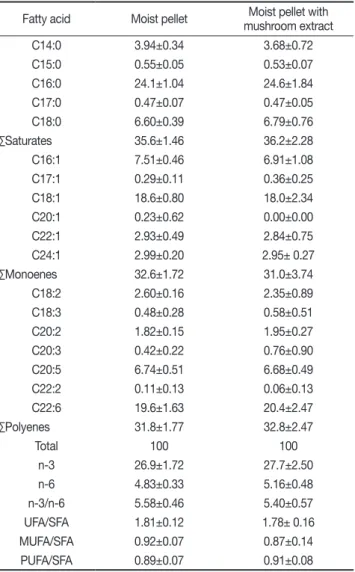
Table 5. The comparison of fatty acid composition (wt%) on muscle in olive flounder P. olivaceus fed moist pellet and moist pellet with mushroom extract for six month
Results are means±SD (n=10). Different superscripts within a same column are significantly different by Duncan's multiple range at P<0.05.
방산 조성은 포화지방산이 각각 35.6±1.46%, 36.2±2.28%, 단일불포화지방산이 각각 32.6±1.72%, 31.0±3.74% 다가 불포화지방산이 각각 31.8±1.77%, 32.8±2.47%이었다. 그 리고 대부분 포화지방산은 palmitic acid (16:0)가 주요 성분이 었으며, 단일불포화지방산은 palmitoleic acid (16:1)와 oleic acid (18:1), 그리고 다가불포화지방산은 eicosapentaenoic acid (20:5), docosahexaenoic acid (22:6)의 조성비가 가장 높게 나 타났다(Table 5). 그러나 사료 섭이에 따른 지방산 조성비는 유 의적인 차이가 없었다(P>0.05).
체내에서 생성되지 않아 음식물을 통해 섭취되어야 하는 n-3 지방산 조성비는 MP와 MPME를 섭이시킨 넙치근육에서 각 각 26.9±1.72% 및 27.7±2.50% 이었으며, n-6 지방산은 각각 4.83±0.33% 및 5.16±0.48%로 나타났다. 사료별에 따른 지방 산 조성비와 마찬가지로 두 개체군간의 유의적인 차이는 없었다 (P>0.05).
어류 근육 중의 지방산 조성의 차이는 어종, 환경요인, 크기, 연령, 식이에 따라 다르다고 보고하고 있으나(Gruger, 1967;
Saito et al., 1999; Kiessling et al., 2001), 넙치 배합사료에 켈 프, 크릴, 마늘 및 감귤 분말 등을 첨가가 미치는 효능을 조사한 결과, 대조구와 크릴을 첨가한 넙치 근육에서 C14:0, C20:4n-6 가 가장 높게 나타났으나 이외의 지방산 조성 및 조지방함량을 유의적인 차이가 없으므로 사료첨가제에 영향을 받지 않는 것 으로 보고하고 있다(Seo et al., 2010). 또한 배합사료(EP) 및 습 사료(MP)를 공급한 넙치 근육의 지방산 조성이 넙치의 크기에 따라 전어체 및 등근육의 지방산 조성에 유의적인 차이를 보였 다고 보고하고 있다(Kim et al., 2010). 그러나 사료의 지방산 조성이 어류 근육의 지방산 조성에 변화에 영향을 준다는 보고 (Morishita et al., 1989) 등과 관련하여 본 연구에서는 혼합버섯 추출물을 첨가한 사료와 일반 습사료와의 지방산 조성은 차이가
없으므로 사료별에 따른 넙치근육의 지방산 조성의 차이는 없는 것으로 사료된다.
근육의 파괴강도 비교
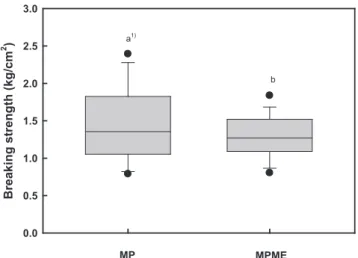
생선회의 단단함(toughness)은 어종, 원료어의 신선도 및 조 리후의 저장 조건에 따라서 달라지며, 어육중의 결합조직의 주 성분인 collagen의 함량 및 분포 형태가 육질의 단단함에 깊이 관여하고 있음이 밝혀져 있다. 어육의 단단함은 우리나라 생선 회 식문화에서는 생선회의 맛에 직결되며, 육질이 단단한 어종 일수록 고급횟감으로 취급된다(Kang et al., 2009). 따라서 사료 별에 따른 넙치 근육의 파괴 강도를 측정한 결과, MP를 섭이시 킨 넙치 근육에서는 파괴강도 값(1.44±0.51 kg/cm2) 이 MPME 를 섭이시킨 넙치 근육에서는 파괴강도 값(1.29±0.30 kg/cm2) 비하여 다소 높았다(P<0.05, Fig. 1). 사료별에 따른 파괴강도 값 의 차이는 시료 개체 및 조사시기별로 큰 차이를 나타내기 때문 으로 판단되며, 조사전 공급 사료, 환경과 활어의 운반상태 등이 영향을 준 것으로 판단된다.
이상의 결과로 살펴볼 때, 각 영양성분별로 함량의 차이는 나 타났으나, 동일한 시료채취시기, 연령, 크기 등을 고려할 때, 버 섯추출물 등을 혼합한 습사료 섭이에 따른 넙치의 식품학적 품 질은 일반 MP와 차이가 없었다. 그러나 두 개체 모두 양질의 단 백질 공급원이며, 불포화지방산인 DHA 및 EPA를 다량 함유하 고 있는 고급 식품이다.
사 사
본 연구는 국립수산과학원(수출용 넙치의 수송 및 보관기술, RP-2011-FS-018) 지원에 의해 수행된 연구결과입니다.
참고문헌
AOAC. 1995. Official Methods of Analysis. 16th Ed. Associa- tion of Official Analytical Chemist, Arlington, Virginia, U.S.A.
Ando M, Toyohara H, Shimizu Y and Sakaguchi M. 1991.
Validity of a puncture test for evaluating change in muscle firmness of fish during ice storage. Nippon Suisan Gak- kaishi 57, 2341.
Anderson, D.P., 1992. Immunostimulants, adjuvants and vac- cine carriers in fish: Applications to aquaculture Ann Rev Fish Dis 2, 281-307.
Choi SM, Ko SH, Park GJ, Lim SR, Yu GY, Lee JH and Bai SC. 2004. Utilization of Song-Gang stone as the dietary additive in juvenile olive flounder, Paralichthys olivaceus.
J Aquacult 17, 39-45.
Cho SH, Lee SM, Park BH, Ji SC, Kwon MG, Kim YC, Lee JH, Park SG and Han HK. 2006. Effects of dietary inclu- sion of various sources of green tea on immune system Breaking strength (kg/cm2 )
0.0 0.5 1.0 1.5 2.0 2.5 3.0
MP MPME
a1)
b
Fig. 1. The comparison of breaking strength on muscle in olive flounder P. olivaceus fed moist pellet and moist pellet with mushroom extract for six month, n=10.
--- mean, 1) Different superscripts on the bar are significantly different by Duncan's multiple range at P<0.05.
Lyons TA, Castell JD, Anderson DM and Albert JJ. 2001.
Effects of the partial replacement of fish meal with crab meal in diets for Atlantic salmon (Salmo salar) smolts.
Current Issues in Salmonid & Marine Fish Nutrition- Part 3. Canada.
Morishita T, Uno K, Araki T and Takahashi T. 1989. Com- parison of the fatty acid compositions in cultured red sea bream differing the localities and culture methods, and those in wild fish. B Jpn Soc Sci Fish 55, 847-852.
Morishita T, Uno K, Araki T and Takahashi T. 1989. Com- parison of the fatty acid compositions in cultured red sea bream differing the localities and culture methods, and those in wild fish. B Jpn Soc Sci Fish 55, 847-852.
Seo JY, Kim KD, Son MH and Lee SM. 2010. Growth perfor- mance, hematological parameter and fatty acid composi- tion of growing olive flounder (Paralichthys olivaceus) to dietary inclusion of kelp meal, krill meal, garlic powder or citrus meal. Kor J Fish Aquat Sci 43, 451-456.
Seo JY, Kim KD, Shin IS, Choi KD and Lee SM. 2009. Ef- fects of supplemental dietary wasabi extract, chitosan and Pophyra on growth and body composition of juvenile flounder, Paralichthys olivaceus. Kor J Fish Aquat Sci 42, 257-261.
Sakai M. 1999. Current research status of fish immunostimu- lants. Aquaculture 172, 63-92.
Steel RGD and Torrie JH. 1980. Principle and procedure of statistics; a biometrical approach (2nd ed.). MacGraw-Hill Book Co. Inc. New York, U.S.A., 401-437.
Satoh KI, Nakagawa H and Kasahara S. 1987. Effect of Ulva meal suuplementation on disease resistance of red sea bream. Nipp Suisan Gakka 53, 1115-1120.
Saito H, Yamashiro R, Alasalvar C and Konno T. 1999. Influ- ence of diet on fatty acids of three subtropical fish, sub- family caesioninae (Caesio diagramma and C. tile) and family siganidae (Siganus canaliculatus). Lipids 34, 1073- 1082.
2011년 9월 22일 접수 2011년 11월 1일 수정 2011년 12월 7일 수리 and challenging test of juvenile olive flounder Paralichthys
olivaceus. J Aquacult 19, 84-89.
Cho SH. 2011. Effects of putative growth or health-enhancing dietary additives on juvenile olive flounder, Paralichthys olivaceus, performance. J World Aquacult 42, 90-95.
Folch J, Lee M and Sloane-Stanley GH. 1957. A simple meth- od for the isolation and purification of total lipids from animal tissues. J Biol Chem 226, 497.
Gould NL, Glover MM, Davidson LD and Brown PB. 2003.
Dietary flavor additives influence consumption of feeds by yellow perch (Perca flavescens). J World Aquacult Soc 34, 412-417.
Gruger EHJr. 1967. Fatty acid composition. In: Stansby, M.E.
(Ed.), Fish Oils. AVI Publishing Co., Westport, CT, 3.
Hoyle NT and Merritt JH, 1994. Quality fish protein hydroly- sates from herring (Clupea harergus). J Food Sci 59, 76- 79.
Hwang JW and Myeong JI. 2010. An economic effect of the selective breeding program on the oliver flounder aquacul- ture. Electronic J 41, 113-128.
Iwasaki M and Harada R 1985. Proximate and amino acid composition of the roe and muscle of selected marine spe- cies. J Food Sci 50, 1585-1587.
Kang HW, Shim KB, Cho YJ, Kang DY, Cho KC. Kim JH and Park GJ. 2009. Biochemical composition of the wild and cultured yellow croaker (Larimichthys polyactis) in Korea.
Kor J Fish Aquat Sci 43, 18-24.
Kiessling A, Pickova J, Johansson L, Asgard T, Storebakken T and Kiessling KH. 2001. Changes in fatty acid composi- tion in muscle and adipose tissue of farmed rainbow trout (Oncorhynchus mykiss) in relation to ration and age. Food Chem 73, 271-284.
Kim KW, Kim KD, Kim SK, Son MH, Jang MS, Kang YJ, Bai SC and Lee KJ. 2010. Quality characteristics of olive flounder muscle fed with extruded pellet and raw fish- based moist pellet. Kor J Fish Aquat Sci 43, 451-456.
Kim DS, Kim JH, Jong CH, Lee SY, Lee SM and Moon YB.
1998. Utilization of obosan (dietary herbs) Ⅰ. Effects on survival, growth, feed conversion ratio and condition fac- tor in olive flounder, Paralichthys olivaceus. J Aquacult 11, 213-221.