J. Appl. Biol. Chem. 50(3), 160-163 (2007) Article
The Inhibitory Activity of
Erigeron annuus-Derived Components on Interferon-
γand Lipopolysaccharide-Induced Nitric Oxide
Production in Mouse Pheritoneal Macrophage
Hee Jung Lee
1, You Ah Kim, Na Ho Jeong
2, Seung Heon Hong
3and Youngwan Seo*
1Busan Regional Food & Drug Administration, Test & Analysis Center, Busan 608-829, Korea
2College of Pharmacy, Woosuk University, Samrye 565-701, Republic of Korea
3College of Oriental Pharmacy, Wonkwang University, Iksan, Jeonbuk, 570-749, Korea Division of Marine Environment and Bioscience, Korea Maritime University,
1 Dongsam-Dong, Youngdo-Gu, Busan, 606-791, Korea Received July 30, 2007; Accepted September 11, 2007
Two flavonoids (1 and 2) and one phenolic acid (3) obtained from Erigeron annuus have recently been shown to have potent antioxidant activities. Aim of this study was to investigate the inhibitory effects of these components on interferon-γ and lipopolysaccharide-induced nitric oxide productions in the mouse pheritoneal macrophage. Compounds 2 and 3 showed marked inhibitory activities against inducible nitric oxide synthase (iNOS) on the lipopolysaccharide and interferon-γ- stimulated mouse pheritoneal macrophages without cytotoxicity. Therefore, these results suggest that the compounds could be effective anti-inflammatory agents as nitric oxide inhibitors in vivo. Key words: Erigeron annuus, interferon-γ, LPS (lipopolysaccharide), mouse pheritoneal macrophage,
nitric oxide
Among of the various inflammatory mediators released by the activated macrophages, nitric oxide (NO) is identified as a potent molecule, which may exert regulatory or cytotoxic effects depending on the concentration acting on the target cell [Mondanam et al., 1991]. NO is synthesized from the three types of human nitric oxide synthase (NOS) isoforms.
The ecNOS (endothelial constitutive NOS) and ncNOS (neuronal constitutive NOS) types are constitutively expressed in neuroectodermal and endothelial cells, respectively in the Ca/calmodulin-dependent manner.
The third NOS isoform, so-called inducible type or iNOS, is expressed Ca/calmodulin-independently to significant levels in various kinds of cells only after the cell activation by immunological stimuli such as bacterial endotoxins and cytokines [Zhang and Vogel, 1994; Matsuoka et al., 1994; Griffith and Steuhr, 1995]. NO is a reactive, gaseous, lipophilic molecule that functions as a defensive
cytotoxin against the tumor cells and pathogens at high concentrations and as a signal in many diverse physiological processes including blood pressure regulation, neurotrans- mission, learning, and memory at low concentrations [Butler, 1995; Coleman, 2001; Bruckdorfer, 2005].
Although the iNOS isozyme is critical for the immune response, it is also implicated in most diseases involving NO overproduction. Pathologies related to the excessive NO production include immune type diabetes, inflammatory bowel disease, rheumatoid arthritis, carcinogenesis, septic shock, multiple sclerosis, transplant rejection, and stroke [Clancy and Abramson, 1995; Robbins et al., 2000; Chan and Mattiacci, 2001; Fischer et al., 2002; Rao, 2004].
Therefore an inhibitor of iNOS may be effective as a therapeutic agent for the pathological conditions related to NO.
Erigeron annuus (L.) Pers., a member of the Compositae (Asteraceae), is widely distributed throughout the urban and rural areas of Korea [Bennington and Stratton, 1998;
Kim and Lee, 1991; Kim et al., 1992] and has also been used as a hypoglycemic drug in China [Shougakukan, 1985]. It had been reported that (5-butyl-3-oxo-2,3- dihydrofuran-2-yl)-acetic acid, 3-hydroxy-pyran-4-one, as well as two cinnamic acid derivatives isolated from E.
annuus [Oh et al., 2002] act as anti-germination constituents.
*Corresponding author
Phone: +82-51-410-4328; Fax: +82-51-404-3538 E-mail: [email protected]
Abbreviations: LPS, Lipopolysaccharide; NOS, nitric oxide synthase; ecNOS, endothelial constitutive NOS; ncNOS, neu- ronal constitutive NOS
Nitric Oxide-Inhibitory Activity of Erigeron annuus-Derived Components in Activated Macrophage 161 Sesquiterpenoids, diterpenoids, and cyclopentenone
derivatives have also been reported to be present in E.
annuus [Iijima et al., 2003a,b].
We have reported previously three antioxidative components from E. annuus [Lee and Seo, 2006]. Herein, we report the iNOS inhibitory activities of the compounds in mouse pheritoneal macrophage stimulated with interferon-γ and lipopolysaccaride.
Materials and Methods
Plant materials. Whole plant of E. annuus (1.2 kg) was collected at Daebudo, Gyeonggi-Do, Korea in September 2002. The collected sample was briefly dried under shade and kept at −25oC until use. A voucher specimen was deposited at the Herbarium of Department of Biology, Kyungsung University under the curatorship of Prof.
Sung Gi Moon
Isolation of compounds. Chemical components of E.
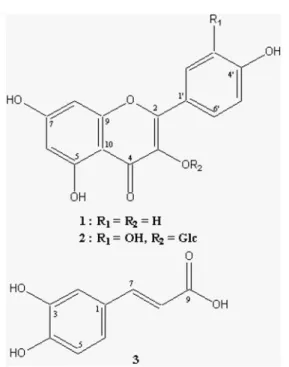
annuus were isolated as described previously [Lee and Seo, 2006]. The chemical structures of these components are illustrated in Fig. 1.
Reagents. Dulbecco’s Modified Eagle’s Medium (DMEM), N-(1-naphtyl)-ethylenediamine dihydrochloride, LPS, sodium nitrite, and pyrrolidine dithiocarbamate were purchased from Sigma (St. Louis, MO). Thioglycollate (TG) was purchased from Difco Laboratories (Detroit, MI). Syringe filter (0.2µm), tissue culture plates of 96 and 4 wells, and 100-mm diameter dishes were purchased from Nunc (Naperville, IL). DMEM containing L- arginine (84 mg/L), Hank’s balanced salt solution (HBSS), fetal bovine serum (FBS), and other tissue culture reagents were purchased from Life Technologies (Grand Island, NY). Male C57BL/6J mice were purchased from Damul Science Co. (Daejon, Korea).
Peritoneal macrophage cultures. TG-elicited macrophages were harvested 3~4 days after the i.p. injection of 2.5 mL TG to the mice, and isolated as reported previously [Chung et al., 2002]. Using 8 mL of HBSS containing 10 U/mL heparin, a peritoneal lavage was performed.
Subsequently, the cells were distributed in the 4-well tissue culture plates (2.5×10⁵ cells/well), and added DMEM supplemented with 10% heat-inactivated FBS) into each well. The culture plates were incubated for 3 h at 37oC in an atmosphere of 5% CO2, washed three times with HBSS to remove the non-adherent cells, and equilibrated with DMEM containing 10% FBS before treatment.
Measurement of nitrite concentration. Peritoneal macrophages (2.5×10⁵ cells/well) were cultured with various concentrations of the compounds. The cells were then stimulated with LPS (10µg/mL). NO syntheses in
the cell cultures were measured by a microplate assay method as previously described [Chung et al., 2002]. To measure the nitrite concentration, 100 mL aliquots were removed from the conditioned medium and incubated with an equal volume of Griess reagent (1% sulfanilamide/
0.1% N-(1-naphtyl)-ethylenediamine dihydrochloride/
2.5% H3PO4) at room temperature for 10 min. The absorbance at 540 nm was determined using a Titertek Multiskan (Flow Laboratories, North Ryde, Australia).
Fig. 1. Chemical structures of the Erigeron annuus
components.
Table 1. Effect of three compounds isolated E. annuus on NO production in peritoneal macrophages and cyto- toxicity
µg/ml Inhibition (%) MTT
compound 1 100 *85.8 ± 2.40 43.4
10 70.2 ± 3.50 85.7
1 44.7 ± 3.34 93.5
compound 2 100 *68.6 ± 1.53 149
10 60.6 ± 2.23 92.8
1 36.2 ± 2.51 88.1
compound 3 100 *82.2 ± 0.58 86.9
10 8.6 ± 1.59 105.6
1 17.0 ± 0.91 107.3
Indomethacin 100 *47.6 ± 1.96 99.3 Peritoneal macrophages (2.5×10⁵ cells/well) were cultured with various concentrations of compounds isolated from E.
annuus. The peritoneal macrophages were then stimulated with rIFN-γ (10 U/mL) and LPS (10µg/mL). After 48 h of culture, NO release was measured as a form of nitrite by the Griess method. *p< 0.05 compared to rIFN-γ+ LPS.
162 Hee Jung Lee et al.
NO2− was determined using sodium nitrite as a standard.
The cell-free medium alone contained 5 to 9µM NO2−. This value was determined in each experiment and subtracted from the value obtained from the medium with peritoneal macrophages. Cytotoxicity was assayed by the mitochondrial-dependent reduction of 3-(4,5-dimethyl- thiazol-2-yl)-5-diphenyl tetrazolium bromide (MTT) into formazan. The cells in 48-well plates were incubated with MTT for 4 h and solubilized by dimethylsulfoxide. The extent of the reduction of MTT into formazan in the cells was quantified by the measuring the absorbance at 570 nm [Sladowski et al., 1992].
Results and Discussion
The overproduction of NO in vivo is a potential pathological mechanism in various disease states.
Therefore, specific NOS inhibitors offer an opportunity for drug discovery. However, the therapeutic potential of some of the approaches may be limited due to the possible nonspecific effects or lack of selectivity for a particular NOS isoform. Because the excessive production of NO from the iNOS isoform has been implicated in sevsral inflammatory and immunologically mediated diseases, the development of potent and selective inhibitors of the human iNOS is an important therapeutic target.
In our search for anti-allergy and anti-inflammatory drugs from the salt marsh plants, we isolated three compounds, kaempferol (1), quercetin-3-O-glucoside (2), and caffeic acid (3), from E. annuus. To evaluate the effects of these compounds on NO production in IFN-γ- and LPS-induced mouse pheritoneal macrophages, nitrite accumulation was measured. Under the aqueous aerobic conditions at the physiological pH, NO was further oxidized very quickly to its inactive, stable end products, nitrite (NO2−) and nitrate (NO3−).
Mouse pheritoneal macrophages markedly increased the NO production after IFN-γ and LPS stimuli. Table 1 shows apigenin and quercetin-glucoside effectively inhibited the NO production in a dose-dependent manner.
NO productions of the mouse pheritoneal macrophages stimulated by IFN-γ and LPS were suppressed 85.8 and 68.6% by apigenin and quercetin glucoside, respectively.
The cell viability measured by MTT-reduction assay showed that quercetin-3-O-glucoside (2) had no significant effects on the cell growth. However, kaempferol (1) at 100µg/mL had an inhibitory effect on the cell growth by 43.4% of the control. Caffeic acid (3) showed 85.9%
inhibitory activity of NO production without cytotoxicity at 100µg/mL but did not show a significant inhibitory activity at 10µg/mL.
In conclusion, these results suggested that compounds 2 and 3 have the potential to be developed as new anti- inflammatory agents.
Acknowledgments. This work was financially supported by Korea Research Foundation (KRF) grant KRF-2006- 005-J00502.
References
Bennington CC and Stratton DA (1998) Field tests of den- sity and frequency-dependent selection in Erigeron annuus (Compositae). Am J Bot85, 540-545.
Butler AR (1995) The biological roles of nitric oxide. Chem Ind16, 828-830.
Bruckdorfer R (2005) The basics about nitric oxide. Mol.
Aspects Med26, 3-31.
Chan MM and Mattiacci JA (2001) Nitric oxide: actions and roles in arthritis and diabetes. The Foot 11, 45-51.
Chung HS, Jeong HJ, Hong SH, Kim MS, Kim SJ, Song BK, Jeong IS, Lee EJ, Ahn JW, Back SH, and Kim HM (2002) Induction of nitric oxide synthase by Oldenlan- dia diffusa in mouse peritoneal macrophages. Biol Pharm Bull 25, 1142-1146.
Clancy RM and Abramson SB (1995) A novel mediator of inflammation. Soc Exp Bio Med23, 93-101.
Coleman JW (2001) Nitric oxide in immunity and inflam- mation. Int Immunopharmacol1, 1397-1406.
Fischer A, Flokerts G, Geppetti P, and Groneberg DA (2002) Mediators of Asthma: Nitric oxide. Pulm Phar- macol Ther 15, 73-81.
Griffith OW and Steuhr DJ (1995) Nitric oxide synthases:
Properties and catalytic mechanism. Annu Rev Physiol
57, 707-736.
Iijima T, Yaoita Y, and Kikuchi M (2003a) Two new cyclo- pentenone derivatives and a new cyclooctadienone deriv- ative from Erigeron annuus (L.) Pers., Erigeron philadelphicus L., and Erigeron sumatrensis RETZ.
Chem Pharm Bull51, 894-896.
Iijima T, Yaoita Y, and Kikuchi M (2003b) Five new ses- quiterpenoids and a new diterpenoid from Erigeron annuus (L.) Pers., Erigeron philadelphicus L. and Eri- geron sumatrensis RETZ. Chem Pharm Bull 51, 545- Kim TS and Lee HJ (1991) Life history and growth pattern549.
on the Erigeron annuus. Korean J Ecol14, 211-231.
Kim TS, Lee HJ, and Byun DW (1992) Germination, shade tolerance and community characteristics of Erigeron annuus L. in Cheju. Korean J Ecol15, 103-116.
Lee HJ and Seo Y (2006) Antioxidant Properties of Eri- geron annuus Extract and Its Three Phenolic Constitu- ents. Biotechnol Bioeng11, 13-18.
Matsuoka A, Steuehr DJ, Olson JS, Clark P, and Ikeda-Saito M (1994) L-arginine and calmodulin regulation of the heme iron reactivity in neuronal nitric oxide synthase. J Biol Chem269, 20335-20339.
Nitric Oxide-Inhibitory Activity of Erigeron annuus-Derived Components in Activated Macrophage 163 Mondanam S, Palmer RM, and Higgs EA (1991) Nitric
oxide: physiology, phathophysiology and pharmacology.
Pharmacol Rev43, 109-142.
Oh H, Lee S, Lee HS, Lee DH, Lee SY, Chung HT, Kim TS, and Kwon TO (2002) Germination inhibitory con- stituents from Erigeron annuus. Phytochem 61, 175-179.
Rao CV (2004) Nitric oxide signaling in colon cancer chemoprevention. Mutat Res555, 107-119.
Robbins RA, Hadeli K, Nelson D, Sato E, and Hoyt JC (2000) Nitric oxide, peroxynitrite and lower respiratory
tract inflammation. 48, 217-221.
Sladowski D, Steer SJ, Clothier RH, and Balls M (1992) An improved MTT assay. J Immunol Methods 157, 203-207.
Zhang M and Vogel HJ (1994) Charactrization of the calm- odulin binding domain of rat cerebellar nitric oxide syn- thase. J Biol Chem269, 981-985.
Dictionary of Chinease Materia Medica (1985) Shanghai scientific technological publishers and shougakukan (eds). Vol. 1, pp. 25, Shougakukan, Tokyo.