야채스프의 RAW 264.7 세포에서 항염증 효과
심재근1․이재혁1․신태용2․신혜영3․정숙희4․김미혜4․구호준5․박정숙5†
1남부대학교 한방자원개발학과, 2우석대학교약학과
3아주대학교 분자 과학기술단, 4남부대학교 향장미용학과
5남부대학교 대체의학과
Anti-Inflammatory Effects of Vegetable Soup in Murine Macrophage RAW 264.7 Cells
Jae-Geun Sim1, Jae-Hyeok Lee1, Tae-Yong Shin2, Hye-Young Shin3, Sook-Hee Jeong4, Mi-Hye Kim4, Ho-Jun Ku5, and Jeong-Suk Park5†
1
Dept. of Oriental Pharmaceutical Development, Nambu University, Gwangju 506-606, Korea
2
College of Pharmacy, Woosuk University, Jeonbuk 565-701, Korea
3
Dept. of Molecular Science and Technology, Ajou University, Gyeonggi 443-749, Korea
4
Dept. of Cosmotology and
5Dept. of Alternative Medicine, Nambu University, Gwangju 506-606, Korea
Abstract
The aim of the present study is to investigate the anti-inflammatory effect of a vegetable soup (VS). The present study was designed to determine the effect of the vegetable soup on pro-inflammatory factors such as NO, iNOS and TNF-α in lipopolysaccharide (LPS)-stimulated RAW 264.7 macrophages. The cell toxicity was determined by MTS assay. To evaluate the anti-inflammatory effect of vegetable soup, amount of NO was measured using the NO detection kit and the iNOS expression was measured by reverse transcriptase poly- merase chain reaction (RT-PCR). Also, proinflammatory cytokines were measured by ELISA kit. The results showed that the vegetable soup reduced NO, iNOS and TNF-α production without cytotoxicity. Our results sug- gest that the vegetable soup may have an anti-inflammatory property through suppressing inflammatory media- tor productions and appears to be useful to develop the functional food realted to anti-inflammation.
Key words: vegetable soup, anti-inflammatory, MTS assay, NO, iNOS
†Corresponding author. E-mail: [email protected]
†Phone: 82-62-970-0167, Fax: 82-62-970-0162
서 론
최근 인간의 수명 연장과 건강에 대한 관심이 고조되면서 노화억제와 건강유지를 위해 각종 채소 등 자연식품의 기능 성 및 생리활성물질에 대한 연구가 널리 진행되고 있으며, 이러한 자연식품을 이용하여 암이나 당뇨 동맥경화 같은 성 인병을 예방하기 위한 많은 방법들이 제시되고 있다(1,2).
최근 이러한 자연식품을 이용한 건강법 중 일상생활에서 쉽 게 섭취할 수 있는 당근, 무, 무청, 우엉, 표고버섯을 재료로 한 스프가 국내에서는 암환자, 성인병질환 및 아토피질환의 환자에게 많은 관심을 불러 일으켰으며 많은 제품들이 판매 되고 있다. 당근은 비타민 A의 전구체인 카로틴을 많이 함유 하고 있으며(3,4), 인체에서 암이나 노화, 각종 성인병을 일 으키는 활성산소를 억제하는 작용이 있고(5,6), 무는 소화불 량, 숙취해소, 진해거담, 해열 소염작용 등이 있다고 하며, 항염 항산화 성분인 phenolic compound, flavonoid 함량이
높다(7-10). 특히 무의 잎 부분인 무청은 35% 이상이 식이섬 유이고 20% 내외의 단백질과 철분, 칼슘 등을 함유하고 있 으며(11) 에탄올 추출물의 폐암에 대한 효과(7), 위장 내 자 극과 자궁 수축 활성능 등에 관한 연구가 보고되고 있다(12).
우엉은 caffeic acid, chlorogenic acid 등 많은 종류의 polyphenol 화합물을 함유하고 항균작용이 있으며(13) 염증 억제, amaranth 식이에 대한 보호효과 및 성분 분석 등에 대한 연구가 보고되고 있다(14). 표고버섯 역시 항암작용 등 의 약리효과가 알려져 있다(15).
한편, 염증반응은 세균감염과 같은 외부 자극이나 생체 내 대사산물과 같은 내부자극에 대한 생체조직의 방어기전 으로(16) 세포내 다양한 염증조절인자들인 TNF-α, IL-1β, IL-6 등과 같은 proinflammatory cytokines, prostagrandin, lysosomal enzyme, free radicals 등 다양한 매개물질이 관여 한다(17-19). 특히 대식세포에서 cytokines, tumor necrosis factor(TNF-α), lipopolysaccharide(LPS)와 같은 자극에 의
해 염증 반응의 전사 인자를 활성화시키며 그 결과 inducible nitric oxide synthase(iNOS), cyclooxygenase-2(COX-2)를 발현시켜 nitric oxide(NO)와 prostaglandin E2(PGE2)를 생 성하여 염증을 일으킨다(20-22). 또한 NO가 필요 이상으로 생성되면 염증 반응의 항진, 과도한 혈관 확장에 의한 패혈 성 쇼크 유발, 상처 치유의 억제, 신경조직의 손상 등을 일으 켜 생체에 유해한 작용을 나타낸다(23-25).
따라서 본 연구는 당근, 무, 무청, 우엉 및 표고버섯을 가열 처리하여 만들어진 야채스프가 만성 염증성질환 및 성인병 질환에 주로 음용이 되고 항염증 효과가 있을 것으로 예상됨 에 따라, 야채수프의 기초적인 생리활성작용을 입증하기 위 한 연구의 일환으로 RAW264.7 세포에서 NO의 생성, iNOS 의 발현정도와 염증성 cytokine인 TNF-α 분비량 등을 조사 하여 야채스프의 항염증활성을 검토하고자 하였다.
재료 및 방법
실험재료
본 실험에 사용한 야채스프는 광주지역에서 유기농법으 로 무농약 재배된 무, 당근, 무청, 우엉 및 표고버섯을 원료 로, 세척 등의 전처리를 거친 다음 100oC에서 2시간 열수 추출 하여 150 mL 액상 파우치로 제조(2009년 11월 20일)한 제품을 (주)참든마을(Gwangju, Korea)에서 제공받아 사용 하였으며 이를 Whatman No.42 여과지로 여과하고 동결건 조 한 후 분말화 하여 실험재료(vegetable soup: VS)로 사용 하였다.
야채스프의 구성성분
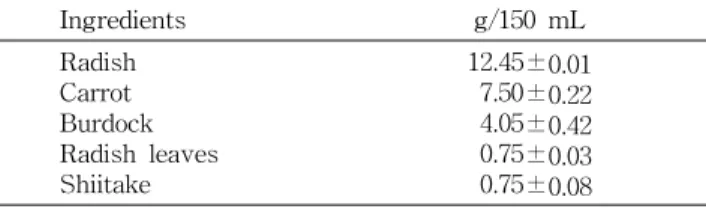
본 실험에 사용한 야채스프의 구성성분과 함량은 Table 1과 같다.
시약
세포 배양액인 Dulbecco's modified Eagle's medium (DMEM)과 fetal bovine serum(FBS), streptomycin-pen- icillin 등의 세포배양용 시약들은 Gibco BRL사(Grand Island, NY, USA), lipopolysaccharide(LPS)는 Sigma- Aldrich사(St. Louis, MO, USA), Cell Titer 96® AQueous
One Solution(MTS)은 Promega사(Madison, WI, USA)에 서 구입하여 사용하였다. Tumor necrosis factor-α(TNF-α) ELISA kit는 eBioscience사(San Diego, CA, USA)에서 구
Table 1. Compositions of the vegetable soup
Ingredients g/150 mL
Radish Carrot Burdock Radish leaves Shiitake
12.45±0.01 7.50±0.22 4.05±0.42 0.75±0.03 0.75±0.08 The results were expressed as mean±SD.
입하였고 NO(nitric oxide) detection kit는 iNtRON Bio- technology사(Suwon, Korea)에서 구입하여 사용하였다. 이 외에 실험에 사용된 시약은 모두 분석용 시약 특급을 사용하 였다.
세포배양
실험에 사용한 마우스의 대식세포주인 RAW264.7 세포 는 한국세포주은행(KCLB)에서 분양 받았으며, 세포배양을 위해 10% FBS과 1% penicillin-streptomycin을 포함하는 DMEM 배지를 사용하였다. 세포는 CO2 배양기(37oC, 5%
CO2, MCO-15AC, SANYO, Osaka, Japan)에서 배양하였다.
세포독성
야채스프의 세포에 대한 독성은 Desai 등(26)의 방법에 준하여 측정하였다. 이는 mitochondrial dehydrogenases에 의하여 MTS가 formazan으로 전환되는 것을 측정하는 것으 로 96 well plate에 1.0×10⁵ cells/well로 RAW264.7 세포를 분주하고 18시간 동안 배양한 후 야채스프를 2 mg/mL 처리 하여 24시간 동안 배양하였다. 배양 후, 20 μL의 MTS solution을 첨가한 후 CO2 배양기(37oC, 5% CO2)에서 4시간 반응시킨 후, 450 nm에서 흡광도의 변화를 측정하여 대조군 에 대한 세포 생존율을 백분율로 표시하였다.
Nitric oxide 측정
NO의 농도는 배양액 내의 nitrite 농도를 Wang 등(27)의 방법에 따라 Griess Reagent System을 이용하여 측정하였 다. RAW264.7 세포를 96 well plate에 1.0×10⁵ cells/well이 되도록 분주하고 18시간 동안 배양한 후 2 mg/mL 야채스프 를 전처리하고 1시간 후에 LPS 100 ng/mL 처리한 후, 다시 24시간 동안 배양하였다. 배양액과 동량의 griess reagent를 가하고 10분간 상온에서 반응시킨 후 540 nm에서 흡광도를 측정하였다. Sodium nitrite의 농도별 표준곡선을 이용하여 배양액의 NO 농도를 결정하였다.
Reverse transcription polymerase chain reaction (RT-PCR)
RAW264.7 세포에서 발현되는 iNOS의 유전자발현에 대 한 야채스프의 효과를 조사하기 위해 RT-PCR을 수행하였 다. 먼저 RAW264.7 세포를 60 mm dish에 4.0×10⁶ cells로 분주하고 18시간 동안 배양하였다. 야채스프를 전처리하고 LPS(100 ng/mL) 처리 후 6시간 동안 배양하였다. 세포를 수거하여 4oC에서 2,000 rpm으로 5분간 원심분리한 후 Easy Blue®시약(iNtRON Biotechnology)을 이용하여 total RNA 를 분리하였다. 분리된 RNA로 QuantiTect® Reverse Transcription kit(Qiagen, Hilden, Germany)를 이용하여 cDNA를 합성하였다. 합성된 cDNA에 대한 PCR을 수행하 기 위해 cDNA 1 μg에 Table 2의 primers(sense, anti-sense) 1 μL 및 10×buffer(10 mM Tris-HCl, pH 8.3, 50 mM KCl, 0.1% Triton X-100), 250 μM dNTP, 1 U Taq polymerase
Table 2. The primers for PCR
Primer Sequences
iNOS Sense Antisense
5'-GAC CAG ATA AGG CAA GCA C-3' 5'-CTT GTC TTT GAC CCA GTA GC-3' GAPDH Sense
Antisense
5'-CTC GTG GAG TCT ACT GGT GT-3' 5'-GTC ATC ATA CTT GGC AGG TT-3'
를 혼합한 후 denaturation을 위해 94oC에서 45초, annealing 을 위해 55∼60oC에서 45초 및 extension을 위해 72oC에서 60초 조건으로 30 cycles를 수행하였다. PCR 반응의 표준 대조구로 GAPDH를 사용하였다.
사이토카인 측정
RAW264.7 세포를 96 well plate에 1.0×10⁵ cells/well이 되도록 분주하고 18시간 동안 배양한 후 2 mg/mL 야채스프 를 전처리하고 1시간 후에 LPS 100 ng/mL 처리하여 배양하 였다. 24시간 배양한 후 세포배양액을 수거하여 배양액에 함유된 TNF-α을 ELISA kit을 이용하여 측정하였다.
통계적 분석
실험결과는 Students' t-test로 처리하였으며 p<0.05일 때 유의성이 있는 것으로 판정하였다.
결과 및 고찰
마우스 대식세포에서의 세포증식에 미치는 영향
마우스 대식세포인 RAW264.7은 염증반응에서 중추적인 역할을 하며(28) 항염 효과를 평가하는 염증모델로 많이 사 용된다(29). 이러한 RAW264.7 대식세포에 대한 야채스프의 세포독성을 측정하기 위하여 MTS assay를 수행하였다. 대 조군과 야채스프(2 mg/mL)를 24시간 처리한 실험군의 세포 생존률이 각각 105.6%, 101.2%로서 실험에 사용한 야채스프 는 세포독성이 없는 것으로 나타났다(Table 3).
NO 생성 및 iNOS 발현에 미치는 영향
활성산소의 일종으로 염증유발에 중요한 역할을 하는 것 으로 최근 알려진 NO(30)는 높은 반응성을 가진 생체 생성 분자로서, NOS(nitric oxide synthase)에 의해 L-arginine으 로부터 생성되는데, 특히 iNOS(inducible NOS)가 염증반응 에 관여하며, TNF-α, LPS와 같은 염증성 사이토카인의 자
Table 3. Effects of the vegetable soup on the cell viability of RAW 264.7 cells
Group1) Cell viability (%)2)
Control VS
105.6±2.54 101.2±0.69
1)Control and VS (vegetable soup 2 mg/mL)
2)Results of the experiments were expressed as the mean values of three independent experiments and are shown as percentage cell viability compared with the viability of untreated control cells.
Table 4. Inhibitory effects of the vegetable soup on the production of NO in LPS-stimulated RAW 264.7 cells
Group1) NO (μm)2)
Control LPS LPS+VS
5.33±0.12 19.53±1.02 15.54±1.89*
1)Control, LPS (lipopolysaccharide 100 ng/mL) and VS (vegetable soup 2 mg/mL)
2)NO concentration. Results of the experiments were expressed as the mean values of three independent experiments and as- terisks indicate the significant differences (*p<0.05).
극이 있을 때 발현된다(19). 염증 유발물질로 사용되는 LPS 를 이용하여 RAW264.7 세포의 NO 생성에 대한 야채스프의 효과를 측정한 결과(Table 4), RAW264.7 세포만 배양한 대 조군에서 NO의 농도는 5.33 μM로 매우 낮게 측정되었으며, LPS를 처리한 군에서 NO의 농도는 19.53 μM로 현저히 증 가되었다. 야채스프를 처리한 실험군은 15.54 μM로 NO 생 성이 억제되는 것을 관찰할 수 있었다.
iNOS는 세포내에 존재하지 않으나 일단 자극에 의해 유 도가 되면 NO를 생성하며 생성된 NO는 혈관확장, 세포독 성, 조직손상과 같은 작용을 하며 염증을 심화시키는 것으로 알려져 있다(31). 또한 염증반응과 관련된 조직 손상에서 NO와 iNOS의 발현이 증가되어 있음이 보고되어 있다(32).
LPS에 의해 활성화된 RAW264.7 세포로부터 생성되는 NO 의 합성효소인 iNOS의 유전자 발현에 대한 야채스프의 효 과를 조사하기 위하여 RT-PCR을 수행하였다. 그 결과(Fig.
1), RAW264.7 세포만 배양한 대조군에서는 iNOS의 발현이 나타나지 않았으나 LPS 100 ng/mL를 처리한 군에서는 iNOS 의 발현이 대조군에 비하여 현저히 증가하였다. RAW264.7 세포에 야채스프를 2 mg/mL의 농도로 처리한 경우 iNOS의 발현은 억제되었다. 당근 추출물에 의한 NO 생성과 iNOS 생성에 대한 Metzger 등(33)의 보고에 의하면 RAW264.7 세포에 LPS 처리 시 염증유발물질인 NO와 iNOS 생성에 대해 농도 의존적으로 억제효과를 나타냈으며 이는 당근에 함유된 carotenoid와 같은 생리활성물질에 의한 것이며, Zhao 등(34)은 우엉의 생리활성성분인 arctigenin을 RAW 264.7과 THP-1 세포에서 LPS로 자극한 후 염증 억제력을 살펴본 결과 iNOS expression과 iNOS enzymatic activity 의 down-regulation에 따라 NO의 생성이 억제됨을 보고하 였다.
이런 결과는 야채스프에 사용된 야채들의 생리활성물질 들이 LPS에 의해 유도되는 염증효소인 iNOS 유전자의 발현 을 효과적으로 억제시켜 NO의 생성을 억제시킨 것으로 사 료된다.
TNF-α 분비에 미치는 영향
TNF-α는 LPS 반응의 주요 매개체로 선천면역반응에 있 어서 중요한 역할을 한다(35). Macrophage와 mast cell에서 분비되는 TNF-α는 tumor cell에서 세포독성을 나타내며 만
iNOS
GAPDH
LPS (100 ng/mL) VS (2 mg/mL)
- -
+
-
+
+
0 20 40 60 80 100 120
CTL LPS VS
iN O S (% c o n tro l) .
*
LPS (100 ng/mL) VS (2 mg/mL)
- -
+ -
+ +
Fig. 1. Inhibitory effects of the vegetable soup on the ex- pression of iNOS in LPS-stimulated RAW 264.7 cells. Results of the experiments were expressed as the mean values of three independent experiments and asterisks indicate the significant differences (*p<0.05) from cells treated with LPS alone. Quantifi- cation of iNOS mRNA expression was measured by densitometric analysis. The values were expressed as a percentage of maximal band intensity in culture treated with LPS alone. Data are the mean±
SEM of iNOS/GAPDH. LPS: lipopolysaccharide 100 ng/mL, VS: vegetable soup 2 mg/mL.
성염증과 관련되어 있다(36). 야채스프가 염증성 사이토카 인인 TNF-α의 분비에 미치는 영향을 살펴보기 위해 RAW 264.7 세포에 LPS(100 ng/mL) 단독처리 또는 LPS와 야채 스프(2 mg/mL)를 처리한 후 배지에 분비된 TNF-α의 농도 를 ELISA 방법으로 측정하였다. 그 결과(Table 5), RAW264.7 세포만 배양한 대조군에서의 TNF-α 농도는 0.112 ng/mL로 매우 낮게 측정되었으며, LPS를 처리한 군에서의 TNF-α 농도는 1.76 ng/mL로 현저히 증가되었다. 야채스프를 처리 한 실험군은 1.35 ng/mL로 TNF-α 분비가 억제되는 것을 관찰할 수 있었다. 최근 생리활성물질로 야채에 들어있는
Table 5. Inhibitory effects of the vegetable soup on the production of TNF-
α
in LPS-stimulated RAW 264.7 cellsGroup1) TNF-α production (ng/mL)2)
Control LPS LPS+VS
0.112±0.021 1.76±0.301 1.35±0.26*
1)Control, LPS (lipopolysaccharide 100 ng/mL) and VS (vegetable soup 2 mg/mL)
2)Results of the experiments were expressed as the mean values of three independent experiments and asterisks indicate the significant differences (*p<0.05).
특정성분에 대한 연구가 활발히 이루어지고 있다. 특히 무나 무청에 들어있는 phenolic compound나 flavonoid에 대한 항 산화, 항염, 항암의 효능이 연구를 통해 밝혀지고 있으며 (7,8) Metzger 등(33)에 의하면 당근의 phytochemical들이 대식세포와 상피세포에 LPS로 활성화시킨 후 proinflam- matory cytokines인 TNF-α, IL-6, IL-1β가 감소됨을 보였 고 특히 TNF-α의 분비량이 66% 감소됨을 보였다. 이는 당 근에 함유된 carotenoids, phenolics, polyacetylenes 등의 phytochemical에 의한 효과이며, Cho 등(37)의 실험에 의하 면 우엉 성분 중의 하나인 arctigenin이 LPS에 의해 활성화 된 RAW264.7 세포에서 TNF-α의 분비에 관여하는 mitogen- activated protein(MAP) kinases, ERK1/2, p38kinase와 JNK 등의 활성을 억제시키는 것을 관찰하였다. 야채스프의 TNF-α의 분비억제 효과는 사용되어진 야채들의 특정성분 들에 의한 상호작용으로 사료된다.
요 약
본 연구의 목적은 일상생활에서 쉽게 섭취할 수 있는 당근, 무, 무청, 우엉, 표고버섯을 재료로 한 야채 스프의 항염증성 을 검토하기 위한 것으로, RAW264.7 세포에서 LPS에 의해 유도되는 염증물질 중 NO와 염증성 사이토카인 TNF-α에 대한 억제력을 관찰하였다. 실험결과 실험에 사용된 야채스 프는 세포독성을 나타내지 않았다. 세포독성이 없음을 확인 한 후 LPS로 처리한 RAW264.7 세포에서 야채스프의 NO 생성억제를 평가한 결과 RAW264.7 세포만 배양한 대조군 에서 NO의 농도는 매우 낮게 측정되었으며, LPS를 처리한 군에서 NO의 농도는 현저히 증가되었다. 또한 야채스프를 처리한 실험군은 NO 생성이 유의성 있게 억제되었으며, RAW264.7 세포를 LPS로 처리 시 iNOS가 발현되어 NO를 생성하게 되므로 iNOS의 발현에 미치는 영향을 평가하였 다. LPS 처리 시 iNOS 유전자 발현이 유의하게 증가되었으 나, 야채스프를 전 처리한 실험군에서 iNOS의 양이 감소하 였다. 야채스프에 의한 iNOS의 발현억제는 NO 생성억제를 유도를 의미한다. Proinflammatory cytokines인 TNF-α 분 비 억제를 살펴본 결과 LPS를 처리한 군에서 TNF-α의 분 비가 현저하게 증가되었으나 야채스프를 처리한 군에서는 유의한 억제를 나타냈다. 이상과 같이 야채스프는 RAW264.7 세포에서 LPS에 의해 유도되는 NO의 생성억제, iNOS의 발 현을 억제시켰으며, proinflammatory cytokines인 TNF-α 의 분비량도 억제시켰다. 이는 야채수프의 항염증성을 입증 하기 위한 기초자료로 활용이 가능하다고 사료된다.
문 헌
1. Goldberg I. 1994. Functional Foods. Chapman & Hall Press, New York, USA. p 350-550.
2. Sadaki O. 1996. The development of functional foods and
material. Bio-industry 13: 44-50.
3. Heinonen MI. 1990. Carotenoids and provitamin A activity of carrot (Daucus carota L.) cultivars. J Agric Food Chem 38: 609-612.
4. Simon PW. 1990. Carrots and other horticultural crops as a source of provitamin A carotenes. Hortscience 25: 1495- 1499.
5. Weisburger HH. 1991. Nutritional approach to cancer pre- vention with emphasis on vitamins, antioxidants, and caro- tenoids. Am J Clin Nutr 53: 2265-2375.
6. Bendich A. 1994. Recent advances in clinical research in- volving carotenoids. Pure Appl Chem 66: 1017-1025.
7. Yim HB, Lee G, Chae HJ. 2004. Cytotoxicity of ethanol ex- tract of Raphanuse sativus on human lung cancer cell lines.
J Korean Soc Food Sci Nutr 33: 287-290.
8. Shimotoyodome A, Meguro S, Hase T, Tokimitsu I, Sakata T. 2001. Sulfated polysaccharides, but not cellulose, in- crease colonic mucus in rats with loperamide-induced con- stipation. Digest Dis Sci 46: 1482-1489.
9. Matsuoka H, Toda Y, Yoneyama K, Uda Y. 1998. Formation of raphanusanius depends on extraction procedure and sol- vent. Phytochemistry 47: 957-977.
10. Monde K, Takasugi M, Shirata A. 1995. Three sulphur- containing stress metabolites from Japanese radish. Phyto-
chemistry 39: 581-586.
11. Ku KH, Lee KA, Kim YL, Lee YW. 2006. Quality character- istics of hot-air dried radish (Raphanus sativus L.) leaves.
J Korean Soc Food Sci Nutr 34: 780-785.
12. Ghayur MN, Gilani AH. 2005. Gastrointestinal stimulatory and uterotonic activities of dietary radish leaves extract are mediated through multiple pathways. Phytother Res 19:
750-755.
13. Takeda H, Kiriyama S. 1991. Difference between rats and chicks in the protective effect of dietary fiber against amar- anth toxicity. Agric Biol Chem 55: 1299-1305.
14. Takeda H, Kiriyama S. 1991. Effect of feeding amaranth (food red no. 2) on the jejunal sucrase and digestion- absorption capacity of the jejunum in rats. J Nutr Sci Vit-
aminol (Tokyo) 37: 611-623.
15. Park MH, Oh KY, Lee BW. 1998. Anti-cancer of Lentinus
edodes and Pleurotus astreatus. Korean J Food Sci Technol
30: 702-708.16. Kang-Rotondo CH, Major S, Chiang TM, Myers LK, Kang ES. 1996. Upregulation of nitric oxide synthase in cultured human keratinocytes after ultraviolet B and bradykinin.
Photodermatol Photoimmunol Photomed 12: 57-65.
17. Seo SJ, Choi HG, Chung HJ, Hong CK. 2002. Time course of expression of mRNA of inducible nitric oxide synthase and generation of nitric oxide by ultraviolet B in keratino- cyte cell lines. Br J Dermatol 147: 655-662.
18. Weller R. 1997. Nitric oxide-a newly discovered chemical transmitter in human skin. Br J Dermatol 137: 665-672.
19. Moncada S, Higgs A. 1993. The L-arginine-nitric oxide pathway. N Engl J Med 329: 2002-2012.
20. Shew RL, Papka RE, McNeill DL, Yee JA. 1993. NADPH- diaphorase-positive nerves and the role of nitric oxide in CGRP relaxation of uterine contraction. Peptides 14: 637- 641.
21. Kwqamata H, Ochiai H, Mantani N, terasawa K. 2000.
Enhanced expression of inducible nitric oxide synthase by Juzen-taiho-to in LPS activated RAW264.7 cells, a murine macrophage cell line. Am J Chin Med 28: 217-226.
22. Lee BG, Kim SH, Zee OP, Lee KR, Lee HY, Han JW, Lee HW. 2000. Suppression of inducible nitric oxide synthase expression in RAW 264.7 macrophages by two-carboline
alkaloids extracted from Melia azedarach. Eur J Pharmacol 406: 301-309.
23. Seo WG, Pae HO, Oh GS, Chai KY, Yun YG, Kwon TO, Chung HT. 2000. Inhibitory effect of ethyl acetate fraction from Cudrania tricuspidata on the expression of nitric oxide synthase gene in RAW 264.7 macrophages stimulated with interferon and lipopolysaccharide. Gen Pharmacol 35: 21-28.
24. Chiou WF, Chou CJ, Chen CF. 2001. Camptothecin sup- presses nitric oxide biosynthesis in RAW 264.7 macrophages.
Life Sci 69: 625-635.
25. Seo WG, Pae HO, Oh GS, Kim NY, Kwon TO, Shin MK, Chai KY, Chung HT. 2001. The aqueous extract of Rhodiola
sachalinensis root enhances the expression of inducible ni-
tric oxide synthase gene in RAW264.7 macrophage. JEthnopharmacol 76: 119-123.
26. Desai A, Vyas T, Amiji M. 2008. Cytotoxicity and apoptosis enhancement in brain tumor cells upon coadministration of paclitaxel and ceramide in nanoemulsion formulations. J
Pharm Sci 97: 2745-2756.
27. Wang S, Chen Y, He D, He L, Yang Y, Chen J, Wang X.
2007. Inhibition of vascular smooth muscle cell proliferation by serum from rats treated orally with Gastrodia and
Uncaria decoction, a traditional Chinese formulation. J Eth- nopharmacol 114: 458-462.
28. Iontcheva I, Amar S, Zawawi KH, Kantarci A, Van Dyke TE. 2004. Role for moesin in lipopolysaccharide-stimulated signal transduction. Infect Immun 72: 2312-2320.
29. Kim JY, Park SJ, Yun KJ, Cho YW, Park HJ, Lee KT. 2008.
Isoliquiritigenin isolated from the roots of Glycyrrhiza ur-
alensis inhibits LPS-induced iNOS and COX-2 expression
via the attenuation of NF-kappaB in RAW 264.7 macro- phages. Eur J Pharmacol 584: 175-184.30. Weisz A, Ciacatiello I, Esumi H. 1996. Regulation of the mouse inducible-type nitric oxide synthase gene promoter by interferon-gamma, bacterial lipopolysaccharide and NG-monomethyl-L-arginine. Biochem J 316: 209-215.
31. Ryu JH, Ahn H, Kim JY, Kim YK. 2003. Inhibitory activity of plant extracts on nitric oxide synthesis in LPS-activated macrophage. Phytother Res 17: 485-489.
32. McCartney N, Allen JB, Mizel DE, Albina JE, Xie QW, Nathan CF, Wahl SM. 1993. Suppression of arthritis by an inhibitor of nitric oxide synthase. J Expe Med 178: 749-754.
33. Metzger BT, Barnes DM, Reed JD. 2008. Purple carrot (Daucus carota L.) polyacetylenes decrease lipopolysac- charide-induced expression of inflammatory proteins in macrophage and endothelial cells. J Agric Food Chem 56:
3554-3560.
34. Zhao F, Wang L, Liu K. 2009. In vitro anti-inflammatory effects of arctigenin, a lignan from Arctium lappa L., through inhibition on iNOS pathway. J Ethnopharmacol 122: 457-462.
35. Lee AK, Sung SH, Kim YC, Kim SG. 2003. Inhibition of lipopolysaccharide-inducible nitric oxide synthase, TNF-α and COX-2 expression by sauchinone effects on I-κBα phosphorylation, C/EBP and AP-1 activation. Br J Pharmacol 139: 11-20.
36. Chen F, Castranova V, Shi X. 2001. New insights into the role of nuclear factor-kappaB in cell growth regulation. Am
J Pathol 159: 389-397.
37. Cho MK, Jang YP, Kim YC, Kim SG. 2004. Arctigenin, a phenylpropanoid dibenzylbutyrolactone lignan, inhibits MAP kinases and AP-1 activation via potent MKK in- hibition: the role in TNF-alpha inhibition. Int Immunophar-
macol 4: 1419-1429.
(2010년 3월 10일 접수; 2010년 7월 21일 채택)