*1 Received on March 8, 2010; accepted on March 23, 2010
*2 Institute of Natural Medicine, Hallym University, Chuncheon 200-702, Korea
*3 Center for Efficacy Assessment and Development of Functional Foods and Drugs, Hallym University, Chuncheon 200-702, Korea
*4 Department of Food Science and Nutrition, Hallym University, Chuncheon 200-702, Korea
*5 Department of Forest Biomaterials Engineering, Kangwon National University, Chuncheon 200-701, Korea
†
Corresponding author : Young Soo Bae (e-mail: [email protected])
Aldose Reductase Inhibition Effect of Phenolic Compounds Isolated from Paulownia coreana Bark* 1
Jin Kyu Kim*
2, Yeon Sil Lee*
3, Soon Sung Lim*
2,3,4, and Young Soo Bae*
5†ABSTRACT
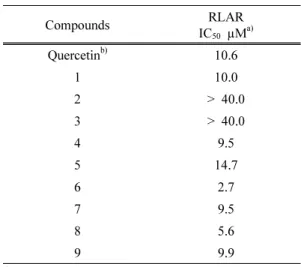
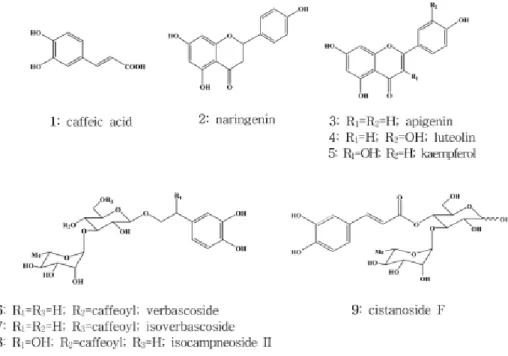
Nine compounds, caffeic acid, naringenin, apigenin, luteolin, kaempferol, verbascoside, isoverbascoside, isocampneoside II, and cistanoside F, were isolated from the EtOAc and n-BuOH fractions of P. coreana bark. The structures of these compounds (1-9) were elucidated by spectroscopic methods and literature data. All the isolates were subjected to in vitro bioassay to evaluate their inhibitory activity against rat lens aldose reductase. Among these, compounds 6 and 8 indicated the significant inhibitory activity on rat lens aldose reductase with IC
50values of 2.67 and 5.59 µM, respectively. Especially, The inhibition activity of acteoside was 3.9 times better than that of quercetin as a positive control (10.6 μM). These results suggested that phenylethanoid glycosides are likely to be the potential compounds for the pre- vention and/or treatment of diabetic complications.
Keywords : Aldose reductase inhibition, Paulownia coreana, phenylpropanoid glycosides, diabetic com- plications
1. INTRODUCTION
For a long time, many researchers have ap- plied traditional medicinal plants to treat hyper- glycemia and diabetes mellitus (Cignarella et al., 1996; Ahmed et al., 2001), and these me- dicinal plants are known to be effective in treat- ing diabetes (Kesari et al., 2005). These medici- nal plants are known to be effective in treating diabetes and expected to achieve a high level of antihyperglycemic effect without adverse re-
actions, unlike conventional antidiabetic drugs.
These medicinal plants contain polyphenol in their seeds, fruits, leaves, and barks (Prior and Gu, 2005).
Aldose reductase (EC 1.1.1.21; ALR2) is a
NADPH-specific aldo-keto oxidoreductase used
to catalyze the conversion of glucose to sorbitol
in the polyol pathway (Scheme 1), which is the
alternate route of glucose metabolism: a minor
part of nonphosphorylism: glucose (Ahmed et
al., 2001; Kesari et al., 2005). Because polyols
Scheme 1. Polyol pathway.
such as sorbitol do not readily move across the cell membranes, they can generate a severe os- motic stress causing swelling and cell damage.
Under hyperglycermia, the increased flux of glucose goes through the polyol pathway be- cause of the saturation of hexokinase with am- bient glucose. This leads to overflow of the products of the polyol pathway (Gabbay, 1973) (Scheme 1).
Through polyol pathway, glucose is turned into sorbitol by aldose reductase (AR), the first and rate-limiting enzyme in the pathway, con- comitant with conversion of NADPH into NADP
+. Another enzyme, sorbitol dehydrogen- ase, then oxidizes sorbitol to fructose. In dia- betes melitus, the increased glucose level results in sorbitol being produced at a faster rate than tis oxidation to fructose and the accumulation of sorbitol in small blood vessels, nerves, lens, rti- na, and kidney can produce a hyperosmotic ef- fect, leading to membrane permeability changes and the onset of cellular pathology (Kador et al., 1985). AR inhibitors are thus an attractive pharmacological target for the treatment of dia- betic complications.
P. coreana is a fast growing tree and has been used in the traditional medicine from an- cient times to treat cough, phlegm, carbuncle, hemorrhoid, gonorrhea, and bronchitis pneumo- nia (Kim, 1996) and also extensively used in the wood industry for furniture making, musical instruments, and handicrafts.
This study was attempted to determine the possible rat lens aldose reductase-inhibitory ef- fects of 70% acetone extracts from the bark of P. coreana, as well as the effects of its organic solvent soluble fractions, including the dichloro-
methane (CH
2Cl
2), ethyl acetate (EtOAc), n-bu- tanol (n-BuOH) and water (H
2O) layers, using DL-glyceraldehyde as a substrate. Via bioassay- guided separations of the above extracts, several flavonoids were isolated as active components.
In the present study, we tried to find out con- stituents from the barks of P. coreana and their inhibitory effects on rat lens aldose reductase (RLAR) was evaluated.
2. MATERIALS and METHODS
2.1. Gneneral and Chemical
The
1H- and
13C-NMR spectra were obtained from a Bruker Avance DPX 600 spectrometer at the operating frequency of 600 MHz (
1H) and 100 MHz (
13C), respectively. Chemical shifts were given in δ values with tetramethylsilane as an internal standard. FAB-MS was performed with a micromass Autospec M363 spectrometer using m-nitro benzyl alcohol as a matrix. DL- glycealdehyde, the reduced form of nicotinamide adenine dinucleotide phosphate (NADPH), and quercetin were purchased from Sigma (St.
Louis, MO, USA). Sephadex LH-20 (GE Health- care Bio-Science AB, Sweden) was used as the column packing material. All other chemicals and reagents were of analytical grade, and com- mercially available.
2.2. Plant Materaials
The barks of P.coreana were collected from the experimental forest of Kangwon National University in 2006. It was identified by Prof.
Wan-Geun Park of the Department of Forestry.
Avoucher specimen (No. WSE0604-2) has been
deposited at the herbarium in the Department of
Forest biomaterials Engineering, Kangwon Na-
tional University, Chuncheon, Korea.
2.3. Isolation and Identification
Air-dried barks (4.0 kg) of P.coreana were exhaustively extracted with acetone-H
2O (7:3, v/v) for 72 h at room temperature. Combined aque- ous acetone solutions were concentrated under reduced pressure and freeze dried. The crude extracts 350 g were suspended in H
2O and frac- tionated successively with n-hexane, methyl- enechloride (CH
2Cl
2), ethyl acetae (EtOAc), and butanol (BuOH), respectively. The EtOAc resi- due (16.7 g) of bark was subjected to column chromatography on SephadexLH-20, eluting with MeOH-H
2O (5:1, v/v) to give three main fractions and labeled PBE-1 (16.4 g), PBE-2 (100 mg) and PBE-3 (131 mg). Fraction PBE-1 was rechromatographed on a column for further purification with MeOH-H
2O (3:1, 1:1, 1:2, 1:3, v/v) and EtOH-Hexane (3:1, v/v) as eluting sol- vents to isolate compound 1 (caffeic acid, 266 mg) and compound 2 (naringenin, 64 mg), com- pound 6 (verbascoside, 6.33 g) and compound 7 (isoverbascoside, 872 mg). Compound 5 (kaem- pferol, 41 mg) and compound 1 (caffeic acid, 44 mg) were obtained from PBE-2 when MeOH-H
2O (3:1, v/v) was used as an eluent. PBE-3 was re- applied on a column for further purification with MeOH-H
2O (3:1, v/v) to get compound 3 (apigenin, 11 mg), compound 4 (luteolin, 39 mg). A portion of BuOH soluble fraction (38 g) was applied on column chromatography on SephadexLH-20, eluting with MeOH-H
2O (3:1, v/v) to give four fractions and labeled PBB-1 (2.4 g), PCSB-2 (33.6 g), PBB-3 (1.8 g) and PBB-4 (149 mg). PBB-4 was identified and numbered as compound 6 (isoverbascoside, 149 mg). PB-3 was further chromatographed using MeOH-H
2O (1:1, 1:4, v/v) as eluents to give compound 6 (verbascoside, 280 mg), compound 7 (isoverbascoside, 142 mg), compound 8 (isocam- pneoside II, 35 mg), compound 9 (cistanoside F, 9 mg).
2.4. Assay for Rat Lens Aldose Re- ductase (RLAR) Inhibitory Activity
Rat lenses were removed from Sprague Dawley rats weighing 250∼280 g and frozen until required. The crude aldose reductase was prepared according to the method of Hayman and Kinoshita with some modification (Hayman and Kinoshita, 1965; Lee et al., 2008). A parti- ally purified enzyme with a specific activity of 6.5 U/mg was routinely used to test the enzyme inhibition. The partially purified material was separated into 1.0 ㎖ aliquots and stored at 40°C. RLAR activity was assayed spectrophoto- metrically by measuring the decrease in the ab- sorption of NADPH at 340 nm over 4 min. pe- riod with DL-glyceraldehyde as the substrate.
Each 1.0 ㎖ cuvette contained equal units of the enzyme, 0.10 M sodium phossphate buffer (pH 6.2), 0.3 mM NADPH, with or without 10 mM of the substrate and an inhibitor. The cencentra- tion of inhibitors giving 50% inhibition of en- zyme activity (IC
50) was calculated from the least-squares regression line of the logarithmic concentrations plotted against the residual activity.
3. RESULTS and DISCUSSION
It has been acknowledged that plant-derived extracts and phytochemicals are potential alter- natives to synthetic inhibitors against AR. Cu- rrently, the compounds isolated from plants as ARIs are classified as flavonoids, stilbenes, ella- gic acid and its derivatives, and alkaloids (Kawa- nishi et al., 2003)
The 70% acetone extract of P.coreana was
shown to exert an inhibitory effect on rat lens
aldose reductase. In order to identify the active
compounds from the bark of P.coreana, the ex-
tract was systematically separated into five frac-
tions, which were then tested for inhibitory ac-
Table 2. Inhibitory effects of the compounds isolated from P. coreana bark on rat lens aldose reductase (RLAR)
Compounds RLAR
IC
50µM
a)Quercetin
b)10.6
1 10.0
2 > 40.0
3 > 40.0
4 9.5
5 14.7
6 2.7
7 9.5
8 5.6
9 9.9
a)
Inhibtion rates were calculated as percentages with respect to the control value. The concentration of each rest sample giving rise to 50% inhibition of activity (IC
50) was estimated from the least-squares regression line of the logarithmic concentration plotted against inhibitory activity.
b)
Quercetin was used as a positive control.
Table 1. Inhibitory effects of P. coreana bark on rat lens aldose reductas (RLAR) Extract and Fractions Inhibition (%)
a)70% acetone extract 65.39
Hexane fraction 32.88
CH
2Cl
2fraction 25.59
EtOAc fraction 70.79
BuOH fraction 69.32
H
2O fraction 46.13
Quercetin
b)74.23
Sample concentration was 5 µg/ ㎖.
a)
Inhibiton rates were calculated as percentages with respect to the control value.
b)