• 검색 결과가 없습니다.

Thickness Changes in the Fovea and Peripapillary Retinal Nerve Fiber Layer Depend on the Degree of Myopia

N/A
N/A
Protected

Academic year: 2022

Share "Thickness Changes in the Fovea and Peripapillary Retinal Nerve Fiber Layer Depend on the Degree of Myopia"

Copied!
5
0
0

로드 중.... (전체 텍스트 보기)

전체 글

(1)

Nerve Fiber Layer Depend on the Degree of Myopia

Sung-Won Choi, MD, Seok-Joon Lee, MD

Department of Ophthalmology, Wonju Christian Hospital. Yonsei University, Wonju College of Medicine, Wonju, Korea

Purpose: To investigate changes in the thickness of the fovea and peripapillary RNFL associated with myopia.

Methods: Sixty-five Korean adults (for a total of 130 eyes) between 23 and 26 years of age were selected as test subjects. Thirty-eight test subjects were male, and 27 were female. Subjects with glaucoma or other identified ocular diseases were excluded. Patients whose manifest refraction measurement values ranged between 0 to -2D were classified as group one (emmetropia and low myopia), those between -2 to -5D were classified as group two (moderate myopia), and those more than -5D were classified as group three (high myopia). Using the OCT, the thickness of the fovea and peripapillary RNFL were measured for every subject.

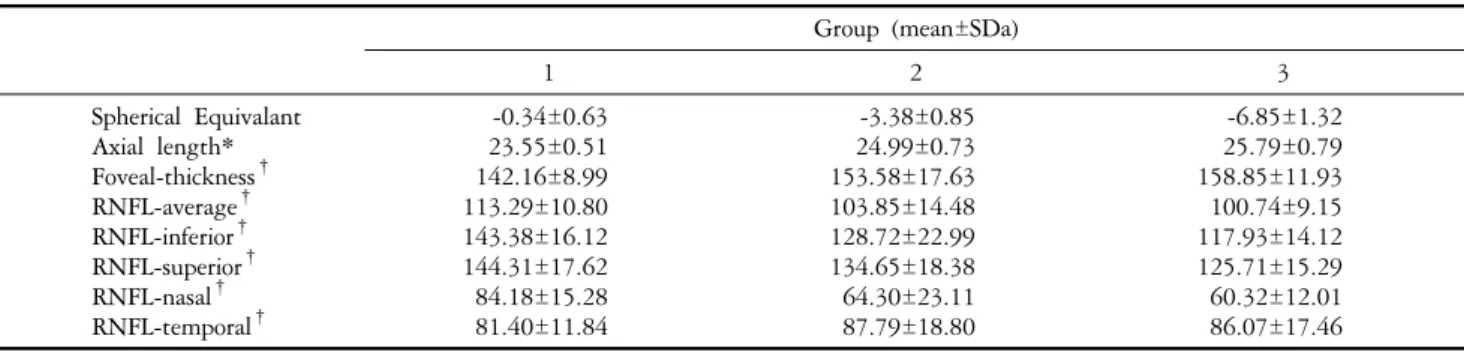
Results: The thicknesses of the fovea for each of three groups were 142.16±8.99 µm in group one (45 eyes), 153.58±17.63 µm in group two (43 eyes) and 158.86±11.93 µm in group three (28 eyes). The data showed significant differences in fovea thickness between the groups. The average thicknesses of the peripapillary RNFL for each of three groups were 113.29±10.80 µm in group one, 103.85±14.48 µm in group two and 100.74±9.15 µm in group three. A statistically significant difference was found between group one and the other groups (p<0.05).

Conclusions: As the level of myopia increased, the thickness of the fovea also increased, while the thickness of the peripapillary RNFL decreased. Therefore, when interpreting OCT results in the clinic, careful consideration should be given to various changes associated with myopia. Korean Journal of Ophthal- mology 20(4):215-219, 2006

Key Words: Foveal thickness, Myopia, Optical coherence tomography, Peripapillary retinal nerve fiber layer

Received: May 29, 2006 Accepted: November 21, 2006 Reprint requests to Seok-joon Lee, MD. Department of Ophthal- mology, Wonju Christian Hospital, Yonsei University, Wonju College of Medicine, #162 Ilsan-dong, Wonju 220-701, Korea. Tel: 82-33- 741-0633, Fax: 82-33-745-2965, E-mail: [email protected]

Many factors contribute to myopia.

1-3

In East Asia, where there has been rapid industrialization and urbanization, several reports show that the prevalence of myopia is increa- sing.

4,5

Notably, an increase in education level is associated with an increase in myopia.

6,7

In 2004, Kang et al.

8

published a Korean study relating environmental factors, such as the level of education and urbanization, to an increase in the prevalence of myopia.

Histopathologic findings associated with myopia are well documented. The sclera becomes thinner, and there is a partial expansion of the posterior pole. With choroidal degene- ration and atrophy,

9

it has been shown that the sensory retina becomes thinner.

10

In light of those changes, caution is called for when interpreting results from the fundus examination as well as other eye tests for myopia.

Recently, optical coherence tomography (OCT) has been applied to measure fovea and the peripapillary retinal nerve

fiber layer (RNFL) thickness. When the OCT projects light beams into the tissue, the difference in time of the reflected lights from each part of the tissue is measured using the optical interferometer, resulting in acquisition of high reso- lution transverse images of the retina. OCT is easy to use and highly reproducible in clinical practice.

11,12

Since OCT has been implemented in the clinic, a concern has been raised regarding the accuracy of this technique with aging. Many investigators have reported that the thickness of the fovea and the peripapillary RNFL decreases with increa- sing age.

13-17

As there are few studies to date on those changes in myopia, and what studies do exist yield incon- sistent reports,

18-20

we have evaluated the relationship between fovea and peripapillary RNFL thickness and myopic changes in healthy Korean adults.

Material and Methods

Sixty-five healthy Korean adults (for a total of 130 eyes)

between the ages of 23 and 26 were selected on the basis

of basic ophthalmic examination. Using the Snellen chart,

vision was measured. The same experimenter measured the

intraocular pressure three times in each eye with the

(2)

Group (mean±SDa)

1 2 3

Spherical Equivalant Axial length*

Foveal-thickness

RNFL-average

RNFL-inferior

RNFL-superior

RNFL-nasal

RNFL-temporal

-0.34±0.63 23.55±0.51 142.16±8.99 113.29±10.80 143.38±16.12 144.31±17.62 84.18±15.28 81.40±11.84

-3.38±0.85 24.99±0.73 153.58±17.63 103.85±14.48 128.72±22.99 134.65±18.38 64.30±23.11 87.79±18.80

-6.85±1.32 25.79±0.79 158.85±11.93 100.74±9.15 117.93±14.12 125.71±15.29 60.32±12.01 86.07±17.46

*: mm,

: μm,

a

: standard deviation.

Table 1. Summary of OCT measurement in Group Goldmann tonometer. The refractive error from the manifest refraction (MR) was adjusted to the spherical equivalent. The visual field was measured using the Humphrey

field analyzer (HFA 750i, Carl Zeiss Meditec), with the central 30-2 SITA-standard program. Every patient was instilled with a drop of Mydrin-P

(1% tropicamide and 2.5% phenyle- phrine hydrochloride) in each eye 3 times at 15 minute intervals to dilate the pupil. A fundus examination was precisely performed in all subjects.

The thicknesses of the fovea and the peripapillary RNFL were measured through the dilated pupil using the StratusOCT (Carl Zeiss Meditec, Dublin, CA). The thinnest dimension was used as the thickness of the fovea using Retinal Thickness/Volume Analysis. To determine the thickness of the peripapillary RNFL, RNFL thickness analysis on a RNFL thickness (3.46 mm) scan was used to measure the average thickness in four sectors, the superior, inferior, temporal and nasal parameters.

Any subject who had measurements outside of normal range on their basic ophthalmic examination was excluded.

The normal group included subjects with corrected vision than 20/25, an intraocular pressure between 10 to 21 mmHg, a mean deviation ≥-2.79 and a pattern standard deviation ≤ 2.24 with an adequate confidence level for the visual field test.

21,22

From the fundus examination, those included in the study had a tigroid fundus and a peripapillary chorioretinal atrophy of less than 3.46 mm from the disc, as well as an impression of myopia.

From the spherical equivalent data, measurements between zero to -2D were classified into group one (emmetropia and low myopia), measurements between -2 to -5D were classified into group two (moderate myopia), and measurements more than -5D were classified into group three (high myopia).

From the total of 130 eyes, 14 eyes were excluded from the study as their measurements fell outside of the normal range.

For the eyes studied, group one contained 45 eyes, group two contained 43 eyes, and 28 eyes were included in group three.

The SPSS 10.0 program was used for statistical analysis.

Differences among the three groups were compared using ANOVA, and multiple comparisons were performed using the Turkey’s HSD procedure. Simple regression analysis was

used to analyze changes in the axial length, the thickness of the fovea and the peripapillary RNFL depending on the differences in the spherical equivalent (p=0.05).

Results

The average of the spherical equivalents was -0.34±0.63 D in group one (45 eyes, 38.8%), -3.88±0.85 D in group two (43 eyes, 37.1%), and -6.85±1.32 D in group three (28 eyes, 24.1%). The range was 0 to -9.25. The average axial length was 24.46±1.00 mm (range, 22.31 to 26.40 mm). The spherical equivalents, axial lengths, and thickness values for the fovea and the peripapillary RNFL are shown in Table 1.

In all three groups, there were significant differences in axial length and in the thickness of the inferior RNFL. As for the foveal thickness, group one showed the thinnest thickness in the average, superior and nasal RNFL compared to the other groups. However, for all three groups, there were no significant differences in the thickness of the temporal RNFL.

As myopia increased, changes in other parameters were evaluated by simple regression analysis. The axial length of the eye became longer (P<0.001; Fig. 1), and the thickness

Fig. 1. Relationship between axial length and myopia.

(3)

Fig. 2. Relationship between foveal thickness and myopia.

Fig. 3. Relationship between RNFL-average thickness and myopia.

Fig. 4. Relationship between RNFL-inferior thickness and myopia.

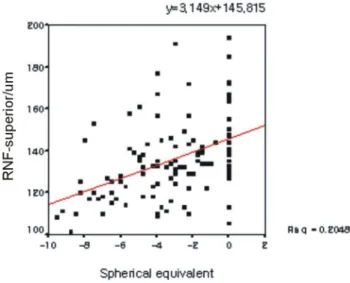
Fig. 5. Relationship between RNFL-superior thickness and myopia.

Fig. 6. Relationship between RNFL-nasal thickness and myopia.

Fig. 7. Relationship between RNFL-temporal thickness and myopia.

(4)

of the fovea significantly increased (P<0.001; Fig. 2).

Conversely, the thickness of the average, superior, inferior and nasal RNFL decreased (P<0.001; Figs. 3, 4, 5, 6). There was no correlation between myopia and thickness of the temporal RNFL (P=0.236; Fig. 7).

Discussion

Histopathologic findings of the sensory retina and cho- roidal atrophy of the choroid in myopia are well known.

9,10,23

However, tissue samples used to measure thickness of the retina are very sensitive to the condition of the specimens, such as hydration. This leads to wide variations in the measurements.

14,15

Therefore, the OCT and the Retinal Thickness Analyzer have been employed to give accurate and reproducible measurements.

14,15,18-20,24,25

Since Huang et al.

24

first introduced the OCT in 1991, it has become the most widely used piece of equipment in the eye clinic. The OCT is a noninvasive imaging technology, which needs no direct contact with the eye. It is analogous to the B-scan of the ultrasonograph, using light beams instead of sound waves. Time differences in reflected light from each part of the tissue are measured using optical interferometry.

In this study, we used the StratusOCT (Carl Zeiss Meditec, Dublin, CA), which projects a broad bandwidth near-infrared light beam (820 nm) onto the retina from a super luminescent diode. The longitudinal (depth) scan range is 2 mm into the tissue.

26

The StratusOCT has a smaller footprint, can scan four times faster, and store 10 times as much data than earlier models.

25

The StratusOCT model used in this study is known for its reproducibility and reliability.

11

One experimenter tested all subjects. The OCT test was performed when the pupil was dilated more than 5 mm, with internal fixation used to avoid fixation loss during the test.

Healthy Korean adults between the ages of 23 and 26 were selected to exclude age related differences. The range of the spherical equivalents was 0 to -9.25D, which is within the focus adjustment range of the OCT (-12 to +20D) suggested by Huang et al.

24

Group one, classified as emmetropia, represents healthy Korean adults. In this study, the thickness of the average, superior, inferior, temporal and nasal RNFL were similar to that reported by Lee et al.

27

Our results showed the characteristic double hump pattern

28

of the normal eye, where the superior and inferior RNFL was the thickest. The thickness of the fovea was 142.16±8.99 μm, similar to that in previous reports.

13,20,29

Except for the thickness of the temporal RNFL, there was a statistically significant differ- ence between the myopia (groups 2 and 3) and emmetropia (group 1) (P<0.05), especially in the axial length and thickness of the inferior RNFL. As myopia increased, the thickness of the fovea increased, while the thickness of the RNFL decreased. This relationship to myopia is shown in Fig. 1-7. The R-squared correlation was the highest (0.67) for axial length, and thickness of the inferior and nasal RNFL

was the next highest value observed. However, the thickness of the temporal RNFL was not correlated to myopia (P=0.23).

Our findings are inconsistent with those reported by Mrugacz et al.

12

who showed that as myopia increased, the thickness of the fovea decreased while the thickness of the peripapillary RNFL remained unchanged. However, other authors

19,20

had results consistent with our study, where the thickness of the fovea increased as myopia increased. Few reports concerning the relationship between myopia and thickness of RNFL have been issued to date. Mrugacz et al.

used the OCT 2000 and 60 eyes for their experiment, fewer cases than used in our study. In addition, the subjects that participated in Mrugacz et al.’s study were between the ages of 14 and 18, which makes comparison with our data difficult, as all of our subjects were adults.

In conclusion, we found that as myopia increased, the thickness of the fovea increased , while the thickness of the RNFL decreased, except for the temporal RNFL. Therefore, more attention is required to accurately interpret OCT results in patients with high degrees of myopia.

References

1. Hammond CJ, Shnieder H, Gilbert CE, Spector TD. Genes and environment in refractive error : The twin eye study.

Invest Ophthalmol Vis Sci 2001;42:1232-6.

2. Young FA. The nature and control of myopia. J Am Optom Assoc 1977;48:451-7.

3. Mutti DO, Mitchell GL, Moeschberger ML, et al. Parental myopia, near work, school achievement, and children's refractive error. Invest Ophthalmol Vis Sci 2002;43:3633-40.

4. Lin LL, Shih YF, Hsiao CK, et al. Epidemiologic study of the prevalence and severity of myopia among school- children in Taiwan in 2000. J Formos Med Asso 2001;100:

684-91.

5. Wong TY, Foster PJ, Hee J, et al. Prevalence and risk factors for refractive errors in adult Chinese in Singapore.

Invest Ophthalmol Vis Sci 2000;41:2486-94.

6. Au Eong KG, Tay TH, Lim MK. Education and myopia in 110,236 young Singaporean males. Singapore Med J 1993;

34:489-92.

7. Tay MT, Au Eong KG, Ng CY, Lim MK. Myopia and educational attainment in 421,116 young Singaporean males. Ann Acad Med Singapore 1992;21:785-91.

8. Kang SH, Kim PS, Choi DG. Prevalence of Myopia in 19-year-old Korean Males : The Relationship between the Prevalence and Education or Urbanization. J Korean Ophthalmol Soc 2004;45:2082-7.

9. Curtin BJ, Karlin DB. Axial length measurements and fundus changes of the myopic eye. Am J Ophthalmol 1971;

1:42-53.

10. Yanoff M, Fine BS. Ocular pathology: A text and atlas, 3rd ed. JB Lippincott, 1989;408

11. Budenz DL, Michael A, Chang RT, et al. Senditivity and Specificity of the StratusOCT for perimetric Glaucoma.

Ophthalmology 2005;112:3-9.

12. Malgorzata M, Alina BL, Dorota SK. Use of optical coherence tomography in myopia. J Pediatr Ophthalmol Strabismus 2004;41:159-62.

13. Kanai, Abe T, Murayama K. Retinal thickness and changes

(5)

with age. Nippon Ganka Gakkai Zassbi 2002;106:162-5.

14. Asrani S, Zou S, d'Anna S, et al. Noninvasive mapping of the normal retinal thickness at the posterior pole.

Ophthalmology 1999;106:269-73.

15. Hee-jin Jung, Jae Hoon Hyun, Young Il Kim, et al. Normal macular thickness measured macular mapping of OCT3. J Korean Ophthalmol Soc 2004;45:962-8.

16. Balazsi AG, Rootman J, Drance SM, et al. The effect of age on the nerve fiber population of the hyman optic nerve.

Am J Ophthalmol 1984;97:760-6.

17. Johnson BM, Miao M, et al. Age-related decline of human optic nerve axon populations. Age 1987;10:5-9.

18. Gobel W, Hartmann F, Haigis W. Determination of retinal thickness in relation to the age and axial length using optical coherence tomography. Ophthalmology 2001;98:157- 62.

19. Wong AC, Chan CW, Hui SP. Relationship of gender, body mass index, and axial length with central retinal thickness using optical coherence tomography. Eye 2005;19:292-7.

20. Lim MC, Hoh ST, Foster PJ, et al. Use of optical coher- ence tomography to assess variations in macular retinal thickness in myopia. Invest Ophthalmol Vis Sci 2005;

46:974-8.

21. Park WS, Lee SH. Comparison between New Threshold Visual Field Strategy, SITA - standard and Full Threshold

Strategy and Their Clinical Usefulness. J Korean Ophthalmol Soc 2000;41:1187-91.

22. Bengtsson B, Olsson J, Heijl A. A new generation of algorithms for computerized threshold perimetry, SITA.

Acta Ophthalmol Scand 1997;75:368-75.

23. Grossniklaus HE, Green WR. Pathologic findings in pathologic myopia. Ophthalmology 1992;12:127-33.

24. Huang D, Swanson EA, Lin CP, et al. Optical coherence tomography. Science 1991;254:1178-81.

25. Kent C. Creating a “virtual biopsy”: improvements in technology make it possible to “see” more internal tissue than ever before. Ophthalmology Management 2002;6:111- 2.

26. StratusOCT user manual 2003;4.

27. Lee JH, Ahn CS, Lee DY. Qauntification of retinal nerve fiber layer thickness in the normal subjects using optical coherence tomography. J Korean Ophthalmol Soc 1999;40:

2804-15.

28. Caprioli J, Ortiz-Colberg R, Miller JM, et al. Measurement of peripapillary nerve fiber layer contour in glaucoma. Am J Ophthalmol 1989;108:404-13.

29. Lee DY, Yu SY, Kwak HW. Quantitative analysis of

macular thickness with OCT map. J Korean Ophthalmol

Soc 2004;45:1496-502.

수치

Fig. 1. Relationship  between  axial  length  and  myopia.
Fig. 2. Relationship  between  foveal  thickness  and  myopia.

참조

관련 문서

Purpose: We investigated changes in the thickness of the peripapillary retinal nerve fiber layer (RNFL) following the onset of an epiretinal membrane (ERM) in glaucoma

Purpose: To evaluate changes in the peripapillary retinal nerve fiber layer RNFL thicknesses using spectral-domain optical coherence tomography SD-OCT in hydroxychloroquine HCQ

Average thickness, four-quadrant RNFL thicknesses, and intraocular pressure (IOP) in affected eyes were measured before and 6 and 12 months after anti-VEGF injection for

In conclusion, the average and nasal RNFL thicknesses were significantly thinner in migraine patients compared to healthy subjects and the RNFL thicknesses were thinner in the

Purpose: To examine the effects of panretinal photocoagulation (PRP) using a pattern scanning laser (PASCAL) system on the retinal nerve fiber layer (RNFL) thickness in patients

Purpose: To evaluate the association between age and peripapillary retinal nerve fiber layer (RNFL) thickness measured by Cirrus high-definition (HD) spectral domain optical

Purpose: To compare the peripapillary retinal nerve fiber layer (RNFL) thickness of normal patients and those with various glaucoma diseases by time domain (Stratus) and

Baseline optical coherence tomography was employed to measure retinal thickness in the macula (horizontal, vertical, and central) and the peripapillary zone (superior, inferior,