INTRODUCTION
During a survey for the exploration of coastal fishes in Korea with SCUBA gear, we encountered an interesting bottom-dwelling goby at a depth of about 15m in the southern coastal waters of Jejudo Island, Korea, in June 2015. The goby was smaller than 10cm in length with three blackish saddles on a dark brownish body when alive and was found amongst rubble and on sandy substrates of a relatively steep reef slope. In late September of the same year, two specimens were collected for the first time by a combination of hand net and homemade angling at similar depths from the same locality.
These specimens had well-developed cutaneous sen- sory papillae on the head and were easily identified as a member of the goby genus Callogobius Bleeker, 1874, comprising about currently 25 valid species worldwide among 49 nominal species(Eschmeyer and Fricke, 2016).
Of these, the following 10 species have been known from the northwestern Pacific: C. hasseltii(Bleeker, 1851); C.
sclateri(Steindachner, 1879); C. okinawae(Snyder, 1908);
C. tanegasimae(Snyder, 1908); C. maculipinnis(Fowler, 1918); C. shunkan Takagi, 1957; C. flavobrunneus(Smith, 1958); C. hastatus McKinney and Lachner, 1978; C. cras- sus McKinney and Lachner, 1984; Callogobius sp.(sensu Akihito et al., 2013). Although no individuals have been known from the Korean waters until now, we identified the specimens as Callogobius shunkan Takagi, based on mor- phological accordance with the original description of the species. The species has been known from the Western Pa- cific, including the east coast of northern Australia, Indo- nesia, and north to Japan. In the present study, we therefore describe C. shunkan as the first record from Korean waters based on two specimens(54.9~66.1mm standard length, SL) collected from the southern waters of Jejudo Island.
Counts and measurements generally followed those of Hubbs and Lagler(1964), and the numbering system of sensory papillae rows was those of Akihito and Meguro (1977) and Delventhal and Mooi(2013). The numbers of vertical fin rays and vertebrae were determined using radiographs(Softex CMB-2, Japan). The dorsal fin ptery- giophore formula(P-V) followed those of Akihito(1984) in describing the pattern of the interdigitation of the dor- sal fin pterygiophores between the neural spines. Voucher specimens are deposited in the fish collection at the Natio- nal Institute of Biological Resources(NIBR-P), Kor ea.
—251 — http://www.fishkorea.or.kr
저자 직위: 안정현(전문위원), 김병직(환경연구관), 김상길(대표)
* Corresponding author: Byung-Jik Kim Tel: 82-32-590-7475, Fax: 82-32-590-7250, E-mail: [email protected]
ISSN: 1225-8598(Print), 2288-3371(Online). DOI: https://doi.org/10.35399/ISK.32.4.7
Accepted: December 18, 2020
First Record of a Goby, Callogobius shunkan(Perciformes: Gobiidae) from the Southern Coastal Waters of Jejudo Island, Korea
By Jung-Hyun An1,2, Byung-Jik Kim2,* and Sang-Kil Kim3
1Division of Life Sciences, College of Life Sciences, Incheon National University, Incheon 22012, Republic of Korea
2Biological Resources Research Department, National Institute of Biological Resources, Incheon 22689, Republic of Korea
3PADI 5 Star IDC Center, Good Diver, Jeju 63558, Republic of Korea
ABSTRACT We described the first record of Callogobius shunkan from Korea, based on two specimens(54.9~66.1mm in standard length) collected from the southern coastal waters of Jejudo Island. These specimens were characterized by prominent papillae ridges on the head, including postnasal and postorbital rows, well-developed pelvic frenum, dark brownish head, scattered whitish flecks on the body, and three blackish spots on the basal portion of dorsal fins. We proposed a new Korean name, “Ju-reum-mang-dug” for the species.
Key words: Callogobius shunkan, goby, Ju-reum-mang-dug, Jejudo Island
TAXONOMIC ACCOUNTS Genus Callogobius Bleeker, 1874 (New Korean name: Ju-reum-mang-dug-sog) Callogobius Bleeker, 1874: 318(type species: Eleotris has-
seltii Bleeker).
Head compressed at preopercular portion; interorbital regi on narrower than eye diameter; both nostrils tubular and anterior one longer, reaching upper margin of upper lip when depressed; lower jaw more projected than upper jaw, posterior tip of maxilla not beyond anterior margin of eye;
lower margin of gill opening beyond posteriorly anterior margin of pelvic girdle; teeth on both jaw unicuspidal. Pit organs on head a single row, pits opening on dermal fold, and teeth on outer row large(Akihito and Meguro, 1977).
Callogobius shunkan Takagi, 1957 (New Korean name: Ju-reum-mang-dug)
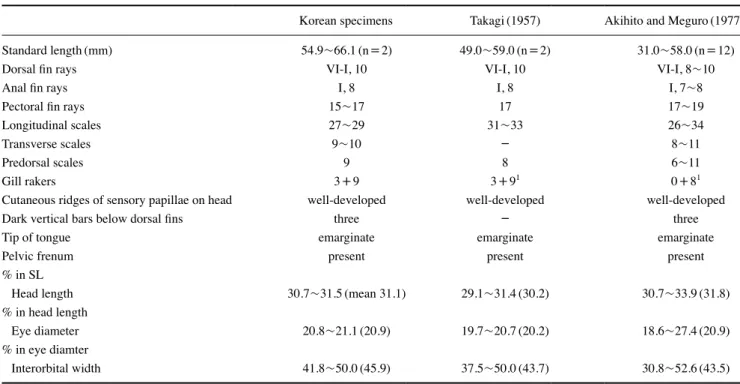
(Figs. 1~2; Table 1)
Callogobius shunkan Takagi, 1957: 112, pl. 5, fig. d(type locality: Matsugaura Chiran, Kagoshima Prefecture, Jap- an); Motomura et al., 2015: 29(Uji Island, Japan).
Callogobius snelliusi: Akihito and Meguro, 1977: 119(Jap- an); Akihito et al., 2002: 1169(Japan).
Material examined. Two specimens: NIBR-P0000041563, 66.1mm in standard length(SL), NIBR-P0000041564, 54.9mm in SL, collected off Beophwan-dong, Seogwipo- si, Jeju-do, Korea, at 15.6~16.6m depths, on 23 Septem- ber 2015, by Byung-Jik Kim and Gang-Il Choi, SCUBA gear, a hand net or homemade angling.
Diagnosis. A small goby species with prominent papillae ridges on head, including postnasal and postorbital rows, well-developed pelvic frenum, dark brownish head, scat- tered whitish flecks on body, and three blackish spots on basal portion of dorsal fins when fresh.
Description. Dorsal fin rays VI-I, 10; anal fin rays I, 8;
pectoral fin rays 15~17, upper- and lowermost one or two rays unbranched; pelvic fin rays, I, 5, forming sucking disc, pelvic frenum well-developed; principal caudal fin rays 17; gill rakers 3+9=12; vertebrae 26; P-V 3/II II I I 0/9; scales in longitudinal row 27~29; scales in transverse row 9~10; predorsal scales 8~9. Proportion of percentage in SL: body depth at origin of pectoral fin 17.3~18.5(mean 17.9); body depth at anal fin origin 17.3~17.7(17.5); body width 18.4~18.6(18.5); head length 30.7~31.5(31.1);
head width 23.3~23.5(23.4); eye diameter 6.5~6.6(6.5);
interorbital width 2.7~3.3(3.0) at bony part; snout length
10.3~10.7(10.5); cheek depth 6.7~7.1(6.9); upper jaw length 9.7~9.8(9.8); postorbital length 14.7~15.5(15.1);
snout to origin of first dorsal fin 36.2~36.8(36.5); snout to origin of second dorsal fin 54.8~55.4(55.1); snout to origin of pectoral fin 29.5~29.7(29.6); snout to origin of pelvic fin 29.0~29.7(29.4); snout to origin of anal fin 59.8~62.1(60.9); base of dorsal fins 43.0~46.4(44.7);
length of first dorsal fin 16.8~24.2(20.5); length of sec- ond dorsal fin 17.1~21.7(19.4); length of third dorsal spine 16.2~16.6(16.4); length of second dorsal fin spine 12.6~13.2(12.9); length of longest soft dorsal ray(pen- ultimate ray) 18.6~21.0(19.8); length of anal fin spine 6.6~7.1(6.8); length of longest anal soft ray(penultimate ray) 20.4~22.8(21.6); length of pectoral fin 25.9~27.7 (26.8); length of pelvic fin 21.7~24.7(23.2); length of pelvic spine 6.1~6.2(6.1); length of caudal fin 26.6~26.9 (26.8); depth of caudal peduncle 13.3~13.5(13.4); length
Fig. 1. Two fresh specimens(A: above, NIBR-P0000041563, 66.1mm SL, male; below, NIBR-P0000041564, 54.9mm SL, female) and under- water photograph(B: Seopseom Island, Jeju-do, Korea, 26 Septem- ber, 2019) of Callogobius shunkan, from the southern coastal waters of Jeju do Island, Korea.
A
B
of caudal peduncle 22.6~24.4(23.5).
Body elongate, cylindrical anteriorly, and slightly com- pressed posteriorly with rather slender caudal peduncle.
Head moderate and somewhat depressed anteriorly; papil- lae ridges well-developed. Mouth small and oblique, lower jaw slightly longer than upper jaw, its posterior tip reaches a vertical at posterior nostril; small conical teeth on upper and lower jaws, in three to four and five to six irregular rows, respectively, outer row enlarged; vomer and palatines without teeth; nostrils tubular, anterior nostril longer than posterior one. Eye rather large, situated dorsally and inter- orbital space very narrow. Tongue emarginated with a shallow groove at its tip and fused with mouth floor with a thin membrane. Gill opening not wide and gills fused with isthmus. Dorsal fins two and nearly connected to each other by a minute membrane; second dorsal fin slightly lower than first dorsal fin and of nearly equal height as anal fin.
First and second spinous rays of first dorsal fin longer than those of other rays. Second dorsal fin and anal fin opposite and similar in shape as each other. Pectoral fin rather large, all rays branched, and its posterior margin reaches a vertical at second dorsal fin origin. Pelvic fin rather large and pelvic frenum well-developed. Caudal fin round and fan-like.
Body with large ctenoid scales except anterior portion of head. Predorsal region and upper part of opercle with cycloid scales. Snout, ventral sides of head, and gill mem- brane naked.
Cephalic sensory canal pores(Fig. 2): B’, C(single), D (single), E, F, G, and H’ on preoculoscapular canal; K’and L’ on postoculoscapular canal; M’, N, and O’ on preoper- cular canal.
Papillae row configuration(Fig. 2): internasal row(Row 1) short; postnasal row rather long and between posterior nostrils(2); interorbital row(3) on anteromedial region between orbitals; oblique premaxillary row(4) very short;
preorbital row(5) below nostrils; upper longitudinal pre- maxillary row(6) rather short; lower longitudinal premaxil- lary row(7); transverse maxillary(8), anterior suborbital(9), and mid suborbtial(10) rows on anterior portion of cheek;
posterior suborbital row(11); longitudinal cheek row(12);
transverse cheek row(13); longitudinal maxillary row(14) long beyond transverse cheek row posteriorly; longitudinal mandibular row(15) very long along mandible; transverse mandibular rows(16) three and short; postorbital row(17);
upper cranial row(18); lower cranial row(19) on dorsola- terally; preopercular row(20) restricted on upper region of preopercle; transverse opercular row(21) long along ante- rior region of opercle; oblique opercular row(22); suboper- cular row(23) rather short; intermandibular(24) on medial region of lower jaw.
Color when fresh. Head and body uniformly dark brown with whitish flecks. First dorsal fin yellowish brown with five pale pinkish oblique stripes and second dorsal fin dark brown with three to four rows of pale pinkish dots. Bases of first and second dorsal fins with single and double dots, respectively. Pectoral fin dark brown with irregular whitish stripes and its distal margin whitish. Pelvic and anal fins uniformly blackish with white distal margin. Caudal fin dark with irregular whitish speckles.
Color after preservation. Nearly same as when fresh,
Fig. 2. Dorsal(above), lateral(middle), and ventral(below) aspects of head region in Callogobius shunkan(NIBR-P0000041563, 66.1mm SL) showing the cephalic sensory canal and papillae. Bar indicates 10mm.
except lighter brown on head and body, and yellow and pink color disappeared from body.
Distribution. Known from Hong Kong, Japan(Akihito and Meguro, 1977; Akihito et al., 2013), and Korea(present study).
Remarks. The specimens collected from the southern coastal waters of Jejudo Island, Korea, were readily assig- ned as a member of the genus Callogobius Bleeker, based on well-developed cutaneous ridges of sensory papillae on the head(Akihito and Meguro, 1977). Among the 10 valid Callogobius species known from the northwestern Pacific, including Callogobius sp.(sensu Akihito et al., 2013), the present specimens were in good agreement with C. shunkan Takagi, 1957. The specimens had prominent papillae ridges on the head including postnasal and postorbital rows, well-developed pelvic frenum, dark brownish head and body with scattered whitish flecks, and three blackish spots on the basal portion of dorsal fins, as well as major mor- phometric characters, as shown in Table 1. There was a slight difference in the total number of gill rakers between the present study and Akihito and Meguro(1977). However, it is likely that they missed some small rakers on the upper limb of the gill arch due to their minute size. Although Takagi(1964) treated C. shunkan as a junior synonym of C. snelliusi Koumans, 1953 without any taxonomical con- sideration, and Akihito and Meguro(1977) subsequently
followed Takagi’s treatment of the species(Akihito et al., 2013), Takagi(1957) clearly noted that C. shunkan differs from the similar species C. snelliusi Koumans, 1953 in 10 dorsal and 8 anal soft rays, lower body height, smaller eye, longer snout, and emarginated tongue at the tip. In addition, Akihito et al.(2013: 2125) suggested C. shunkan as a valid species distinguishable from C. snelliusi by the head charac- teristics, as well as the distribution pattern of scales on the ventral side of the head. The Korean specimens have many small scales on their head, and their anterior limit on the ventral head region is below the preopercle, as mentioned by Akihito et al.(2013). The new Korean name, “Ju-reum- mang-dug”, refers to having dermal folds for sensory papillae on the head.
ACKNOWLEDGEMENTS
We express our thanks to Mr. Gang-Il Choi(Good Diver, Jeju, Korea) for his support in collecting the specimens during fieldwork. We would like to thank Editage(www.
editage.co.kr) for English language editing. This work was supported by a grant from the National Institute of Biolo- gical Resources, funded by the Ministry of Environment of the Republic of Korea(NIBR No. 201501117).
Table 1. Comparison of diagnostic characters of Callogobius shunkan between the present study and previous works
Korean specimens Takagi(1957) Akihito and Meguro(1977)
Standard length(mm) 54.9~66.1(n=2) 49.0~59.0(n=2) 31.0~58.0(n=12)
Dorsal fin rays VI-I, 10 VI-I, 10 VI-I, 8~10
Anal fin rays I, 8 I, 8 I, 7~8
Pectoral fin rays 15~17 17 17~19
Longitudinal scales 27~29 31~33 26~34
Transverse scales 9~10 - 8~11
Predorsal scales 9 8 6~11
Gill rakers 3+9 3+91 0+81
Cutaneous ridges of sensory papillae on head well-developed well-developed well-developed
Dark vertical bars below dorsal fins three - three
Tip of tongue emarginate emarginate emarginate
Pelvic frenum present present present
% in SL
Head length 30.7~31.5(mean 31.1) 29.1~31.4(30.2) 30.7~33.9(31.8)
% in head length
Eye diameter 20.8~21.1(20.9) 19.7~20.7(20.2) 18.6~27.4(20.9)
% in eye diamter
Interorbital width 41.8~50.0(45.9) 37.5~50.0(43.7) 30.8~52.6(43.5)
Superscription means the number of specimen examined.
REFERENCES
Akihito, P. 1984. Suborder Gobioidei. In: Masuda, H., K. Amaoka, C. Araga, T. Uyeno and T. Yoshino(eds.), The fishes of the Japanese Archipelago. Tokai Univ. Press, Tokyo, Japan, pp.
236-238.
Akihito, P. and K. Meguro. 1977. Five species of the genus Cal- logobius found in Japan and their relationships. Japan. J.
Ichthyol., 24: 113-117.
Akihito, P., K. Sakamoto, Y. Ikeda and K. Sugiyama. 2002. Gobioi- dei. In: Nakabo, T.(ed.), Fishes of Japan with pictorial keys to the species, English ed. Tokai Univ. Press, Tokyo, Japan, pp. 1139-1310.
Akihito, P., K. Sakamoto, Y. Ikeda and M. Aizawa. 2013. Gobioidei.
In: Nakabo, T.(ed.), Fishes of Japan with pictorial keys to the species, 3rd ed. Tokai Univ. Press, Kanagawa, Japan, pp.
1349-1541.
Bleeker, P. 1851. Over eenige nieuwe soorten van Blennioïden en Gobioïden van den Indischen Archipel. Natuurk. Tijdschr.
Ned.-Indië, 1: 236-258.
Bleeker, P. 1874. Esquisse d’un système naturel des Gobioïdes.
Arch. Néerl. Sc. Exact., 9: 289-331.
Delventhal, N.R. and R.D. Mooi. 2013. Callogobius winterbottomi, a new species of goby(Teleostei: Gobiidae) from the western Indian Ocean. Zootaxa, 3630: 155-164.
Eschmeyer, W.N. and R. Fricke. 2016. Eschmeyer’s catalog of fishes:
genera, species, references. Available at: http://reserch arch ive.
calcademy.org/research/ichthyology/catalogfishcatmain.asp., (accessed 5 Jan. 2016).
Fowler, H.W. 1918. New and little-known fishes from the Philippine Islands. Proc. Acad. Nat. Sci. Philadelphia, 70: 2-71.
Hubbs, C.L. and K.F. Lagler. 1964. Fishes of the Great Lakes region.
University of Michigan Press, Ann Arbor, U.S.A., xv+213pp.
Koumans, F.P. 1953. Biological results of the Snellius expedition, XVI: The Pisces and Leptocardii of the Snellius expedition.
Temminckia, 9: 177–275.
McKinney, J.F. and E.A. Lachner. 1978. Two new species of Callogo- bius from Indo-Pacific waters(Teleostei: Gobiidae). Proc.
Biol. Soc. Wash., 91: 203-215.
McKinney, J.F. and E.A. Lachner. 1984. Callogobius crassus, a new fish from the Indo-Pacific region(Teleostei: Gobiidae). Proc.
Biol. Soc. Wash., 97: 627-631.
Motomura, H., A. Habano, Y. Arita, M. Matsuoka, K. Furuta, K.
Koeda, T. Yoshida, Y. Hibino, B. Jeong, S. Tashiro, H. Hata, Y. Fukui, K. Eguchi, T. Inaba, T. Uejo, A. Yoshiura, Y. Ando, Y. Haraguchi, H. Senou and K. Kuriiwa. 2015. The Ichthyo- fauna of the Uji Islands, East China Sea: 148 new records of fishes with notes on biogeographical implications. Mem. Fac.
Fish. Kagoshima Univ., 64: 10-34.
Smith, J.L.B. 1958. The fishes of the family Eleotridae in the western Indian Ocean. Ichthyol. Bull. Dept. Ichthyol., Rhodes Univ., 11: 137-163, pls. 1-3.
Snyder, J.O. 1908. Descriptions of eighteen new species and two new genera of fishes from Japan and the Riu Kiu Islands. Proc. U.
S. Natl. Mus., 35: 93-111.
Steindachner, F. 1879. Ichthyologsche Beiträge(VIII). Sitz.-Ber. K.
Akad. Wiss., math.-naturwiss. Kl., 80: 119-191, pls. 1-3.
Takagi, K. 1957. Description of some new goboid fishes of Japan, with a proposition on the sensory line system as a taxonomic character. J. Tokyo Univ. Fish., 43: 97-126.
Takagi, K. 1964. Studies on the comparative morphology, phylogeny, distribution, and ecology of gobioid fishes in the Japanese waters. Doctoral Thesis, Kyoto University, Japan, iii+273pp., 47 pls.
제주도 남부 연안 해역에서 채집된 농어목 망둑어과 한국첫기록종, Callogobius shunkan
안정현1,2·김병직2·김상길3
1인천대학교대학원 생물학과, 2국립생물자원관 생물자원연구부, 3제주굿다이버
요 약 : 우리나라 연안성 어류자원 미발굴 분류군 탐색을 위해 제주도 남부 연안해역에서 SCUBA를 이용한 수
중조사 과정 중 2015년 9월 수심 약 15미터에서 망둑어과 한국첫기록종인 Callogobius shunkan 2개체(표준 체장
54.9~66.1mm)를 채집하였다. 본 종은 살아있을 때 암갈색 바탕에 등지느러미 기저부에서 시작하는 3개의 흑갈색
안상반문이 있는 점, 두부 감각관과 잘 발달된 피습에 공기열이 배열되어 있는 점(특히 비공과 안와 후방에 공기열
이 있는 점), 배지느러미막이 잘 발달된 점, 흑갈색 바탕의 체색에 백색 반점이 산재하는 특징이 있다. 본 종의 신한
국명으로 ‘주름망둑’을 제안한다.
찾아보기 낱말 : Callogobius shunkan, 망둑어류, 주름망둑, 제주도