731
Copyright © 2017 The Korean Society of Fisheries and Aquatic Science pISSN:0374-8111, eISSN:2287-8815
서 론
전복류
(Haliotis spp.)
의 국내 양식총생산양은2000
년에는20
톤에 불과하였으나2016
년에는12,346
톤으로증가하였으 며,
세계양식총생산양은2000
년에는2,540
톤에불과하였으 나2015
년에는139,594
톤으로크게증가하여서(FAO, 2017)
전복의양식대상종으로서의중요성은앞으로도지속될것으로 예상된다.
양어용배합사료뿐만아니라전복용배합사료에서 도동물성단백질공급원으로서어분(fish meal)
은폭넓게사용 되고있다.
그러나어분의국제가격이매년상승하고있는추 세에있기때문에이들어분을대체할수있는사료원의개발이절실히필요한실정이다
.
수산용배합사료내어분대체원으 로서가장선호되는단백질원중의하나가대두박이다.
대두박 은가격이어분에비하여저렴하고공급이안정적일뿐만아니라단백질함량
(45-55%)
이다른곡물류에비하여비교적높으며
,
옥수수나다른곡물류에부족하기쉬운lysine, tryptophan, threonine, isoleucine, valine
과같은필수아미노산이풍부하여 동물 사료용식물성단백질원으로서우수하다고 인식되어 왔 다(Emmert and Baker, 1997; Storebakken et al., 2000; Kim et al., 2012).
대두박은넙치(Paralichthys olivaceus),
무지개송 어(Oncorhynchus mykiss),
방어(Seriola quinqueradiata), tin foil barb (Barbodes altus), cobia (Rachycentron canadum)
와까막전복(Haliotis discus) 치패용 EP (Extruded pellet)사료내 어분과 다시마(Saccharina japonica) 대체원으로서 대두박과 생미강의 대체 효과
김희성·정해승
1·김준
1·윤아영
1·이기욱·조성환
1*
한국해양대학교 해양생명과학부, 1한국해양대학교 해양과학기술전문대학원
Substitution Effect of Fish Meal and Saccharina with Soybean Meal and Rice Bran in the Extruded Pellet on Juvenile Abalone Haliotis discus (Reeve 1846)
Hee Sung Kim, Hae Seung Jeong
1
, June Kim1
, Ahyeong Yun1
, Ki Wook Lee and Sung Hwoan Cho1
*Department of Convergence Study on the Ocean Science and Technology, Korea Maritime University, Busan 49112, Korea
1Division of Marine Environment and BioScience, College of Ocean Science and Technology, Korea Maritime University, Busan 49112, Korea
Substitution effect of fish meal and Saccharina japonica with soybean and rice bran in extruded pellet (EP) on ju- venile abalone was determined. Two thousand five hundred and twenty juvenile abalone were distributed into 36 plastic containers. Four EP were prepared and extruder-pelletized. Twenty percent fish meal, 12% soybean meal and 14% Saccharina japonica were included in the Control diet. Fifty percent of fish meal, combined 50% of fish meal and Saccharina japonica , and 100% of fish meal and Saccharina japonica were substituted with the same amount of soybean meal, and combined soybean meals and rice brans, referred to as FS50, FS50+SS50 and FS100+SS100 diets, respectively. Four domestic and 3 imported commercial diets for abalone and salted Saccharina japonica were prepared. The diets were fed to abalone once a day for 16 weeks. The highest survival was obtained in abalone fed FS50+SS50 diet. Weight gain and SGR of abalone fed FS50+SS50 diet was higher than those of abalone fed the FS50 and FS100+SS100 diets. Proximates of abalone was affected by dietary nutrient composition. In conclusion, 50% fish meal and combined 50% fish meal and Saccharina japonica could be replaced with the same amount of soybean meal and combined soybean meal and rice bran in EP of abalone.
Key words: Abalone Haliotis discus ( Reeve 1846 ), Fish meal, Saccharina japonica , Soybean meal, Rice bran
This is an Open Access article distributed under the terms of the Creative Commons Attribution Non-Commercial Licens (http://creativecommons.org/licenses/by-nc/3.0/) which permits unrestricted non-commercial use, distribution, and reproduction in any medium, provided the original work is properly cited.
https://doi.org/10.5657/KFAS.2017.0731 Korean J Fish Aquat Sci 50(6) 731-737, December 2017
Received 10 October 2017; Revised 30 October 2017; Accepted 14 November 2017
*Corresponding author: Tel: +82. 51. 410. 4755 Fax: +82. 51. 404. 4750
E-mail address: [email protected]
같은다양한어종의배합사료내어분대체원
(Viyakarn et al., 1992; Elangovan and Shim, 2000; Choi et al., 2004; Chou et al., 2004; Heikkinen et al., 2006)
으로서뿐만아니라전복(H.
discus hannai)
용배합사료내카제인이나어분대체원으로서도우수한단백질원
(Uki et al., 1985; Lee et al., 1998; Cho, 2010)
이라고알려진바있다.
특히, Cho (2010)
는전복치패용배합사 료내어분대체원으로서대두박과대두박에부족하기쉬운me- thionine
의0.5%
혼합대체시배합사료내함유되어있는35%
어분을전량대체가능하다고보고하였다
.
자연상태에서전복의먹이뿐만아니라배합사료제조시에도 미역이나다시마와같은해조류가폭넓게사용되고있으며
,
이들해조류는전복용배합사료제조시가장비싼원료
(3,000-
4,000
원/kg)
중하나이다.
이용가능한해조류의종류나가격 에따라서다소다르기는하지만국내에서제조되고있는국내 산전복용배합사료의경우에는약5-25%
내외의해조류가전 복용배합사료에함유된다.
따라서이들값비싼해조류를대체 할수있는새로운사료원료의개발이절실히필요한실정이다. Kim et al. (2016)
의연구결과에따르면까막전복(H. discus)
치패의경우배합사료내20%
다시마첨가시다시마대신에곡 물부산물인생미강(rice bran)
으로전량대체가능하였으며,
특 히다시마의40%
를생미강으로대체시가장우수한전복의성 장을보였다.
과거전복용배합사료내 어분과다시마대체원으로서 대두 박이나생미강의대체가능성이나그효과는실험용배합사료 를제조하여공급한전복에서의결과이지만이러한결과를전 복양식산업현장에보급시키거나상용화시키기위해서는
EP (extruded pellet)
에서이들대체원료의효과검증이반드시선 행되어야한다.
따라서본연구에서는대두박과생미강의어분 및다시마대체효과및그유용성을시판용배합사료와동일한EP
의형태로제조하여서검증하고자한다.
또한이들사료의효 능을국내에서제조된국내산4
종류와해외에서수입되어사용 되고있는3
종류의전복용수입사료와비교하였다.
재료 및 방법
전복의 사육 및 관리
실험에 이용된 까막전복 치패는 개인양식장
(
평대수산,
제 주특별자치도)
에서 구입하여 사육실험 조건에2
주간 적응시 켰으며,
적응기간동안에는건미역(Undaria)
을1
일1
회전체 중의2%
정도공급하였다. 36
개의70 L
플라스틱수용기(120 cm×36 cm)
에각각70
마리의전복치패(
시작시평균무게, 5.3 g/
마리)
를수용하였고, 2
개의9
톤콘크리트raceway (
수량, 3
톤)
에각각18
개의플라스틱수용기를분산수용하였다.
이때 모든수용기에는충분한양의air
를공급하여주었으며,
플라스 틱수용기에는shelter
를넣어주어전복의은신처를제공하여 주었다.
사육실험기간동안실험사료의공급은1
일1
회(17:00)
충분한양의먹이를공급
(
전체중의2-3%)
하였으며,
남은먹이 는매일제거하여주었다.
사육실험기간동안평균사육수온(Mean±SD)
은18.4±0.99°C (16.7°C-21.8°C)
이었으며, race- way
당환수량은48.2 L/min
이었고,
빛은자연광주기를따랐 다.
전복사육실험기간은총16
주간이었다.
실험용 사료 및 전복 가식부의 일반성분 분석
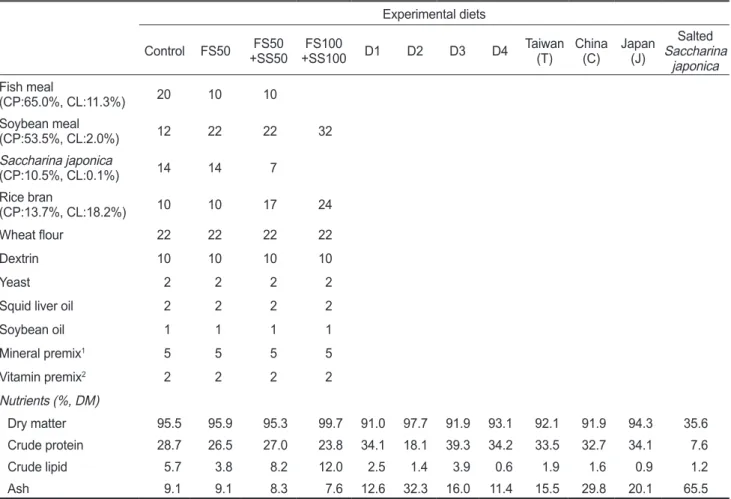
전복실험용사료의조성표와일반성분분석결과는
Table 1
과같다
.
대조구(Control)
사료에는20%
어분과12%
대두박을 주요단백질원으로공급하였으며, 22%
소맥분과10% dextrin
을주요탄수화물원및2%
오징어간유와1%
대두유를주요 지질원으로각각공급하였다.
또한Control
사료에는14%
의다 시마를첨가하였다. Control
사료에함유된어분의50%
를대두박으로대체한실험구
(FS50)
와어분과해조류를각각대두박과생미강으로
50%
씩혼합대체한실험구(FS50+SS50)
및어 분과해조류를각각대두박과생미강으로전량100%
씩혼합 대체한실험구(FS100+SS100)
를두었다.
이들4
종류의실험사 료는㈜
이화유지공업에의뢰하여상업용시판사료와동일하게extruded pelleter (Jyoda, Japan)
으로제조하였다.
또한국내에 서제조된4
종류의국내시판용사료(D1, D2, D3, D4)
와수 입되어시판되고있는3
종류의수입시판용사료[Taiwan (T), China (C), Japan (J)]
를준비하였다.
실험용사료의유용성을 비교하기위하여제주도전복양식산업현장에서폭넓게사용 되고있는염장미역을공급하는실험구를두었다.
모든실험구 는3
반복구를두었다.
실험용 사료와 전복 가식부의 일반성분 분석
16
주간의사육실험종료시각각의실험구에서생존한전복10
마리씩을무작위로샘플하여냉동보관(-70°C)
하였으며,
각 전복의각장과각폭은digital caliper (Mitutoyo Corporation, Kawasaki, Japan)
을이용하여측정하였고,
영양학적상태지수 측정을위해전중량에대한가식부의비를계산하였다.
실험용사료와전복가식부의일반성분분석은
AOAC (1990)
에따라조단백질은Kjeldahl method (Auto Kjeldahl System, Buchi B-324/435/412, Switzerland)
과조지방(
에테르추출법)
을분석하였으며,
조회분은550°C
회화로에서4
시간동안태 운후정량하였고,
수분은105°C dry oven
에서24
시간건조시 킨후측정하였다.
통계 분석
One-way ANOVA
와Duncan's multiple range test (Duncan, 1955)
로서SAS version 9.3 program (SAS Institute, Cary, NC, USA)
을이용하여각실험구간의유의성을검정하였다.
결과 및 고찰
전복용실험사료와국내외시판용사료를
16
주간공급한전복의성장결과는
Table 2
와같다.
전복의생존율은73.3-92.7%
의범위이었으며
,
실험구간에 유의적인 차이가나타났다.
어 분과다시마를대두박과생미강으로50%
씩혼합대체한사료(FS50+SS50)
를공급한실험구에서가장높은생존율을보였으며
,
대조구(Contorl)
사료나또는어분과다시마를100%
씩혼합대체한사료
(FS100+SS100)
와는유의적인차이가없었으나
(P>0.05),
어분50%
를대두박으로대체한사료(FS50)
보 다는유의적(P<0.05)
으로높았다. D4
사료는수입용시판사료(T, C, J)
와유의적인차이는없었다(P>0.05). D1
사료를공급한 실험구에서가장낮은생존율을보였다.
염장미역을공급한실 험구에서도D1
사료를공급한실험구를제외한다른배합사료 공급구에비하여비교적낮은생존율이관찰되었다.
전복의체중증가
(weight gain)
와일일성장률(SGR, specific growth rate)
은수입사료인J
사료를공급한실험구에서가장높았으며
,
그 다음으로 국내산시판사료인D4
와D3
사료의 순이었으나,
이들3
종류의사료간에 유의적인차이는없었다(P>0.05). FS50+SS50
사료를공급한실험구에서전복의체중 증가와SGR
이Control
사료공급구와는유의적인차이가없 었으나(P>0.05), FS50
이나FS100+SS100
사료를공급한실험 구보다는유의적(P<0.05)
으로우수하였다. FS100+SS100, D1
사료와염장다시마를공급한실험구간에전복의체중증가와SGR
은유의적인차이가없었다(P>0.05).
가장낮은체중증가 와SGR
이D2
사료를공급한실험구에서관찰되었다.
FS50+SS50
사료 공급구에서 전복의생존율과 성장(
체중과SGR)
은Control
사료공급구에비하여비유의적이지만높았으며
, FS50
이나FS100+SS100
사료공급구에비하여유의적으 로우수한성장을보인결과는전복용배합사료내어분을대두박으로
50%
대체가능하거나또는어분과다시마를대두박Table 1. Ingredients of the experimental diets (%, DM basis)
Experimental diets Control FS50 FS50
+SS50 FS100
+SS100 D1 D2 D3 D4 Taiwan(T) China (C) Japan
(J)
Salted Saccharina
japonica Fish meal
(CP:65.0%, CL:11.3%) 20 10 10
Soybean meal
(CP:53.5%, CL:2.0%) 12 22 22 32
Saccharina japonica
(CP:10.5%, CL:0.1%) 14 14 7
Rice bran
(CP:13.7%, CL:18.2%) 10 10 17 24
Wheat flour 22 22 22 22
Dextrin 10 10 10 10
Yeast 2 2 2 2
Squid liver oil 2 2 2 2
Soybean oil 1 1 1 1
Mineral premix1 5 5 5 5
Vitamin premix2 2 2 2 2
Nutrients (%, DM)
Dry matter 95.5 95.9 95.3 99.7 91.0 97.7 91.9 93.1 92.1 91.9 94.3 35.6
Crude protein 28.7 26.5 27.0 23.8 34.1 18.1 39.3 34.2 33.5 32.7 34.1 7.6
Crude lipid 5.7 3.8 8.2 12.0 2.5 1.4 3.9 0.6 1.9 1.6 0.9 1.2
Ash 9.1 9.1 8.3 7.6 12.6 32.3 16.0 11.4 15.5 29.8 20.1 65.5
1Vitamin premix contained the following amount which were diluted in cellulose (g/kg mix): riboflavin, 23.8; pyridoxine, 4.7; niacin, 95.2;
Ca-pantothenate, 33.3; inositol, 476.9; folic acid, 1.5; p-amino benzoic acid, 47.6; filler, 31.7. 2Mineral premix contained the following in- gredients (g/kg mix): MgSO4, 140.8; NaH2PO4, 92.4; KH2PO4, 246; Ca(H2PO4)2, 139.5; ZnSO4, 22.5; Ca-lactate, 310; AlCl3, 0.15; KI, 0.15;
MnSO4, 2; CoCl2, 1; filler, 45.5. FS50, 50% fish meal was substituted with the same amount of soybean meal; FS50+SS50, 50% fish meal and 50% Saccharina japonica were substituted with the same amount of soybean meal and rice bran, respectively; FS100+SS100, 100% fish meal and 100% Saccharina japonica were substituted with the same amount of soybean meal and rice bran, respectively; D1, domestic 1;
D2, domestic 2; D3, domestic 3; D4, domestic 4.
과생미강으로
50%
씩혼합대체가능하다는것을의미하며,
어 분과다시마를대두박과생미강으로100%
씩혼합대체시에 는전복의성장에부정적인영향을미친다는것을의미한다.
특 히, FS50+SS50
사료에서전복의생존율과성장(
체중과SGR)
이
FS50
사료에비하여유의적으로향상된것은주로다시마의생미강대체효과에서기인하는것으로판단되며
,
이러한결과 는전복용배합사료내다시마를생미강으로40%
대체시대조 구(
생미강0%
대체)
보다더우수한성장을보였으나생미강으로
100%
대체시대조구에비하여비유의적이지만전복의성장이감소하였다는연구
(Kim et al., 2016)
결과와일치하였다.
그러나Uki et al. (1985)
은전복용배합사료내다양한종류의 단백질원이용시카제인을함유한배합사료를공급받은참전 복(H. discus hannai)
의성장이다른종류의단백질원을함유 한배합사료를공급받은전복보다우수하였으며,
특히대두박 을함유한배합사료를공급받은전복의성장이어분을함유한 배합사료를공급받은전복보다우수하였다고보고하였다.
또한
Cho (2010)
는참전복치패용배합사료내어분을대두박과0.5% methionine
의혼합대체시전량대체가능하였다는과거연구결과와본연구에서
FS50
사료공급시비유의적이지만소량감소한전복의성장과
FS100+SS100
사료를공급받은전복에서의유의적인성장감소를고려하면
,
전복용배합사료내어 분을대두박으로전량대체하기위해서는대두박에부족하기쉬운
methionine
의보충이나또는대두박과동물성단백질원의혼합대체등과같은방법개선이필요해보인다
. Bautista-
Teruel et al. (2003)
도전복(H. asinina)
용배합사료내동물성 단백질과 식물성단백질원혼합분(
어분,
새우분과탈지대두박또는
Spirulina)
이 식물성단백질원들의 혼합분(
탈지대두박과Spirulina)
보다우수한성장을보인다고보고하였다.
FS100+SS100
사료공급구에서전복의성장(
체중과SGR)
감 소는어분을대두박으로전량대체함에따른사료내단백질함 량감소와다시마를생미강으로전량대체함에따른사료내지 질 함량증가의복합적인요인에서 기인한결과로생각된다.
전복용배합사료내단백질과지질요구량은각각25-35%
및3-7%
인것으로알려져있으며(Mai et al., 1995a, 1995b; Flem- ing et al., 1996; Bautista-Teruel et al., 2003), FS100+SS100
사료의 단백질함량은전복의 단백질요구량에 비하여낮으 며,
또한지질함량은요구량에비하여높았다.
전복은prote- ase, amylase, cellulose
와alginase
와 같은소화효소를다량으로 함유하고 있으나
lipases
소화효소 함량이낮기때문에(Emerson, 1967; Gomez-Pinchetti and Garcia-Reina, 1993;
Britz et al., 1994; Garcia-Esquivel and Felbeck, 2006)
에너 지원으로서 지질보다는 탄수화물을 잘 이용하는 것으로 알 려져있다(Britz et al., 1994; Monje and Viana, 1998; Thon- grod et al., 2003). Yokoe and Yasumasu (1964)
는2
종의전복(H. gigantea
와H. japonica)
의장내에서cellulase
를발견하였 고, Nakagawa and Nagayama (1988)
는전복(Haliotis discus hannai
와H. seibaldii)
의추출물에서고활성의xylanase
와car- boxymethylcellulase
를발견하여해양무척추동물의소화기내 Table 2. Survival (%), weight gain (g/abalone) and specific growth rate (SGR, %/day) of juvenile abalone Haliotis discus fed the experi- mental diets for 16 weeksExperimental diets Initial weight
(g/abalone) Final weight
(g/abalone) Survival
(%) Weight gain
(g/abalone) SGR1
(%/day)
Control 5.3±0.00 7.2±0.12 88.0±3.06abc 1.9±0.12cd 0.27±0.015cd
FS50 5.3±0.01 7.1±0.03 85.3±0.67bcd 1.8±0.02d 0.26±0.003d
FS50+SS50 5.3±0.00 7.5±0.18 92.7±1.33a 2.2±0.18bc 0.31±0.021bc
FS100+SS100 5.3±0.00 6.4±0.17 87.3±1.76abc 1.1±0.17e 0.17±0.024e
D1 5.3±0.00 6.3±0.11 73.3±0.67e 1.0±0.11e 0.16±0.016e
D2 5.3±0.00 6.0±0.16 81.3±3.71cd 0.7±0.15f 0.11±0.023f
D3 5.3±0.00 8.4±0.11 83.3±1.33cd 3.1±0.11a 0.41±0.011a
D4 5.31±0.01 8.5±0.07 86.0±1.15abcd 3.2±0.06a 0.42±0.006a
T 5.3±0.01 7.3±0.05 92.0±0.00ab 2.0±0.04cd 0.29±0.005cd
C 5.3±0.01 7.8±0.15 84.0±2.31cd 2.5±0.15b 0.34±0.017b
J 5.3±0.01 8.6±0.07 88.0±2.00abc 3.3±0.07a 0.43±0.007a
Salted Saccharina japonica 5.3±0.00 6.5±0.07 79.3±2.91d 1.2±0.07e 0.18±0.010e
1Specific growth rate (SGR, %/day)=[(Ln(Wf)-Ln(Wi)/days of feeding]×100, where Ln(Wf)=natural log of the final mean weight of aba- lone and Ln(Wi)=natural log of the initial mean weight of abalone. FS50, 50% fish meal was substituted with the same amount of soybean meal; FS50+SS50, 50% fish meal and 50% Saccharina japonica were substituted with the same amount of soybean meal and rice bran, respectively; FS100+SS100, 100% fish meal and 100% Saccharina japonica were substituted with the same amount of soybean meal and rice bran, respectively; D1, domestic 1; D2, domestic 2; D3, domestic 3; D4, domestic 4; T, Taiwan; C, China; J, Japan. Values (means of triplicate±SE) in the same column sharing a common superscript are not significantly different (P>0.05).
polysaccharidases
의분포는먹이습성과관련이있다고보고 하였다.
또한, Erasmus et al. (1997)
도전복(H. midae)
간체장 내에서alginate lyase, carboxymethylcellulase, laminarinase, agarase
와carragenase
를관찰하였으며,
전복의소화기에있는bacteria
가먹이내함유된alginate, laminarin, agarose, carra-
genan
와cellulose
의소화를돕는다고주장하였다.
따라서전복 용배합사료내다시마와같은값비싼해조류대체원으로서농 작물기원의탄수화물함량이높은원료나이들부산물은전복 용배합사료내해조류대체원으로서이용가능할것으로생각 된다. Reyes and Fermin (2003)
은필리핀에서동물성단백질(
Table 3. Shell length, shell width, shell height, soft body weight and the ratio of soft body weight to total weight of abalone Haliotis discus fed the experimental diets for 16 weeksExperimental diets Shell length (mm) Shell width (mm) Shell height (mm) Soft body weight (g) Soft body weight/total weight
Control 43.3±0.41b 29.5±0.21a 7.9±0.07a 4.7±0.11a 0.63±0.002a
FS50 43.1±0.85bc 28.8±0.85a 7.7±0.25a 4.6±0.40a 0.60±0.009a
FS50+SS50 42.9±0.60cd 29.1±0.21a 7.9±0.12a 4.8±0.06a 0.63±0.002a
FS100+SS100 41.4±0.50cd 28.0±0.33a 7.6±0.09a 3.6±0.07a 0.59±0.005a
D1 43.5±0.57b 29.6±0.33a 8.0±0.16a 4.5±0.16a 0.64±0.006a
D2 40.5±0.97d 27.2±0.72a 7.3±0.43a 3.4±0.33a 0.59±0.011a
D3 45.8±0.31a 31.5±0.08a 7.9±0.02a 5.5±0.13a 0.64±0.007a
D4 45.0±0.48ab 30.7±0.39a 8.0±0.13a 5.5±0.21a 0.63±0.008a
T 44.3±0.34ab 29.8±0.15a 7.9±0.07a 4.6±0.04a 0.61±0.002a
C 45.0±0.31ab 30.5±0.28a 8.1±0.18a 5.3±0.15a 0.61±0.002a
J 46.0±0.82a 31.1±0.49a 8.1±0.22a 5.7±0.18a 0.65±0.005a
Salted Saccharina japonica 41.4±0.25cd 27.5±0.11a 7.4±0.08a 3.9±0.12a 0.58±0.003a FS50, 50% fish meal was substituted with the same amount of soybean meal; FS50+SS50, 50% fish meal and 50% Saccharina japonica were substituted with the same amount of soybean meal and rice bran, respectively; FS100+SS100, 100% fish meal and 100% Saccharina japonica were substituted with the same amount of soybean meal and rice bran, respectively; D1, domestic 1; D2, domestic 2; D3, domestic 3; D4, domestic 4; T, Taiwan; C, China; J, Japan. Values (means of triplicate±SE) in the same column sharing a common superscript are not significantly different (P>0.05).
Table 4. Chemical composition (%) of the soft body of juvenile abalone Haliotis discus fed experimental diets for 16 weeks
Experimental diets Moisture Crude protein Crude lipid Ash
Control 74.1±0.56ef 16.8±0.06e 2.2±0.00c 2.0±0.00ef
FS50 75.3±0.82de 16.4±0.10fg 2.0±0.03d 2.0±0.00ef
FS50+SS50 74.1± 0.06ef 16.6±0.19ef 2.4±0.03b 1.9±0.03f
FS100+SS100 75.7±0.60cde 16.1±0.03g 2.8±0.09a 2.0±0.03ef
D1 77.8±0.52ab 18.1±0.06b 1.8±0.03e 2.3±0.00d
D2 78.1±0.09a 15.7±0.10h 1.4±0.09f 3.0±0.03a
D3 74.1±0.71ef 19.0±0.09a 2.1±0.03d 2.5±0.03c
D4 72.3±0.70g 18.1±0.18b 1.1±0.03g 2.0±0.03e
T 77.1±0.72abc 17.6±0.13c 1.7±0.03e 2.5±0.03c
C 72.9±0.45fg 17.3±0.03d 1.1 ± 0.03g 2.6±0.03b
J 76.4±0.12bcd 18.2±0.03b 1.4 ± 0.00f 2.6±0.03b
Salted Saccharina japonica 75.3±0.19de 15.7±0.00h 1.4 ± 0.00f 3.0±0.00a
FS50, 50% fish meal was substituted with the same amount of soybean meal; FS50+SS50, 50% fish meal and 50% Saccharina japonica were substituted with the same amount of soybean meal and rice bran, respectively; FS100+SS100, 100% fish meal and 100% Saccharina japonica were substituted with the same amount of soybean meal and rice bran, respectively; D1, domestic 1; D2, domestic 2; D3, domestic 3; D4, domestic 4; T, Taiwan; C, China; J, Japan. Values (means of triplicate±SE) in the same column sharing a common superscript are not significantly different (P>0.05).
어분과새우분
)
과식물(Moringa oliefera)
잎또는담수산수서 식물(Azolla pinnata)
을혼합사용시전복(H. asinina)
용배합 사료의우수한사료원이라고보고한바있다.
본연구에서염 장다시마를공급한실험구에서전복의생존율에서는D1
사료 를제외하며,
성장(
체중과SGR)
에서는FS100+SS100, D1
과D2
사료를제외한다른배합사료에 비하여전복의낮은생존 율과성장을보인결과는영양학적으로균형이잘맞는배합사 료의공급은다시마,
미역또는kelp
와같은해조류의공급시보 다우수한생산성을보인다는연구결과와일치하였다(Lee et al., 1997; Kim et al., 1998; Viana et al., 1993; Lee et al., 1998;
Cho et al., 2008; Garcia-Esquivel and Felbeck, 2009; Jung et al., 2016).
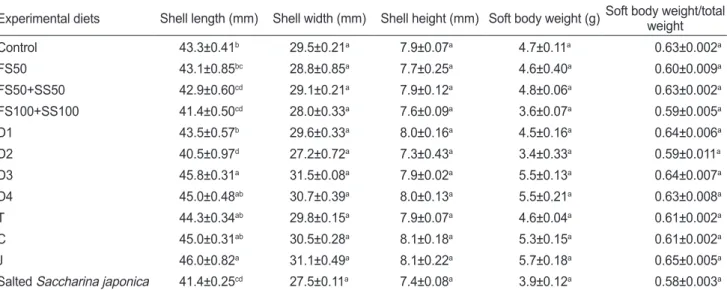
전복의각장,
각폭,
각고,
가식부무게및전중에대한 가식부의비율은Table 3
에나타내었다.
가장긴각장은J
사료 를공급한실험구에서관찰되었으나D3, D4, T
와C
사료를공 급한실험구와유의적인차이는없었다(P>0.05).
가장짧은각 장은D2
사료를공급한실험구에서관찰되었으며, FS50+SS50
와
FS100+SS100
사료또는염장다시마를공급한실험구와유의적인차이는없었다
(P>0.05).
각폭,
각고,
가식부무게및전 중에대한가식부의비율은실험용사료간에유의적인차이가 없었다(P>0.05).
전복가식부의일반성분분석결과는
Table 4
에나타내었다.
전복가식부의수분함량은D2
사료를공급한실험구에서가장 높게나타났으며, D4
사료를공급한실험구에서가장높게나타 났다.
전복가식부의조단백질함량은D3
사료를공급한실험 구에서가장높게나타났으며, D2
사료와염장다시마를공급한 실험구에서가장낮게나타났다.
전복가식부의조지질함량은FS100+SS100
사료를공급한실험구에서가장높게나타났으며
, D4
사료를공급한실험구에서가장낮게나타났다.
전복가 식부의회분함량은D2
사료와염장다시마를공급한실험구에 서가장높게나타났으며, FS50+SS50
사료를공급한실험구에 서가장낮게나타났다. D3
사료를공급한실험구에서전복가 식부의높은단백질함량, D2
사료와염장다시마를공급한실험구에서낮은단백질함량
, FS100+SS100
사료를공급한실험구에서높은지질함량
, D4
사료를공급한실험구에서낮은지 질함량과염장다시마를공급한실험구에서높은회분함량은 실험에이용된사료들의영양소함량을잘반영하고있으며,
이 러한결과는전복가식부의영양소함량은공급한사료내영양소함량에의해서크게영향을받는다는과거의연구결과
(Lee
et al., 1998; Cho et al., 2008: Jung et al., 2016)
와일치하였다.
이상의결과를고려할때전복치패용EP
내어분을50%
대체 하거나또는어분과다시마를대두박과생미강으로각각50%
씩혼합대체하여도전복의생산성에는부정적인영향을미치
지않았으며
, 50%
씩혼합대체시오히려생산성이증가하였다.
사 사
이 논문은
2017
년도 정부(
미래창조과학부)
의 재원으로 한국연구재단의 지원을 받아 수행된 기초연구사업이며
(No.
2017R1A2B4009773),
또한2014
년해양수산부재원으로한 국해양과학기술진흥원의지원을받아수행된연구(“
과립형양 어미립자초기사료개발”)
로서이에감사드립니다.
References
Association of Official Analytical Chemists (AOAC). 1990. Of- ficial Methods of Analysis (15th edn). Association of Official Analytical Chemists, Arlington, VA, U.S.A.
Bautista-Teruel MN, Fermin AC and Koshio SS. 2003. Diet development and evaluation for juvenile abalone, Haliotis
asinine: animal and plant protein sources. Aquaculture 219,
645-653. http://dx.doi.org/10.1016/S0044-8486(02)00410-6.Britz PJ, T. Hecht T, Knauer and Dixon MG. 1994. The devel- opment of an artificial feed for abalone farming. S Afr J Sci 90, 7-8.
Cho SH. 2010. Effect of fishmeal substitution with various ani- mal and/or plant protein sources in the diet of the abalone
Haliotis discus hannai Ino. Aquacult Res 41, e587-e593.
http://dx.doi.org/10.1111/j.1365-2109.2010.02561.x.
Cho SH, Park J, Kim C and Yoo J. 2008. Effect of casein substitution with fishmeal, soybean meal and crustacean meal in the diet of the abalone Haliotis discus hannai Ino.
Aquacult Nutr 14, 61-66. http://dx.doi.org/10.1111/j.1365- 2095.2007.00505.x.
Choi S, Wang X, Park G, Lim S, Kim K, Bai SC and Shin I. 2004.
Dietary dehulled soybean meal as a replacement for fish meal in fingerling and growing olive flounder Paralichthys
olivaceus (Temminck et Schlegel). Aquacult Res 35, 410-
418. http://dx.doi.org/10.1111/j.1365-2109.2004.01046.x.Chou RL, Her BY, SU MS, Hang G, Wu YH and Chen HY.
2004. Substituting fish meal with soybean meal in diets of juvenile cobia Rachycentron canadum. Aquaculture 229, 325-333. https://doi.org/10.1016/S0044-8486(03)00395-8.
Duncan DB. 1955. Multiple range and multiple F tests. Biomet- rics 11, 1-42.
Elangovan A and Shim KF. 2000. The influence of replacing fish meal partially in the diet with soybean meal on growth and body composition of juvenile tin foil barb (Barbodes altus).
Aquaculture 189, 133-144. https://doi.org/10.1016/S0044- 8486(00)00365-3.
Emersion DN. 1967. Carbohydrate metabolism of Planorbis
corneus (Mollusca, Planorbidae) during starvation. Comp
Biochem Physiol 22, 571-579. https://doi.org/10.1016/0010- 406X(67)90619-6.Emmert JL and Baker DH. 1997. A chick bioassay approach for determining the bioavailable choline concentration in nor- mal and overheated soybean meal, canola meal and peanut meal. J Nutr 127, 745-752.
Erasmus JH, Cook RA and Coyne VE. 1997. The role of bac- teria in the digestion of seaweed by the abalone Haliotis
midae. Aquaculture 155, 377-386. https://doi.org/10.1016/
S0044-8486(97)00112-9.
FAO (Food and Agriculture Organization). 2017. Food and Ag- riculture Organization of the United Nations, Rome, Italy.
Fleming AE, Barneveld RJ and Hone P. 1996. The development of artificial diets for abalone: A review and future direc- tions. Aquaculture 140, 5-53. https://doi.org/10.1016/0044- 8486(95)01184-6.
Gomez-Pinchetti JL and Garcia-Reina G. 1993. Enzymes from marine phycophages that degrade cell walls of sea- weeds. Mar Biol 116, 553-558. https://doi.org/10.1007/
BF00355473.
Gracia-Esquivel Z and Felbeck H. 2006. Activity of digestive enzymes along the gut of juvenilered abalone, Haliotis rufe-
scens, fed natural and balanced diets. Aquaculture 261, 615-
625. https://doi.org/10.1016/j.aquaculture.2006.08.022.Garcia-Esquivel Z and Felbeck H. 2009. Comparative perfor- mance of juvenile red abalone, Haliotis rufescens, reared in laboratory with fresh kelp and balanced diets. Aqua- cult Nutr 15, 209-217. http://dx.doi.org/10.1111/j.1365- 2095.2008.00585.x.
Heikkinen J, Vielma J, Kemilainen O, Tirola M, Eskelinen P, Kiuru T, Navia-Paldanius D and Wright AV. 2006. Effects of soybean meal based diet on growth performance, gut his- topathology and intestinal microbiota of juvenile rainbow trout (Oncorhynchus mykiss). Aquaculture 261, 259-268.
https://doi.org/10.1016/j.aquaculture.2006.07.012.
Jung W, Kim HS, Lee KW, Kim YE, Choi DK, Jang B, Cho SH, Choi CY, Kim B and Joo Y. 2016. Growth and body composition effects of tuna byproduct meal substituted for fish meal in the diet of juvenile abalone, Haliotis discus. J World Aquacult Soc 47, 74-81. http://dx.doi.org/10.1111/
jwas.12255.
Kim J, Lee S, Han S, Kim B and Park S. 1998. Effects of ex- perimental diet, commercial diets and algae (Undaria) on growth and body composition among juvenile abalones (Haliotis discus, H. sieboldii and H. discus hannai). J Aqua- culture 11, 505-512.
Kim EJ, Utterback PL and Parsons CM. 2012. Comparison of amino acid digestibility coefficients for soybean meal, canola meal, fish meal, and meat and bone meal among 3 different bioassays. Poult Sci 91, 1350-1355. https://doi.
org/10.3382/ps.2011-01861.
Kim YE, Myung SH, Kim HS, Jung W, Cho SH, Jwa MS, Kim PY, Kim MK, Park M and Kim B. 2016. Effect of dietary substitution of sea tangle (ST), Laminaria japonica with rice bran (RB) on growth and body composition of juvenile aba- lone (Haliotis discus). Aquacult Res 47, 120-1208. https://
dx.doi.org/10.1111/are.12577.
Lee S, Lee GA, Jeon I and Yoo SK. 1997. Effects of experi- mental formulated diets, commercial diet and natural diet on growth and body composition of abalone (Haliotis discus
hannai). J Aquaculture 10, 417–424.
Lee S, Yun SJ and Hur SB. 1998. Evaluation of dietary protein sources for abalone (Haliotis discus hannai). J Aquaculture 11, 19-29.
Mai K, Mercer JP and Donlon J. 1995a. Comparative studies on the nutrition of species of abalone, Haliotis tuberculata L. and Haliotis discus hannai Ino. Responses of abalone to various levels of dietary lipid. Aquaculture 134, 65-80.
http://dx.doi.org/10.1016/0044-8486(95)00043-2.
Mai K, Mercer JP and Donlon J. 1995b. Comparative studies on the nutrition of two species of abalone, Haliotis tubercu-
lata L. and Haliotis discus hannai Ino. IV. Optimum dietary
protein level for growth. Aquaculture 136, 165-180. http://dx.doi.org/10.1016/0044-8486(95)01041-6.
Monje H and Viana MT. 1998. The effect of cellulose on the growth and cellulolytic activity of abalone Haliotis fulgens when uses as an ingredient in formulated artificial diet. J Shellfish Res 17, 667-671.
Nakagawa T and Nagayama F. 1988. Distribution of glycosi- dase activities in marine invertebrates. J Tokyo Univ Fish 75, 239-246.
Reyes OS and Fermin AC. 2003. Terrestrial leaf meals or fresh- water aquatic fern as potential feed ingredients for farmed abalone Haliotis asinina (Linnaeus 1758). Aquacult Res 34, 593-599.
Storebakken T, Refstie S and Ruyter B. 2000. Soy products as fat and protein sources in fish diets for intensive aquacul- ture. Pages 127-170 in J. K. Drackley, editor. Soy in animal nutrition. Federation of Animal Science Societies, Savoy, Il- linois, U.S.A.
Thongrod S, Tamtin M, Chairat C and Boonyaratpalin M. 2003.
Lipid to carbohydrate ratio in donkey’s ear abalone (Haliotis
asinina, Linne) diets. Aquaculture 225, 165-174. https://doi.
org/10.1016/S0044-8486(03)00287-4.
Uki N, Kemuyama A and Watanabe T. 1985. Nutritional evalu- ation of several protein sources in diets for abalone Haliotis
discus hannai. Bull Jpn Soc Sci Fish 51, 1835-1839. http://
dx.doi.org/10.2331/suisan.51.1835.
Viana MT, López LM and Salas A. 1993. Diet development for juvenile abalone Haliotis fulgens evaluation of two artifi- cial diets and macroalgae. Aquaculture 117, 149-156. http://
dx.doi.org/10.1016/0044-8486(93)90131-H.
Viyakarn V, Watanabe T, Aoki H, Tsuda H, Sakamoto H, Oka- moto N, Iso N, Satoh S and Takeuchi T. 1992. Use of soy- bean meal as a substitute for fish meal in a newly developed soft-dry pellet for yellowtail. Nip Sui Gakk 58, 1991-2000.
http://dx.doi.org/10.2331/suisan.58.1991.
Yokoe Y and Yasumasu I. 1964. The distribution of cellulase in invertebrates. Comp Biochem Physiol 13, 323-338. https://
doi.org/10.1016/0010-406X(64)90027-1.