329
Copyright © 2014 The Korean Society of Fisheries and Aquatic Science pISSN:0374-8111, eISSN:2287-8815
서 론
전복
(Haliotis discus hannai)
의국내총양식생산량은2000
년 에는20
톤에불과하였으나2014
년에는8,982
톤으로약450
배 증가하였으며(KOSIS, 2015),
전복의국내양식생산량도매년 지속적으로증가될것으로예상된다.
국내전복양식장의경우 전복양식어민들은양식장관리의용이성때문에미역과다시 마와같은자연산해조류를먹이로공급하는것을선호하고있 지만,
이들해조류는자연상태에서는겨울철을제외한다른계 절에는이들자연산해조류를공급하기어렵기때문에이들해조류를건조시키거나염장처리하여사용하고있는실정이다
.
전복의 사료내 단백질과 지질 요구량은 각각
25-35%
및3-5%
내외인것으로알려져있지만(Uki et al., 1985a; Mai et al., 1995a, 1995b),
이들자연산해조류의단백질과지질함량 은10-20%
와1%
내외에불과하여전복의성장에필요로하는 영양학적요구량에비하여아주낮으며,
건조나또는염장처리 과정에서야기되는이들영양소의파괴나손실로인하여더낮 은영양학적가치를가지게되어서전복의성장둔화를초래하 여결국전복의양식생산단가를상승시키는주요원인이되고 있는실정이다.
전복(Haliotis discus hannai) 용 배합사료내 오징어분 및
해조류 대체원으로서 대두박이 전복 치패의 성장과 체조성에 미치는 영향
김병학
1·김희성·조성환*
1국립수산과학원 남서해수산연구소, 한국해양대학교 해양생명과학부
The Effects of Substituting Squid Meal and Macroalgae with Soybean Meal in a Commercial Diet on Growth and Body Composition of
Juvenile Abalone Haliotis discus hannai
Byeng-Hak Kim
1
, Hee Sung Kim and Sung Hwoan Cho*1
Southwest Sea Fisheries Research Institute, National Fisheries Research and Development Institute, Yeosu 556-823, Korea Division of Marine Bioscience, Korea Maritime and Ocean University, Busan 606-791, Korea
We examined the effect of substituting squid meal and macroalgae with soybean meal in a commercial diet on the growth and body composition of juvenile abalone Haliotis discus hannai . We randomly distributed 2310 juvenile aba- lone into 33 rectangular plastic containers and fed them five experimental diets in triplicate as follows. The control diet (Con) consisted of 12% squid meal, 8% corn gluten and 20% soybean meal as protein source, wherein 10% α-starch, 20% wheat flour, and 5% dextrin were carbohydrate source. The experimental diets, 50% squid meal (SM50), 50%
squid meal and 50% macroalgae (SM50+MA50), and 100% squid meal and 50% macroalgae (SM100+MA50) were substituted with the same respective amounts of soybean meal. The fifth experimental diet consisted of the control diet plus 1% diatom powder (DP). We prepared two domestic (Domestic A and B) and two imported (China and Japan) abalone feeds. Finally, we prepared Undaria and sea tangle. We found that the weight gain of abalone fed the Con, DP, and China and Japan diets was significantly greater than that of abalone fed Undaria and sea tangle. We conclude that the substituting squid meal and macroalgae with soybean meal in abalone feed has limited benefits, but supplementing diets with 1% diatom powder is effective in improving weight gain.
Key words: Abalone ( Haliotis discus hannai ), Dietary substitution, Fishmeal, Macroalgae, Soybean meal
This is an Open Access article distributed under the terms of the Creative Commons Attribution Non-Commercial Licens (http://creativecommons.org/licenses/by-nc/3.0/)which permits unrestricted non-commercial use, distribution, and reproduction in any medium, provided the original work is properly cited.
http://dx.doi.org/10.5657/KFAS.2015.0329 Korean J Fish Aquat Sci 48(3) 329-336, June 2015
Received 8 May 2015; Revised 21 June 2015; Accepted 22 June 2015
*Corresponding author: Tel: +82. 51. 410. 4755 Fax: +82. 51. 404. 4750
E-mail address: [email protected]
전복용 배합사료내 단백질원으로서 카제인이 가장 우수한 것으로알려져있으나
(Uki et al., 1985a, 1985b; Uki et al.,
1986a),
카제인은가격이아주높기때문에상업용배합사료로제조시사료원으로이용하기에는비실용적이다
.
따라서전복 용배합사료의카제인대체단백질원으로어분,
대두박,
갑각류 분등다양한형태의동물성및식물성단백질원의이용가능성 에대한연구가수행된바있다(Uki et al., 1985b; Viana et al., 1993; Lee et al., 1998a; Sales and Britz, 2001; Bautista-Teruel et al., 2003; Garcia-Esquivel and Felbeck, 2009; Cho et al., 2008; Cho, 2010).
특히전복용배합사료내카제인단독대체 단백질원으로어분이나대두박을이용할경우전복의성장이카제인
31%
함유사료와유사하였고면실박이나다시마분말첨가의경우어분을소량만첨가하여도카제인과유사한성장
(Lee et al., 1998a)
을보였으며,
새우머리분또한전복용배합 사료내우수한단백질원으로이용가능한것으로보고된바있 다(Cho et al., 2008).
최근수산용배합사료내단백질공급원으로널리사용되고있 는어분이나오징어분의가격이급격하게상승하고있으며
,
또 한해조류(
미역,
다시마등)
의가격상승으로인하여이들어분(
오징어분)
이나해조류를대체할수있는새로운사료원료의개 발이절실히필요한실정이다.
따라서전복의양식생산비용을 절감시키기위해서는값비싼어분과해조류를대체할수있는 공급이안정적이며값싼대체원료의개발이시급하다.
따라서 본연구에서는전복용배합사료내오징어분및해조류대체원 으로서대두박의이용성을평가하였다.
또한이들대체사료원 료의효능을평가하기위하여국내외상업용시판사료및미역 과다시마와비교분석하였다.
재료 및 방법
전복의 사육 및 관리
실험에이용된전복치패는개인양식장에서구입하여사육실 험조건에
2
주간적응시켰으며,
적응기간동안에는건다시마(Laminaria japonica)
를1
일1
회전체중의2%
정도공급하였 다. 33
개의70 L
플라스틱수용기(120 cm×36 cm)
에각각70
마리의전복치패(
평균마리무게: 0.98 g)
를수용하여1
개의30
톤콘크리트raceway (
수량: 10
톤)
에분산수용하였으며,
충분 한양의산소를공급하여주었다.
플라스틱수용기에는shelter
를넣어주어전복의은신처를제공하여주었다.
사료의공급은1
일1
회(17:00)
충분한양의먹이를공급(
전체중의3%)
하였으 며,
남은먹이는매일제거하여주었다.
실험기간동안평균사 육수온(Mean±SD)
은24.6±3.60°C
이었으며, raceway
별 환 수량은76.3 L/min
이었고,
빛은자연광주기를따랐다.
전복사 육실험은총16
주간실시하였다.
실험사료의 조성 및 일반성분
전복용실험사료의 사료 조성표는
Table 1
과 같다.
대조구(Con)
사료는주요단백질원으로오징어분12%,
콘글루텐8%
및대두박
20%
를첨가하였으며,
주요탄수화물원으로소맥분20%, α-starch 10%
와덱스트린5%
를첨가하였고,
주요지질원 으로오징어간유와대두유를각각1%
씩첨가하였다.
또한16%
해조류와
1% Spirulina
를대조구사료에첨가하였다.
오징어분50%
를 대두박으로 대체한실험사료(SM50),
오징어분50%
와해조류
(Macroalgae mixture) 50%
를각각대두박으로50%
씩대체한실험사료
(SM50+MA50),
오징어분100%
와해조류50%
를각각대두박으로대체한실험사료(SM100+MA50)
및 대조구사료에소맥분1%
대신에규조류(Melosira nummuloi- des
와Fragilariopsis sp.
가우점종) 1%
를첨가한실험사료(DP)
를두었으며,
이들사료는이화유지공업(
주)
에의뢰하여상업용 시판사료와동일하게extruded pelleter (Jyoda, Japan)
로제조 하였다.
실험사료의사료의효능을비교하기위하여국내에서 시판되고있는상업용시판사료2
종류(Domestic A, Domestic B)
와국외상업용시판사료인중국산(China)
과일본산(Japan)
사료를준비하였으며,
자연산먹이인미역(Undaria)
과다시마(Sea tangle)
를공급하는실험구를두었다.
모든실험사료는3
반복구를두었다.
실험사료와 전복 가식부의 영양 성분 분석
16
주간의사육실험종료시각각의실험구에서생존한전복10
마리씩을무작위로샘플하여냉동보관(-70°C)
하였으며,
각 전복의각장과각폭은digital caliper (Mitutoyo Corporation, Kawasaki, Japan)
을이용하여측정하였고,
영양학적상태지수 측정을위해전중량에대한가식부의비를계산하였다.
실험사료와 전복 가식부의 일반성분분석은
AOAC (1990)
에따라조단백질은Kjeldahl method (Auto Kjeldahl System, Buchi B-324/435/412, Switzerland)
과조지방(
에테르추출법)
을분석하였으며,
조회분은550°C
회화로에서4
시간동안태운 후정량하였고,
수분은105°C dry oven
에서24
시간건조시킨 후측정하였다.
실험사료의아미노산분석은high speed amino acid analyzer (Hitachi L-8800, Tokyo, Japan)
을이용하여아미 노산조성을분석하였으며,
지방산분석은Folch et al. (1957)
의방법에따라클로로폼과메탄올혼합액(2:1)
으로총지질을 추출하여14% BF
3-MeOH (Sigma, St Louis, Mo, USA)
용액 으로지방산을methylation
시킨후, capillary column (SP
TM- 2560, 100 m×0.25 mm i.d., film thickness 0.20 μm, Supelco, Bellefonte, PA, USA)
이 장착된gas chromatograph (Truce GC, Thermo, USA)
로지방산조성을분석하였다.
통계 분석
One-way ANOVA
와Duncan's multiple range test (Duncan
1955)
로서SAS version 9.3 program (SAS Institute, Cary, NC,
USA)
을이용하여각실험구간의유의성을검정하였다.
결과 및 고찰
실험에이용된사료의아미노산분석결과미역과다시마에 서모든필수아미노산
(Arg, His, Ile, Leu, Lys, Met, Phe, Thr
및Val)
의함량이실험용배합사료에비해낮게나타났다(Table 2).
국내시판사료(Domestic A, Domestic B)
에서도제조한실 험사료와국외시판사료(China, Japan)
에비하여모든필수아 미노산함량이낮았다.
실험사료들의지방산분석결과(Table 3),
미역과 다시마에서n-3 HUFA (highly unsaturated fatty acid)
비율은각각25.96%
와21.48%
로나타나서다른실험사 료들에비해서높게나타났으나,
미역과다시마에서의지질함 량(0.1%)
이다른실험사료들(1.6-4.4%)
에비하여낮았기때문 에미역과다시마에서의n-3 HUFA
함량은낮은것으로나타났 다.
미역과다시마에서의eicosapentaenoic acid (EPA, 20:5n- 3)
비율이각각11.76%
와5.16%
로나타났으나, docosahexae- noic acid (DHA, 22:6n-3)
는전혀측정되지않았다.
국내상업용시판사료
(Domestic A, Domestic B)
와국외상업용시판사 료(China, Japan)
에서는gamma-linolenic acid (18:3n-6)
가전 혀나타나지않았다.
미역과다시마는단백질,
특히필수아미노 산과지질함량이전복용사료내요구량(Uki et al., 1985a; Uki et al., 1986a, 1986b)
을충족시켜주지못하기때문에전복의성 장에크게영향을미칠것으로판단된다.
실험사료를
16
주간공급한전복의성장결과는Table 4
와같 다.
전복의 생존율(Survival)
은77.6-100%
의 범위이었으며, Con, SM50, SM50+MA50, SM100+MA50, DP, China, Ja-
pan,
미역및다시마를공급한실험구가국내상업용시판사료인
Domestic A
와Domestic B
를공급한실험구보다유의적으 로우수하였으며(P<0.05), SM50
과SM50+MA50
사료를공 급한실험구에서가장우수하였다.
국내상업용시판사료를공 급한실험구에서의생존율이다른실험구에비해낮은것은국 내상업용시판사료내필수아미노산함량이낮은것에서기인 한것으로생각된다.
전복의체중증가(weight gain/individual)
Table 1. Ingredients (%, DM basis) and nutrient composition of the experimental dietsExperimental diets
Con SM50 SM50+
MA50 SM100+
MA50 DP Domestic
A Domestic
B China Japan Undaria Sea tangle Ingredient (%)
Squid meal 12 6 6 0 12
Corn gluten 8 8 8 8 8
Soybean meal 20 26 34 40 20
α-starch 10 10 10 10 10
Wheat flour 20 20 20 20 19
Spirulina 1 1 1 1 1
Dextrin 5 5 5 5 5 closed closed closed closed
Diatom powder1 1
Macroalgae mixture2 16 16 8 8 16
Squid liver oil 1 1 1 1 1
Soybean oil 1 1 1 1 1
Vitamin premix3 2 2 2 2 2
Mineral premix4 4 4 4 4 4
Nutrients (DM, %)
Dry matter 9.0 8.6 7.1 7.6 7.8 13.7 13.3 10.5 10.3 9.6 13.3
Crude protein 29.7 30.5 31.3 31.2 31.2 31.3 35.2 32.3 30.3 20.1 9.1
Crude lipid 1.8 1.7 1.8 1.7 1.8 1.6 4.4 1.8 1.7 0.1 0.1
Ash 8.7 8.8 7.5 6.8 8.5 12.7 15.0 14.2 17.6 25.6 17.0
1Diatom powder containing dominantly Melosira nummuloides andFragilariopsis sp. was purchased from Asbicinter Co. Ltd., (Busan, Korea).
2Macroalgae mixture contained Undaria pinnatifida, Laminaria japonica and Sargassum fulvellum at a ratio 1:1:1.
3Vitamin and 4mineral premixes were the same as Cho (2010)’ study.
는국외상업용시판사료
(China, Japan), Con
과규조류첨가 사료인DP
사료를공급한실험구가다른사료를공급한실험 구보다유의적으로 높게나타났으며(P<0.05),
다시마를 공급 한실험구에서 가장낮게 나타났다.
이와유사하게Viana et al. (1993)
은casein
이나어분위주의배합사료가macroalgae (Macrocystis pyrifera)
보다전복(H. flugens)
의성장에더우수 한결과를보인다고보고하였으며, Nie et al. (1986)
도배합사 료가다시마보다전복(H. discus hannai)
성장에우수한결과를 보인다고보고하였다.
또한자연산먹이인미역과다시마의경 우다시마를공급한실험구보다미역을공급한실험구에서전 복의체중증가가우수한것을고려할때전복의먹이로서다시 마보다는미역이더우수한것으로생각된다.
본결과와유사하 게전복용배합사료내생미역첨가시생다시마첨가보다비유 의적이기는하지만전복(H. discus hannai)
의성장개선효과를 보였다(Lee et al., 1998b).
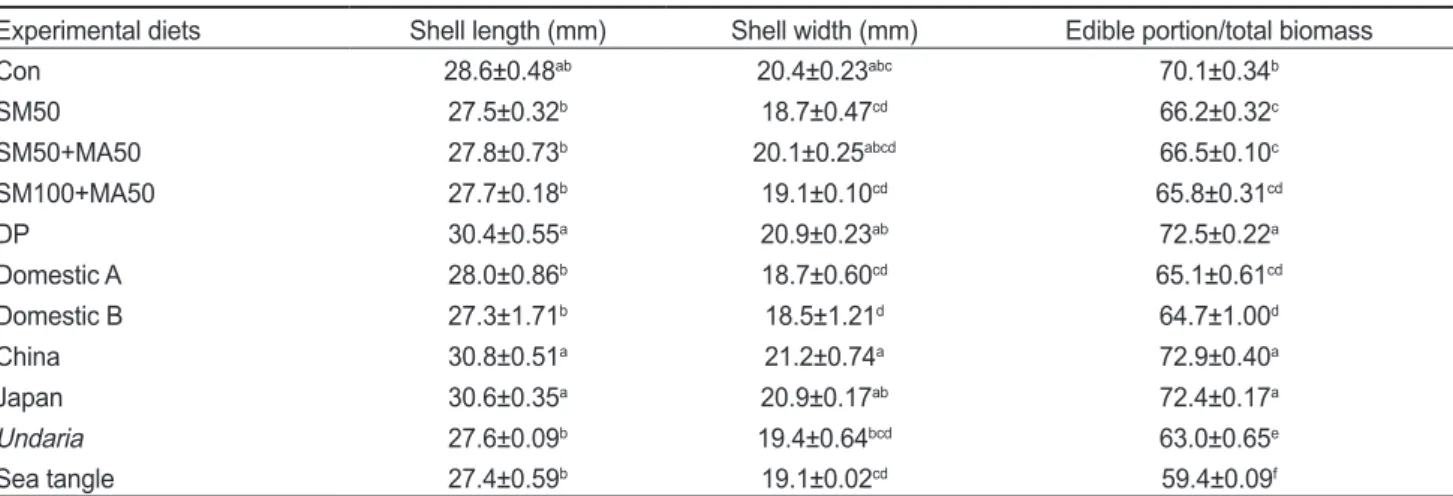
전복의각장
(shell length)
은DP, China
와Japan
사료공급구 가대조구와유의적인차이는없었으나(P>0.05),
다른실험구 보다는유의적으로길었다(P<0.05) (Table 5).
그러나대조구 와다른실험구(SM50, SM50+MA50
및SM100+MA50, Do- mestic A, Domestic B,
미역및다시마)
간에유의적인차이는 없었다.
전복의각폭(Shell width)
은China
사료공급구에서가장높았으며
Japan, DP,
대조구또는SM50+MA50
사료공급 구와유의적인차이는없었으나다른실험구보다는유의적으 로높았다(P<0.05).
전체중에대한가식부의비(Edible portion/
total weight)
는DP, China
와Japan
사료를공급한실험구에서 다른사료를공급한모든실험구보다유의적으로높게나타났 다(P<0.05). DP
사료를공급한실험구에서의성장이SM50
또 는SM50+MA50
또는SM100+MA50
사료공급구보다각장,
각폭및가식부의비율이높은것을미루어보아규조류의사료 내첨가는전복의성장개선효과가기대되며,
본결과와유사하 게사료내Spirulina 2%
첨가시전복의성장개선효과및패각 색채개선효과가뚜렷하게관찰되었다(Cho et al., 2006).
그러 나전복용배합사료내Spirulina
를어분대체원으로5%, 10%
또는
15%
첨가시전복의성장개선효과는전혀없는것으로보고되었다
(Lee et al., 1998b).
또한성장이느려진소형전복(H.
discus hannai)
에게부착성규조류인Caloneis schroderi
를공 급하였을경우미역을공급한경우보다성장이크게회복되었 다(Han and Hur, 2000).
미역과 다시마를 공급한실험구는 다른 실험 사료를 공급 한 실험구보다유의적으로낮게나타났다
(P<0.05). Bautista- Teruel et al. (2001)
은자연산먹이에비하여영양학적으로균 형이잘맞는전복용배합사료의공급은단백질,
지질및고도 Table 2. Amino acid profiles (%, DM basis) of the experimental dietsExperimental diets
Con SM50 SM50+
MA50 SM100+
MA50 DP Domestic
A Domestic
B China Japan Undaria Sea tangle
Ala 1.69 1.57 1.74 1.61 1.87 1.01 1.31 1.77 1.44 1.33 0.40
Arg 1.71 1.70 2.01 1.81 1.97 1.14 1.24 1.63 1.72 1.01 0.17
Asp 2.62 2.58 3.03 2.82 2.93 1.75 1.94 2.97 2.65 1.91 2.29
Cys 0.38 0.42 0.46 0.45 0.43 0.29 0.35 0.48 0.48 0.19 0.11
Glu 5.02 5.12 5.81 5.67 5.66 4.19 5.25 5.34 6.12 2.19 3.81
Gly 1.41 1.26 1.45 1.21 1.60 1.21 1.12 1.37 1.52 1.07 0.24
His 0.73 0.68 0.79 0.75 0.80 0.48 0.58 0.71 0.71 0.39 0.06
Ile 1.44 1.28 1.47 1.44 1.47 0.80 1.16 1.51 1.24 0.91 0.16
Leu 2.85 2.55 2.89 2.97 3.03 1.42 2.19 2.92 2.21 1.61 0.30
Lys 1.57 1.41 1.03 1.50 1.68 1.05 1.25 1.92 1.75 1.13 0.23
Met 0.59 0.51 0.55 0.45 0.63 0.29 0.43 0.40 0.48 0.39 0.10
Phe 1.59 1.40 1.60 1.57 1.59 1.03 1.38 1.80 1.45 0.94 0.23
Pro 1.73 1.89 2.06 1.89 1.98 1.57 1.81 1.87 2.00 1.04 0.55
Ser 1.34 1.34 1.52 1.44 1.53 0.94 1.17 1.53 1.47 0.92 0.25
Thr 1.17 1.11 1.27 1.15 1.30 0.87 0.93 1.29 1.22 0.96 0.28
Tyr 1.02 0.82 0.93 0.92 1.01 0.51 0.84 1.02 0.99 0.55 0.08
Val 1.56 1.55 1.72 1.61 1.68 1.05 1.32 1.71 1.48 1.20 0.34
Con is the control diet. SM50, SM50+MA50 and SM100+MA50 diets are the diets substituting 50% squid meal, 50% squid meal and 50%
macroalgae mixture, and 100% squid meal and 50% macroalgae mixture with the same respective amounts of soybean meal. DP is the diet containing 1% diatom powder in the control diet at the expense of 1% wheat flour.
불포화지방산
,
특히20:4n-6, 20:5n-3, 22:6n-3
의함량이해조 류에비하여높아서전복의성장(
생산성)
이우수하다고보고하 였다.
또한전복용배합사료내단백질원으로서동물성단백질 원또는식물성단백질원의단독공급보다는이들동물성및식 물성단백질원의혼합공급이전복의생산성향상에효과적이 며(Bautista-Teruel et al., 2003; Cho et al., 2008),
본연구에 서도동물성단백질원인오징어분의대두박에의한
100%
대 체(SM100+MA50
사료)
시대조구나오징어분50%
대체사료(SM50
또는SM50+MA50
사료)
시보다전복의성장이저하되 는것으로나타났다.
본연구에서이러한결과는식물성단백질 원인대두박에포함된필수아미노산인Met
의낮은함량(Table
2)
때문에야기된결과로사료된다.
또한미역을공급한실험구에서의전장
,
각고및전중에대한가식부의비율이다시마를공 급한실험구보다미역을공급한실험구에서높게나타난점을 미루어볼때전복의성장을위해서는다시마보다는미역이우 수하다는전복의성장결과를잘반영하였다.
전복의사육실험종료시전복가식부의일반성분분석결과 는
Table 6
과 같다.
전복가식부의 수분 함량은77.0-80.3%
의 범위로서
Domestic B
사료 공급구에서 대조구, SM50,
SM100+MA50, DP
및 다시마공급구보다 유의적으로높은값을보였으나
(P<0.05),
다른실험구와유의적인차이는없었 다.
전복가식부의 조단백질 함량은17.2-20.6%
의 범위로서China
사료공급구에서다른모든실험구보다유의적으로높은값을보였으며
(P<0.05), Japan
사료공급구에서가장낮은값 Table 3. Fatty acid profiles (% of total fatty acid) of the experimental dietsExperimental diets
Fatty acid Con SM50 SM50+
MA50 SM100+
MA50 DP Domestic
A Domestic
B China Japan Undaria Sea
tangle
12:0 0.4
14:0 3.89 3.80 2.57 3.30 3.40 5.84 4.94 2.22 2.33 1.93 10.02
15:0 0.39 0.38 0.35 0.35 0.35
16:0 22.26 21.91 21.74 21.69 21.99 18.39 19.22 21.10 19.94 13.08 19.42
17:0 0.37 0.34 0.36 0.28
18:0 3.29 3.17 3.22 3.21 3.41 2.14 3.35 0.35 2.65 0.88
20:0 0.33 0.44 0.64
∑Saturates 30.20 29.60 27.53 28.55 29.51 26.37 28.87 24.11 24.92 16.53 29.44
16:1n-7 3.67 3.72 2.48 3.59 3.31 2.11 3.61 2.17 2.96 0.39 2.32
17:1n-9 1.49
18:1n-9 17.47 18.15 17.17 17.63 17.63 25.29 22.38 17.90 12.75 5.68 20.94
18:1n-1 1.70 1.77 1.56 1.80 1.68 1.58 2.02 1.62 2.00
20:1n-9 1.11 0.67 0.86 0.37 1.15 0.55 0.69 1.38
24:1n-9 0.41
∑Monoenes 23.95 24.31 22.07 23.39 23.77 28.98 28.56 22.79 19.09 7.56 23.26
18:2n-6 27.33 30.53 37.56 36.24 30.89 30.90 24.90 37.29 32.74 7.07 8.25
18:3n-3 4.41 4.70 4.72 4.97 4.30 3.68 3.01 4.82 3.80 10.02 2.69
18:3n-6 0.51 0.44 0.55 0.51 0.51 1.61 5.65
18:4n-3 1.86 1.73 1.12 1.18 1.47 0.81 0.89 0.61 1.67 21.50 6.20
20:2n-6 0.60 0.40
20:3n-3 1.93 1.55 1.14 0.73 1.42 2.97 1.91 1.29 1.35 13.01 16.32
20:3n-6 0.49
20:4n-3 0.70
20:5n-3 3.25 2.67 2.14 1.70 3.01 2.84 4.47 1.93 4.79 11.76 5.16
22:6n-3 2.93 1.92 2.14 0.84 3.15 1.72 4.41 2.27 4.94
∑n-3 HUFA 8.11 6.14 5.42 3.27 7.58 8.13 11.19 5.49 11.08 25.96 21.48
Unknown 3.64 2.56 1.02 1.88 2.11 1.14 2.59 1.73 6.70 9.75 3.03
Abbreviation of Con, SM50, SM50+MA50, SM100+MA50, and DP diets are referring to footnotes of Table 2.
Table 5. Shell length (mm), shell width (mm) and the ratio of edible portion to total biomass of juvenile abalone Haliotis discus hannai fed experimental diets for 16 weeks
Experimental diets Shell length (mm) Shell width (mm) Edible portion/total biomass
Con 28.6±0.48ab 20.4±0.23abc 70.1±0.34b
SM50 27.5±0.32b 18.7±0.47cd 66.2±0.32c
SM50+MA50 27.8±0.73b 20.1±0.25abcd 66.5±0.10c
SM100+MA50 27.7±0.18b 19.1±0.10cd 65.8±0.31cd
DP 30.4±0.55a 20.9±0.23ab 72.5±0.22a
Domestic A 28.0±0.86b 18.7±0.60cd 65.1±0.61cd
Domestic B 27.3±1.71b 18.5±1.21d 64.7±1.00d
China 30.8±0.51a 21.2±0.74a 72.9±0.40a
Japan 30.6±0.35a 20.9±0.17ab 72.4±0.17a
Undaria 27.6±0.09b 19.4±0.64bcd 63.0±0.65e
Sea tangle 27.4±0.59b 19.1±0.02cd 59.4±0.09f
Values (means of triplicate±SE) in the same column sharing a common superscript are not significantly different (P>0.05). Abbreviation of Con, SM50, SM50+MA50, SM100+MA50, and DP diets are referring to footnotes of Table 2.
Table 6. Chemical composition (%) of edible portion of juvenile abalone Haliotis discus hannai fed experimental diets for 16 weeks
Experimental diets Moisture Crude protein Crude lipid Ash
Con 78.2±0.25bc 18.5±0.10bc 1.1±0.03b 2.1±0.03ef
SM50 75.7±0.79d 18.8±0.12b 1.1±0.06bc 3.3±0.12a
SM50+MA50 78.9±0.62abc 18.9±0.09b 1.5±0.03a 2.0±0.06ef
SM100+MA50 78.2±0.21bc 17.9±0.09d 0.8±0.00d 3.0±0.12b
DP 78.2±0.03bc 18.9±0.10b 1.5±0.03a 2.5±0.09d
Domestic A 80.0±0.27ab 17.8±0.07d 1.1±0.03b 2.8±0.07c
Domestic B 80.3±0.38a 18.0±0.07d 1.0±0.03c 2.4±0.06d
China 78.7±0.20abc 20.6±0.20a 1.1±0.00bc 2.0±0.09ef
Japan 79.0±1.09abc 17.2±0.12e 1.5±0.00a 2.2±0.07e
Undaria 79.4±1.09ab 18.6±0.21bc 1.5±0.03a 2.0±0.00ef
Sea tangle 77.0±0.74cd 18.3±0.23cd 1.1±0.10bc 1.9±0.06f
Values (means of triplicate±SE) in the same column sharing a common superscript are not significantly different (P>0.05). Abbreviation of Con, SM50, SM50+MA50, SM100+MA50, and DP diets are referring to footnotes of Table 2.
Table 4. Survival (%) and weight gain (g/abalone) of juvenile abalone Haliotis discus hannai fed the experimental diets for 16 weeks Experimental diets Initial weight (g/individual) Final weight (g/individual) Survival (%) Weight gain (g/individual)
Con 0.98±0.004 3.3±0.02 99.0±0.95a 2.3±0.02a
SM50 0.98±0.004 3.2±0.01 100.0±0.00a 2.2±0.02b
SM50+MA50 0.98±0.003 3.1±0.02 100.0±0.00a 2.1±0.02b
SM100+MA50 0.98±0.003 2.8±0.03 99.0±0.48a 1.8±0.03d
DP 0.97±0.001 3.4±0.01 97.6±0.95a 2.4±0.02a
Domestic A 0.98±0.001 3.2±0.11 77.6±2.90c 2.2±0.11b
Domestic B 0.98±0.001 3.0±0.05 86.7±0.48b 2.0±0.05c
China 0.98±0.007 3.5±0.01 97.6±1.26a 2.5±0.01a
Japan 0.98±0.003 3.4±0.07 99.0±0.48a 2.4±0.08a
Undaria 0.98±0.004 3.1±2.96 98.0±1.26a 2.1±0.01bc
Sea tangle 0.98±0.000 2.7±0.01 96.2±0.95a 1.7±0.09d
Values (means of triplicate±SE) in the same column sharing a common superscript are not significantly different (P>0.05). Abbreviation of Con, SM50, SM50+MA50, SM100+MA50, and DP diets are referring to footnotes of Table 2.
을보였다
.
전복가식부의조지질함량은0.8-1.5%
의범위로서SM50+MA50, DP, Japan
및미역공급구에서다른모든실험구 보다유의적으로높은값을보였으며(P<0.05), SM100+MA50
사료공급구에서가장낮았다.
전복가식부의회분함량은1.9-
3.3%
의범위로서SM50
사료를공급한실험구에서다른모든실험구보다유의적으로높은값을보였으며
(P<0.05),
다시마를 공급한실험구에서가장낮은값을보였다.
전복가식부의일반 성분결과는실험구간에차이를보였지만공급된사료들의영 양학적차이를잘반영하지는못하였으며,
실험구간에뚜렷한 경향을찾을수는없었다.
그러나본연구의결과와는달리전 복가식부의일반성분은사료의영양소함량에따라크게영향 을받는것으로보고되었다(Mai et al., 1995a, 1995b; Bautista- Teruel and Millamena, 1999, Thongrod et al., 2003; Cho et al., 2008; Garacia-Esquivel and Felbeck, 2009; Cho, 2010).
이상의결과를고려할때전복용배합사료내 단백질원으로 공급된 오징어분과 해조류 대체원으로서 대두박의 단독 대 체가능성은제한적이었지만전복용배합사료내
1%
의규조류 첨가는전복치패의성장개선효과를이루었으며,
일부사료(SM50+MA50, SM100+MA50, Domestic B)
를제외한대부 분의배합사료는미역이나다시마공급구보다우수한성장을 보였다.
사 사
본연구는국립수산과학원연구용역사업
(
전복치패중간육성 용배합사료개발)
의지원에의해수행되었습니다.
References
Association of Official Analytical Chemists (AOAC). 1990. Of- ficial Methods of Analysis (15th edn). Association of Official Analytical Chemists, Arlington, VA, USA.
Bautista-Teruel MN and Millamena OM. 1999. Diet develop- ment and evaluation for juvenile abalone, Haliotis asinina:
protein/energy levels. Aquaculture 178, 117-126. http://
dx.doi.org/10.1016/S0044-8486(99)00121-0.
Bautista-Teruel MN, Millamena OM and Fermin AC. 2001. Re- productive performance of hatchery-bred donkey's ear aba- lone, Haliotis asinina, Linne, fed natural and artificial diets.
Aquacult Res 32, 249-254. http://dx.doi.org/10.1046/j.1355- 557x.2001.00022.x.
Bautista-Teruel MN, Fermin AC and Koshio SS. 2003. Diet development and evaluation for juvenile abalone, Haliotis
asinina: animal and plant protein sources. Aquaculture 219,
645-653. http://dx.doi.org/10.1016/S0044-8486(02)00410- Cho SH. 2010. Effect of fishmeal substitution with various 6.animal and/or plant protein sources in the diet of the aba- lone Haliotis discus hannai Ino. Aquacult Res 41, 587-593.
http://dx.doi.org/10.1111/j.1365-2109.2010.02561.x.
Cho SH, Park J, Kim C, Yoo J and Lee S. 2006. Effect of the various sources of dietary additives on growth, body com- position and shell color of abalone Haliotis discus hannai. J Aquaculture 19, 275-280.
Cho SH, Park J, Kim C and Yoo J. 2008. Effect of casein substitution with fishmeal, soybean meal and crustacean meal in the diet of the abalone Haliotis discus hannai Ino.
Aquacult Nut 14, 61-66. http://dx.doi.org/10.1111/j.1365- 2095.2007.00505.x.
Duncan DB. 1955. Multiple range and multiple F tests. Biomet- rics 11, 1-42.
Folch J, Lees M and Stanley GHS. 1957. A simple method for the isolation and purification of total lipids form animal tis- sues. J Biol Chem 226, 496-509.
Gracia-Esquivel Z and Felbeck H. 2009. Comparative perfor- mance of juvenile red abalone, Haliotis rufescens, reared in laboratory with fresh kelp and balanced diets. Aqua- cult Nut 15, 209-217. http://dx.doi.org/10.1111/j.1365- 2095.2008.00585.x
Han H and Hur SB. 2000. Dietary values of benthic diatoms for growth recovery of the retarded spat of abalone, Haliotis
discus hannai Ino. J Aquaculture 13, 163-168.
KOSIS 2015. Korean Statistical Information Service. Korea.
Lee S, Yun SJ and Hur SB. 1998a. Evaluation of dietary protein sources for Haliotis discus hannai. J Aquaculture 11, 19-29.
Lee S, Lim Y, Moon YB, Yoo SK and Rho S. 1998b. Effects of supplemental and Spirulina in the diets on growth per- formance in juvenile Haliotis discus hannai. J Aquaculture 11, 31-38.
Mai K, Mercer JP and Donlon J. 1995a. Comparative studies on the nutrition of species of abalone, Haliotis tuberculata L. and Haliotis discus hannai Ino. Responses of abalone to various levels of dietary lipid. Aquaculture 134, 65-80.
http://dx.doi.org/10.1016/0044-8486(95)00043-2
Mai K, Mercer JP and Donlon J. 1995b. Comparative studies on the nutrition of two species of abalone, Haliotis tubercu-
lata L. and Haliotis discus hannai Ino. IV. Optimum dietary
protein level for growth. Aquaculture 136, 165-180. http://dx.doi.org/10.1016/0044-8486(95)01041-6
Nie ZQ, Z. Wang Q and Yan JP. 1986. Experiments on preparing of formulated feed and feeding efficiency of young abalone,
Haliotis discus hannai Ino. Mar Fish Res 7, 53-64
Sales J and Britz PJ. 2001. Evaluation of different markers to determine apparent nutrient digestibility coefficients of feed ingredients for South African abalone Haliotis midae L. Aquaculture 202, 113-129. http://dx.doi.org/10.1016/
S0044-8486(01)00575-0
Thongrod S, Tamtin M, Chairat C and Boonyaratpalin M. 2003.
Lipid to carbohydrate ratio in donkey’s ear abalone (Hali-
otis asinine, Linne) diets. Aquaculture 225, 165-174. http://
dx.doi.org/10.1016/S0044-8486(03)00287-4
Uki N, Kemuyama A and Watanabe T. 1985a. Development of semipurified test diets for abalone. Bull Jpn Soc Sci Fish 51, 1825-1833. http://dx.doi.org/10.2331/suisan.51.1825 Uki N, Kemuyama A and Watanabe T. 1985b. Nutritional evalu-
ation of several sources in diets for abalone Haliotis discus
hannai. Bull Jpn Soc Sci Fish 51, 1835-1839. http://dx.doi.
org/10.2331/suisan.51.1835
Uki N, Kemuyama A and Watanabe T. 1986a. Optimum protein level in diets for abalone. Bull Jpn Soc Sci Fish 51, 1825- 1833. http://dx.doi.org/ suisan.51.1005
Uki N, Sugiura M and Watanabe T. 1986b. Requirement of es- sential fatty acids in the abalone Haliotis discus hannai. Bull Jpn Soc Sci Fish 51, 1835-1839. http://dx.doi.org/10.2331/
suisan.
Viana MT, Lopez LM and Salas A. 1993. Diet development for juvenile abalone Haliotis fulgens evaluation of two artifi- cial diets and macroalgae. Aquaculture 117, 149-156. http://
dx.doi.org/10.1016/0044-8486(93)90131-H