181
Copyright © 2020 The Korean Society of Fisheries and Aquatic Science pISSN:0374-8111, eISSN:2287-8815
서 론
참다랑어
(bluefin tuna)
는대표적인회유성어종으로,
우리나 라의동해와남해,
일본전역과태평양,
대서양등전세계해역 에널리분포한다.
참다랑어는최대500 kg
전∙
후까지빠르게성 장할뿐만아니라맛이좋아,
수요가높은고부가가치어종이 다(Kumai, 1998).
참다랑어는분포위치와형태에따라대서양 참다랑어(Thunnus thynnus),
태평양참다랑어(Thunnus orien- talis),
남방참다랑어(Thunnus maccoyii)
로분류된다.
세계연 간 대서양참다랑어의 어획량은22,117
톤으로,
양식생산량인6,909
톤에비해높아어획에대한의존도가높다(FAO, 2019).
대서양참다랑어는스페인
,
크로아티아,
몰타등에서생산되며(Van Beijnen, 2017),
대부분성어와자∙
치어를채포하여양성 한다(Benetti et al., 2016). ICCAT (international commission for the conservation of Atlantic tunas)
는참다랑어의남획을막 기위해연간대서양참다랑어의어획량을규제하고있다(FAO, 2011).
한국의어획할당량은2018
년도기준210
톤이다(MOF,
2017).
참다랑어에대한어획규제는앞으로계속될것으로예상되고있어참다랑어양식에대한중요성이대두되었다
.
참다랑어의최대소비국인 일본은가장먼저북태평양참다랑어 양식을연구하기 시작했다
. 1970
년도에시작된연구는1979
년도에자연산친어로부터채란에성공하였고(Miyashita,
2002), 2002
년도에산란유도와종묘생산기술을확보하며참다랑어의완전양식을가능하게하였다
(Sawada et al., 2005).
태치어기 대서양 참다랑어( Thunnus thynnus) 사료 내 효소처리 어분과 DHA유의 이용성
지승철·신재형
1·김대중·정민환·김정현·이경준
1,2*
국립수산과학원 제주수산연구소, 1제주대학교 해양생명과학과, 2제주대학교 해양과학연구소
Utilization of Enzyme-treated Fish Meal and DHA Oil in Diets for Juve- nile Atlantic Bluefin Tuna Thunnus thynnus
Seung-Cheol Ji, Jaehyeong Shin1, Dae-Jung Kim, Minhwan Jeong, Jung-hyun Kim and Kyeong-Jun Lee1,2*
Marine Science Institute, Jeju National University, Jeju 63333, Korea
1Department of Marine Life Science, Jeju National University, Jeju 63243, Korea
2Marine Science Institute, Jeju National University, Jeju 63333, Korea
This study was conducted to estimate the optimum dietary DHA oil level and replacement level of enzyme treated fish meal (EFM) with sardine fish meal for juvenile Atlantic bluefin tuna Thunnus thynnus . Four diets were used: 1) EFM75 in which 75% EFM and 4% DHA oil were applied, 2) EFM60, with 60% EFM and 15% sardine fish meal, 3) DHA2 with 2% of DHA oil, and 4) SL as a raw fish feed. In a feeding trial, juvenile bluefin tuna (body weight 30.1 g) were randomly stocked into four experimental tanks (69 tones) and fed the experimental diets for 13 days.
Fish weight gain was higher in the EFM75 and SL groups than in the DHA2 and EFM60 groups. The feed conver- sion ratio was lower in the EFM75 and DHA2 groups than in the EFM60 and SL groups. Survival was higher in fish fed the formulated diet groups (EFM75, EFM60 and DHA2) than in fish fed SL. This study clearly indicates that up to 10% dietary sardine fish meal can be used in juvenile T. thynnus diets, with an optimum dietary DHA oil level of approximately 3%.
Keywords: Enzyme-treated fish meal, DHA, Tuna, Protein source, Feeds
*Corresponding author: Tel: +82. 64. 754. 3423 Fax: +82. 64. 756. 3493 E-mail address: [email protected]
This is an Open Access article distributed under the terms of the Creative Commons Attribution Non-Commercial Licens (http://creativecommons.org/licenses/by-nc/3.0/) which permits unrestricted non-commercial use, distribution, and reproduction in any medium, provided the original work is properly cited.
Received 27 December 2019; Revised 24 February 2020; Accepted 28 February 2020 저자 직위: 지승철(연구사), 신재형(대학원생), 김대중(연구관), 정민환(연구 사), 김정현(연구사), 이경준(교수),
https://doi.org/10.5657/KFAS.2020.0181
Korean J Fish Aquat Sci 53(2), 181-190, April 2020
평양참다랑어의경우
,
배합사료내조단백질과조지질(Biswas et al., 2009b),
탄수화물(Biswas et al., 2009a), vitamin C
요구 량(Biswas et al., 2013)
과사료내단백질원에관한연구가일 부진행되었다(Biswas et al., 2011; Ji et al., 2017).
그러나,
대 서양참다랑어를대상으로진행된연구는미흡한실정이다.
배 합사료연구의부재로인해참다랑어양식에는아직까지생사 료를주로사용하고있다.
친환경적이고지속가능한양식을위 해참다랑어용배합사료의개발이절실하다.
참다랑어용배합 사료를개발에있어가장큰문제는‘
어분의낮은이용효율’
이 다.
어분은조단백질함량이60-75%
로높고필수아미노산과필 수지방산이골고루함유되어있다.
뿐만아니라미지성장인자(unknown growth factors)
로인해대부분의어류에서유인성 이뛰어나양어사료내주단백질원으로사용된다(Miles and Chapman, 2015).
그러나,
참다랑어는어분에대한소화율이타 어종에비해낮은것으로알려져있다(Carter et al., 1999).
치어 기참다랑어(0.46 g)
를대상으로한연구에서어분이53%
사용 된배합사료가생사료보다유의적으로낮은성장률을보였고,
어분의가공공정에서발생되는‘
단백질의변성’
이원인이라고 보고되었다(Takii et al., 2007a; 2007b).
참다랑어배합사료연 구는어분의대체원료를찾는데초점을두고진행되었다. Ji et al. (2008)
은치어기참다랑어를대상으로주단백질원이‘
효소 처리어분(enzyme-treated fish meal)’
인실험사료와생사료(
냉 동까나리)
의사육효능을비교한결과,
두실험구의성장률은 유사하여 단백질원으로 이용가능함을 보고하였다.
효소처리 어분은어류가공과정에서발생하는부산물을papain, pepsin, trypsin
등의효소와반응시켜제조된다(Je et al., 2009; Hsu, 2010; Ngo et al., 2010).
효소처리어분은저분자peptide
의함 량이많아,
체내이용률이높을뿐만아니라다양한생리활성물 질을함유하고있어양어사료내주단백질원으로높은효율을 보였다(Neklyudov et al., 2000; Chalamaiah et al., 2012).
국내의경우
,
참다랑어용배합사료를자체적으로개발하기위 한일부연구가수행되었다. Ji et al. (2019)
은효소처리어분과DHA
유를사용한배합사료의사육효능을생사료(
까나리)
와비 교한결과,
두실험구사이에유사한성장을보여주단백질원 과지질원으로사용가능함을보고하였다.
그러나,
효소처리어 분과DHA
유는비교적높은가격에거래되는원료로다량사용할경우
,
사료의제조단가를증가시킬수있다. DHA
는해산어의필수지방산으로어류의성장과생존율에중요한요소 로알려져있다
(NRC, 2011a).
참다랑어의체내DHA
함량은다 른어종에비해비교적높은것으로보고되었다(Aubourg et al., 1990; Sawada et al., 1993; Saito et al., 1995).
참다랑어의정확한
DHA
요구량은규명되지않았으나일반적으로참다랑어용배합사료에는
DHA
함량이높은고가의연어난유(salmon egg oil)
와가다랑어유(bonito oil)
가지질원으로사용된다(Ji et al., 2008). DHA
유는순도가80%
이상인고농축유로명태간유(cod liver oil)
와비교하여약100
배정도비싼가격에거래되는고가의원료이다
.
과학적이고경제적인사료를만들기위해사 료내두원료의적정함량에대한연구는필수적이다.
따라서,
본연구는치어기참다랑어사료내효소처리어분과DHA
유의 적정첨가비율을조사하고자수행되었다.
재료 및 방법
실험사료
실험사료는효소처리어분이
75%
포함된사료(EFM75),
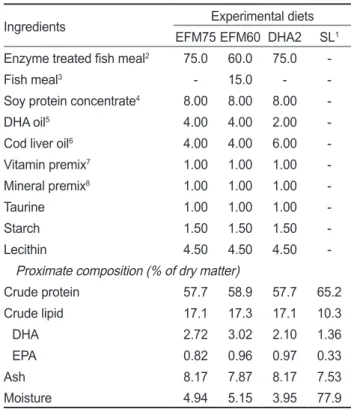
효Table 1. Dietary formulation and proximate compositions of the experimental diets for juvenile Atlantic bluefin tuna Thunnus thyn- nus
Ingredients Experimental diets
EFM75 EFM60 DHA2 SL1 Enzyme treated fish meal2 75.0 60.0 75.0 -
Fish meal3 - 15.0 - -
Soy protein concentrate4 8.00 8.00 8.00 -
DHA oil5 4.00 4.00 2.00 -
Cod liver oil6 4.00 4.00 6.00 -
Vitamin premix7 1.00 1.00 1.00 -
Mineral premix8 1.00 1.00 1.00 -
Taurine 1.00 1.00 1.00 -
Starch 1.50 1.50 1.50 -
Lecithin 4.50 4.50 4.50 -
Proximate composition (% of dry matter)
Crude protein 57.7 58.9 57.7 65.2
Crude lipid 17.1 17.3 17.1 10.3
DHA 2.72 3.02 2.10 1.36
EPA 0.82 0.96 0.97 0.33
Ash 8.17 7.87 8.17 7.53
Moisture 4.94 5.15 3.95 77.9
1Sand lance, China. 2CPSP, Sopropeche, France. 3Sardine,Orizon S.A., Chile. 4Corp. Korea flavor, Korea. 5Corp. Comport, Korea (DHA concentration: 80%). 6Corp. E-wha oil & fat industry, Ko- rea. 7Vitamin premix (g/ kg of mixture): L-ascorbic acid, 121.2;
DL-a tocopheryl acetate, 18.8; thiamine hydrochloride, 2.7; ri- boflavin, 9.1; pyridoxine hydrochloride, 1.8; niacin, 36.4; Ca-D- pantothenate, 12.7; myo-inositol, 181.8; D-biotin, 0.27; folic acid, 0.68; p-aminobenzoic acid, 18.2; menadione, 1.8; retinyl acetate, 0.73; cholecalciferol, 0.003; cyanocobalamin, 0.003. 8Mineral pre- mix (g/ kg of mixture): MgSO4∙7H2O, 80; NaH2PO4∙2H2O, 370;
KCl, 130; Ferric citrate, 40; ZnSO4∙7H2O, 20; Ca-lactate, 356.5;
CuCl, 0.2; AlCl3∙6H2O, 0.15; Na2Se2O3, 0.01; MnSO4∙H2O, 2.0;
CoCl2∙6H2O, 1.0; EFM75, including 75% of enzyme-treated fish meal; EFM60, including 60% of enzyme-treated fish meal; DHA2, including 2% of DHA oil; SL, sand lance.
소처리어분을 일반어분으로
20% (
사료내15%)
대체한사 료(EFM60), DHA
유를기존의4%
에서2%
로감소시킨 사료(DHA2)
와대조구로생사료인까나리(sand lance, SL)
가사용 되었다(Table 1).
비타민과미네랄혼합물(premix)
은방어등의 해산어류의요구량을토대로제작하여 사용되었다.
실험사료 의영양소함량은참다랑어의조단백질과조지질요구량을기 초로조성되었다(Biswas et al., 2009b).
실험사료는파쇄기를 이용하여모든사료원을미세한분말로만든후,
사료조성표에 따라측량및혼합되었다.
혼합물은사료제작기(SP-50, Gum- gang engineering, Daegu, Korea)
를이용하여총2
가지크기(2, 3 mm)
로성형되었다.
완성된사료는건조후(24 h, 20°C),
사료공급전까지냉동보관(-20°C)
되었다.
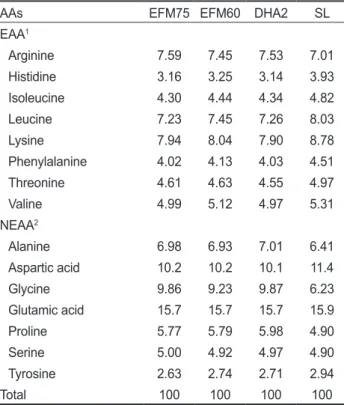
실험사료에대한아 미노산과지방산조성은Table 2
와Table 3
에각각나타내었다. 실험어와 사육관리
실험에사용된참다랑어
(
부화후60
일)
는국립수산과학원제 주수산연구소에서인공부화된치어를이용하였고,
사양실험은 연구소내참다랑어전용사육시설에서진행되었다.
참다랑어 는3
일간생사료와배합사료를교차로공급하여실험환경에적응시킨후
,
사육실험에이용되었다.
예비사육후,
참다랑어(
평 균무게, 30.1 g)
는총4
개의원형콘크리트수조(
용량, 69
톤;
지 름7 m×
높이1.8 m)
에각30
마리씩배치되었다.
수조내용 존산소(dissolved oxygen, DO)
는 산소발생기(aeration)
와 액 화산소주입기를통해조절되었다.
실험사료는1
일4
회(08:00, 11:00, 14:00, 17:00 h)
에나누어총13
일간만복공급되었다.
수조바닥의이물질은4
일1
회siphon
을사용하여제거되었다. 성장률 측정
실험어의최종무게는사육실험종료후측정되었고
,
소화기 관의음식물을제거하기위해무게측정17
시간전부터사료Table 2. Essential and non-essential amino acid composition of the experimental diets for Atlantic bluefin tuna Thunnus thynnus (%
of protein)
AAs EFM75 EFM60 DHA2 SL
EAA1
Arginine 7.59 7.45 7.53 7.01
Histidine 3.16 3.25 3.14 3.93
Isoleucine 4.30 4.44 4.34 4.82
Leucine 7.23 7.45 7.26 8.03
Lysine 7.94 8.04 7.90 8.78
Phenylalanine 4.02 4.13 4.03 4.51
Threonine 4.61 4.63 4.55 4.97
Valine 4.99 5.12 4.97 5.31
NEAA2
Alanine 6.98 6.93 7.01 6.41
Aspartic acid 10.2 10.2 10.1 11.4
Glycine 9.86 9.23 9.87 6.23
Glutamic acid 15.7 15.7 15.7 15.9
Proline 5.77 5.79 5.98 4.90
Serine 5.00 4.92 4.97 4.90
Tyrosine 2.63 2.74 2.71 2.94
Total 100 100 100 100
1Essential amino acids. 2Non-essential amino acids. EFM75, in- cluding 75% of enzyme-treated fish meal; EFM60, including 60%
of enzyme-treated fish meal; DHA2, including 2% of DHA oil;
SL, sand lance.
Table 3. Fatty acids composition of the experimental diets for At- lantic bluefin tuna Thunnus thynnus (% of lipid)
Fatty acids EFM75 EFM60 DHA2 SL
12:0 0.10 0.10 0.10 0.13
14:0 8.30 8.80 9.19 9.08
14:1 0.10 0.10 0.10 0.00
15:0 0.70 0.60 0.70 0.38
16:0 27.4 27.5 28.6 33.6
16:1 4.18 4.26 4.67 2.94
17:0 0.40 0.40 0.40 0.26
17:1 0.10 0.10 0.10 0.00
18:0 6.00 5.82 6.30 9.85
18:1n9 (OA) 17.3 15.5 16.8 12.8
18:2n6 (LA) 5.47 4.77 5.23 1.47
18:3n3 (LNA) 2.10 1.82 2.06 2.67
18:3n6 0.10 0.10 0.10 1.32
20:0 0.36 0.35 0.39 0.28
20:1 5.04 4.64 5.42 1.14
20:3n3 0.08 0.08 0.09 0.41
20:3n6 0.19 0.17 0.20 0.24
20:4n6 (AA) 0.38 0.45 0.44 0.96
20:5n3 (EPA) 4.82 5.60 5.71 3.86
22:0 0.14 0.12 0.13 0.24
22:1n9 0.75 0.72 0.87 1.43
22:6n3 (DHA) 16.0 18.0 12.4 16.9
DHA/EPA 3.31 3.21 2.17 4.37
∑n-31 22.9 25.4 20.1 23.4
∑n-62 5.86 5.22 5.67 2.43
n-3/n-6 3.91 4.86 3.55 9.64
Total 100 100 100 100
1Omega-3 fatty acids: 18:3n3, 20:5n3, 22:6n3. 2Omega-6 fatty acid: 18:2n6, 20:4n6. EFM75, including 75% of enzyme-treated fish meal; EFM60, including 60% of enzyme-treated fish meal;
DHA2, including 2% of DHA oil; SL, sand lance.
공급을중단하였다
. 10
마리의실험어를무작위로선별하여얼 음물에마취시킨 후,
소화기관을 적출하였다.
적출된소화기 관은증류수와혼합되어 분쇄후,
원심분리를거쳐소화효소 활성분석에사용되었다.
기관적출후,
남은어체(carcass)
는 일반성분분석에 사용되었다.
실험어의 성장률과 사료전환효 율등에대한계산식은다음과같다.
성장률(weight gain, WG;
%)=100×(final mean body weight-initial mean body weight)/
initial mean body weight;
일간성장률(specific growth rate, SGR; %)=[(log
efinal body weight-log
einitial body weight)/
days]×100;
사료계수(feed conversion ratio, FCR) = dry feed fed/wet weight gain;
단백질이용효율(protein efficiency ratio, PER)=wet weight gain/total protein given;
사료공급량(feed intake, FI)=dry feed fed/fish.
일반성분
원료
,
실험사료,
어체(
각수조당5
마리)
에대한일반성분분석은
AOAC (2000)
의 방법에 따라 수분은 상압가열건조법(125°C, 3 h),
조회분은 직접회화로법(550°C, 6 h),
단백질은 조단백분석기(Kjeltec
TM2300, FOSS analytical, Hilleroed, Denmark)
로분석되었으며,
지방은Folch et al. (1957)
의방법 에따라Soxhlet
추출장치(SOX406 fat analyzer, Jinan Hanon Instruments, Shandong, China)
를이용하여분석되었다. 간∙위∙장중량과 비만도
실험어
(
각수조당10
마리)
의간,
위,
장을각각분리하여체 질량대비무게를계산하였고,
체중과전장을이용해비만도 를계산하였다.
조사항목의계산식은다음과같다.
간중량지수(hepato-somatic indexes, HSI)=(liver weight×100)/fish body weight;
위중량지수(stomach-somatic indexes, SSI)=(stomach weight×100)/fish body weight;
장중량지수(intestine-somatic indexes, ISI)=(intestine weight×100)/fish body weight;
비 만도(condition factor, CF; %)=(fish body weight / fish body length
3)×100.
소화효소 활성
실험어
(
각수조당5
마리)
의소화기관내5
가지종류의효소활성
(pepsin, trypsin, chymotrypsin, amylase, lipase)
이분석되었 다.
적출된장기는증류수와혼합되어조직균질기(tissue grind- er)
를이용해분쇄되었다.
분쇄된샘플은원심분리(4°C, 10,000 g, 15 min)
후상층액이분석에사용되었다.
각시료의단백질 총량(total protein)
은Bradford (1976)
의방법에따라kit
를이 용하여분석되었다. Pepsin
과amylase
의활성은Worthington (1991)
의방법에따라, trypsin
의활성은Erlanger et al. (1961)
의방법에따라, chymotrypsin
의활성은Erlanger et al. (1961)
의방법에따라, lipase
의활성은Borlongan (1990)
의방법에따 라분석되었다.
아미노산
시료는
0.5 mm
이하로분쇄되었고, 6N HCl 15mL
를첨가하 여 건조오븐(110°C)
에서24 h
반응시켰다.
분해된시료는항 온수조(55°C)
를이용하여2
회감압농축시킨후, 25 mL volu- metric flask
에정용되었다. 0.45 μL membrane filter
로여과 후,
아미노산분석기(S433, Sykam GmbH, Fuerstenfeldbruck, Germany)
를통해분석되었다.
지방산
지방산은
Metcalfe and Schmitz (1961)
의방법에따라추출 되었다.
분리된지방산은capillary column (112-88A7, 100 m×0.25 mm, film thickness 0.20 μm, Agilent Technologies, USA)
이장착된gas chromatography (6800GC, Agilent, San Francisco, USA)
를통해분석되었다. Carrier gas
는수소를사 용하였고, oven
의온도는140°C
에서240°C
까지4°C/min
으로 증가시켰다. Inject
의온도는240°C, detector
의온도는240°C
로 설정하였다. Standard sample
은PUFA 37 component FAME Mix (Supelco, USA)
를사용하였다.
수질
사육실험기간동안수조내수온과용존산소를
1
일2
회측정 하였다.
측정은동일한위치에서진행되었으며,
용존산소측정 기(YSI 600QS, YSI, Yellow Springs, USA)
를이용하였다.
사 육실험기간내평균사육수온은24.7°C,
용존산소는10.3 mg/
L
로유지되었다.
Table 4. Growth performance and feed utilization of juvenile Atlantic bluefin tuna Thunnus thynnus fed the experimental diets for 13 days
Dietary treatment FBW1 WG2 SGR3 FCR4 PER5 FI6 Survival (%)
EFM75 93.8±18.8a 202 7.38 0.57 2.78 35.9 52.0
EFM60 63.1±19.7c 103 4.73 1.07 1.49 34.2 48.0
DHA2 75.7±20.2b 144 5.95 0.86 1.84 38.5 52.0
SL 101±20.9a 226 7.89 1.38 1.15 96.6 36.0
1Final mean body weight (g). 2Weight gain (%). 3Specific growth rate (%). 4Feed conversion ratio. 5Protein efficiency ratio. 6Feed intake (g).
EFM75, including 75% of enzyme-treated fish meal; EFM60, including 60% of enzyme-treated fish meal; DHA2, including 2% of DHA oil; SL, sand lance. Mean values of FBW are presented as mean±standard deviation. Values in the same column having different superscript letters are significantly different (P<0.05). The lack of superscript letter indicates no significant differences among treatments.
통계분석
분석결과는
SPSS (Version 12.0)
프로그램을이용하여One- way ANOVA
로통계분석되었다.
데이터값의유의차는Dun- can’s multiple range test
로평균간의유의성(P≤0.05)
을비교 하였다.
데이터는평균값±
표준편차(mean±standard deviation)
로나타내었으며,
백분율데이터는arcsine
변형값으로계산하 여통계분석되었다.
결 과
실험어의최종평균무게는
EFM75
구와SL
구가유사하였고, DHA2, EFM60
순으로낮았다(Table 4).
흥미롭게도사료전환효율은
EFM75
구가가장낮았고, DHA2, EFM60, SL
순으로 높았다.
사료공급량은SL
구가가장높았고, DHA2, EFM75,
EFM60
순으로 낮았다.
생존율은 배합사료 실험구(EFM75,
EFM60, DHA2)
가SL
구보다높은경향을나타냈다.
실험어(carcass)
의 일반성분조성(
조단백질,
조지질,
조회분 함량)
과 간,
위,
장중량,
비만도는실험구간유의적인차이를보이지않 았다(Table 5, 6).
흥미롭게도실험어의소화기관내pepsin
과lipase
의활성은배합사료구(EFM75, EFM60, DHA2)
가생사 료구(SL)
에비해유의적으로낮았다(Table 7). Trypsin
과amy-
lase
활성은배합사료구가생사료구보다유의적으로높았다.
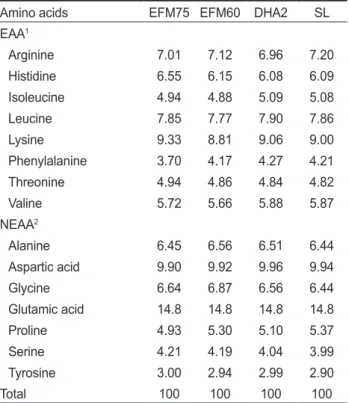
실험어의아미노산조성은실험구간유의적인차이를보이지 않았다
(Table 8).
실험어의DHA
함량은배합사료구가생사료 구와비교하여유의적으로높았다.
Table 5. Carcass proximate compositions of juvenile Atlantic bluefin tuna Thunnus thynnus fed the experimental diets for 13 days (% of wet basis)
Dietary treatment Crude protein Crude lipid Crude ash Moisture
EFM75 18.9±0.45 3.60±0.93 5.09±0.60 72.2±3.99
EFM60 19.0±0.75 3.62±0.39 5.20±0.35 73.4±4.35
DHA2 18.5±0.32 3.56±0.51 4.95±0.71 72.5±2.48
SL 18.3±0.63 3.50±0.42 5.03±0.83 73.5±5.10
EFM75, including 75% of enzyme-treated fish meal; EFM60, including 60% of enzyme-treated fish meal; DHA2, including 2% of DHA oil; SL, sand lance. Mean values of five samples are presented as mean±standard deviation. Values in the same column having different su- perscript letters are significantly different (P<0.05). The lack of superscript letter indicates no significant differences among the treatments.
Table 6. Biological assessment of digestive organs of juvenile Atlantic bluefin tuna Thunnus thynnus fed the experimental diets for 13 days
Dietary treatment HSI1 SSI2 ISI3 CF4
EFM75 1.77±0.40 1.37±0.10 0.64±0.04 1.36±0.09
EFM60 2.04±0.56 1.38±0.16 0.58±0.22 1.29±0.14
DHA2 2.44±0.55 1.37±0.24 0.47±0.16 1.28±0.16
SL 2.44±0.40 1.27±0.13 0.56±0.18 1.29±0.12
1Hepato-somatic index=(liver weight×100)/fish body weight. 2Stomach-somatic index=(stomach weight×100)/fish body weight. 3Intestine- somatic index=(intestine weight×100)/fish body weight. 4Condition factor=(fish body weight/fish body length3)×100. EFM75, including 75% of enzyme-treated fish meal; EFM60, including 60% of enzyme-treated fish meal; DHA2, including 2% of DHA oil; SL, sand lance.
Mean values of ten samples are presented as mean±standard deviation. Values in the same column having different superscript letters are significantly different (P<0.05). The lack of superscript letter indicates no significant differences among the treatments.
Table 7. Digestive enzyme activities of juvenile Atlantic bluefin tuna Thunnus thynnus fed the experimental diets for 13 days (U / mg pro- tein)
Dietary treatment Pepsin Trypsin Chymo-trypsin Amylase Lipase
EFM75 28.5±2.32b 12.1±1.52a 6.30±1.68 3.92±0.39a 130±4.25b
EFM60 26.2±1.08b 13.1±2.02a 5.98±0.59 4.17±0.57a 120±6.05b
DHA2 27.2±2.02b 12.5±0.28a 5.53±0.23 4.09±0.55a 128±3.08b
SL 35.7±1.62a 9.15±1.46b 7.32±1.25 1.49±0.48b 149±7.48a
EFM75, including 75% of enzyme-treated fish meal; EFM60, including 60% of enzyme-treated fish meal; DHA2, including 2% of DHA oil; SL, sand lance. Mean values of five samples are presented as mean±standard deviation. Values in the same column having different su- perscript letters are significantly different (P<0.05). The lack of superscript letter indicates no significant differences among the treatments.
고 찰
참다랑어는빛
,
진동등의외부자극에민감해사육실험의생 존율이다른어류에비해낮게나타난다(Miyashita, 2002).
본 연구에서도참다랑어의생존율(36-52%)
은낮았다.
이전의참 다랑어연구에서도낮은생존율을보여사육실험에는특별한 문제가없었던것으로판단된다(Ji et al., 2008, 2017, 2019).
본연구의사육실험결과
,
정어리어분은참다랑어사료에다 량으로사용하기에는어려울것으로판단된다. Ji et al. (2017)
은치어기참다랑어(2.36 g)
를대상으로어분이32%
포함된배 합사료와생사료의사육효능을비교하였다.
실험결과,
배합사료구는생사료구대비
23%
낮은성장을보여주단백질원으로사용하기에는어렵다고보고하였다
.
참다랑어는어분의이용 효율이낮은것으로알려져있다(Takii et al., 2007a, 2007b).
Carter et al. (1999)
은치어기참다랑어를대상으로in vitro
소 화율을분석한결과,
참다랑어는대서양연어보다어분에대한소화율이낮다고보고하였다
.
본연구의사육실험결과를고려 하였을때,
치어기참다랑어사료내어분의적정사용함량은10%
이하라고판단된다.
어류의소화효소활성은체중과함께증가하는것으로알려져있다
.
어류의소화율은소화기관내효 소의활성에영향을받는것으로알려져있다(Manjappa et al., 2002; Tibaldi et al., 2006; Lin and Luo, 2011; Li et al., 2014).
치어기참다랑어
(0.68-10.7 g)
를대상으로진행된연구에서도성장함에 따라소화효소 활성이증가된다고보고되었다
(Ji et
Table 8. Essential and non-essential amino acids composition of juvenile Atlantic bluefin tuna Thunnus thynnus fed the experimen- tal diets for 13 days (% of protein)
Amino acids EFM75 EFM60 DHA2 SL
EAA1
Arginine 7.01 7.12 6.96 7.20
Histidine 6.55 6.15 6.08 6.09
Isoleucine 4.94 4.88 5.09 5.08
Leucine 7.85 7.77 7.90 7.86
Lysine 9.33 8.81 9.06 9.00
Phenylalanine 3.70 4.17 4.27 4.21
Threonine 4.94 4.86 4.84 4.82
Valine 5.72 5.66 5.88 5.87
NEAA2
Alanine 6.45 6.56 6.51 6.44
Aspartic acid 9.90 9.92 9.96 9.94
Glycine 6.64 6.87 6.56 6.44
Glutamic acid 14.8 14.8 14.8 14.8
Proline 4.93 5.30 5.10 5.37
Serine 4.21 4.19 4.04 3.99
Tyrosine 3.00 2.94 2.99 2.90
Total 100 100 100 100
1Essential amino acids. 2Non-essential amino acids. EFM75, in- cluding 75% of enzyme-treated fish meal; EFM60, including 60%
of enzyme-treated fish meal; DHA2, including 2% of DHA oil; SL, sand lance. Mean values of three samples are presented. Values in the same row having different superscript letters are significantly different. The lack of superscript letter indicates no significant dif- ferences among the treatments (P<0.05).
Table 9. Fatty acids composition of juvenile Atlantic bluefin tuna Thunnus thynnus fed the experimental diets for 13 days (% of lipid)
Fatty acids EFM75 EFM60 DHA2 SL
12:0 0.11 0.11 0.12 0.13
14:0 4.69b 4.45b 4.80b 9.08a
14:1 0.56 0.23 0.62 0.00
15:0 0.35 0.17 0.29 0.38
16:0 18.6b 18.0b 19.5b 33.6a
16:1 6.43a 5.57a 5.77a 2.94b
17:0 1.10 1.02 1.77 0.26
17:1 1.17 1.24 1.14 0.00
18:0 5.67b 5.60b 4.96b 9.85a
18:1n9 (OA) 18.3a 17.4a 17.5a 12.8b 18:2n6 (LA) 6.58a 5.55a 5.74a 1.47b
18:3n3 (LNA) 1.08 2.24 1.75 2.67
18:3n6 1.17 0.94 1.19 1.32
20:0 0.19 0.83 0.79 0.28
20:1 1.21 1.22 1.77 1.14
20:3n3 0.00 0.33 0.82 0.41
20:3n6 0.16 0.28 0.17 0.24
20:4n6 (AA) 1.08 0.45 0.58 0.96
20:5n3 (EPA) 5.42a 4.57a 5.34a 3.86b
22:0 0.22 0.23 0.14 0.24
22:1n9 5.52b 7.90a 6.04b 1.43c
22:6n3 (DHA) 20.4a 21.6a 19.2a 16.9b
DHA/EPA 3.76 4.73 3.60 4.37
∑n-31 26.9 28.5 26.3 23.4
∑n-62 7.66 6.00 6.32 2.43
n-3/n-6 3.51 4.74 4.17 9.64
Total 100 100 100 100
1Omega-3 fatty acid: 18:3n3, 20:5n3, 22:6n3. 2Omega-6 fatty acid:
18:2n6, 20:4n6. EFM75, including 75% of enzyme-treated fish meal; EFM60, including 60% of enzyme-treated fish meal; DHA2, including 2% of DHA oil; SL, sand lance. Mean values of three samples are presented. Values in the same row having different superscript letters are significantly different (P<0.05).