824
Copyright © 2014 The Korean Society of Fisheries and Aquatic Science pISSN:0374-8111, eISSN:2287-8815
서 론
양어사료에서단백질원료의사용비율은매우높으며
,
이는 양어사료의품질과가격을결정짓는중요한요인으로작용한 다.
어분은높은수준의단백질과우수한아미노산조성을가지고있는주요단백질사료원료로특히육식성해산어류의사료 내첨가비율
(50-70%)
이매우높다.
따라서어획량감소에의한 가격상승으로양어사료내어분을대체할수있는사료원료개 발에대한관심이부각되고있다(Yang et al., 2011; Song et al.,
2014).
대두박은다른식물성원료와비교하여상대적으로높은넙치(Paralichthys olivaceus) 치어 사료에서 산 가수분해 농축대두박 (Acid-concentrated soybean meal)의 어분대체효과 및 소화율 평가
김성삼·오대한
1·조성준
2·서상현
2·한현섭·이경준
3*
국립수산과학원 사료연구센터, 1CJ 제일제당 생물자원연구소, 2CJ 제일제당 소재연구소, 3제주대학교 해양생명과학과
Evaluation of Acid-concentrated Soybean Meal as a Fishmeal Replacement and its Digestibility in Diets for Juvenile Olive Flounder
Paralichthys olivaceus
Sung-Sam Kim, Dae-Han Oh
1
, Seong-Jun Cho2
, Sang-Hyun Seo2
, Hyon-Sob Han and Kyeong-Jun Lee3
*Aquafeed Research Center, National Fisheries Research and Development Institute, Pohang 791-923, Korea
1
Animal Bioscience Research Institute, CJ CheilJedang Corporation, Incheon 400-103, Korea
2
Food Ingredients R&D Center, CJ CheilJedang Corporation, Seoul 152-866, Korea
3
Department of Marine Life Sciences, Jeju National University, Jeju 690-756, Korea
This study was conducted to investigate the effects of fishmeal replacement with acid-concentrated soybean meal (ACSBM) on growth performance, blood biochemistry, and ingredient digestibility in juvenile olive flounder Para- lichthys olivaceus . Six experimental diets were formulated to replace fishmeal protein with ACSBM at 0%, 20%, 30%, 40%, 50%, and 60% (designated ACSBM0, ACSBM20, ACSBM30, ACSBM40, ACSBM50, and ACSBM60, respectively). Triplicate groups of fish (initial fish mean weight: 14.3±0.03 g) were fed the experimental diets to apparent satiation (twice daily at 08:00 and 18:00 h). After a 12-week feeding trial, a total of 180 healthy fish were randomly distributed into three Guelph system tanks at a density of 60 fish/tank (initial fish mean weight : 50.6±2.4 g) to test the apparent digestibility coefficients of the ingredients (ACSBM, fishmeal, and soybean meal). Although negative effects were observed with ACSBM40, ACSBM50 and ACSBM60 after 12 weeks of feeding, up to 20% of the fishmeal protein could be successfully replaced with ACSBM without significant growth depression. Hemoglobin and hematocrit values of fish fed the ACSBM50 and ACSBM60 diets were significantly lower than those of fish fed the ACSBM0 diet. Glucose values of fish fed the ACSBM60 diet were significantly higher than those of fish fed the ACSBM0 and ACSBM20 diets. Digestibility of protein in ACSBM and soybean meal was 85.9% and 82.5%, respec- tively. Results indicated that at least 20% of fishmeal protein can be replaced by ACSBM in diets of juvenile olive flounder without supplementation of limiting amino acids.
Key words: Olive flounder, Fish meal, Acid-concentrated soybean meal, Digestibility, Replacement
This is an Open Access article distributed under the terms of the Creative Commons Attribution Non-Commercial Licens (http://creativecommons.org/licenses/by-nc/3.0/)which permits unrestricted non-commercial use, distribution, and reproduction in any medium, provided the original work is properly cited.
http://dx.doi.org/10.5657/KFAS.2014.0824 Kor J Fish Aquat Sci 47(6) 824-831, December 2014
Received 22 October 2014; Revised 4 November 2014; Accepted 13 November 2014
*Corresponding author: Tel: +82. 64. 754. 3423 Fax: +82. 64. 756. 3493
E-mail address: [email protected]
단백질함량과우수한아미노산조성을가지고있으며어분에 비해가격이저렴하여가장효율적으로어분을대체할수있는 것으로알려져있다
(Storebakken et al., 2000; Leenhouwers et al., 2006; Gatlin et al., 2007).
하지만대두박에는영양소의소 화와흡수를저해시키는protease inhibitor, tannins, lectins
및non-starch polysaccharides
와같은항영향인자(antinutritional factors, ANF)
를포함하고있어어류의성장에부정적인영향 을미침으로써양어사료원료로서의사용에많은제약이따른 다(Francis et al., 2001). ANF
는열처리,
용매추출또는생물 학적처리(bioprocess)
등을통해함량을낮추고제거하거나불 활성화시킬수있다(Rumsey et al., 1994; Buttle et al., 2001;
Refstie et al., 1998, 2005).
최근에는대두박의어분대체효율 을높이기위해대두박에별도의가공처리를하여이용성을높 이는연구가수행되고있다.
분리대두단백(soy protein isolates, SPI),
농축대두단백(soy protein concentrates, SPC),
고단백대 두박(high protein soybean meal, HSB)
은주요대두가공품(soy products)
으로주목받고있다(Chou et al., 2004; Glencross et al., 2005).
이와같은대두가공품은상대적으로높은단백질과 낮은탄수화물및섬유소를함유하고있어다른식물성사료원 료에비해이용성이높은것으로알려져있다(Ao, 2011; Cavins et al., 1972).
산 가수분해 농축대두박
(acid-concentrated soybean meal,
ACSBM)
은어분대체효율및생체내이용성을높이기위해탈지대두박
(defatted soybean meal)
을산가수분해방법을통해 가공처리하여 생산되었다
.
일반적으로 대두박을 열처리(steaming
및roasting)
및산과알코올을이용하여가공처리하 면oligosaccharides, lectins, soya antigens, phytase
및trypsin inhibitors
와같은ANF
의함량이감소하는것으로보고되고있 다(Refstie et al., 1998; Watson et al., 2014).
본연구는넙치치 어를대상으로가공처리시킨산가수분해농축대두박이일반 대두박과 비교하여이용성이향상되었는지를in vivo
소화율 시험을통해검증하고,
사료내어분단백질의대체가능성을알 아보고자수행되었다.
재료 및 방법
산 가수분해 농축대두박 제조 공정
실험에사용된산가수분해농축대두박
(
단백질67.0%,
지방3.4%,
회분3.5%)
은CJ
제일제당에서제공받았다.
탈지대두박 중량에5
배의증류수를가수한다.
그후혼합하면서1 N HCl
을 첨가하여pH 4.5
수준으로조성하였다.
조성물을30
분간실온 에서교반한후원심분리기를이용하여5,000 g
에서20
분간원 심분리하여상등액을 제거하였으며,
회수된침전물을동결건 조하여산가수분해농축대두박(ACSBM)
분말을제조하였다. 실험사료
실험에사용된산가수분해농축대두박
(
단백질67.0%,
지방3.4%,
회분3.5%)
은CJ
제일제당으로부터제공되었다.
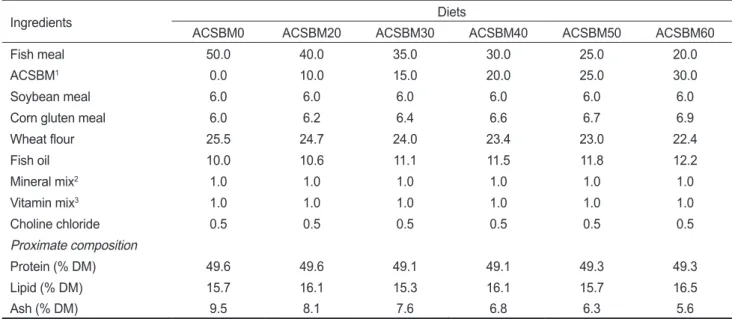
실험사Table 1. Formulation and proximate composition of the experimental diets for olive flounder Paralichthys olivaceus
Ingredients Diets
ACSBM0 ACSBM20 ACSBM30 ACSBM40 ACSBM50 ACSBM60
Fish meal 50.0 40.0 35.0 30.0 25.0 20.0
ACSBM1 0.0 10.0 15.0 20.0 25.0 30.0
Soybean meal 6.0 6.0 6.0 6.0 6.0 6.0
Corn gluten meal 6.0 6.2 6.4 6.6 6.7 6.9
Wheat flour 25.5 24.7 24.0 23.4 23.0 22.4
Fish oil 10.0 10.6 11.1 11.5 11.8 12.2
Mineral mix2 1.0 1.0 1.0 1.0 1.0 1.0
Vitamin mix3 1.0 1.0 1.0 1.0 1.0 1.0
Choline chloride 0.5 0.5 0.5 0.5 0.5 0.5
Proximate composition
Protein (% DM) 49.6 49.6 49.1 49.1 49.3 49.3
Lipid (% DM) 15.7 16.1 15.3 16.1 15.7 16.5
Ash (% DM) 9.5 8.1 7.6 6.8 6.3 5.6
1Acid-concentrated soybean meal (ACSBM) was provided by CJ CheilJedang Corp. 2MgSO4.7H2O, 80.0; NaH2PO4.2H2O, 370.0; KCl, 130.0;
Ferric citrate, 40.0; ZnSO4.7H2O, 20.0; Ca-lactate, 356.5; CuCl, 0.2; AlCl3.6H2O, 0.15; Na2Se2O3, 0.01; MnSO4.H2O, 2.0; CoCl2.6H2O, 1.0.
3L-ascorbic acid, 121.2; DL-αtocopheryl acetate, 18.8; thiamin hydrochloride, 2.7; riboflavin, 9.1; pyridoxine hydrochloride, 1.8; niacin, 36.4; Ca-D-pantothenate, 12.7; myo-inositol, 181.8; D-biotin, 0.27; folic acid, 0.68; p-aminobezoic acid, 18.2; menadione, 1.8; retinyl acetate, 0.73; cholecalficerol, 0.003; cyanocobalamin, 0.003.
료제작에사용된사료조성표와실험사료의일반성분은
Table 1
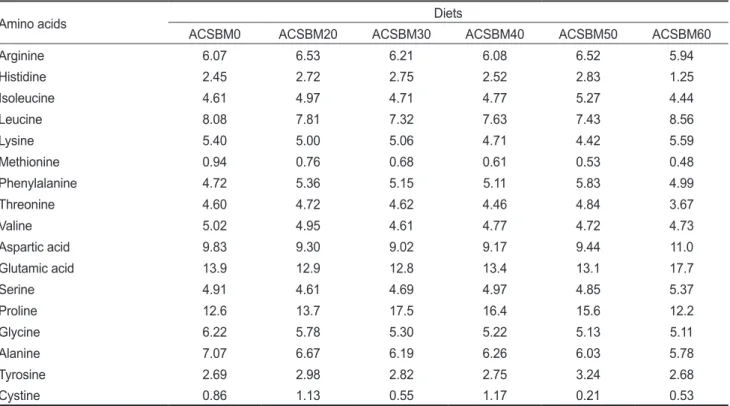
에나타내었으며실험사료의아미노산조성은Table 2
에나타 내었다.
실험사료는어분을기초로한사료를대조구로하였으 며ACSBM
으로어분단백질을20%, 30%, 40%, 50%
및60%
대체하여 총
6
개의 실험사료를 제작하였다(ACSBM0, AC- SBM20, ACSBM30, ACSBM40, ACSBM50
및ACSBM60).
실험사료는우선사료원들을혼합기에넣어완전히섞은다음
,
어유를첨가한뒤사료원총량의30%
에해당하는증류수를첨 가하여사료혼합기(NVM-14-2P, Daeyoung, Korea)
로 혼합,
반죽하였다.
혼합반죽물은 소형초파기(SMC-12, Kuposlice, Busan, Korea)
를이용하여알맞은크기로뽑아내었다.
실험사료는건조기를이용하여
24 h
동안건조시켜사료공급전까지-20°C
에보관하면서사용하였다. 실험어 및 사육관리
실험에사용된넙치치어는제주도내에위치한종묘배양장우 도수산에서구입하여제주대학교소속해양과환경연구소로이 송하였다
.
실험어류는2
주동안시판배합사료를공급하면서실 험환경에적응할수있도록순치되었다.
예비사육후넙치(
초기 평균무게: 14.3±0.03 g)
는총18
개의150 L
원형플라스틱수 조에각수조당40
마리씩무작위로선택하여배치되였다.
사육 수는모래여과해수를사용하여2-3 L/min
의유수량이공급되 도록조절하였고모든실험수조에용존산소유지를위하여에 어스톤을설치하였다.
사육수온은자연수온(15-22℃)
에의존하였으며광주기는형광등을이용하여
12-h light/12-h dark
로 유지되었으며실험사료공급은1
일2
회(08:00 h
및18:00 h)
만 복공급을하였다.
어류무게측정은매3
주마다실시하였으며측정
24 h
전에실험어류의스트레스를줄이기위해모든실험어류를절식시켰다
.
사료공급실험은총12
주간진행되었다. 샘플수집 및 분석
실험종료 후 실험어류의 최종 무게를 측정하여 증체율
(weight gain),
일간성장률(specific growth rate),
사료전환효 율(feed conversion ratio),
단백질이용효율(protein efficiency ratio)
및생존율(survival)
을산출하였다.
최종무게측정후수 조당3
마리의 어류를 무작위로 선별하여2-phenoxyethanol
(200 ppm)
용액으로마취시킨후헤파린처리된주사기를이용하여미부동맥에서채혈을하였다
.
채혈된전혈은hematocrit, hemoglobin
분석에사용되었다.
분석후남은혈액은원심분 리기를이용하여 혈장을분리한후alanine aminotransferase (ALT), aspartate aminotransferase (AST)
분석을실시하였다. Hematocrit
은microhematocrit technique
방법으로 분석하였 으며, hemoglobin, ALT, AST, protein
및glucose
함량은자동 생화학분석기(Express plus system, Bayer, USA)
를이용하여 측정하였다.
실험사료의일반성분분석은
AOAC (1995)
방법에따라수 분은상압가열건조법(125℃, 3 h),
회분은직접회화법(550℃, 6 h),
조단백질은자동조단백질분석기(Kejltec system 2300,
Table 2. Amino acid composition (% protein) of the experimental diets for olive flounder Paralichthys olivaceus
Amino acids Diets
ACSBM0 ACSBM20 ACSBM30 ACSBM40 ACSBM50 ACSBM60
Arginine 6.07 6.53 6.21 6.08 6.52 5.94
Histidine 2.45 2.72 2.75 2.52 2.83 1.25
Isoleucine 4.61 4.97 4.71 4.77 5.27 4.44
Leucine 8.08 7.81 7.32 7.63 7.43 8.56
Lysine 5.40 5.00 5.06 4.71 4.42 5.59
Methionine 0.94 0.76 0.68 0.61 0.53 0.48
Phenylalanine 4.72 5.36 5.15 5.11 5.83 4.99
Threonine 4.60 4.72 4.62 4.46 4.84 3.67
Valine 5.02 4.95 4.61 4.77 4.72 4.73
Aspartic acid 9.83 9.30 9.02 9.17 9.44 11.0
Glutamic acid 13.9 12.9 12.8 13.4 13.1 17.7
Serine 4.91 4.61 4.69 4.97 4.85 5.37
Proline 12.6 13.7 17.5 16.4 15.6 12.2
Glycine 6.22 5.78 5.30 5.22 5.13 5.11
Alanine 7.07 6.67 6.19 6.26 6.03 5.78
Tyrosine 2.69 2.98 2.82 2.75 3.24 2.68
Cystine 0.86 1.13 0.55 1.17 0.21 0.53
Sweden)
로분석하였으며,
조지방은Folch et al. (1959)
의방 법에 따라Soxhlet
추출장치(Soxhlet heater system C-SH6,
Korea)
를이용하여분석하였다.
실험사료의아미노산분석은Sycom S-433D automatic amino acid analyzer (Sykam, Eres- ing, Germany)
를이용하여분석되었다.
사료원료의 외관상소화율 측정
실험사료원료
(
산가수분해농축대두박,
어분,
대두박)
의외관 상소화율을조사하기위해실용사료원을기초로참고사료(ref- erence diet)
와실험사료(test diets)
를제작하여사용하였다.
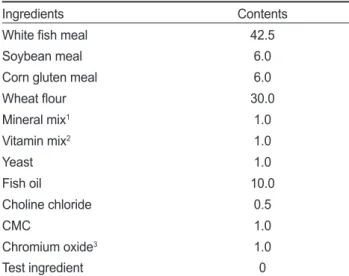
참 고사료조성표는Table 5
에나타내었다.
실험사료는참고사료 와실험사료원료를7:3
의비율로혼합하여제작되었다.
소화율 을분석하기위한지시제(indicator)
로chromium oxide (Cr
2O
3,
Sigma-Aldrich)
를사용하였으며참고사료와실험사료에각각1.0%
가포함되도록설계되었다.
실험어류는
2
주 동안 분 수집장치(Guelph system)
수조에 서참고사료를공급하면서실험환경에적응할수있도록순치 시킨후 소화율실험에 사용하였다.
넙치 치어(
초기평균무게: 50.6±2.4 g)
는총6
개의400 L Guelph system
분수집장치수 조에각수조당60
마리씩무작위로선택하여배치하였다.
사육 수는1
차적으로모래여과된해수를다시카트리지필터가장착 된하우징을설치하여2
차여과기를통과시키면서1 L/min
의 유수량이되도록조절하였다.
사료공급은매일17:00 h
에만복 공급하였으며사료공급후수조내이물질제거를위해환수를 실시하였다.
익일09:00 h
에분(feces)
수집장치에모인분을채 집하였다.
채집된분은여과지(110 mm, F1093-110, Chmlab)
를이용하여해수를제거하여
-70°C
에보관한뒤동결건조하여분석에사용되었다
.
분채집은총10
일간실시하였으며사육수 온은자연수온(19-22℃)
에의존하였다.
실험사료와분에서지시제로사용된
chromium oxide
함량은Divakaran et al. (2002)
의방법을토대로분석되었다.
샘플을 회화로(550℃)
에서3 h
동안회화시킨후얻어진시료를분석 에사용하였다.
먼저chromium oxide
를mono-chromate
형태 로산화시키기위해샘플5-10 mg
을측량하여glass test tube
에 옮긴다.
시료가담긴glass test tub
에perchloric reagent 4 mL
를 첨가한다. Perchloric reagent
는100 mL
의증류수에200 mL
의 질산을혼합한후,
냉각시킨다음70% perchloric acid 200 mL
을혼합하여만든다.
시료와perchloric reagent
가첨가된glass test tube
를가열판에넣고300℃
에서20
분간가열한후실온에 서방냉시킨다.
전처리가끝난샘플은50 mL
유리플라스크에 옮긴후3
차증류수로25 mL
가되도록정량한다.
그후분광광 도계(Beckman DU-730, USA)
를이용하여350 nm
에서흡광 도를측정하였다.
측정한흡광도는시료분석과같이전처리된Standard
용액으로만들어진standard
방정식을이용하여시료 의Chromium oxide
함량을계산하였다.
사료원료소화율은다음과같은방법으로계산되었다
.
참고사료 및 실험사료의 영양소 소화율(%)
=100×[1–(
사료내지시제%/
분내지시제%)×(
분내영양소%/
사료내영양소%)]
실험원료의영양소소화율
(%)
=[(
사료내영양소함량×
실험사료의영양소소화율)–(0.7×
참고사료의 영양소 함량
×
참고사료의 영양소소화율)]/[(1- 0.7)×
실험원료의영양소함량]
통계학적분석
실험사료의배치는완전확률계획법
(Completely randomized design)
을실시하고,
성장및분석결과는SPSS (Version 12.0)
프로그램을이용하여One-way ANOVA
로통계분석된다.
데 이터값의유의차는Tukey's test (P≤0.05)
로비교되었다데이 터는평균값±
표준편차(mean±SD)
로나타내었다.
백분율데 이터는arcsine
변형값으로계산하여통계분석하였다.
결과 및 고찰
12
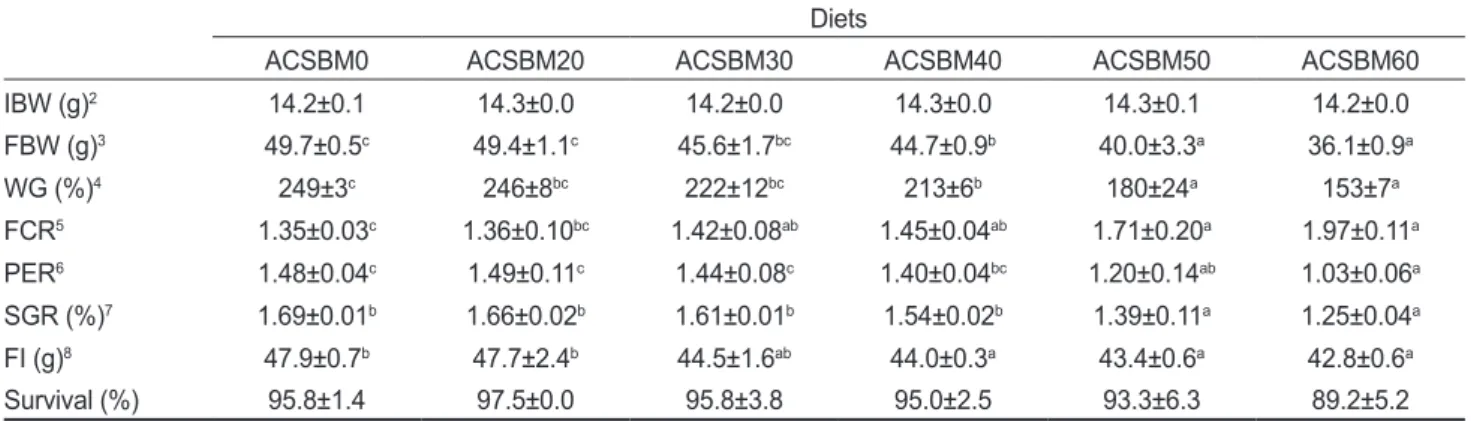
주간수행된사료공급실험의성장결과는Table 3
에나타내 었다.
증체율과일간성장률분석결과어분단백질을20%
에서30%
까지대체한ACSBM20, ACSBM30
실험구는대조구인ACSBMS0
실험구와유의적인차이를보이지않았으나, 40%
이상실험구인
ACSBM40, ACSBM50
및ACSBM60
실험구는대체함량이증가함에따라
ACSBM0
실험구에비해유의적으로감소하였다
.
단백질전환효율역시증체율과같은경향을 보였다.
사료전환효율의경우ACSBM20
실험구는ACSBM0
실험구와유의적인차이를보이지않았으나
ACSBM30, AC-
SBM40, ACSBM50, ACSBM60
실험구는ACSBM0
실험구 에 비해유의적으로 낮은효율을보였다.
사료섭취율은AC-
SBM20
과ACSBM30
이대조구와유의적인차이를보이지않았으며
, ACSBM40, ACSBM50, ACSBM60
실험구는대조구 및ACSBM20
에비해유의적으로낮은섭취율을보였다.
생존 율은모든실험구에서유의적인차이를보이지않았다.
이상의 성장결과를종합해보면,
산가수분해농축대두박을이용하여 넙치사료내어분단백질을40%
까지대체하여도성장에대한 유의적인차이가없는것으로사료된다.
하지만어분을30%
이 상대체한실험구의성장이경향적으로감소되는것으로보아장기간실험이진행될경우
30%
이상어분을대체한실험구의성장이유의적으로감소될것으로예상된다
.
대두박은육식 성어류의사료내어분을20-30%
대체할수있는것으로보고 되고있다(Chou et al., 2004; Hernandez et al., 2007; Lim and
Lee, 2008). Soy protein hydrolysates
의경우강도다리사료내 어분을85%
까지대체할수있었으며(Song et al., 2014), Soy
protein concentrate (SPC)
의경우대서양넙치(Atlantic hali-
but, Berge et al.,1999),
대서양연어(Atlantic salmon, Refstie
et al.,2001),
잉어(Common carp, Escaffre et al., 1997),
무지 개송어(Rainbow trout, Médale et al., 1998; Mambrini et al.,
1999)
및세네갈서대(Senegalese sole, Aragão et al., 2003)
의 사료내어분을완전또는부분적(40-75%)
으로대체할수있 는것으로보고되었다.
하지만넙치와Turbot
에서사료내SPC
의어분대체비율은본연구결과와유사한25%
로상대적으로 낮은것을알수있었다(Day et al., 2000; Deng et al., 2006).
식물성사료원료의어분대체비율은제한아미노산
(methionine, lysine)
의첨가여부,
실험사료조성및어종에따라다르게나 타날수있다(Deng et al., 2006).
본연구는별도의제한아미 노산(methionine)
을첨가하지않은실험사료를사용하여실험 을진행하였으며어분대체비율이증가함에따라실험사료의methionine
함량이감소되는것을확인할수있었다(Table 2).
이러한필수아미노산함량의변화에따른사료내추가보충이
없어서
20%
이상대체하였을때성장률이감소된것으로판단된다
.
따라서산가수분해농축대두박은넙치치어사료내어 분을20%
까지안정적으로대체할수있을것으로판단되며,
제 한아미노산(methionine, lysine
등),
철,
인, phytase
등첨가시20%
이상의어분대체가가능한지에대한추가연구가필요할것으로사료된다
.
실험어류의일반적인 건강도를 알아보기위한혈액학적 분 석결과는
Table 4
에 나타내었다. Hematocrit
분석결과AC- SBM20, ACSBM30
및ACSBM40
실험구는ACSBM0
실험구와유의적인차이를보이지않았으나
ACSBM50
과AC-
SBM60
실험구는ASBM0
실험구에비해유의적으로감소하였다
. Hemoglobin
의경우ACSBM20
과ACSBM30
실험구는ACSBM0
실험구와 유의적인차이가없었으며, ACSBM40,
ACSBM50
및ACSBM60
실험구는ACSBM0
실험구에 비 해유의적으로감소하였다. Glucose
수치는ACSBM60
실험 구가ACSBM0
과ACSBM20
실험구에비해유의적으로높았 다. ALT, AST, protein
수치는모든실험구에서유의적인차이 를 보이지않았다.
혈액성분분석은어류의건강도와체내대사를알아보기위한지표로사용된다
. ACSBM
으로어분대체함량이증가할수록
hematocrit, hemoglobin
수치는유의적으 로감소하였으며,
이와반대로glucose
함량은어분대체함량 이증가함에따라유의적으로증가하였다. ACSBM
으로어분 Table 3. Growth performance of olive flounder Paralichthys olivaceus fed the six experimental diets for 12 weeks1Diets
ACSBM0 ACSBM20 ACSBM30 ACSBM40 ACSBM50 ACSBM60
IBW (g)2 14.2±0.1 14.3±0.0 14.2±0.0 14.3±0.0 14.3±0.1 14.2±0.0
FBW (g)3 49.7±0.5c 49.4±1.1c 45.6±1.7bc 44.7±0.9b 40.0±3.3a 36.1±0.9a
WG (%)4 249±3c 246±8bc 222±12bc 213±6b 180±24a 153±7a
FCR5 1.35±0.03c 1.36±0.10bc 1.42±0.08ab 1.45±0.04ab 1.71±0.20a 1.97±0.11a PER6 1.48±0.04c 1.49±0.11c 1.44±0.08c 1.40±0.04bc 1.20±0.14ab 1.03±0.06a SGR (%)7 1.69±0.01b 1.66±0.02b 1.61±0.01b 1.54±0.02b 1.39±0.11a 1.25±0.04a
FI (g)8 47.9±0.7b 47.7±2.4b 44.5±1.6ab 44.0±0.3a 43.4±0.6a 42.8±0.6a
Survival (%) 95.8±1.4 97.5±0.0 95.8±3.8 95.0±2.5 93.3±6.3 89.2±5.2
1Mean values of triplicate groups, values are presented as mean ± SD. Values in the same row having different superscript letters are sig- nificantly different (P<0.05). 2Initial mean body weight. 3Final mean body weight. 4Weight gain (%)=100×(final mean body weight – initial mean body weight)/initial mean body weight. 5Feed conversion ratio=dry feed fed/wet weight gain. 6Protein efficiency ratio=wet weight gain/total protein given. 7Specific growth rate (%)=[(loge final body weight–loge initial body weight)/days]×100. 8Feed intake (g) = dry feed fed/fish.
Table 4. Serological characteristics of olive flounder Paralichthys olivaceus fed the six experimental diets for 12 weeks1 Diets
ACSBM0 ACSBM20 ACSBM30 ACSBM40 ACSBM50 ACSBM60
Hematocrit (%) 21.3±0.6c 20.1±1.2c 21.3±2.1c 19.1±0.2bc 16.8±0.7ab 15.7±1.2a Hemoglobin (g/dL) 4.54±0.03c 4.60±0.20c 4.46±0.29c 4.29±0.35bc 3.74±0.21ab 3.52±0.35a
ALT (U/L) 32.9±5.5 34.3±3.6 41.0±8.4 38.2±7.7 34.0±8.7 29.7±6.4
AST (U/L) 11.5±1.8 13.0±1.4 12.6±1.1 10.1±1.5 10.5±1.3 10.7±3.3
Protein (g/dL) 4.23±0.12 3.76±4.08 4.08±0.46 4.20±0.91 4.76±0.25 4.49±0.23
Glucose (mg/dL) 18.5±0.7a 18.7±1.5a 22.8±4.7ab 22.6±2.6ab 26.8±3.5ab 29.5±6.6b
1Mean values of triplicate groups, values are presented as mean ± SD. Values in the same row having different superscript letters are signifi- cantly different (P< 0.05).
을대체하게되면어분과비교하여대두박에서부족하기쉬운
methionine
및lysine
등필수아미노산등이제한아미노산으 로작용하고,
식물성단백질원이가지고있는항영양인자의함 량이증가하기때문에대체함량이증가함에따라유의적으로 낮은hematocrit
및hemoglobin
수치를보인것으로판단된다.
또한대체함량이증가함에따라사료섭취율역시유의적으로감소하는것을알수있었다
.
식물성원료인ACSBM
의함량이증가함에따라기호성이떨어져결국사료섭취량이감소한 것도영향을미친것으로판단된다
.
이와반대로ACSBM50
과ACSBM60
실험구에서는유의적으로높은glucose
수치를보 였다. Glucose
는어류의체내대사가원활할때그값이감소 한다고보고되고있으며(Gordon, 1968),
스트레스를받으면그 값이증가하여스트레스의지표로도활용되기도한다.
이결과역시
ACSBM
으로어분의대체함량이증가함에따라사료섭취량이감소하고
,
필수아미노산의함량이감소함에따라영양대 사불균형으로부터기인한것으로사료된다.
사료원료의외관상소화율분석결과는
Table 6
에나타내었다.
건물소화율은 어분이대두박과
ACSBM
에비해유의적으로높은값을보였다
.
단백질소화율의경우어분이91.5%
로가장 높았으며ACSBM
은85.9%
로일반대두박(82.5%)
에비해다 소높은값을나타내었다.
따라서산처리를통한가수분해방법으로농축시킨가공처리방법은일반탈피대두박의소화율 을향상시켜그이용성을높일수있는가공처리방법이라판 단된다
.
연구결과를종합해보면
,
산가수분해농축대두박은넙치치 어사료내어분을20%
까지대체할수있을것으로판단되며,
산가수분해방법은일반대두박의이용성을보다더향상시킬 수있는가공방법으로판단된다.
향후제한아미노산등을첨가 하여어분을보다더대체할수있는추가연구가수행되어야할 것으로판단된다.
사 사
이연구는국립수산과학원
(
친환경실용배합사료개발및품 질관리연구, RP-2014-AQ-126)
및CJ
제일제당의지원에의 해연구되었습니다.
실험원료의소재인산가수분해농축대두 박원료를제공해준CJ
제일제당소재연구소의지원에감사 드립니다.
References
Ao T. 2011. Using exogenous enzymes to increase the nutritional value of soybean meal in poultry diet. In: El-Shemy H, Ed.
Soybean and Nutrition. InTech, New York, USA, 201-214.
AOAC (Association of Official Analytical Chemists), 1995. Of- ficial Methods of Analysis. 16th edn. Association of Official Analytical Chemists, Arlington, Virginia, USA.
Aragão C, Conceicção LEC, Dias J, Marques AC, Gomes E and Dinis MT. 2003. Soy protein concentrate as a protein source for Senegalese sole (Solea senegalensis Kaup 1858) diets:
effects on growth and amino acid metabolism of postlarvae.
Aquac Res 34, 1443-1452. http://dx.doi.org/10.1111/j.1365- 2109.2003.00971.x.
Berge GM, Grisdale-Helland B and Helland SJ. 1999. Soy pro- tein concentrate in diets for Atlantic halibut (Hippoglossus
hippoglossus). Aquaculture 178, 139-148. http://dx.doi.
org/10.1016/S0044-8486(99)00127-1.
Table 6. Apparent digestibility coefficient (%, ADC) of dry matter and protein in the test ingredient determined by fecal collection method (Guelph system) for olive flounder Paralichthys olivaceus1 Test ingredient Acid-concentrated
soybean meal Fish meal Soybean meal ADC of test
ingredients
Dry matter (%) 57.7±8.0a 82.0±14.6b58.3±17.6a Protein (%) 85.9±1.3 91.5±7.7 82.5±7.8
1Mean values of triplicate groups, values are presented as mean ± SD. Values in the same row having different superscript letters are significantly different (P< 0.05).
Table 5. Formulation of the reference diet for digestibility test (%
of DM basis)
Ingredients Contents
White fish meal 42.5
Soybean meal 6.0
Corn gluten meal 6.0
Wheat flour 30.0
Mineral mix1 1.0
Vitamin mix2 1.0
Yeast 1.0
Fish oil 10.0
Choline chloride 0.5
CMC 1.0
Chromium oxide3 1.0
Test ingredient 0
1MgSO4.7H2O, 80.0; NaH2PO4.2H2O, 370.0; KCl, 130.0; Fer- ric citrate, 40.0; ZnSO4.7H2O, 20.0; Ca-lactate, 356.5; CuCl, 0.2;
AlCl3.6H2O, 0.15; Na2Se2O3, 0.01; MnSO4.H2O, 2.0; CoCl2.6H2O, 1.0.
2L-ascorbic acid, 121.2; DL-αtocopheryl acetate, 18.8; thiamin hydrochloride, 2.7; riboflavin, 9.1; pyridoxine hydrochloride, 1.8;
niacin, 36.4; Ca-D-pantothenate, 12.7; myo-inositol, 181.8; D-bio- tin, 0.27; folic acid, 0.68; p-aminobezoic acid, 18.2; menadione, 1.8; retinyl acetate, 0.73; cholecalficerol, 0.003; cyanocobalamin, 0.003.
Buttle LG, Burrells AC, Good JE, Williams PD, Southgate PJ and Burrells C. 2001. The binding of soybean agglutinin (SBA) to the intestinal epithelium of Atlantic salmon, Salmo
salar and Rainbow trout, Oncorhynchus mykiss, fed high
levels of soybean meal. Vet Immunol Immunopathol 80, 237-244. http://dx.doi.org/10.1016/S0165-2427(01)00269- Cavins JF, Kwolek WF, Inglett GE and Cowan JC. 1972. Amino 0.acid analysis of soybean meal: interlaboratory study. J Assoc Off Anal Chem 55, 686–691.
Chou RL, Her BY, Su MS, Hwang G, Wu YH and Chen HY.
2004. Substituting fish meal with soybean meal in diets of juvenile cobia Rachycentron canadum. Aquaculture 229, 325-333. http://dx.doi.org/10.1016/S0044-8486(03)00395- Day OJ and Plascencia González HG. 2000. Soybean pro-8.
tein concentrate as a protein source for turbot Scophthal-
mus maximus L. Aquacult Nutr 6, 221-228. http://dx.doi.
org/10.1046/j.1365-2095.2000.00147.x.
Deng J, Mai K, Ai Q, Zhang W, Wang X, Xu W and Liufu Z.
2006. Effects of replacing fish meal with soy protein con- centrate on feed intake and growth of juvenile Japanese flounder, Paralichthys olivaceus. Aquaculture 258, 503- 513. http://dx.doi.org/10.1016/j.aquaculture.2006.04.004.
Divakaran S, Leonard GO, and Ian PF. 2002. Note on the meth- ods for determination of chromic oxide in shrimp feeds. J Agric Food Chem 50, 464-467. http://dx.doi.org/10.1021/
jf011112s.
Escaffre AM, Zambonino Infante JL, Cahu CL, Mambrini M, Bergot P and Kaushik SJ. 1997. Nutritional value of soy pro- tein concentrate for larvae of common carp (Cyprinus car-
pio) based on growth performance and digestive enzyme ac-
tivities. Aquaculture 153, 63-80. http://dx.doi.org/10.1016/S0044-8486(97)00010-0.
Folch J, Lees M and Sloane-Stanley GH. 1957. A simple method for the isolation and purification of total lipids from animal tissues. J Biol Chem 226, 497-509.
Francis G, Makkar HPS and Becker K. 2001. Antinutritional factors present in plant-derived alternate fish feed ingre- dients and their effects in fish. Aquaculture 199, 197-227.
http://dx.doi.org/10.1016/S0044-8486(01)00526-9.
Gatlin III DM, Barrows FT, Brown P, Dabrowski K, Gaylord TG, Hardy RW, Hermen E, Hu G, Krogdahl A, Nelson R, Overturf K, Rust M, Sealey W, Skonberg D, Souza EJ, Stone D, Wilson R and Wurtele E. 2007. Expanding the uti- lization of sustainable plant products in aquafeeds: a review.
Aquac Res 38, 551–579. http://dx.doi.org/10.1111/j.1365- 2109.2007.01704.x.
Glencross B, Evans D, Dods K, McCafferty P, Hawkins W, Maas R and Sipsas S. 2005. Evaluation of the digestible value of lupin and soybean protein concentrates and iso- lates when fed to rainbow trout, Oncorhynchus mykiss, us-
ing either stripping or settlement faecal collection methods.
Aquaculture 245, 211-220. http://dx.doi.org/10.1016/j.aqua- culture.2004.11.033.
Bell GR. 1968. Distribution of transaminase (Aminotransferas- es) in the tissues of the pacific salmon (Oncorhynchus), with emphasis on the properties and diagnostic use of glutamic oxaloacetic transaminase. J Fish Res Bd Can 25, 1247-1268.
http://dx.doi.org/10.1139/f68-108.
Hernandez MD, Martínez FJ, Jover M and Garcia Garcia B.
2007. Effects of partial replacement of fish meal by soy- bean meal in sharpsnout seabream (Diplodus puntazzo) diet.
Aquaculture 263, 159-167. http://dx.doi.org/10.1016/j.aqua- culture.2006.07.040.
Leenhouwers JI, Adjei-Boateng D, Verreth JAJ and Schrama JW. 2006. Digesta viscosity, nutrient digestibility and organ weights in African catfish (Clarias gariepinus) fed diets supplemented with different levels of a soluble non-starch polysaccharide. Aquacult Nutr 12, 111-116. http://dx.doi.
org/10.1111/j.1365-2095.2006.00389.x.
Lim SJ and Lee KJ. 2008. Supplemental iron and phospho- rus increase dietary inclusion of cottonseed and soybean meal in olive flounder (Paralichthys olivaceus). Aqua- cult Nutr 14, 423-430. http://dx.doi.org/10.1111/j.1365- 2095.2007.00546.x.
Mambrini M, Roem AJ, Cravèdi JP, Lallès JP and Kaushik SJ.
1999. Effects of replacing fishmeal with soy protein concen- trate and of DL-methionine supplementation in high-energy, extruded diets on the growth and nutrient utilization of rain- bow trout, Oncorhynchus mykiss. J Anim Sci 77, 2990-2999.
Médale F, Boujard T, Vallée F, Blanc D, Mambrini M, Roem A and Kaushik SJ. 1998. Voluntary feed intake, nitrogen and phosphorus losses in rainbow trout (Oncorhynchus
mykiss) fed increasing dietary levels of soy protein con-
centrate. Aquat Living Resour 11, 239-246. http://dx.doi.org/10.1016/S0990-7440(98)89006-2.
Refstie S, Sahlström S, Bråthen E, Baeverfjord G and Krogedal P. 2005. Lactic acid fermentation eliminates indigestible car- bohydrates and antinutritional factors in soybean meal for Atlantic salmon (Salmo salar). Aquaculture 246, 331-345.
http://dx.doi.org/10.1016/j.aquaculture.2005.01.001.
Refstie S, Storebakken T, Baeverfjord G and Roem AJ. 2001.
Long-term protein and lipid growth of Atlantic salmon (Salmo salar) fed diets with partial replacement of fish meal by soy protein products at medium or high lipid level.
Aquaculture 193, 91-106. http://dx.doi.org/10.1016/S0044- 8486(00)00473-7.
Refstie S, Storebakken T and Roem AJ. 1998. Feed consump- tion and conversion in Atlantic salmon (Salmo salar) fed di- ets with fish meal, extracted soybean meal or soybean meal with reduced content of oligosaccharides, trypsin inhibitors, lectins and soya antigens. Aquaculture 162, 301-312. http://
dx.doi.org/10.1016/S0044-8486(98)00222-1.
Rumsey GL, Siwicki AK, Anderson DP and Bowser PR. 1994.
Effect of soybean protein on serological response, non-spe- cific defense mechanisms, growth, and protein utilization in rainbow trout. Vet Immunol Immunopathol 41, 323-339.
http://dx.doi.org/10.1016/0165-2427(94)90105-8.
Song Z, Li H, Wang J, Li P, Sun Y and Zhang L. 2014. Effects of fishmeal replacement with soy protein hydrolysates on growth performance, blood biochemistry, gastrointestinal digestion and muscle composition of juvenile starry floun- der (Platichthys stellatus). Aquaculture 427, 96-104. http://
dx.doi.org/10.1016/j.aquaculture.2014.01.002.
Storebakken T, Refstie S and Ruyter B. 2000. Soy products as fat and protein sources in fish diets for intensive aquaculture.
In: Drackley, J. K, Ed. Soy in Animal Nutrition. Federation of Animal Science Societies, Savoy, IL, 127-170.
Watson AM, Buentello A and Place AR. 2014. Partial replace- ment of fishmeal, poultry by-productmeal and soy protein concentrate with two non-geneticallymodified soybean cul- tivars in diets for juvenile cobia, Rachycentron canadum.
Aquaculture 434, 129-136. http://dx.doi.org/10.1016/j.aqua- culture.2014.08.003.
Yang YH, Wang YY, Lu Y and Li QZ. 2011. Effect of replacing fish meal with soybean meal on growth, feed utilization and nitrogen and phosphorus excretion on rainbow trout (On-
corhynchus mykiss). Aquacult Int 19, 405-419. http://dx.doi.
org/10.1007/s10499-010-9359-y.