376
Copyright © 2018 The Korean Society of Fisheries and Aquatic Science pISSN:0374-8111, eISSN:2287-8815
서 론
전복류
(Haliotis spp.)
의 세계 양식생산량은2000
년에는2,540
톤에서2015
년에는139,594
톤으로 크게 증가하였으며(FAO, 2018),
이러한증가추세는앞으로도지속될것으로예 상되고있기때문에전복에대한다양한연구가수행되고있 다.
특히전복의안정적인양식생산을위해서는저비용고효율 의배합사료사용이필수적이지만,
국내전복양식장에서는여 전히자연산먹이(
미역,
다시마,
톳등)
의공급이선호되고있는 실정이다.
그러나이들해조류는전복의빠른성장을위한주요영양소
(Mai et al., 1995a, b; Fleming et al., 1996; Bautista- Teruel et al., 2003)
요구량(
단백질요구량25-35%,
지질요구량
3-7%)
을충족시키지못하기때문에성장저하로양식생산단가를상승시키는원인이되기도한다
.
전복용배합사료원료중에서어분
(2,000-2,500
원/kg)
과해조 류분말(4,000-5,000
원/kg)
은가장값비싼원료들이다.
따라서 저비용고효율의전복용배합사료를개발하기위해서는이들 어분과해조류를대체할수있는공급이안정적이고가격이저 렴한사료원료의사용이필요하다.
전복용배합사료내어분대 체원개발을위한다양한동물성과식물성원료및이들혼합분까막전복(Haliotis discus) 치패용 EP사료내 어분과 해조류 대체원으로서 참치부산물분과 생미강의 효과
윤아영·김준·정해승
1·이기욱
1·조성환*
한국해양대학교 해양생명과학부, 1해양과학기술전문대학원
Effects of Substituting Fish Meal and Macroalgae for Tuna Byproduct Meal and Rice Bran in Extruded Pellets Fed to Juvenile Abalone
Haliotis discus (Reeve 1846)
Ahyeong Yun, June Kim, Hae Seung Jeong1, Ki Wook Lee1 and Sung Hwoan Cho*
Division of Marine BioScience, College of Ocean Science and Technology, Korea Maritime and Ocean University, Busan 49112, Korea
1Department of Convergence Study on the Ocean Science and Technology, Korea Maritime and Ocean University, Busan 49112, Korea
We investigated the effect of replacing tuna byproduct meal (TBM) and rice bran (RB) with fish meal (FM) and macroalgae (MA) in extruded pellets (EP) supplied as a diet to juvenile Abalone Haliotis duscus in aquaculture. In total, 80,000 juvenile abalone were distributed among eight indoor raceways and supplied with one of four experi- mental diets. The control diet consisted of FM, fermented soybean meal, corn gluten meal and shrimp meal as protein sources, with wheat flour and dextrin as carbohydrate sources; the control diet also contained MA. In the FM50 diet, TBM was replaced with 50% FM. In the MA 50 diet, RB was replaced with 50% MA. The final diet, FM50+MA50, included TMB and RB in place of 50% FM and 50% MA. Abalone were fed to satiation with little food leftover for 16 weeks. Weight gain and specific growth rate of abalone fed the control diet were greater than those of abalone fed the FM50 and MA50 diets, but not different from those of abalone fed FM50+MA50 diet. The proximate composition of abalone soft body did not vary according to experimental diets. Based on these results, it appears that the traditional commercial diet for juvenile abalone, comprising FM and MA, could be replaced with one containing 50% TBM and 50% RB without any retardation of growth.
Key words: Haliotis discus , Fish meal, Macroalgae, Tuna byproduct, Rice bran
This is an Open Access article distributed under the terms of the Creative Commons Attribution Non-Commercial Licens (http://creativecommons.org/licenses/by-nc/3.0/) which permits unrestricted non-commercial use, distribution, and reproduction in any medium, provided the original work is properly cited.
https://doi.org/10.5657/KFAS.2018.0376
Korean J Fish Aquat Sci 51(4) 376-382, August 2018 Received 24 April 2018; Revised 16 May 2018; Accepted 23 May 2018
*Corresponding author: Tel: +82. 51. 410. 4755 Fax: +82. 51. 404. 4750
E-mail address: [email protected]
의이용성에대한연구
(Uki et al., 1985; Britz, 1996; Guzmán and Viana, 1998; Lee et al., 1998; Shipton and Britz, 2001;
Bautista-Teruel et al., 2003; Cho 2010; Tung and Alfaro, 2012;
Jung et al., 2016; Myung et al., 2016; Kim et al., 2017)
와해조 류대체원개발에대한연구들(Reyes and Fermin, 2003; Kim et al., 2016; Kim et al., 2017; Jang et al., 2018)
이수행되어져 왔다.
Jung et al. (2016)
의연구에서어분을28%
첨가한까막전복(H. discus, Reeve 1846)
치패용실험사료내국내에서시판되 는참치부산물분(Tuna byproduct meal)
으로어분을75%
대 체하여도전복의생존율과 성장은차이를보이지않았다.
배 합사료내참치부산물분의어분대체는넙치(Paralichthys oli- vaceus)
에서는30% (Kim et al., 2014)
와 조피볼락(Sebastes schlegeli)
에서는40% (Jeon et al., 2014)
까지가능하였다.
그 리고Kim et al. (2016)
은까막전복치패용실험사료내20%
다 시마첨가시농산물부산물인생미강(Rice bran)
으로80%
까지 대체하여도전복의생산성에부정적인영향을미지치않는다고 보고한바있다.
전복(H. midae)
간췌장내에서alginate lyase, carboxymethyl cellulase, laminarinase, agarase, carragenase
가관찰되었으며,
전복의소화기에있는bacteria
가먹이내함 유된alginate, laminarin, agarose, carragenan, cellulose
의소 화를돕는것으로보고되었다(Erasmus et al., 1997).
필리핀에 서Moringa oliefera
의잎과담수산수서식물(Azolla pinnata)
이전복(H. asinina)
배합사료의우수한사료원으로사용될수 있다는Reyes and Fermin (2003)
의연구결과들을고려할때 생미강도전복용사료원료로사용될수있을것으로판단된다. Jung et al. (2016)
과Kim et al. (2016)
의연구결과를전복양 식현장에적용시키위해서는이들원료들의어분및해조류대 체가능성과유용성을상업용사료형태인extruded pellet (EP)
으로제조하여검증하는과정이필요하다.
따라서본연구에서 는전복용EP
사료내어분과해조류대체원으로서참치부산물 분과생미강의이용성을조사하였다.
재료 및 방법
사육 관리
실험에 이용된 까막전복 치패는 개인양식장
(
제주특별자치 도)
에서구입하여사육실험조건에2
주간적응시켰으며,
적응 기간동안에는건미역(Undaria pinnatifida)
을1
일1
회체중의1.5-2.0%
공급하였다. 8
개의1,800 L FRP (fiber-reinforced plastic) raceway
수조(6 m×1 m)
에각각10,000
마리의전복 치패(
시작시마리당평균무게1.9 g)
를무작위로수용하였으 며,
각수조내에는shelter
를넣어주었다. Raceway
별주수량 은37.6 L/min
이었고,
사육실험기간동안충분한양의에어를 공급하였다.
실험사료는
2
일1
회(17:00)
씩체중의1.9-2.2%
를공급하였으며
,
섭취되지않고남은먹이와찌꺼기는3-4
일간격으로제거 하고바닥청소를실시하였다.
사육실험기간동안의사육수온 은13.8℃-25.3℃[
평균수온18.4±3.15℃ (Mean±SD)]
이었 으며,
빛은자연광주기를따랐다.
사육실험은2
반복으로16
주 간실시하였다.
실험 사료의 준비
실험용
EP
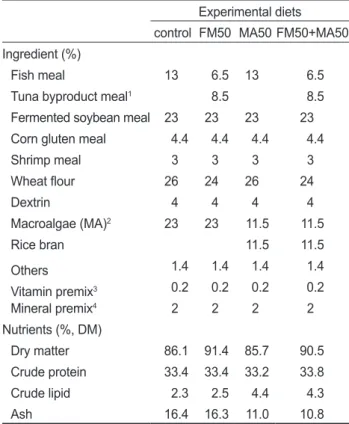
사료의원료조성과일반성분분석결과는Table 1
과같다.
실험용EP
사료는총4
종류를두었다.
대조구(control)
사료에는어분13%,
발효대두박23%,
옥수수글루텐밀4.4%
Table 1. Ingredients of the experimental diets (%, DM basis) Experimental diets control FM50 MA50 FM50+MA50 Ingredient (%)
Fish meal 13 6.5 13 6.5
Tuna byproduct meal1 8.5 8.5
Fermented soybean meal 23 23 23 23
Corn gluten meal 4.4 4.4 4.4 4.4
Shrimp meal 3 3 3 3
Wheat flour 26 24 26 24
Dextrin 4 4 4 4
Macroalgae (MA)2 23 23 11.5 11.5
Rice bran 11.5 11.5
Others 1.4 1.4 1.4 1.4
Vitamin premix3 0.2 0.2 0.2 0.2
Mineral premix4 2 2 2 2
Nutrients (%, DM)
Dry matter 86.1 91.4 85.7 90.5
Crude protein 33.4 33.4 33.2 33.8
Crude lipid 2.3 2.5 4.4 4.3
Ash 16.4 16.3 11.0 10.8
1Tuna byproduct meal was purchased from HIF Co., Ltd. (Chang- won-si, Gyeongsangnam-do, Korea). 2Macroalgae (MA) is the mixture of Undaria pinnatifida and Hizikia fusiforme at a ratio of 1:1. 3Vitamin premix contained the following amount which were diluted in cellulose (g/kgmix): riboflavin, 23.8; pyridoxine, 4.7;
niacin, 95.2; Ca-pantothenate, 33.3; inositol, 476.9; folic acid, 1.5;
p-amino benzoic acid, 47.6; filler, 31.7. 4Mineral premix contained the following ingredients (g/kg mix): MgSO4, 140.8; NaH2PO4, 92.4; KH2PO4, 246; Ca(H2PO4)2, 139.5; ZnSO4, 22.5; Ca-lactate, 310; AlCl3, 0.15; KI, 0.15; MnSO4, 2; CoCl2, 1; filler, 45.5. FM50, 50% fish meal was replaced with tuna byproduct meal in the diet;
FA50, 50% macroalgae was replaced with rice bran in the diet;
FM50+MA50, 50% fish meal and 50% macroalgae was replaced with tuna byproduct meal and rice bran in the diet.
와새우분
3%
를주요단백질원으로사용하였다.
소맥분26%
와덱스트린
4%
를탄수화물원으로사용하였고, control
사료에 는미역과톳을1:1
분말로혼합한해조류혼합분을23%
첨가하였다
. Control
사료에함유된어분과해조류분말을참치부산물분과생미강으로
50%
씩각각대체한FM50
과MA50
사료를 설계하였다.
또한어분과해조류혼합분을동시에각각50%
씩대체한
FM50+MA50
사료를설계하였다.
모든실험사료는영양소요구량에적합하도록설계하였다
(Uki et al., 1986a; Mai et al., 1995a, b). EP
형태로의사료제조를위하여사료회사(Ewha Oil and Fat Industry Co. Ltd., Busan, Korea)
에의뢰하 여실험사료를제조하였다.
전복의 성장 측정
16
주간의사육실험종료시생존한전복의성장측정은전복박리제
(
아발론S: vitamin C 10%, citric acid 10%) 16 g
을10 L
해수에희석한용액을분무하는방식으로이용하여각각의실 험구에서무작위로샘플한200
마리전복의전체중을측정하였 으며,
이중50
마리는분석시까지냉동(-70℃)
보관하였다.
각 장,
각폭및각고는digital caliper (Mitutoyo Corporation, Ka- wasaki, Japan)
을이용하여측정하였고,
영양학적상태지수를측정을위해전중량에대한가식부무게의비를계산하였다
. 실험용 사료와 전복 가식부의 영양학적 분석
실험용
EP
사료와 전복 가식부의 일반성분 분석은AOAC
(1990)
방법에 따라서 조단백질은Kjeldahl method (Auto Kjeldahl System, Buchi B-324/435/412, Switzerland)
과조지 방(
에테르추출법)
을분석하였으며,
조회분은550℃
회화로에 서4
시간동안태운후정량하였고,
수분은105℃ dry oven
에서24
시간건조시킨후측정하였다.
실험용EP
사료의아미노산구 성은high speed amino acid analyzer (Hitachi L-8800, Tokyo, Japan)
을이용하여분석하였다.
지방산조성분석은AOCS of- ficial method Ce 1b-89 (AOCS, 2005)
에따라분석하였다. 통계 분석
One-way ANOVA
와Duncan's multiple range test (Duncan,
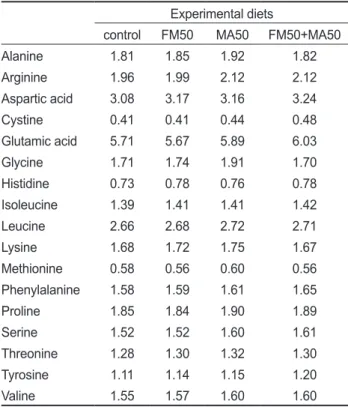
Table 2. Amino acid composition of the experimental diets (% of the diet)
Experimental diets
control FM50 MA50 FM50+MA50
Alanine 1.81 1.85 1.92 1.82
Arginine 1.96 1.99 2.12 2.12
Aspartic acid 3.08 3.17 3.16 3.24
Cystine 0.41 0.41 0.44 0.48
Glutamic acid 5.71 5.67 5.89 6.03
Glycine 1.71 1.74 1.91 1.70
Histidine 0.73 0.78 0.76 0.78
Isoleucine 1.39 1.41 1.41 1.42
Leucine 2.66 2.68 2.72 2.71
Lysine 1.68 1.72 1.75 1.67
Methionine 0.58 0.56 0.60 0.56
Phenylalanine 1.58 1.59 1.61 1.65
Proline 1.85 1.84 1.90 1.89
Serine 1.52 1.52 1.60 1.61
Threonine 1.28 1.30 1.32 1.30
Tyrosine 1.11 1.14 1.15 1.20
Valine 1.55 1.57 1.60 1.60
FM50, 50% fish meal was replaced with tuna byproduct meal in the diet; FA50, 50% macroalgae was replaced with rice bran in the diet; FM50+MA50, 50% fish meal and 50% macroalgae was replaced with tuna byproduct meal and rice bran in the diet.
Table 3. Fatty acid composition of the experimental diets (% of total fatty acid)
Experimental diets
control FM50 MA50 FM50+MA50
C14:0 2.90 3.16 1.35 0.88
C16:0 19.66 21.06 18.38 18.16
C18:0 2.88 4.16 2.30 2.27
C20:0 0.28 0.37 0.40
C22:0 0.29 0.29 0.34
C24:0 0.28 0.42 0.46
∑Saturates 25.42 29.23 23.11 22.51
C16:1n-7 3.32 3.70 1.75 1.11
C18:1n-9 21.70 20.91 29.42 30.14
C20:1n-9 2.94 2.45 1.72 1.26
C22:1n-9 1.98 1.24 0.85 0.54
C24:1n-9 0.34 0.35
∑Monoenes 30.28 28.65 33.74 33.05
C18:2n-6 30.31 27.87 35.06 39.12
C18:3n-3 2.81 2.65 2.33 2.56
C18:4n-3 0.67 0.63 0.38
C20:3n-3 1.04 1.16 0.31
C20:5n-3 4.26 3.60 2.25 1.37
C22:5n-3 0.76 0.62 0.40
C22:6n-3 3.94 4.59 2.41 1.40
∑n-3 HUFA 10.00 9.97 5.37 2.77
Unknown 0.49 0.99
FM50, 50% fish meal was replaced with tuna byproduct meal in the diet; FA50, 50% macroalgae was replaced with rice bran in the diet; FM50+MA50, 50% fish meal and 50% macroalgae was replaced with tuna byproduct meal and rice bran in the diet.
1955)
로서SAS version 9.3 program (SAS Institute, Cary, NC, USA)
을이용하여실험구간의유의성을검정하였다.
결과 및 고찰
실험용
EP
사료의아미노산 및지방산분석결과는Table 2
와
3
에각각나타내었다. EP
사료내비필수아미노산중에서as- partic acid
와glutamic acid
가가장풍부하였으며,
필수아미노 산중에서arginine
과leucine
이가장풍부하였다.
그리고어분 과해조류혼합분을참치부산물분이나생미강으로대체하여도control
사료에비하여다른실험용EP
사료에서필수아미노산함량이뚜렷하게줄어드는경향은보이지않았다
.
그러나지방 산은EPA (eicosapentaenoic acid, 20:5n-3)
와n-3
고도불포화 지방산(highly unsaturated fatty acids, HUFA)
함량이어분과 해조류혼합분을참치부산물분과생미강으로대체함에따라서 점차감소하는경향을보였다.
실험용
EP
사료를16
주간공급한전복의성장결과는Table 4
와같다.
전복의생존율은82.9-87.8%
의범위이었으며,
실험 용EP
사료간에유의적인차이는없었다.
그러나control
사료를 공급한실험구보다FM50
과MA50
사료를공급한실험구에서 유의적(P<0.05)
으로낮은전복의성장과일일성장율(specific growth rate, SGR)
을보였다.
본연구에서전복의가장느린성장은
FM50
사료를공급한실험구에서관찰되었으며,
까막전복용실험사료내
28%
어분첨가시참치부산물분으로75%
대체 가능하였다는Jung et al. (2016)
의연구결과와상이한결과를 보였다.
본연구에서까막전복의SGR
은0.78-0.90%/day
의범 위로서유사한크기(
시작시마리당무게, 1.3 g)
의동일한종 의전복을평균수온18.4℃(
수온범위, 16.7℃-21.8℃)
에서16
주간사육한Jung et al. (2016)
에서보고된SGR (0.28-0.34 %/
day)
보다훨씬우수하였다.
또한동일한종의어린치패(
시작 시마리당무게, 0.43 g)
를평균수온18.4℃(
수온범위, 16.7℃- 21.8℃)
에서16
주간사육한결과,
실험사료내20%
다시마첨 가시생미강으로80%
까지대체가능하였으며,
특히다시마를 생미강으로40%
대체시에는다시마를첨가한대조구보다훨씬우수한성장을보였다는
Kim et al. (2016)
의연구결과와도 상이하였으며,
이때보고된SGR
은0.45-0.46 %/day
의범위이 었다.
본연구에서관찰된전복의높은일일성장율은기존의소 규모실험들(Jung et al., 2016; Kim et al., 2016)
에서는매일남 은먹이를제거하고바닥청소를해주었으나본실험에서는상 업성규모의전복양식장사육관리방법과유사하게3-4
일마다 남은먹이를제거하고청소를해주어서소규모실험들에서야 기된빈번한청소나또는공기중노출등으로인한스트레스등 에의하여낮은일일성장율이관찰된것으로생각된다.
어분과해조류혼합분을참치부산물분과생미강으로동시에
50%
씩대체한FM50+MA50
사료를공급한실험구에서전복의성장과
SGR
이대조구와유의적인차이를보이지않은결 과는전복용EP
사료내어분과해조류혼합분을참치부산물분 과생미강으로동시에각각50%
씩대체가능하다는것을의 미한다.
뿐만아니라어분이나해조류혼합분의가격과참치 부산물분과 생미강의 가격을고려하면FM50+MA50
사료가 본실험에사용된어떠한사료보다훨씬더경제적이다.
실험 용EP
사료간의필수아미노산에뚜렷한차이가없으며(Table 2), FM50+MA50
사료의불포화지방산,
특히DHA
와n-3
고도 불포화지방산함량(
사료내함량각각0.06%
와0.12%)
이낮음(Table 3)
에도불구하고control
사료(
사료내DHA
함량0.09%, n-3
고도불포화지방산함량0.23%)
와유사한전복의성장을 보인결과는본실험조건하에서FM50+MA50
사료의DHA
와
n-3
고도불포화지방산의낮은함량이전복의성장에부정적인영향을미치지않았다는것을의미한다
.
본결과와유사하 게Kim et al. (2017)
은EP
사료내어분과다시마를동시에각각50%
씩대두박과생미강으로대체시까막전복치패의성장이 개선되었지만어분만을50%
대체하거나또는어분과다시마 를동시에전량(
각각100%)
대체하였을경우에는전복의성장 이뚜렷하게둔화되었다고보고하였다.
그러나전복용배합사료내어분을동물성과식물성단백질원 또는이들혼합분으로대체시필수아미노산인
lysine, methio- nine, histidine (Shipton and Britz, 2001; Bautista-Teruel et al., 2003; Cho et al., 2008; Cho, 2010)
과참치부산물100%
대체 Table 4. Survival (%), weight gain (g/abalone) and specific growth rate (SGR, %/day) of juvenile abalone Haliotis discus fed the experimen- tal diets substituting fish meal and macroalgae with tuna byproduct meal and rice bran, respectively for 16 weeksExperimental diets Initial weight (g/abalone) Final weight (g/abalone) Survival (%) Weight gain (g/abalone) SGR1 (%/day)
control 1.9±0.01 5.0±0.01 87.8±0.07a 3.2±0.01a 0.90±0.001a
FM50 1.9±0.01 4.4±0.01 82.9±1.73a 2.5±0.02c 0.78±0.003c
MA50 1.9±0.01 4.9±0.01 86.9±0.05 a 3.0±0.01b 0.87±0.002b
FM50+MA50 1.9±0.00 5.0±0.01 85.2±1.28a 3.1±0.01a 0.90±0.002a
1Specific growth rate (SGR, %/day)=[(Ln(Wf)-Ln(Wi)/days of feeding]×100, where Ln (Wf)=natural log of the final mean weight of aba- lone and Ln (Wi)=natural log of the initial mean weight of abalone. FM50, 50% fish meal was replaced with tuna byproduct meal in the diet; FA50, 50% macroalgae was replaced with rice bran in the diet; FM50+MA50, 50% fish meal and 50% macroalgae was replaced with tuna byproduct meal and rice bran in the diet. Values (means of duplicate±SE) in the same column sharing a common superscript are not significantly different (P>0.05).
시대부분의필수아미노산
(Jung et al., 2016)
이제한영양소이 었으나,
본연구에서어분을참치부산물분으로50%
대체함에 따른필수아미노산의뚜렷한감소경향은보이지않았다. Uki et al. (1986b)
은전복(H. discus hannai)
치패의경우5%
지질사 료내n-3 HUFA
요구량이1%
라고보고하였으며,
본연구에서 사용된모든EP
사료는전복의n-3 HUFA
요구량을모두충족 시켜준것으로판단된다. Bautista-Teruel et al. (2011)
은대구 간유와대두박유의1:1
혼합유를3.6%
함유한배합사료내필수 지방산[linoleic acid, linolenic acid (18:3n-3)
와HUFA
의혼합]
함량을0-1.6%
까지달리한경우1.6%
필수지방산을함유한사 료가가장우수한전복(H. asinina)
의성장을보였다고보고한 바있다. Xu et al. (2011)
은전복(H. discus hannai)
은Linoleic acid (18:2n-6)
로부터Arachidonic acid (20:4n-6)
를합성하며,
아마도EPA
로부터DHA (Docosahexaenoic acid, 22:6n-3)
도 합성할수있을것이라고제안한바있다.
이러한결과는본실 험에서도출된전복의성장차이는EP
사료간의영양적(
아미노 산,
지방산)
차이나결핍이원인이되기보다는다른요인에의 한것으로판단된다.
본연구에서는실험사료들의수중안정성 은조사하지는않았지만,
사료의수중안정성도전복의생산성 에크게영향을미치는것으로알려져있다(Knauer et al., 1993;
Mai et al., 1995a; Guzmán and Viana, 1998; Bautista-Teruel et al., 2003; Gómez-Montes et al., 2003; Lee et al., 2016, 2017).
또한
Britz et al. (1997)
은전복용EP
사료는사육수온이12℃
에서
24℃
로증가함에따라EP
사료의건물용출율이5.7%
에 서12%
로크게증가한다고보고한바있다.
16
주간의사육실험종료시생존한전복의각장,
각폭,
각고,
가 식부무게및전중에대한가식부의비율은Table 5
에나타내었 다.
각장,
각폭과각고는실험용EP
사료간에유의적인차이는 없었지만(P>0.05),
각장과각폭은전복의성장결과와유사한 경향을보였다. control, MA50
과FM50+MA50
사료를공급받은전복의가식부무게와전중에대한가식부의비율은
FM50
사료를공급받은 전복보다모두유의적
(P<0.05)
으로높았다.
전복의생물학적인 측정항목(
각장,
각폭,
각고,
가식부무게 등)
은전복의성장률과일치하는것으로알려져있다(Bautista- Teruel et al., 2003; Cho, 2010).
16
주간의사육실험종료시생존한전복가식부의 일반성분분석결과는
Table 6
에나타내었다.
전복가식부의일반성분(
수 분,
조단백질,
조지방과회분)
은실험용EP
사료간에유의적인 차이가나타나지않았다(P>0.05).
이러한결과는전복가식부 의영양소함량은공급한사료내영양소함량이나대체원에따 라서영향을받는다는과거의연구결과와상이하였다(Mai et al., 1995a, b; Lee et al., 1998; Thongrod et al., 2003; Cho et al., 2008; Garcia-Esquivel and Felbeck, 2009; Cho, 2010; Jung et al., 2016; Kim et al., 2016; Myung et al., 2016).
이상의결과를고려할때전복치패용
EP
사료내어분과해 조류혼합분을각각50%
씩참치부산물분과생미강으로대체 한사료보다는이들을동시에50%
씩혼합대체한사료가전복 의성장에우수할뿐만아니라사료제조가격고려시에도훨 씬저렴하다.
Table 5. Shell length, shell width, shell height, soft body weight and the ratio of soft body weight to total weight of abalone Haliotis discus fed the experimental diets substituting fish meal and macroalgae with tuna byproduct meal and rice bran, respectively for 16 weeks Experimental diets Shell length (mm) Shell width (mm) Shell height (mm) Soft body weight (g) Soft body weight/total weight
control 33.5±0.01a 22.7±0.11a 6.1±0.02a 2.4±0.05a 0.62±0.001a
FM50 31.8±0.50a 21.7±0.34a 5.8±0.00a 2.0±0.05b 0.60±0.000b
MA50 33.0±0.19a 22.5±0.04a 6.1±0.10a 2.2±0.03a 0.62±0.005a
FM50+MA50 33.3±0.00a 22.7±0.01a 6.3±0.05a 2.3±0.01a 0.62±0.000a
FM50, 50% fish meal was replaced with tuna byproduct meal in the diet; FA50, 50% macroalgae was replaced with rice bran in the diet;
FM50+MA50, 50% fish meal and 50% macroalgae was replaced with tuna byproduct meal and rice bran in the diet. Values (means of duplicate±SE) in the same column sharing a common superscript are not significantly different (P>0.05).
Table 6. Chemical composition (%) of the soft body of juvenile abalone Haliotis discus at the end of 16-week feeding trial
Experimental diets Moisture Crude protein Crude lipid Ash
control 75.4±0.65a 17.2±0.82a 2.1±0.00a 2.7±0.12a
FM50 73.0±2.94a 16.3±0.04a 2.1±0.04a 2.7±0.08a
MA50 71.8±1.59a 16.3±0.24a 2.0±0.00a 3.0±0.04a
FM50+MA50 76.8±0.00a 18.3±0.04a 2.1±0.04a 2.5±0.08a
FM50, 50% fish meal was replaced with tuna byproduct meal in the diet; FA50, 50% macroalgae was replaced with rice bran in the diet;
FM50+MA50, 50% fish meal and 50% macroalgae was replaced with tuna byproduct meal and rice bran in the diet. Values (means of duplicate±SE) in the same column sharing a common superscript are not significantly different (P>0.05).
사 사
이 논문은
2017
년도 정부(
미래창조과학부)
의 재원으로 한국연구재단의 지원을 받아 수행된 기초연구사업이며
(No.
2017R1A2B4009773),
이에감사드립니다.
References
AOAC (Association of Official Analytical Chemists). 1990. Of- ficial Methods of Analysis (15thedn). Association of Official Analytical Chemists, Arlington, VA, U.S.A.
AOCS (American Oil Chemists’ Society). 2005. The official methods and recommended practices of the AOCS (5thedn).
American Oil Chemists’ Society, Urbana, IL, U.S.A.
Bautista-Teruel MN, Fermin AC and Koshio SS. 2003. Diet development and evaluation for juvenile abalone, Haliotis
asinine: animal and plant protein sources. Aquaculture 219,
645-653. http://dx.doi.org/10.1016/S0044-8486(02)00410- Bautista-Teruel MN, Koshio SS and Ishikawa M. 2011. Diet 6.development and evaluation for juvenile abalone, Haliotis
asinine Linne: Lipid and essential fatty acids levels. Aqua-
culture 312, 172-179. https://dx.doi.org/10.1016/j.aquacul- ture.2011.01.004.Britz PJ. 1996. Effect of dietary protein level on growth per- formance of South African abalone, Haliotis midae, fed fishmeal-based semi-purified diets. Aquaculture 140, 55-61.
https://doi.org/10.1016/0044-8486(95)01198-6.
Britz PJ, Hecht T and Mangold S. 1997. Effect of temperatuer on growth, feed consumption and nutritional indices of Hal-
iotis midae fed a formulated diet. Aquaculture 152, 191-203.
https://dx.doi.org/10.1016/S0044-8486(97)00002-1.
Cho SH, Park J, Kim C and Yoo J. 2008. Effect of casein substitution with fishmeal, soybean meal and crustacean meal in the diet of the abalone Haliotis discus hannai Ino.
Aquacult Nutr 14, 61-66. http://dx.doi.org/10.1111/j.1365- 2095.2007.00505.x.
Cho SH. 2010. Effect of fishmeal substitution with various ani- mal and/or plant protein sources in the diet of the abalone
Haliotis discus hannai Ino. Aquacult Res 41, e587-e593.
https://dx.doi.org/10.1111/j.1365-2109.2010.02561.x.
Duncan DB. 1955. Multiple range and multiple F tests. Biomet- rics 11, 1-42.
Erasmus JH, Cook RA and Coyne VE. 1997. The role of bacteria in the digestion of seaweed by the abalone Haliotis midae.
Aquaculture 155, 377-386. https://dx.doi.org/10.1016/
S0044-8486(97)00112-9.
FAO (Food and Agriculture Organization). 2018. Food and Ag- riculture Organization of the United Nations. FAO, Rome, Italy.
Fleming AE, Barneveld RJ and Hone P. 1996. The devel- opment of artificial diets for abalone: A review and fu-
ture directions. Aquaculture 140, 5-53. https://dx.doi.
org/10.1016/00448486(95)01184-6.
Gómez-Montes L, García-Esquivel Z, D'Abramo LR, SHimada A, Vásquez-Peláez and Viana MT. 2003. Effect of dietary protein:energy ratio on intake, growth and metabolism of juvenile green abalone Haliotis fulgens. Aquaculture 220, 769-780. https://dx.doi.org/10.1016/S0044-8486(02)00533- Garcia-Esquivel Z and Felbeck H. 2009. Comparative perfor-1.
mance of juvenile red abalone, Haliotis rufescens, reared in laboratory with fresh kelp and balanced diets. Aqua- cult Nutr 15, 209-217. http://dx.doi.org/10.1111/j.1365- 2095.2008.00585.x.
Guzmán JM and Viana MT. 1998. Growth of abalone Haliotis
fulgens fed diets with and without fish meal, compared to
commercial diet. Aquaculture 165, 321-331. https://dx.doi.org/10.1016/S0044-8486(98)00271-3.
Jang B, Kim PY, Kim HS, Lee KW, Kim HJ, Choi DG, Cho SH, Min B, Kim K and Han H. 2018. Substitution effect of sea tangle (ST) (Laminaria japonica) with tunic of sea squirt (SS) (Halocynthia roretzi) in diet on growth and carcass compositon of juvenile abalone (Haliotis discus, Reeve 1846). Aquacult Nutr 24, 586-593. https://dx.doi.
org/10.1111/anu.12593.
Jeon GH, Kim HS, Myung SH and Cho SH. 2014. The effect of the dietary substitution of fishmeal with tuna by-prod- uct meal on growth, body composition, plasma chemistry and amino acid profiles of juvenile Korean rockfish (Se-
bastes schlegeli). Aquctult Nutr 20, 753-761. http://dx.doi.
org/10.1111/anu.12153.
Jung W, Kim HS, Lee KW, Kim YE, Choi DK, Jang B, Cho SH, Choi CY, Kim B and Joo Y. 2016. Growth and body composition effects of tuna byproduct meal substituted for fish meal in the diet of juvenile abalone, Haliotis discus. J World Aquacult Soc 47, 74-81. http://dx.doi.org/10.1111/
jwas.12255.
Kim YE, Myung SH, Kim HS, Jung W, Cho SH, Jwa MS, Kim PY, Kim MK, Park M and Kim B. 2016. Effect of dietary substitution of sea tangle (ST), Laminaria japonica with rice bran (RB) on growth and body composition of juvenile aba- lone (Haliotis discus). Aquacult Res 47, 1202-1208. https://
dx.doi.org/10.1111/are.12577.
Kim HS, Jung W, Myung SH, Cho SH and Kim DS. 2014.
Substitution effect of fishmeal with tuna byproduct meal in the diet on growth, body composition, plasma chemistry and amino acid profiles of juvenile olive flounder (Parali-
chthys olivaceus). Aquaculture 431, 92-98. http://dx.doi.
org/10.1016/j.aquaculture.2014.03.025.
Kim HS, Jeong HS, Kim J, Yun A, Lee KW and Cho SH. 2017.
Substitution effect of fish meal and Saccharina with soybean meal and rice bran in the extruded pellet on juvenile abalone
Haliotis discus (Reeve 1846). Korean J Fish Aquat Sci 50,
731-737. https://dx.doi.org/10.5657/KFAS.2017.0731.
Knauer J, Britz PJ and Hecht T. 1993. The effect of seven bind- ing agents on 24-hour water stability of an artificial weaing diet for the South African abalone, Haliotis midae (Haliot- idae, Gastropoda). Aquaculture 115, 327-334. https://dx.doi.
org/10.1016/00448486(93)90146-P.
Lee S, Yun SJ and Hur SB. 1998. Evaluation of dietary protein sources for abalone (Haliotis discus hannai). J Aquaculture 11, 19-29.
Lee KW, Kim HS, Yun A, Choi D, Jang BI, Kim HJ, Cho SH, Joo Y, Kim B and Kim B. 2016. Effect of the formu- lated diets on performance and resistance of juvenile aba- lone [Haliotis discus (Reeve, 1846)] subjected to various stress conditions. J Shellfish Res 35, 481-491. http:/dx.doi.
org/10.2983/035.035.0221.
Lee KW, Kim HS, Kim HS, Choi DG, Jang BI, Cho SH, Min B, Kim K and Joo Y. 2017. Effects of dietary carbohydrate sources on growth and body composition of juvenile aba- lone (Haliotis discus, Reeve). J Shellfish Res 36, 151-156.
https://dx.doi.org/10.2983/036.036.0115.
Mai K, Mercer JP and Donlon J. 1995a. Comparative studies on the nutrition of species of abalone, Haliotis tuberculata L. and Haliotis discus hannai Ino. III. Responses of abalone to various levels of dietary lipid. Aquaculture 134, 65-80.
http://dx.doi.org/10.1016/0044-8486(95)00043-2.
Mai K, Mercer JP and Donlon J. 1995b. Comparative studies on the nutrition of two species of abalone, Haliotis tubercu-
lata L. and Haliotis discus hannai Ino. IV. Optimum dietary
protein level for growth. Aquaculture 136, 165-180. http://dx.doi.org/10.1016/0044-8486(95)01041-6.
Myung SH, Jung W, Kim HS, Kim YE, Cho SH, Jwa MS, Kim PY, Kim MK, Park M and Kim B. 2016. Effects of dietary substitution of fishmeal with the combined dry microalgae,
Nannochloropsis oceanica (NO) biomass residue and casein
on growth and body composition of juvenile abalone (Hali-otis discus). Aquacult Res 47, 341-348.
Reyes OS and Fermin AC. 2003. Terrestrial leaf meals or fresh- water aquatic fern as potential feed ingredients for farmed abalone Haliotis asinina (Linnaeus 1758). Aquacult Res 34, 593-599.
Shipton TA and Britz PJ. 2001. The partial and total replacement of fishmeal with selected plant protein sources in diets for the South African abalone, Haliotis midae L. J Shellfish Res 20, 637-645.
Thongrod S, Tamtin M, Chairat C and Boonyaratpalin M. 2003.
Lipid to carbohydrate ratio in donkey’s ear abalone (Hali-
otis asinina, Linne) diets. Aquaculture 225, 165-174. https://
dx.doi.org/10.1016/S0044-8486(03)00287-4.
Tung C and Alfaro AC. 2012. Alternative protein sources in arti- ficial diets for New Zealand's black-footed abalone, Haliotis
iris, Martyn 1784, juveniles. J World Aquacult Soc 43, 1-29.
https://doi.org/10.1111/j.1749-7345.2011.00545.x.
Uki N, Kemuyama A and Watanabe T. 1985. Nutritional evalu- ation of several protein sources in diets for abalone Haliotis
discus hannai. Bull Jpn Soc Sci Fish 51, 1835-1839. http://
dx.doi.org/10.2331/suisan.51.1835.
Uki N, Kemuyama A and Watanabe T. 1986a. Optimum protein level in diets for abalone. Bull Jpn Soc Sci Fish 52, 1005- 1012. https://dx.doi.org/10.2331/suisan.52.1005.
Uki N, Sugiura M and Watanabe T. 1986b. Requirement of es- sential fatty acids in the abalone Haliotis discus hannai. Bull Jpn Soc Sci Fish 52, 1013-1023. https://dx.doi.org/10.2331/
suisan.52.1013.
Xu W, Mai KS, Ai QH, TAn BP, Zhang WB, Ma HM and Li- ufu ZG. 2011. Influence of 18:2n-6/20:5n-3 ratio in diets on growth and fatty acid composition of juvenile abalone, Hali-
otis discus hannai Ino. Aquacult Nutr 17, 346-351. https://
dx.doi.org/10.1111/j.1365-2095.2010.00802.x.