149
Copyright © 2019 The Korean Society of Fisheries and Aquatic Science pISSN:0374-8111, eISSN:2287-8815
서 론
넙치는 국내 양식산업의 대표 어종으로써 2017년에 약 41,207톤이생산되었으며, 생산금액은약 5,845억원에달했다
(KOSIS, 2017a). 넙치양식이미래에도지속가능한산업으로
발전하기위해서는사료내어분함량을낮춘배합사료의개발 이요구된다. 타어종에서는이미 extruded pellet (EP)을이용 하여어분대체연구를하고있으며(Øverland et al., 2009), 6개 월이상의장기간실험도진행되었다(Hansen et al., 2007). 넙 치에서도사료내어분을대체하기위해다양한연구가진행되 어왔으며(Pham et al 2007; Kim et al., 2018), EP를이용한어 분대체연구도진행되었다(Jang et al., 2013). 하지만 EP를이
용하여 6개월이상장기간진행된어분대체연구는미흡한실 정이다.
성공적인양식산업경영을위해서는사료, 양식환경, 어병등 다양한요인을고려해야한다. 사료비는어류양식생산원가의 약 50%를차지하는매우중요한요인이다(KOSIS, 2017b). 넙 치는단백질이용성이높고(Kim et al., 2000), 탄수화물의이용 능력이낮아(Shin and Kim, 2002) 타어종에비해사료내어분 의사용비중이높다. 어분은단백질함량이 60-70%로높고, 필 수아미노산, 지방산, 미네랄과같은영양소가풍부할뿐만아니 라미지성장인자(unidentified growth factors)를다량함유하고 있는최적의단백질원료이다(Lee et al., 1996; Hardy, 2010). 세 계양식생산량은양식기술이발전함에따라증가하였고(Tacon
압출성형 배합사료 내 어분대체가 넙치(Paralichthys olivaceus)의 성장, 사료효율 및 소화율에 미치는 영향
김민기·이초롱·신재형·이봉주1·김강웅2·이경준*
제주대학교 해양생명과학과, 1국립수산과학원 사료연구센터, 2국립수산과학원 양식관리과
Effects of Fish Meal Replacement in Extruded Pellet Diet on Growth, Feed Utilization and Digestibility in Olive Flounder Paralichthys olivaceus
Min-Gi Kim, Chorong Lee, Jaehyeong Shin, Bong-Joo Lee1, Kang-Woong Kim2 and Kyeong-Jun Lee*
Department of Marine Life Sciences, Jeju National University, Jeju 63243, Korea
1Aquafeed Research Center, National Institute of Fisheries Science, Pohang 37517, Korea
2Aquaculture Management Division, National Institute of Fisheries Science, Busan 46083, Korea
This study investigated the effects of replacing fish meal (FM) with a mixture of four protein sources (wheat gluten, soy protein concentrate, tankage meal, and poultry byproduct meal) in an extruded pellet (EP) diet for olive flounder Paralichthys olivaceus. Five experimental diets were formulated with alternative proteins replacing 0%, 20%, 30%, 40%, and 50% of FM. Taurine and betaine were added as attractants in the diets. Triplicate groups of fish (initial body weight: 196±2 g) were fed the diets to apparent satiation. Over the course of a 6-month feeding trial, there were no significant differences between the groups in growth performance, feed utilization, survival, or villus height. The dry matter and protein digestibility of FM50 diet were significantly lower than those of the control diet at water tempera- tures below 18.5℃ in months 4 and 6. This is a highly significant first report on FM replacement in an EP diet given to olive flounder over a 6-month-long feeding period. It shows that the proper mixture of protein sources can replace up to 50% of FM in olive flounder EP diets with taurine and betaine supplementation. It also shows that 40% of FM could be safely replaced in EP diets during periods of low water temperature.
Key words: Fish meal, Long-term feeding, Olive flounder, Low-fish meal diet, Extruded pellet
*Corresponding author: Tel: +82. 64. 754. 3423 Fax: +82. 64. 756. 3493 E-mail address: [email protected]
This is an Open Access article distributed under the terms of the Creative Commons Attribution Non-Commercial Licens (http://creativecommons.org/licenses/by-nc/3.0/) which permits unrestricted non-commercial use, distribution, and reproduction in any medium, provided the original work is properly cited.
Received 26 February 2019; Revised 18 March 2019; Accepted 25 March 2019 저자 직위: 김민기(대학원생), 이초롱(대학원생), 신재형(대학원생), 이봉주 (연구사),김강웅(연구관), 이경준(교수)
https://doi.org/10.5657/KFAS.2019.0149
Korean J Fish Aquat Sci 52(2), 149-158, April 2019
and Metian, 2008), 어분의사용량도함께증가하였다. 그러나, 어분은계속된남획으로인한어획량감소와생산국의어분소 비증가로인해수급이불안정하다(Ha and Kim, 2018). 사료 내어분을대체하기위한다양한연구가진행되어왔으나, 한종 류의단백질원료만을이용하여어분을대체할경우, 대체가능 성의한계를드러냈다(Chen et al., 2010; Dawood et al., 2015).
특히, 단일원료만으로어분을대체할시, 제한아미노산과항 영양인자로인한소화율저하등의문제가발생하였다(Kim et al., 2000; Krogdahl et al., 2010). 다양한단백질원료를혼합하 여사용할경우, 제한아미노산과부족한영양소를서로보완할 수있어한가지단백질원료를사용하는것보다효과적으로어 분을대체할수있다고보고되었다(Lee et al., 1996). 특히, 동∙ 식물성단백질원료의혼합은다량의어분을대체할수있는최 적의방법으로알려져있다(Kissinger et al., 2016; Scerra et al., 2016).
따라서, 본연구는동∙식물성단백질원료들의혼합을통해넙 치사료내어분을대체하고자하였다. 특히, EP 실험사료를이 용하여 6개월간 semi-pilot규모의사양실험을통해넙치용저 어분사료개발을위한기초자료를제공하고자수행되었다.
재료 및 방법 실험어 및 사육관리
실험에사용된넙치는제주도서귀포시성산읍신산리에위치 한대형수산에서구입하였다. 실험환경에적응시키기위해시 판용넙치배합사료를공급하면서순치하였다. 예비사육후, 육 성기넙치(196±2 g)를수조마다 40마리씩각사료구당 3반복 으로 2000 L 원형 propylene 수조에무작위로배치하였다. 실 험사료는 1일 2회(08:30, 17:30), 6개월간만복공급되었고사 료공급 30분후에환수를진행하였다. 사육수는모래여과된해 수가사용되었고, 수조당유수량은 15-20 L/min이되도록조절 하였다. 모든실험수조에에어스톤을설치하였고, 사양실험동 안의사육수온은자연수온에의존하였다(Table 1).
실험사료
실험사료(Table 2)에는 2종류의어분(정어리, 멸치)이사용되
었다. 대조사료(Control)의어분함량은국내배합사료의어분
사용평균치인약 65%로설정하였다. 실험사료는 4종의원료 (wheat gluten, soy protein concentrate, tankage meal, poultry
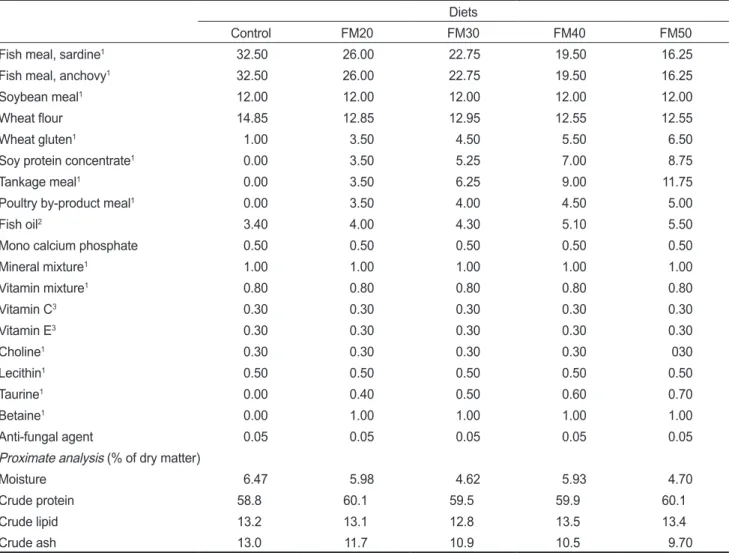
by-product meal)를이용하여대조사료내어분함량을각각 20, 30, 40, 50% (FM20, FM30, FM40, FM50) 대체하였다. Tau- rine과 betaine은사료의기호성증진을위해어분대체실험사 료에첨가되었다. 실험사료는국립수산과학원사료연구센터에 서압출성형기(ATXD-II Extruder, Fesco, Korea)를이용하여 제조되었다. 성형된실험사료는 70℃에서 3시간동안열풍건 조되었으며, 수분분석기를이용하여건물(dry matter) 함량계 산후, 어유를첨가하였다.
어체측정
성장률과생존율조사를위해매달수조전체어류를측정하 였다. 실험넙치는어체측정 18시간전부터절식되었다. 사양실 험종료까지매달평균무게(mean body weight, g), 사료섭취량 (feed intake, g/fish), 사료전환효율(feed conversion ratio), 단 백질전환효율(protein efficiency ratio)을 조사하였다. 사양실 험종료후에는비만도(condition factor), 간중량지수(hepato- somatic index, %), 장중량지수(viscerosomatic index, %)를추 가로조사하였다.
샘플수집
최종무게측정후, 각수조마다 3마리의실험어를무작위로 선별한후, 2-phenoxyethanol 용액(200 ppm)으로마취시켰다. 대상어류의융모길이(villus height) 관찰을위해유문부와장 의접점을기준으로 1 cm 떨어진전장(anterior intestine)을자 르고, Bouin’s solution에고정하여장조직을샘플하였다. 내장 이제거된실험어(carcass)는 -50℃에서냉동시킨후, 일반성분 분석에사용하였다.
일반성분분석
실험사료, 전어체의 일반성분분석은 AOAC (2000) 방법에 따라수분은상압가열건조법(125℃, 3시간), 조회분은직접회
화법(550℃, 4시간)으로분석되었다. 단백질은자동조단백질
분석기(Keiltec system 2300, FOSS, Sweden)로분석되었다. 지방은 Folch et al. (1957)의방법에따라분석되었다. 조직학적 분석
전장조직은 Bouin’s solution으로고정되었으며, 분석시까지 70% ethyl alcohol에고정되었다. 고정된전장조직은적절한 크기로절단되어 tissue processor (TP1020, Leica, Germany)
Table 1. Monthly water temperature during the feeding trial
Water temperature (℃)
Overall 1 month 2 month 3 month 4 month 5 month 6 month
Average 19.7±4.5 25.3±2.4 23.3±1.4 21.8±1.1 18.5±1.5 15.3±0.8 13.7±1.1
Maximum 29.1 26.0 23.7 20.9 16.7 15.1
Minimum 20.8 21.0 19.8 15.4 13.4 11.4
에서단계별탈수과정을거친후, 파라핀(paraffin) 작업후 he- matoxylin and eosin (H&E) 염색을하였다. 융모의길이는현 미경(CKX-41, Olympus, Japan)을이용하여 100배확대후측 정되었다.
소화율 평가
소화율실험사료는곱게분쇄된 99%의 EP 실험사료와 1%
의 chromium oxide (Cr2O3, DaeJung, Korea)를혼합하여제작 하였다. 혼합물총중량의 25%에해당하는증류수를첨가하여 사료혼합기로혼합∙반죽한후, 펠렛성형기(SP-50, Geumgang
ENG, Korea)를이용하여펠렛사료형태로제작하였다. 제작된
실험사료는건조기를이용하여 25℃에서 24시간건조시켰으
며, -20℃에보관하면서소화율실험에사용하였다. 소화율평가
에사용된넙치는실험환경에대한적응과장내에일반사료가 남아있지않도록 1주간순치되었다. 예비사육후, 실험넙치는 5 개의 400 L guelph system (분수집장치수조)에각수조당 25 마리씩무작위로선택되어배치되었다. 사육수는 1차적으로모 래여과된해수를카트리지필터가장착된필터하우징을통해 여과되었다. 각수조의유수량은 1 L/min로세팅하였으며, 실 험기간동안의사육수온은자연수온에의존되었다. 소화율평 가는실험 2개월차부터 6개월차까지사양실험과동시에진행 되었다. 매달 2주간소화율실험사료를공급하면서분을수집
Table 2. Composition (% of dry matter basis) of the experimental diets for olive flounder Paralichthys olivaceus Diets
Control FM20 FM30 FM40 FM50
Fish meal, sardine1 32.50 26.00 22.75 19.50 16.25
Fish meal, anchovy1 32.50 26.00 22.75 19.50 16.25
Soybean meal1 12.00 12.00 12.00 12.00 12.00
Wheat flour 14.85 12.85 12.95 12.55 12.55
Wheat gluten1 1.00 3.50 4.50 5.50 6.50
Soy protein concentrate1 0.00 3.50 5.25 7.00 8.75
Tankage meal1 0.00 3.50 6.25 9.00 11.75
Poultry by-product meal1 0.00 3.50 4.00 4.50 5.00
Fish oil2 3.40 4.00 4.30 5.10 5.50
Mono calcium phosphate 0.50 0.50 0.50 0.50 0.50
Mineral mixture1 1.00 1.00 1.00 1.00 1.00
Vitamin mixture1 0.80 0.80 0.80 0.80 0.80
Vitamin C3 0.30 0.30 0.30 0.30 0.30
Vitamin E3 0.30 0.30 0.30 0.30 0.30
Choline1 0.30 0.30 0.30 0.30 030
Lecithin1 0.50 0.50 0.50 0.50 0.50
Taurine1 0.00 0.40 0.50 0.60 0.70
Betaine1 0.00 1.00 1.00 1.00 1.00
Anti-fungal agent 0.05 0.05 0.05 0.05 0.05
Proximate analysis (% of dry matter)
Moisture 6.47 5.98 4.62 5.93 4.70
Crude protein 58.8 60.1 59.5 59.9 60.1
Crude lipid 13.2 13.1 12.8 13.5 13.4
Crude ash 13.0 11.7 10.9 10.5 9.70
1Fish meal, sardine (crude protein 68.0%, crude lipid 8.6%, ash 17.1%), fish meal, anchovy (crude protein 69.4%, crude lipid 8.3%, ash 17.8%), Soybean meal (crude protein 52.7%, crude lipid 1.8%, ash 6.8%), wheat gluten (crude protein 83.2%, crude lipid 3.69%, ash 1.3%), soy protein concentrate (crude protein 68.9%, crude lipid 0.5%, ash 7.1%), tankage meal (crude protein 86.3%, crude lipid 9.0%, ash 7.5%) and poultry by-product meal (crude protein 71.6%, crude lipid 13.5%, ash 10.5%) were by The Feed Co., Ltd., Seoul, Korea. 2Fish oil was by E-wha oil Co., Ltd., Busan, Korea. 3Vitamin C and vitamin E were by AlphaAqua Co., Busan, Korea. FM20, 20% fish meal was replaced with mixture of protein sources in diet. FM30, 30% fish meal was replaced with mixture of protein sources in diet. FM40, 40% fish meal was replaced with mixture of protein sources in diet. FM50, 50% fish meal was replaced with mixture of protein sources in diet.
하였다. 매달분을수집한후다음달분수집전까지 EP 실험사 료가공급되었다. 분수집 16시간전실험어를소화율실험사료 로만복공급시켰다. 만복공급후, 수조에남은사료및이물질 을깨끗이청소하였다. 그후, 카트리지필터를교체하여다시 한번환수한후, 1일 1회(09:00 h) 분수집을진행하였다. 수집
한분샘플은여과지를이용하여해수를제거한후 -50℃ 저온
냉동고에보관하고, 동결냉동건조(freeze-dryer) 시킨후분석 에사용하였다. 실험사료와분샘플에서의 chromium oxide는 Divakaran et al. (2002)의방법을토대로분석되었다. 실험사료 의단백질소화율은 Bui et al. (2014)의방법으로계산되었다. 통계분석
실험사료의배치는완전확률계획법(completely randomized design)으로 실시되었다. 실험결과들은 SPSS (version 18.0) 프로그램이이용되어 One-way ANOVA로통계분석되었다.
데이터값의유의적인차이는 Tukey’s HSD를통해평균값간
의유의성(P≤0.05)이비교되었다. 데이터는평균값±표준편차 (mean±SD)로 나타내었으며, 백분율데이터는 arcsine 변형 값으로계산되어통계분석되었다.
결 과
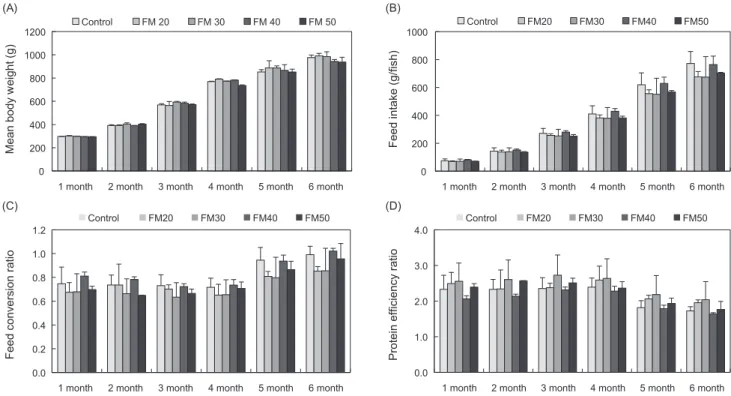
6개월간매달측정한성장, 사료섭취량, 사료효율결과는 Fig.
1에나타내었다. 매월평균무게, 사료섭취량, 사료전환효율및 단백질전환효율은대조구와모든실험구에서유의적인차이가 없었다. 사양실험종료후의생존율, 비만도, 간중량지수및장 중량지수조사결과에서도(Table 3) 대조구와어분대체실험구 간에유의적인차이는없었다.
전어체수분함량은대조구에비해 FM20, FM30 실험구가유
의적으로낮았다(Table 4). 전어체단백질과회분은경향적으로
FM30 실험구가대조구에비해높았으나유의적인차이는없었
다. 전어체지방분석결과 FM20 실험구가가장높았으나실험
구간의유의적인차이는없었다.
5개월간의장내융모의길이를측정한결과는 Fig. 2에나타
냈었다. 1개월차측정에서는 683-958 μm로나타났으며, 이후 매월 816-1141 μm, 1188-1417 μm, 1479-1641 μm로나타나 4 개월차측정까지점점증가되는경향을보였다. 5개월차조사 에서는 1372-1804 μm이었다. 모든실험구사이의유의적인차 이는없었다.
Fig. 1. Cummulative mean body weight (A), feed intake (B), feed conversion ratio (C) and protein efficiency ratio (D) of olive flounder Paralichthys olivaceus (initial mean body weight: 196±2g) fed the five experimental diets for 6 months [Feed intake (g/fish)=dry feed consumed (g)/fish, Feed conversion ratio=dry feed intake/wet weight gain, Protein efficiency ratio=wet weight gain/protein intake]. FM20, 20% fish meal was replaced with mixture of protein sources in diet. FM30, 30% fish meal was replaced with mixture of protein sources in diet. FM40, 40% fish meal was replaced with mixture of protein sources in diet. FM50, 50% fish meal was replaced with mixture of protein sources in diet.
0 200 400 600 800 1000 1200
1 month 2 month 3 month 4 month 5 month 6 month
Mean body weight (g)
(A) Control FM 20 FM 30 FM 40 FM 50
0 200 400 600 800 1000
1 month 2 month 3 month 4 month 5 month 6 month
Feed intake (g/fish)
(B) Control FM20 FM30 FM40 FM50
0.0 0.2 0.4 0.6 0.8 1.0 1.2
1 month 2 month 3 month 4 month 5 month 6 month
Feed conversion ratio
(C) Control FM20 FM30 FM40 FM50
0.0 1.0 2.0 3.0 4.0
1 month 2 month 3 month 4 month 5 month 6 month
Protein efficiency ratio
(D) Control FM20 FM30 FM40 FM50
넙치용 저어분 EP사료 개발 연구 153
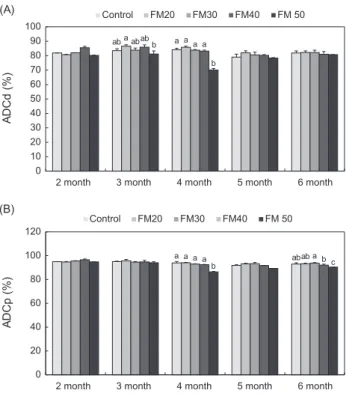
소화율조사결과(Fig. 3), 건물소화율은 3개월째에 FM20 실
험구가 FM50 실험구에비해유의적으로높았다. 4개월차조사
에서는 FM50 실험구가다른모든실험구에비해유의적으로
낮았다. 2, 5, 6개월차조사에서는모든실험구에서유의적인차
이가없었다. 단백질소화율은 4개월차조사에서 FM50 실험구 가다른모든실험구에비해유의적으로낮았다. 6개월차조사 에서는 FM30 실험구가 FM40, FM50 실험구에비해유의적으
로높았다. FM50 실험구의단백질소화율은다른실험구에비
해유의적으로낮았다.
고 찰
넙치사료내동∙식물성원료의어분대체율은대두박 17-30%, 주정박 18.5%, 우모분 18.8-26%, 돈모분 7.5-30%, 참치부산물 20-30%, 육골분 10-20%로보고되었다(Kikuchi et al., 1994;
Kim et al., 2008; Ye et al., 2011; Lee et al., 2012; Kim et al., 2014; Bae et al., 2015; Kim et al., 2018). 위의연구결과다양
한원료에서 7-30%의어분대체가능성이보고되었는데, 모두
단일단백질원료로어분대체연구가진행되었다. 반면, 대두박, 건조홍합살, 혈분, 콘글루텐밀을혼합하였을경우, 넙치사료내 어분을 46%까지대체가능하다고보고되었다(Kikuchi, 1999).
Fig. 2. Villus heights of olive flounder Paralichthys olivaceus fed the five experimental diets for 5 months. FM20, 20% fish meal was replaced with mixture of protein sources in diet. FM30, 30% fish meal was replaced with mixture of protein sources in diet. FM40, 40% fish meal was replaced with mixture of protein sources in diet. FM50, 50% fish meal was replaced with mixture of protein sources in diet.
0 500 1000 1500 2000 2500
1 month 2 month 3 month 4 month 5 month
Control FM20 FM30 FM40 FM50
0 10 20 30 40 50 60 70 80 90 100
2 month 3 month 4 month 5 month 6 month Control FM20 FM30 FM40 FM 50
0 20 40 60 80 100 120
2 month 3 month 4 month 5 month 6 month
Villus height (μm)ADCd (%)
(A)
ADCp (%)
(B) Control FM20 FM30 FM40 FM 50
a abab b a a a a b ab
a a a a b abab a b c
Fig. 3. Apparent digestibility coefficient (%, ADC) of dry matter (A) and protein (B) in the experimental diets. Values (mean±SD) with different letter are significantly different (P<0.05). ADCd, apparent digestibility coefficient dry matter. ADCp, apparent di- gestibility coefficient protein. FM20, 20% fish meal was replaced with mixture of protein sources in diet. FM30, 30% fish meal was replaced with mixture of protein sources in diet. FM40, 40% fish meal was replaced with mixture of protein sources in diet. FM50, 50% fish meal was replaced with mixture of protein sources in diet.
0 500 1000 1500
1 month 2 month 3 month 4 month 5 month
0 10 20 30 40 50 60 70 80 90 100
2 month 3 month 4 month 5 month 6 month Control FM20 FM30 FM40 FM 50
0 20 40 60 80 100 120
2 month 3 month 4 month 5 month 6 month
Villus height (μm)ADCd (%)
(A)
ADCp (%)
(B) Control FM20 FM30 FM40 FM 50
a abab b a a a a b ab
a a a ab abab a b c
Table 3. Survival and morphological indexes of olive flounder fed five experimental diets for 6 months1 Diets
Control FM20 FM30 FM40 FM50
Survival (%)2 64.2±12.8 78.3±5.8 75.8±1.4 78.3±8.0 67.5±2.5
CF3 1.20±0.16 1.36±0.18 1.21±0.06 1.19±0.00 1.20±0.06
HSI (%)4 2.37±0.47 2.36±0.30 2.86±0.67 2.31±0.59 2.42±0.83
VSI (%)5 4.74±1.11 5.72±0.37 5.36±0.31 5.04±0.40 5.33±1.24
1The lack of superscript letter indicates no significant differences among treatments. 2Survival (%)=Number of fish at end of feeding tri- al/number of fish stocked×100. 3CF (Condition factor)=fish weight×100/total body length. 4HSI [Hepatosomatic index (%)]=100×(liver weight/body weight). 5VSI [Viscerosomatic index (%)]=100×(visceral weight/body weight). FM20, 20% fish meal was replaced with mix- ture of protein sources in diet. FM30, 30% fish meal was replaced with mixture of protein sources in diet. FM40, 40% fish meal was replaced with mixture of protein sources in diet. FM50, 50% fish meal was replaced with mixture of protein sources in diet.
유럽농어(Dicentrarchus labrax)를대상으로진행된연구에서 녹두박, 우모분, 혈분을혼합하여사료내어분을 50%까지대체 가능하다고보고되었으며(Scerra et al., 2016), 혈분, 대두농축 단백, 콘글루텐밀, 밀글루텐, 채종박혼합물로는 82% 까지대 체가능하다고보고되었다(Torrecillas et al., 2017). 본연구에 서도 4가지단백질원료(wheat gluten, soy protein concentrate, tankage meal and poultry by-product meal)의조합을통해단 일원료사용시에부족하게되는영양소를서로보완해줄수있 었기때문에어분을 50%까지대체함에도성장과사료효율에 문제가없었던것으로판단된다.
Taurine은어분과동물성원료에다량함유되어있으나, 식물
성원료에는함량이적어식물성원료를이용한어분대체연구 시 taurine의첨가가필요하다(Lunger et al., 2007: Lim et al., 2013). 넙치사료내 taurine을첨가할경우성장률, 사료효율이 유의적으로향상된다고보고되었다(Park et al., 2002; Kim et al., 2005). Taurine(a beta-amino sulfur amino acid)은대부분 의동물조직에고농도로함유되어있으며식물조직에는거의 존재하지않는황함유아미노산의일종이다. 세포막의안정화 와항산화효과및삼투압조절에 taurine이중요한역할을하 기때문에어류는사료로부터충분한 taurine이공급되어야한 다. 특히, 사료에식물성단백질원료가다량함유되면 taurine 이 반드시 첨가되어야만 하는 조건부 필수영양소로 알려져 있다(Lim et al., 2013). 넙치사료내 taurine의요구량은참돔 (Pagrus major, 0.5%, Matsunari et al., 2008), 유럽농어(0.2%, Martinez et al., 2004), 돌돔(Oplegnathus faciatus, 0.88%, Lim et al., 2013)에비해매우높은 1.5-2.0%로보고되었다(Park et al., 2001). Choi et al. (2004)는 betaine을어분대체사료에첨가 하면넙치의성장과소화율을향상시킬수있다고보고하였다. 본연구에서는대조구를제외한모든실험구에 taurine과 be- taine을첨가하였으며, 어분대체율이 10% 증가할수록 taurine 을 0.1%씩추가적으로첨가하였다. 그결과, 넙치의성장률과 사료효율에긍정적인영향을주어어분대체가능성을향상시 킨것으로판단된다.
육식성어종의경우식물성단백질원료내다양한항영양인자
가소화기관에피해를끼친다고보고되었다(Martínez-Llorens et al., 2012). 농어(Lates calcarifer), 대서양연어(Salmo salar), 터봇(Scophthalmus maximus)을대상으로식물성단백질원료 가사용된사료를공급하였을때, 장세포공포화, 흡수성공포 수감소, 점막고유층과점막하조직의넓이및세포침윤증가와 같은장변화가관찰되었다(Boonyaratpalin et al., 1998; Øver- land et al., 2009; Gu et al., 2016). 특히, 융모의길이는사포닌 과같은항영양인자로발생된염증에의해감소된다(Zhang et al., 2018). 넙치사료내대두농축단백을 22% 이상사용하면융 모길이의감소가나타났다(Khosravi et al., 2018). 반면, Tus- che et al. (2012)는무지개송어(Oncorhynchus mykiss) 사료내 밀글루텐을이용하여어분을대체할시항영양물질의작용이 관찰되지않는다고보고하였다. 대서양연어를대상으로한연 구에서는사료단백질의 35%까지밀글루텐을사용해도장변 화가발생하지않았다(Storebakken et al., 2000). 본연구에서 는식물성단백질원료로써대두농축단백과밀글루텐이사용되 었다. 대두농축단백의함량은최대 8.75%였으며, 어분대체율 이증가함에도장길이의유의적인변화가없었던것으로보아 어분대체에의한장내부작용은없는것으로판단된다.
어분을식물성단백질원료로대체할경우사료내섬유소와 항영양인자함량이증가할수있다(Gatlin et al., 2007). 대부 분의육식성어류는섬유소를 소화할수있는능력이부족하
여식물성사료원료사용시소화율이낮아진다(Apper-Bossard
et al., 2013). 식물성단백질원료내항영양인자에의한소화율 감소도보고되었다(Krogdahl et al., 2010). 이전연구에서넙 치사료내탈피대두박을이용하여어분을 30% 대체시건물소 화율과단백질소화율이감소하였다(Choi et al., 2004). 대두농 축단백을이용하여어분을 25% 이상대체시건물, 단백질, 아 미노산소화율이유의적으로감소하였다(Deng et al., 2006). 반 면, 본연구에서사용된식물성단백질원료중밀글루텐은섬 유소함량이낮고, 사료내사용시항영양인자에의한부작용 이관찰되지않는식물성단백질원료이다(NRC, 2011; Tusche et al., 2012). 은연어(Oncorhychus kisutch), 무지개송어, 귀족 도미(Saparus aurata), 틸라피아(Oreochromis niloticus), 대서
Table 4. Carcass composition (% of wet weight) of olive flounder Paralichthys olivaceus fed the five experimental diets for 6 months1 Diets
Control FM20 FM30 FM40 FM50
Moisture (%) 71.7±0.5b 70.5±0.3a 70.5±0.1a 71.3±0.4ab 70.8±0.4ab
Protein (%) 20.8±3.0 20.9±1.9 22.0±0.6 20.7±1.9 19.8±0.2
Lipid (%) 3.22±0.62 4.70±0.10 3.93±0.25 3.48±0.48 3.93±0.25
Ash (%) 11.0±0.5 10.5±1.7 8.8±0.0 10.6±1.3 9.3±1.7
1Values are means form triplicate groups of fish where the values in each row the different superscripts are significantly different (P<0.05).
The lack of superscript letter indicates no significant differences among treatment. FM20, 20% fish meal was replaced with mixture of protein sources in diet. FM30, 30% fish meal was replaced with mixture of protein sources in diet. FM40, 40% fish meal was replaced with mixture of protein sources in diet. FM50, 50% fish meal was replaced with mixture of protein sources in diet.
양대구(Gadus morhua)를대상으로원료소화율을측정한결과 밀글루텐이어분에비해높은단백질소화율을보였다(Sugiura et al., 1997; Kissil and Lupatsch, 2004; Schneider et al., 2004;
Tibbetts et al., 2006). Storebakken et al. (2000)은대서양연 어사료내어분을밀글루텐으로대체할시소화율이향상된다 고보고하였다. 동물성단백질원료는뼈, 가죽, 고기, 피와같은 구성요소에따라영양소함량및소화율이다르다(Yigit et al.,
2006). 본연구에서사용된가금부산물분과수지박은각각가
금류와육류의가식부를주로사용하여높은단백질(crude pro-
tein, CP: 71.6%, 86.3%) 조성을지닌제품이다. 가금부산물분 (CP: 64.9%)을사용하여틸라피아사료내어분을 100% 대체 한연구에서소화율이감소하지않았다고보고하였다(Hernán- dez et al., 2010). 본연구에서는 4개월차, 6개월차소화율측정
을제외하면어분을 50% 대체했음에도소화율에있어대조구
와타실험구사이에유의적인차이가나타나지않았다. 밀글 루텐, 고품질의가금부산물분과수지박을사용하였기때문에 어분을대체했음에도소화율의저하가발생하지않았던것으 로판단된다.
선행연구에서대두박을이용하여사료내어분을 30% 대체
시소화율이감소하였으나, betaine이포함된섭이촉진제첨가 시대조구와소화율에서 차이가없었으며, 어분을 20% 대체 한사료내첨가시대조구에비해소화율이증가되었다(Choi et al., 2004). 코비아(Rachycentron canadum) 자어를대상으 로한연구에서는사료내 taurine 첨가시 amylase, lipase, tryp- sin, pepsin과같은소화효소의활성이증가하였다(Salze et al.,
2012). 본연구에서도대조구를제외한모든실험사료내 be-
taine과 taurine이첨가되었으며, 어분대체에따른소화율감소 를보완해준것으로사료된다.
어류의소화율은사육수온과같은환경조건등에영향을받을 수있으며(Sullivan and Reigh, 1995), 항상일정한수준으로유 지되지않는다(McGoogan and Reigh, 1996). 넙치의최적사육 수온은 21-24℃이다(Son et al., 2006). 본연구에서 6개월간의 수온측정결과, 4개월차에최적사육수온보다낮은평균수온 을나타내었으며, 15.4℃까지수온이내려간것으로나타났다. 6개월차평균수온은 13.7℃, 최저수온 11.4℃까지 내려갔다.
FM50 실험구가 4, 6개월차에대조구에비해소화율이감소한
이유는수온저하에민감하게반응하였기때문으로판단된다. 따라서, 적정수온에서넙치사료내 taurine과 betaine 첨가시 밀글루텐, 대두농축단백, 수지박, 가금부산물분을혼합하여사 료내어분의 50%까지대체가가능할것으로판단된다. 소화 율결과를고려하였을때, 저수온(18.5℃ 이하)에서는 40%까 지어분대체가가능할것으로판단된다.
사 사
이논문은국립수산과학원(R2017021) 및해양수산부의지원 으로수행된연구이며연구비지원에감사드립니다.
References
AOAC (Association of Official Analytical chemists). 2000. Of- ficial methods of analysis. association of official analytical chemists Inc, Arlington, VA, U.S.A.
Apper-Bossard E, Feneuil A, Wagner A and Respondek F. 2013.
Use of vital wheat gluten in aquaculture feeds. Aquat Bio- syst 2013, 9-21. https://doi/10.1186/2046-9063-9-21.
Bae KM, Kim KW and Lee SM. 2015. Evaluation of rice distill- ers dried grain as a partial replacement for fish meal in the practical diet of the juvenile olive flounder Paralichthys oli- vaceus. Korean Fish Aquat Sci, 18, 151-158. http://dx.doi.
org/10.5657/FAS.2015.0151.
Boonyaratpalin M, Suraneiranat P and Tunpibal T. 1998. Re- placement of fish meal with various types of soybean products in diets for the Asian seabass, Lates calcari- fer. Aquaculture 161, 67-78. https://doi.org/10.1016/S0044- 8486(97)00257-3.
Bui HTD, Khosravi S, Fournier V, Herault M and Lee KJ. 2014.
Growth performance, feed utilization, innate immunity, di- gestibility and disease resistance of juvenile red seabream (Pagrus major) fed diets supplemented with protein hydro- lysates. Aquaculture, 418, 11-16. https://doi.org/10.1016/j.
aquaculture.2013.09.046.
Chen Z, Ai Q, Mai K, Xu W, Ma H, Li Y and Zhang J. 2010.
Effects of dietary canola meal on growth performance, digestion and metabolism of Japanese seabass, Lateo- labrax japonicus. Aquaculture 305, 102-108. https://doi/
org/10.1016/j.aquaculture.2010.03.031.
Choi SM, Wang X, Park GJ, Lim SR, Kim KW, Bai SC and Shin IS. 2004. Dietary dehulled soybean meal as a re- placement for fish meal in fingerling and growing olive flounder Paralichthys olivaceus (Temminck et Schlegel).
Aquac Res 35, 410-418. https://doi.org/10.1111/j.1365- 2109.2004.01046.x.
Dawood MAO, Koshio S, Ishikawa M and Yokoyama S.
2015. Effects of Partial substitution of Fish Meal by Soy- bean Meal with or without Heat-Killed Latobacillus plan- tarum (LP20) on Growth Performance, Digestibility, and Immune Response of Amberjack, Seriola dumerili Ju- veniles. Biomed Res Int. 2015, 132-135. http://dx.doi.
org/10.1155/2015/514196.
Deng J, Mai K, Ai Q, Zhang W, Wang X, Xu W and Liufu Z.
2006. Effects of replacing fish meal with soy protein con- centrate on feed intake and growth of juvenile Japanese flounder, Paralichthys olivaceus. Aquaculture 258, 503- 513. https://doi.org/10.1016/j.aquaculture.206.04.004.
Divakaran S, Obaldo LG and Forster IP. 2002. Note on the meth- ods for determination of chromic oxide in shrimp feeds. J Agric Food Chem 50, 464-467.
Folch J, Lees M and Sloane-Stanley GH. 1957. A simple method for the isolation and purification of total lipids from animal