350
Copyright © 2021 The Korean Society of Fisheries and Aquatic Science pISSN:0374-8111, eISSN:2287-8815
서 론
세계어류양식생산량은지난
50
년간급속하게증가하였고,
연간소비되는어류의절반가량이어류양식을통해공급되고 있다(Galkanda-Arachchige et al., 2020; FAO, 2021).
양식산업이발전함에따라양식경비의
50%
이상을차지하는배합사료의주원료인어분
(fish meal, FM)
의수요가꾸준히증가하고 있지만,
어획량의감소와생산국의어분소비변화에의해어분 의수급이불안정한상황이다(Abdul-Halim et al., 2014; Hua et
al., 2019).
어분은단백질과아미노산의균형이좋으며지질의함량이높아참돔배합사료의주단백질원으로사용되어왔다
.
참돔은우리나라에서
2019
년5,502
톤생산되었으며,
전체어 류양식생산량의약6%
를차지한다(KOSIS, 2021).
지속가능 하고안정적인참돔양식을위해서는사료내어분대체의연구 가시급한실정이다.
식물성단백질원료는어분에비해저렴하 고안정적으로수급이가능하여어분의대체단백질원으로주 로사용되고있다(Gisbert et al., 2016; Lim et al., 2020).
대두 박(soybean meal)
은단백질의함량(
약45%)
이높고,
수급이용 이하여어분대체를위한대표적인식물성원료로이용되고있 다(Kim et al., 2020).
대두박은제한아미노산(Met, Thr, Lys)
으 로인해육식성해산어류사료에서는어분의대체율이낮다고 보고되었다(Cheng et al., 2010; Dawood et al., 2015).
또한,
대저수온기 참돔(Pagrus major) EP사료 내 동ㆍ식물성단백질 혼합물의 어분 대체
임종호·김민기·임현운·이봉주
1·이승형
1·허상우
1·김강웅
1·이경준
2*
제주대학교 해양생명과학과, 1국립수산과학원 사료연구센터, 2제주대학교 해양과학연구소
Fish Meal Replacement with a Mixture of Plant and Animal Protein Sources in Extruded Pellet (EP) Diet for Red Seabream Pagrus major at Low Water Temperature
Jongho Lim, Min-Gi Kim, Hyunwoon Lim, Bong-Joo Lee1, Seunghyung Lee1, Sang-Woo Hur1, Kang- Woong Kim1 and Kyeong-Jun Lee2*
Department of Marine Life Sciences, Jeju National University, Jeju 63243, Korea
1Aquafeed Research Center, National Institute of Fisheries Science, Pohang 37517, Korea
2Marine Science Institute, Jeju National University, Jeju 63333, Korea
This study aimed to evaluate how fish meal (FM) replacement in diets with a mixture of animal and plant protein sources affect growth performance, feed utilization, hematological parameters and innate immunity of red seabream Pagrus major . A control FM diet was formulated to contain 65% FM (Con). Two other diets were prepared replacing FM in the control diet with a mixture of protein sources (wheat gluten, soy-protein concentrate, tankage meal, and poultry by-product meal) by 30 and 40% (FM30 and FM40, respectively). Total 300 red seabream (body weight, 77.6±0.3g) were distributed to 12 tanks (300 L) in 4 replicates per diet. The fish were fed the diets to apparent satia- tion for 19 weeks. After the feeding trial, no significant differences could be observed in growth performance, feed utilization, hematological parameters, innate immunity, and survivals among all the dietary treatments. This long- term feeding trial at low water temperature (13.8-17.5°C) indicates that a proper mixture ratio of wheat gluten, soy protein concentrate, tankage meal, and poultry by-product meal can replace FM up to 40% in red seabream diets.
Keywords: Red seabream, Fish meal, Animal and plant protein, Replacement, Low water temperature
*Corresponding author: Tel: +82. 64. 754. 3423 Fax: +82. 64. 756. 3493 E-mail address: [email protected]
This is an Open Access article distributed under the terms of the Creative Commons Attribution Non-Commercial Licens (http://creativecommons.org/licenses/by-nc/3.0/) which permits unrestricted non-commercial use, distribution, and reproduction in any medium, provided the original work is properly cited.
Received 1 April 2021; Revised 4 May 2021; Accepted 24 May 2021
저자 직위: 임종호(대학원생), 김민기(인턴연구원), 임현운(대학원생), 이봉주(
연구사), 이승형(연구사), 허상우(연구사), 김강웅(연구관), 이경준(교수) https://doi.org/10.5657/KFAS.2021.0350
Korean J Fish Aquat Sci 54(3), 350-357, June 2021
두박에존재하는
soy-saponin, tannin
과같은항영양인자(anti- nutritional factors)
는어류의소화를방해하여어분을대체하 는데있어서한계가있는것으로보고되었다(Krogdahl et al., 2010).
이러한문제를해결하기위해대두박을2
차로가공한대 두농축단백(soy protein concentrate, SPC)
이나대두분리단백(soy protein isolate, SPI)
을이용한연구가수행되었다(Chou et al., 2004; Glencross et al., 2005). SPC
는대두박에비해대 부분의 어류에서 그 이용성이 높은 것으로 보고되었다(Ao, 2011). SPC
는60-65%
의조단백질을함유하고있는고단백질 가공식물성원료로서무지개송어(Oncorhynchus mykiss), At- lantic halibut Hippoglossus hippoglossus,
대서양연어(Salmo salar)
사료내어분대체원료로주목받았다(Berge et al., 1999;
Storebakken et al., 2000; Burr et al., 2012).
밀글루텐(wheat gluten meal)
은조단백질함량이높고(
약80%),
섬유소와항영 양인자의함량이대부분의식물성단백질원료에비해낮아서 많은어종에서어분대체원료로연구되었다(Apper-Bossard et al., 2013; Arnason et al., 2018; Daniel, 2018, Lim et al., 2020).
동물성단백질원료는일반적으로단백질의함량이높고
(50-
80%)
식물성단백질원료에 비해 아미노산 조성이우수하다(NRC, 2011).
가금부산물분(poultry by-product meal)
은도축 된가금류의내장을제외한머리,
목,
발등으로구성되며,
조 단백질의함량이높고,
필수지방산의조성이균등하여어류사 료내어분대체단백질원료로적합한것으로보고되었다(Cruz- Suarez et al., 2007; Galkanda-Arachchige et al., 2020).
수지 박(tankage meal)
은가축의부산물로생산되는데,
영양성분은 대부분의동물성단백질원료와크게다르지않다(Choi et al., 2020).
동물성단백질원료의구성,
온도,
보관방법은동물성단 백질원료의품질에직접적인영향을준다(Cruz-Suarez et al.,
2007).
동물성단백질원료는현대식가공시설의발전과대량생산설비의확충으로품질과수급의안정성이점차개선되고 있어
,
새로운어분대체원으로써주목받고 있다(Najafabadi et al., 2007).
한가지원료를사용하여어분을대체할경우
,
제한아미노산,
항영양인자와같은여러제한요소로인해어분대체율이낮은 것으로보고되었다(Cheng et al., 2010; Krogdahl et al., 2010).
반면
,
다양한단백질원료를혼합하여어분을대체할경우각원 료의부족한영양소를서로보충할수있어서단일원료를이 용한어분대체보다도대체율이 증가하는 것으로보고되었다(Kim et al., 2019a; Kim et al., 2020; Lim et al., 2020).
특히,
동·
식물성단백질원료의혼합은다량의어분을대체할수있는 최적의방법으로알려져있다(Kissinger et al., 2016; Scerra et al., 2016).
넙치를대상으로한최근의연구(Kim et al., 2019a, 2020)
에서는동·
식물성단백질원료혼합물(
가금부산물분,
수 지박, SPC,
밀글루텐)
로사료내어분을40-50%
까지대체가 능하다고보고되었다.
수온은어류의직접적인스트레스를주는요인으로서
,
성장과사료의섭취에영향을준다
.
특히,
참돔의경우에는저수온기
(10°C
내외)
에서활동량과 사료의섭취량이급격히감소하는것으로보고되었다
(Barton and Lwama, 1991; Song et al., 2013). Kim et al. (2019a)
은넙치사료에서동·
식물성단백질원 료의혼합물로어분을대체했을때,
적정수온(
약24°C)
에서는50%
까지,
저수온(18.5°C
이하)
에서는40%
까지대체가능하다 고보고하였다.
참돔을대상으로동·
식물성원료를이용한어분 대체연구는아직까지미흡한실정이다.
이번연구에서는어분의대체원료로써동
∙
식물성단백질혼합 물(
가금부산물분,
수지박,
밀글루텐, SPC)
의이용가능성을평 가하고자참돔을대상으로저수온기에장기간의사육실험을하 였다.
특히,
산업현장에서의적용가능성을높이고자extruded pellet (EP)
사료로실험사료를제작하여연구를수행하였다.
재료 및 방법
실험사료조성표는
Table 1
에나타내었다.
대조사료(control, Con)
내어분(sardine, anchoby, 1:1)
의함량은65%
가되도록 설정하였고, 2
종의저어분사료(FM30, FM40)
는밀글루텐,
대 두농축단백,
수지박및가금부산물분으로대조사료내어분을각각
30, 40%
대체하도록조성하였다.
실험사료는국립수산과학원 사료연구센터에서 압출성형기
(ATX-2; Fesco, Pohang, Korea)
로EP
형태의부상사료로제작하여사용하였다.
사육실 험은제주대학교동물생명윤리위원회의윤리규정(2020-0035)
을준수하며총19
주간의장기간진행되었다.
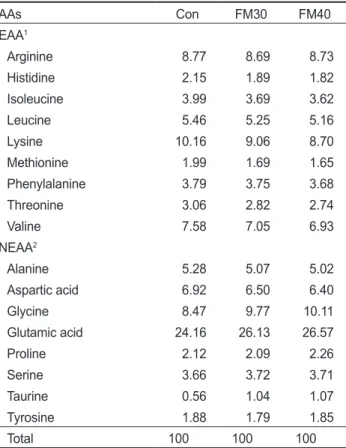
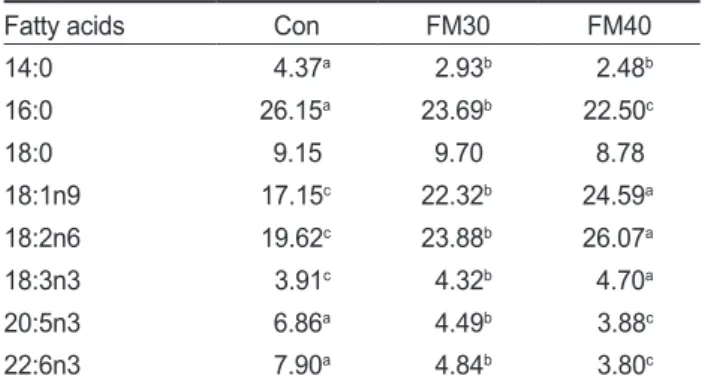
실험사료의아미 노산과지방산조성은Table 2
와Table 3
에각각나타내었다.
사 육실험에사용된참돔은전남고흥군두원면에위치한정석수 산에서구입하였다.
실험어는운송후실험환경적응을위해2
주간순치하였다.
예비사육후,
참돔(77.6±0.3 g)
은총12
개의 원형polypropylene
수조(300 L)
에수조당25
마리씩,
실험구 당4
반복으로무작위배치되었다.
실험사료는1
일2
회(09:00, 17:30)
만복 공급하였다.
사육수는 저수온기 자연해수(13.8-
17.5°C)
를모래여과하여사용하였으며각수조별유수량이3-4
L/min
이되도록조절하였다.
용존산소의유지를위해에어스톤을설치하여충분한용존산소를공급하였다
.
광주기는형광등 을이용하여12 light:12 dark
로조절되었다.
사육실험중실험 어의무게는3
주마다측정하였으며스트레스를최소화하기위 해측정전24
시간동안절식하였다.
사육실험종료후에는성장 률(weight gain, WG),
일간성장률(specific growth rate, SGR),
사료섭취량(feed intake, FI),
사료계수(feed conversion ratio, FCR),
단백질전환효율(protein efficiency ratio, PER),
생존율(survival)
을계산하였다.
최종무게측정후
,
각수조당6
마리의어류를무작위로선별 하여2-phenoxyethanol (200 ppm)
로마취시켰다.
혈액은미부 동맥에서채혈하였으며6
마리중3
마리의혈액은헤파린을30
μL
처리하여hemoglobin
측정에사용하였으며,
채혈된전혈 은원심분리(5,000 rpm, 10 min, Micre17TR; Hanil Science,
Gimpo, Korea)
후상층액을분리하여aspartate aminotrans- ferase (AST), alanine aminotransferase (ALT)
분석 전까지 초저온냉동고에 보관(-70°C)
하였다.
전어체(whole-body)
는냉동
(-20°C)
후,
믹서기로분쇄하여일반성분분석을진행하였다
.
실험사료와전어체일반성분분석은AOAC (2005)
방법 에따라분석되었다. Hemoglobin, AST, ALT
는시판Kit
를이 용하여,
혈액생화학분석기(ch 100
plus; RADIM company, Fi-
renze, Italy)
를통해분석되었다. Myeloperoxidase (MPO)
분 석은Kumari and Sahoo (2005)
의방법을, lysozyme
활성은Mohammed et al. (2018)
의방법을, anti-protease
활성은El- lis (1990)
의방법을기초로분석하였다.
혈장(plasma)
내total immunoglobulin (Ig)
수치는Siwicki and Anderson (1993)
의 방법을바탕으로분석하였다.
지방산은Metcalfe and Schmitz (1961)
의방법에따라추출되었다.
분리된지방산은capillary column (112-88A7, 100 m×0.25 mm, film thickness 0.20 μm; Agilent Technologies, Santa Clara, CA, USA)
이장착된gas chromatography (Gas Agilent 6800GC; Agilent Technolo- gies, Santa Clara, CA, USA)
를통해분석되었다.
아미노산분 석은HPLC 4 (Ultimate 3000; Thermo dionex, Waltham, MA, USA)
를통해분석되었다.
실험사료의배치는완전확률계획법(completely randomized design)
을실시하였다.
모든데이터 는SPSS (version 24.0; International Business Machines Co., New York, NY, USA)
를이용하여one-way ANOVA
로통계 분석하였으며데이터값의유의차는Tukey’s HSD
로평균간 의유의성(P<0.05)
으로분석되었다.
데이터는평균값±
표준편 차(mean±SD)
로나타내었으며,
백분율데이터는arcsine
변형 값으로계산한후분석되었다.
Table 1. Dietary formulation and proximate composition of the three experimental diets for red seabream Pagrus major (%, dry matter). The fish meal in diets was replaced with animal-plant pro- tein mixture by 30 and 40% (Con, FM30 and FM40)
Ingredients (%) Experimental diets
Con FM30 FM40
Fish meal, sardine1 32.50 22.75 19.50 Fish meal, anchovy2 32.50 22.75 19.50
Soybean meal3 12.0 12.0 12.0
Wheat flour 14.9 13.0 12.6
Wheat gluten4 1.00 4.50 5.50
Soy protein concentration5 0.00 5.25 7.00
Tankage meal6 0.00 6.25 9.00
Poultry by-product meal7 0.00 4.00 4.50
Fish oil8 3.40 4.30 5.10
Betaine 0.00 1.00 1.00
Taurine 0.00 0.50 0.60
Lecithin 0.50 0.50 0.50
Mono-calcium phosphate 0.50 0.50 0.50
Mineral Mix 1.00 1.00 1.00
Vitamin Mix 0.80 0.80 0.80
Vitamin C9 0.30 0.30 0.30
Vitamin E9 0.30 0.30 0.30
Choline 0.30 0.30 0.30
Proximate composition (%)
Moisture 6.31 6.89 6.96
Crude protein 58.4 60.3 60.2
Crude lipid 10.4 10.9 11.9
Crude ash 14.3 11.6 10.9
1Fish meal, sardine (crude protein 68.0%, crude lipid 8.6%, ash 17.1%). 2fish meal, anchovy (crude protein 69.4%, crude lipid 8.3%, ash 17.8%). 3Soybean meal (crude protein 52.7%, crude lipid 1.8%, ash 6.8%). 4Wheat gluten (crude protein 83.2%, crude lipid 3.69%, ash 1.3%). 5Soy protein concentrate (crude protein 68.9%, crude lipid 0.5%, ash 7.1%). 6Tankage meal (crude pro- tein 86.3%, crude lipid 9.0%, ash 7.5%). 7Poultry by-product meal (crude protein 71.6%, crude lipid 13.5%, ash 10.5%) were by The Feed Co., Ltd., Seoul, Korea. 8Fish oil was by E-wha oil Co., Ltd., Busan, Korea. 9AlphaAqua Co., Busan, Korea. Con, control.
Table 2. Essential and non-essential amino acid composition of the experimental diets for red seabream Pagrus major (% of protein)
AAs Con FM30 FM40
EAA1
Arginine 8.77 8.69 8.73
Histidine 2.15 1.89 1.82
Isoleucine 3.99 3.69 3.62
Leucine 5.46 5.25 5.16
Lysine 10.16 9.06 8.70
Methionine 1.99 1.69 1.65
Phenylalanine 3.79 3.75 3.68
Threonine 3.06 2.82 2.74
Valine 7.58 7.05 6.93
NEAA2
Alanine 5.28 5.07 5.02
Aspartic acid 6.92 6.50 6.40
Glycine 8.47 9.77 10.11
Glutamic acid 24.16 26.13 26.57
Proline 2.12 2.09 2.26
Serine 3.66 3.72 3.71
Taurine 0.56 1.04 1.07
Tyrosine 1.88 1.79 1.85
Total 100 100 100
1Essential amino acids. 2Non-essential amino acids. Con, control.
결과 및 고찰
19
주간의장기간사육실험결과,
최종평균무게,
사료섭취량,
사료계수,
단백질전환효율,
생존율에서대조구와저어분구사 이에유의적인차이는없었다(Table 4). Biswas et al. (2017)
은SPC
및대두펩타이드로참돔사료내어분의57-77%
까지대 체가능하다고보고하였다. Lim et al. (2020)
은육성기넙치를 대상으로대두박,
밀글루텐, SPC
혼합물과아미노산3
종(Met, Thr, Lys)
을혼합사용하여어분을최대40%
까지대체할수있 었다고보고하였다. Kim et al. (2019b)
은치어기넙치를대상 으로대두박,
밀글루텐, SPC
를혼합하여사료내어분을30%
까 지대체할수있었다.
밀글루텐,
콘글루텐밀(corn gluten meal),
대두박을적절히혼합하여사용하면무지개송어사료내어분 을40%
까지대체할수있다고보고되었다(Jalili et al., 2013).
밀글루텐은
Atlantic halibut
사료내어분을20%
까지대체할 수있다고알려져있다(Helland and Grisdale-Helland, 2006).
완두콩박
, SPC,
밀글루텐,
콘글루텐밀,
감자농축단백을혼합하 여사용하면Senegal sole Solea senegalensis
사료내어분을75%
까지대체할수있다고보고되었다(Valente et al., 2016).
또한
, SPC,
밀글루텐,
대두박을 혼합 사용하면 숭어(Mugil cephalus)
사료내어분의75%
까지대체가능하다고보고되었 다(Gisbert et al., 2016).
대부분의육식성어류는섬유소의소화능력이부족하여식물 성원료를섭취할경우소화율이 낮아지며
(Apper-Bossard et
al., 2013),
어분을다량대체할경우에는일부아미노산이결핍되어아미노산을별도로첨가해줄필요가있다
(Ahmed et al., 2019).
수지박,
육골분,
가금부산물분과같은가공된동물 부산물은가격이저렴하여어분대체원료로서의잠재력이크 다고보고되었다(Hertrampf and Piedad-Pascual, 2000; Rossi and Davis, 2014; Galkanda-Arachchige et al., 2020). Ye et al.
(2011)
은동물성과식물성단백질원료의적절한혼합사용이어분대체에더효율적이라고보고하였다
. Kikuchi (1999)
은대두 박,
건조홍합살,
혈분,
콘글루텐밀을혼합사용하여넙치사료 내어분을46%
까지대체할수있었다. Kim et al. (2019a)
은육 성기넙치(200-1,000 g)
사료에밀글루텐, SPC,
수지박,
가금부 산물분을혼합(20:27:37:16, w:w:w:w)
사용하여어분의50%
까지대체가능하였지만
,
저수온(18.5°C
이하)
에서는소화율을 고려하여40%
까지어분대체가가능할것으로제안하였다.
또 한, Kim et al. (2020)
은밀글루텐, SPC,
수지박,
가금부산물분 을혼합하여치어기넙치(5-70 g)
사료내어분의50%
까지대 체하는데성공하였다.
유럽농어(Dicentrarchus labrax)
를대상 으로한연구에서Scerra et al. (2016)
은녹두박,
우모분,
혈분을 혼합하여사료내어분의50%
까지대체하였으며, Torrecillas et al. (2017)
은밀글루텐, SPC,
콘글루텐밀,
채종박,
혈분을혼 합사용하여어분을82%
까지대체하였다.
따라서이번연구에 서는네가지동·
식물성단백질원료를적절히혼합사용하면서 아미노산을별도로추가하지않아도사료내아미노산의함량 에큰변화가없었다(Table 2).
또한,
혼합물로어분을대체하면Table 4. Growth performance, feed utilization and whole body proximate composition of red seabream Pagrus major fed experi- mental diets for 19 weeks (% of wet basis). The fish meal in diets was replaced with animal-plant protein mixture by 30 and 40%
(Con, FM30 and FM40)
Dietary treatment Con FM30 FM40
IBW1 77.4±1.09 78.0±0.97 77.5±0.84
FBW2 197±4.04 201±7.27 199±14.06
WG3 154±6.82 157±6.99 156±16.65
FI4 189±9.67 179±5.52 177±1.38
FCR5 1.58±0.09 1.46±0.11 1.47±0.19
PER6 1.11±0.07 1.18±0.09 1.18±0.14
SGR7 0.71±0.02 0.72±0.02 0.71±0.05
Survival (%) 70.0±12.44 90.0±4.00 78.0±21.04 Proximate composition (%)
Moisture 65.8±0.90 67.5±0.65 65.1±0.17 Crude protein 17.7±1.78 17.6±0.14 19.0±0.16 Crude lipid 9.97±5.46 12.0±3.06 9.73±3.36 Crude ash 6.73±0.91 4.46±3.44 5.12±0.13
1Initial body weight (g). 2Final body weight (g). 3Weight gain (%)=[(final body weight-initial body weight)/initial body weight]×100. 4Feed intake (g/fish)=dry feed consumed (g)/fish.
5Feed conversion ratio=dry feed fed/wet weight gain. 6Protein ef- ficiency ratio=fish weight gain (g)/protein. 7Specific growth ratio (%)=[(loge final body weight-loge initial body weight)/days]×100.
Con, control. Values are mean of triplicate groups and presented as mean±SD. Values with different superscripts in the same column are significantly different (P<0.05). The lack of superscript letter indicates no significant differences among treatments.
Table 3. Fatty acid composition of the experimental diets for red seabream Pagrus major (% of lipid)
Fatty acids Con FM30 FM40
14:0 4.37a 2.93b 2.48b
16:0 26.15a 23.69b 22.50c
18:0 9.15 9.70 8.78
18:1n9 17.15c 22.32b 24.59a
18:2n6 19.62c 23.88b 26.07a
18:3n3 3.91c 4.32b 4.70a
20:5n3 6.86a 4.49b 3.88c
22:6n3 7.90a 4.84b 3.80c
Con, control. Values are mean of triplicate groups and presented as mean±SD. Values with different superscripts in the same row are significantly different (P<0.05).
서조건부필수아미노산으로여겨지는
taurine
을보충첨가하여
(Table 1)
대조구보다어분구사료에서의함량을더높임으로써
(Table 2),
장기간(19
주)
의어분대체에따른참돔의성장과 사료효율의감소를막을수있었던것으로사료된다.
전어체일반성분은대조구와저어분구사이에유의적인차이 가없었다
(Table 4).
참돔에서도SPC
단독으로(Biswas et al., 2019)
혹은SPC
와krill meal, squid meal
의혼합물(Kader et al., 2010)
로어분을대체하였을경우,
전어체일반성분의조성 에서유의적인차이가없었다고보고되었다.
육성기넙치에서도대두박
, SPC,
밀글루텐을혼합사용했을때전어체일반성분조성에는유의적인차이가없었다고보고되었다
(Lim et al.,
2020).
일반적으로어분대체 연구에서는모든실험사료의조단백질과조지방의함량을동일하게조성한다
.
성장결과에서 유의적인차이가없는한,
대부분전어체일반성분조성에서도 유의적인차이가발견되지않는다(Kader et al., 2010; Biswas et al., 2019; Lim et al., 2020).
이번연구의사료내지방산조 성(Table 3)
에서는어분을대체할수록EPA (eicosapentaenoic acid)
와DHA (docosahexaenoic acid)
함량이유의적으로감소 하였지만,
참돔의EPA
요구량(Takeuchi et al., 1990; Furuita et al., 1996)
인1.0-2.25%
와DHA
요구량인0.5-0.95%
를훨씬초 과하였기에성장,
사료효율,
비특이적면역력에서문제가없었 던것으로판단된다.
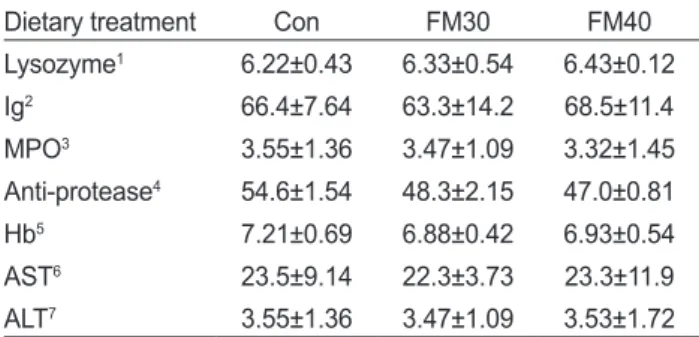
비특이적면역력과혈액학적분석결과는
Table 5
에나타내었 다. Lysozyme, MPO, hemoglobin, AST, ALT, anti-protease,
Ig
은대조구와어분구사이에유의적인차이가없었다.
혈액학적분석은어류의기초건강도를판단하는지표로이용된다
(Pe- dro et al., 2005).
혈액내혈장의성분은사료의영양소,
사육 환경,
실험동물의건강도등에따라달라질수있다(Lee et al., 1993).
넙치에서사료내산(acid)
가수분해농축대두박(Kim et
al., 2014)
으로어분을대체하거나대두박과면실박의혼합물로(Lim et al., 2011)
어분을대체했을경우,
어분대체율이증가할 수록hemoglobin
의농도가감소하는것으로나타났다. AST
와ALT
는주로어류에서아미노산의대사에관여하는효소로써 조직에물리적,
병리적손상을입을경우에혈액내농도가증가 하기때문에어류의건강도와스트레스를조사하는지표로사 용된다(Jiang et al., 2015). Lysozyme
은항균효소의하나로특 정세균에대한항균작용이아닌비특이적으로다양한균에대 해항균작용을나타내는효소이며, MPO
는백혈구로부터방출 되어hypochlorous acid
를생성해병원체를사멸시킨다(Kim et al., 2011). Ig
는선천적,
후천적면역에서중요한역할을한다(Magnadóttir, 2006). Kim et al. (2019b)
은넙치사료내어분을 대두박, SPC,
밀글루텐혼합물로대체했을때혈액의hemoglo- bin
과hematocrit
에는영향이없었다고보고하였다. Lim et al.
(2020)
도넙치사료내어분을대두박, SPC,
밀글루텐혼합물과3
종의필수아미노산(Lys, Met, Thr)
을사용하여어분을40%
까 지대체했을때AST, ALT, lysozyme
활성에서유의적인차이 가없었다고보고하였다.
참돔에서도SPC
단독(Biswas et al., 2019)
혹은SPC, krill meal, squid meal
의혼합물(Kader et al., 2010)
로대체하였을 경우,
혈액의hemoglobin
과hematocrit
에는유의적인차이가없었다. Bui et al. (2014)
은참돔사료 내어분의5%
를krill hydrolysate, shrimp hydrolysate, tilapia hydrolysate
으로대체하였을때성장,
사료효율,
소화율,
비특이 적면역력과질병저항성이향상된다고보고하였다.
따라서이 번연구에서처럼밀글루텐, SPC,
수지박,
가금부산물분의적절 한혼합으로어분을대체할경우,
참돔의건강도와비특이적면 역력에는영향이없을것으로판단된다.
식물성단백질원료만으로어분을대체할경우특정영양소의 결핍으로어분대체에한계가있을수있다
.
하지만이번연구 에서는동·
식물성단백질원료의적절한혼합물을사용함으로 써결핍되기쉬운영양소를서로보완해주었기때문에어분을40%
까지대체하여도참돔의성장,
사료효율,
생존율,
건강도,
비특이적면역력에문제가없었던것으로판단된다.
이번연구 의저수온기(13.8-17.5°C)
외에적수온,
고수온기에서의추가 연구를통해참돔사료에서동·
식물성단백질원료혼합물의최 대이용율을조사할필요가있을것으로사료된다.
사 사
이논문은국립수산과학원
(R2021016),
해양수산부및정부(
교육부)
의재원으로한국연구재단의지원을받아수행된기초 연구사업(2019R1A6A1A03033553)
입니다.
Table 5. Hematological parameters and non-specific immune responses of red seabream Pagrus major (initial body weight, 77.6±0.3g) fed the experimental diets for 19 weeks. The fish meal in diets was replaced with animal-plant protein mixture by 30 and 40% (Con, FM30 and FM40)
Dietary treatment Con FM30 FM40
Lysozyme1 6.22±0.43 6.33±0.54 6.43±0.12
Ig2 66.4±7.64 63.3±14.2 68.5±11.4
MPO3 3.55±1.36 3.47±1.09 3.32±1.45
Anti-protease4 54.6±1.54 48.3±2.15 47.0±0.81
Hb5 7.21±0.69 6.88±0.42 6.93±0.54
AST6 23.5±9.14 22.3±3.73 23.3±11.9
ALT7 3.55±1.36 3.47±1.09 3.53±1.72
1Lysozyme (μg/mL). 2Total immunoglobulin (mg/mL). 3Myeloper- oxidase (absorbance). 4Anti-protease (% inhibition). 5Hemoglobin (g/dL). 6aspartate aminotransferase (U/L). 7alanine aminotransfer- ase (U/L). Con, control. Values are mean of quadruplicate groups and presented as mean±SD. Values with different superscripts in the same column are significantly different (P<0.05). The lack of superscript letter indicates no significant differences among treat- ments.
References
Abdul-Halim HH, Aliyu-Paiko M and Hashim R. 2014. Partial replacement of fish meal with poultry by-product meal in di- ets for snakehead Channa striata (Bloch, 1793), fingerlings.
J World Aquac Soc 45, 233-241. https://doi.org/10.1111/
jwas.12112.
Ahmed M, Liang H, Kasiya HC, Ji K, Ge X, Ren M, Liu B, Zhu X and Sun A. 2019. Complete replacement of fish meal by plant protein ingredients with dietary essential amino acids supplementation for juvenile blunt snout bream Megalo-
brama amblycephala. Aquac Nutr 25, 205-214. https://doi.
org/10.1111/anu.12844.
AOAC (Association of Official Analytical Chemists). 2005.
Official methods of analysis. Association of Official Analytical Chemists, Arlington, VA, U.S.A. https://doi.
org/10.1002/0471740039.vec0284.
Ao T. 2011. Using exogenous enzymes to increase the nutrition- al value of soybean meal in poultry diet. In: El-Shemy H, Ed. Soybean and Nutrition. In Tech, New York, NY, U.S.A., 201-214.
Apper-Bossard E, Feneuil A, Wagner A and Respondek F. 2013.
Use of vital wheat gluten in aquaculture feeds. Aquat Bio- syst 9, 9-21. https://doi.org/10.1186/2046-9063-9-21.
Arnason J, Imsland AKD, Helmig T, Gunnarsson S and Krist- jansson GO. 2018. Fishmeal replacement by mixed plant proteins and effect on growth and sensory attributes in on-growing turbot. Aquac Nutr 24, 1041-1047. https://doi.
org/10.1111/anu.12642.
Barton BA and Lwama GK. 1991. Physiological changes in fish from stress in aquaculture with emphasis on the response and effects of corticosteroids. Annu Rev Fish Dis 1, 3-26.
https://doi.org/10.1016/0959-8030(91)90019-G.
Berge GM, Grisdale-Helland B and Helland SJ. 1999. Soy protein concentrate in diets for Atlantic halibut Hippoglos-
sus hippoglossus. Aquaculture 178, 139-148. https://doi.
org/10.1016/S0044-8486(99)00127-1.
Biswas A, Araki H, Sakata T, Nakamori T, Kato K and Takii K.
2017. Fish meal replacement by soy protein from soymilk in the diets of red seabream Pagrus major. Aquac Nutr 23, 1379-1389. https://doi.org/10.1111/anu.12513.
Biswas A, Araki H, Sakata T, Nakamori T and Takii K. 2019.
Optimum fish meal replacement by soy protein concentrate from soymilk and phytase supplementation in diet of red seabream Pagrus major. Aquaculture 506, 51-59. https://
doi.org/10.1016/j.aquaculture.2019.03.023.
Burr GS, Wolters WR, Barrows FT and Hardy RW. 2012. Re- placing fishmeal with blends of alternative proteins on growth performance of rainbow trout Oncorhynchus mykiss, and early or late stage juvenile Atlantic salmon Salmo salar.
Aquaculture 334-337, 110-116. https://doi.org/10.1016/j.
aquaculture.2011.12.044.
Bui HTD, Khosravi S, Fournier V, Herault M and Lee KJ. 2014.
Growth performance, feed utilization, innate immunity, di- gestibility and disease resistance of juvenile red seabream
Pagrus major fed diets supplemented with protein hydroly-
sates. Aquaculture 418-419, 11-16. https://doi.org/10.1016/j.aquaculture.2013.09.046.
Cheng Z, Ai Q, Mai K, Xu W, Ma H, Li Y and Zhang J. 2010.
Effects of dietary canola meal on growth performance, digestion and metabolism of Japanese seabass Lateo-
labrax japonicus. Aquaculture 305, 102-108. https://doi.
org/10.1016/j.aquaculture.2010.03.031.
Choi W, Hamidoghli A, Bae J, Won S, Choi YH, Kim KW, Lee BJ, Hur SW, Han H and Bai SC. 2020. On-farm evaluation of dietary animal and plant proteins to replace fishmeal in subadult olive flounder Paralichthys olivaceus. Fish Aquatic Sci 23, 22. https://doi.org/10.1186/s41240-020-00169-4.
Chou RL, Her BY, Su MS, Hwang G, Wu YH and Chen HY.
2004. Substituting fish meal with soybean meal in diets of juvenile cobia Rachycentron canadum. Aquaculture 229, 325-333. https://doi.org/10.1016/S0044-8486(03)00395-8.
Cruz-Suarez LE, Nieto-Lopez M, Guajardo-Barbosa C, Tapia- Salazar M, Scholz U and Ricque-Marie D. 2007. Replace- ment of fish meal with poultry by-product meal in practical diets for Litopenaeus vannamei, and digestibility of the test- ed ingredients and diets. Aquaculture 272, 466-476. https://
doi.org/10.1016/j.aquaculture.2007.04.084.
Dawood MAO, Koshio S, Ishikawa M and Yokoyama S. 2015.
Effects of partial substitution of fish meal by soybean meal with or without heat-killed Latobacillus plantarum (LP20) on growth performance, digestibility, and immune response of amberjack Seriola dumerili juveniles. Biomed Res Int 2015, 132-135. https://doi.org/10.1155/2015/514196.
Daniel N. 2018. A review on replacing fish meal in aqua feeds using plant protein sources. Int J Fish Aquat Stud 6, 164- Ellis AE. 1990. Serum antiprotease in fish. In: Techniques in fish 179.
immunology, (ed. by JS Stolen, TC Fletcher, DP Anderson, WB Roberson and WB Van Muiswinkel), SOS Publication, Fair Haven, CT, U.S.A., 95-99.
FAO (Food and Agriculture Organization). 2021. Global aqua- culture production (online query). Retrieved from http://
www.fao.org/fishery/statistics/global-aquaculture-produc- tion/en on Mar 03, 2021.
Furuita H, Takeuchi T, Toyota M and Watanabe T. 1996. EPA and DHA requirements in early juvenile red seabream using HUFA enriched artemia nauplii. Fish Sci 62, 246-251. http://
doi.org/10.2331/fishsci.62.246.
Galkanda-Arachchige HSC, Wilson AE and Davis DA. 2020.
Success of fishmeal replacement through poultry by-product meal in aquaculture feed formulations: a meta-analysis. Rev Aquac 12, 1624-1636. https://doi.org/10.1111/raq.12401.
Gisbert E, Mozanzadeh MT, Kotzamanis Y and Estéevez A.
2016. Weaning wild flathead grey mullet Mugil cephalus fry with diets with different levels of fish meal substitution.
Aquaculture 462, 92-100. https://doi.org/10.1016/j.aquacul- ture.2016.04.035.
Glencross B, Evans D, Dods K, McCafferty P, Hawkins W, Maas R and Sipsas S. 2005. Evaluation of the digestible value of lupin and soybean protein concentrates and iso- lates when fed to rainbow trout Oncorhynchus mykiss, us- ingeither stripping or settlement faecal collection methods.
Aquaculture 245, 211-220. https://doi.org/10.1016/j.aqua- culture.2004.11.033.
Helland SJ and Grisdale-Helland B. 2006. Replacement of fish meal with wheat gluten in diets for Atlantic halibut Hip-
poglossus hippoglossus: Effect on whole-body amino acid
concentrations. Aquaculture 261, 1363-1370. https://doi.org/10.1016/j.aquaculture.2006.09.025.
Hertrampf JW and Piedad-Pascual F. 2000. Meat by-product meals. In: Handbook on Ingredients for Aquaculture Feeds.
Springer, Dordrecht, Nederland, 291-301.
Hua K, Cobcroft JM, Cole A, Condon K, Jerry DR, Mangott A, Praeger C, Vucko MJ, Zeng C, Zenger K and Strugnell JM.
2019. The future of aquatic protein: implications for protein sources in aquaculture diets. One Earth 1, 316-329. https://
doi.org/10.1016/j.oneear.2019.10.018.
Jalili R, Tukmechi A, Agh N, Noori F and Ghasemi A. 2013.
Replacement of dietary fish meal with plant protein sources in rainbow trout Oncorhynchus mykiss; effect on growth performance, immune responses, blood indices and disease resistance. Iran J Fish Sci 12, 577-591. http://aquaticcom- mons.org/id/eprint/22624.
Jiang J, Feng L, Tang L, Liu Y, Jiang W and Zhou X. 2015.
Growth rate, body composition, digestive enzymes and transaminase activities, and plasma ammonia concentra- tion of different weight Jian carp (Cyprinus carpio var.
Jian). Anim Nutr 1, 373-377. https://doi.org/10.1016/j.
aninu.2015.12.006.
Kader MA, Koshio S, Ishikawa M, Yokoyama S and Buldul M. 2010. Supplemental effects of some crude ingredients in improving nutritive values of low fishmeal diets for red seabream Pagrus major. Aquaculture 308, 136-144. https://
doi.org/10.1016/j.aquaculture.2010.07.037.
Kikuchi K. 1999. Use of defatted soybean meal as a substitute for fish meal in diets of Japanese flounder Paralichthys
olivaceus. Aquaculture 179, 3-11. https://doi.org/10.1016/
S0044-8486(99)00147-7.
Kim KW, Kim SS, Jeong JB, Jeon YJ, Kim KD, An CM and Lee KJ. 2011. Effects of dietary fluid on growth performance, immune responses, blood components, and disease resis- tance against Edwardsiella tarda and Streptococcus iniae in olive flounder Paralichthys olivaceus. Korean J Fish Aquat Sci 44, 644-652. https://doi.org/10.5657/KFAS.2011.0644.
Kim SS, Oh DH, Cho SJ, Seo SH, Han HS and Lee KJ. 2014.
Evaluation of acid-concentrated soybean meal as a fishmeal replacement and its digestibility in diets for juvenile olive flounder Paralichthys olivaceus. Korean J Fish Aquat Sci 47, 824-831. http://dx.doi.org/10.5657/KFAS.2014.0824.
Kim MG, Lee CR, Shin JH, Lee BJ, Kim KW and Lee KJ.
2019a. Effects of fish meal replacement in extruded pellet diet on growth, feed utilization and digestibility in olive flounder Paralichthys olivaceus. Korean J Fish Aquat Sci 52, 149-158. https://doi.org/10.5657/KFAS.2019.0149.
Kim MG, Shin JH, Lee CR, Lee BJ, Hur SW, Lim SG and Lee KJ. 2019b. Evaluation of a mixture of plant protein source as a partial fish meal replacement in diets for juvenile olive flounder Paralichthys olivaceus. Korean J Fish Aquat Sci 52, 374-381. https://doi.org/10.5657/KFAS.2019.0374.
Kim MG, Lim HW, Lee BJ, Hur SW, Lee SH, Kim KW and Lee KJ. 2020. Replacing fish meal with a mixture of plant and animal protein source in the diets of juvenile olive flounder
Paralichthys olivaceus. Korean J Fish Aquat Sci 53, 577-
582. https://doi.org/10.5657/KFAS.2020.0577.Kissinger KR, Garcíia-Ortega A and Trushenski JT. 2016. Par- tial fish meal replacement by soy protein concentrate, squid and algal meals in low fish-oil diets containing Schizochy-
trium limacinum for longfin yellowtail Seriola rivoliana.
Aquaculture 452, 37-44. https://doi.org/10.1016/j.aquacul- ture.2015.10.022.
KOSIS (Korean Statistical Information Service). 2021. Ex- penditure per aquaculture. Retrieved from http://kosis.kr/
statisticsList/statisticsListIndex.do?menuId=M_01_01
&vwcd=MT_ZTITLE&parmTabId=M_01_01#SelectStats BoxDiv on Jun 25, 2021.
Krogdahl A, Penn M, Thorsen J, Resfstie S and Bakke AM.
2010. Important antinutrients in plant feedstuffs for aquaculture: an update on recent findings regarding re- sponses in salmonids. Aquac Nutr 41, 333-344. https://
doi.org/10.1111/j.1365-2109.2009.02426.x.
Kumari J and Sahoo PK. 2005. Effects of cyclophosphamide on the immune system and disease resistance of asian cat- fish Clarias batrachus. Fish Shellfish Immunol 19, 307-316.
https://doi.org/10.1016/j.fsi.2005.01.008.
Lee SM, Lee Jy, Kang YJ and Hur SB. 1993. Effects of dietary n-3 highly unsaturated fatty acids on growth and biochemi- cal changes in the Korean rockfish Sebastes schlegeli II.
Chages of blood chemistry and properties of lliver cells. J Aquac 6, 107-123.
Lim HW, Kim MG, Shin JH, Shin JB, Hur SW, Lee BJ and Lee KJ. 2020. Evaluation of three plant proteins for fish meal replacement in diet for growing olive flounder Paralichthys
olivaceus. Korean J Fish Aquat Sci 53, 464-470. https://doi.
org/10.5657/KFAS.2020.0464.
Lim SJ, Kim SS, Ko GY, Song JW, Oh DH, Kim JD, Kim JU and Lee KJ. 2011. Fish meal replacement by soybean meal in diets for tiger puffer, Takijugu rubripes. Aquaculture 313,