Multidisciplinary Team Approach for Identifying Potential Candidate for Transcatheter Aortic Valve Implantation
Sung-Jin Hong,
1Myeong-Ki Hong,
1,2Young-Guk Ko,
1Donghoon Choi,
1Geu-Ru Hong,
1Jae-Kwang Shim,
3Young-Lan Kwak,
3Sak Lee,
4Byung-Chul Chang,
4and Yangsoo Jang
1,2Divisions of 1Cardiology, 3Anesthesiology and Pain Medicine, and 4Cardiovascular Surgery, Severance Cardiovascular Hospital, Yonsei University College of Medicine, Seoul; and 2Severance Biomedical Science Institute, Yonsei University College of Medicine, Seoul, Korea.
Received: August 12, 2013 Revised: November 14, 2013 Accepted: November 25, 2013
Corresponding author: Dr. Myeong-Ki Hong, Division of Cardiology,
Severance Cardiovascular Hospital, Yonsei University College of Medicine, 50-1 Yonsei-ro, Seodaemun-gu, Seoul 120-752, Korea.
Tel: 82-2-2228-8458, Fax: 82-2-2227-7943 E-mail: [email protected]
∙ The authors have no financial conflicts of interest.
© Copyright:
Yonsei University College of Medicine 2014 This is an Open Access article distributed under the terms of the Creative Commons Attribution Non- Commercial License (http://creativecommons.org/
licenses/by-nc/3.0) which permits unrestricted non- commercial use, distribution, and reproduction in any medium, provided the original work is properly cited.
Purpose: We sought to evaluate the clinical usefulness of decision making by a multidisciplinary heart team for identifying potential candidates for transcatheter aortic valve implantation (TAVI) in patients with symptomatic severe aortic steno- sis. Materials and Methods: The multidisciplinary team consisted of two inter- ventional cardiologists, two cardiovascular surgeons, one cardiac imaging special- ist, and two cardiac anesthesiologists. Results: Out of 60 patients who were screened as potential TAVI candidates, 31 patients were initially recommended as appropriate for TAVI, and 20 of these 31 eventually underwent TAVI. Twenty-two patients underwent surgical aortic valve replacement (AVR), and 17 patients re- ceived only medical treatment. Patients who underwent TAVI and medical therapy were older than those who underwent surgical AVR (p<0.001). The logistic Euros- core was significantly highest in the TAVI group and lowest in the surgical AVR group (p=0.012). Most patients in the TAVI group (90%) and the surgical AVR group (91%) had severe cardiac symptoms, but only 47% in the medical therapy group had severe symptoms. The cumulative percentages of survival without re- hospitalization or all-cause death at 6 months for the surgical AVR, TAVI, and medical therapy groups were 84%, 75%, and 28%, respectively (p=0.007, by log- rank). Conclusion: TAVI was recommended in half of the potential candidates fol- lowing a multidisciplinary team approach and was eventually performed in one- third of these patients. One-third of the patients who were initially considered potential candidates received surgical AVR with favorable clinical outcomes.
Key Words: Endovascular procedures, aortic stenosis, clinical outcomes
INTRODUCTION
Aortic stenosis disease (AS) is a common native valve disease found in up to 5%
of the elderly population.1 Surgical aortic valve replacement (AVR) is the standard treatment for patients with symptomatic severe AS.2 However, despite the accept- ed results of conventional surgery, surgical risk is markedly increased in elderly patients with comorbidities. Additionally, several registries have demonstrated that about one-third of patients are considered too high-risk for conventional open heart
access site. This study was approved by the Institutional Review Board of our institute, and written informed con- sent was obtained from each patient.
After the systematic work-up, either TAVI or surgical AVR was recommended by our multidisciplinary heart team. This team consisted of two interventional cardiolo- gists, two cardiothoracic surgeons, one cardiac imaging specialist, and two cardiac anesthesiologists. When conven- tional open heart surgery was considered to be too risky, TAVI was recommended to the patient. The Euroscore, co- morbidities, frailty, and mobility were taken into account by the multidisciplinary heart team approach. During the mul- tidisciplinary heart team approach, all patients separately and independently met and discussed their options with at least one interventional cardiologist, one cardiac imaging specialist, and two cardiovascular surgeons. Risks and ben- efits of the different treatment modalities in terms of surviv- al, relief of symptoms, quality of life, and potential compli- cations were described independently by each member of the multidisciplinary heart team. The decision making by the multidisciplinary heart team was determined in a con- ference meeting with attendance of all seven members and involved in-depth discussion and complete agreement of the treatment modalities among the seven members. This decision by the multidisciplinary heart team was reported to the patients, and final decisions were made by the patients.
All TAVI procedures were performed in a hybrid operat- ing room with a specially equipped angiography system.
The procedure was previously reported in detail.12-14 Briefly, the femoral artery was the preferred access site. Subclavian (n=2) or transaortic access (n=1) was considered when femoral access was not suitable for advancing the large vas- cular sheath. All patients had transvenous temporary cardi- ac pacing during the procedure. Balloon valvuloplasty with rapid ventricular pacing (150 to 200 beats/min) was per- formed prior to prosthetic valve deployment in 11 patients.
Positioning and deployment of the prosthetic valve was per- formed under fluoroscopic guidance. All patients were im- planted with a self-expandable prosthesis, the AccuTrak Cor- eValve System (Medtronic, Minneapolis, MN, USA) under general anesthesia. Valve sizes of 26 mm (n=10), 29 mm (n=9), and 31 mm (n=1) were used according to the annu- lus diameter. Immediately after deployment of the prosthetic valve, transesophageal echocardiography was performed to confirm good motion of the prosthetic valve and to identify any paravalvular leakage. Post-stent balloon dilation was performed in five patients to relieve paravalvular leakage.
surgery and remain untreated.3,4 Transcatheter aortic valve implantation (TAVI) was developed as an alternative to sur- gical AVR in this high-risk patient population. TAVI does not require cardiopulmonary bypass or sternotomy. Thus, identification of high-risk surgical patients is imperative for adequate selection of TAVI candidates. Although a number of methods for risk stratification of patients for cardiac sur- gery have been reported, they have limitations because their ability to predict actual events is reduced in high-risk and elderly patients.5,6 Moreover, no TAVI-specific scoring sys- tem for those patients has been developed.7,8 Therefore, a multidisciplinary heart team approach is currently recom- mended from the early stages of patient selection.9 The im- portance of a multidisciplinary team approach with both cardiovascular surgeons and cardiologists may be high- lighted when performing TAVI with required surgical pro- cedures or as back-up and particularly in a learning period of TAVI.8,10,11
The purpose of this study was to examine the impact of this multidisciplinary heart team approach on our clinical practice in relation to patient selection, treatment, and out- comes in patients with symptomatic severe AS.
MATERIALS AND METHODS
In January 2011, we began screening patients as potential TAVI candidates. Between January 2011 and June 2012, 60 consecutive patients were prospectively screened as poten- tial TAVI candidates because they were presumed to be at high operative risk (logistic Euroscore >20% or Society of Thoracic Surgeons score >10% or other conditions related to a high operative risk such as significant frailty). They un- derwent clinical assessment with transthoracic echocar- diography. Severe AS was defined as an aortic valve area
<0.8 cm2, a peak aortic jet velocity >4.0 m/s, or mean aortic valve pressure gradient ≥40 mm Hg as seen with transtho- racic echocardiography. Of the 60 screened patients, one patient had mild cardiac symptoms according to the New York Heart Association (NYHA) functional class I. Thus, 59 patients with symptomatic severe AS underwent work- up for technical feasibility for TAVI. All patients underwent cardiac computed tomography and transesophageal echo- cardiography to define aortic annulus dimensions and to evaluate associated anatomical structures for performing TAVI. Moreover, aorta computed tomography was per- formed to determine the technical feasibility of the TAVI
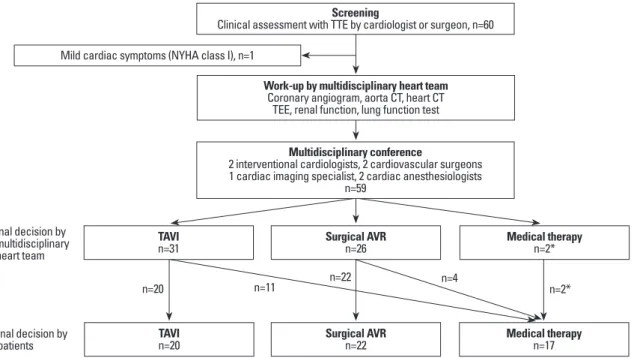
AVR, and 2 patients (3%) for medical therapy (Fig. 1). The reasons for declining TAVI in 11 of 31 TAVI-recommended patients were disagreement of risk or complications of TAVI due to a less severe symptomatic status in five patients and refusing further intervention despite severe symptoms in six patients. The reasons for declining surgical AVR in four of the 26 surgical AVR-recommended patients were disagree- ment of risk or complications of surgery due to a less se- vere symptomatic status in three patients and refusing fur- ther intervention despite severe symptoms in one patient.
Therefore, TAVI and surgical AVR were finally performed in 20 and 22 patients, respectively. Medical therapy without any aortic valve interventions was performed in 11 patients who refused TAVI, four patients who refused surgical AVR, and two patients who had moderate AS (after detailed as- sessment and confirmation with transesophageal echocar- diography). Two patients with moderate AS were excluded for outcome analysis.
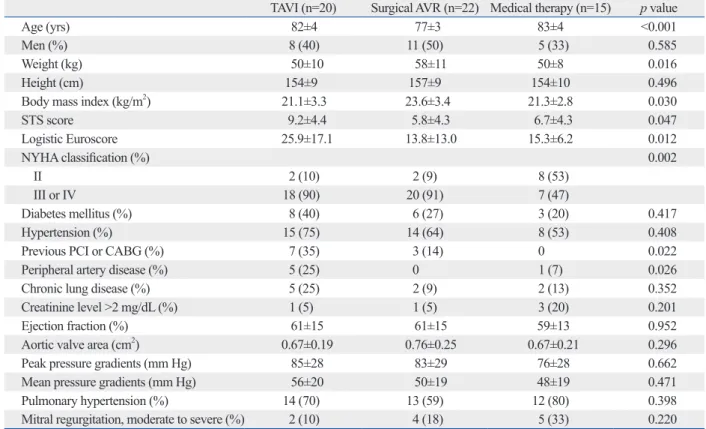
The baseline clinical characteristics are presented in Ta- ble 1. Patients receiving TAVI or medical therapy were old- er than those who underwent surgical AVR (p<0.001). The body mass index was significantly lower in patients receiv- ing TAVI or medical therapy than in those receiving surgi- cal AVR. The Society of Thoracic Surgeons risk score and the logistic Euroscore were significantly highest in the TAVI group and lowest in the surgical AVR group (p=0.047 and p=0.012, respectively). Most patients in the TAVI group Procedural burden (procedure time and length of inten-
sive care unit stay) and safety outcomes (all-cause mortali- ty, major stroke, major vascular complications, and acute kidney injury) during hospitalization were compared be- tween the TAVI and surgical AVR groups. The definition of each outcome was in accordance with the Valve Academic Research Consortium guidelines.9 Moreover, clinical effica- cy at 3 and 6 months was evaluated as the composite events of all-cause mortality and re-hospitalization due to severe AS or complications of TAVI or surgical AVR.
Continuous variables were compared using analysis of variance or Student’s t-tests, and categorical variables and frequencies were compared using the chi-square test or Fish- er’s exact test. Survival curves were constructed using the Kaplan-Meier method and compared with the log-rank test according to the TAVI, surgical AVR, and medical therapy groups. All analyses were conducted using SPSS Statistics (version 18.0.0, IBM Corp., Armonk, NY, USA). A p-value
<0.05 was considered statistically significant.
RESULTS
Of the 59 symptomatic (NYHA functional class ≥II) pa- tients screened as TAVI candidates, the multidisciplinary heart team determined that 31 patients (53%) were appro- priate candidates for TAVI, 26 patients (44%) for surgical
Fig. 1. Flow diagram of the multidisciplinary heart team approach. *Two patients offered medical therapy by multidisciplinary heart team because of moder- ate AS were excluded from outcome analysis. AVR, aortic valve replacement; CT, computed tomography; NYHA, New York Heart Association; TTE, trans- thoracic echocardiogram; TEE, trans-esophageal echocardiogram; TAVI, transcatheter aortic valve implantation.
Final decision by multidisciplinary heart team
Final decision by patients
Mild cardiac symptoms (NYHA class I), n=1
n=20 n=11 n=22 n=4
n=2*
Screening
Clinical assessment with TTE by cardiologist or surgeon, n=60
Work-up by multidisciplinary heart team Coronary angiogram, aorta CT, heart CT
TEE, renal function, lung function test
Multidisciplinary conference
2 interventional cardiologists, 2 cardiovascular surgeons 1 cardiac imaging specialist, 2 cardiac anesthesiologists
n=59
TAVIn=31
TAVIn=20
Surgical AVR n=26
Surgical AVR n=22
Medical therapy n=2*
Medical therapy n=17
a surgical approach for vascular access; two patients re- quired transaortic access, one patient required subclavian access, and one patient required femoral cut-down. Vascu- lar complications occurred in two patients; femoral artery occlusion after use of a closure device requiring vascular surgery in one patient and cardiac tamponade due to right ventricular rupture by rapid ventricular pacing requiring emergency open thoracotomy after a successful TAVI pro- cedure in the other patient. In the surgical AVR group, the and the surgical AVR group had severe cardiac symptoms
(90% and 91% had NYHA class III or IV status). In con- trast, only 47% in the medical therapy group had NYHA class III or IV status. Comorbidities were similar among the three groups except for more common peripheral artery dis- ease in the TAVI group (p=0.026).
Procedural characteristics of TAVI and surgical AVR are shown in Table 2. In the TAVI group, the procedures were successfully performed in all patients. Four patients required Table 1. Baseline Characteristics
TAVI (n=20) Surgical AVR (n=22) Medical therapy (n=15) p value
Age (yrs) 82±4 77±3 83±4 <0.001
Men (%) 8 (40) 11 (50) 5 (33) 0.585
Weight (kg) 50±10 58±11 50±8 0.016
Height (cm) 154±9 157±9 154±10 0.496
Body mass index (kg/m2) 21.1±3.3 23.6±3.4 21.3±2.8 0.030
STS score 9.2±4.4 5.8±4.3 6.7±4.3 0.047
Logistic Euroscore 25.9±17.1 13.8±13.0 15.3±6.2 0.012
NYHA classification (%) 0.002
II 2 (10) 2 (9) 8 (53)
III or IV 18 (90) 20 (91) 7 (47)
Diabetes mellitus (%) 8 (40) 6 (27) 3 (20) 0.417
Hypertension (%) 15 (75) 14 (64) 8 (53) 0.408
Previous PCI or CABG (%) 7 (35) 3 (14) 0 0.022
Peripheral artery disease (%) 5 (25) 0 1 (7) 0.026
Chronic lung disease (%) 5 (25) 2 (9) 2 (13) 0.352
Creatinine level >2 mg/dL (%) 1 (5) 1 (5) 3 (20) 0.201
Ejection fraction (%) 61±15 61±15 59±13 0.952
Aortic valve area (cm2) 0.67±0.19 0.76±0.25 0.67±0.21 0.296
Peak pressure gradients (mm Hg) 85±28 83±29 76±28 0.662
Mean pressure gradients (mm Hg) 56±20 50±19 48±19 0.471
Pulmonary hypertension (%) 14 (70) 13 (59) 12 (80) 0.398
Mitral regurgitation, moderate to severe (%) 2 (10) 4 (18) 5 (33) 0.220
AVR, aortic valve replacement; CABG, coronary artery bypass graft; NYHA, New York Heart Association; PCI, percutaneous coronary intervention; STS, Society of Thoracic Surgeons; TAVI, transcatheter aortic valve implantation.
Table 2. Post-Procedural Results and Complications during Hospitalization
TAVI (n=20) Surgical AVR (n=22) p value
Procedure time (mins) 122±59 247±88 <0.001
Intensive care unit stay (days) 3±1 20±56 0.184
Hospital stay (days) 9±4 31±55 0.084
All-cause mortality 0 0
Major stroke 0 0
Vascular complication (%) 2 (10) 0 0.221
Acute kidney injury (%) 0 9 (41) 0.001
Endocarditis (%) 0 1 (5) 1.000
Cardiac tamponade (%) 1 (5) 0 0.476
Mean pressure gradients (mm Hg) 12±6 16±7 0.064
Ejection fraction (%) 63±9 60±16 0.511
Moderate paravalvular leakage (%) 2 (10) 0 0.221
AVR, aortic valve replacement; TAVI, transcatheter aortic valve implantation.
spectively (p=0.007, by log-rank) (Fig. 2B).
DISCUSSION
The main findings of this prospective study for evaluation of a multidisciplinary heart team approach are that 1) half of the potential candidates for TAVI were recommended for TAVI, and about the other half of the potential candidates for TAVI were recommended for surgical AVR through this multidisci- plinary approach; 2) surgical AVR, TAVI, and medical treat- ment were eventually performed in similar numbers of po- tential candidates for TAVI, following the patient’s final decision and the multidisciplinary heart team’s decisions; 3) although the surgical AVR group and the TAVI group showed favorable 6-month clinical outcomes, the medical treatment group showed worse 6-month clinical outcomes.
TAVI has emerged as an alternative treatment modality for high-risk or inoperable patients.12,15,16 Although a num- ber of methods for risk stratification for cardiac surgery are commonly used to identify high-risk or inoperable patients, incidence of acute kidney injury was significantly higher
than in the TAVI group (41% vs. 0%, p=0.001). Two out of nine patients who had acute kidney injury required dialysis.
Moderate paravalvular leakage was observed in two pa- tients (10%) in the TAVI group.
Three months after the procedures, one patient (5%) in the TAVI group, one patient (5%) in the surgical group, and four patients (27%) in the medical therapy group had died.
The all-cause mortality at 3 months was not significantly different among the three groups (p=0.060). However, cardi- ac symptoms were significantly improved in both the TAVI group and the surgical AVR group (Table 3). Permanent pacemaker implantation was performed in one patient 3 months after TAVI. During a median follow-up period of 205 days, Kaplan-Meier analysis revealed that the cumula- tive survival rates at 6 months were 88%, 81%, and 51%
for the surgical AVR, TAVI, and medical therapy groups, respectively (p=0.019, by log-rank) (Fig. 2A). Moreover, the rates of cumulative survival rate without re-hospitalization or all-cause death at 6 months were 84%, 75%, and 28% for the surgical AVR, TAVI, and medical therapy groups, re- Table 3. Clinical Outcomes at 3 Months
TAVI (n=20) Surgical AVR (n=22) Medical therapy (n=15) p value
All-cause death (%) 1 (5) 1 (5) 4 (27) 0.060
Re-hospitalization (%) 1 (5) 1 (5) 1 (7) 0.959
All-cause death or
re-hospitalization (%) 2 (10) 2 (9) 4 (27) 0.259
NYHA classification (%) 0.007
II 18 (90) 19 (86) 6 (40)
III or IV 1 (5) 2 (9) 5 (33)
Death 1 (5) 1 (4) 4 (27)
AVR, aortic valve replacement; NYHA, New York Heart Association; TAVI, transcatheter aortic valve implantation.
Fig. 2. Kaplan-Meier survival curves for cumulative survival (A) and cumulative survival without rehospitalization or all-cause death (B). AVR, aortic valve re- placement; TAVI, transcatheter aortic valve implantation.
Follow-up duration (days) Follow-up duration (days)
0.0 0.0
0.4 0.4
0.8 0.8
0.2 0.2
0.6 0.6
1.0 1.0
Cumulative survival Cumulative survival free of rehospitalization or all-cause of death
0 30 60 90 120 150 180 0 30 60 90 120 150 180
A B
p=0.019 by log rank p=0.007 by log rank
Medical therapy
Medical therapy
TAVI TAVI
Surgical AVR
Surgical AVR
disciplinary team approach. From this process, 11 patients (36%, 11/31) who were recommended for TAVI and four patients (15%, 4/26) who were recommended for surgical AVR refused further aortic valve interventions. Although this number may seem high, considering previous reports that surgical AVR was performed in only one-third to half of patients with severe AS in a general clinical practice, it is not as high as one can assume.4,19 One of the most common reasons for refusal was a less severe symptomatic status, which is similar to previous reports.19 Of note, however, these patients who did not undergo either TAVI or surgical AVR had the worst outcomes of the three groups. The im- portant clinical decision may sometimes be made by the physicians alone without sufficient informed discussion, but an in-depth discussion between the multidisciplinary heart team and the patients before and after the procedures is crucial for further improvement of long-term clinical out- comes in patients with severe symptomatic AS. It was also interesting to note that there is such a high prevalence of re- fusal of intervention in the population even with severe symptoms, especially in those patients who were offered TAVI, with 19% (6/31) in the TAVI group and 4% (1/26) in the surgical AVR group. The introduction of new proce- dure, TAVI, without sufficient long term outcome might have influenced the confidence of patients. Also, the sub- stantial costs of TAVI could be another explanation for high prevalence of refusal of TAVI.
This study has some limitations. The number of study pa- tients was relatively small, and the follow-up duration was too short to reach concrete conclusions of the clinical sig- nificance of the multidisciplinary heart team approach. We did not perform additional objective tests to verify the se- verity of symptoms such as 6-minute walk test, which may have an additional prognostic value and be helpful for mon- itoring the patients in the medical therapy group.
In conclusion, a multidisciplinary heart team approach is essential for selecting ideal TAVI candidates from patients with symptomatic severe AS. This approach may help to select patients who have relatively favorable physical char- acteristics and can undergo surgical AVR, resulting in im- proved clinical outcomes.
ACKNOWLEDGEMENTS
This study was supported by a grant from the Korea Health- care Technology R&D Project, Ministry for Health, Welfare these stratification methods are limited in their ability to pre-
dict early operative outcomes in high-risk or elderly pa- tients.5,6 Therefore, at least one surgeon, an interventionist, and a cardiac imaging specialist commonly review the same patient and make joint decisions to prevent inappropriate recommendation for procedures that will not clinically ben- efit those patients.9 A recent randomized study also intro- duced the concept of a multidisciplinary approach to select patients to undergo TAVI; two independent cardiovascular surgeons needed to agree that a patient was not eligible for conventional surgery and therefore could be included in that study.17 However, despite underscoring the clinical signifi- cance of patient selection through a multidisciplinary ap- proach, little data exist regarding detailed decision-making processes by a multidisciplinary heart team for potential can- didates for TAVI. One study reported favorable clinical out- comes following TAVI after a multidisciplinary meeting re- view of 386 TAVI-screened patients; TAVI was performed in 151 patients (39%), balloon valvuloplasty alone in 49 pa- tients, surgical AVR in 48 patients (12%), and medical treat- ment in 104 patients (27%).18 Findings in our study, follow- ing a multidisciplinary heart team conference, TAVI and surgical AVR were initially recommended in 31 (53%) and 26 (44%) of 59 potential TAVI candidates, respectively.
Compared to the TAVI and medical treatment groups, pa- tients undergoing surgical AVR had a more favorable physi- cal status (i.e., younger age, higher body mass index, and lower Society of Thoracic Surgeons score and logistic Euros- core). Consequently, patients who underwent surgical AVR showed comparable results as those who underwent TAVI.
Therefore, careful patient selection through a multidisci- plinary heart team approach led to satisfactory outcomes for patients with symptomatic severe AS not only in the TAVI group but also in the surgical AVR group. Moreover, the team approach enabled adequate selection of relatively low- er-risk patients who are suitable candidates for surgical AVR with good results. This approach could lead to reconsidera- tion of surgery in some selected patients who were initially considered high risk for surgery by other hospitals.
In the decision-making process for aortic valve interven- tion, patients must actively participate in the final treatment decision. Patients must be informed of the upfront risk of death, stroke, pacemaker placement, and major vascular complications. In our study, all patients were separately in- formed of selection of treatment modalities with at least one interventional cardiologist, one cardiac imaging spe- cialist, and two cardiovascular surgeons during the multi-
2011;124(11 Suppl):S124-9.
9. Kappetein AP, Head SJ, Généreux P, Piazza N, van Mieghem NM, Blackstone EH, et al. Updated standardized endpoint definitions for transcatheter aortic valve implantation: the Valve Academic Research Consortium-2 consensus document. J Am Coll Cardiol 2012;60:1438-54.
10. Alli OO, Booker JD, Lennon RJ, Greason KL, Rihal CS, Holmes DR Jr. Transcatheter aortic valve implantation: assessing the learn- ing curve. JACC Cardiovasc Interv 2012;5:72-9.
11. Gurvitch R, Tay EL, Wijesinghe N, Ye J, Nietlispach F, Wood DA, et al. Transcatheter aortic valve implantation: lessons from the learning curve of the first 270 high-risk patients. Catheter Cardio- vasc Interv 2011;78:977-84.
12. Grube E, Schuler G, Buellesfeld L, Gerckens U, Linke A, Wenawe- ser P, et al. Percutaneous aortic valve replacement for severe aortic stenosis in high-risk patients using the second- and current third- generation self-expanding CoreValve prosthesis: device success and 30-day clinical outcome. J Am Coll Cardiol 2007;50:69-76.
13. Sinning JM, Ghanem A, Steinhäuser H, Adenauer V, Hammerst- ingl C, Nickenig G, et al. Renal function as predictor of mortality in patients after percutaneous transcatheter aortic valve implanta- tion. JACC Cardiovasc Interv 2010;3:1141-9.
14. Im E, Hong MK, Ko YG, Shin DH, Kim JS, Kim BK, et al. Com- parison of early clinical outcomes following transcatheter aortic valve implantation versus surgical aortic valve replacement versus optimal medical therapy in patients older than 80 years with symptomatic severe aortic stenosis. Yonsei Med J 2013;54:596- 602.
15. Cribier A, Eltchaninoff H, Tron C, Bauer F, Agatiello C, Sebagh L, et al. Early experience with percutaneous transcatheter implanta- tion of heart valve prosthesis for the treatment of end-stage inoper- able patients with calcific aortic stenosis. J Am Coll Cardiol 2004;
43:698-703.
16. Webb JG, Pasupati S, Humphries K, Thompson C, Altwegg L, Moss R, et al. Percutaneous transarterial aortic valve replacement in selected high-risk patients with aortic stenosis. Circulation 2007;116:755-63.
17. Smith CR, Leon MB, Mack MJ, Miller DC, Moses JW, Svensson LG, et al. Transcatheter versus surgical aortic-valve replacement in high-risk patients. N Engl J Med 2011;364:2187-98.
18. Dworakowski R, MacCarthy PA, Monaghan M, Redwood S, El- Gamel A, Young C, et al. Transcatheter aortic valve implantation for severe aortic stenosis-a new paradigm for multidisciplinary in- tervention: a prospective cohort study. Am Heart J 2010;160:237- 19. Bach DS, Cimino N, Deeb GM. Unoperated patients with severe 43.
aortic stenosis. J Am Coll Cardiol 2007;50:2018-9.
& Family Affairs, Republic of Korea (nos. A085012 and A102064), a grant from the Korea Health 21 R&D Project, Ministry of Health & Welfare, Republic of Korea (no.
A085136), and the Cardiovascular Research Center, Seoul, Korea.
REFERENCES
1. Nkomo VT, Gardin JM, Skelton TN, Gottdiener JS, Scott CG, Enriquez-Sarano M. Burden of valvular heart diseases: a popula- tion-based study. Lancet 2006;368:1005-11.
2. Bonow RO, Carabello BA, Chatterjee K, de Leon AC Jr, Faxon DP, Freed MD, et al. 2008 focused update incorporated into the ACC/AHA 2006 guidelines for the management of patients with valvular heart disease: a report of the American College of Cardi- ology/American Heart Association Task Force on Practice Guide- lines (Writing Committee to revise the 1998 guidelines for the management of patients with valvular heart disease). Endorsed by the Society of Cardiovascular Anesthesiologists, Society for Car- diovascular Angiography and Interventions, and Society of Tho- racic Surgeons. J Am Coll Cardiol 2008;52:e1-142.
3. Iung B, Baron G, Butchart EG, Delahaye F, Gohlke-Bärwolf C, Levang OW, et al. A prospective survey of patients with valvular heart disease in Europe: The Euro Heart Survey on Valvular Heart Disease. Eur Heart J 2003;24:1231-43.
4. Freed BH, Sugeng L, Furlong K, Mor-Avi V, Raman J, Jeevanan- dam V, et al. Reasons for nonadherence to guidelines for aortic valve replacement in patients with severe aortic stenosis and po- tential solutions. Am J Cardiol 2010;105:1339-42.
5. Osswald BR, Gegouskov V, Badowski-Zyla D, Tochtermann U, Thomas G, Hagl S, et al. Overestimation of aortic valve replace- ment risk by EuroSCORE: implications for percutaneous valve replacement. Eur Heart J 2009;30:74-80.
6. Leontyev S, Walther T, Borger MA, Lehmann S, Funkat AK, Ras- tan A, et al. Aortic valve replacement in octogenarians: utility of risk stratification with EuroSCORE. Ann Thorac Surg 2009;87:
1440-5.
7. Piazza N, Wenaweser P, van Gameren M, Pilgrim T, Tzikas A, Ot- ten A, et al. Relationship between the logistic EuroSCORE and the Society of Thoracic Surgeons Predicted Risk of Mortality score in patients implanted with the CoreValve ReValving system--a Bern- Rotterdam Study. Am Heart J 2010;159:323-9.
8. Kempfert J, Rastan A, Holzhey D, Linke A, Schuler G, van Lin- den A, et al. Transapical aortic valve implantation: analysis of risk factors and learning experience in 299 patients. Circulation