• 검색 결과가 없습니다.

Aprotinin Inhibits Vascular Smooth Muscle Cell Inflammation and Proliferation via Induction of HO-1

N/A
N/A
Protected

Academic year: 2022

Share "Aprotinin Inhibits Vascular Smooth Muscle Cell Inflammation and Proliferation via Induction of HO-1"

Copied!
7
0
0

로드 중.... (전체 텍스트 보기)

전체 글

(1)

123

ABBREVIATIONS: HO-1, heme oxygenase-1; VSMC, vascular smooth muscle cells; SHR, spontaneously hypertensive rats; WKY, wistar Kyoto rats; CO, carbon monoxide; CDK, cyclin-dependent kinase;

MTT, 3-(4,5 dimethylthiazol-2yl)-2,5-diphenyl tetrazolium bromide thiazolyl blue; DMEM, Dulbecco’s modified eagle media; FBS, fetal bovine serum; DMSO, dimethyl sulfoxide.

Corresponding to: Young Jin Kang, Department of Pharmacology, College of Medicine, Yeungnam University, 317-1, Daemyung-dong, Nam-gu, Daegu 705-717, Korea. (Tel) 82-53-620-4354, (Fax) 82-53- 656-7995, (E-mail) [email protected]

Aprotinin Inhibits Vascular Smooth Muscle Cell Inflammation and Proliferation via Induction of HO-1

Dong Hyup Lee

1

, Hyoung Chul Choi

2

, Kwang Youn Lee

2

, and Young Jin Kang

2

Departments of

1

Thoracic and Cardiovascular Surgery,

2

Pharmacology and Aging-associated Vascular Disease Research Center, College of Medicine, Yeungnam University, Daegu 705-717, Korea

Aprotinin is used clinically in cardiopulmonary bypass surgery to reduce transfusion requirements and the inflammatory response. The mechanism of action for the anti-inflammatory effects of aprotinin is still unclear. We examined our hypothesis whether inhibitory effects of aprotinin on cytokine-induced inducible nitric oxide synthase (iNOS) expression (IL-1β plus TNF-α ), reactive oxygen species (ROS) generation, and vascular smooth muscle cell (VSMC) proliferation were due to HO-1 induction in rat VSMCs. Aprotinin induced HO-1 protein expression in a dose-dependent manner, which was potentiated during inflammatory condition. Aprotinin reduced cytokine mixture (CM)-induced iNOS expression in a dose dependent manner. Furthermore, aprotinin reduced CM-induced ROS generation, cell prolife- ration, and phosphorylation of JNK but not of P38 and ERK1/2 kinases. Aprotinin effects were reversed by pre-treatment with the HO-1 inhibitor, tin protoporphyrin IX (SnPPIX). HO-1 is therefore closely involved in inflammatory-stimulated VSMC proliferation through the regulation of ROS generation and JNK phosphorylation. Our results suggest a new molecular basis for aprotinin anti-inflammatory properties.

Key Words: Aprotinin, Inflammation, Vascular smooth muscle cell, Proliferation, HO-1, iNOS

INTRODUCTION

Aprotinin is a broad-spectrum serine protease inhibitor extracted from bovine lung tissue. It was initially in- troduced into clinical practice for the treatment of pan- creatitis in the 1950s, and is widely used in cardiovascular surgery as a hemostatic agent (Westaby, 1993). The hema- tostatic effects of aprotinin are mediated by the preserva- tion of platelet function and reduced fibrolysis through in- hibition of multiple proteases, including plasmin, plasmi- nogen, and plasminogen activator (Poullis et al., 2000;

Landis et al., 2001). Cardiac surgery with cardiopulmonary bypass (CBP) is associated with the development of a sys- temic inflammatory response that frequently leads to major organ dysfunction (Landis et al., 2001). Some reports have suggested that aprotinin therapy during CBP may have an- ti-inflammatory effects through reduction of complement and neutrophil activation (Wachtfogel et al., 1993; Asima- kopoulos et al., 2000). We examined a mechanism of action for the simultaneous anti-thrombotic and anti-inflammatory effects of aprotinin.

Heme oxygenase (HO) is the rate-limiting enzyme that catalyzes heme degradation into biliverdin, carbon mon- oxide (CO), and iron (Tenhunen et al., 1968). HO is a micro- somal enzyme with the inducible isoform HO-1 and the con- stitutive forms HO-2 and HO-3 (McCoubrey et al., 1997;

Maines, 1998). The 32 kDa HO-1 protein is expressed after cellular exposure to different stimuli (Keyse and Tyrrell, 1989). HO-1 expression has been induced both in vitro and in vivo by the anti-inflammatory molecules simvastatin (Lee et al., 2004) and resveratrol (Juan et al., 2005). HO-1 has also been induced in human and rat smooth muscle cells by IL-10 in lipopolysaccharide (LPS)-activated macro- phages (Lee and Chau, 2002) and by 15-deoxy-∆

12,14

-prosta- glandin J

2

(15-deoxy-∆

12,14

PGJ

2

) in LPS-activated macro- phages (Lee et al., 2003). All HO isoforms are inhibited by the metalloprotoporphyrins zinc protoporphyrin IX (ZnPP) and tin protoporphyrin IX (SnPP) (Yoshinaga et al., 1982).

Both HO-1 over-expression and induction have been asso- ciated with anti-inflammatory events. Transgenic mice with HO-1 over-expression in the lungs protected against pulmonary inflammation (Minamino et al., 2001). A human patient with HO-1 deficiency exhibited a fatal severe phe- notype of general inflammation (Yachie et al., 1999), and similar observations were noted in HO-1 null mice (Poss and Tonegawa, 1997; Kapturczak et al., 2004). HO-1 also confers significant cytoprotective effects on vascular cells.

HO-1 induction in vascular cells led to increased resistance

to oxidative stress, while HO-1 deficiency resulted in en-

hanced cell injury (Motterlini et al., 1996; Yachie et al.,

1999; Clark et al., 2000). Bilirubin is a product of biliverdin

(2)

degradation, and HO-1 cytoprotective effects are dependent on bilirubin generation (Motterlini et al., 1996; Clark et al., 2000). HO-1 also modulates interactions between platelets and vessel walls. HO-1 induction in vascular smooth muscle cells (VSMC) inhibited platelet aggregation in a plate- let-VSMC co-incubation system, suggesting a potentially important antithrombotic role for HO-1 (Wagner et al., 1997). HO-1-mediated effects were mediated by CO release (Johnson et al., 1995; Motterlini et al., 1998), and HO-in- duced CO had anti-atherosclerotic effects through in- hibition of VSMC proliferation in another study (Otterbein et al., 2003).

These results suggest that HO-1 is involved in the modu- lation of inflammation. We examined our hypothesis that aprotinin inhibits iNOS and proliferation during in- flammation in VSMCs through HO-1 gene induction. To mimic VSMC inflammation, we stimulated VSMCs with mixture of two representative cytokines (TNF-α and inter- leukin-1β).

METHODS Reagents

Cell culture reagents were purchased from Hyclone, acrylamide and western blot reagents were purchased from Bio-Rad, and signal transduction antibodies were pur- chased from Cell Signaling Technology (Beverly, MA, USA), Santa Cruz Biotechnology Inc. (Santa Cruz, CA, USA), and Upstate Biotechnology (Lake placid, NY, USA). The an- ti-HO-1 antibody was purchased from Stressgen Biorea- gents (Vitoria, BC), and the anti-iNOS antibody was pur- chased from BD Transduction (Franklin Lakes, NJ).

PRO-PREP protein extract solution was purchased from iNtRON Biotechnology (Seongnam, Korea), the ECL west- ern blotting detection kit was purchased from NEURONEX, and aprotinin, PD98059, SB203580, JNK inhibitor and tin protoporphyrine (SnPP) were purchased from Calbiochem (La Jolla, CA, USA). Lipofectamine 2000, IL-1β, and TNF-α were purchased from R&D Systems (Minneapolis, MN, USA), and 2’,7’-dichlorodihydroflurescein diacetate (H

2

DCFHDA) was obtained from Molecular Probe (Eugene, OR). All other chemicals were purchased from Sigma-Aldrich (St. Louis, MO).

Rats

Male Sprague-Dawley rats were used in this study. All experimental animals received autoclaved food and bedding to minimize exposure to viral or microbial pathogens. The rats were cared for in accordance with the Guide for the Care and Use of Experimental Animals of the Yeungnam Medical Center.

Cell culture

Rats were anesthetized by pentobarbital (50 mg/kg).

Thoracic aortae were isolated and connective tissues were removed. VSMCs were processed using a chop setting (1 mm) in a 10 cm culture dish, and were cultured with DMEM containing 50% fetal bovine serum and 1% anti- biotics (penicillin 10,000 U/ml, amphotericin B 25 μl/ml, streptomycin 10,000 μl/ml) and were incubated in a CO

2

incubator (95% O

2

/5% CO

2

, 37

o

C) for 7 days. Cells from pas-

sages 4 to 10 were used for the experiments.

Cell proliferation

VSMCs were seeded at a 1×10

4

cell/ml density to measure proliferation. Cell numbers were determined after 0, 1, 2, 3, and 4 days in response to stimulation with 10% FBS by a hemocytometer. Cell viability was analyzed with the MTT assay. VSMCs were seeded on 24-well plates (1×10

4

cells/

well) and were cultured for 3 days in DMEM containing 10% FBS. VSMCs were serum starved for 48 hours and stimulated with or without reagents. MTT aliquots (50 μl of the 1 mg/ml solution) were added to each well (0.1 mg/ml) after treatment and were incubated for 4 hours. Superna- tants were aspirated, crystals were dissolved in 200 μl di- methyl sulfoxide (DMSO), and were placed in 96-well plates (100 μl/well). Light absorbance at 570 nm was read on a microplate reader (Bio-Rad). Experiments were repeated three times in triplicate.

Western blot analysis

Cells were lysed in the PRO-PREP protein extract solution.

Samples were centrifuged at 13,000 g for 5 minutes at 4

o

C and protein concentrations were determined by the Bradford method. Equal volumes of 2× sample buffer were added to supernatant fraction aliquots from lysates. The mixes were boiled for 5 minutes. Proteins (30 μg) were loaded onto each lane and resolved by 10% SDS-PAGE for 90 minutes at 30 mA. The separated proteins were transferred to PVDF membranes (Millipore) for one hour at 100 V with a semi-dry transfer cell (Bio-Rad). Membranes were blocked with 5% skim milk in 1× PBS and 0.05% tween 20 (PBS-T) for 60 minutes at room temperature. Membranes were in- cubated with antibodies against HO-1, iNOS, JNK, and p-JNK. Proteins were detected with a horseradish perox- idase-coupled secondary antibody with the ECL system.

RT-PCR

Total RNA was extracted with the TRIzol

reagent (Invitrogen, Carlsbad, CA) according to the manufacturer’s instructions. RNA was reverse transcribed into single- stranded cDNA with a Maxime RT premix kit (iNtRON Biotechnology, Sungnam, Korea). Samples were incubated for 10 minutes at 30

o

C, 30 minutes at 42

o

C, and 5 minutes at 99

o

C in a final volume of 20 μl. RT products (1 μl apiece) were transferred to an Accupower

PCR premixed tube us- ing the Accupower

PCR premix kit (Bioneer Inc, Alameda CA). PCR amplification was performed with cDNAs equiv- alent to 10 ng of initial mRNA samples. Amplification was performed with specific oligonucleotide primers for HO-1 (forward, 5'-ACTTTCAGAAGGGTCAGGTGTCC-3' and re- verse, 5' TTGAGCAGGAAGGCGGTCTTAG-3'), and β-actin (forward, 5'-TAGGCAGGCCTCTTTTCTCA-3' and reverse 5'-AGAGGGGACCTGGGTTTAGA-3'). The cDNAs were heated for 5 minutes at 95

o

C. HO-1 cycling conditions included 27 cycles of amplification (94

o

C for 45 sec, 55

o

C for 1 minutes, 72

o

C for 1 minutes) followed by an extension step of 5 mi- nutes at 72

o

C. PCR products were separated on 1.2% ethi- dium bromide stained agarose gels.

Determination of nitrite concentration

Accumulated nitrite is a stable breakdown product of NO.

(3)

Fig. 1. Aprotinin induces HO-1 on cytokine-stimulated VSMCs. VSMCs were pre-treated with aprotinin (1∼100 μM) for 1 hr and treated with cytokine (10 ng/ml IL-1β plus 25 ng/ml TNF-α, I+T) for 12 hrs prior to measurement of HO-1 proteins by Western blotting (A, C). Cells were pre-treated with aprotinin (10μM) and SnPPIX (1 μM) for 1 hr, and were treated with cytokine for 12 hrs prior to measurement of HO-1 mRNA by RT-PCR (B, D). Results represent three independent experiments. *p value<0.001 compared with control, **p value<0.001 compared with I+T plus aprotinin.

We used the Griess reagent to detect the presence of accu- mulated nitrite in the culture media. In brief, an aliquot of the cell culture medium was mixed with an equal volume of Griess reagent and incubated at room temperature for 10 minutes. The azo dye production was analyzed by spec- trophotometer with absorbance set at 550 nm (Biorad mi- croplate reader). Sodium nitrite was used as a standard.

Detection of ROS generation

Intracellular ROS production was measured with 2’, 7’-dichlorodihydrofluorescein fluorescence using live image microscopy and fluorescence activated cell sorting (FACs) analysis. Cells were incubated in sodium acetate-free media containing 10 μM of 2’, 7’-dichlorodihydrofluorescein de- acetate (H

2

DCFHDA) for 1 hour for live image microscopy.

Intercellular fluorescence was monitored using a temper- ature-regulated (37

o

C) live image microscope (Leica, Wetzlar, Germany). Cells were incubated in sodium acetate-free me- dium with 10 μM of 2’, 7’-dichlorodihydrofluorescein deace- tate (H

2

DCFHDA) for 1 hour for FACS analysis. Cells were collected by scraping after drug treatment, were washed twice with phosphate buffered saline (PBS), and were re- suspended in 1 ml PBS. Emission of the trapped oxidized DCFH was analyzed on a FACs system (Becton-Dickinson).

Statistical analysis

Results were expressed as mean±standard error of the mean (SEM) from at least three independent experiments.

Statistical significance was tested by the Mann-Whitney test using the SPSS 12.0 version for comparisons between multiple groups.

RESULTS

Aprotinin induces HO-1 on cytokine-stimulated VSMC To test whether aprotinin could induce HO-1, aprotinin was treated in VSMCs. Aprotinin stimulated marked in- crease in HO-1 mRNA and protein levels in a concen- tration-dependent manner with cytokines (IL-1β plus TNF-α, I+T) (Fig. 1A, B). In contrast, treatment of VSMCs with cytokines did not stimulate HO-1 mRNA and protein compared with untreated controls. To confirm these effects of aportinin were related with HO-1 induction, we treated with HO-1 inhibitor. HO-1 mRNA and protein augmented by increasing concentration of aprotinin (Fig. 1). In con- trast, VSMC incubation with the HO-1 inhibitor SnPPIX blocked aprotinin-mediated increase in HO-1 mRNA and protein.

Aprotinin inhibits cytokine-induced iNOS expression in VSMC through HO-1

We additionally examined the anti-inflammatory, an-

ti-proliferative, and anti-oxidant effects of aprotinin. The

effects of aprotinin on CM-induced iNOS protein expression

and nitrite production were evaluated. Aprotinin sig-

nificantly inhibited CM-induced iNOS protein and NO pro-

duction (Fig. 2). To confirm HO-1 mediates these inhibitory

effects, SnPPIX was included in this system. As expected,

SnPPIX markedly blocked iNOS protein expression in

CM-activated-VSMCs, suggesting that aprotinin has poten-

tial anti-inflammatory effects in VSMCs through HO-1

induction.

(4)

Fig. 2. Aprotinin inhibits cytokine-induced iNOS expression in VSMCs through HO-1. VSMCs were pre-treated with aprotinin (1∼100 μM), were treated with cytokine (I+T) for 12 hrs prior to mea- surement of iNOS protein expression (A), and for 24 hrs prior to measurement of nitrite production (B). Cells were pre- treated with aprotinin (10 μM) and SnPPIX (1 μM), and were treated with cytokine for 12 hrs prior to measurement of iNOS protein expression (C) and nitrite production (D). Data represent mean±SD values of four independent experiments.

*p value<0.001 compared with control,

**p value<0.001 compared with I+T,

p value<0.001 compared with aprotinin.

Fig. 3. Aprotinin inhibits cytokine-induced VSMC proliferation through HO-1. VSMCs were pretreated with aprotinin (1∼100 μ M) for 1 hr, and were treated with cytokine (I+T) for 48 hrs prior to measure- ment of cell proliferation by the MTT assay (A) and for 4 days prior to counting cell numbers (B). Cells were pre-treated with aprotinin (10 μM) and SnPPIX (1 μ M) for 1 hr, and were treated with cytokines for 48 hrs prior to measure- ment of cell proliferation by the MTT assay (C) and for 4 days prior to counting cell numbers (D). Data represent the mean±SD values of four independent experiments.

Aprotinin inhibits cytokine-induced VSMC proliferation through HO-1

The effects of aprotinin on CM-induced proliferation were evaluated by MTT assay and cell counts. Aprotinin de- creased CM-induced VSMC proliferation in a concen- tration-dependent manner (Fig. 3). To confirm HO-1 medi- ates this inhibitory effect of aprotinin, we treated with SnPPIX (HO-1 competitive inhibitor). SnPPIX markedly blocked cell proliferation in VSMCs activated with CM.

These findings suggested that aprotinin has potential an- ti-proliferative VSMC effects through HO-1 induction.

Aprotinin inhibits cytokine-induced ROS production in VSMC through HO-1

We demonstrated the effects of aprotinin on CM-stimu-

lated ROS production by live image microscopy and FACS

analysis. Aprotinin significantly inhibited ROS generation

in the presence of CM in VSMCs (Fig. 4). We again treated

with SnPPIX to confirm that HO-1 mediates effect of

aprotinin. SnPPIX inhibited ROS production in CM-acti-

vated VSMCs when compared to the control. These facts

suggested that aprotinin has potential anti-oxidant effects

in VSMCs through HO-1 induction.

(5)

Fig. 4. Aprotinin inhibits cytokine-induced ROS generation in VSMCs through HO-1. VSMCs were pre-treated with aprotinin (10 μM) and SnPPIX (1 μM) for 1 hr, and were treated with cytokine for 12 hrs prior to measurement of ROS generation by live image microscopy (A) and FACs analysis (B). ROS was detected using H

2

DCFHDA. Data represent the mean±SD values of four indepen- dent experiments.

Fig. 5. JNK plays a role in the prevention of cytokine-induced iNOS expression and proliferation. VSMCs were pre-treated with the MEK inhibitor (PD98059, 2.5 μM), p38 inhibitor (SB203580, 10 μM), and JNK inhibitor (10 μM) for 1 hr, and were treated with cytokines for 12 hrs prior to measurement of iNOS protein expression (A), for 24 hrs prior to measurement of nitrite production (B), for 48 hrs prior to measurement of cell proliferation by MTT assay (C), and for 4 days prior to measurement of cell proliferation by cell counts (D). Data represent the mean±SD values of four independent experiments. *p value<0.0001 compared with control, **p value<0.0001 compared with I+T.

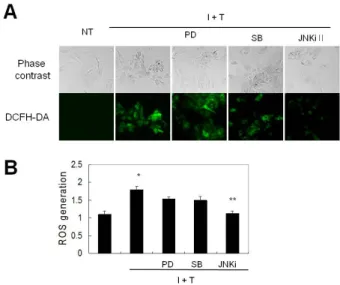
Fig. 6. JNK plays a role in the prevention of cytokine-induced ROS generation in VSMCs. VSMCs were pre-treated with MEK inhibitor (PD98059, 2.5 μM), p38 inhibitor (SB203580, 10 μM), and JNK inhibitor (10 μM) for 1 hr, and were treated with cytokine for 12 hrs prior to measurement of ROS generation by live image microscopy (A) and by FACs analysis (B). Data represent the mean±SD values of four independent experiments.

Aprotinin inhibits cytokine-induced JNK phosphory- lation through HO-1

We investigated the association between aprotinin and mitogen-activated protein kinase (MAPKs) pathways in in- flammatory responses. We examined the involvement of MAPKs pathways on iNOS protein expression, proliferation, and ROS generation in CM-activated VSMCs by treatment with the MEK inhibitor PD98059, p38 inhibitor SB203580,

and JNK inhibitor CM-induced iNOS protein expression, nitrite production, and proliferation were blocked by the JNK inhibitor, but not by the ERK or p38 inhibitors (Fig.

5). CM-induced ROS generation was also blocked by the

JNK inhibitor, which was not blocked by either ERK or p38

inhibitors (Fig. 6). When examined iNOS expression, ROS

production and proliferation with JNK siRNA- transfected

VSMCs, transfection of VSMC with JNK siRNA but not

scrambled siRNA inhibited CM-induced iNOS protein ex-

pression, nitrite production, and proliferation (Data not

(6)

Fig. 7. Aprotinin inhibits cytokine-induced JNK phosphorylation through HO-1. Phosphorylated JNK was measured in cells treated with cytokines (I+T) for 1 hr by Western blotting (A). Cells were pre-treated with aprotinin (10 μM) and SnPPIX (1 μM) for 1 hr, and were treated with cytokines for 5 minutes prior to measure- ment of phosphorylated JNK by Western blotting (B). Results are representative of three experiments.

shown).

We also evaluated whether HO-1 mediate the effects of aprotinin on JNK phosphorylation. VSMCs were treated with CM and phosphorylation of JNK was examined.

Phosphorylation of JNK levels peaked within 5 minutes and it declined to basal levels (Fig. 7A). Treatment with aprotin- in abolished CM-induced JNK phosphorylation (Fig. 7B).

In contrast, the HO-1 competitive inhibitor SnPPIX re- versed the effects of aprotinin. These results suggested that aprotinin-induced HO-1 is involved in the CM-induced phosphorylation of JNK in VSMCs.

DISCUSSION

Aprotinin is widely used as a hemostatic agent in various types of open heart surgery, and it effectively attenuates the post-bypass systemic inflammatory responses. The an- ti-inflammatory properties of aprotinin in CBP have been recognized for more than 10 years, although its molecular mechanisms are unclear. We demonstrated that aprotinin increased HO-1 expression through activation of JNK phos- phorylation and it significantly decreased CM-induced iNOS expression in VSMCs. Aprotinin is clinically asso- ciated with decreased NO production during CBP (Hill et al., 1997).

Aprotinin-induced HO-1 may protect VSMCs from oxida- tive stress in inflammatory condition. However, no studies have suggested that aprotinin induces HO-1 expression during inflammatory conditions in VSMCs. We used repre- sentative proinflammatory cytokines such as IL-1β and TNF-α to mimic inflammatory condition in VSMC. They can be powerful stimulatory signals for NO production and ROS production in VSMC (Guikema et al., 2005). It has been reported that NO can induce HO-1 gene expression in VSMC (Durante et al., 1997). However, we showed that aprotinin is able to inhibit inflammatory key mediator, iNOS expression and nitrite production. Indeed, aproti- nin-induced HO-1 inhibited production of NO from iNOS.

We evaluated the protective effects of aprotinin against oxi- dative stress (cytokines) in VSMCs are due to HO-1 in- duction by using with SnPPIX. Anti-oxidative effects of aprotinin against CM-induced stress in VSMCs were exam- ined with live image microscopy and FACs analysis, in which aprotinin promoted VSMC protection against oxida- tive stress through HO-1 dependent mechanisms.

CBP is associated with significant thrombin generation in the bypass circuit (Brister et al., 1993). Thrombin is gen-

erated in significant quantities during CBP and mediates platelet aggregation and pro-inflammatory responses. Apro- tinin used clinically to reduce both transfusion require- ments and the inflammatory response to bypass (Day et al., 2006). Induction of HO-1 in VSMCs inhibited platelet aggregation in a platelet-VSMC co-incubation system, sug- gesting that HO-1 induction in VSMCs may possess antith- rombotic activity (Wagner et al., 1997). VSMCs from HO-1-deficient mice displayed enhanced DNA synthesis, enhanced growth, and greater intimal thickening than con- trol mice (Duckers et al., 2001). HO-induced CO has an- ti-atherosclerotic effects through the inhibition of VSMC proliferation (Otterbein et al., 2003). Aprotinin increased HO-1 expression by activation of JNK phosphorylation and significantly decreased cytokine induced VSMC pro- liferation in the present study. This provides molecular evi- dence for an association between HO-1 induction and apro- tinin-mediated inhibition of VSMC proliferation. HO-1 in- duction and inhibition of VSMC proliferation by aprotinin were abrogated by the SnPPIX inhibitor.

Our results suggested that aprotinin induces HO-1 mRNA and protein expression in VSMC through JNK phosphorylation. This HO-1 induction may have con- tributed to aprotinin’s ability to inhibit VSMC proliferation and inflammation. Thus, induction of HO-1 by aprotinin may serve as a therapeutic target for the alleviation of sys- temic inflammatory responses, particularly vascular in- flammation, during CBP.

ACKNOWLEDGEMENTS

This research was supported by the Yeungnam University research grants in 2007.

REFERENCES

Asimakopoulos G, Thompson R, Nourshargh S, Lidington EA, Mason JC, Ratnatunga CP, Haskard DO, Taylor KM, Landis RC.

An anti-inflammatory property of aprotinin detected at the level of leukocyte extravasation. J Thorac Cardiovasc Surg 120: 361−

369, 2000.

Brister SJ, Ofosu FA, Buchanan MR. Thrombin generation during cardiac surgery: is heparin the ideal anticoagulant? Thromb Haemost 70: 259−262, 1993.

Clark JE, Foresti R, Green CJ, Motterlini R. Dynamics of haem oxygenase-1 expression and bilirubin production in cellular protection against oxidative stress. Biochem J 348: 615−619, 2000.

Day JR, Taylor KM, Lidington EA, Mason JC, Haskard DO, Randi AM, Landis RC. Aprotinin inhibits proinflammatory activation of endothelial cells by thrombin through the protease-activated receptor 1. J Thorac Cardiovasc Surg 131: 21−27, 2006.

Duckers HJ, Boehm M, True AL, Yet SF, San H, Park JL, Clinton Webb R, Lee ME, Nabel GJ, Nabel EG. Heme oxygenase-1 protects against vascular constriction and proliferation. Nat Med 7: 693−698, 2001.

Durante W, Kroll MH, Christodoulides N, Peyton KJ, Schafer AI.

Nitric oxide induces heme oxygenase-1 gene expression and carbon monoxide production in vascular smooth muscle cells.

Circ Res 80: 557−64, 1997.

Hill GE, Springall DR, Robbins RA. Aprotinin is associated with a decrease in nitric oxide production during cardiopulmonary bypass. Surgery 121: 449−455, 1997.

Guikema BJ, Ginnan R, Singer HA, Jourd'heuil D. Catalase

potentiates interleukin-1beta-induced expression of nitric oxide

synthase in rat vascular smooth muscle cells. Free Radic Biol

(7)

Med 38: 597−605, 2005.

Johnson RA, Lavesa M, Askari B, Abraham NG, Nasjletti A. A heme oxygenase product, presumably carbon monoxide, mediates a vasodepressor function in rats. Hypertension 25: 166−169, 1995.

Juan SH, Cheng TH, Lin HC, Chu YL, Lee WS. Mechanism of concentration-dependent induction of heme oxygenase-1 by resveratrol in human aortic smooth muscle cells. Biochem Pharmacol 69: 41−48, 2005.

Kapturczak MH, Wasserfall C, Brusko T, Campbell-Thompson M, Ellis TM, Atkinson MA, Agarwal A. Heme oxygenase-1 modulates early inflammatory responses: evidence from the heme oxygenase- 1-deficient mouse. Am J Pathol 165: 1045−1053, 2004.

Keyse SM, Tyrrell RM. Heme oxygenase is the major 32-kDa stress protein induced in human skin fibroblasts by UVA radiation, hydrogen peroxide, and sodium arsenite. Proc Natl Acad Sci USA 86: 99−103, 1989.

Landis RC, Asimakopoulos G, Poullis M, Haskard DO, Taylor KM.

The antithrombotic and antiinflammatory mechanisms of action of aprotinin. Ann Thorac Surg 72: 2169−2175, 2001.

Landis RC, Haskard DO, Taylor KM. New antiinflammatory and platelet-preserving effects of aprotinin. Ann Thorac Surg 72:

S1808−1813, 2001.

Lee TS, Chang CC, Zhu Y, Shyy JY. Simvastatin induces heme oxygenase-1: a novel mechanism of vessel protection. Circulation 110: 1296−1302, 2004.

Lee TS, Chau LY. Heme oxygenase-1 mediates the anti-inflam- matory effect of interleukin-10 in mice. Nat Med 8: 240−246, 2002.

Lee TS, Tsai HL, Chau LY. Induction of heme oxygenase-1 expression in murine macrophages is essential for the anti- inflammatory effect of low dose 15-deoxy-∆

12,14

-prostaglandin J

2

. J Biol Chem 278: 19325−19330, 2003.

Maines MD. Heme oxygenase: function, multiplicity, regulatory mechanisms, and clinical applications. FASEB J 2: 2557−2568, 1988.

McCoubrey WK Jr, Huang TJ, Maines MD. Isolation and characterization of a cDNA from the rat brain that encodes hemoprotein heme oxygenase-3. Eur J Bioche 247: 725−732, 1997.

Minamino T, Christou H, Hsieh CM, Liu Y, Dhawan V, Abraham

NG, Perrella MA, Mitsialis SA, Kourembanas S. Targeted expression of heme oxygenase-1 prevents the pulmonary inflam- matory and vascular responses to hypoxia. Proc Natl Acad Sci USA 98: 8798−8803, 2001.

Motterlini R, Foresti R, Intaglietta M, Winslow RM. NO-mediated activation of heme oxygenase: endogenous cytoprotection against oxidative stress to endothelium. Am J Physio 270: H107−H114, 1996.

Otterbein LE, Zuckerbraun BS, Haga M, Liu F, Song R, Usheva A, Stachulak C, Bodyak N, Smith RN, Csizmadia E, Tyagi S, Akamatsu Y, Flavell RJ, Billiar TR, Tzeng E, Bach FH, Choi AM, Soares MP. Carbon monoxide suppresses arteriosclerotic lesions associated with chronic graft rejection and with balloon injury. Nat Med 9: 183−190, 2003.

Poss KD, Tonegawa S. Reduced stress defense in heme oxygenase deficient cells. Proc Natl Acad Sci USA 94: 10925−10930, 1997.

Poullis M, Manning R, Laffan M, Haskard DO, Taylor KM, Landis RC. The antithrombotic effect of aprotinin: actions mediated via the protease activated receptor 1. J Thorac Cardiovasc Surg 120:

370−378, 2000.

Tenhunen R, MArver HS, Schmid R. The enzymatic conversion of heme to bilirubin by microsomal heme owygenase. Proc Natl Acad Sci USA 61: 748−755, 1968.

Wachtfogel YT, Kucich U, Hack CE, Gluszko P, Niewiarowski S, Colman RW, Edmunds LH Jr. Aprotinin inhibits the contact, neutrophil, and platelet activation systems during simulated extracorporeal perfusion. J Thorac Cardiovasc Surg 106: 1−9, 1993.

Wagner CT, Durante W, Christodoulides N, Hellums JD, Schafer AI. Hemodynamic forces induce the expression of heme oxygenase in cultured vascular smooth muscle cells. J Clin Invest 100: 589−

596, 1997.

Westaby S. Aprotinin in perspective. Ann Thorac Surg 55: 1033−

1041, 1993.

Yachie A, Niida Y, Wada T, Igarashi N, Kaneda H. Oxidative stress causes enhanced endothelial cell injury in human heme oxygenase-1 deficiency. J Clin Invest 103: 129−135, 1999.

Yoshinaga T, Sassa S, Kappas A. Purification and properties of bovine spleen heme oxygenase: amino acid composition and sites of action of inhibitors of heme oxygenase. J Biol Chem 257: 7778−

7785, 1982.

수치

Fig. 1. Aprotinin induces HO-1 on  cytokine-stimulated VSMCs. VSMCs were pre-treated with aprotinin (1∼100 μM)  for 1 hr and treated with cytokine (10  ng/ml IL-1β plus 25 ng/ml TNF-α, I+T)  for 12 hrs prior to measurement of HO-1 proteins by Western blott
Fig. 2. Aprotinin inhibits cytokine-induced iNOS expression in VSMCs through  HO-1. VSMCs were pre-treated with  aprotinin (1∼100 μM), were treated with cytokine (I+T) for 12 hrs prior to  mea-surement of iNOS protein expression (A), and for 24 hrs prior t
Fig. 5. JNK plays a role in the prevention of cytokine-induced iNOS expression and  proliferation
Fig. 7. Aprotinin inhibits cytokine-induced JNK phosphorylation  through HO-1. Phosphorylated JNK was measured in cells treated with cytokines (I+T) for 1 hr by Western blotting (A)

참조

관련 문서

Inhibitory effect of the Callophyllis japonica extract (CJE) in lipopolysaccharide (LPS)-induced inducible nitric oxide synthase (iNOS) and cyclooxygenase-2 (COX-2) protein

RGE inhibited LTA-induced nitric oxide (NO) secretion and inducible nitric oxide synthase (iNOS) expression in BV-2 microglial cells, without affecting cell

Effect of Maesil extract on protein expressions of inducible nitric oxide synthase (iNOS) and cell adhesion molecules (CAMs) and production of nitric oxide in

Key words : Cyclo-oxygenase-2 (COX-2), inducible nitric oxide synthase (iNOS), lipopolysaccharide, NF-κB p65, Oxya chinensis sinuosa, pro-inflammatory cytokine, RAW 264.7

PEIC also inhibits the OVA-induced inducible nitric oxide synthase (iNOS) expression and nitrite production.. However, PEIC did not suppress the cyclooxygenase- 2 (COX-2)

MIF, macrophage migration inhibitory factor; TNF-α, tumor necrosis factor-α; NF-κB p65, nuclear factor- κB p65; iNOS, inducible nitric oxide synthase;

Consequently, the inducible nitric oxide synthase (iNOS), cyclooxygenase (COX)- 2 protein expression inhibitory effect was decreased by 8.6%, 25.1% at 100 μg/ml concentration..

Here, we show that radicicol, a fungal antibiotic, resulted in marked inhibition of inducible nitric oxide synthase (iNOS) transcription by the pancreatic beta cell