315 http://dx.doi.org/10.4196/kjpp.2013.17.4.315
ABBREVIATIONS: iNOS, inducible nitric oxide synthase; IFN-γ, interferon-γ; TNF-α, tumor necrosis factor-α; IL-1β, interleukin-1β.
Received March 25, 2013, Revised May 22, 2013, Accepted July 5, 2013
Corresponding to: Young Jin Jeon, Department of Pharmacology, School of Medicine, Chosun University, 375, Susuk-dong, Dong-gu, Gwangju 501-759, Korea. (Tel) 82-62-230-6338, (Fax) 82-62-232- 9213, (E-mail) [email protected]
*These authors contributed equally to this work.
This is an Open Access article distributed under the terms of the Creative Commons Attribution Non-Commercial License (http://
creativecommons.org/licenses/by-nc/3.0) which permits unrestricted non-commercial use, distribution, and reproduction in any medium, provided the original work is properly cited.
Radicicol Inhibits iNOS Expression in Cytokine-Stimulated Pan- creatic Beta Cells
Cha Kyung Youn1,2,*, Seon Joo Park1.2,*, Mei Hong Li2, Min Young Lee1,2, Kun Yeong Lee2, Man Jin Cha2, Ok Hyeun Kim2, Ho Jin You1,2, In Youp Chang1,3, Sang Pil Yoon4, and Young Jin Jeon1,2
1DNA Damage Response Network Center, Chosun University, Kwangju 501-709, Departments of 2Pharmacology, 3Anatomy, School of Medicine, Chosun University, Gwangju 501-759, 4Department of Anatomy, School of Medicine, Jeju National University, Jeju 690-756, Korea
Here, we show that radicicol, a fungal antibiotic, resulted in marked inhibition of inducible nitric oxide synthase (iNOS) transcription by the pancreatic beta cell line MIN6N8a in response to cytokine mixture (CM: TNF-α, IFN-γ, and IL-1β ). Treatment of MIN6N8a cells with radicicol inhibited CM-stimulated activation of NF-κ B/Rel, which plays a critical role in iNOS transcription, in a dose-related manner. Nitrite production in the presence of PD98059, a specific inhibitor of the extra- cellular signal-regulated protein kinase-1 and 2 (ERK1/2) pathway, was dramatically diminished, suggesting that the ERK1/2 pathway is involved in CM-induced iNOS expression. In contrast, SB203580, a specific inhibitor of p38, had no effect on nitrite generation. Collectively, this series of experiments indicates that radicicol inhibits iNOS gene expression by blocking ERK1/2 signaling. Due to the critical role that NO release plays in mediating destruction of pancreatic beta cells, the inhibitory effects of radicicol on iNOS expression suggest that radicicol may represent a useful anti-diabetic activity.
Key Words: β cells, ERK1/2, iNOS, NO
INTRODUCTION
Insulin-dependent Diabetes mellitus (IDDM) is an auto- immune disease that selectively destroys insulin-producing beta cells in the pancreatic islets of Langerhans. Strong ex- perimental evidence suggests that nitric oxide (NO) is pro- duced by proinflammatory cytokines, such as tumor ne- crosis factor (TNF)-α, interferon (IFN)-γ, and interleukin (IL)-1β and plays an important role in the development of pancreatic beta cell destruction by stimulating production of oxygen radicals [1-3]. Further, IFN-γ, TNF-α and IL-1β synergistically activate inducible NO synthase (iNOS) mRNA expression and NO production [1,4]. Studies on transgenic mice have shown that NO is important in beta cell destruc- tion [5,6]. Specifically, transgenic mice expressing mouse iNOS cDNA under the control of the insulin promoter have been shown to develop diabetes, whereas treatment with
aminoguanidine, an iNOS inhibitor, was shown to prevent or delay the development of diabetes [5]. Further, it was shown that IL-1β fails to induce iNOS mRNA expression or increase nitrite formation in islets isolated from iNOS knockout mice [6]. iNOS knockout mice further display re- duced sensitivity to multiple low-dose streptozotocin-in- duced diabetes [6]. Therefore, inhibition of high-output NO production by blocking iNOS production or activity may be a useful strategy for the treatment of inflammatory dis- orders, including IDDM.
Radicicol is a macrocyclic fungal antibiotic originally iso- lated from the fungus Monosporium bonorden and inhibits angiogenesis [7,8]. Radicicol induces reversal of the trans- formed phenotype of src-transformed cells and exhibits p60v-src tyrosine kinase inhibitor activity [9,10]. Radicicol also blocks the activation of the mitogen-activated protein kin- ase/extracellular signal-regulated kinase (MAPK/ERK) path- way through destabilization of Raf kinase [11]. It has been reported that radicicol suppresses the expression of mi- togen-inducible cyclooxygenase, which is important in in- flammatory responses [12]. We have shown that expression of iNOS, another important mediator of inflammatory re- sponses, p38 kinase pathway activation, and NF-κB acti- vation were inhibited by radicicol in LPS-stimulated macro- phages [13]. In the present study, we investigated the ef- fects of radicicol on the regulation of iNOS, NF-κB activity, p65 nuclear translocation, and p44/42 activity in proin-
flammatory cytokine-stimulated MIN6N8a cells, a mouse pancreatic beta cell line.
METHODS Cell culture and Reagents
MIN6N8a cells, SV40 T-transformed insulinoma cells de- rived from NOD mice, were grown in Dulbecco’s Modifed Eagle’s Medium supplemented with 10% fetal bovine se- rum, 2 mM L-glutamine, 100 U/ml of penicillin, 100 μg/ml of streptomycin, and 50 μM 2-mercaptoethanol. For each experiment, cells (5×10⁵ cells/ml) were plated in 100-mm dishes. Radicicol, SN50, PD98059 (2’-amino-3’-methoxyfla- vone), and SB203580 (4-(4-fluorophenyl)-2-(4-methylsul- finylphenyl)-5-(4-pyridyl) 1H-imidazole) were purchased from CalBiochem (San Diego, CA). Anti-iNOS and anti-p65 antibodies were purchased from Upstate Biotechnology (Lake Placid, NY) and Santa Cruz Biotechnology Inc (Santa Cruz, CA), respectively. Antibodies against phospho-p44/42 and p44/42 were purchased from Cell Signaling Technology, Inc. (Beverly, MA).
Nitrite determination
MIN6N8a cells were treated with the indicated concen- trations of radicicol in the presence of cytokine mixture (CM: TNF-α, 500 U/ml; IFN-γ, 100 U/ml; IL-1β, 10 U/ml) for 48 h. Culture supernatants were collected, and the accu- mulation of NO2− in culture supernatants was measured as an indicator of NO production in the medium as pre- viously described [14,15].
Immunofluorescence statining
MIN6N8a cells were treated with radicicol (100 ng/ml) in the presence of CM on a cover slide in 12-well plates.
Cells were rinsed 3 times with PBS, fixed with 4% paraf- ormaldehyde for 10 min at room temperature, and rinsed again. Cells were then blocked with 1% bovine serum albu- min, followed by the addition of the primary antibody. After extensive washing with Tris-buffered saline, fluorescein iso- thiocyanate-conjugated IgG was added. Following incuba- tion, the slides were rinsed, mounted, and viewed at 488 nm on a confocal microscope (FV300, Olympus, Japan).
RT-PCR
Total RNA was isolated with TRI Reagent (Molecular Research Center, Cincinnati, OH, USA). Forward and re- verse primer sequences were as follows: iNOS: 5’-CTG CAG CAC TTG GAT CAG GAA CCT G-3’, 5’-GGG AGT AGC CTG TGT GCA CCT GGA A-3’; and β-actin: 5’-TGG AAT CCT GTG GCA TCC ATG AAA C-3’, 5’-TAA AAC GCA GCT CAG TAA CAG TCC G-3’. Equal amounts of RNA were re- verse-transcribed into cDNA with oligo(dT)15 primers. PCR was performed with cDNA and each primer. Samples were heated to 94oC for 5 min and cycled 30 times at 94oC for 1 min, 55oC for 1.5 min, and 94oC for 1 min, after which an additional extension step at 72oC for 5 min was con- ducted. PCR products were separated by 8% SDS-PAGE, followed by staining in ethidium bromide. The iNOS and β-actin primers produced amplified products of 311 and 349 bp, respectively.
Western immunoblot analysis
Whole cell lysates were separated by 10% SDS-PAGE and then electrotransferred to nitrocellulose membranes (Amer- sham International, Buckinghamshire, UK). The mem- branes were then preincubated for 1 h at room temperature in Tris-buffered saline (TBS), pH 7.6 containing 0.05%
Tween-20 and 3% bovine serum albumin, followed by in- cubation with iNOS, phosphorylated ERK1/2, and phos- pho-ERK1/2 (Thr202/Tyr204)-specific antibodies. Immuno- reactive bands were detected by incubation with conjugates of anti-rabbit IgG with horseradish peroxidase and en- hanced chemiluminescence reagent (Amersham).
Electrophoretic mobility shift assay (EMSA)
EMSA was performed as described in previous literature [16,17]. Nuclear extracts were prepared as previously de- scribed [18]. The double-stranded oligonucleotides were end-labeled with [γ-32P]-ATP. Nuclear extracts (5 μg) were incubated with poly (dI-dC) and the [32P]-labeled DNA probe in binding buffer (100 mM KCl, 30 mM HEPES, 1.5 mM MgCl2, 0.3 mM EDTA, 10% glycerol, 1 mM DTT, 1 mM PMSF, 1 μg/ml of aprotinin, and 1 μg/ml of leupeptin) for 10 min. DNA-binding activity was separated from free probe by 4% SDS-PAGE in 0.5× TBE buffer. Following elec- trophoresis, the gel was dried and subjected to autoradio- graphy.
Transient transfection of MIN6N8aMIN6N8a cells Vector constructions were performed as previously de- scribed [19]. MIN6N8aMIN6N8a cells were transfected us- ing the DEAE-dextran method, diluted to 5×10⁵ cells per 1 ml of complete media, plated on 24-well plates, and then incubated in the presence of 5% CO2 at 37oC for 24 h. The transfectants were then treated with CM and radicicol for 18 h, after which cells were lysed with lysis buffer. The lysates were centrifuged (12,000×g for 10 min at 4oC), and the supernatant was assayed for CAT enzyme expression using a CAT ELISA kit (Roche Molecular Biochemicals, Mannheim, Germany) according to the manufacturer’s ins- tructions.
Statistical analysis
The mean±SD was determined for each treatment group in a given experiment. When significant differences oc- curred, treatment groups were compared to the vehicle con- trols using a Dunnett’s two-tailed t test [20].
RESULTS
Effect of radicicol on iNOS expression in cytokine- stimulated MIN6N8a cells
Cytokines, including IL-1β, IFN-γ, and TNF-α are known to induce or potentiate iNOS expression and NO production [1-3]. We investigated the effects of radicicol on NO production in cytokine-stimulated MIN6N8a, a mouse pancreatic beta cell line. Cytokine mixture (CM: TNF-α, 500 U/ml; IFN-γ, 100 U/ml; IL-1β, 10 U/ml) increased pro- duction of nitrite ≥15-fold over basal levels in MIN6N8a
Fig. 1. Inhibition of nitrite production by radicicol in cytokine-mixture (CM)- stimulated pancreatic beta cells. Pan- creatic beta cell line, MIN6N8a, was treated with the indicated concentra- tions of radicicol in the presence of cytokine mixture (CM: TNF-α, 500 U/ml; IFN-γ, 100 U/ml; IL-1β, 10 U/ml) for 48 h. (A) Supernatants were subsequently isolated and analyzed for nitrite. (B) Cells were analyzed for the viablility by 0.4% trypan blue stai- ning. Each column shows the mean±
S.D. of triplicate determinations. *Res- ponse that is significantly different from the control group as determined by Dunnett’s two-tailed t test at p<0.05.
Fig. 2. Inhibition of iNOS gene expression by radicicol in CM- stimulated MIN6N8a cells. (A) MIN6N8a cells were treated with radicicol (100 ng/ml) in the presence of CM for 24 h on a cover slide in 12-well plates. Cells were subjected to immunofluores- cence staining using an antibody specific for murine iNOS.
Immunoreactivity of iNOS was localized along the margins of the cytoplasm in the control group. MIN6N8a cells were treated with the indicated concentrations of radicicol in the presence of CM for 24 h (B) or 8 h (C). (B) Expression of iNOS was analyzed by Western immunoblotting using antibody specific for murine iNOS.
(C) Total RNA was isolated and analyzed for mRNA expression levels of iNOS and β-actin.
cells (Fig. 1A). This induction of nitrite generation by CM was inhibited by radicicol in a dose-dependent manner. No effect on cell viability was observed in any of the treatment groups, and it always exceeded 90% as determined by try- pan blue staining (Fig. 1B).
To investigate the effects of radicicol on iNOS production, expression of iNOS was measured by immunohistochemical staining. MIN6N8a cells (5×10⁵ cells/ml) were incubated
with radicicol (100 ng/ml) in the presence of CM for 24 h on a cover slide in 12-well plates. Cells were then subjected to immunohistochemical staining using an antibody specific for murine iNOS. Immunofluorescence staining of iNOS showed that radicicol inhibited iNOS production (Fig. 2A).
After MIN6N8a cells were exposed to radicicol in the pres- ence of CM, the expression level of iNOS was monitored by Western immunoblot analysis. As shown in Fig. 2B, iNOS protein production was inhibited by radicicol treat- ment. Consistent with these findings, radicicol inhibited the production of iNOS mRNA in CM-stimulated MIN6N8a cells (Fig. 2C). Control β-actin was constitutively expres- sed and was not affected by radicicol treatment. These re- sults indicate that radicicol reduces gene expression of iNOS, which is involved in pancreatic beta cell destruction.
Inhibition of NF-κB/ Rel activation by radicicol in CM-stimulated MIN6N8a cells
Since it has been reported that protein binding at NF-κB/
Rel-binding sequences is necessary for induction of iNOS expression [21], we assessed the effect of radicicol on NF-κB/
Rel activation using a transient transfection assay. MIN- 6N8a cells were transiently transfected with p(NF-κB/
Rel)3-CAT showed reduced gene expression of CAT in re- sponse to radicicol treatment in the presence of CM (Fig.
3A). Although CM treatment significantly increased CAT expression by MIN6N8a cells, CM-induced CAT expression was inhibited by radicicol treatment. Oct, a transcription factor that binds to the promoter of the iNOS gene, mod- erated CAT activity and was not influenced by either CM or radicicol treatment (Fig. 3B). Transcriptional activation of the NF-κB/Rel transcription factor is preceded by its binding to DNA. Therefore, we further analyzed the effect of radicicol on activation of NF-κB/Rel, whose binding mo- tif is in the promoter of the iNOS gene, using EMSA.
MIN6N8a cells treated with CM displayed a marked in- crease in NF-κB/Rel binding to its cognate site. Further, induction of NF-κB/Rel binding was inhibited by radicicol (Fig. 3C). Radicicol had no effect on Oct DNA-binding activ- ity (Fig. 3D). The specificity of the retarded bands was con- firmed by the addition of excess 32P-unlabeled double- stranded κB or Oct (data not shown). These results in- dicate that radicicol reduces the DNA-binding activity and transcriptional activation of NF-κB/Rel, which is impor- tant in the regulation of iNOS gene expression.
Fig. 3. Inhibition of NF-κB/Rel activation by radicicol in CM-stimulated MIN6N8a cells. (A, B) Inhibition of NF-κB/Rel tran- scriptional activation by radicicol. MIN6N8a cells were transfected with p(NF-κB/Rel)3- CAT (A) or p(Oct)3-CAT (B) using the DEAE dextran method. Twenty-four hours after transfection, cells were treated with the indicated concentrations of radicicol in the presence of CM for 18 h. Cell extracts were then prepared and analyzed for the expression of CAT using a CAT ELISA kit.
(C, D) Inhibition of NF-κB/Rel DNA binding by radicicol. Cells were incubated with radicicol in the presence of CM for 2 h. Nuclear extracts (5 mg/ml) were then isolated and analyzed for the activities of NF-κB/Rel (C) and Oct (D). Each column shows the mean±S.D. of triplicate deter- minations. *Response that is significantly different from the control group as determined by Dunnett’s two-tailed t test at p<0.05.
Fig. 4. Inhibition of p65 nuclear translocation by radicicol in CM-stimulated MIN6N8a cells. (A) Cells (5×10⁵ cells/ml) were incubated with radicicol (100 ng/ml) in the presence of CM for 2 h on a cover slide in 12-well plates. Cells were subjected to immunofluorescence staining using an antibody specific for murine p65. One of two representative experiments is shown. (B) Cells were treated with SN50 (10 μM) for 48 h in the presence of CM. The supernatants were subsequently isolated and analyzed for nitrite. Each column shows the mean±S.D. of triplicate determinations. *Response that is significantly different from the control group as determined by Dunnett’s two-tailed t test at p<0.05.
Inhibition of p65 nuclear translocation by radicicol in CM-stimulated MIN6N8a cells
To further investigate whether or not radicicol inhibits nuclear translocation of p65, a component of NF-κB/Rel, we performed immunofluorescence staining. CM-stimu- lated MIN6N8a cells showed marked p65 staining in nuclei, whereas unstimulated cells showed weaker nuclear p65 ex- pression along with stronger staining in the cytoplasm.
Radicicol treatment significantly inhibited CM-induced nu- clear translocation of p65 (Fig. 4A). These results indicate that radicicol reduces the nuclear translocation and DNA- binding activity of NF-κB/Rel, which is important in the regulation of iNOS gene expression.
We further confirmed the involvement of p65 nuclear translocation and NO production using SN50, a NF-κB/Rel nuclear translocation inhibitor. SN50, a cell-permeable in- hibitor peptide, was reported to inhibit nuclear translo- cation of NF-κB/Rel [22]. Treatment of MIN6N8a cells with SN50 blocked CM-induced nitrite generation (Fig. 4B).
Collectively, these results demonstrate that NF-κB/Rel plays an important role in the activation of iNOS gene ex- pression by CM in pancreatic beta cells, and it is inhibited by radicicol.
Inhibition of p44/ 42 phosphorylation by Radicicol in CM-stimulated MIN6N8a cells
Since p44/42 and p38 kinases are possible targets of radi-
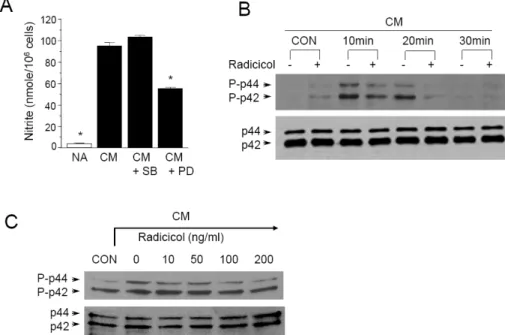
Fig. 5. Inhibition of p44/42 phosphory- lation by Radicicol in CM-stimulated MIN6N8a cells. (A) MIN6N8a cells were treated with PD98059 (50 μM) or SB203580 (30 μM) for 48 h in the presence of CM. The supernatants were subsequently isolated and analyzed for nitrite. Each column shows the mean±
S.D. of triplicate determinations. *Res- ponse that is significantly different from the control group as determined by Dunnett’s two-tailed t test at p<0.05.
(B) Cells were treated with radicicol for the indicated time in the presence of CM. (C) Cells were treated with radi- cicol for 20 min in the presence of CM.
The phosphorylation of p44/p42 was analyzed by Western blot assay.
cicol, we further determined whether or not these kinase pathways are involved in CM-induced NO production. The p44/42 and p38 kinase pathways were specifically blocked when MIN6N8a cells were challenged with CM. PD98059 is a specific inhibitor of mitogen activated protein kin- ase/extracellular signal-regulated kinase 1 (MEK-1), which is responsible for ERK1/2 activation. SB203580, a bicyclic imidazole compound, is a specific inhibitor of p38. PD98059 inhibited CM-induced production of nitrite, whereas SB20- 3580P had no inhibitory effect (Fig. 5A). These results sug- gest that the p44/42 kinase pathway is important in the regulation of NO production in MIN6N8a cells by CM.
We further assessed the effect of radicicol on p44/42 phos- phorylation in CM-stimulated MIN6N8a cells. CM-induced phosphorylation of p44/42 peaked at 10 min, was main- tained until 20 min, and then decreased at 30 min (Fig.
5B). On the other hand, radicicol strongly inhibited p44/42 phosphorylation. A dose-response experiment further showed that radicicol inhibited CM-induced p44/42 phosphorylation in a dose-dependent manner (Fig. 5C). Collectively, this ser- ies of experiments indicates that p44/42 kinases are im- portant in the regulation of iNOS in CM-stimulated MIN6N8a cells, and they are inhibited by radicicol.
DISCUSSION
In a previous study, we showed that production of NO, an important mediator of inflammatory responses, is in- hibited by radicicol in LPS-stimulated macrophages [13].
Since proinflammatory cytokines are known to induce the expression of iNOS mRNA and production of NO, resulting in cell death of beta cells [1-3], we investigated whether or not radicicol suppresses iNOS gene expression induced by cytokines. In the present study, we found that radicicol inhibits iNOS gene expression in cytokine-stimulated MIN6N8a beta cells.
NF-κB/Rel plays an important role in cytokine-induced beta cell destruction, as cell death is blocked in beta cells by inhibition of NF-κB/Rel activation [23,24]. Conditional
and specific blockage of NF-κB/Rel protects pancreatic be- ta cells against diabetes induced by multiple low doses of streptozotocin [25]. We observed that NF-κB/Rel was pos- itively regulated by CM for induction of iNOS gene ex- pression, whereas radicicol significantly inhibited the CM- induced NF-κB/Rel transcriptional activation and DNA- binding activity (Fig. 3). NF-κB/Rel is a regulator of many genes involved in inflammatory responses, including iNOS [21]. NF-κB/Rel exists in the cytoplasm of unstimulated cells in an inactive form bound to IκB, an inhibitor of NF- κB/Rel. Activation by external stimuli including lipopoly- saccharide and cytokines results in the phosphorylation of IκB, which releases the active DNA-binding form of NF-κB/
Rel for translocation to the nucleus to bind κB motifs in the promoter regions of various genes. EMSA studies showed strong induction of two separate κB-binding com- plexes by CM. Further, radicicol inhibited activation of both of the binding complexes (Fig. 3C). It has been shown that p50 proteins have DNA-binding activity, whereas p65 pro- teins contain transactivation domains in their C termini and are thus able to activate the transcription of target genes [26]. Immunofluorescence staining of p65, the active component of NF-κB/Rel, confirmed nuclear translocation of p65 induced by CM, whereas radicicol inhibited nuclear translocation of p65 (Fig. 4A).
We also showed that radicicol significantly inhibits the ERK1/2 pathway in MIN6N8a cells. It has been reported that radicicol blocks the activation of the MAPK/ERK path- way through destabilization of Raf kinase [11,27]. ERK ac- tivity is required for iNOS gene expression in insulin-pro- ducing INS-1E cells [28]. In the present study, we investi- gated the involvement of the ERK1/2 and p38 pathways in iNOS regulation in a mouse insulinoma cell line stimulated with cytokines. Two inhibitors, PD98059 and SB203580, which selectively inhibit the ERK1/2 and p38 pathways, re- spectively, were used to address this issue. Data presented herein clearly show that the ERK1/2 pathway is involved in iNOS regulation in MIN6N8a cells. Specifically, PD98059 inhibited NO production in response to CM. ERK has been reported to be involved in NF-κB/Rel-mediated tran-
scription of iNOS, indicating that ERK regulates iNOS gene expression by increasing the transactivation capacity of NF-κB/Rel [28].
In summary, these experiments demonstrate that radici- col inhibits CM-induced iNOS gene expression in MIN6N8a cells. Based on our findings, the most likely mechanism that can account for this biological effect involves inhibition of NF-κB and the ERK1/2 kinase pathway. Due to the crit- ical role that NO release plays in mediating inflammatory responses in pancreatic beta cells, the inhibitory effects of radicicol on iNOS expression suggest that this anti-fungal may represent a useful anti-diabetic agent.
ACKNOWLEDGEMENTS
This research was supported by research funds from Chosun University, 2012.
REFERENCES
1. Cetkovic-Cvrlje M, Eizirik DL. TNF-alpha and IFN-gamma potentiate the deleterious effects of IL-1 beta on mouse pan- creatic islets mainly via generation of nitric oxide. Cytokine.
1994;6:399-406.
2. Darville MI, Eizirik DL. Regulation by cytokines of the in- ducible nitric oxide synthase promoter in insulin-producing cells. Diabetologia. 1998;41:1101-1108.
3. Eizirik DL, Sandler S, Welsh N, Cetkovic-Cvrlje M, Nieman A, Geller DA, Pipeleers DG, Bendtzen K, Hellerström C. Cyto- kines suppress human islet function irrespective of their effects on nitric oxide generation. J Clin Invest. 1994;93:1968-1974.
4. Yamada K, Otabe S, Inada C, Takane N, Nonaka K. Nitric oxide and nitric oxide synthase mRNA induction in mouse islet cells by interferon-gamma plus tumor necrosis factor-alpha.
Biochem Biophys Res Commun. 1993;197:22-27.
5. Takamura T, Kato I, Kimura N, Nakazawa T, Yonekura H, Takasawa S, Okamoto H. Transgenic mice overexpressing type 2 nitric-oxide synthase in pancreatic beta cells develop insul- in-dependent diabetes without insulitis. J Biol Chem. 1998;
273:2493-2496.
6. Flodström M, Tyrberg B, Eizirik DL, Sandler S. Reduced sensitivity of inducible nitric oxide synthase-deficient mice to multiple low-dose streptozotocin-induced diabetes. Diabetes.
1999;48:706-713.
7. Fukuhara Y, Turner RJ. Cation dependence of renal outer cortical brush border membrane L-glutamate transport. Am J Physiol. 1985;248:F869-875.
8. Oikawa T, Ito H, Ashino H, Toi M, Tominaga T, Morita I, Murota S. Radicicol, a microbial cell differentiation modulator, inhibits in vivo angiogenesis. Eur J Pharmacol. 1993;241:
221-227.
9. Kwon HJ, Yoshida M, Abe K, Horinouchi S, Beppu T. Radicicol, an agent inducing the reversal of transformed phenotypes of src-transformed fibroblasts. Biosci Biotechnol Biochem. 1992;
56:538-539.
10. Kwon HJ, Yoshida M, Fukui Y, Horinouchi S, Beppu T. Potent and specific inhibition of p60v-src protein kinase both in vivo and in vitro by radicicol. Cancer Res. 1992;52:6926-6930.
11. Soga S, Kozawa T, Narumi H, Akinaga S, Irie K, Matsumoto K, Sharma SV, Nakano H, Mizukami T, Hara M. Radicicol leads to selective depletion of Raf kinase and disrupts K-Ras- activated aberrant signaling pathway. J Biol Chem. 1998;273:
822-828.
12. Chanmugam P, Feng L, Liou S, Jang BC, Boudreau M, Yu G, Lee JH, Kwon HJ, Beppu T, Yoshida M, Xia Y, Wilson CB,
Hwand D. Radicicol, a protein tyrosine kinase inhibitor, sup- presses the expression of mitogen-inducible cyclooxygenase in macrophages stimulated with lipopolysaccharide and in experi- mental glomerulonephritis. J Biol Chem. 1995;270:5418-5426.
13. Jeon YJ, Kim YK, Lee M, Park SM, Han SB, Kim HM. Radicicol suppresses expression of inducible nitric-oxide synthase by blocking p38 kinase and nuclear factor-kappaB/Rel in lipopoly- saccharide-stimulated macrophages. J Pharmacol Exp Ther.
2000;294:548-554.
14. Green LC, Wagner DA, Glogowski J, Skipper PL, Wishnok JS, Tannenbaum SR. Analysis of nitrate, nitrite, and [15N] nitrate in biological fluids. Anal Biochem. 1982;126:131-138.
15. Huong PT, Lee MY, Lee KY, Chang IY, Lee SK, Yoon SP, Lee DC, Jeon YJ. Synergistic induction of iNOS by IFN-γ and glycoprotein isolated from dioscorea batatas. Korean J Physiol Pharmacol. 2012;16:431-436.
16. Jeon YJ, Yang KH, Pulaski JT, Kaminski NE. Attenuation of inducible nitric oxide synthase gene expression by delta 9-tetra- hydrocannabinol is mediated through the inhibition of nuclear factor-kappa B/Rel activation. Mol Pharmacol. 1996;50:334-341.
17. Li MH, Kothandan G, Cho SJ, Huong PT, Nan YH, Lee KY, Shin SY, Yea SS, Jeon YJ. Magnolol inhibits LPS-induced NF- κB/Rel activation by blocking p38 kinase in murine macro- phages. Korean J Physiol Pharmacol. 2010;14:353-358.
18. Xie QW, Whisnant R, Nathan C. Promoter of the mouse gene encoding calcium-independent nitric oxide synthase confers in- ducibility by interferon gamma and bacterial lipopolysacchari- de. J Exp Med. 1993;177:1779-1784.
19. Jeon YJ, Han SH, Lee YW, Yea SS, Yang KH. Inhibition of NF-kappa B/Rel nuclear translocation by dexamethasone: me- chanism for the inhibition of iNOS gene expression. Biochem Mol Biol Int. 1998;45:435-441.
20. Dunnett M. A multiple comparison procedure for comparing several treatments with a control. J Am Statistics Assoc. 1955;
50:1096-1121.
21. Xie QW, Kashiwabara Y, Nathan C. Role of transcription factor NF-kappa B/Rel in induction of nitric oxide synthase. J Biol Chem. 1994;269:4705-4708.
22. Lin YZ, Yao SY, Veach RA, Torgerson TR, Hawiger J. Inhi- bition of nuclear translocation of transcription factor NF-kappa B by a synthetic peptide containing a cell membrane-permeable motif and nuclear localization sequence. J Biol Chem. 1995;270:
14255-14258.
23. Heimberg H, Heremans Y, Jobin C, Leemans R, Cardozo AK, Darville M, Eizirik DL. Inhibition of cytokine-induced NF-kappaB activation by adenovirus-mediated expression of a NF-kappaB super-repressor prevents beta-cell apoptosis. Diabetes. 2001;
50:2219-2224.
24. Baker MS, Chen X, Cao XC, Kaufman DB. Expression of a dominant negative inhibitor of NF-kappaB protects MIN6 beta- cells from cytokine-induced apoptosis. J Surg Res. 2001;97:
117-122.
25. Eldor R, Yeffet A, Baum K, Doviner V, Amar D, Ben-Neriah Y, Christofori G, Peled A, Carel JC, Boitard C, Klein T, Serup P, Eizirik DL, Melloul D. Conditional and specific NF-kappaB blockade protects pancreatic beta cells from diabetogenic agents.
Proc Natl Acad Sci USA. 2006;103:5072-5077.
26. Schmitz ML, Baeuerle PA. The p65 subunit is responsible for the strong transcription activating potential of NF-kappa B.
EMBO J. 1991;10:3805-3817.
27. Roe SM, Prodromou C, O’Brien R, Ladbury JE, Piper PW, Pearl LH. Structural basis for inhibition of the Hsp90 molecular chaperone by the antitumor antibiotics radicicol and gelda- namycin. J Med Chem. 1999;42:260-266.
28. Larsen L, Størling J, Darville M, Eizirik DL, Bonny C, Billes- trup N, Mandrup-Poulsen T. Extracellular signal-regulated kinase is essential for interleukin-1-induced and nuclear factor kappaB-mediated gene expression in insulin-producing INS-1E cells. Diabetologia. 2005;48:2582-2590.