• 검색 결과가 없습니다.

Bilateral Video-Assisted Thoracoscopic Surgery Resection for Multiple Mediastinal Myelolipoma: Report of a Case

N/A
N/A
Protected

Academic year: 2021

Share "Bilateral Video-Assisted Thoracoscopic Surgery Resection for Multiple Mediastinal Myelolipoma: Report of a Case"

Copied!
4
0
0

로드 중.... (전체 텍스트 보기)

전체 글

(1)

Korean J Thorac Cardiovasc Surg 2014;47:189-192 □ Case Report □ http://dx.doi.org/10.5090/kjtcs.2014.47.2.189 ISSN: 2233-601X (Print) ISSN: 2093-6516 (Online)

− 189 − Department of Thoracic Surgery, Respiratory Center, Toranomon Hospital

Received: September 13, 2013, Revised: October 8, 2013, Accepted: October 10, 2013

Corresponding author: Masatoshi Nakagawa, Department of Thoracic Surgery, Respiratory Center, Toranomon Hospital, 2-2-2 Toranomon, Minato-ku, Tokyo 105-8470, Japan

(Tel) 81-3-3588-1111 (Fax) 81-3-3582-7068 (E-mail) [email protected]

C

The Korean Society for Thoracic and Cardiovascular Surgery. 2014. All right reserved.

CC
This is an open access article distributed under the terms of the Creative Commons Attribution Non-Commercial License (http://creative- commons.org/licenses/by-nc/3.0) which permits unrestricted non-commercial use, distribution, and reproduction in any medium, provided the original work is properly cited.

Bilateral Video-Assisted Thoracoscopic Surgery Resection for Multiple Mediastinal Myelolipoma: Report of a Case

Masatoshi Nakagawa, M.D., Tadasu Kohno, M.D., Ph.D., Mingyon Mun, M.D., Ph.D., Tomoharu Yoshiya, M.D.

Myelolipoma in the mediastinum is an extremely rare entity. In this report, we present the case of a 79-year-old asymptomatic man who had three bilateral paravertebral mediastinal tumors. The three tumors were resected simul- taneously using bilateral three-port video-assisted thoracoscopic surgery (VATS). There has been no evidence of re- currence within four years after the operation. Multiple bilateral mediastinal myelolipomas are extremely rare. There are no reports in the English literature of multiple bilateral thoracic myelolipomas that were resected simultaneously using bilateral VATS. We also present characteristic features of myelolipomas, which are helpful for diagnosis.

Key words: 1. Mediastinal neoplasms 2. Myelolipoma

3. Minimally invasive surgery 4. Thoracoscopy

CASE REPORT

Myelolipoma is a rare, benign tumor composed of hema- topoietic tissue and mature adipose tissue. It is nonfunct- ioning and often detected in the adrenal glands during routine X-ray or computed tomography (CT) as incidentalomas. Extr- amedullary myelolipomas are extremely rare, and half of them are located in the presacral area. We report a patient with multiple bilateral mediastinal myelolipomas that were re- sected simultaneously using bilateral three-port video-assisted thoracoscopic surgery (VATS). This is the first case report of multiple bilateral myelolipomas that were simultaneously re- moved and diagnosed using VATS. We also present charac- teristic features of myelolipomas, which are helpful for diagnosis.

The patient was a 79-year-old male with a history of hy- pertension, nephrosclerosis, and alcoholic liver hepatitis. Abd- ominal CT was performed routinely at a nearby hospital, and three bilateral paravertebral mediastinal tumors were detected incidentally. He had no symptoms due to the tumors. He was referred to Toranomon Hospital for further examination and treatment.

Laboratory tests showed a slight elevation of serum liver enzymes and creatinine. Other laboratory tests including tu- mor markers were within normal limits. He had no history of hematologic disorder or chronic anemia.

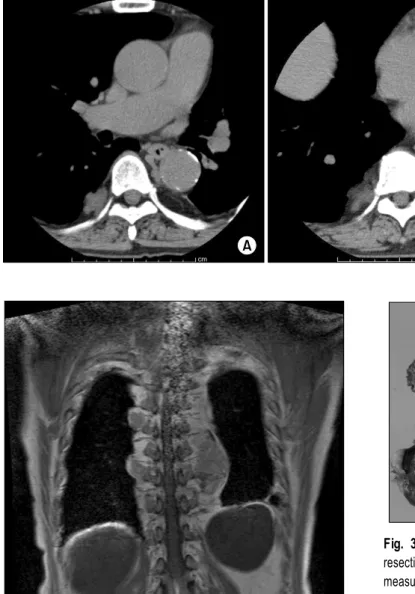
CT revealed three bilateral paravertebral thoracic tumors.

Two of them were located on the right side of the vertebrae

at the levels of Th-8 and Th-10. The tumors were 20 mm

and 35 mm in diameter, respectively. The third tumor was lo-

(2)

Masatoshi Nakagawa, et al

− 190 −

Fig. 1. (A and B) Thoracic computed tomography showed three bilateral paravertebral mediastinal tumors.

Fig. 2. Magnetic resonance imaging showed that the signal in- tensity of the tumors was mainly isointense with that of the bone marrow and partially isointense with that of the adipose tissue.

Fig. 3. Macroscopic inspection of the tumor on the left side after resection showed that it was brown and partially yellow, and measured 75×45×30 mm.

cated on the left side of the vertebrae, extending from Th-9 to Th-11, and was 75 mm in diameter. These tumors were heterogeneous. The CT density of the tumors ranged from -60.0 to +20.0 Hounsfield Units. There was no calcification in the tumors. Contrast medium was not used because of his poor renal function (Fig. 1). Magnetic resonance imaging re- vealed that the signal intensity of the tumors was mainly iso- intense with that of the bone marrow and partially isointense with that of the adipose tissue (Fig. 2). Differential diagnosis included neurogenic tumors, lymphomas, pleural mesotheli- omas, and metastatic tumors of unknown origin, but none of

them had any conclusive evidence.

Bilateral VATS with the three-port technique was perf- ormed. The tumors were soft and fragile and bled easily. The tumor on the left side adhered to its surroundings firmly and hence, took several hours to resect. The operation time was 5 hours and 27 minutes, and the blood loss was 327 mL.

The enucleated tumors were brown and partially yellow,

and measured 19×15×11 mm, 40×34×15 mm, and 75×45×30

mm, respectively (Fig. 3). Microscopic examination revealed

mature adipose tissue with hematopoietic elements consistent

with myelolipoma (Fig. 4). The surgical margins of the tu-

mors were all negative. The patient’s postoperative course

was uncomplicated, and he was discharged on the fourth

postoperative day. It has been four years since the operation,

(3)

Multiple Mediastinal Myelolipoma

− 191 −

Fig. 4. (A and B) Histopathologic examination revealed mature adipose tissue with hematopoietic elements consistent with a myelolipoma (H&E, ×4 and ×200, respectively).

and there has been no sign of recurrence.

DISCUSSION

Myelolipomas are rare, benign tumors, and most of these tumors are detected in the adrenal glands as incidentalomas.

Myelolipoma consists of mature adipose tissue and bone mar- row cells. Symptoms caused by the tumor rarely occur; how- ever, growth of the tumor may cause compression of the ad- jacent organs, resulting in several symptoms [1].

The proposed causes of myelolipoma include degenerative changes in hyperplastic tumor cells or adenomas of the adre- nal glands, metaplasia in primary stem mesenchymal cells of the adrenal cortex, and displacement of differentiated bone marrow cells during embryogenesis [2]. Extra-adrenal myelo- lipoma is an extremely rare form of myelolipoma that can occur in the retroperitoneum, stomach, liver, or mediastinum.

About half of all extra-adrenal myelolipomas are located in the presacral region [3]. In the thoracic area, they are fre- quently found in the mediastinum or the paravertebral thora- cic region; however, sometimes they are located in the lung or the thoracic spine [4].

There are several distinctive imaging features of myelolipoma. It mostly occurs as a single, unilateral tumor and is often well-circumscribed and encapsulated. The ratios

of bone marrow tissue and adipose tissue are different in each tumor. This reflects the heterogeneous nature of the tu- mors and explains the observation of varying CT densities.

Calcification in the tumor is rare but has been reported [1].

The differential diagnosis includes neurogenic tumor, lym- phoma, lymph node metastasis, malignant mesothelioma, and extramedullary hematopoietic tissue. Among them, differ- entiation between myelolipoma and extramedullary hema- topoiesis is important. In cases of extramedullary hematopoi- esis, there is often chronic anemia due to hematological dis- eases such as thalassemia or hereditary spherocytosis. Chronic anemia can be used to differentiate between myelolipoma and extramedullary hematopoiesis [5].

Most cases of myelolipoma are treated with surgical re-

section because myelolipoma is a rare disease and its pre-

operative diagnosis is difficult. However, there are some re-

ports of successful diagnosis with CT-guided or endoscopic

ultrasonography-guided biopsy [6,7]. There have been no re-

ports of malignant myelolipoma. The decision for surgical re-

section is based on either increasing size or local symptoms

such as chest pain, pleural effusion, or superior vena cava

obstruction. Kenny et al. suggested that myelolipoma that is

larger than 10 cm in diameter should be resected because the

possibility of rupture and bleeding is higher with larger tu-

mors [8].

(4)

Masatoshi Nakagawa, et al

− 192 − Once there is a definitive diagnosis, and there are no signs or symptoms of increasing size, observation without any treatment can be a reasonable option. Surgical resection is the most common method of treatment, and a majority of re- sections are performed via thoracotomy. In this case, three bi- lateral myelolipomas in the posterior mediastinum were re- sected using bilateral VATS. To the best of our knowledge, this is the first case report of three bilateral mediastinal mye- lolipomas resected simultaneously using bilateral VATS.

Mediastinal myelolipoma is a rare tumor, but it should be considered when there is a differential diagnosis of media- stinal tumors. Most reports are cases of single and unilateral tumors; however, bilateral and multiple tumors can occur, al- though they are extremely rare. When surgery is necessary for diagnosis or treatment, VATS can be an alternative choice to thoracotomy.

CONFLICT OF INTEREST

No potential conflict of interest relevant to this article was reported.

REFERENCES

1. Vaziri M, Sadeghipour A, Pazooki A, Shoolami LZ. Primary mediastinal myelolipoma. Ann Thorac Surg 2008;85:1805-6.

2. Dieckmann KP, Hamm B, Pickartz H, Jonas D, Bauer HW.

Adrenal myelolipoma: clinical, radiologic, and histologic fea- tures. Urology 1987;29:1-8.

3. Franiel T, Fleischer B, Raab BW, Fuzesi L. Bilateral thora- cic extraadrenal myelolipoma. Eur J Cardiothorac Surg 2004;

26:1220-2.

4. Omdal DG, Baird DE, Burton BS, Goodhue WW Jr, Giddens EM. Myelolipoma of the thoracic spine. AJNR Am J Neuroradiol 1997;18:977-9.

5. Rosai J. Mediastinum. In: Rosai J, editor. Rosai and Acker- man’s surgical pathology. 9th ed. St. Louis (MO): Mosby;

2004. p. 494.

6. Kawanami S, Watanabe H, Aoki T, et al. Mediastinal myelo- lipoma: CT and MRI appearances. Eur Radiol 2000;10:

691-3.

7. Rossi M, Ravizza D, Fiori G, et al. Thoracic myelolipoma diagnosed by endoscopic ultrasonography and fine-needle as- piration cytology. Endoscopy 2007;39 Suppl 1:E114-5.

8. Kenney PJ, Wagner BJ, Rao P, Heffess CS. Myelolipoma:

CT and pathologic features. Radiology 1998;208:87-95.

수치

Fig. 2. Magnetic resonance imaging showed that the signal in- in-tensity of the tumors was mainly isointense with that of the bone  marrow and partially isointense with that of the adipose tissue.

참조

관련 문서

In this paper, I would like to elaborate on single-port video-assist- ed thoracic surgery (VATS) thymectomy through the subx- iphoid approach for anterior mediastinal tumors, with the

Video-assisted thoracoscopic surgery (VATS) has been established as the surgical approach of choice for lobectomy in patients with early-stage non-small cell lung cancer

Intraoperative events can occur during video-assisted thoracoscopic surgery (VATS) lo- bectomy due to unfavorable surgical anatomy, such as dense adhesions or calcifications around

We would like to introduce a hybrid Ivor Lewis MIE technique (thoracoscopy combined with laparotomy) for video-assisted thoracoscopic surgery (VATS) extracorpore- al

Purpose: The objectives of this study are to describe the outcome of adolescent idiopathic scoliosis (AIS) patients treated with Video Assisted Thoracoscopic Sur- gery (VATS)

Video-assisted mediastinoscopic surgery: Clinical feasibility and accuracy of mediastinal lymph node staging... Medford ARL, Bennett JA, Free CM,

Herein, is reported a case of unilateral diffuse PAVM in an 18 year old female patient, who underwent a right pneumonectomy, under a video-assisted thoracic surgery

Serratus anterior plane block or thoracic paravertebral block for postoperative pain treatment after uniportal video-assisted thoracoscopic surgery: a