• 검색 결과가 없습니다.

Mediastinal Paraganglioma: Complete Resection Using Video-Assisted Thoracoscopic Surgery

N/A
N/A
Protected

Academic year: 2021

Share "Mediastinal Paraganglioma: Complete Resection Using Video-Assisted Thoracoscopic Surgery"

Copied!
3
0
0

로드 중.... (전체 텍스트 보기)

전체 글

(1)

Korean J Thorac Cardiovasc Surg 2014;47:197-199 □ Case Report □ http://dx.doi.org/10.5090/kjtcs.2014.47.2.197 ISSN: 2233-601X (Print) ISSN: 2093-6516 (Online)

− 197 −

Department of Thoracic and Cardiovascular Surgery, Chungbuk National University College of Medicine Received: September 5, 2013, Revised: September 24, 2013, Accepted: October 1, 2013

Corresponding author: Jong-Myeon Hong, Department of Thoracic and Cardiovascular Surgery, Chungbuk National University College of Medicine, 52 Naesudong-ro, Heungdeok-gu, Cheongju 361-804, Korea

(Tel) 82-43-269-6062 (Fax) 82-43-269-6969 (E-mail) [email protected]

C

The Korean Society for Thoracic and Cardiovascular Surgery. 2014. All right reserved.

CC
This is an open access article distributed under the terms of the Creative Commons Attribution Non-Commercial License (http://creative- commons.org/licenses/by-nc/3.0) which permits unrestricted non-commercial use, distribution, and reproduction in any medium, provided the original work is properly cited.

Mediastinal Paraganglioma: Complete Resection Using Video-Assisted Thoracoscopic Surgery

Dohun Kim, M.D., Si-Wook Kim, M.D., Jong-Myeon Hong, M.D.

Mediastinal paragangliomas are very rare neuroendocrine tumors. Complete resection is the standard treatment of a paraganglioma because of the tumor’s potential malignancy and poor response to chemo- or radiotherapy. However, the highly vascular nature of the tumor and its characteristic anatomic location make complete resection difficult.

We report a case of an anterior mediastinal paraganglioma, which was incidentally found on a chest computed to- mography scan for chronic cough work-up of a 55-year-old woman. Complete resection was accomplished using video-assisted thoracoscopic surgery, and the patient recovered without any complications.

Key words: 1. Video-assisted thoracic surgery (VATS) 2. Mediastinal neoplasms

3. Paraganglioma

CASE REPORT

Mediastinal paragangliomas are very rare neuroendocrine tumors. Most of the tumors are benign, but some of them can be diagnosed as malignant [1]. Complete resection is the standard treatment of paragangliomas [2]. However, the high- ly vascular nature of these tumors and their characteristic anatomic locations make complete resection difficult. There- fore, cardiopulmonary bypass through median sternotomy is often required to perform complete resection [3,4]. However, whether minimally invasive surgery is unsuitable for this highly vascular mass if the mass is sufficiently small for vid- eo-assisted thoracoscopic surgery (VATS) is still uncertain.

Therefore, here, we report a case of the complete resection of a paraganglioma using VATS.

A 55-year-old woman was admitted to the hospital because of a mass in the anterior mediastinum. Her past medical his-

tory was unremarkable, but she was suffering from ongoing cough. Computed tomography was performed in a local hos- pital, and an anterior mediastinal mass was found (Fig. 1).

Physical examination revealed normal blood pressure, and the routine blood work results, including complete blood count, electrolytes, and chemistry, were within the normal limits.

The mass was located under the sternum; therefore, percuta- neous biopsy was not easy. Hence, to achieve the patho- logical and surgical goal, complete mass resection was planned. The mass was located near the great vessels (under the left innominate vein, immediately above the aortic arch), but there was no sign of local invasion. Therefore, we plan- ned the surgical resection of the tumor using VATS.

A double lumen ET tube was inserted under general anes-

thesia, and the position was changed to the right decubitus

position. A 10-mm-scope port was created in the 4th inter-

costal space (ICS) close to the anterior axillary line, and a

(2)

Dohun Kim, et al

− 198 −

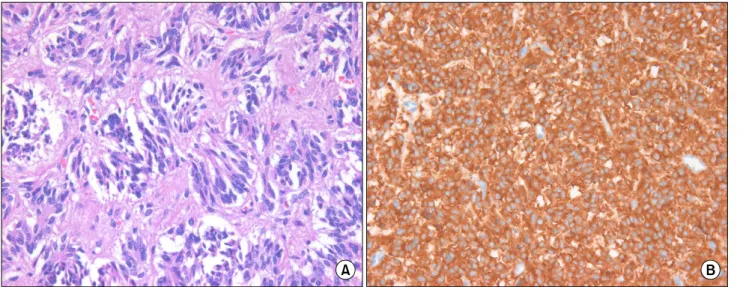
Fig. 2. Microscopic slides showed the typical characteristics of the paraganglioma. (A) H&E stain (×400) and (B) immunohistochemical stain (×400).

Fig. 1. The computed tomography image showing an anterior me- diastinal mass (arrow mark) having a diameter of 27 mm.

window measuring 30 mm was created in the 3th ICS close to the anterior scapular border. An additional 5-mm port for a left-hand instrument was created in the 5th ICS close to the mid-axillary line. The mass was totally surrounded by media- stinal fat tissue. After confirming that the mass did not in- vade the neighboring organ, we dissected the mass with the surrounding fat tissue. We tried not to manipulate the mass directly but to push or pull the surrounding fat tissue. The mass was completely resected using a Harmonic scalpel (Ethicon Endosurgery, Cincinnati, OH, USA). The mass was

assumed to be thymoma type A by frozen biopsy. A small chest tube (12 Fr.) was inserted, and the operation was com- pleted without any accident, including a hypertensive crisis or sudden bleeding. The chest tube was removed on post-oper- ative day 2, and the patient was discharged without complications. The final pathological report revealed the typi- cal characteristics of a paraganglioma (Fig. 2A). The tumor cells stained positive for synaptophysin (Fig. 2B). The re- section margin was clear, but the tumor cells invaded into the pericapsular connective tissue and the mitosis was consid- erable (10/10 high-power field).

DISCUSSION

Paragangliomas are rare neuroendocrine tumors that arise in sympathetic and parasympathetic paraganglia. Most of them (range, 80% to 85%) arise from the adrenal medulla, but the remaining 15% to 20% are located in the extra-adrenal chro- maffin tissue. Malignancy is defined by the presence of meta- stasis and tumor invasion in sites where the chromaffin tissue is normally absent, such as lungs, liver, and bones. The mass considered in this study did not show metastasis but had an invasion into the pericapsular tissue and considerable mitosis.

Therefore, after consulting a pathologist, we defined the mass

as a malignancy.

(3)

Complete VATS Resection of the Paraganglioma

− 199 − Complete resection of the paraganglioma using VATS was feasible. Complete resection is the treatment of choice in the case of paragangliomas. However, this treatment is sometimes difficult because of the tumor’s vascular nature and anatomi- cal location. Therefore, preoperative embolization or car- diopulmonary bypass is used for the safe resection of huge masses [3-5]. However, minimally invasive surgery has also been attempted in the case of this risky tumor. Thus far, a laparoscopic attempt has been successful, but a thoracoscopic approach has not been successful [6,7]. An indirect manipu- lation of the tumor and the tumor’s small size are thought to be the key to the safe and complete resection of this tumor.

The prognosis in the case considered here is not certain.

Prognosis after complete resection is encouraging. Lamy et al.

[2] reported the results of a follow-up of 79 patients with paragangliomas over a period of 180 months. In the case of patients undergoing complete resection, the survival rate was 84.6% and the mean survival time was 125 months; in con- trast, in the case of patients undergoing incomplete resection, the survival rate was 50.0% and the mean survival time was 71 months [2]. However, the latest study on the subject re- ported that the large size and the anterior mediastinal location of this tumor were the poor prognostic factors [8]. The pa- tient in this case had a relatively small tumor, but the mass was located in the anterior mediastinum. Moreover, peri- capsular invasion and considerable mitosis were found.

However, the role of adjuvant treatment was not established.

Therefore, a short-term outpatient clinic visit without adjuvant treatment was decided upon as the follow-up plan.

In summary, paragangliomas might be incorporated in the differential diagnosis of an anterior mediastinal mass. Surgical management using VATS can be successfully achieved for the complete resection of a small paraganglioma, and careful manipulation is required to prevent intraoperative compli- cations.

CONFLICT OF INTEREST

No potential conflict of interest relevant to this article was reported.

ACKNOWLEDGMENTS

This work was supported by the research grant of Chungbuk National University in 2012.

REFERENCES

1. Eisenhofer G, Bornstein SR, Brouwers FM, et al. Malignant pheochromocytoma: current status and initiatives for future progress. Endocr Relat Cancer 2004;11:423-36.

2. Lamy AL, Fradet GJ, Luoma A, Nelems B. Anterior and middle mediastinum paraganglioma: complete resection is the treatment of choice. Ann Thorac Surg 1994;57:249-52.

3. Paul S, Jain SH, Gallegos RP, Aranki SF, Bueno R.

Functional paraganglioma of the middle mediastinum. Ann Thorac Surg 2007;83:e14-6.

4. Andrade CF, Camargo SM, Zanchet M, Felicetti JC, Cardoso PF. Nonfunctioning paraganglioma of the aortopulmonary window. Ann Thorac Surg 2003;75:1950-1.

5. Shakir M, Blossom G, Lippert J. Anterior mediastinal para- ganglioma: a case for preoperative embolization. World J Surg Oncol 2012;10:134.

6. Mitchell J, Siperstein A, Milas M, Berber E. Laparoscopic resection of abdominal paragangliomas. Surg Laparosc Endosc Percutan Tech 2011;21:e48-53.

7. Lin MW, Chang YL, Lee YC, Huang PM. Non-functional paraganglioma of the posterior mediastinum. Interact Cardiovasc Thorac Surg 2009;9:540-2.

8. Ayala-Ramirez M, Feng L, Johnson MM, et al. Clinical risk

factors for malignancy and overall survival in patients with

pheochromocytomas and sympathetic paragangliomas: pri-

mary tumor size and primary tumor location as prognostic

indicators. J Clin Endocrinol Metab 2011;96:717-25.

수치

Fig. 1. The computed tomography image showing an anterior me- me-diastinal mass (arrow mark) having a diameter of 27 mm.

참조

관련 문서