• 검색 결과가 없습니다.

Nodal Outcomes of Uniportal versus Multiportal Video-Assisted Thoracoscopic Surgery for Clinical Stage I Lung Cancer

N/A
N/A
Protected

Academic year: 2021

Share "Nodal Outcomes of Uniportal versus Multiportal Video-Assisted Thoracoscopic Surgery for Clinical Stage I Lung Cancer"

Copied!
10
0
0

로드 중.... (전체 텍스트 보기)

전체 글

(1)

KJTCVS

The Korean Journal of Thoracic and Cardiovascular Surgery

Clinical Research Nodal Outcomes of Uniportal versus Multiportal Video-Assisted Thoracoscopic Surgery for Clinical Stage I Lung Cancer

Jung Suk Choi, M.D.

1

, Jiyun Lee, M.D.

1

, Young Kyu Moon, M.D., Ph.D.

2

, Seok Whan Moon, M.D., Ph.D.

1

, Jae Kil Park, M.D., Ph.D.

1

, Mi Hyoung Moon, M.D., Ph.D.

1

1

Department of Thoracic and Cardiovascular Surgery, Seoul St. Mary’s Hospital, College of Medicine, The Catholic University of Korea;

2

Department of Thoracic and Cardiovascular Surgery, Eunpyeong St. Mary’s Hospital, College of Medicine, The Catholic University of Korea, Seoul, Korea

ARTICLE INFO

Received August 26, 2019 Revised October 18, 2019 Accepted October 30, 2019 Corresponding author Mi Hyoung Moon Tel 82-2-2258-6768 Fax 82-2-594-8644

E-mail [email protected] ORCID

https://orcid.org/0000-0003-2799-4570

Background: Accurate intraoperative assessment of mediastinal lymph nodes is a critical aspect of lung cancer surgery. The efficacy and potential for upstaging implicit in these dissections must therefore be revisited in the current era of uniportal video-assisted tho- racoscopic surgery (VATS).

Methods: A retrospective study was conducted in which 544 patients with stage I (T1abc–T2a, N0, M0) primary lung cancer were analyzed. To assess risk factors for nodal upstaging and to limit any imbalance imposed by surgical choices, we constructed an inverse probability of treatment-weighted (IPTW) logistic regression model (in addition to non-weighted logistic models). We also evaluated risk factors for early locoregional recur- rence using IPTW logistic regression analysis.

Results: In the comparison of uniportal and multiportal VATS, the resected lymph node count (14.03±8.02 vs. 14.41±7.41, respectively; p=0.48) and rate of nodal upstaging (6.5%

vs. 8.7%, respectively; p=0.51) appeared similar. Predictors of nodal upstaging included tu- mor size (odds ratio [OR], 1.74; 95% confidence interval [CI], 1.12–2.70), carcinoembryonic antigen level (OR, 1.11; 95% CI, 1.04–1.18), and histologically confirmed pleural invasion (OR, 3.97; 95% CI, 1.89–8.34). The risk factors for locoregional recurrence within 1 year were found to be number of resected N2 nodes, age, and nodal upstaging.

Conclusion: Uniportal and multiportal VATS appear similar with regard to accuracy and thoroughness, showing no significant difference in the extent of nodal dissection.

Keywords: Lung neoplasms, Nodal upstaging, Single port video-assisted thoracic sur- gery, Uniportal, Video-assisted thoracic surgery

Copyright

© The Korean Society for Thoracic and Cardiovascular Surgery. 2020. All right reserved.

This is an Open Access article distributed under the terms of the Creative Commons Attribution Non-Commercial License (http://creativecommons.org/licenses/

Introduction

Mediastinal lymph node staging is an essential part of the assessment and management of patients with early- stage lung cancer. Since the extent of lymph node involve- ment is the most important prognostic factor in these pa- tients, it heavily influences therapeutic strategies [1].

According to the current consensus and guidelines, preop- erative invasive mediastinal lymph node assessment is rec- ommended via endobronchial ultrasound-transbronchial needle aspiration, endoscopic ultrasound, mediastinosco- py, or video-assisted thoracoscopic surgery (VATS). Pa- tients with peripherally-situated clinical stage IA tumors, normal-sized lymph nodes, and negative position-emission

tomography and computed tomography studies (PET/CT) are exceptions [2]. However, clinical practice patterns seem to vary substantially and often depart from these guide- lines. Inaccurate preoperative staging heightens the role of mediastinal node removal at the time of resection in stag- ing [3,4].

Controversy lingers regarding the survival benefit of dis- secting versus sampling mediastinal nodes, but systematic nodal dissection is recommended in all cases to ensure compliance with evidence-based guidelines adopted in Eu- rope and the United States [1,5]. Although the extent of nodal dissection has yet to be stipulated, most current guidelines and studies recommend that at least 3 N2 nodes be examined, and to ensure pathologic N0 status, at least 6

https://doi.org/10.5090/kjtcs.2020.53.3.104 pISSN: 2233-601X eISSN: 2093-6516

Korean J Thorac Cardiovasc Surg. 2020;53(3):104-113

(2)

Jung Suk Choi, et al. Uniportal Thoracoscopic LN Dissection KJTCVS

nodes from the hilar and mediastinal stations should be removed [5,6].

Since the first VATS lobectomy for lung cancer (in the early 1990s), the feasibility, safety, benefits and oncologic outcomes of VATS have compared favorably with thoracot- omy [7]. Advances in instrument technology and video-as- sisted surgery now allow for fewer ports than before (now 1 or 2). The first report of uniportal VATS was published in 2011. Subsequent data on clinical outcomes, feasibility, and safety have since dispelled concerns of inferiority [8-10].

However, single-port mediastinal lymph node dissection (MLND) presents a technical challenge that few studies have attempted to address [11,12].

The purpose of this study was to investigate uniportal and multiportal VATS in patients with clinical T1abc–T2a N0 lung cancer by analyzing differences in the extent of MLND and the incidence of nodal upstaging. We also as- sessed the likelihood and clinical implications of nodal up- staging.

Methods

Patient cohort

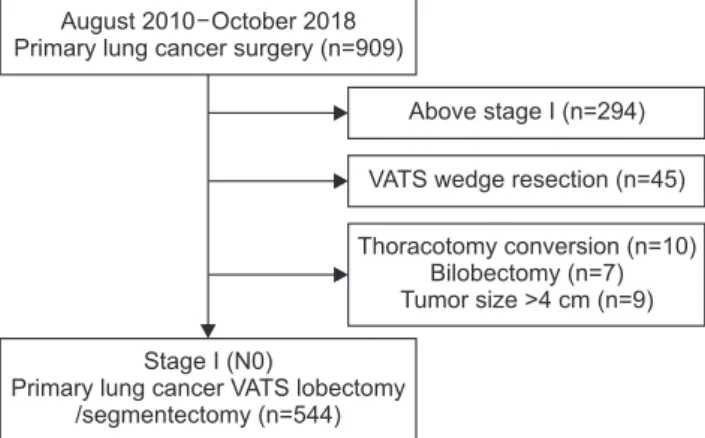
This retrospective review drew upon prospectively-col- lected institutional data. We identified patients who under- went surgical treatment of primary lung cancer with cura- tive intent between August 2010 and October 2018. The grounds for exclusion were as follows: (1) T stage T2b or higher, (2) clinical N1 or N2 disease, (3) wedge resection or surgery with non-curative intent, (4) bilobectomy, and (5) surgical thoracotomy or conversion of VATS to open tho- racotomy (Fig. 1). To emphasize the standard practice of lymph node dissection, we intentionally excluded data from patients who underwent wedge resection (n=45), bi- lobectomy (n=7), or VATS-to-thoracotomy conversion (n=10). We also excluded patients with sizeable (>40-mm) tissue-confirmed tumors that were preoperatively assessed as clinical stage I but proved instead to be stage II (n=9).

One-sleeve lobectomy was categorized simply as lobecto- my.

Both chest CT and PET/CT findings were used to define clinical N0 lung cancer. A lymph node with a short-axis diameter of less than 1 cm on an axial CT scan and no sig- nificant focal fluorodeoxyglucose uptake on PET/CT was defined as clinical N0 [7].

Locoregional recurrence was defined as recurrent disease at the bronchial stump, stapled margin, ipsilateral hilum or mediastinum, ipsilateral pleura, or ipsilateral chest wall

[13,14]. Early locoregional recurrence was defined in this study as recurrence within 1 year after surgery. Distant metastasis was equated with a recurrent tumor of the ipsi- lateral or contralateral lung, contralateral mediastinum, supraclavicular lymph node, or extrathoracic location. The first date upon which imaging studies raised suspicion of recurrence was considered the date of recurrence for our purposes.

This study was approved by the institutional review board of Seoul St. Mary’s Hospital (approval no., KC19RE- SI0521). The requirement for the informed consent of indi- vidual patients was waived on the basis of the retrospective design of this study.

Surgical techniques used in video-assisted thoracoscopic surgery

Our uniportal VATS program began in 2017. Each pa- tient was placed in the lateral decubitus position with a semi-flexed arm, as in multiportal VATS procedures. In our uniportal approach, a working incision of 3–5 cm was made at the fourth or fifth intercostal space at the anterior axillary line as described previously [15]. A 10-mm 30°

thoracoscope was used. The procedure was otherwise sim- ilar to multiportal VATS, in which 2 (n=22), 3 (n=2), or 4 (n=367) ports were created. For 2-port and 4-port VATS, the camera ports were placed over the seventh and eighth intercostal spaces, respectively, on the mid-axillary line.

The utility incision for 4-port VATS was made at the fifth intercostal space, with 2 instrumental ports at the seventh intercostal space anteriorly and the remaining 2 at the sixth intercostal space posteriorly.

Thoracotomy conversion (n=10) Bilobectomy (n=7) Tumor size >4 cm (n=9) August 2010 October 2018

Primary lung cancer surgery (n=909)

Stage I (N0)

Primary lung cancer VATS lobectomy /segmentectomy (n=544)

Above stage I (n=294) VATS wedge resection (n=45)

Fig. 1. Study flowchart, with counts and reasons for exclusion.

VATS, video-assisted thoracoscopic surgery.

(3)

https://doi.org/10.5090/kjtcs.2020.53.3.104

KJTCVS

Statistical analysis

Baseline characteristics were expressed conventionally, using mean±standard deviation for continuous variables and frequencies with percentages for categorical variables.

The distributions of continuous variables were compared via the Student t-test or the Mann-Whitney U-test, de- pending on the results of the normality test. The chi- square test or the Fisher exact test were utilized to compare categorical variables. Risk factors for nodal upstaging were assessed via binary logistic regression analysis. Receiver operating curve analyses were performed to calculate the area under the curve for the tumor size and serum carci- noembryonic antigen (CEA) level in the prediction of nod- al upstaging.

Given the observational nature of this study, surgical al- location to either the uniportal or the multiportal group was not random. To address this, we first used propensity scores (PS) to balance baseline variables and maximize the balance between the 2 groups. Variables included in the PS model were those that (in our institutional experience) in- fluenced the decision to perform uniportal surgery: age, sex, presence of chronic obstructive pulmonary disease or interstitial lung disease, clinical tumor-node-metastasis stage, and type of surgery planned (lobectomy or segmen- tectomy). Because the distribution of PS within the 2 groups differed considerably, and the study cohort was of limited size, inverse probability of treatment weighting (IPTW) was applied [16,17]. The IPTW method has been shown to outperform simple logistic regression in the con- text of case-mix adjustment. Weights were extracted from the PS model to calculate the IPTW, after which the IPTW was utilized in each case to produce an average treatment among the treated (ATT) estimate. The ATT estimate ac- counted for the unavoidable non-random selection of sur- gical patients and facilitated coherence in PS matching [18].

In the assessment of the clinical significance of nodal up- staging, considering the differences in follow-up time, we used early locoregional recurrence within a 1-year period after surgery as another endpoint. The factors associated with early locoregional recurrence were assessed with IPTW logistic regression analysis. Two-sided p-values less than 0.05 were used to indicate statistical significance, and variables that demonstrated statistical significance in uni- variate analysis were incorporated into a multivariate mod- el. All computations were facilitated by R freeware ver. 3.6.1 (R Project for Statistical Computing, Vienna, Austria;

https://www.R-project.org/).

Results

General characteristics of the patients and clinical outcomes

Ultimately, 544 patients (men, 242; women, 302) quali- fied for this study, all diagnosed with clinical stage I (T1abc or T2a N0M0) lung cancer. The mean age was 63.91 years (range, 30–85 years). Uniportal VATS was preferentially performed over multiportal VATS in women (65.0% versus 52.2%, p=0.016) and in patients with lower forced expirato- ry volume in 1 second (93.0±15.66 L versus 96.6±17.83 L, p=0.037), lower diffusing capacity for carbon monoxide as a percentage of predicted value (92.1%±15.07% versus 88.1%±

18.02%, p=0.015), and smaller tumor size (1.86±0.83 cm versus 2.11±0.83 cm, p=0.002). There were no group-wise differences in age; smoking history; history of tuberculosis, chronic obstructive pulmonary disease, or interstitial lung disease; or history of contralateral lung surgery or extent of surgery (segmentectomy versus lobectomy). The median follow-up time for the overall cohort was 34 months. The total number of dissected lymph node was 14.03±8.02 for the uniportal group and 14.41±7.41 for the multiportal group (p=0.48).

Detailed data on patient enrollees are shown in Table 1 according to the type of surgery and the number of ports.

Among members of the lobectomy group, no differences were observed between the uniportal and multiportal groups with regard to the distribution of major demo- graphic characteristics, underlying lung disease, tumor histotype, preoperative forced expiratory volume in 1 sec- ond, CEA level, or the location or size of the tumor. The same was true of the segmentectomy group, with the ex- ception that T1a/b/c tumors were more prevalent in the uniportal lobectomy group than in the multiportal lobec- tomy group (p=0.003).

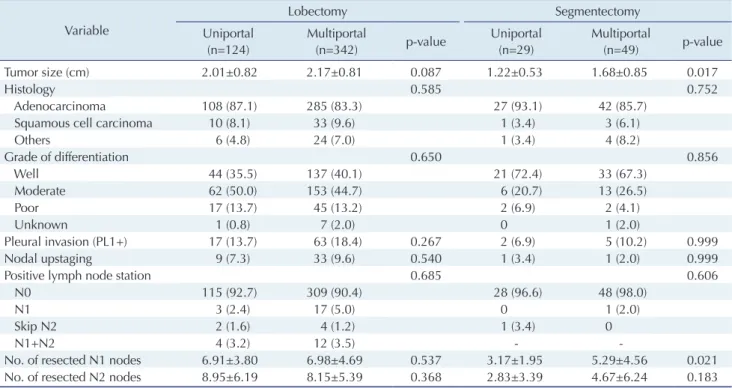
Surgical outcomes are presented in Table 2. Regardless of the type of surgery performed, there were no significant differences in terms of operative time, postoperative mor- bidity, adjuvant treatment, or crude locoregional recur- rence. For each type of surgery, the uniportal group exhib- ited lower blood loss volumes and shorter hospital stays than the multiportal group. Operative mortality was 0.55%

(3 of 544), including 2 patients in the uniportal lobectomy

group (1.6%) and 1 patient in the multiportal lobectomy

group (0.3%). The causes of death were pneumonia and

acute respiratory distress syndrome. No deaths occurred in

the segmentectomy group.

(4)

Jung Suk Choi, et al. Uniportal Thoracoscopic LN Dissection KJTCVS

Nodal upstaging

Pathologic outcomes are shown in Table 3. The overall incidence of nodal upstaging in this cohort was 8.09% (44 of 544). From the perspective of uniportal versus multipor- tal surgery, the number of resected lymph nodes differed among the resected lobes, as follows: the right upper lobe (RUL), 17.2±9.2 versus 14.4±7.7, respectively); right middle lobe (RML), 9.7±4.8 versus 14.3±7.5; right lower lobe (RLL), 15.9±4.8 versus 16.4±8.2; left upper lobe (LUL), 10.7±7.2 versus 12.8±6.5; and left lower lobe (LLL), 11.5±6.0 versus 14.0±6.1. After Bonferroni adjustment, statistical signifi- cance remained present only between the uniportal LUL versus multiportal RLL and uniportal RUL versus multi- portal LUL pairs. Regardless of the type of surgery per- formed, uniportal and multiportal VATS showed no signif- icant differences in either nodal upstaging (10 [6.5%] versus 34 [8.7%], respectively; p=0.5) or resected node counts

(14.03 versus 14.41, p=0.48). Likewise, the nature of surgery had no significant impact on nodal upstaging (Table 3).

More lymph nodes were dissected in the lobectomy group than in the segmentectomy group, but the lymph node to- tals at each station did not differ significantly by number of ports within the lobectomy or segmentectomy groups.

No significant differences were observed in the frequency of single or multi-station nodal metastasis according to the number of ports (p=0.999), type of surgery (p=0.999), his- tological findings (p=0.758), or resected lobe (p=0.384).

Factors associated with nodal upstaging

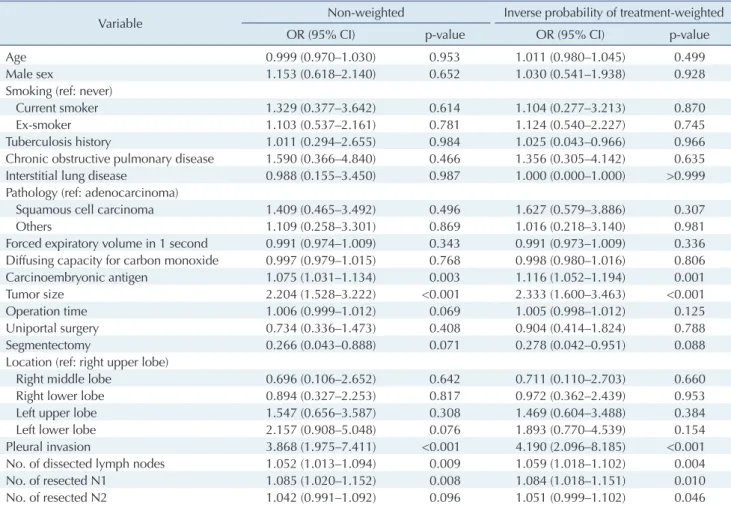
The factors associated with nodal upstaging were ana- lyzed using univariate and multivariate logistic regression methods. Additionally, to reduce the imbalances associated with choice of treatment, we calculated PS and constructed the IPTW model before logistic regression was performed Table 1. Patient characteristics by type of surgery and number of ports

Characteristic

Lobectomy Segmentectomy

Uniportal (n=124)

Multiportal

(n=342) p-value Uniportal (n=29)

Multiportal

(n=49) p-value

Male sex 46 (37.1) 162 (47.4) 0.062 9 (31.0) 25 (51.0) 0.138

Age (yr) 64.19±11.20 63.68±10.09 0.637 66.79±9.64 63.06±9.16 0.092

Smoking (pack-years)

a)

26.49±18.76 33.86±20.14 0.025 33.07±15.28 30.35±21.32 0.459

Smoking status 0.236 0.726

Current smoker 5 (4.0) 29 (8.5) 2 (6.9) 4 (8.2)

Ex-smoker 33 (26.6) 94 (27.5) 12 (41.4) 15 (30.6)

Never smoked 86 (69.4) 219 (64.0) 15 (51.7) 30 (61.2)

Tuberculosis history 11 (8.9) 30 (8.8) 0.999 5 (17.2) 3 (6.1) 0.239

Chronic obstructive pulmonary disease 3 (2.4) 19 (5.6) 0.245 2 (6.9) 1 (2.0) 0.552

Interstitial lung disease 3 (2.4) 17 (5.0) 0.346 1 (3.4) 4 (8.2) 0.646

Previous lung operation 2 (1.6) 0 0.070 3 (10.3) 6 (12.2) 0.999

Forced expiratory volume in 1 second (% of predicted)

94.13±14.66 97.18±18.03 0.088 88±18.85 92.76±15.98 0.239

Diffusing capacity for carbon monoxide (%) 92.63±15.23 88.18±17.75 0.014 89.69±14.35 87.24±19.94 0.566

Carcinoembryonic antigen (ng/mL) 2.63±4.80 2.74±5.51 0.139 3.77±11.17 1.77±1.56 0.587

Clinical T stage 0.003 0.194

Tis 4 (3.2) 12 (3.5) 4 (13.8) 7 (14.3)

T1a 12 (9.7) 24 (7.0) 12 (41.4) 11 (22.4)

T1b 61 (49.2) 121 (35.4) 11 (37.9) 20 (40.8)

T1c 32 (25.8) 92 (26.9) 2 (6.9) 5 (10.2)

T2a 15 (12.1) 93 (27.2) 0 6 (12.2)

Tumor location 0.627 0.532

Right upper lobe 44 (35.5) 136 (39.8) 5 (17.2) 9 (18.4)

Right middle lobe 11 (8.9) 31 (9.1) 0 0

Right lower lobe 30 (24.2) 68 (19.9) 5 (17.2) 13 (26.5)

Left upper lobe 18 (14.5) 61 (17.8) 11 (37.9) 20 (40.8)

Left lower lobe 21 (16.9) 46 (13.5) 8 (27.6) 7 (14.3)

Values are presented as number (%) or mean±standard deviation.

a)

Data were derived from 161 available patients.

(5)

https://doi.org/10.5090/kjtcs.2020.53.3.104

KJTCVS

Table 2. Clinical outcomes by type of surgery and number of ports Variable

Lobectomy Segmentectomy

Uniportal (n=124)

Multiportal

(n=342) p-value Uniportal (n=29)

Multiportal

(n=49) p-value

Operation time (min) 146.40±42.02 141.40±41.56 0.194 150.60±40.78 171.10±44.54 0.056

Blood loss (mL) 78.14±109.59 180.9±275.52 <0.001 86.55±120.04 161±157.90 0.001

Numerical Rating Scale on postoperative day 1

3.06±1.71 2.02±1.77 <0.001 3.28±1.91 1.55±1.44 <0.001

Postoperative complications 19 (15.3) 61 (17.8) 0.619 6 (20.7) 11 (22.4) 0.999

Prolonged air leak 9 (7.3) 47 (13.7) 0.082 2 (6.9) 9 (18.4) 0.196

Pneumonia 2 (1.6) 6 (1.8) 0.999 2 (6.9) 0 0.135

Bleeding

a)

2 (1.6) 2 (0.6) 0.289 0 0 -

Chylothorax 1 (0.8) 6 (1.8) 0.681 2 (6.9) 0 0.135

Hoarseness 1 (0.8) 4 (1.2) 0.999 1 (3.4) 1 (2.0) 0.999

Others 2 (1.6) 4 (1.2) 0.659 0 1 (2.0) 0.999

Adjuvant treatments 0.523 0.999

None 116 (93.5) 313 (91.5) 28 (96.6) 46 (93.9)

Chemotherapy 8 (6.5) 24 (7.0) 1 (3.4) 3 (6.1)

Chemoradiation 0 5 (1.5) -

Hospital stay duration (day) 5.2±4.44 6.5±5.84 0.003 4.9±5.50 7.5±9.63 0.029

Locoregional recurrence 6 (4.8) 20 (5.8) 0.848 1 (3.4) 4 (8.2) 0.646

Distant metastasis 5 (4.0) 30 (8.8) 0.129 0 5 (10.2) 0.151

In-hospital death 2 (1.6) 1 (0.3) 0.345 0 0 -

Follow-up duration (mo) 14.2±6.36 52.0±25.94 <0.001 14.9±6.77 53.4±21.88 <0.001

Values are presented as mean±standard deviation or number (%).

a)
Bleeding was defined as that requiring transfusion.

Table 3. Pathologic outcomes by type of surgery and number of ports Variable

Lobectomy Segmentectomy

Uniportal (n=124)

Multiportal

(n=342) p-value Uniportal

(n=29)

Multiportal

(n=49) p-value

Tumor size (cm) 2.01±0.82 2.17±0.81 0.087 1.22±0.53 1.68±0.85 0.017

Histology 0.585 0.752

Adenocarcinoma 108 (87.1) 285 (83.3) 27 (93.1) 42 (85.7)

Squamous cell carcinoma 10 (8.1) 33 (9.6) 1 (3.4) 3 (6.1)

Others 6 (4.8) 24 (7.0) 1 (3.4) 4 (8.2)

Grade of differentiation 0.650 0.856

Well 44 (35.5) 137 (40.1) 21 (72.4) 33 (67.3)

Moderate 62 (50.0) 153 (44.7) 6 (20.7) 13 (26.5)

Poor 17 (13.7) 45 (13.2) 2 (6.9) 2 (4.1)

Unknown 1 (0.8) 7 (2.0) 0 1 (2.0)

Pleural invasion (PL1+) 17 (13.7) 63 (18.4) 0.267 2 (6.9) 5 (10.2) 0.999

Nodal upstaging 9 (7.3) 33 (9.6) 0.540 1 (3.4) 1 (2.0) 0.999

Positive lymph node station 0.685 0.606

N0 115 (92.7) 309 (90.4) 28 (96.6) 48 (98.0)

N1 3 (2.4) 17 (5.0) 0 1 (2.0)

Skip N2 2 (1.6) 4 (1.2) 1 (3.4) 0

N1+N2 4 (3.2) 12 (3.5) - -

No. of resected N1 nodes 6.91±3.80 6.98±4.69 0.537 3.17±1.95 5.29±4.56 0.021

No. of resected N2 nodes 8.95±6.19 8.15±5.39 0.368 2.83±3.39 4.67±6.24 0.183

Values are presented as mean±standard deviation or number (%).

(6)

Jung Suk Choi, et al. Uniportal Thoracoscopic LN Dissection KJTCVS

(Table 4). All standardized differences became <0.10, indi- cating that the model was effective in controlling covariate imbalance (Fig. 2). One limitation of PS matching is the exclusion of many control or treatment cases. To overcome this issue and strengthen the result, we adopted the IPTW

method as an adjunct.

Upon univariate analysis, the non-weighted and IPTW model produced the same results regarding the presence or absence of statistical significance for each variable. The number of ports (uniportal versus multiportal surgery) and Table 4. Factors predicting nodal upstaging per univariate logistic regression: non-weighted and weighted model

Variable Non-weighted Inverse probability of treatment-weighted

OR (95% CI) p-value OR (95% CI) p-value

Age 0.999 (0.970–1.030) 0.953 1.011 (0.980–1.045) 0.499

Male sex 1.153 (0.618–2.140) 0.652 1.030 (0.541–1.938) 0.928

Smoking (ref: never)

Current smoker 1.329 (0.377–3.642) 0.614 1.104 (0.277–3.213) 0.870

Ex-smoker 1.103 (0.537–2.161) 0.781 1.124 (0.540–2.227) 0.745

Tuberculosis history 1.011 (0.294–2.655) 0.984 1.025 (0.043–0.966) 0.966

Chronic obstructive pulmonary disease 1.590 (0.366–4.840) 0.466 1.356 (0.305–4.142) 0.635

Interstitial lung disease 0.988 (0.155–3.450) 0.987 1.000 (0.000–1.000) >0.999

Pathology (ref: adenocarcinoma)

Squamous cell carcinoma 1.409 (0.465–3.492) 0.496 1.627 (0.579–3.886) 0.307

Others 1.109 (0.258–3.301) 0.869 1.016 (0.218–3.140) 0.981

Forced expiratory volume in 1 second 0.991 (0.974–1.009) 0.343 0.991 (0.973–1.009) 0.336 Diffusing capacity for carbon monoxide 0.997 (0.979–1.015) 0.768 0.998 (0.980–1.016) 0.806

Carcinoembryonic antigen 1.075 (1.031–1.134) 0.003 1.116 (1.052–1.194) 0.001

Tumor size 2.204 (1.528–3.222) <0.001 2.333 (1.600–3.463) <0.001

Operation time 1.006 (0.999–1.012) 0.069 1.005 (0.998–1.012) 0.125

Uniportal surgery 0.734 (0.336–1.473) 0.408 0.904 (0.414–1.824) 0.788

Segmentectomy 0.266 (0.043–0.888) 0.071 0.278 (0.042–0.951) 0.088

Location (ref: right upper lobe)

Right middle lobe 0.696 (0.106–2.652) 0.642 0.711 (0.110–2.703) 0.660

Right lower lobe 0.894 (0.327–2.253) 0.817 0.972 (0.362–2.439) 0.953

Left upper lobe 1.547 (0.656–3.587) 0.308 1.469 (0.604–3.488) 0.384

Left lower lobe 2.157 (0.908–5.048) 0.076 1.893 (0.770–4.539) 0.154

Pleural invasion 3.868 (1.975–7.411) <0.001 4.190 (2.096–8.185) <0.001

No. of dissected lymph nodes 1.052 (1.013–1.094) 0.009 1.059 (1.018–1.102) 0.004

No. of resected N1 1.085 (1.020–1.152) 0.008 1.084 (1.018–1.151) 0.010

No. of resected N2 1.042 (0.991–1.092) 0.096 1.051 (0.999–1.102) 0.046

OR, odds ratio; CI, confidence interval; ref, reference.

0.5 0.4 0.3 0.2 0.1

0.0

Unweighted Weighted

ASD

es.mean.ATT ks.mean.ATT ASD value before and after weighting

Age Sex COPD ILD Surgery T1a T1b T1c T2a Tis

0.099 0.248 0.248 0.173 0.164 0.185 0.220 0.062 0.522 0.017

0.021 0.003 0.046 0.010 0.064 0.035 0.008 0.003 0.027 0.004 Before After

Unweighted Weighted

Fig. 2. Plot for absolute standard-

ized differences before and after

weighting. ASD, absolute standard

difference; COPD, chronic obstruc-

tive pulmonary disease; ILD, inter-

stitial lung disease.

(7)

https://doi.org/10.5090/kjtcs.2020.53.3.104

KJTCVS

type of surgery (segmentectomy versus lobectomy) did not impact nodal upstaging risk. However, larger tumor size, pathologic pleural invasion beyond grade PL1 (as visual- ized with elastic stain), and higher number of resected N1 nodes emerged as significant predictors of nodal upstaging after surgery.

To further increase the robustness of our findings, we conducted a multivariate analysis using all clinically rele- vant and statistically significant variables from the univar- iate models (Table 5). Larger tumor size, higher serum CEA level, and tissue-confirmed pleural invasion were found to be significantly associated with nodal upstaging in both the non-weighted and IPTW models. Longer oper- ative time and higher N1 node count were also significant in the non-weighted model. Analysis of deviance in the non-weighted model indicated that tumor size was associ- ated with the strongest reduction in deviance (deviance re- sidual, 14.296; p<0.001) and thus was the strongest predic- tor of nodal upstaging, followed by the serum CEA level (deviance residual, 12.867; p<0.001) and pathologic pleural invasion (deviance residual, 10.241; p=0.001).

Receiver operating curve analyses were performed for CEA level and tumor size. The area under the curve for tu- mor size (0.704) was higher than that for serum CEA level (0.622). The cutoff values were 2.1 cm for tumor size (sen- sitivity, 75.0%, specificity, 60.8%) and 2.52 ng/mL for the CEA level (sensitivity, 48.8%, specificity, 74.4%).

Locoregional recurrence

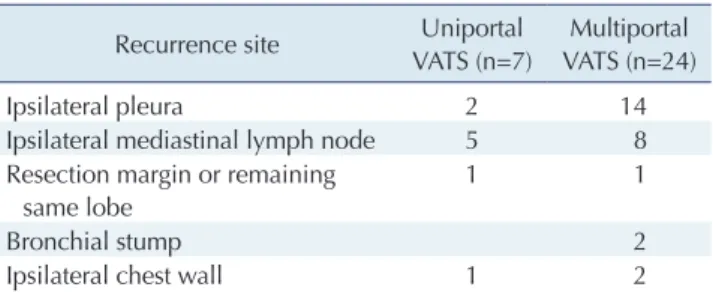
The most common sites of locoregional recurrence

during follow-up were the ipsilateral pleura and the medi- astinal lymph nodes (Table 6). In the multiportal group, 3 patients developed recurrence at 2 locations: the parietal pleura and mediastinal lymph node in 1 patient, the pleura and chest wall in 1 patient, and the bronchial stump and chest wall in 1 patient. In the uniportal group, 1 patient experienced recurrence of the pleura and mediastinal lymph node, while the other patient developed recurrence of the pleura and chest wall. Univariate logistic regression analysis was performed to assess the factors related to lo- coregional recurrence within 1 year. Since recurrence oc- curred in only 9 patients, we did not perform a multivari- ate analysis. Nodal upstaging (OR, 5.776; 95% CI, 1.303–21.056; p=0.011), number of resected N2 nodes (OR, 1.105; 95% CI, 1.011–1.200; p=0.021), and age (OR, 1.258;

95% CI, 1.134–1.436; p<0.001) were found to be significant predictors of locoregional recurrence.

Discussion

Continued efforts towards less invasive surgery have fos- tered surgical innovations. Uniportal surgery was initially used for sympathectomy and was then applied to simple wedge resection, with Gonzalez-Rivas et al. [8] reporting the first uniportal VATS lobectomy in 2011 [19]. The safety and feasibility of uniportal VATS for primary lung cancer has since been validated [11,20].

Until now, most studies have focused on pulmonary re- sections via single-port lung surgery, which, despite its in- creasing popularity, raises some concerns regarding the completeness of surgical nodal staging. Indeed, operative methods for MLND have been proposed, and several re- ports from high-volume centers have demonstrated that the total number of dissected nodes remained the same or Table 5. Multivariate analysis of nodal upstaging: weighted and

non-weighted model

Variable Odds ratio (95%

confidence interval) p-value Non-weighted model

CEA 1.077 (1.030–1.132) 0.001

Tumor size 1.705 (1.131–2.584) 0.011

Pleural invasion 3.614 (1.737–7.422) <0.001 Operation time 1.007 (1.000–1.014) 0.041 Dissected N1 1.069 (1.000–1.140) 0.043 IPTW model

CEA (ng/mL) 1.101 (1.042–1.175) 0.001 Tumor size (cm) 1.783 (1.158–2.762) 0.010 Pleural invasion 3.820 (1.804–7.974) <0.001 No. of dissected N1 1.071 (0.998–1.146) 0.050 Hosmer-Lemeshow test of IPTW model (p=0.210). McFadden R

2

index=

0.164.

CEA, carcinoembryonic antigen; IPTW, inverse probability of treatment- weighted.

Table 6. Pattern of locoregional recurrence (number of cases with recurrence=31)

Recurrence site Uniportal VATS (n=7)

Multiportal VATS (n=24)

Ipsilateral pleura 2 14

Ipsilateral mediastinal lymph node 5 8

Resection margin or remaining same lobe

1 1

Bronchial stump 2

Ipsilateral chest wall 1 2

Counting was based on the recurrence site, resulting in a difference between the values and the total number of patients in the lobectomy group. In addition, the number of recurrences refers to the number that occurred during the total study period.

VATS, video-assisted thoracoscopic surgery.

(8)

Jung Suk Choi, et al. Uniportal Thoracoscopic LN Dissection KJTCVS

exceeded those achieved using multiportal VATS [11,21,22].

In the present study, the count of dissected lymph nodes did not differ significantly according to the number of ports (uniportal group, 14.03±8.02; multiportal group, 14.41±7.41; p=0.48), a finding that aligned with prior stud- ies. However, a critical issue is the clinical implication of the total number of dissected lymph nodes.

Nodal upstaging after surgery for lung cancer can be de- fined as the presence of unsuspected pathologic hilar (pN1) or mediastinal (pN2) disease detected during the final pathologic examination of surgical specimens [23]. Ac- cording to the Cancer and Leukemia Group B prospective clinical trial (CALGB 9761), the incidence of nodal upstag- ing is 28% in clinical stage I lung cancer, 14% in stage II, and 14% in stage III [24]. More recently, an Italian VATS group reported nodal upstaging rates of 6.03% (N0 to N1) and 5.45% (N0 to N2) [25]. The overall incidence of nodal upstaging in our study was 8.09% (3.86% for N0 to N1, 3.13% for N0 to N1/2, and 1.11% for N0 to skip-N2 disease).

The recommended number of nodes or stations for accu- rate nodal staging varies among sources. Some authors have proposed that 11–14 lymph nodes or at least 5 stations be resected [25,26]. The guidelines of the European Society of Thoracic Surgeons recommend systematic MLND for all resectable lung cancer, including at least 3 N2 stations [5].

Although the Italian group demonstrated a positive cor- relation between the number of resected nodes and the rate of upstaging, our data do not support this. A possible ex- planation is that the mean count of resected nodes in the present analysis was 14, which is larger than the recom- mended totals for accurate staging cited in several investi- gative reports. Moreover, the hilar or mediastinal lymph node totals we observed did not differ significantly accord- ing to the number of ports. However, the hilar node totals for segmentectomy were higher for multiportal than for uniportal VATS, perhaps reflecting the inherent difficul- ties of single-port nodal staging. The duration of follow-up after uniportal surgery was particularly limited, so more data are needed to reach a definitive conclusion.

Many researchers have explored risk factors for nodal upstaging, including those pertaining to patients (such as diabetes mellitus, history of tuberculosis, and connective tissue disorders) and to tumor-related factors (such as cen- tral location, higher T stage, higher standardized uptake value, and histotype) [23,26]. We did so as well and found that only tumor-related factors (namely serum CEA levels, lesion size, and tissue-confirmed pleural invasion) height- ened the risk of nodal upstaging. Application of both a conventional logistic model and an adjunctive IPTW mod-

el (derived through calculation) confirmed the importance of tumor-related factors. Analysis of deviance reduction indicated that tumor size reduced deviance the most, fol- lowed by CEA levels and pleural invasion. Interestingly, the hilar node count proved to be a positive risk factor in the non-weighted model, despite showing a mere tendency in the weighted model. Nevertheless, the McFadden R

2

index was 16.4%, indicating the existence of other unknown fac- tors affecting nodal upstaging. This study, can therefore only suggest that these factors might contribute to nodal upstaging, and further studies with larger patient cohorts should be performed to clarify the risk factors of nodal up- staging.

The role of serum CEA levels as a predictor of lymph node metastasis has been studied, and elevated serum CEA levels (>5.0 ng/mL) have been shown to be associated with upstaging and poor prognosis [27]. In addition, Koike et al.

[28] proposed that a serum CEA level of 3.5 ng/mL or higher is associated with a higher risk of lymph node me- tastasis, even though that level fell within the normal range determined for that study.

In the present study, despite the limited follow-up dura- tion after uniportal VATS, we evaluated the potential rela- tionship between nodal upstaging and locoregional recur- rence as a preliminary analysis. Our study showed that nodal upstaging, the number of resected N2 nodes, and patient age were related to locoregional recurrence. These relationships were statistically significant, but the wide 95% confidence intervals weaken the strength of these findings; therefore, further studies with longer follow-up periods and larger numbers of patients are warranted.

One interesting detail is that patients in the uniportal group felt more intense pain on postoperative day 1, as re- flected by a higher numerical rating scale score. In unipor- tal surgery, the VATS instrument and thoracoscope must move within the same intercostal space, resulting in more pressure on the intercostal nerve and more pain. Moreover, the surgeons’ learning curve in the uniportal group also may have played a role in the higher numerical rating scale score. These findings imply that the surgical procedure should be further elaborated.

In conclusion, uniportal and multiportal VATS proce-

dures compared favorably in mediastinal nodal dissections

performed during curative surgery for lung cancer. Tu-

mor-related factors, specifically lesion size, serum CEA

level, and pleural invasion (as visualized with elastic stain-

ing), were identified as risk factors of nodal upstaging in

our cohort. Provided that MLND is adequate, the surgical

technique alone is not predictive of nodal upstaging risk.

(9)

https://doi.org/10.5090/kjtcs.2020.53.3.104

KJTCVS

For segmentectomy, however, multiportal surgery may be a better choice.

Conflict of interest

No potential conflict of interest relevant to this article was reported.

Acknowledgments

We would like to give special thanks to the biostatistics consulting team of our institute.

Funding

This study was supported by a Grant of the Samsung Vein Clinic Network (Daejeon, Anyang, Cheongju, Cheonan;

Fund no. KTCS04-139).

ORCID

Jung Suk Choi: https://orcid.org/0000-0001-7733-6408 Jiyun Lee: https://orcid.org/0000-0002-4554-9676 Young Kyu Moon: https://orcid.org/0000-0002-6875-6918 Seok Whan Moon: https://orcid.org/0000-0003-3348-6011 Jae Kil Park: https://orcid.org/0000-0002-4953-1473 Mi Hyoung Moon: https://orcid.org/0000-0003-2799-4570

References

1. National Comprehensive Cancer Network. Non-small cell lung can- cer: version 5 [Internet]. Plymouth Meeting (PA): National Compre- hensive Cancer Network; 2019 [cited 2019 Jul 22]. Available from:

https://www.nccn.org/professionals/physician_gls/pdf/nscl.pdf.

2. Lin J, Fernandez F. Indications for invasive mediastinal staging for non-small cell lung cancer. J Thorac Cardiovasc Surg 2018;156:

2319-24.

3. Turner SR, Seyednejad N, Nasir BS. Patterns of practice in mediasti- nal lymph node staging for non-small cell lung cancer in Canada.

Ann Thorac Surg 2018;106:428-34.

4. Wang Y, Darling GE. Complete mediastinal lymph node dissection versus systematic lymph node sampling in surgical treatment of non- small cell lung cancer: do we have the answer? J Thorac Dis 2017;9:

4169-70.

5. Lardinois D, De Leyn P, van Schil P, et al. ESTS guidelines for intra- operative lymph node staging in non-small cell lung cancer. Eur J Cardiothorac Surg 2006;30:787-92.

6. Goldstraw P. Report on the international workshop on intrathoracic staging: London, October 1996. Lung Cancer 1997;18:107-11.

7. Lewis RJ. The role of video-assisted thoracic surgery for carcinoma of the lung: wedge resection to lobectomy by simultaneous individu- al stapling. Ann Thorac Surg 1993;56:762-8.

8. Gonzalez-Rivas D, de la Torre M, Fernandez R, Mosquera VX. Sin- gle-port video-assisted thoracoscopic left upper lobectomy. Interact Cardiovasc Thorac Surg 2011;13:539-41.

9. Wang BY, Tu CC, Liu CY, Shih CS, Liu CC. Single-incision thoraco- scopic lobectomy and segmentectomy with radical lymph node dis- section. Ann Thorac Surg 2013;96:977-82.

10. Hirai K, Takeuchi S, Usuda J. Single-port video-assisted thoracic surgery for early lung cancer: initial experience in Japan. J Thorac Dis 2016;8(Suppl 3):S344-50.

11. Liu CC, Shih CS, Pennarun N, Cheng CT. Transition from a multi- port technique to a single-port technique for lung cancer surgery: is lymph node dissection inferior using the single-port technique? Eur J Cardiothorac Surg 2016;49 Suppl 1:i64-72.

12. Mu JW, Gao SG, Xue Q, et al. A propensity matched comparison of effects between video assisted thoracoscopic single-port, two-port and three-port pulmonary resection on lung cancer. J Thorac Dis 2016;8:1469-76.

13. Taylor MD, Nagji AS, Bhamidipati CM, et al. Tumor recurrence af- ter complete resection for non-small cell lung cancer. Ann Thorac Surg 2012;93:1813-20.

14. Fedor D, Johnson WR, Singhal S. Local recurrence following lung cancer surgery: incidence, risk factors, and outcomes. Surg Oncol 2013;22:156-61.

15. Lee J, Lee JY, Choi JS, Sung SW. Comparison of uniportal versus multiportal video-assisted thoracoscopic surgery pulmonary segmen- tectomy. Korean J Thorac Cardiovasc Surg 2019;52:141-7.

16. McCaffrey DF, Griffin BA, Almirall D, Slaughter ME, Ramchand R, Burgette LF. A tutorial on propensity score estimation for multiple treatments using generalized boosted models. Stat Med 2013;32:

3388-414.

17. Austin PC, Stuart EA. Moving towards best practice when using in- verse probability of treatment weighting (IPTW) using the propensity score to estimate causal treatment effects in observational studies:

version 2. Stat Med 2015;34:3661-79.

18. Austin PC. The performance of different propensity score methods for estimating marginal hazard ratios. Stat Med 2013;32:2837-49.

19. Rocco G, Martin-Ucar A, Passera E. Uniportal VATS wedge pulmo- nary resections. Ann Thorac Surg 2004;77:726-8.

20. Heo W, Kang DK, Min HK, Jun HJ, Hwang YH. Feasibility and safety of single-port video-assisted thoracic surgery for primary lung cancer. Korean J Thorac Cardiovasc Surg 2017;50:190-6.

21. Delgado Roel M, Fieira Costa EM, Gonzalez-Rivas D, Fernandez LM, Fernandez Prado R, de la Torre M. Uniportal video-assisted tho- racoscopic lymph node dissection. J Thorac Dis 2014;6(Suppl 6):

S665-8.

22. Gonzalez-Rivas D, Paradela M, Fernandez R, et al. Uniportal vid-

(10)

Jung Suk Choi, et al. Uniportal Thoracoscopic LN Dissection KJTCVS

eo-assisted thoracoscopic lobectomy: two years of experience. Ann Thorac Surg 2013;95:426-32.

23. Toker A, Ozyurtkan MO, Kaba E. Nodal upstaging: effects of instru- mentation and three-dimensional view in clinical stage I lung cancer.

J Vis Surg 2017;3:76.

24. D’Cunha J, Herndon JE 2nd, Herzan DL, et al. Poor correspondence between clinical and pathologic staging in stage 1 non-small cell lung cancer: results from CALGB 9761, a prospective trial. Lung Cancer 2005;48:241-6.

25. Bertani A, Gonfiotti A, Nosotti M, et al. Nodal management and up- staging of disease: initial results from the Italian VATS Lobectomy

Registry. J Thorac Dis 2017;9:2061-70.

26. Tantraworasin A, Saeteng S, Siwachat S, et al. Impact of lymph node management on resectable non-small cell lung cancer patients. J Thorac Dis 2017;9:666-74.

27. Bao F, Yuan P, Yuan X, Lv X, Wang Z, Hu J. Predictive risk factors for lymph node metastasis in patients with small size non-small cell lung cancer. J Thorac Dis 2014;6:1697-703.

28. Koike T, Koike T, Yamato Y, Yoshiya K, Toyabe S. Predictive risk

factors for mediastinal lymph node metastasis in clinical stage IA

non-small-cell lung cancer patients. J Thorac Oncol 2012;7:1246-51.

수치

Fig. 1. Study flowchart, with counts and reasons for exclusion.
Table 3. Pathologic outcomes by type of surgery and number of ports Variable Lobectomy Segmentectomy Uniportal   (n=124) Multiportal (n=342) p-value Uniportal  (n=29) Multiportal (n=49) p-value Tumor size (cm) 2.01±0.82 2.17±0.81 0.087 1.22±0.53 1.68±0.85
Fig. 2. Plot for absolute standard- standard-ized differences before and after  weighting
Table 6. Pattern of locoregional recurrence (number of cases with  recurrence=31)

참조

관련 문서

Long-term outcomes of short dental implants supporting single crowns in posterior region: a clinical retrospective study of 5-10 years.. Osteotome sinus

Evaluation of prevalance and clinical impact for unknown origin hypereosinophilia patients.. By

Approved clinical use of bone marrow stem cells for myocardial infarction treatment... Cardiac

They reported that single injection of dexamethasone, 2 to 3 hr prior to surgery, hastened the recovery profiles (clinical duration, recovery index, as

The clinical outcomes were assessed by measuring the Korea shoulder society (KSS) score, Mayo elbow performance (MEP) score and the postoperative complications.

Conclusion: In Neer type II distal clavicle fracture treatment, both groups showed satisfactory result in clinical and radiological outcomes, but the hook plate

Previous retrospective study, included patients who underwent colorectal resection, reported similar result to ours that no significant differences were observed

Although visceral fat adiposity has known to be associated with clinical, pathologic, and oncologic outcomes in patients with colorectal cancer (CRC), the