DOI: https://doi.org/10.7473/EC.2019.54.4.271
Control of Mechanical Properties of Polyurethane Elastomers Synthesized with Aliphatic Diisocyanate Bearing a Symmetric Structure
Ken Kojio *,**,***,† , Shuhei Nozaki * , Atsushi Takahara *,**,*** , and Satoshi Yamasaki ****
*
Graduate School of Engineering,
**Institute for Materials Chemistry and Engineering
***
WPI-I
2CNER, Kyushu University, 744 Motooka, Nishi-ku, Fukuoka 819-0395, Japan
****
Mitsui Chemicals, Inc. 580-32, Nagaura, Sodegaura, Chiba 299-0265, Japan (Received June 17, 2019, Revised July 22, 2019, Accepted July 23, 2019)
Abstract: Polyurethane elastomers (PUEs) were synthesized using trans-1,4-bis(isocyanatomethyl) cyclohexane (1,4- H
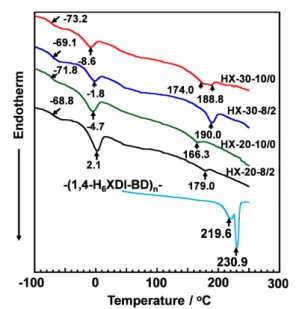
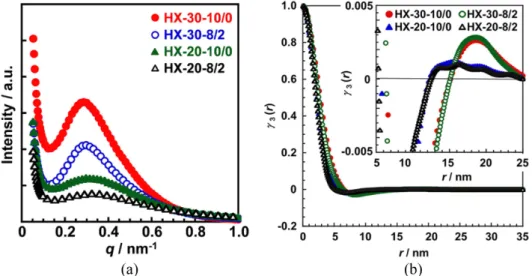
6XDI), poly(oxytetramethylene) glycol, 1,4-butanediol (BD), and 1,1,1-trimethylol propane (TMP). To control the molec- ular aggregation state and mechanical properties of these PUEs, hard segment contents of 20 and 30 wt% and BD/TMP ratios of 10/0 and 8/2 were chosen. Differential scanning calorimetry and small-angle X-ray scattering measurements revealed that the degree of microphase separation increased with an increase in both hard segment content and BD ratio.
The Young’s modulus and strain at break of the 1,4-H
6XDI-based PUE were 6-20 MPa and 5-15, respectively. Incorporation of 20% TMP as a cross-linking agent into BD increased the melting temperature of the hard segment chains, that is, heat resistance, and decreased the Young’s modulus. This could be due to the low density of the physical cross-linking network and the dispersion of hard segment chains in the soft segment matrix in the PUE in the presence of 20% TMP.
Keywords: Polyurethane elastomers, mechanical properties, differential scanning calorimetry, small-angle X-ray scatter- ing, Young’s modulus
Introduction
Polyurethane elastomers (PUEs) exhibit versatile mechan- ical properties as one can see many applications like coating, adhesive, sealant, sealant, and so on.
1The PUEs are basically composed of alternating hard and soft segments. Soft and hard segments are generally composed of polyether, poly- ester or polycarbonate-based glycol and diisocyanate and low molecular weight diol, respectively. The resulting polymeric PUE molecules form a microphase-separated structure depend- ing on the thermodynamic immiscibility of the constituent segments. The hard segment chains occasionally are in the crystalline state with the formation of hydrogen-bonded.
Since the molecular aggregation structure including the microdomain structure, the degree of microphase separation, and the hydrogen bonding state of hard segments are closely related to the mechanical property, investigation and control of the structure are quite important.
Since there are a very large number of starting materials for polymerization of PUE, the various properties can be
tuned by choice of materials, conditions, molar ratio and so on. For example, poly(oxytetramethylene) glycol (PTMG), 4,4’-diphenylmethane diisocyanate (MDI) and 1,4-butanediol (BD)-based PUE is well-known as to exhibit superior mechan- ical property.
2,3To complement lack property, for instance, flexibility, low Young’s modulus, durability for light of PTMG- MDI-BD-based PUE, amorphous polyol, like poly(oxypro- pylene) glycol (PPG), cycloaliphatic/aliphatic diisocyanate
4-6and so on, should be employed. Recently, it was reported that trans-1,4-bis(isocyanatomethyl) cyclohexane (1,4-H
6XDI) exhibits superior property in terms of mechanical property and durability for light.
7-9However, the structure-property relationship of the 1,4-H
6XDI-based PUEs are not well understood and control of mechanical properties in the wide range has not been attained.
In this study, four types of 1,4-H
6XDI-based PUEs were synthesized with various hard segment content and BD/TMP ratio. The relationship between structure and properties of the 1,4-H
6XDI-based PUEs were studied by swelling test, infra- red spectroscopy (IR), differential scanning calorimetry (DSC), wide-angle X-ray diffraction and small-angle X-ray scatter- ing (WAXD and SAXS), dynamic viscoelastic property mea-
†