• 검색 결과가 없습니다.

Traumatic Right Pulmonary Artery Rupture after Accidentally Being Stepped on the Chest

N/A
N/A
Protected

Academic year: 2021

Share "Traumatic Right Pulmonary Artery Rupture after Accidentally Being Stepped on the Chest"

Copied!
4
0
0

로드 중.... (전체 텍스트 보기)

전체 글

(1)

ISSN: 2233-601X (Print) ISSN: 2093-6516 (Online)

− 380 −

Received: April 2, 2019, Revised: July 8, 2019, Accepted: July 8, 2019, Published online: October 5, 2019

Corresponding author: Joon Yong Cho, Department of Thoracic and Cardiovascular Surgery, Kyungpook National University Hospital, School of Medicine, Kyungpook National University, 130 Dongdeok-ro, Jung-gu, Daegu 41944, Korea

(Tel) 82-53-200-5665 (Fax) 82-53-426-4765 (E-mail) [email protected]

© The Korean Society for Thoracic and Cardiovascular Surgery. 2019. All right reserved.

This is an open access article distributed under the terms of the Creative Commons Attribution Non-Commercial License (http://creativecommons.org/

licenses/by-nc/4.0) which permits unrestricted non-commercial use, distribution, and reproduction in any medium, provided the original work is properly cited.

Traumatic Right Pulmonary Artery Rupture after Accidentally Being Stepped on the Chest

Shin-Ah Son, M.D. 1 , Chae-Min Bae, M.D. 1 , Tak-Hyuk Oh, M.D. 1 , Young Woo Do, M.D. 1 , Yangki Seok, M.D., Ph.D. 2 , Joon Yong Cho, M.D. 1

1
Department of Thoracic and Cardiovascular Surgery, Kyungpook National University Hospital, School of Medicine, Kyungpook National University, Daegu;

2

Department of Thoracic and Cardiovascular Surgery,

Soonchunhyang University Gumi Hospital, Gumi, Korea

Traumatic pulmonary artery rupture is a rare, life-threatening injury. Currently, no strict guidelines for its management exist. Herein, we report a successful surgical repair of a right pulmonary artery rupture caused by being stepped on.

Key words: 1. Trauma

2. Pulmonary artery 3. Cardiopulmonary bypass

Case report

A thin 75-year-old woman was transferred to Kyungpook National University Hospital with a com- plaint of chest wall pain resulting from her chest be- ing stepped on while she was lying down supine.

Her initial systolic blood pressure and heart rate were 137 mm Hg and 73 beats/min, respectively.

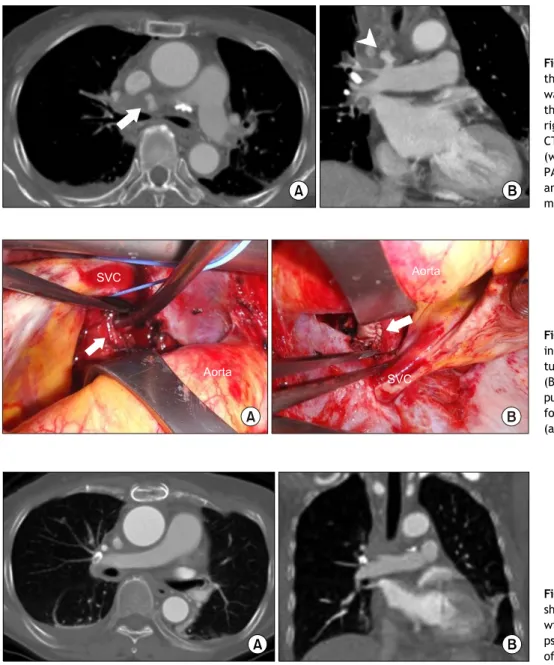
She was mentally alert. Her hemoglobin level was 11.8 g/dL, and electrocardiography revealed a normal sinus rhythm. An initial chest computed tomography (CT) scan revealed a right hemothorax, multiple rib fractures, and a sternum fracture. There was an ap- proximately 1.2-cm right pulmonary artery (PA) blind pouch that was suspicious for a rupture, 4 cm apart from the main pulmonary trunk, accompanied by dif- fuse bronchial anthracofibrosis (Fig. 1A, B). The pa- tient was immediately transferred to the operating room for surgical repair with normothermic heart- beating cardiopulmonary bypass (CPB). The injured

right PA was approached through a median sternotomy. CPB was established by arterial cannula- tion of the ascending aorta near the aortic arch and bicaval venous cannula without venting. Upon open- ing of the right PA, an approximately 1.5-cm rup- tured area of tissue was present at the distal superi- or aspect of the right PA before branching (Fig. 2A).

Proximal and distal clamping of the PA was not per- formed due to lack of space, and the field of view was secured using a pediatric intracardiac sucker.

After removing the injured tissue and hematoma, the black-pigmented enlarged calcified lymph node was visible next to the injured tissue. PA angioplasty was performed along the healthy PA borders with bovine pericardium with 6-0 Prolene in a running fashion (Fig. 2B). After definite deairing before closing the PA, routine closure was performed. The total oper- ative time was 123 minutes, and the CPB time was 37 minutes.

The patient’s postoperative course was uneventful,

Korean J Thorac Cardiovasc Surg 2019;52:380-383 □ CASE REPORT □

https://doi.org/10.5090/kjtcs.2019.52.5.380

(2)

Traumatic Pulmonary Artery Rupture

− 381 −

Fig. 1. (A) Initial CT scans showing the formation of a blind pouch that was suspicious for a PA rupture at the distal superior aspect of the right PA (white arrow). (B) Initial CT scans showing right PA rupture (white arrowhead) before the right PA branching and diffuse bronchial anthracofibrosis. CT, computed to- mography; PA, pulmonary artery.

Fig. 2. (A) Operative findings show- ing approximately 1.5 cm of rup- tured right pulmonary tissue (arrow).

(B) Operative findings showing right pulmonary artery angioplasty per- formed with bovine pericardium (arrow). SVC, superior vena cava.

Fig. 3. (A) Postoperative CT scans showing a patient pulmonary artery without leakage, and no evidence of pseudoaneurysm. (B) Coronal view of CT. CT, computed tomography.

and the patient was extubated following usual proce- dures, without any adverse events. On postoperative day (POD) 10, CT revealed a patent PA and no evi- dence of pseudoaneurysm (Fig. 3A, B). The patient was discharged on POD 20 without complications and was placed on a routine outpatient follow-up schedule.

The patient provided written informed consent for publication of clinical details and images.

Discussion

The circulation of the PA is relatively low-pres-

sure; however, it is tricky to manipulate given the thin and friable nature of the PA wall. In addition, transection or rupture of even a small branch of the PA can cause fatal exsanguination [1]. Spontaneous PA injury can occur as a complication of chronic PA hypertension, leading to pulmonary aneurysm rupture.

The cases of traumatic PA injury described in the lit-

erature mainly involve iatrogenic trauma following

PA catheterization. In severe blunt chest trauma,

traumatic PA injuries are very rare compared to

aortic injuries [1-5]. In a previous report, Kemmerer

et al. [6], in an autopsy series, found only 4 cases of

blunt PA injuries among 585 deaths in fatal traffic

(3)

Shin-Ah Son, et al

− 382 − accidents.

There is no definitive consensus regarding the management of traumatic PA rupture, and manage- ment should be based on the involved lesion, the pa- tient, and the competence of the trauma center.

Management of traumatic PA injuries is difficult;

no definitive consensus exists, as surgical treatment remains associated with high perioperative mortality [2]. Above all, in PA surgical repairs, CPB should be used to avoid the risk of fatal bleeding and to main- tain hemodynamic stability. Pereira and Narrod [7]

suggested that more extensive injuries (greater than 50% of the circumference of the PA) are consistent with an arterial transection and require the in- stitution of CPB for complete visualization and repair.

In addition, circulatory arrest as well as CPB should be considered for nearly complete transection of the PA or complete visualization of the extent of the injury. However, the complications of median sternot- omy and CPB should be considered. In such a sit- uation, resection of the injured part and anastomosis of the healthy PA borders are technically challenging for trauma surgeons [2].

Patients with massive hemothorax may require thoracotomy. An injury of the PA at the hilum is thus diagnosed and treated, often requiring lung resection [8]. The surgical approach used for the patient is de- termined by the location of the lesion and associated injuries; however, when choosing an approach, the top priority should be to ensure hemodynamic stability.

The low pressure of the PA allows conservative treatments; however, it is not known when a pseu- doaneurysm achieves complete resolution and stabil- ity, and trauma surgeons should be aware that some stimuli may cause a delayed rupture. Demondion et al. [4] reported a case in which a right PA rupture was managed with conservative treatment because of severe head trauma. More generally, the authors con- cluded that an initial conservative management strat- egy must be considered when anticoagulation is contraindicated.

An endovascular approach may also be acceptable [9,10]. However, a large stent for the PA is rarely available in an emergency situation, and using a coil or plug at the rupture site or pseudoaneurysm poses a risk of migration.

In this case, although the patient was geriatric, she

had no pre-existing conditions predictive of a poor prognosis prior to the surgical intervention. Although her vital signs were stable, we decided to perform immediate open repair because an absence of bleed- ing could not be guaranteed in light of the increasing amount of hemothorax in serial CT scans. Bronchial anthracofibrosis and an enlarged calcified lymph node were present in close proximity to the injured tissue. According to the surgical findings, we could assume that PA was damaged by surrounding stiff tissues when an external stimulus was given. In addi- tion, in geriatric patients with decreased elasticity of the PA, usage of the patch technique must be consid- ered as a main surgical approach for repair.

In conclusion, traumatic PA rupture is an unusual occurrence that only a few surgeons encounter. In this report, a case of surgical repair of traumatic right PA rupture was presented. The patient was ac- cidentally stepped on by another individual. However, the majority of PA ruptures are caused by vehicular traffic accidents. Therefore, the case presented above is highly unusual in terms of its cause.

Conflict of interest

The authors declare that they have no competing interests.

Acknowledgments

We certify that this report is our own work and all sources of information used in this report have been fully acknowledged.

ORCID

Shin-Ah Son: https://orcid.org/0000-0003-3317-6857 Chae-Min Bae: https://orcid.org/0000-0001-6957-9020 Tak-Hyuk Oh: https://orcid.org/0000-0002-1300-9149 Young Woo Do: https://orcid.org/0000-0001-9725-9163 Yangki Seok: https://orcid.org/0000-0001-8212-109X Joon Yong Cho: https://orcid.org/0000-0003-3855-4191

References

1. Abbas AE. Traumatic injury of the pulmonary artery:

transection, rupture, pseudoaneurysm, or dissection?:

sometimes semantics do matter. J Thorac Cardiovasc Surg

(4)

Traumatic Pulmonary Artery Rupture

− 383 −

2016;152:1437-8.

2. Felten J, Cogne K, Fischbach-Boulanger C, et al. Atypical right pulmonary artery dissection complicating severe blunt chest trauma. Semin Thorac Cardiovasc Surg 2019;

31:137-9.

3. Perrotta S, Lentini S. Pulmonary artery dissection. J Card Surg 2015;30:442-7.

4. Demondion P, Bellemare P, El-Hamamsy I. Conservative management of an intrapericardial contained rupture of the right pulmonary artery in blunt trauma: a good idea? J Thorac Cardiovasc Surg 2016;152:1435-6.

5. Maury JM, Deslandes L, Oheix S, David JS. Acute traumatic right pulmonary artery rupture in blunt trauma. Intensive Care Med 2015;41:134-5.

6. Kemmerer WT, Eckert WG, Gathright JB, Reemtsma K, Creech O Jr. Patterns of thoracic injuries in fatal traffic

accidents. J Trauma 1961;1:595-9.

7. Pereira SJ, Narrod JA. Repair of right pulmonary artery transection after blunt trauma. Ann Thorac Surg 2009;87:

939-40.

8. Hawkins ML, Carraway RP, Ross SE, Johnson RC, Tyndal EC, Laws HL. Pulmonary artery disruption from blunt thoracic trauma. Am Surg 1988;54:148-52.

9. Karak P, Dimick R, Hamrick KM, Schwartzberg M, Saddekni S. Immediate transcatheter embolization of Swan-Ganz catheter-induced pulmonary artery pseudoaneurysm. Chest 1997;111:1450-2.

10. Gottwalles Y, Wunschel-Joseph ME, Hanssen M. Coil embo-

lization treatment in pulmonary artery branch rupture

during Swan-Ganz catheterization. Cardiovasc Intervent

Radiol 2000;23:477-9.

수치

Fig. 1. (A) Initial CT scans showing  the formation of a blind pouch that  was suspicious for a PA rupture at  the distal superior aspect of the  right PA (white arrow)

참조

관련 문서

However, all greetings are usually used to welcome people and wish them

그래서 나는 대학에서 음악을 공부하기 원하지만 나의 부모님은 내가 그것을 공 부하게 하지 않으실 것이다.. 그 문제는

A source of light waves moving to the right with velocity 0.7c. The frequency is higher on the right, and lower

However, all greetings are usually used to welcome people and wish them

NIH-PA Author Manuscript NIH-PA Author Manuscript NIH-PA Author Manuscript Table 3 Properties of the 99% credible set of SNPs at ten established T2D susceptibility loci on the

Since every classical or virtual knot is equivalent to the unknot via a sequence of the extended Reidmeister moves together with the forbidden moves, illustrated in Section 2,

• The supply and demand curves cross at the equilibrium price and quantity.. • You can read off approximate equilibrium values

A tangential section of the common ivy, Hedera helix, shows some vasicentric tracheids to the left of the vessel, which is the white space at right.. A maceration of the wood