Nutrition Research and Practice 2015;9(6):673-676
ⓒ2015 The Korean Nutrition Society and the Korean Society of Community Nutrition http://e-nrp.org
Short Communication
Attenuating effect of Lactobacillus brevis G101 on the MSG symptom complex in a double-blind, placebo-controlled study
Dong-Hyun Kim1, Yeji Choi2, Sun-Sung Park2, Se-Young Kim3 and Myung Joo Han2§
1Department of Life and Nanopharmaceutical Sciences, College of Pharmacy, Kyung Hee University, Seoul 130-701, Korea
2Department of Food and Nutrition, Kyung Hee University, 26, Kyungheedae-ro, Dongdaemun-gu, Seoul 130-701, Korea
3R & D center, CTCBIO Inc., Gyeonggi 445-913, Korea
BACKGROUND/OBJECTIVES: Lactobacillus brevis G101 suppresses the absorption of monosodium glutamate (MSG) from the intestine into the blood in mice. Therefore, the attenuating effect of orally administered G101 on monosodium glutamate (MSG) symptom complex was investigated in humans
MATERIALS/METHODS: Capsules (300 mg) containing Lactobacillus brevis G101 (1×10¹⁰ CFU/individual) or maltodextrin (placebo) was orally administered in 30 respondents with self-recognized monosodium glutamate (MSG) symptom complex for 5 days and the rice with black soybean sauce containing 6 g MSG (RBSM) was ingested 30 min after the final administration. Thereafter, the MSG symptom complex (rated on a 5-point scale: 1, none; 5, strong) was investigated in a double blind placebo controlled study. The intensity of the MSG symptom complex was significantly reduced in respondents of the G101 intake group (2.87
± 0.73) compared to that in those treated with the placebo (3.63 ± 1.03) (P = 0.0016). Respondents in the placebo group exhibited more of the various major conditions of the MSG symptom complex than in the G101 intake group. Although there was no significant difference in the appearance time of the MSG symptom complex between subjects orally administered G101 and those administered the placebo, its disappearance in < 3 h was observed in 69.9% of subjects in the G101 treatment group and in 38.0% of subjects in the placebo group (P = 0.0841).
CONCLUSIONS: Oral administration of Lactobacillus brevis G101 may be able to reduce the intensity of the MSG symptom complex.
Nutrition Research and Practice 2015;9(6):673-676; doi:10.4162/nrp.2015.9.6.673; pISSN 1976-1457 eISSN 2005-6168 Keywords: Monosodium glutamate, side effect, Lactobacillus brevis G10, blind study
INTRODUCTION15)
Monosodium glutamate (MSG), the sodium salt of glutamate, is used worldwide as a flavor enhancer in various processed foods [1-3]. MSG was extracted from seafood and has been as the source of the umami taste [4]. The Food and Drug Adminis- tration (FDA) has classified MSG as a generally recognized as safe (GRAS) substance and no limitation is placed on its use as a food additive. Nevertheless, Kwok first described a complex of symptoms, including numbness at the back of the neck and arms, weakness, and palpitation, after ingestion of a Chinese meal and suggested that MSG was one of the possible causes [5]. These symptoms were referred to collectively as Chinese Restaurant Syndrome (CRS). In 1995, the Federation of American Societies for Experimental Biology (FASEB) proposed the term MSG symptom complex to denote the reactions that occur following ingestion of MSG [6]. When > 5 g may be ingested, it is characterized by unpleasant reactions such as numbness, tingling, headaches, muscle tightness, general weakness, and flushing [7].
Lactic acid bacteria are found in yogurt, cheese, kimchi, and in the gut microbiota [8]. Upon ingestion, lactic acid bacteria confer beneficial effects on the health of the host [9]. Of these lactic acid bacteria, some convert MSG to gamma-aminobutyric acid (GABA), which has been reported to possess various physiological functions that act via the decarboxylation of glutamic acid by glutamate decarboxylase [10,11]. Therefore, lactic acid bacteria have been used as initiators to produce GABA-rich foods [12]. We previously isolated Lactobacillus brevis G-101, a kimchi-derived lactic acid bacterium that potently converted MSG to GABA [13]. Lactobacillus brevis G101 reduces the concentration of MSG in the blood of mice fed oral administration in mice: G101 suppresses the absorption of MSG from the intestine into the blood rather than mediating the biotransformation of MSG to GABA [14].
In the present study, to investigate the ability of orally administered Lactobacillus brevis G101 to attenuate the MSG symptom complex, we orally administered G101 or a placebo (maltodextrin) to respondents presenting with self-recognized MSG symptom complex, following ingestion of rice with black
§Corresponding Author: Myung Joo Han, Tel. 82-2-961-0553, Fax. 82-2-961-0260, Email. [email protected] Received: January 9, 2015, Revised: September 9, 2015, Accepted: September 9, 2015
This is an Open Access article distributed under the terms of the Creative Commons Attribution Non-Commercial License (http://creativecommons.org/licenses/by-nc/3.0/) which permits unrestricted non-commercial use, distribution, and reproduction in any medium, provided the original work is properly cited.
674 Effect of Lactobacillus G101 on MSG symptom
Group Treatment with Lactobacillus brevis G101
Mon Tue Wed Thu Fri
First test A + + + + +/RBSM1)
B - - - - -/RBSM
Second test A - - - - -/RBSM
B + + + + +/RBSM
1)RBSM is the rice with black soybean sauce containing 6 g MSG.
Table 1. Experimental plan for the effect of oral administered Lactobacillus brevis G101 on the MSG symptom complex in a double-blind, placebo-controlled study
Symptom Number (%)
G1011) Placebo
None 0 (0.0) 0 (0.0)
χ2 = 13.8421 df = 4 P = 0.0031
Slight 10 (33.3) 6 (20.0)
Moderate 14 (46.7) 5 (16.7)
Slightly strong 6 (20.0) 13 (43.3)
Strong 0 (0.0) 6 (20.0)
Total 30 (100.0) 30 (100.0)
1)Lactobacillus brevis G101
Table 2. The effect of orally administered Lactobacillus brevis G 101 on the intensity of RBSM-induced MSG symptom complex
Symptom1) Number (%)
G1012) Placebo Total
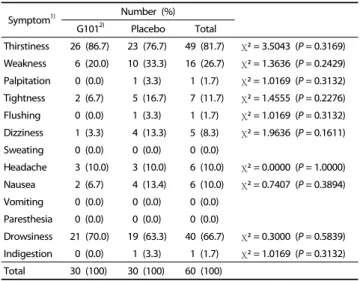
Thirstiness 26 (86.7) 23 (76.7) 49 (81.7) χ2 = 3.5043 (P = 0.3169) Weakness 6 (20.0) 10 (33.3) 16 (26.7) χ2 = 1.3636 (P = 0.2429) Palpitation 0 (0.0) 1 (3.3) 1 (1.7) χ2 = 1.0169 (P = 0.3132) Tightness 2 (6.7) 5 (16.7) 7 (11.7) χ2 = 1.4555 (P = 0.2276) Flushing 0 (0.0) 1 (3.3) 1 (1.7) χ2 = 1.0169 (P = 0.3132) Dizziness 1 (3.3) 4 (13.3) 5 (8.3) χ2 = 1.9636 (P = 0.1611) Sweating 0 (0.0) 0 (0.0) 0 (0.0)
Headache 3 (10.0) 3 (10.0) 6 (10.0) χ2 = 0.0000 (P = 1.0000) Nausea 2 (6.7) 4 (13.4) 6 (10.0) χ2 = 0.7407 (P = 0.3894) Vomiting 0 (0.0) 0 (0.0) 0 (0.0)
Paresthesia 0 (0.0) 0 (0.0) 0 (0.0)
Drowsiness 21 (70.0) 19 (63.3) 40 (66.7) χ2 = 0.3000 (P = 0.5839) Indigestion 0 (0.0) 1 (3.3) 1 (1.7) χ2 = 1.0169 (P = 0.3132) Total 30 (100) 30 (100) 60 (100)
1)Mulltiple response
2)Lactobacillus brevis G101
Table 4. The effect of orally administered Lactobacillus brevis G101 on RBSS-induced MSG symptom variety
Gender MSG symptom complex1)
T-value
G1012) Placebo
Male (N = 10) 3.10 ± 0.883) 3.60 ± 1.26 -1.03 (P = 0.3177) Female (N = 20) 2.75 ± 0.64 3.65 ± 0.93 -3.56 (P = 0.0010)
Total 2.87 ± 0.73 3.63 ± 1.03 -3.32 (P = 0.0016)
1)MSG symptom complex was evaluated as follows: 1 = none, 2 = slight, 3 = moderate, 4-slightly storong, and 5 = strong.
2)Lactobacillus brevis G101
3)Mean ± SD.
Table 3. The difference on the efficacy of Lactobacillus brevis G101 on the MSG symptom complex by gender
soybean sauce (Jajangbap) containing 6 g MSG (RBSM), and then investigated the intensity of the MSG complex in them.
This experiment was performed as a double-blind, placebo- controlled study.
SUBJECTS AND METHODS Subjects
The study subjects consisted of 30 healthy Korean individuals (average age, 23.57 ± 2.36 yrs; 10 male subjects, 23.00 ± 3.46 yrs; 20 female subjects, 23.85 ± 1.60 yrs) who self-identified as MSG-sensitive. Exclusion criteria included consumption of any current medication. The recruitment of subjects was approved by the Committee for the Care and Use of Clinical Study at Kyung Hee University (KHSIRB-14-004) and performed according to CONSORT 2010 guidelines.
Experimental plan
All 30 subjects participated in an orientation session for this study. The subjects were evenly divided into 2 groups (A and B). In the first week, group A subjects were orally administered one capsule (Lactobacillus brevis G101) at 11:00 am for 5 days and group B subjects took the placebo capsule every day (Table 1). RBSM was ingested 30 min after the final administration of G101, and the intensity and variety of the MSG symptom complex over 6 h were described. In the second week, group A switched with group B and the test was performed for 5 days.
The intensity of the MSG symptom complex was rated according to a 5-point scale (1 = none, 5 = strong).
Capsules (300 mg) containing 1 × 10¹⁰ CFU Lactobacillus brevis G101 or maltodextrin (placebo) were prepared by CTCBIO Inc.
RBSM was prepared by mixing steamed rice (180 g) and MSG-contained black soybean sauce. The ingredients of the MSG-contained black soybean sauce (one serving) were as follows: 40 g pork, 40 g onion, 40 g zucchini, 30 g carrot, 50
g cabbage, 1 Tsp black soybean sauce without MSG, 1/2 Tsp soybean oil, 6 g MSG, 1 tsp starch, and 1 2/3 Tsp water. MSG was purchased from a local market.
Statistical analysis
The results obtained through this experiment were analyzed using the statistical analysis system (SAS) 9.3 program. The significance of each sample was established using χ2-test and t-test, as appropriate.
RESULTS
Effect of Lactobacillus brevis G101 on the intensity of RBSM- induced MSG symptom complex
To evaluate the attenuating effect of Lactobacillus brevis G101 against the MSG symptom complex, we orally administered G101 to volunteers who then ingested RBSM, and after which we evaluated the MSG symptom complex for 6 h in a double- blind, placebo-controlled study (Table 2). The intensity of MSG symptom complex was measured using a 5-point scale (1 = none, 5 = strong). Oral administration of G101 significantly attenuated the intensity of the MSG symptom complex (P = 0.0016). When treated with the placebo, 43.3% of respondents presented with more than a slightly strong MSG symptom complex, but when treated with G101, only 20.0% of respon-
Dong-Hyun Kim et al. 675
Time Number (%)
G1011) Placebo
< 10 min 6 (20.0) 3 (10.0)
χ2 = 3.5043 df = 4 (P = 0.4772) 10 min≤ time < 30 min 10 (33.3) 8 (26.7)
30 min≤ time < 60 min 11 (36.7) 15 (50.0) 60 min≤ time < 90 min 2 (6.7) 4 (13.3)
90 min≤ 1 (3.3) 0 (0.0)
Total 30 (100.0) 30 (100.0)
1)Lactobacillus brevis G101
Table 5. The effect of orally administered Lactobacillus brevis G101 on the appearance time of RBSS-induced MSG symptom complex
Time Number (%)
G1011) Placebo
< 1 hr 4 (13.3) 2 (6.7)
χ2 = 11.1404 df = 6 (P = 0.0841) 1 hr≤ time < 2 hr 10 (33.3) 5 (16.5)
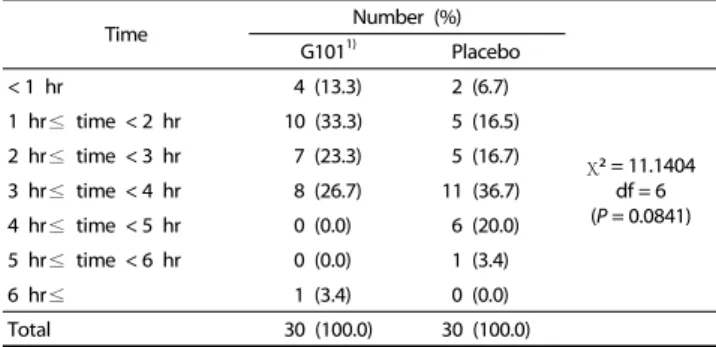
2 hr≤ time < 3 hr 7 (23.3) 5 (16.7) 3 hr≤ time < 4 hr 8 (26.7) 11 (36.7) 4 hr≤ time < 5 hr 0 (0.0) 6 (20.0) 5 hr≤ time < 6 hr 0 (0.0) 1 (3.4)
6 hr≤ 1 (3.4) 0 (0.0)
Total 30 (100.0) 30 (100.0)
1)Lactobacillus brevis G101
Table 6. The effect of orally administered Lactobacillus brevis G101 on the disappearance time of RBSS-induced MSG symptom complex
dents exhibited more than a slightly strong response. A significant difference was observed among female subjects, but not among male subjects, indicating that female respondents were more sensitive to the MSG symptom complex than male (Table 3).
Effect of Lactobacillus brevis G101 on RBSS-induced MSG symptom variety
The effects of orally administered G101 on RBSM-induced self-recognized MSG symptoms (variety) experienced by the respondents were investigated (Table 4). After ingestion of RBSM, the most frequently observed self-recognized symptoms associated with the MSG symptom complex were thirstiness (81.7%) and drowsiness (70.0%), followed by weakness (26.7%), tightness (11.7%), headache (10.0%), nausea (10.0%), dizziness (8.3%), palpitation (1.7%), flushing (1.7%), and indigestion (1.7%).
No significant difference was observed between the varieties of self-recognized symptoms experienced by respondents who were orally administered G101 and those administered the placebo.
Effect of Lactobacillus brevis G101 on the appearance and disappearance time of RBSS-induced MSG symptom complex
The effect of orally administered G101 on the time at which the RBSM-induced MSG symptom complex appeared was also evaluated (Table 5). There was no significant difference in the appearance time of the MSG symptom complex observed between subjects orally administered G101 and those admini- stered the placebo. When subjects were treated with G101, the appearance for the MSG symptoms complex was less than 1 h for 70.0% of the respondents in the group, and in subjects
treated with the placebo, the appearance time was for 76.6%
of the group.
Next, we investigated the effect of orally administered G101 on the disappearance time for the RBSM-induced MSG symp- toms complex (Table 6). There was no significant difference in the appearance time for the MSG symptom complex between subjects orally administered G101 and those administered the placebo. Disappearance of the MSG symptom complex in less than 3 h was observed in 69.9% of subjects in the G101 treatment group and in 38.0% of subjects in the placebo group (P = 0.0841).
DISCUSSION
MSG is frequently used in various canned foods and in food from Chinese restaurant. MSG has been associated with various side effects, including numbness, headaches, migraines, palpita- tions, tightness, weakness, aching, flushing, sweating, fasciculation, lacrimation, syncope, dizziness, shudder attacks, paresthesia, arrhythmia and tachycardia [1]. Although the oral threshold range for minimal MSG-induced symptoms in humans is considerably variable, in the previous study, the oral threshold range for minimal MSG-induced symptoms in 36 subjects was found to be 1.5 to 12 g, and increased intensity of the MSG symptom response was related to an increase in the oral dose [15]. In this study, we found that oral administration of RBSM, which is containing 6 g of MSG, showed various side effects including thirstiness (56.7%), drowsiness (23.3%), weakness (6.7%), indigestion (6.7%), headache (3.3%), and nausea (3.3%).
It was previously shown that the elimination of all food sources containing MSG resulted in a decreased frequency of headaches [3]. These results suggest that the side effects of MSG are dependent on the daily intake amount of MSG, and the oral intake of more than 6 g of MSG may cause its side effect.
Therefore, Xiong et al. suggested possible ways to reduce the side effects of MSG, such as taking vitamin C or pre-exposure to a low dose of MSG that may either prevent or reduce the side effects of MSG [3]. Nevertheless, it is not sufficient to reduce only the side effects of MSG. Therefore, we investigated the ability of Lactobacillus brevis G101 to reduce the side effects of MSG. Oral administration of Lactobacillus brevis G101 signifi- cantly attenuated the MSG symptom complex. Although G101 did not reduce the variety of side effects, it shortened the disappearance time of the MSG symptom complex.
In conclusion, this study suggests that orally administration of Lactobacillus brevis G101 may be able to reduce the intensity of the MSG symptom complex and shorten its disappearance time.
REFERENCES
1. Geha RS, Beiser A, Ren C, Patterson R, Greenberger PA, Grammer LC, Ditto AM, Harris KE, Shaughnessy MA, Yarnold PR, Corren J, Saxon A. Review of alleged reaction to monosodium glutamate and outcome of a multicenter double-blind placebo-controlled study.
J Nutr 2000;130:1058S-1062S.
2. Yaqub H, Abdel Baky NA, Attia HA, Faggah LM. Hepatoprotective effect of N-acetyl cysteine and/or beta-carotene on monosodium
676 Effect of Lactobacillus G101 on MSG symptom
glutamate-induced toxicity in rats. Res J Med Med Sci 2008;3:206-15.
3. Xiong JS, Branigan D, Li M. Deciphering the MSG controversy. Int J Clin Exp Med 2009;2:329-36.
4. Bellisle F. Glutamate and the UMAMI taste: sensory, metabolic, nutritional and behavioural considerations. A review of the literature published in the last 10 years. Neurosci Biobehav Rev 1999;23:423-38.
5. Kwok RH. Chinese-restaurant syndrome. N Engl J Med 1968;278:796.
6. Meadows M. MSG. A common flavor enhancer. FDA Consum 2003;37:34-5.
7. Yang WH, Drouin MA, Herbert M, Mao Y, Karsh J. The monosodium glutamate symptom complex: assessment in a double-blind, placebo-controlled, randomized study. J Allergy Clin Immunol 1997;99:757-62.
8. Kanmani P, Satish Kumar R, Yuvaraj N, Paari KA, Pattukumar V, Arul V. Probiotics and its functionally valuable products-a review. Crit Rev Food Sci Nutr 2013;53:641-58.
9. Gomes AM, Malcata FX. Bifidobacterium spp. and Lactobacillus acidophilus: biological, biochemical, technological and therapeutical properties relevant for use as probiotics. Trends Food Sci Technol 1999;10:139-57.
10. Cho YR, Chang JY, Chang HC. Production of gamma-aminobutyric acid (GABA) by Lactobacillus buchneri isolated from kimchi and its neuroprotective effect on neuronal cells. J Microbiol Biotechnol 2007;17:104-9.
11. Tamura T, Noda M, Ozaki M, Maruyama M, Matoba Y, Kumagai T, Sugiyama M. Establishment of an efficient fermentation system of gamma-aminobutyric acid by a lactic acid bacterium, Enterococcus avium G-15, isolated from carrot leaves. Biol Pharm Bull 2010;33:1673-9.
12. Cherubini E, Gaiarsa JL, Ben-Ari Y. GABA: an excitatory transmitter in early postnatal life. Trends Neurosci 1991;14:515-9.
13. Jang SE, Han MJ, Kim SY, Kim DH. Lactobacillus brevis G101 inhibits the absorption of monosodium glutamate in mice. J Microbiol Biotechnol 2014;24:1592-6.
14. Jang SE, Hyam SR, Han MJ, Kim SY, Lee BG, Kim DH. Lactobacillus brevis G-101 ameliorates colitis in mice by inhibiting NF-κB, MAPK and AKT pathways and by polarizing M1 macrophages to M2-like macrophages. J Appl Microbiol 2013;115:888-96.
15. Schaumburg HH, Byck R, Gerstl R, Mashman JH. Monosodium L-glutamate: its pharmacology and role in the Chinese restaurant syndrome. Science 1969;163:826-8.