https://doi.org/10.20307/nps.2018.24.4.266
266
Five New Stilbenes from the Stem Bark of Artocarpus communis
Susanna T. S. Chan
1,2, Wendy L. Popplewell
1,3, Heidi R. Bokesch
1,4, Tawnya C. McKee
1,5, and Kirk R. Gustafson
1,*
1
Molecular Targets Program, Center for Cancer Research, National Cancer Institute, Frederick, Maryland, USA, 21702
2
Current Address: The Ferrier Research Institute of Victoria, University of Wellington, Lower Hut, New Zealand
3
Current Address: Institute of Environmental Science and Research Ltd., Kenepuru Science Centre, Porirua, New Zealand
4
Basic Science Program, Leidos Biomedical Research, Inc, Frederick National Laboratory for Cancer Research sponsored by the National Cancer Institute, Frederick, Maryland, USA 21702
5
Current Address: Diagnostic Biomarkers and Technology Branch, Cancer Diagnosis Program, National Cancer Institute, Rockville, Maryland, USA 20850-9728
Abstract − Five new prenylated stilbenes (1 - 5), along with the known compounds cudraflavone C, trans-4- isopentenyl-3,5,2',4'-terahydroxystilbene, trans-4-(3-methyl-E-but-1-enyl)-3,5,2',4'-tetrahydroxystilbene, pannokin G, cycloartobiloxanthone, artonin P, morusin, artocarpin, artonin E, kuwanon C, artobiloxanthone, and artoindonesianin C (6 - 17) were isolated from the stem bark of the tropical tree Artocarpus communis. The structures were established by NMR spectroscopic analysis, MS studies, and comparison with spectral data reported in the literature.
Keywords − Artocarpus communis, Artocarpus altilis, Moraceae, stilbene
Introduction
The flowering tropical tree Artocarpus communis J. R.
Forst. & G. Forst. (Moraceae), synonymous with Artocarpus altilis, is native to Indonesia, Papua New Guinea and Pacific and Tropical Asia. It is commonly known as breadfruit, derived from the Greek words “artos” (bread) and “karpos” (fruit), and it is planted for its edible fruit and as an ornamental or shade tree. A. communis has been used in traditional medicine in the Pacific Islands for a variety of ailments including liver cirrhosis, hypertension, diabetes, skin ailments, and tapeworm infection.
1Previous phytochemical investigations of this plant have yielded over 130 compounds, of which, flavonoids, aryl ben- zofurans, stilbenoids, and lectins are largely responsible for the reported pharmacological effects of the plant.
2As part of a molecularly targeted screening program at the U.S. National Cancer Institute to discover new bioactive metabolites and potential drug leads from natural products, we investigated the chemistry of a Philippines collection of A. communis. The organic solvent extract of the stem bark modulated the activity of the oncogenic transcription factor, hypoxia inducible factor-2 alpha
(HIF-2 α), in a high-throughput cell-based screen.
3Hypoxia inducible factors are key regulators of cancer cell adaptation and survival in the low oxygen environ- ments associated with many solid tumors and are thus attractive anticancer therapeutic targets.
4Details of the HIF-2 α screening assay have been previously described.
5Subsequent chemical investigation of the A. communis extract led to the isolation of five new stilbenes (1 - 5), together with twelve known compounds (6 - 17). The structures of 1 - 5 were elucidated by spectroscopic methods, including 1D and 2D NMR studies, and MS analysis.
Experimental
General experimental procedures – Optical rotations were measured on a PerkinElmer 241 polarimeter. UV spectra were recorded on a Varian Cary 50 UV/Vis spectrophotometer. NMR spectra were obtained with a Bruker Avance III spectrometer operating at 600 MHz for
1
H and 150 MHz for
13C and equipped with a 3 mm cryogenic probe. HRESIMS spectra were acquired on an Agilent Technologies 6530 Accurate-mass Q-TOF LC/
MS. HPLC was performed using a Varian PrepStar HPLC using a Phenomenex Luna C
18(5 μ, 300 Å, 250 × 10 mm) column.
*Author for correspondence
Gustafson, Molecular Targets Program, Center for Cancer Research,
National Cancer Institute, Frederick, Maryland, USA, 21702
Tel: +1-301-846-5197; E-mail: [email protected]
Plant materials – The stem bark of A. communis was collected in the Philippines in July 1992 by D. Doel Soejarto. A voucher specimen (U44Z-7816) is deposited at the Smithsonian Institution, Washington, D. C.
Extraction and isolation – Following the standard NCI extraction protocol, the plant material (353 g) was ground and immersed in CH
2Cl
2-MeOH (1:1) for 15 h in a Soxhlet apparatus.
6The solvent was removed, and the plant material was immersed for another 15 h in 100%
MeOH. The combined extracts were reduced to dryness in vacuo to give 36 g of crude extract.
A portion of the extract (504 mg) was separated by Diol solid-phase extraction eluting with hexane-CH
2Cl
2(9:1), CH
2Cl
2-EtOAc (20:1), 100% EtOAc, EtOAc-MeOH (5:1) and 100% MeOH. Size exclusion chromatography of the 20:1 CH
2Cl
2-EtOAC fraction (116 mg) on Sephadex LH-20, with hexane-CH
2Cl
2-MeOH (2:5:1) as the eluent, provided eight major fractions (A-H). Fraction E (11.2 mg) was purified by reversed-phase HPLC eluting with a gradient of 60 - 100% acetonitrile over 30 min at a flow
rate of 4 mL/min to yield 3 (1.4 mg), 4 (0.5 mg), 5 (0.2 mg), and 9 (1.1 mg). Fractions D (19.1 mg) and G (19.2 mg) were subjected to further Sephadex LH-20 chromato- graphy with 100% MeOH which yielded four sub- fractions each. Sub-fractions C1 (8.1 mg) and D1 (7.0 mg) from fraction D and sub-fraction B1 (10.6 mg) from fraction G were also purified by reversed-phase HPLC eluting with a gradient of 60 - 100% aqueous acetonitrile over 30 min to yield 10 (4.8 mg), 11 (1.4 mg), 12 (3.2 mg), 13 (0.9 mg), and 17 (0.8 mg).
Size exclusion chromatography of the 100% EtOAC fraction (245 mg) on Sephadex LH-20 with hexane- CH
2Cl
2-MeOH (2:5:1) provided seven major sub-fractions (A-H). Sub-fractions D (116 mg) and F (13.0 mg) were purified by reversed-phase HPLC as described above to yield 1 (0.5 mg), 2 (1.2 mg), 6 (0.6 mg), and 14 (12.1 mg). Sub-fraction H (3.1 mg) was purified by reversed- phase HPLC eluting with a gradient of 30 - 100% aqueous acetonitrile over 30 min at a flow rate of 4 mL/min to yield 7 (0.5 mg) and 8 (1.0 mg).
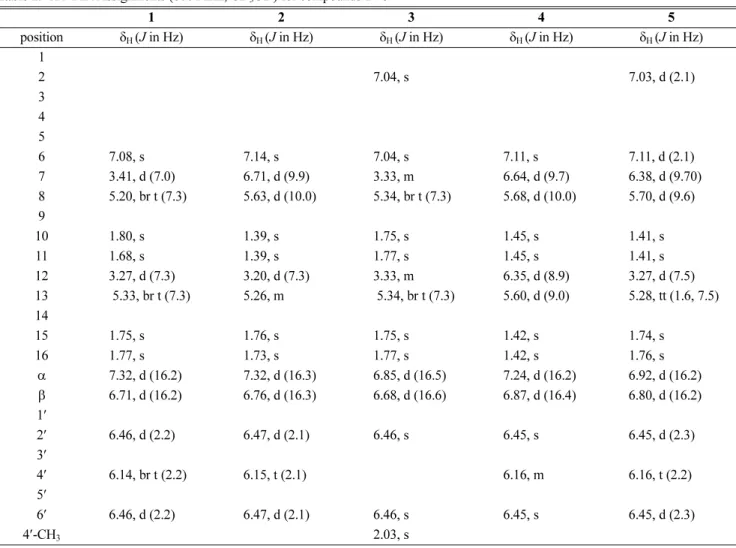
Table 1.
1H NMR Assignments (600 MHz, CD
3OD) for compounds 1 - 5
1 2 3 4 5
position δ
H( J in Hz) δ
H( J in Hz) δ
H( J in Hz) δ
H( J in Hz) δ
H( J in Hz) 1
2 7.04, s 7.03, d (2.1)
3 4 5
6 7.08, s 7.14, s 7.04, s 7.11, s 7.11, d (2.1)
7 3.41, d (7.0) 6.71, d (9.9) 3.33, m 6.64, d (9.7) 6.38, d (9.70)
8 5.20, br t (7.3) 5.63, d (10.0) 5.34, br t (7.3) 5.68, d (10.0) 5.70, d (9.6) 9
10 1.80, s 1.39, s 1.75, s 1.45, s 1.41, s
11 1.68, s 1.39, s 1.77, s 1.45, s 1.41, s
12 3.27, d (7.3) 3.20, d (7.3) 3.33, m 6.35, d (8.9) 3.27, d (7.5)
13 5.33, br t (7.3) 5.26, m 5.34, br t (7.3) 5.60, d (9.0) 5.28, tt (1.6, 7.5) 14
15 1.75, s 1.76, s 1.75, s 1.42, s 1.74, s
16 1.77, s 1.73, s 1.77, s 1.42, s 1.76, s
α 7.32, d (16.2) 7.32, d (16.3) 6.85, d (16.5) 7.24, d (16.2) 6.92, d (16.2)
β 6.71, d (16.2) 6.76, d (16.3) 6.68, d (16.6) 6.87, d (16.4) 6.80, d (16.2)
1 ′
2′ 6.46, d (2.2) 6.47, d (2.1) 6.46, s 6.45, s 6.45, d (2.3)
3′
4′ 6.14, br t (2.2) 6.15, t (2.1) 6.16, m 6.16, t (2.2)
5′
6′ 6.46, d (2.2) 6.47, d (2.1) 6.46, s 6.45, s 6.45, d (2.3)
4 ′-CH
32.03, s
An additional 774 mg of the organic crude extract was chromatographed on a Diaion HP-20 resin column eluting with a step gradient from 20% MeOH in H
2O to 100%
MeOH to provide five fractions (A-E). Fraction C (219 mg), which eluted with 60% MeOH, was subjected to size exclusion chromatography on Sephadex LH-20, with hexane-CH
2Cl
2-MeOH (2:5:1) as the eluent, providing eight sub-fractions (A-H). Sub-fraction F (56 mg) was separated by Diol solid phase extraction eluting with a step gradient of 1% isopropyl alcohol (IPA) in CH
2Cl
2to 20% IPA in CH
2Cl
2to yield five additional sub-fractions (A-E). Sub-fraction B (3.3 mg), eluted with 5% IPA in CH
2Cl
2, provided 15 (0.6 mg) after purification on C
18reversed-phase HPLC eluting with a gradient of 70 - 100%
aqueous MeOH over 30 min.
Sub-fraction D (303 mg), eluted with 80% MeOH in H
2O from the HP-20 column was chromatographed on LH-20 as above to provide sub-fractions A-E. Sub-fraction D (10.9 mg) was purified by C
18reversed-phase HPLC
eluting with a gradient of 70 - 100% aqueous MeOH over 30 min. Final purification was achieved on C
18HPLC by isocratic elution with 80% MeOH in H
2O containing 0.1% TFA to yield 16 (4.7 mg).
(E)-4-(3,5-dihydroxystyryl)-2,6-bis(3-methylbut-2- en-1-yl)benzene-1,3-diol (1) − Colorless gum. UV (MeOH) λ
max(log ε) 210 (4.3), 290 (3.8), 328 (3.8) nm;
1H and
13C NMR data, see Tables 1 and 2; HRESIMS m/z 381.2062 [M+H]
+; (calcd for C
24H
29O
4, 381.2066).
(E)-5-(2-(5-hydroxy-2,2-dimethyl-8-(3-methylbut-2- en-1-yl)-2H-chromen-6-yl)vinyl)benzene-1,3-diol (2) − Colorless gum, UV (MeOH) λ
max(log ε) 213 (4.6), 230 (4.5), 290 (4.5) nm;
1H and
13C NMR data, see Tables 1 and 2; HRESIMS m/z 379.1899 [M+H]
+; (calcd for C
24H
27O
4, 379.1909).
(E)-5-(4-hydroxy-3,5-bis(3-methylbut-2-en-1-yl)styryl)- 2-methylbenzene-1,3-diol (3) − Colorless gum, UV (MeOH) λ
max(log ε) 208 (3.8), 222 (3.7), 317 (3.6) nm;
1H and
13C NMR data, see Tables 1 and 2; HRESIMS m/z 379.2258
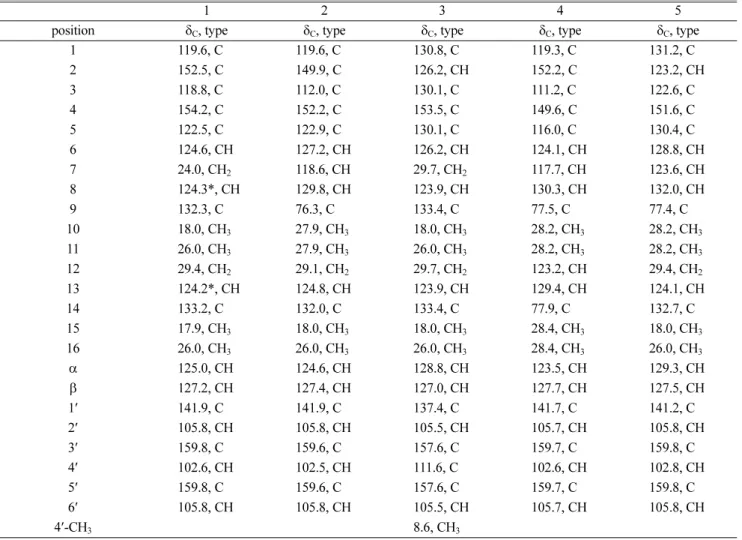
Table 2.
13C NMR Assignments (150 MHz, CD
3OD) for compounds 1 - 5
1 2 3 4 5
position δ
C, type δ
C, type δ
C, type δ
C, type δ
C, type
1 119.6, C 119.6, C 130.8, C 119.3, C 131.2, C
2 152.5, C 149.9, C 126.2, CH 152.2, C 123.2, CH
3 118.8, C 112.0, C 130.1, C 111.2, C 122.6, C
4 154.2, C 152.2, C 153.5, C 149.6, C 151.6, C
5 122.5, C 122.9, C 130.1, C 116.0, C 130.4, C
6 124.6, CH 127.2, CH 126.2, CH 124.1, CH 128.8, CH
7 24.0, CH
2118.6, CH 29.7, CH
2117.7, CH 123.6, CH
8 124.3*, CH 129.8, CH 123.9, CH 130.3, CH 132.0, CH
9 132.3, C 76.3, C 133.4, C 77.5, C 77.4, C
10 18.0, CH
327.9, CH
318.0, CH
328.2, CH
328.2, CH
311 26.0, CH
327.9, CH
326.0, CH
328.2, CH
328.2, CH
312 29.4, CH
229.1, CH
229.7, CH
2123.2, CH 29.4, CH
213 124.2*, CH 124.8, CH 123.9, CH 129.4, CH 124.1, CH
14 133.2, C 132.0, C 133.4, C 77.9, C 132.7, C
15 17.9, CH
318.0, CH
318.0, CH
328.4, CH
318.0, CH
316 26.0, CH
326.0, CH
326.0, CH
328.4, CH
326.0, CH
3α 125.0, CH 124.6, CH 128.8, CH 123.5, CH 129.3, CH
β 127.2, CH 127.4, CH 127.0, CH 127.7, CH 127.5, CH
1′ 141.9, C 141.9, C 137.4, C 141.7, C 141.2, C
2′ 105.8, CH 105.8, CH 105.5, CH 105.7, CH 105.8, CH
3′ 159.8, C 159.6, C 157.6, C 159.7, C 159.8, C
4 ′ 102.6, CH 102.5, CH 111.6, C 102.6, CH 102.8, CH
5 ′ 159.8, C 159.6, C 157.6, C 159.7, C 159.8, C
6 ′ 105.8, CH 105.8, CH 105.5, CH 105.7, CH 105.8, CH
4 ′-CH
38.6, CH
3*interchangeable
[M+H]
+; (calcd for C
25H
31O
3, 379.2273).
4-((E)-3,5-dihydroxystyryl)-2,6-bis((Z)-3-hydroxy-3- methylbut-1-en-1-yl)benzene-1,3-diol (4) − Colorless gum, UV (MeOH) λ
max(log ε) 213 (4.1), 238 (4.2), 289 (4.2), 322 (4.0) nm;
1H and
13C NMR data, see Tables 1 and 2;
HRESIMS m/z 435.1788 [M+Na]
+; (calcd for C
24H
28O
6Na, 435.1784).
5-((E)-4-hydroxy-3-((Z)-3-hydroxy-3-methylbut-1- en-1-yl)-5-(3-methylbut-2-en-1-yl)styryl)benzene-1,3- diol (5) − Colorless gum, UV (MeOH) λ
max(log ε) 213 (4.5), 231 (4.5), 274 (4.4), 322 (4.4) nm;
1H and
13C NMR data, see Tables 1 and 2; HRESIMS m/z 403.1877 [M+Na]
+; (calcd for C
24H
28O
4Na, 403.1885).
Result and Discussion
The HREIMS of 1 gave a molecular ion of m/z 381.2062 [M+H]
+, which established a molecular formula of C
24H
28O
4, requiring eleven unsaturation equivalents.
13
C NMR resonances at δ 141.9 (C-1'), 105.8 (C-2', 6'), 159.8 (C-3', 5') and 102.6 (C-4') along with
1H resonances at δ 6.14 (H-4') and 6.46 (H-2', 6') indicated the presence of a symmetrical trisubstituted benzene ring. Two vinyl protons at δ 5.33 (H-13) and 5.20 (H-8), four vinylic methyl groups at δ 1.75 (H-15), 1.77 (H-16), 1.80 (H-10) and 1.68 (H-11), and four allylic protons at δ 3.27 (2H, H-
12) and 3.41 (2H, H-7) suggested the presence of two aryl-substituted prenyl moieties. The
1H NMR showed signals for two trans olefinic protons at δ 7.32 (H-α, d, J = 16.2 Hz) and 6.71 (H-β, d, J = 16.2 Hz), and the remaining four unsaturation equivalents were attributed to a penta substituted benzene ring ( δ
H7.08 (1H, s)/ δ
C124.6). This data along with a UV absorbance at λ
max328 suggested the basic structure of a prenylated stilbene.
HMBC correlations from H- α to C-1 (δ 119.6), C-2 (δ 152.5), C-6 ( δ 124.6), and C-1' established the connectivity between the two benzene rings. An HMBC correlation from the methylene protons at H-12 to C-4 ( δ 154.2), C-5 ( δ 122.5) and C-6 allowed placement of one of the prenyl groups on C-5. Similarly, HMBC correlations from the H
2-7 methylene protons to C-2, C-3 ( δ 118.8), and C-4 allowed placement of the remaining prenyl group on C-3.
The chemical shifts of C-2 ( δ 152.5), C-4 (δ 154.2), C-3' ( δ 159.8), and C-5' (δ 159.8) indicated the presence of four hydroxy groups, which was consistent with the molecular formula requirements. Comparison of literature values to known prenylated stilbenes showed that the
1H and
13C NMR signals of 1 were closely related to pannokin G,
7except for the replacement of a hydroxy group for a methoxy group at C-2.
Compound 2 gave a molecular formula of C
24H
26O
4with a [M+H]
+pseudomolecular ion peak of m/z 1899,
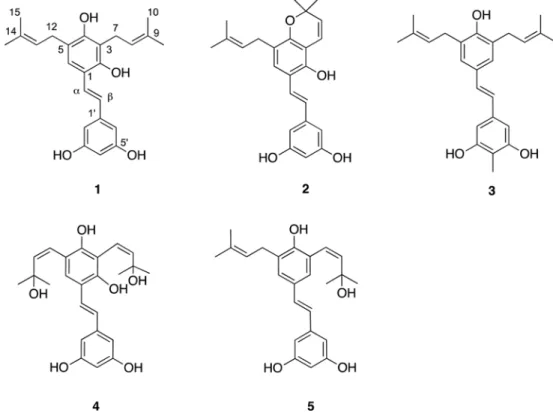
Fig. 1. Structures of compounds 1 - 5 isolated from Artocarpus communis.
requiring twelve unsaturation equivalents.
13C and
1H NMR signals showed the same core stilbene structure except for changes in the prenyl group substituted on C-3 ( δ 112.0). Loss of the allylic methylene protons, an additional olefinic proton at δ 6.71 (H-7), and a quaternary carbon at δ 76.3 (C-9) indicated that the prenyl group was cyclized with one of the aryl oxygens to form a benzopyran ring, accounting for the remaining two unsaturation equivalents. HMBC correlations from the olefinic protons at δ 5.63 (H-8) and δ 6.71 (H-7) to C-3 and from H-8 to C-9 and to the methyl carbons at δ 27.9 (C-10, C-11) accounted for the remaining carbon signals and suggested a 2,2-dimethylchromene ring fused at C-3 and C-4 ( δ 152.2). An HMBC correlation from H-12 (δ 3.20) to C-4, in addition to a modest 4-bond correlation from H-10/H-11 ( δ 1.39) to C-4, confirmed the benzopyran ether link between C-4 and C-9.
The molecular formula of compound 3 was shown to be C
25H
30O
3with a [M+H]
+molecular ion peak of m/z 379.2258, and the
1H and
13C NMR signals closely corre- sponded with those of 1. However, only sixteen carbon signals were observed in the
13C spectrum so nine of theses resonances accounted for two carbons each due to symmetry considerations. Another spectral difference was due to an additional aryl methyl signal ( δ
C8.6, δ
H2.03, 3H, s) and HMBC correlations from the methyl signal to C-3' ( δ 157.6), C-5' (δ 157.6), and C-4' (δ 111.6) allowed
placement of the methyl group on C-4'. Methylation at the C-4' position has been reported for a number of other stilbene and dihydrostilbenoid derivatives,
8,9but it is less common than O-methylation in this compound class. The loss of a hydroxy group on C-2, as evidenced by a chemical shift change from δ 152.5 in compound 1 to δ 126.2 in compound 3, and the doubling of a proton signal at δ 7.04 (2H, s, H-2, H-6) pointed to a symmetrically substituted benzene ring. Thus, the structure of 3 was assigned as ( E)-5-(4-hydroxy-3,5-bis(3-methylbut-2-en-1- yl)styryl)-2-methylbenzene-1,3-diol.
The molecular formula of compound 4 was C
24H
28O
6with a sodiated [M+Na]
+molecular ion peak at m/z 435.1788. The
1H and
13C NMR spectra were similar to compound 1 in the stilbene portion of the molecule but differed in the prenyl groups, with the loss of two allylic protons and the addition of a quaternary carbon bearing oxygen. A disubstituted double bond with a Z confi- guration, as evidenced by the vicinal coupling constant between H-7 ( δ 6.64, d, J = 9.7 Hz) and H-8 (δ 5.68, d, J = 10.0 Hz), was substituted on C-3 (δ 111.2) based on HMBC correlations from H-7 to C-2 ( δ 152.2), C-3 and C-4 ( δ 149.6). Two equivalent methyl groups (δ
C28.2, δ
H1.45, 6H) were attached at C-9 ( δ 77.5) through HMBC
correlations from H-8 to C-10 and C-11. HMBC correla-
tions from H-7, H-8, H-10, and H-11, to a signal at δ 77.5
indicated there was a hydroxy group attached at C-9. The
Fig. 2. Key HMBC correlations for compounds 1 - 5.
remaining modified prenyl moiety had the same structural features and was attached on C-5 ( δ 116.0) through HMBC correlations from H-12 ( δ 6.35) to C-4, C-5, and C-6 ( δ 124.1).
Compound 5 had a molecular formula of C
24H
28O
4with a [M+Na]
+molecular ion peak of m/z 403.1877.
Comparison of
1H and
13C NMR signals to those of 1 again showed the loss of a hydroxy group on C-2, as evidenced by the change in chemical shift from δ 152.5 in compound 1 to δ 123.2 in 5, and the addition of an aromatic proton ( δ 7.03, 1H, d, J = 2.1 Hz) on C-2 as shown by an HSQC correlation. In addition, there was evidence for one standard prenyl moiety, with one vinyl proton at δ 5.28 (H-13), two vinylic methyl groups at δ 1.74 (H-15) and 1.76 (H-16), and two allylic protons at δ 3.27 (H-12). The remaining aliphatic signals were similar to the modified prenyl moieties in 4, and this substituent was placed on C-3 ( δ 122.6) based on HMBC correlations from H-7 ( δ 6.38) to C-4 (δ 151.6) and C-2.
The known compounds were identified as cudraflavone C (6),
10trans-4-isopentenyl-3,5,2',4'-tetrahydroxystilbene (7),
11trans-4-(3-methyl-E-but-1-enyl)-3,5,2',4'-tetrahydroxy- stilbene (8),
12pannokin G (9),
7cycloartobiloxanthone (10),
13artonin P (11),
14morusin (12),
15,16artocarpin (13),
17,18artonin E (14),
19kuwanon C (15),
16,20artobiloxanthone (16),
13and artoindonesianin C (17)
21by comparing their
1